
SUMMARY
Low-Level DC Leakage and Fault Currents in Transit Systems: Developing a Prototype for Detection and Mitigation
The objective of this research is to develop a prototype system that can detect low-level faults in electrified transit systems powered by third rails. It has been quite challenging to detect these faults, and there has not been any technology proven to locate the fault currents.
The University of Akron (UA) developed an active clamp sensor to determine the health condition of the power line through measuring its high-frequency impedance at selected segments. The technology does not require the shutdown of an electrified system, nor does it interfere with an electrified systemʼs operation. The proposed approach would enhance the active clamp sensor to make it applicable for third-rail direct current (DC) transit systems, as the electrical makeup of these systems varies widely with the use of multiple feeder conductors in conduits and tunnels to serve the third rails.
This project integrates the proposed technology into systems that can be applied to third-rail DC transit systems in a variety of monitoring and reporting applications. The use of continuous system condition information will enable predictive maintenance, outage avoidance, and real-time evaluation of the electric network condition (Sozer et al. 2017). The proposed sensor system presented in Figure 1 consists of a custom impedance sensor, a nano-crystalline circular cut core for current injection, a signal conditioning circuit, and a microcontroller-based processing unit with a graphical user interface (GUI) for real-time monitoring.
The method correlates the high-frequency impedance of the supply lines to their physical integrity. The sensor system generates an injection signal into the lines and monitors the high-frequency impedance of the line. The section of the line can be isolated from the rest of the network virtually through installation of additional sensor units acting as blockers. The sensors acting as blockers can be installed at the substations or train for virtual isolation (Ibrahem et al. 2017). The method can be used for both protection and monitoring of the physical condition of the system. The method is non-intrusive and non-destructive, and it can be used for both DC and alternating current (AC) systems without making major changes to the existing system or incurring large costs. The high-frequency-based electrical railway monitoring system has been rigorously analyzed, simulated, constructed, and experimentally validated.
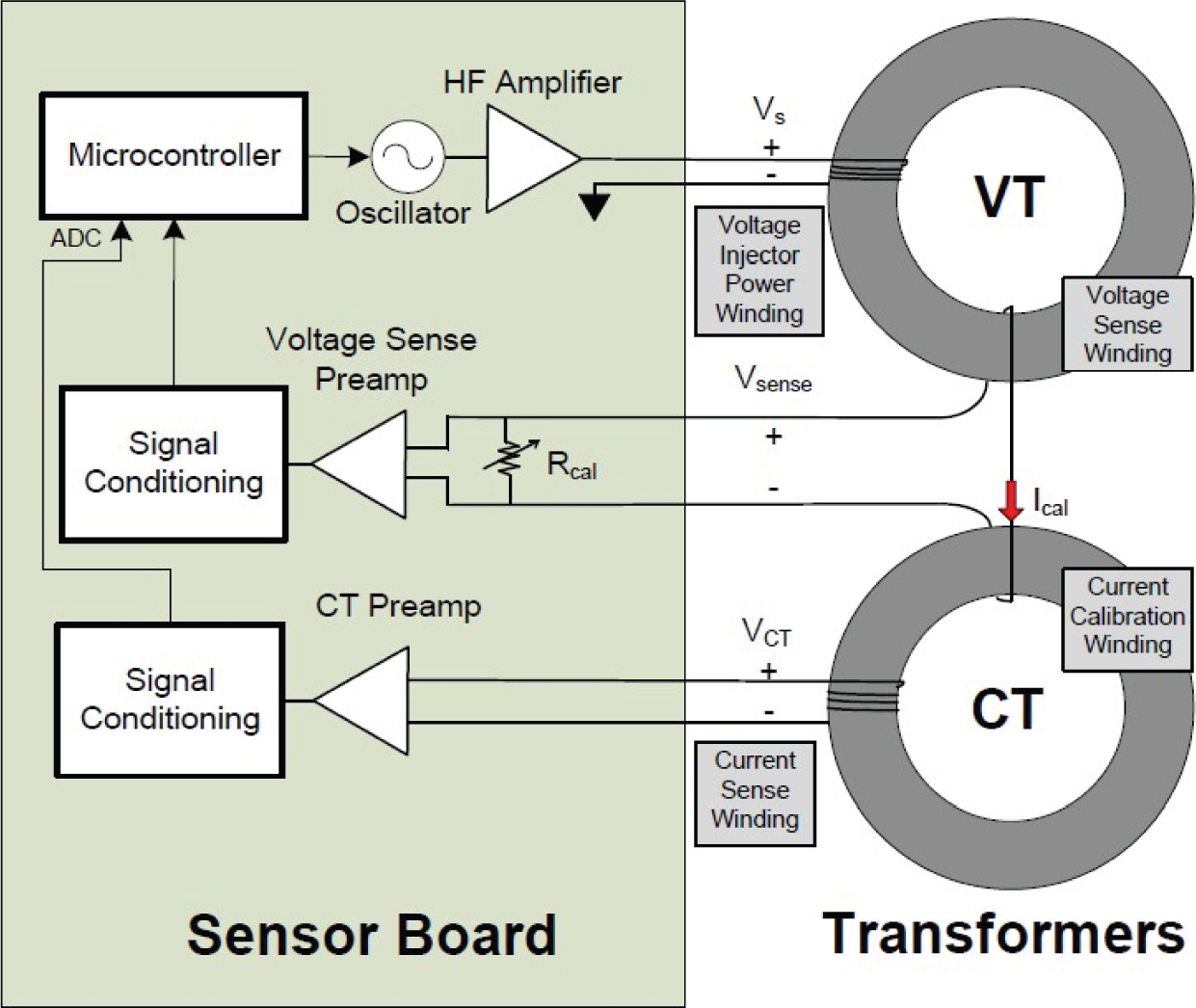
Note: VT = voltage transformer; CT = current transformer; HF = high frequency; ADC = analog to digital converter; and Rcal = calibration resistor.
Long Description.
The impedance sensor device structure consists of the sensor board on the left and the Transformers on the right. The sensor board contains a microcontroller connected to an oscillator and high-frequency (HF) amplifier, feeding a voltage injector power winding on a Voltage Transformer (VT). The VT also has a voltage sense winding connected to a voltage sense preamp, followed by signal conditioning that flows back to the microcontroller. Below and connected to the VT, a Current Transformer (CT) is shown with a current sense winding and a current calibration winding in the transformers board, connected to a CT preamp and signal conditioning on the sensor board that also flows back to the microcontroller.

