The Business Case for Knowledge Management: A Guide (2026)
Chapter: 1 KM Fundamentals

CHAPTER 1
KM Fundamentals
1.1 Introduction
For decades, state DOTs have been the custodians of our nationʼs physical transportation infrastructure. These organizations have focused on roads, rail, airports, ferries, bridges, tunnels, drainage systems and culverts, traffic signals, signage, maintenance vehicles and equipment, and other types of tangible assets. DOTs have excelled at acquiring, developing, and maintaining these physical assets in our expanding transportation networks.
More recently, the transportation sector has entered an era where knowledge is increasingly recognized as a critical business asset. While information technology has played a role in this evolution, the true paradigm shift lies in the growing appreciation of intangible assets. These assets, also referred to as KAs or “intellectual assets,” encompass a wide range of valuable resources, including data, experience, expertise, ideas, and know-how. As the importance of these intangible assets becomes increasingly apparent, state DOTs face a new imperative. Just as they have long been stewards of physical transportation infrastructure, they must now become leaders in the stewardship of their KAs. This shift in perspective requires DOTs to develop new strategies for effectively managing and leveraging these intangible resources, ensuring they contribute to the sectorʼs ongoing innovation and improvement.
This shift represents both a challenge and an opportunity. The challenge is to apply the same types of financial analysis and investment decision-making traditionally used for physical assets to this new asset class. The opportunity lies in developing robust capabilities for managing KAs, which can strengthen decision-making, improve operational efficiencies, and drive innovation in ways that complement and amplify traditional strengths.
In this chapter, the definition of KAs is expanded, and relevant examples are provided. The terms “tacit knowledge” and “explicit knowledge” are introduced, and the activities, processes, policies, and practices that are generally accepted as part of KM and contained within a KM business function are listed and defined.
1.2 Understanding Knowledge Assets in DOTs
KAs, broadly defined, are the intellectual resources that an organization possesses. They encompass both explicit and tacit forms of knowledge and reside in people, processes, and systems. Understanding the KAs an organization possesses is crucial for effective KM.
Here are a few examples of KAs in the context of transportation departments:
- Business processes, established methodologies, and standard operating procedures (SOPs).
- Expertise and know-how (i.e., the collective experience and skills of the DOT workforce).
- Data and information, such as traffic patterns, infrastructure condition assessments, environmental impact studies, and historical performance metrics.
- Best practices, such as maintenance procedures and safety protocols.
- Intellectual property, such as research findings, innovative designs, and proprietary software.
- Relationships and networks, such as partnerships with contractors and relationships with community stakeholders and inter-agency collaborations.
Knowledge resides in a multitude of formats. Table 1 lists almost 100 types of KAs commonly used in business. All of these should be familiar to DOTs.
State DOTs have numerous KAs that are unique to the transportation sector. Table 2 lists almost 90 transportation-related KAs.
The point of listing the many examples earlier is to demonstrate that KAs are not new. The term may be new, but the reports, studies, designs, plans, and other documents are not. They are ubiquitous.
In summary:
- KAs are the inputs and outputs of much of the work that goes on in DOTs.
- KAs are created by existing processes, projects, and teams.
- KAs are not static; knowledge can grow, decay, or even get lost in the shuffle without proper care.
- KAs are vital to the safe and efficient operation of transportation systems.
1.3 Tacit and Explicit Knowledge
The examples of KAs in Tables 1 and 2 are explicit knowledge. Explicit knowledge is any data, information, or knowledge that can be readily articulated, written down, and shared. Explicit knowledge is easily shared because it can be transferred through written communication, digital media, or formal instruction (e.g., classroom or online training). Typically, explicit knowledge can be found in paper and electronic documents housed in folders, file repositories, databases, content management systems, and community spaces.
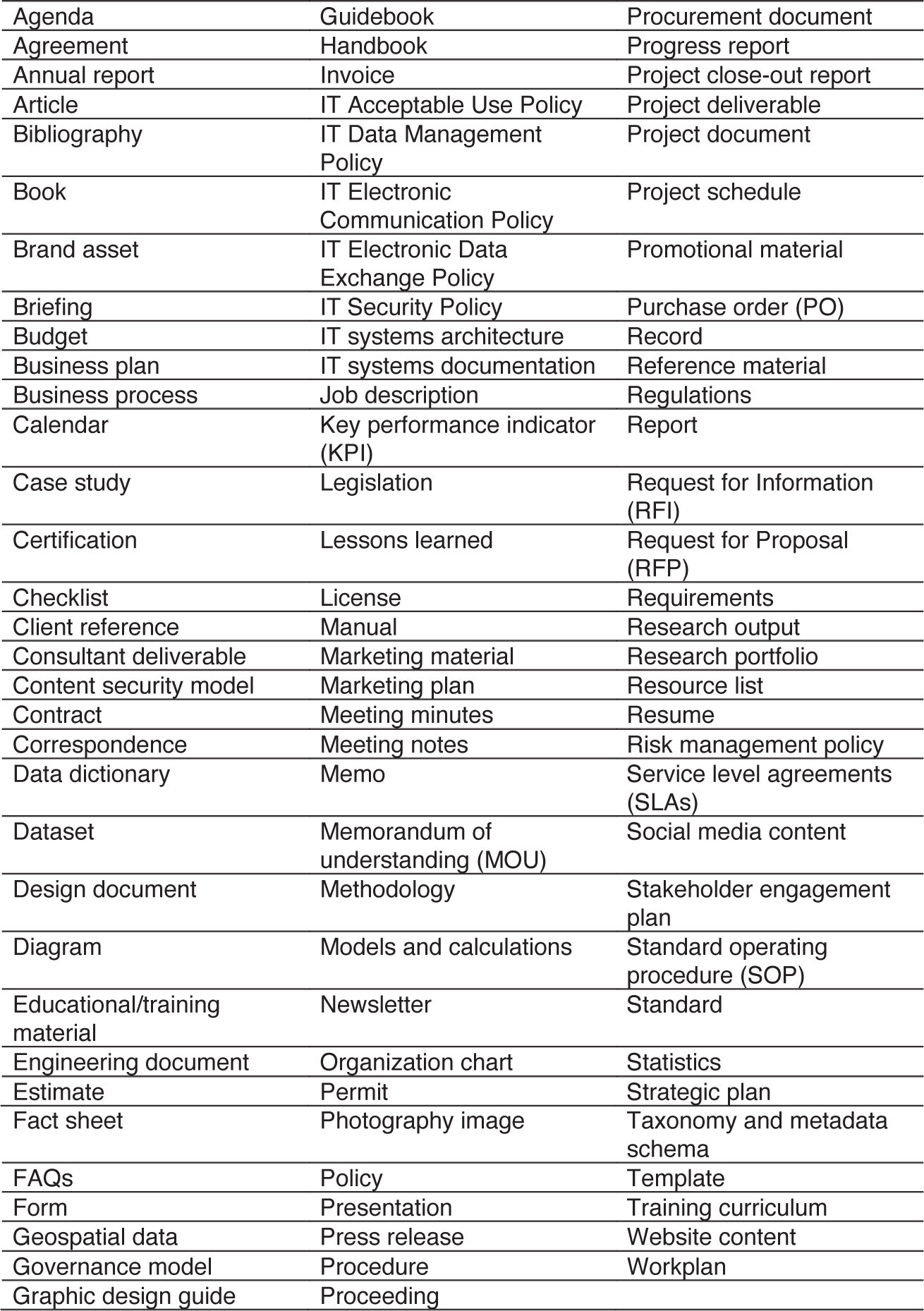
Long Description.
The table lists the following: Agenda, Agreement, Annual report, Article, Bibliography, Book, Brand asset, Briefing, Budget, Business plan, Business process, Calendar, Case study, Certification, Checklist, Client reference, Consultant deliverable, Content security model, Contract, Correspondence, Data dictionary, Data set, Design document, Diagram, Educational or training material, Engineering document, Estimate, Fact sheet, FAQs, Form, Geospatial data, Governance model, Graphic design guide, Guidebook, Handbook, Invoice, IT Acceptable Use Policy, IT Data Management Policy, IT Electronic Communication Policy, IT Electronic Data Exchange Policy, IT Security Policy, IT systems architecture, IT systems documentation, Job description, Key performance indicator (KPI), Legislation, Lessons learned, License, Manual, Marketing material, Marketing plan, Meeting minutes, Meeting notes, Memo, Memorandum of Understanding (MOU), Methodology, Models and calculations, Newsletter, Organization chart, Permit, Photography image, Policy, Presentation, Press release, Procedure, Proceeding, Procurement document, Progress report, Project close-out report, Project deliverable, Project document, Project schedule, Promotional material, Purchase order (PO), Record, Reference material, Regulations, Report, Request for Information (RFI), Request for Proposal (RFP), Requirements, Research output, Research portfolio, Resource list, Resume, Risk Management Policy, Service level agreements (SLA), Social media content, Stakeholder engagement plan, Standard operating procedure (SOP), Standard, Statistics, Strategic plan, Taxonomy and metadata schema, Template, Training curriculum, Website content, and Workplan.
Tacit knowledge, on the other hand, takes more work to formalize or communicate. The knowledge is gained through experience and involves skills, insights, intuition, and know-how. Tacit knowledge is usually context-specific and personal. Some examples of tacit knowledge include:
- Working with challenging (but necessary) vendors or partners. Effective negotiation often relies on intuition, emotional intelligence, and experience. These skills include reading body language, understanding unspoken cues, and adjusting strategies based on the flow of the conversation, which can be difficult to codify.
- Customer service excellence. Providing exceptional customer service often involves a combination of empathy, problem-solving skills, and the ability to handle complex, unpredictable situations effectively. These skills are usually developed through personal experience rather than formal training.

Long Description.
The table lists the following: Air quality report, Airport layout plan, Americans with Disabilities Act (ADA) compliance report, As-built drawing, Asset inventory list, Asset management plan, Bicycle and pedestrian plan, Bid document, Bridge inspection report, Bridge load rating report, Bridge management system report, Bridge scour analysis, Capacity analysis, Change order, Comprehensive transportation plan, Construction diary, Construction plan, Corridor study, Cost estimate, Crash report, Design exception, Disadvantaged Business Enterprise plan, Driver log, Emergency response plan, Environmental impact statement, Environmental justice analysis, Equipment specification, Erosion control plan, Evacuation route map, Feasibility study, Freight movement study, Fuel consumption report, Geotechnical report, Grant application, Hazardous materials transportation plan, Hydraulic study, Intelligent transportation system plan, Intergovernmental agreement, Intersection design plan, Labor compliance report, Land use plan, Level of service report, Long-range transportation plan, Maintenance of traffic plan, Material test result, Noise contour map, Noise study, Origin-destination study, Parking study, Pavement condition report, Pavement design report, Pavement management system report, Pay estimate, Performance measurement report, Port and maritime facility plan, Project prioritization list, Quality control report, Railroad crossing agreement, Right-of-way map, Risk register, Road safety audit, Route map, Runway safety area study, Safety plan, Sight distance study, Signal timing plan, Speed study, Stormwater management plan, Structural health monitoring report, Title 6 compliance report, Traffic control plan, Traffic count data, Traffic impact study, Traffic management center operations manual, Traffic signal warrant analysis, Transit schedule, Transit-oriented development plan, Transportation improvement program, Transportation security plan, Travel demand forecast, Travel time study, Utility agreement, Utility relocation plan, Value engineering study, Vehicle maintenance log, Wetland delineation report, Winter maintenance plan, and Zoning map.
- Cultural sensitivity. Understanding and navigating the subtleties of cultural norms and practices often require personal experience and an intuitive grasp of social cues, which can be difficult to teach formally.
- Operating complex equipment, such as asphalt paving. The ability to successfully set up, operate, and maintain complex equipment involves nuanced personal skills that are hard to fully convey through teaching. It is learned through practice and personal experience rather than through formal instruction.
- Reputation and social interaction. This consists of intangible factors such as credibility, ethical behavior, and social capital, which are not easily captured in written policies or databases but are critical to organizational success.
The characteristics that describe tacit knowledge are:
- Experience-based. It is acquired through personal involvement and practice. It is usually learned through doing rather than through formal classroom instruction.
- Difficult to transfer. Sharing tacit knowledge typically requires close interaction and personal mentoring. It is often passed on through observation, imitation, and informal learning.
- Implicit. It is often not easily articulated or documented.
Often, the term “soft skills” is used synonymously with tacit knowledge. They are different. Soft skills are interpersonal, communication, and emotional intelligence skills that enable individuals to work effectively with others. Examples include teamwork, adaptability, leadership, and problem-solving. Soft skills facilitate the sharing and application of tacit knowledge.
KM practitioners often distinguish between tacit and explicit knowledge because understanding the difference helps organizations develop strategies to manage and share knowledge more effectively. Explicit knowledge can be easily documented and distributed through reports, manuals, databases, and training materials, while tacit knowledge often requires different approaches, such as mentorship and experiential learning.
1.4 Definition of KM
Many definitions of KM have been published over the last 30 years. Among them are:
- KM is the process of capturing, distributing, and effectively using knowledge (Davenport 1994).
- KM is a discipline that promotes an integrated approach to identifying, capturing, evaluating, retrieving, and sharing all of an enterpriseʼs information assets (Duhon 1998).
- KM is the explicit and systematic management of vital knowledge and its associated processes of creating, gathering, organizing, diffusion, use, and exploitation (Skyrme 2001).
- A key goal of KM is to deliver the “right” or best available information to the right person, at the right time, to make the right decision and/or give the right advice (Martin et al. 2002).
- KM is the planning, organizing, motivating, and controlling of people, processes, and systems in the organization to ensure that its knowledge-related assets are improved and effectively employed (King 2009).
- KM is the process of creating, sharing, using, and managing the knowledge and information of an organization (Girard 2015).
- KM is an umbrella term for a variety of techniques for building, leveraging, and sustaining the know-how and experience of an organizationʼs employees (Spy Pond Partners, LLC 2015).
- KM is a collection of policies and practices relating to the identification, sharing, and retention of intellectual/knowledge-based assets in an organization. It is a management practice fostering collaboration across organizational and disciplinary boundaries; linking people who have the requisite knowledge with those who need it to do their jobs (AASHTO n.d.).
The International Organization for Standardization (ISO) standard on KM defines KM as “management with regard to knowledge,” noting (a) it uses a systemic and holistic approach to improve results and learning, and (b) it includes optimizing the identification, creation, analysis, representation, distribution, and application of knowledge to create organizational value (ISO 2018).
The research team proposes a combination of the best features of the definitions above for this report:
Knowledge management is a holistic set of business processes, policies, and practices relating to the capture, curation, storage, retrieval, and dissemination of an organizationʼs data, information, and knowledge assets.
This definition includes the terms data, information, and knowledge because it recognizes the transformation of data into tangible knowledge throughout the process. This transformation
is illustrated by the Data, Information, Knowledge, Wisdom (DIKW) Pyramid, also known as the knowledge pyramid or information hierarchy, shown in Figure 1. The pyramid shape represents the idea that large amounts of data transform into a smaller quantity of useful information, and this information then becomes an even smaller quantity of knowledge. The apex of the pyramid was originally “Wisdom” but has been recently replaced by the phrase “Insight and Understanding.” Moving upward from the base of the pyramid illustrates the progression from being inexperienced to developing an understanding (i.e., a state of mastery) based on the accumulation and synthesis of data, information, knowledge, and insights, with the ultimate goal of fact-based, or evidence-based, decision-making that incorporates all available inputs.
1.5 Core Elements of KM
While numerous critical elements drive effective KM, three core elements stand out as particularly crucial for KM success: KM business processes, KM performance metrics, and KM policies. These interconnected components provide the structural foundation that enables organizations to systematically capture, share, and leverage their collective knowledge.
1.5.1 KM Business Processes
Well-defined business processes are the backbone of any successful organization. They provide a clear framework for how work gets done, ensuring consistency, efficiency, and improved quality. By standardizing tasks and procedures, organizations can minimize errors, reduce waste, and improve employee productivity. Clear processes also facilitate better communication and collaboration across departments, leading to smoother workflows and faster turnaround times.
KM programs can greatly benefit from having clear and well-defined business processes. One of the most respected lists of KM business processes has been developed by the American Productivity & Quality Center (APQC).
The APQCʼs Process Classification Framework® (PCF) includes about 25 processes and subprocesses that define the foundation for enterprise KM. As background, the PCF is a taxonomy of cross-functional business processes intended to objectively compare organizational performance within and among organizations. The APQC and its member companies developed the PCF as an open standard to facilitate improvement through process management and benchmarking,

Long Description.
The pyramid is titled 'DIKW Pyramid.' It shows a hierarchy from bottom to top, which includes Data to Insight and Understanding. It has Data in the fourth (bottom layer), Information in the third layer, Knowledge in the second layer, and Insight and Understanding in the top layer. An arrow from the top layer points to a label that says 'Evidence-based decision making.'
regardless of industry, size, or location. The PCF organizes more than 1,000 operating and management processes and associated activities into 13 enterprise-level categories. The current version of the PCF, Version 7.4, was published in August 2024 and is available for free from the APQCʼs website (www.apqc.org).
KM business processes are listed in the PCF in Section 13.5, Develop and Manage Enterprise-wide Knowledge Management (KM) Capability. The names of the APQCʼs KM processes and subprocesses, and a brief description are presented in Table 3.
Not all these business processes may be relevant or necessary for a KM function. If you are just starting your KM program, you may want to select just a handful and create business process maps to help you visualize the flows.
1.5.2 KM Performance Metrics
Another important element of any KM program is performance management. As discussed in Section 1.3, knowledge is inherently complex, so it is imperative to measure and report on the outcomes of your KM program.
KM performance metrics are measurements used to track and assess the status of the overall KM function or the performance of a specific KM business process or practice. Hundreds of performance metrics have been proposed to measure KM based on existing literature. In this section, we list more than 160 widely used performance metrics for measuring KM. They are presented in three categories: (1) KM Function or Practice Metrics, (2) KM Solution Metrics, and (3) Business Outcome Metrics.
A few of the KM performance metrics can be selected as key performance indicators (KPIs) of your KM program. KM KPIs are a subset of KM performance metrics and are typically based on whether they directly align with the organizationʼs strategic objectives, have defined targets or thresholds, impact decision-making at higher levels, and are considered critical to the organizationʼs core success.
1.5.2.1 KM Function or Practice Metrics
KM function or practice metrics measure the performance of the KM business function or group, as well as internal KM business processes and practices. The metrics are presented in six subgroups based on the type of KM benefit.
Benefit 1: Knowledge creation. Performed by individuals, teams, groups, and organizations in generating new KAs, where high contribution rates signal active knowledge generation. State DOTs can influence the generation of new KAs by promoting a culture of knowledge exploration and discovery.
Employee metrics:
- Number of KAs created over a given period.
- Rate of knowledge creation per employee, team, and group.
- Percentage of increased efficiency in creation of new KAs.
- Number of new employee skills and expertise learned from the creation of new KAs.
Knowledge repository/base metrics:
- Rate/number of employee KA contributions to knowledge repositories.
- Percentage of employees contributing to the KM system.
- Frequency of updates to the knowledge base.
- Ratio of KA generation/creation vs. KA obsoletion.

(continued on next page)
Long Description.
The column headers of the table are APQC PCF Process ID, Process Name, Process Description. The data given in the table row-wise are as follows: Row 1: 13.5; Develop and manage enterprise-wide KM capability; Create and administer the capability of the organization's KM function, develop a strategy for KM, and assess the capabilities of the KM function. Row 2: 13.5.1; Develop a KM strategy; Create a plan for managing the organization’s knowledge base. Determine what specialized knowledge the organization possesses, which elements of this collective knowledge can prove beneficial, how to capture and maintain this knowledge, how to grant access to this library of information, and how the organization should proceed. Row 3: 13.5.1.1; Develop a governance model with roles and accountability; Develop a structure for the governance of the organization’s collective knowledge. Gather, maintain, and make accessible the collective knowledge base. Develop a standard procedure for conserving and perpetuating the organization’s knowledge. Create policies for the usage and maintenance of this knowledge. Establish specialized roles. Row 4: 13.5.1.2; Define roles and accountability of core group versus operating units; Determine the roles and responsibilities of all personnel involved in managing the organization’s corpus of knowledge. Flesh out the roles and responsibilities of the KM core group and the operational staff involved in the upkeep of the KM program. Row 5: 13.5.1.3; Develop funding models; Analyze the organization’s current approach to funding. Learn from the funding approaches of peer organizations. Evaluate the revenue potential and costs of those short-listed funding models. Select funding models to implement. Row 6: 13.5.1.4; Identify links to key initiatives; Identify any links between the KM strategy and any other functional areas. Determine any correlations between the strategic roadmap for KM and any other functional areas. Study each function’s or unit’s attributes. Row 7: 13.5.1.5; Develop core KM methodologies; Create core KM procedures and methods. Initiate the development of a strategy and planning, execution, and improvement approaches. Row 8: 13.5.1.6; Assess IT needs and engage the IT function; Determine the IT needs for developing the KM strategy and collaborating with the IT function to implement the strategy. Assess requirements for technologies to build and implement the KM strategy effectively. Row 9: 13.5.1.7; Develop training and communication plans; Create plans for KM training and for conveying the KM strategy within the organization. Create training programs, sessions, and activities to familiarize employees and management with KM. Row 10: 13.5.1.8; Develop change management approaches; Create approaches for effectively administering the changes for KM. Design an approach that transforms individuals, teams, and the organization to a desired future state represented by the change. Row 11: 13.5.1.9; Develop strategic measures and indicators; Establish measures and indicators for evaluating the performance of the KM function. Define key performance indicators (KPIs) such as the number of KAs created and the number of knowledge projects undertaken.

Source: APQC 2024.
Long Description.
The column headers of the table are APQC PCF Process ID, Process Name, Process Description. The data given in the table row-wise are as follows: Row 12: 13.5.2; Assess KM capabilities; Assess the maturity of the existing initiatives in KM and evaluate existing KM approaches. Identify the gaps and needs to enhance the existing KM approaches. Develop and implement new KM approaches. Row 13: 13.5.2.1; Assess the maturity of existing KM initiatives; Evaluate whether the initiatives are effective or should be discarded. Design a framework for assessing maturity, typically from Level 1 (undefined), Level 2 (repeatable), Level 3 (defined), Level 4 (managed), through Level 5 (optimized). Row 14: 13.5.2.2; Evaluate existing KM approaches; Evaluate the existing KM procedures, policies, and guidelines. Study and examine the organization’s approach in comparison to the industry’s best practices through benchmarking, competitive analysis, and related comparison measures. Row 15: 13.5.2.3; Identify gaps and needs; Assess the KM approach to identify gaps or needs. Compare the performance of the KM approach against the desired or expected performance and the standard KM industry approach. Row 16: 13.5.3; Design and implement KM capabilities; Create knowledge bases and other repositories to preserve and develop company expertise and to train new employees. Row 17: 13.5.3.1; Develop new KM approaches; Design new policies, procedures, and guidelines to support KM. Row 18: 13.5.3.2; Design a resource model for KM approaches; Create a model to describe the resources and approaches needed for KM. Establish standards and guidelines to be followed. Row 19: 13.5.3.3; Implement new KM approaches; Implement new policies, procedures, and guidelines to support KM. Row 20: 13.5.3.4; Leverage and enhance I T for KM approaches; Use existing technologies to improve the organization’s KM processes. Research available third-party offerings. Develop proprietary solutions. Employ knowledge engineers, data scientists, and other relevant personnel. Row 21: 13.5.3.5; Develop measures; Create metrics that can systematically describe KM approaches and capabilities. Choose applicable scales, benchmarks, and units of measure. Determine required precision and error rates. Row 22: 13.5.4; Evolve and sustain KM capabilities; Develop resources for improving KM and knowledge engineering. Row 23: 13.5.4.1; Enhance or modify existing KM approaches; Leverage KM evaluations and identify gaps to enhance existing approaches. Row 24: 13.5.4.2; Sustain awareness and engagement; Develop awareness about available knowledge bases and promote their use to maximize their impact. Row 25: 13.5.4.3; Expand KM infrastructure to meet demand; Augment available resources to better leverage the organization's offerings to serve existing clients and expand the client base.
Work augmentation metrics:
- Number of new processes documented.
- Number of new competencies/work methods developed.
- Number of new best practices documented.
Intellectual capital metrics:
- Number of new insights and ideas presented.
- Number of innovations discovered.
- Number of new patents created.
- Number of new copyrights created.
- Number of new trademarks created.
Benefit 2: Knowledge sharing. Performed by individuals and work teams that share knowledge, information, and expertise across internal and external groups and organizations. Knowledge sharing is a vital activity that can drive innovation, improve efficiency, and foster collaboration. A high sharing rate often correlates with a more innovative and informed workforce as well as increased productivity.
Knowledge sharing transaction metrics:
- Rate/number of KA sharing transactions.
- Amount of KA sharing between employees, teams, groups, and business units.
- Rate/number of cross-departmental knowledge sharing interactions.
Omnichannel knowledge sharing metrics:
- Number of knowledge-sharing sessions per unit (employee, team, group, or department).
- Number of communities of practice (CoPs).
- Amount of employee participation in CoPs.
- Number of forums/discussion groups.
- Number of employees participating in forums/discussion groups.
- Number of knowledge-sharing workshops.
- Workshop attendance.
- Number of knowledge-sharing webinars.
- Webinar attendance.
- Volume of communication in knowledge-sharing forums (e.g., chats, conversations, emails).
Knowledge repository metrics:
- Number of downloads from knowledge repositories.
- Rate of retrieval of shared documents.
- Number of KAs accessed in daily operations.
- Number of exchanges on KAs (e.g., feedback/comments, likes/dislikes).
Benefit 3: Knowledge collaboration. Performed by individuals and teams collaborating on initiatives, programs, and projects as part of a synergistic process that promotes employee personal growth. Collaboration builds strong team relationships and contributes to overall organizational collective knowledge by empowering individuals to leverage their joint expertise to overcome obstacles and achieve shared goals. Collaboration enhances and enriches personal and professional development through exposure to diverse perspectives and provides invaluable opportunities to address complex challenges and find innovative solutions.
Programs and project collaboration metrics:
- Number of programs/projects utilizing KM collaboration.
- Number of collaboration initiatives across teams and groups.
- Rate/number and frequency of cross-departmental individual, team, and group KM collaborations.
- Average work time saved due to KM collaboration.
- Percentage increase in interdepartmental knowledge flow.
Knowledge repositories/base metrics:
- Number of successful collaborations involving a central KM repository (with success being defined in terms of outputs or outcomes from the collaboration).
Success metrics:
- Number of joint problem-solving sessions.
- Survey of KM employee collaboration satisfaction.
Benefit 4: Knowledge preservation and retention. Mission-critical function performed by individuals, teams, groups, business units, and the organization as a whole. Knowledge preservation and retention involve applying best practices to guarantee valuable knowledge and associated KAs remain accessible and usable over time. These safeguards help protect intellectual capital, maintain business and operational continuity, and prevent KA loss or degradation. Vital elements of knowledge preservation and retention include ensuring mission-critical knowledge, historical data, and lessons learned are available to mitigate the risk of disruptions caused by data loss or knowledge gaps.
Knowledge and associated KA transfer metrics:
- Percentage of tacit knowledge converted to explicit knowledge.
- Number of captured and retained KAs after employee departure.
- Average knowledge retention per employee and employee role.
- Knowledge transfer completion rate.
- Rate of knowledge loss due to employee turnover.
- Rate of knowledge retention per department.
- Number of knowledge continuity plans implemented.
Knowledge transfer program metrics:
- Number of mentorship programs over a given period.
- Rate of success of mentoring programs.
- Number of coaching sessions conducted over a given period.
- Rate of success of coaching sessions.
- Number of job shadowing initiatives.
- Number of employee exit interviews.
Succession planning metrics:
- Number of successors for key roles identified.
Knowledge repository metrics:
- Number of knowledge capture and storage transactions.
- Rate of knowledge and KA retention in the knowledge repository.
Benefit 5: KA audit. Performed by a KM specialist, it consists of a systematic assessment of a state DOTʼs intellectual capital at various organizational levels. It involves scanning the organizationʼs knowledge and information holdings to determine where KAs are located and inventoried. A typology of KA that an organization possesses is completed, such as documents, databases, patents, trademarks, or employee expertise.
KA volumetrics:
- Number of KAs.
- Number of KAs by type.
- Frequency with which specific KAs are accessed.
- Frequency of KA audits.
KA quality metrics:
- Significance and value index
- Position and alignment with KM business case initiatives, priorities, and goals.
- Precision index
- Accuracy and consistency (based on facts; error-free).
- KA user satisfaction rating.
- Trustworthiness of the source; peer reviews.
- Integrity index
- KAsʼ meaningfulness and clarity.
- Complete with no missing information.
- Number of KAs errors discovered and revised.
- Survey user feedback on KAsʼ accuracy and completeness.
- Number of KA quality assurance checks done for a given period.
- Availability and format index
- Ease of retrieval.
- Suitability of format for multiple representations.
- Compatibility with peripheral systems.
- Currency index
- Up-to-date and current.
- Age of KAs.
- Number/percentage of outdated KAs.
- Safety and security index
- Digital rights management.
- Unauthorized access and modification safeguards.
Benefit 6: KM governance (KMG). Performed by KMG committee members, KM specialists, and KM business case sponsors. KMG establishes a comprehensive framework that defines the conventions, rules, policies, and processes for managing state DOTʼs knowledge and associated KAs, ensuring support for organizational priorities and goals as well as compliance with laws and regulations. KMG promotes the importance and values of knowledge creation, sharing, and collaboration while helping to mitigate risks associated with knowledge loss.
KMG framework metrics:
- Competence rating of the KMG (based on the resources and effort needed to operate the KMG program).
- Success rating of the KMG program (realization of intended goals and objectives).
KMG policy, standards, and regulations metrics:
- Number of KM policies.
- Percentage of employees that adhere to KM policies.
- Percentage of KM policies supporting operations.
- Frequency of KM review and updates.
- Number of KM standards recognized, certified, and adopted.
- Number of KAs that adhere to standards.
- Number of KM compliance regulations (e.g., privacy, security).
KMG—KM and KAs organizational metrics:
- Return on investment (ROI) of KM initiatives (positive or negative).
- Rate/number of KA utilization.
- Percentage of KA capture and storage.
- Frequency of KAs shared among employees, teams, and groups for a given period.
Knowledge repository metrics:
- Rate of knowledge repository growth.
- Average time it takes to retrieve knowledge/information from the repository.
1.5.2.2 KM Solution Metrics
KM solution metrics measure the performance of KM solutions enabled by one or more software products. The metrics are presented in three important dimensions: technical metrics, knowledge repository-related metrics, and search metrics.
A KM solution is a software or platform that enables state DOT organizations to capture, store, manage, and share knowledge effectively. From a repository standpoint, it encompasses a range of tools, including content, document, and records management systems. Concerning search functionality, it leverages search engine optimization (SEO), discovery, and findability through semantic search (using taxonomy, ontology, and metadata tags), artificial intelligence (AI)–powered search, and knowledge graphs. It incorporates augmented features such as digital asset management and spatial and temporal databases to enhance the storage capabilities of complex KAs.
KM technology solution metrics:
- Number of KM tools used per project.
- KM solution engagement rate by KM project initiatives.
- Number of active users of KM tools.
- User KM solution satisfaction score.
- Survey results on employee KM tool experience and satisfaction.
- User time spent utilizing KM solutions.
- Percentage of growth in registered KM solution users.
- Number of KM solution training sessions (employees per session).
- Percentage of time saved finding KAs.
- Rate of problem-solving success using KM tools.
- Percentage of employees using KM solutions for decision-making.
- Number of KM solution integrations with workflows/processes.
- Frequency of KM solution logins (frequent logins indicate higher engagement and reliance on the KM solutions).
- KM solution uptime (high uptime ensures consistent access to knowledge).
Knowledge repository/knowledgebase metrics:
- Average cost of creating and maintaining KAs.
- Rate/number of KAs stored.
- Rate/number of KA utilization.
- Number of KAs requested for a given period.
- Average response time for KA access and views.
- Rate/number of updates to KAs over a given period.
- Survey user satisfaction with KM resources.
- Number/percentage of KAs tagged with metadata.
- Survey of search relevancy success.
- KA navigation and accessibility score (easy, complicated, complex).
Search metrics:
- Number of search queries executed over a given period.
- Rating of relevance of retrieved documents to queries.
- Rating of KA relevance to business and operational needs.
- Rate of success in the findability of relevant KAs.
- Average response time to KA queries.
- Number of KAs views per search term.
1.5.2.3 Business Outcome Metrics
The third category of KM metrics is business outcome metrics. Business outcome metrics measure the impact of KM on the organizationʼs KPIs. The metrics are presented in five subgroups based on the business benefit area.
Benefit Area 1: Cost and Efficiency Metrics
Employee metrics:
- Employees gain KM competence more quickly.
- Number of employees who apply lessons learned.
- Rate/number of knowledge transfer contributions.
- Surveyed employees rate job satisfaction high as it relates to KM.
- Employee retention rate related to KM.
- Percentage of training cost reduction rate with KM usage.
- Employee competency growth through knowledge sharing.
Programs and project metrics:
- Rate of successful program/project completion due to KM.
- Percentage of program/project completion time reduced due to KM.
- Rate of program/project cost decrease with knowledge reuse (reduction in duplication of effort).
- Number of employee-adopted best practices from KM.
- Percentage of programs/projects and employees utilizing KM lessons learned.
Benefit Area 2: ROI Metrics
- Percentage of cost savings created by KM through reduced errors and efficiency gains.
- Percentage of cost savings from avoiding redundant work.
- Percentage of cost savings and cost avoidance from KA reuse.
- ROI of KM solution investments.
- Increase in value of business and operational outcomes from KM initiatives.
- Percentage of cost savings from the avoidance of fines and penalties attributable to KM.
Benefit Area 3: Productivity Improvement Metrics
- Percentage of productivity gains attributed to KM tools.
- Number of workflows/processes streamlined/removed with KM in place.
- Percentage of time needed for knowledge transfer reduced.
- Percentage of minimized errors and waste with KM.
- Problem resolution time decreased due to KM.
- Rate/number of KAs used in decision-making.
- Number of knowledge gaps identified.
- Rate of improvement in time-to-market for products/services.
Benefit Area 4: Organizational Impact Metrics
- Number of innovations driven by KM.
- Rate of innovation increase from new ideas and insights.
- Number of risk mitigation plans developed with KM.
- Number of better decisions, enhanced preparedness, and improved reputation due to KM.
- Rate of increase in customer service delivery speed.
- Reduced rate of customer problem resolution time due to KM.
- Survey of customer satisfaction improvements from KM.
- Percentage of enhanced organizational agility with KM tools.
Benefit Area 5: Learning and Development Metrics
- Number of learning assets created.
- Percentage increase in training effectiveness with KM.
- Rate of employeesʼ training program completion.
- Amount of time employees spend in KM-related training.
- Rate of KM e-learning course completion.
- Number of knowledge transfer mentorship programs conducted.
- Number of employee KM assessment tests or evaluations.
- Number of peer-to-peer learning instances.
- Rate of on-the-job learning through task interactions.
1.5.3 KM Policies
Several policies are necessary to establish and enable a KM program. Here are the names and short descriptions of five important KM policies.
- Information classification policy. This policy establishes a framework for categorizing different types of information and KAs within an organization. It defines levels of sensitivity and importance, such as public, internal, confidential, and restricted information. The policy outlines how each category should be handled, stored, and shared, ensuring appropriate protection and access controls. It also guides employees on how to identify and label information correctly. This policy is crucial for maintaining information security, compliance, and efficient KM practices.
- Knowledge sharing and collaboration policy. This policy outlines guidelines for sharing knowledge and facilitating collaboration within the organization. It encourages a culture of open communication and knowledge exchange, defining expectations for employees to contribute to and utilize shared knowledge resources. The policy may include guidelines for using collaboration tools, participating in knowledge-sharing initiatives, and recognizing contributions. It also addresses potential barriers to knowledge sharing and provides strategies to overcome them. This policy is essential for fostering innovation, enhancing decision-making, and improving organizational efficiency.
- Information security policy. This policy outlines the measures and practices required to protect the organizationʼs information assets from unauthorized access, use, disclosure, disruption, modification, or destruction. It covers various security aspects, including physical security, cybersecurity, access controls, and employee responsibilities. The policy typically includes guidelines for password management, data encryption, incident reporting, and response procedures. It also addresses compliance with relevant laws and regulations regarding data protection. Regular training and audits are often mandated to ensure adherence to this critical policy.
- Data governance policy. This policy establishes the framework for managing data, information, and knowledge as a valuable organizational asset. It defines the roles and responsibilities for
data management, sets standards for data quality and integrity, and outlines the processes for data creation, storage, use, and disposal. The policy typically includes guidelines for data architecture, metadata management, and data integration across different systems. It also addresses data ownership, access rights, and compliance with data-related regulations. This policy is crucial for ensuring data is accurate, consistent, and usable across the organization. Often, the data governance policy also describes the organizational governance structures.
- Intellectual property protection policy. This policy safeguards the organizationʼs innovations, creative works, and proprietary information. It defines what constitutes intellectual property (IP) within the organization and outlines procedures for identifying, registering, and protecting various forms of IP, such as patents, copyrights, trademarks, and trade secrets. The policy typically includes guidelines for employee confidentiality agreements, proper use of third-party IP, and procedures for commercializing or licensing the organizationʼs IP. It also addresses potential IP issues in collaborative projects and partnerships. This policy is vital for preserving the organizationʼs competitive advantage and monetizing its innovations.
Other policies are often part of KM governance and include:
- Data privacy policy.
- Document management policy.
- Records retention and disposal policy.
- Continuous learning and training policy.
- Quality assurance policy for KAs.
- Reward and recognition policy for knowledge contribution.
- Acceptable use policy for information technology (IT) resources.
- KM technology usage policy.
- Knowledge transfer policy (for departing employees).
KM policies should be customized to fit the unique needs of the organization. The relative importance of the individual KM policies varies depending on the organizationʼs industry, business model, and competitive differentiation.
1.6 Process for Converting Knowledge into a Knowledge Asset
The second half of the definition of KM lists the sequence of process steps for converting knowledge into a KA. Specifically, the four steps mentioned in the definition were knowledge capture, knowledge curation, knowledge storage, and knowledge retrieval and dissemination.
Note: Knowledge creation, also called knowledge discovery (i.e., the process of creating new knowledge), is not generally considered a part of KM. New knowledge is an input into the knowledge capture step.
In this section, the Integration Definition for Function Modeling (IDEF0) methodology is used to describe the four steps. IDEF0 provides a structured approach to representing KM business process steps, activities, tasks, as well as data, information, and knowledge flows.
The IDEF0 methodology uses graphical notation consisting of:
- Function boxes. Rectangular shapes represent the business process steps and activities.
- Arrows. These represent the flow of data and objects, categorized as:
- Inputs are the data or materials that get converted or processed by an activity. Inputs enter the left side of the function box.
- Outputs are the results or products that are produced by an activity. Outputs exit the right side of the function box.
- Mechanisms are the resources, tools, or means used to perform a function. They support the functionʼs execution but are not consumed or transformed by it. Mechanisms enter the bottom of the function box.
- Controls are constraints, rules, or conditions that govern a function or stepʼs operation. They direct or regulate the transformation of inputs into outputs. Controls enter the top of the function box.
A function box and the four arrow types are illustrated in Figure 2.
The knowledge capture, knowledge curation, knowledge storage, and knowledge retrieval and dissemination steps are described below using the IDEF0 methodology.
1.6.1 Knowledge Capture Step
Knowledge capture is the initial step in converting new information into a KA. This process involves identifying, collecting, and recording valuable knowledge from various sources within an organization. Knowledge capture includes gathering explicit knowledge from documents, databases, and other recorded sources, as well as eliciting tacit knowledge from experts. The goal is to transform undocumented expertise and scattered information into a structured format that can be easily shared and utilized. Effective knowledge capture requires a systematic approach to ensure that critical information is not overlooked and that the context of the knowledge is preserved.
In the knowledge capture step, tacit knowledge is made explicit. In other words, tacit knowledge resident in an individualʼs mind is converted into an explicit representation available to the enterprise. One crucial aspect of tacit knowledge capture is knowledge representation. For instance, one should consider the optimal way to represent and record new knowledge.
Knowledge capture often employs techniques such as interviews, surveys, observations, and document analysis. There are several tools for tacit knowledge capture.
Inputs:
- New (raw) information from various sources (e.g., documents, observations, research results), including data from an organizationʼs processes and systems and tacit knowledge from experts (e.g., interviews). Capturing tacit knowledge is problematic because it is often difficult to articulate.

Long Description.
The graph represents four components of Process Step or Activity, which include: Control, Output, Mechanism, and Input.
Outputs:
- Documented explicit knowledge, including recorded tacit knowledge.
- Initial metadata and context.
Mechanisms:
- KM staff.
- Interviews.
- Surveys.
- Recording and transcription tools.
- Document analysis tools.
- Knowledge elicitation techniques.
Controls:
- Knowledge policies and procedures that govern information sharing.
- Privacy and confidentiality concerns.
- Language and communication barriers.
- Time availability of subject matter experts (SMEs).
1.6.2 Knowledge Curation Step
Knowledge curation is the step of refining, organizing, and enhancing captured knowledge to increase its value and usability. This step involves validating the accuracy and relevance of the captured information, structuring it according to organizational taxonomies or ontologies, and enriching it with metadata. Curators analyze the content, identify relationships between different pieces of knowledge, and ensure consistency with existing KAs. They may also synthesize information from multiple sources to create more comprehensive and valuable knowledge units.
Effective curation transforms raw captured knowledge into well-organized, contextualized, easily accessible assets. The curation process often involves peer review and expert validation to maintain high-quality standards.
Inputs:
- Documented explicit knowledge, including recorded tacit knowledge from the previous step.
- Initial metadata and context.
Outputs:
- Validated, refined, structured, and categorized knowledge.
- Enriched metadata and relationships.
Mechanisms:
- KM staff.
- Organizational taxonomy and ontology.
- Data cleansing and normalization tools.
- Taxonomy and ontology management tools.
- Auto-classification tools.
Controls:
- Knowledge policies and procedures that govern IP rights and permissions.
- Quality standards and guidelines to ensure consistency with existing KAs and structures.
- Expert review processes.
- Resource limitations for KA review and refinement.
1.6.3 Knowledge Storage Step (Also Called Knowledge Retention)
Knowledge storage involves securely preserving curated KAs in a manner that ensures their integrity, accessibility, and longevity. This step focuses on selecting appropriate storage systems and technologies that can accommodate various types of KAs, from text documents to multimedia content. It includes implementing robust database structures, content management systems, or specialized knowledge repositories. Proper knowledge storage also encompasses version control, which tracks changes and maintains historical records. Security measures are implemented to protect sensitive information and manage access rights. Additionally, this step involves establishing backup and recovery procedures to safeguard against data loss.
Inputs:
- Validated, refined, structured, and categorized knowledge.
- Enriched metadata and relationships.
Outputs:
- KAs, with complete metadata, securely stored in a content management system or other file storage system.
- Backup copies of KAs.
Mechanisms:
- KM staff.
- Databases, file shares, content management systems, digital asset management systems, and other types of knowledge repositories (both on-premises and cloud solutions).
- Data encryption tools.
- Version control tools.
- Rights management tools.
- Backup and recovery tools.
Controls:
- Storage capacity and scalability.
- IT infrastructure policies and procedures.
- Knowledge policies and procedures covering storage, retention, security, access, and more.
- Technology infrastructure, backup, and disaster recovery limitations.
1.6.4 Knowledge Retrieval and Dissemination Step
Knowledge retrieval and dissemination is the final step, focusing on making stored knowledge accessible and useful to end users. This process involves indexing the stored KAs and developing efficient search and retrieval mechanisms that help users find relevant information quickly. It includes creating user-friendly interfaces and implementing advanced search algorithms to enhance discoverability. Knowledge dissemination strategies can be developed to proactively “push” knowledge to end users through various channels such as portals, newsletters, or collaborative platforms. This step also encompasses monitoring knowledge usage, gathering user feedback, and continuously improving the retrieval and dissemination processes. Effective retrieval and dissemination ensure that the right knowledge reaches the right people at the right time, maximizing the value of KAs within the organization.
Inputs:
- KAs, with complete metadata, securely stored in a content management system or other file storage system.
- User queries and their information needs (for “push” strategies).
- End-user access rights and permissions.
Outputs:
- Indexed and searchable KAs (i.e., content).
- Answers to specific user-submitted queries.
- Disseminated information through various channels.
- Search and usage analytics.
Mechanisms:
- Search engine indexing tools, algorithms, and weightings.
- Taxonomy and ontology.
- Search user interfaces.
- Collaboration and knowledge-sharing portals, platforms, and tools.
- Reporting and analytics tools.
Controls:
- User access levels and permissions.
- IT processing and network limitations.
- Relevance and currency of KAs indexed in the search engine.
1.6.5 Example—Updating a Standard Operating Procedure
These four steps are illustrated using a typical DOT-specific example: updating a standard operating procedure (SOP). In this example, a new observation or finding from studying the procedure in practice identified an improvement. Table 4 shows how revising the SOP progresses through the four steps.

Long Description.
The column headers of the table are Step Number, Step Name, Activities, and Outputs. The data given in the table row-wise are as follows: Row 1: Step Number 1; Knowledge Capture; The process owner would edit the current SOP document to capture the new changes. The updated SOP would be circulated to SMEs for review and approval; The new tacit knowledge is captured and documented in the updated SOP; The metadata and context are inherited from the previous SOP; the revision information is captured as new metadata. Row 2: Step Number 2; Knowledge Curation; A knowledge worker would review the SOP and metadata and may make enhancements to the metadata based on revisions to the enterprise taxonomy; The updated SOP is assigned additional metadata and ontology relationships. Row 3: Step Number 3; Knowledge Storage; The knowledge worker loads the updated SOP into the knowledge repository and removes the older version. Access rights are assigned to the document. The content management system (CMS) automatically stores a copy in a backup system; The updated SOP is stored in the knowledge repository. Row 4: Step Number 4; Knowledge Retrieval and Dissemination; The search engine automatically indexes the updated SOP and its metadata. End users submit queries to the search engine; When users submit relevant queries, the updated SOP is displayed in the search engine results.
Last, the four steps described earlier for converting knowledge into a KA are typically much more complicated. Additional processing activities are usually needed in each step to reflect the full complexity [for example, processing repositories with multilingual content and integrating knowledge repositories with AI tools such as chatbots, intelligent agents, and large language models (LLMs)].
1.7 Business Value of KM
The objective of KM is to ensure that an organizationʼs knowledge is readily available to drive informed decision-making. KM is critical in large organizations (i.e., over 1,000 people) because, historically, knowledge was stored primarily in peopleʼs heads, which may not be easily shared or potentially lost due to changes in employment status. In todayʼs large and complex organizations, a systematic and holistic approach to KM that covers acquiring, curating (capturing, identifying, reviewing, and analyzing), disseminating (including knowledge visibility and availability), and applying knowledge, is necessary.
When knowledge is not easily accessible within an organization, it can be incredibly costly. Valuable time is spent seeking out and extracting relevant information instead of completing outcome-focused tasks. More importantly, sub-optimal decisions are made, which could harm transportation projects and investments for decades.
It is widely acknowledged that the transportation sector is highly knowledge-intensive, and knowledge is becoming DOTsʼ most strategically important asset.
Capturing knowledge by writing it down, storing it in files, publishing it in reports, and collaborating with others on project teams is not new. What is new is that the field of KM has evolved into a set of best practices, methods, and software tools to efficiently and cost-effectively manage knowledge in large enterprises. KM aims to improve organizational performance and create a sustainable competitive advantage.
Improving organizational performance can occur in many ways. KM can create both tangible and intangible business benefits. Tangible benefits include shortened business process cycle times, reduced mistakes and rework, improved allocation of resources, and reduced costs. Intangible benefits include increased innovation, elevated collaboration and teamwork, greater buy-in to decisions, improved morale, and more engaged staff at every level. Tangible and intangible benefits of investing in KM are listed in the following.
Tangible benefits:
- Shortened business process cycle times.
- Faster decision-making.
- Faster response to business issues; quicker speed of execution.
- Sooner access to knowledge resources (24/7 knowledge availability).
- Improved allocation of resources.
- Risk mitigation.
- Reduced redundancy.
- Reduced mistakes and rework.
- Increased operational efficiency.
- Cost savings.
Intangible benefits:
- Better (higher-quality) decision-making.
- Higher-quality outputs.
- Increased innovation.
- Increased collaboration and teamwork.
- Increased communication.
- Increased employee skills and competencies.
- Individuals provide more value added as they become KM-enabled.
- Workforce development and satisfaction.
- Greater buy-in to decisions made.
- Improved morale/employee retention.
- Enhanced stakeholder relationships.
- Aligned thinking and action.
A few of these benefits most applicable to state DOTs include:
- Better decision-making. KM provides access to comprehensive, up-to-date information, which enables more informed decisions. Historical data and lessons learned can inform future project planning and risk assessment. Cross-departmental knowledge sharing can lead to more holistic problem-solving.
- Enhanced operational efficiency. KM streamlines access to information by reducing the time spent searching for data and expertise. Sharing best practices leads to process improvements and reduced redundancies. Predictive analytics can optimize maintenance schedules and resource allocation.
- Increased innovation. A culture of knowledge sharing fosters increased innovative and creative problem-solving. For example, an improved understanding of user needs and emerging trends enables the proactive adaptation of new transportation technologies. Cross-pollination of ideas from different departments can lead to breakthrough solutions.
- Risk mitigation. Better knowledge retention and transfer reduces the risk of losing critical information due to employee turnover. Enhanced documentation and knowledge sharing can improve safety practices and minimize liability.
- Cost savings. More efficient operations and better decision-making lead to more effective use of limited budgets. Knowledge-driven predictive maintenance can significantly reduce the life cycle costs of infrastructure.
- Workforce development and satisfaction. Focusing on knowledge and learning can attract and retain top talent. Employees benefit from increased opportunities for skill development and recognition of their expertise. A sense of purpose and belonging is enhanced.
- Enhanced stakeholder relationships. Improved KM can lead to more transparent and effective communication with the public, legislators, and other stakeholders. Better data-driven insights can support more compelling arguments for funding and support.
In Chapter 3, these benefits are quantified and incorporated into a business case for KM.
1.8 Conclusion: A Call to Action for DOT Executives
State DOTs have long been the stewards of our nationʼs valuable transportation assets. Now is the time to recognize that your organizationʼs collective knowledge and expertise may be the most precious assets of all. This transition from focusing solely on physical assets to equally valuing intellectual assets is not just a trend—it is a business necessity. Effective knowledge stewardship offers many potential rewards, such as improved decision-making, operational efficiencies, and innovation.
DOT executives are uniquely positioned to lead this transformation. As DOTs navigate the complexities of 21st-century transportation, the ability to effectively manage KAs will increasingly differentiate high-performing DOTs from their peers. By embracing this new frontier of KM, DOTs can enhance their own performance and set new standards for public sector excellence in the information age. The road ahead is clear: the future belongs to those who can harness the power of knowledge most effectively.


