Alternative Project Delivery Methods: Assessing and Allocating Risk to Increase Competition (2025)
Chapter: 3 Risk Allocation Strategies

CHAPTER 3
Risk Allocation Strategies
The previous chapter addressed, in general terms, how risk management practices can be integrated into project development, procurement, and execution processes to effectively allocate, communicate, and manage project risks.
This chapter, in turn, focuses on specific risk issues that commonly impact large APD projects. Section 3.1 describes typical project risks, including site conditions, utilities, ROW, government permits, archaeology or protected species and hazardous materials, along with associated allocation strategies and alternatives to better manage the risk. For more information on these risk allocation strategies, along with examples of contractual provisions related to them, see Appendix C.
3.1 Typical Project Risks and Allocation Strategies
3.1.1 Site Conditions (Geotech)
Risks related to site geotechnical site conditions include the following:
- Unexpected geotechnical site issues (e.g., inadequate geotechnical investigation results, poor soil conditions, unsound subgrade conditions, large boulders contained in existing soils, or adverse groundwater conditions).
- Inaccurate/incomplete geotechnical data and reference information (e.g., site surveys, soil samples, boring data, hydrological studies.
Contractual Risk Allocation/Sharing Strategies
DOT Retains Responsibility. The owner obtains as much geotechnical information as possible in advance of advertisement to minimize geotechnical risks.
Differing site conditions (DSC) provisions are universally used to address unforeseen subsurface or concealed conditions that were not discovered during project development or preconstruction site investigations. Typical DSC clauses require several steps, including timely notice to the owner, and proof that a DSC exists and could not have reasonably been avoided or mitigated. To determine if eligible for a change order, the owner may ask for additional information, and, if eligible, will compensate DB Contractor for additional costs and time through the change order process.
DB Contractor Assigned Responsibility. Current practice is to include geotechnical reports and data in RFPs as reference information only. The information is provided for contractors to reference, but DB Contractor must make its own investigation and interpretation of site conditions and geotechnical reference information and not rely on the accuracy or completeness of the reference information in preparing its proposal.
Some Owners have compensated shortlisted proposers for additional site/geotechnical investigations during procurement in return for waiving the Contractorʼs right to claim for a Type 1 DSC.
Shared Responsibility. Owners have used deductible schemes where the DB Contractor is responsible for costs up to a DSC deductible limit incurred for each separate DSC occurrence, subject to a DSC aggregate deductible cap. Costs may be shared above the deductible cap, or the DB Contractor is eligible for a change order for eligible DSCs above the cap.
Some owners are now using or considering using allowances, with the Owner covering the allowance, and the DB Contractor picking up costs over the allowance amount (the inverse of having the Contractor responsible for an initial deductible amount and the owner paying for costs above the deductible limit). Part of what they are balancing is incentivizing Contractors to be creative, given the potential impact that the DSC risk can have on designs.
Other Owners are using or considering the use of a post-award scope validation period clause with caps to limit the Contractorʼs bidding risk for DSCs. The DB Contractor is provided a period (90–120 days) to perform additional subsurface investigations and identify any defects, errors, and inconsistencies in documents, or changed subsurface conditions, which may result in adjustments to the scope and budget.
3.1.2 Utilities
Risks related to utilities, which include utility conflicts, relocation of unidentified utilities, or identified utility relocation impacts, can pose risks to large APD projects.
Contractual Risk Allocation/Sharing Strategies
DOT Retained Risk. The approach to risk allocation for utilities has evolved. To the extent possible, DOTs are addressing utility relocation early in project development for higher-risk projects and, to the extent possible, getting utility relocation work out of the way before procurement.
If utilities cannot be relocated in advance, and unknown utilities are discovered or identified utilities are in a substantially different location than shown on plans that cause extra work or a critical delay, the DB Contractor may be eligible for relief by change order or DSC provisions. DB Contractor is eligible for a change order or a time extension resulting from the failure of a utility to relocate its utility in accordance with an Advance Utility Relocation Agreement with Owner.
DB Contractor Assigned Responsibility. The DB Contractor is required to coordinate with utilities, particularly if a utility was a “non-prior right.” The Contractor is responsible for utility agreements, utility adjustment work, and whatever costs and time are necessary for relocation.
The DB Contractor is not entitled to a change order for adjustment work that was initially anticipated to be performed by the utility owner.
Shared Responsibility. If it is not possible to relocate in advance, shared risk strategies are considered where the Contractor is responsible for an initial deductible, and the agency pays for utility-related costs above the cap.
DB Contractor is entitled to a price increase for an unidentified utility within schematic ROW to the extent the costs increase above a specified dollar amount per utility.
Along with deductibles, allowances are also being considered for certain utilities, including potential incentives for cost sharing if the allowance is not used up. Owners have predefined utility allowances in the contract for certain required utility relocations that incentivize the DB Contractor to share equally in any unused allowance.
3.1.3 ROW
Risks related to ROW include delays caused by additional ROW acquisition not completed before project execution, or resulting from a need for additional property outside the permit boundary.
Contractual Risk Allocation/Sharing Strategies
DOT Retains Responsibility. Owners may commit to a milestone schedule for obtaining ROW parcels that would entitle the DB Contractor to additional time and/or compensation for critical delay impacts for late ROW acquisition.
DB Contractor Assigned Responsibility. If ROW acquisition is not completed by contract execution, the DB Contractor is responsible for acquiring the remaining Project ROW.
The DB Contractor will acquire ROW, including real property within the boundaries included in the NEPA schematics (“Schematic ROW”) and any additional real property needed for the Project outside the Schematic ROW. All Project ROW must be acquired by the DB Contractor in the name of the State. ROW acquisition responsibilities, including surveys, developing ROW plans, legal costs for condemnation, appraisals, and negotiations, will be included in the price proposal. Several contracts specified that the Contractor was responsible for additional ROW acquisition and payment needed for its convenience/design changes.
Shared Responsibility. ROW acquisition responsibilities and costs are shared in various ways between the DOT and DB Contractor. For example,
- If ROW acquisition is delayed, the risk of delay following the expiration of a 365-day period approval of a condemnation package, on an individual parcel basis, is borne equally by each Party for the first 100 days thereafter (i.e., for each parcel, DB Contractor is entitled to 1 day of time extension for every 2 days of delay).
- After expiration of the first 100 days after the initial 365-day period, DB Contractor is entitled to 1 day of time extension for each day of eligible delay.
3.1.4 Government Permits and Approvals
Risks related to government permits and approval include delays in obtaining required environmental or other permits.
Contractual Risk Allocation/Sharing Strategies
Owner Retains Responsibility. The Owner will obtain all initial Owner-required permits and approvals prior to Award or Commercial Closing Date, including Environmental decision documents approved under NEPA covering the limits of the applicable Section; U.S. Army Corps of Engineers permits under Section 404 of the Clean Water Act and accompanying Section 401 Water Quality Certification with respect to the Section; and Local government agency approvals.
The Owner will grant relief for critical delays caused by late government permits and approvals.
DB Contractor-Assigned Responsibility. In certain cases, DB Contractor is assigned with obtaining Governmental permits and approvals except for those that the contract documents expressly make the responsibility of the owner, particularly if revisions to permits are likely during the procurement process.
If the DB Contractorʼs proposed alternative technical concept or design solution requires changes to existing permits or approvals for any reason other than for an Owner-Directed Change or
Other Relief Event, the DB Contractor is responsible for all costs and delays related to revised permits and approvals.
Shared Responsibility. Owner and DB Contractor collaborate on obtaining agreements or memoranda of understanding with permitting agencies that define approval requirements and processes, jointly develop permit applications, and conduct design reviews with permitting agencies based on a preferred alternative or ATC.
3.1.5 Archaeology or Protected Species
Unforeseen archaeological sites or protected species can pose a risk to APD projects.
Contractual Risk Allocation/Sharing Strategies
Owner-Retained Responsibility. Owners predominantly do not conduct survey investigations for archaeology/protected species in advance, and so they do not include this reference information in the contract. Such conditions are not anticipated in most contracts. In a few cases, the contract provisions require that the DB Contractor perform a site investigation in advance to determine the existence of these conditions. With appropriate notice and justification for impacts, these are generally treated as relief events, force majeure events, or DSCs.
3.1.6 Hazardous Materials
Unknown hazardous materials or additional impacts for mitigation of pre-existing hazardous materials can pose risks to APD projects.
Contractual Risk Allocation/Sharing Strategies
Owner Retains Responsibility. If hazardous materials were not anticipated on the project, unforeseen hazardous materials mitigations are generally treated as relief events, force majeure events, or DSCs with appropriate notice and justification for impacts.
The owner may include an allowance item for hazardous materials in the RFP with an agreed-upon unit cost for handling, transport, and disposal.
DB Contractor-Assigned Responsibility. For pre-existing (known) hazardous materials, DB Contractor is responsible for the handling, transport, removal, and disposal of a known quantity of Pre-existing Hazardous Materials after completion of the investigation and testing process to determine whether Pre-existing Hazardous Materials are present.
Shared Responsibility:
- Pre-existing Contaminated Materials Deductible:
- DB Contractor responsible for the first $ [•] of extra work costs.
- DB Contractor compensated for 50% of DB Contractorʼs Reimbursable Hazardous Materials Management Costs for Pre-existing Hazardous Materials that exceed the deductible cap up to $[•].
- Thereafter, DB Contractor compensated for 100% of Reimbursable Hazardous Materials Management Costs for Pre-existing Hazardous Materials greater than $[•], and 100% of Reimbursable Hazardous Materials Management Costs for Pre-existing Hazardous Materials encountered on Additional Properties acquired as a result of a Necessary Basic Configuration Change or Owner-Directed Change.
- DB Contractor is responsible for the first 30 days of critical delay related to Hazardous Material Management, after which DB Contractor is entitled to a time extension of the Completion Deadline.
3.2 Project Readiness Framework
3.2.1 Overview
To help align contractual risk allocation strategies to given project conditions, it can be helpful to view the projectʼs technical “readiness” in terms of the quality of information available and the level of coordination necessary to both define and mitigate risk. This assessment will then inform the project risk profile and support subsequent risk allocation decisions.
For a fixed-price DB procurement process to be effective, data collection and third-party coordination efforts should be sufficient for both the owner and prospective design-builders to be able to adequately assess and price project risks. In some cases, however, project constraints (e.g., schedule, funding, access, and logistical issues, etc.) may result in certain project elements or potential risk areas lacking the optimal level of scope definition or technical “readiness.” Understanding project status in terms of “readiness” can help an owner determine an appropriate risk allocation strategy to minimize bid premiums and help ensure adequate competition.
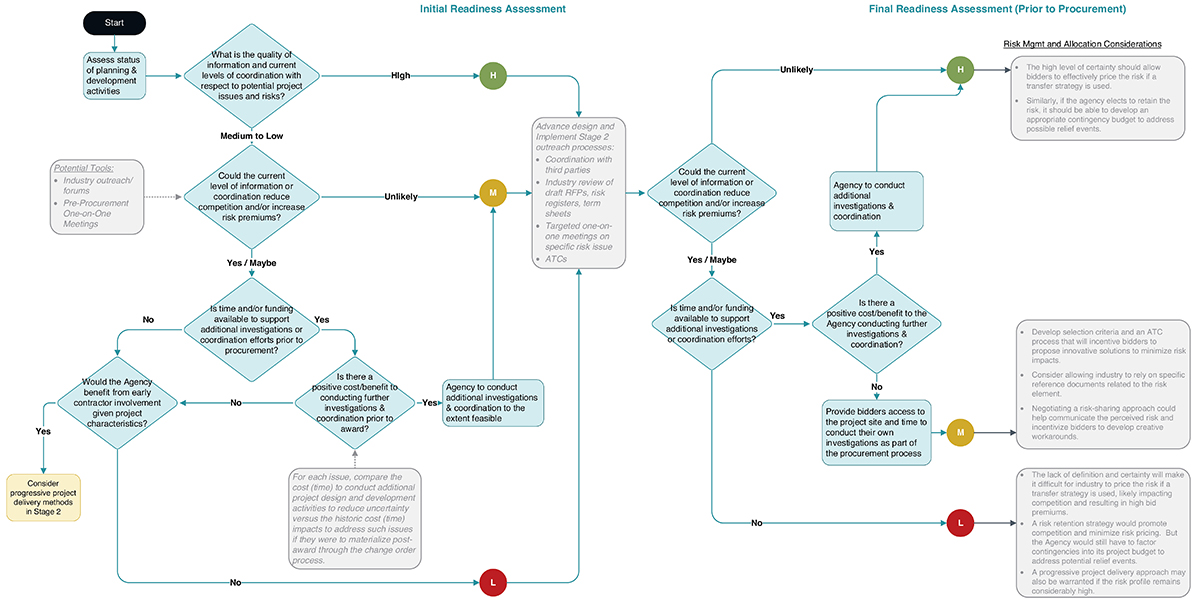
The Project Readiness Framework depicted in Figure 3.1 guides public agencies through this evaluation process. As the figure illustrates, agencies consider a number of factors in a logical sequence:
- The quality of information and current levels of coordination associated with potential project issues and risks;
- Whether the current levels of information and coordination could reduce project competition and/or increase risk premiums;
- Whether sufficient time and/or funding is available to support additional investigations or coordination efforts;
- Whether additional investigations or coordination efforts conducted prior to contract award would generate benefits worth their cost; and
- Whether the agency would benefit from early contractor involvement under a progressive delivery model, given a projectʼs characteristics.
These considerations lead the agency toward an assessment of low, medium, or high readiness:
- L — Low readiness generally signifies a low level of certainty about a given risk, as information quality and levels of coordination are considered insufficient.
- If an agency elects to transfer the risk, then it should expect that the lack of definition and certainty will prompt prospective bidders/proposers to either include a contingency in their pricing or decide to avoid/withdraw from the pursuit of a project; consequently, this could impact both pricing and competition for a project.
- If an agency elects to retain the risk, then the agency should establish an ownerʼs contingency budget sufficient for the likely exposure (e.g., ±25%) to address likely relief events due to unforeseen project conditions.
The impact on pricing and competition will largely depend on the risk allocation approach adopted by the agency with respect to each risk. Under the circumstance of low readiness, an agency might also consider whether the overall projectʼs risk profile warrants consideration of progressive delivery options.
- M — Medium readiness generally signifies a moderate level of certainty about a given risk, as information quality and levels of coordination are considered as being improved.
- If an agency elects to transfer a risk, then it can structure its procurement process and evaluation criteria to incentivize prospective bidders or proposers to consider methods to minimize risk impacts in their bids/proposals. It could also consider allowing bidders/ proposers to rely on specific reference information documents. Regardless, the agency should establish an ownerʼs contingency budget (e.g., ±15%) to address more likely relief events due to unforeseen project conditions.
Long Description.
The flow chart has two major sections: Initial readiness assessment and final readiness assessment (prior to procurement). The initial readiness assessment section begins with: Start, which leads to Assess status of planning and development activities, which leads to the following question box. Question 1. What is the quality of information and current levels of coordination with respect to potential project issues and risks? If High, H: Advance design and implement Stage 2 outreach processes, Coordination with third parties, Industry review of draft RFPs, risk registers, term sheets, Targeted one-on-one meetings on specific risk issues, and ATCs. If Medium to Low: Proceed to the next question box. Question 2. Could the current level of information or coordination reduce competition and/or increase risk premiums? Potential Tools relevant to this question: Industry outreach/forums and Pre-Procurement One-on-One Meetings. If Unlikely, M: Advance design and implement Stage 2 outreach processes (same as above). If Yes or Maybe: Proceed to the next question box. Question 3. Is time and or funding available to support additional investigations or coordination efforts prior to procurement? If Yes: Proceed to the next question box. Question 4. Is there a positive cost slash benefit in conducting further investigations and coordination prior to award? If No (for either questions 3 and 4): Proceed to the decision box (question 5). If Yes (question 4): Agency to conduct additional investigations and coordination to the extent feasible. A text box leading to question 4 reads as follows: For each issue, compare the cost (time) to conduct additional project design and development activities to reduce uncertainty versus the historic cost of time impacts to address such issues if they were to materialize post-award through the change order process. Question 5. Would the Agency benefit from early contractor involvement given project characteristics? If Yes: Consider progressive project delivery methods in Stage 2. If No, L: Advance design and implement Stage 2 outreach processes, Coordination with third parties; Industry review of draft RFPs, risk registers, term sheets; Targeted one-on-one meetings on specific risk issues; and ATCs.
Final Readiness Assessment (Prior to Procurement). Question 1: Could the current level of information or coordination reduce competition and slash or increase risk premiums? If Unlikely, H: Risk Management and Allocation Considerations. The high level of certainty should allow bidders to effectively price the risk if a transfer strategy is used. Similarly, if the agency elects to retain the risk, it should be able to develop an appropriate contingency budget to address possible relief events. If Yes or Maybe: Proceed to the next question. Question 2: Is time and slash or funding available to support additional investigations or coordination efforts? If Yes: Proceed to Question 3. If No, L: The lack of definition and certainty will make it difficult for the industry to price the risk if a transfer strategy is used, likely impacting competition and resulting in high bid premiums. A risk retention strategy would promote competition and minimize risk pricing. But the Agency would still have to factor contingencies into its project budget to address potential relief events. A progressive project delivery approach may also be warranted if the risk profile remains considerably high. Question 3: Is there a positive cost slash benefit to the Agency in conducting further investigations and coordination? If Yes: Agency to conduct additional investigations and coordination. If No: Provide bidders access to the project site and time to conduct their investigations as part of the procurement process, M, Develop selection criteria and an ATC process that will incentivize bidders to propose innovative solutions to minimize risk impacts. Consider allowing the industry to rely on specific reference documents related to the risk element. Negotiating a risk-sharing approach could help communicate the perceived risk and incentivize bidders to develop creative workarounds.
- If the agency decides to share the risk, it should consider strategies that could incentivize bidders/proposers to develop solutions that reduce risk exposure.
- H — High readiness generally signifies a high level of certainty about a given risk, as information quality and levels of coordination are considered satisfactory.
- If the agency elects to transfer the risk, then prospective bidders or proposers should be able to effectively price it.
- Alternatively, if the owner elects to retain the risk, then the agency should be able to determine a relatively accurate contingency budget (e.g., ±5%) to address possible relief events due to unforeseen (but unlikely) project conditions.
As project development activities continue to advance, there may be opportunities prior to procurement and contract award for the agency to enhance the level of information and/or coordination necessary to improve pricing and increase competition. However, if the quality of the reference information or level of coordination with respect to a given risk is still at low or medium levels at the start of procurement, the agency must decide what the optimal approach should be to allocating and managing that risk moving forward.
3.2.2 Example Framework Application (Utility Risk)
Readiness Considerations
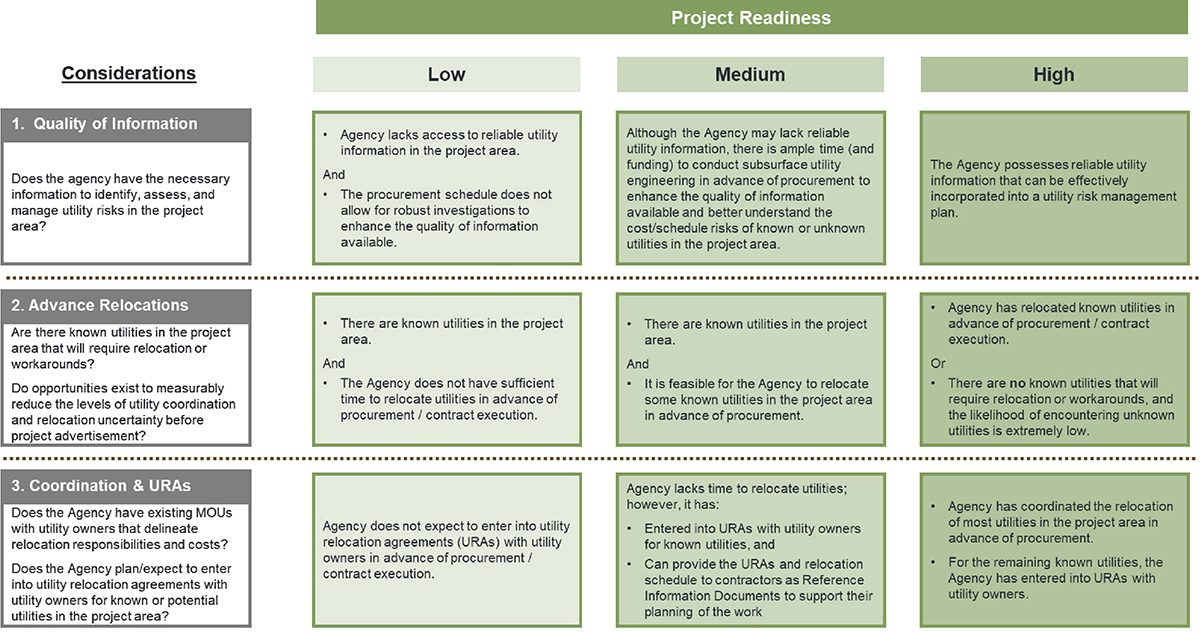
To provide an example of the application of this framework, Figure 3.2 first presents factors that one should consider when assessing the readiness of utility risk information. These factors include:
- The quality of information needed to manage utility relocations in the project area.
- The agencyʼs ability to manage or reduce known utility conflicts before project advertisement.
- The agencyʼs ability to enter into memoranda of understanding or relocation agreements with utilities in advance of or during project execution.
Aligning Readiness to Risk Allocation Strategies
Given the level of project readiness related to each of these risk considerations, the agency can then decide on the most cost-effective approach to risk allocation and management that will promote competition and/or reduce risk premiums. The following examples highlight the decisions regarding risk allocation strategies that follow from different readiness considerations:
- If the quality and reliability of information regarding utilities affecting the project is low or medium, the agency must determine whether it is feasible and/or beneficial to conduct additional investigations prior to the procurement stage to improve the quality of information, or whether it can enter into agreements with utility owners that allow for a relocation schedule for the utilities.
- If project readiness is low and cannot be improved, then the agency would likely retain the utility risk to enhance competition and reduce excessive risk premiums.
- However, if the quality and/or coordination of utility information can be sufficiently improved through additional investigation or utility relocation agreements, the agency may decide that a more cost-effective solution would be to transfer or share the utility risks with the proposers, particularly if proposers have prior experience or existing relationships with the affected utilities.
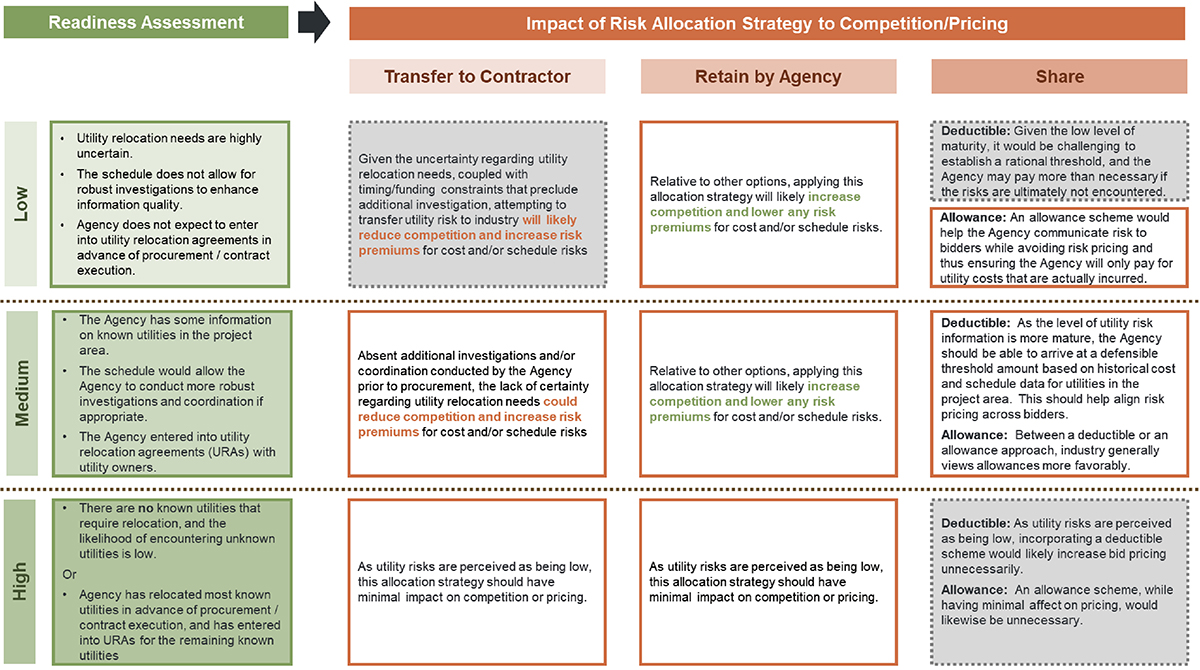
Figure 3.3 illustrates the impact of different allocation strategies on cost and competition given differing levels of readiness. As shown, for certain readiness levels, some risk allocation strategies (shown as gray text boxes with dashed borders) are eliminated from further consideration based on the likelihood of less favorable competition, excessive risk premiums, or unnecessary additional costs.
Long Description.
The chart shows considerations in the first column and project readiness as low, medium, and high in the next three columns. The details are as follows:
1. Quality of Information. Does the agency have the necessary information to identify, assess, and manage utility risks in the project area? Low Project Readiness: Agency lacks access to reliable utility information in the project area. And: The procurement schedule does not allow for robust investigations to enhance the quality of information available. Medium Project Readiness: Although the Agency may lack reliable utility information, there is ample time (and funding) to conduct subsurface utility engineering in advance of procurement to enhance the quality of information available and better understand the cost slash schedule risks of known or unknown utilities in the project area. High Project Readiness: The Agency possesses reliable utility information that can be effectively incorporated into a utility risk management plan.
2. Advance Relocations. Are there known utilities in the project area that will require relocation or workarounds? Do opportunities exist to measurably reduce the levels of utility coordination and relocation uncertainty before project advertisement? Low Project Readiness: There are known utilities in the project area. And: The Agency does not have sufficient time to relocate utilities in advance of procurement slash contract execution. Medium Project Readiness: There are known utilities in the project area. And: It is feasible for the Agency to relocate some known utilities in the project area in advance of procurement. High Project Readiness: The agency has relocated known utilities in advance of procurement slash contract execution. Or: There are no known utilities that will require relocation or workarounds, and the likelihood of encountering unknown utilities is extremely low.
3. Coordination and URAs. Does the Agency have existing MOUs with utility owners that delineate relocation responsibilities and costs? Does the Agency plan slash expect to enter into utility relocation agreements with utility owners for known or potential utilities in the project area? Low Project Readiness: The agency does not expect to enter into utility relocation agreements (URAs) with utility owners in advance of procurement slash contract execution. Medium Project Readiness: Agency lacks time to relocate utilities; however, it has entered into URAs with utility owners for known utilities, and it can provide the URAs and relocation schedule to contractors as Reference Information Documents to support their planning of the work. High Project Readiness: The agency has coordinated the relocation of most utilities in the project area in advance of procurement. For the remaining known utilities, the Agency has entered into URAs with utility owners.
Long Description.
The chart shows readiness assessment in three categories: Low, medium, and high and the impact of risk allocation strategy to competition or pricing in three categories as transfer of contractor, retain by agency, and share. The details are as follows:
1, Low. Utility relocation needs are highly uncertain. The schedule does not allow for robust investigations to enhance information quality. Agency does not expect to enter into utility relocation agreements in advance of procurement slash contract execution. Transfer to contractor. Given the uncertainty regarding utility relocation needs, coupled with timing slash funding constraints that preclude additional investigation, attempting to transfer utility risk to the industry will likely reduce competition and increase risk premiums for cost and slash or schedule risks. Retain by agency. Relative to other options, applying this allocation strategy will likely increase competition and lower any risk premiums for cost and slash or schedule risks. Share. Deductible: Given the low level of maturity, it would be challenging to establish a rational threshold, and the Agency may pay more than necessary if the risks are ultimately not encountered. Allowance: An allowance scheme would help the Agency communicate risk to bidders while avoiding risk pricing and thus ensuring the Agency will only pay for utility costs that are actually incurred.
2, Medium. The Agency has some information on known utilities in the project area. The schedule would allow the Agency to conduct more robust investigations and coordination if appropriate. The Agency entered into utility relocation agreements (URAs) with utility owners. Transfer to contractor. Absent additional investigations and slash or coordination conducted by the Agency prior to procurement, the lack of certainty regarding utility relocation needs could reduce competition and increase risk premiums for cost and slash or schedule risks. Retain by agency. Relative to other options, applying this allocation strategy will likely increase competition and lower any risk premiums for cost and slash or schedule risks. Share. Deductible: As the level of utility risk information is more mature, the Agency should be able to arrive at a defensible threshold amount based on historical cost and schedule data for utilities in the project area. This should help align risk pricing across bidders. Allowance: Between a deductible or an allowance approach, industry generally views allowances more favorably.
3, High. There are no known utilities that require relocation, and the likelihood of encountering unknown utilities is low. Or: Agency has relocated most known utilities in advance of procurement slash contract execution and has entered into URAs for the remaining known utilities. Transfer to contractor. As utility risks are perceived as being low, this allocation strategy should have minimal impact on competition or pricing. Regain by agency. As utility risks are perceived as being low, this allocation strategy should have minimal impact on competition or pricing. Share. Deductible: As utility risks are perceived as being low, incorporating a deductible scheme would likely increase bid pricing unnecessarily. Allowance: An allowance scheme, while having minimal effect on pricing, would likewise be unnecessary.
To choose among the remaining allocation options shown in Figure 3.3, additional implementation considerations are discussed in the remainder of this chapter.
Low Readiness
With reference to Figure 3.3, at a low level of project readiness, either a retention or sharing strategy could be appropriate:
- An agency risk retention strategy with relief for utility delays or conflicts will likely result in improved competition and reduced risk premiums. However, the agency should still include an appropriate contingency in the project budget to cover potential change orders associated with relief events. In addition, the agency could apply selection and award criteria during procurement that incentivize bidders to propose ATCs or workarounds that minimize relocation impacts.
- Alternatively, a risk-sharing allowance scheme could be used to help the agency communicate risk to bidders, only pay for costs that are actually incurred, and potentially incentivize bidders to share in any savings by mitigating utility conflicts through design solutions or enhanced utility coordination. To establish an appropriate allowance amount, the agency should consider its historical cost and schedule data for known utilities in the project area. Between a deductible and an allowance approach, the industry generally views allowances more favorably.
If utility risks at the time of procurement remain so uncertain that the contingency is difficult to price and even a risk retention strategy may still result in high risk premiums and reduced competition, the agency should consider using a progressive project delivery model to allow for a more extended and collaborative preconstruction period to coordinate with utilities and mitigate utility risks.
Medium Readiness
At a “medium” readiness level, it is likely that the agency will have some information on known utilities in the project area. However, the procurement schedule may not allow the agency to conduct more robust investigations and coordination before or during procurement. In such cases, the agency must decide whether it is more cost-effective to retain, transfer, or share the risk, particularly if the level of readiness is higher, can be improved through additional investigation, and/or the contractor can be incentivized to minimize utility risks. Considerations for each strategy, include the following:
- A risk retention strategy with relief for utility-related risks should result in increased competition and reduced risk pricing; however, the agency should include an appropriate contingency in the project budget to cover potential change orders associated with relief events and monitor the drawdown of contingency relative to the remaining risk on the project. The contingency amount may be difficult to determine, and industry may still include some level of risk pricing to cover management of utility-related changes.
- If considering a risk transfer strategy, the agency should evaluate the cost/benefit of performing additional studies and/or coordination activities prior to contract award. This can be determined by comparing the cost (time) to conduct additional investigations and coordination versus the historic cost (time) impacts to address (via change orders) utility issues discovered post-award. Other considerations include developing selection and award criteria that would incentivize bidders to propose workarounds that minimize relocation impacts.
- Discussions with industry in one-on-one meetings before or during procurement may also lead to the conclusion that industry is in the best position to manage certain utility risks, and contractors will take responsibility for utility risks to gain a competitive advantage. In this case, a risk transfer or risk-sharing strategy would be the preferred option. If using a risk-sharing strategy (deductible or an allowance approach), industry generally views allowances more
- favorably. The allowance approach would help the agency communicate risk to bidders while avoiding risk pricing and thus ensuring the agency will only pay for utility costs that are actually incurred.
High Readiness
With reference to Figure 3.3, when the level of project readiness is high (i.e., there are no known utilities that require relocation, and the likelihood of encountering unknown utilities is low, or the agency has relocated most known utilities in advance of procurement/contract execution and has entered into utility relocation agreements for the remaining known utilities) using a risk transfer or risk retention strategy should have minimal impact on competition or pricing. (However, risk-sharing strategies would likely be unnecessary and could potentially result in unnecessary increases in bid pricing or expenditures.)
A high level of readiness is generally consistent with best-practice recommendations to:
- Perform utility investigations as early as possible during project development to identify Utility Owners and facilities that may be impacted by the project.
- Conduct initial meetings with Utility Owners to determine:
- Timing of when the utility owner will perform relocation work, and
- If the utility owner intends for the design-builder to perform utility relocations.
- Execute utility agreements that define the scope of the anticipated relocations, relocation responsibilities (design and construction), and the schedule for relocations before the completion of the procurement process, and communicate progress to proposers.
- Include in the RFP all known information regarding utilities.
To transfer any residual utility risk under these circumstances, the agency should again consider implementing selection and award criteria during procurement that incentivize proposers to develop workarounds that minimize known relocation impacts.


