Alternative Project Delivery Methods: Assessing and Allocating Risk to Increase Competition (2025)
Chapter: Appendix B: Additional Tools for Progressive APD Methods

APPENDIX B
Additional Tools for Progressive APD Methods
Progressive delivery methods, such as CM/GC and PDB, allow the DOT and its industry partners to collaboratively develop the projectʼs scope, evaluate and allocate risks, and adjust the ownerʼs technical scope of work to fit the projectʼs available funding and schedule.
In carrying out these collaborative responsibilities, owners and industry often apply the tools described in this appendix, in addition to those previously addressed in Appendix A.
1. Independent Cost Estimator

Long Description.
The checklist lists the following in two rows:
Row 1: Relevant Project Stage(s).
Initiation
Planning and Development
Procurement
Preconstruction
Construction
Row 2: Relevant Delivery Methods
Design-Build (Fixed Price)
Public-Private Partnership
Progressive Design-Build
Construction Manager slash General Contractor
The options Preconstruction, Progressive Design-Build, and Construction Manager slash General Contractor are checked.
Overview
An independent cost estimator (ICE) is a consultant retained by the owner to provide an opinion on the reasonableness of a contractorʼs proposed guaranteed maximum price (GMP). It is often critical to the DOTʼs open-book decision-making process. Seventy-six percent of DOTs require an ICE in CM/GC and PDB projects, confirming the perceived value added by the ICE open-book process (Gransberg et al. 2024). The ICE is usually an ex-construction contractor charged with preparing a “contractor-style estimate” using a production-based approach. To develop a production-based estimate, “the estimator should have construction experience in order to be able to visualize a line item in terms of the operations needed to construct the work” (Anderson et al. 2007).
Typically, the “engineerʼs estimates” produced by the owner and/or its designer are based on historic cost data gleaned from bid tabulations (Alleman and Tran 2020). In contrast, an ICE replicates the bottom-up, production-based estimating approach used by contractors, which incorporates real-time (as opposed to historic) data.
The ICE should have experience performing contractor-style or production-based estimating to assist the owner in reconciling cost estimates with the contractor. The ICE will be involved in most of the preconstruction services (e.g., partnering, design reviews, innovation, and risk workshops) so that they may have a good understanding of the project to be able to develop informed cost and schedule estimates.
Related tools include the opinion of probable construction cost (OPCC) and open-book negotiations, GMP, cost model, and contractual off-ramps.
Objective
Given the lack of competitive tension associated with the construction phase pricing offered by a CM/GC or PDB contractor, retaining an ICE can help the owner validate cost reasonableness. ICE services are especially critical if the ownerʼs team is relatively inexperienced with developing and/or evaluating contractor-style production estimates.
The ICE can also help identify any errors in the DOT budgets, which are typically established at the early stages of project development before the final scope of work is known, by providing a second validation of quantities of work in terms of current construction prices.
Application
Retaining ICE Services
Qualifications
The RFQ for the ICE customarily specifies that the ICE be an experienced construction contractor with past construction field experience on similar projects. To validate the current
OPCC, it is important that the ICEʼs scope of work include preparing estimates in the same manner as the construction contractor (Alleman et al. 2017, Gransberg et al. 2024).
Colorado DOT, in a 2023 RFP for Statewide ICE Services, required interested firms to address the following qualifications in their proposals:
2.2.3 QUALIFICATIONS & ABILITY TO PROVIDE SERVICES:
Proposal should list and describe all relevant work experience qualifications, and references related to the proposed scope of work, including but not limited to:
- Working knowledge of risk management strategies, including risk identification assessment, and cost quantification and assignment of the probability of occurrence.
- Working knowledge in multiple production-based, heavy civil estimation software platforms as well as proficiency in at least one (1) production-based, heavy civil estimation software platform.
- Negotiation and conflict management experience, including the ability to confer with others to reach an agreement on terms, conditions, and costs.
- General understanding of CMAR delivery method.
- Working knowledge related to aspects of construction, including work package breakdown (project phasing), labor planning, construction site access, site layout, sequence of design and construction, rigging plan, availability and procurement of equipment and materials, prefabrication, pre-assembly, modularization, quality management, materials management, site facilities, safety, operability, and maintainability.
- The consultant personnel performing cost estimating:
Have ten (10) years of relevant estimating experience in all trades of heavy civil, transportation, and building construction, along with a thorough knowledge of construction means, methods, and equipment.
Relevant experience through participation on at least five (5) projects in development of project plans, specifications, and/or construction estimates.
Have been an active participant on at least two construction or CMGC projects of varying size, scope, and construction complexity within the last five (5) years in formal partnering efforts as a contractor or ownerʼs representative on heavy civil, transportation, and/or building construction projects. - The consultant personnel performing as a Scheduler are expected to:
Have eight (8) years of relevant scheduling experience in all trades of heavy civil, transportation, and building construction, along with a thorough knowledge of construction means, methods, and equipment.
Have advanced computer skills and proficiency with document control and scheduling software, including expertise with Primavera P6 or greater, Microsoft Project, Microsoft Excel 2010, running under Windows XP professional or newer platform, etc.
Proficiency in critical path scheduling and analysis on at least three (3) construction projects within the last five (5) years. - The consultant personnel performing as a Constructability Reviewer are expected to have:
Have ten (10) years of relevant review experience in all trades of heavy civil, transportation, and building construction, along with a thorough knowledge of construction means, methods, and equipment.
Demonstrate relevant experience through participation on at least two (2) projects in development of project plans, specifications, and/or construction estimates. - Provide a professional resumeʼ for the key personnel to be assigned to the project. Resumes should include all work relevant to and related to Independent Cost Estimating and Construction Scheduling Services. One page resumes of key staff must be included in the appendix.
- List at least one relevant reference as an appendix, for which you have provided similar services during the last five (5) years. The references should support and demonstrate that your firm is capable of working with a state government organizations with complex and politically sensitive topics. Include the name of the organization, contact person, phone number, e-mail address, contract number and a brief description of the services provided for each reference.
- Please provide the insurance providerʼs form detailing the amount of your firmʼs malpractice insurance coverage as an appendix. The Contractor named in this State Contract promises and agrees to maintain in full force and effect a Professional Liability Insurance Policy in the minimum amount of $1,000,000.00 (One Million Dollars and no cents) that provides coverage for work undertaken pursuant to this Contract, however nothing in this requirement shall limit any greater obligation imposed upon proposer by law for professional liability insurance.
General Scope of Work
The ICE must have the same technical and progress information to prepare the same type of estimate as the contractor. The ICE is often involved in developing the cost model with the owner and the contractor. To validate the contractorʼs estimate, the ICE should price the same means and methods used by the contractor and not compete with the contractor by estimating different, cheaper approaches. The DOT is buying the ICEʼs services to furnish a second opinion of the cost of the contractorʼs project approach. Thus, the two estimates must be highly correlated when it comes to quantities of work, equipment types and numbers, crew sizes, and sustained production rates. The analysis and quantification of risk is the key point where the two will differ (Anderson et al. 2006, Alder 2007, Park 2011, Rowley 2011, Jeong et al. 2021). The engineerʼs estimate will portray the DOTʼs perception of the project risk profile, which might differ from the contractorʼs and ICEʼs perceptions. DOTs often underestimate the cost impact of risk because they believe they can shed most risk contractually (Lopez del Puerto et al. 2016).
By way of example, Utah DOT, in an RFP for Independent Cost Estimating Services to support its FrontRunner 2.0 fixed guideway transit projects, described the scope of work as follows:
The project will be delivered by progressive design-build. The ICE consultant will play a key role on the project team. The selected consultant would be expected to participate in person as requested by the Project Manager, including during the cost reconciliation process. The consultant is expected to utilize FTA Standard Cost Category (SCC) codes for cost development. The ICE consultant will need to have expertise in production-based contractor-style estimates. The ICE consultant will need to have expertise in estimating multiple forms of work including; earthwork, rail construction, structures, drainage systems, station modifications, new station construction, train control signal systems, and roadwork.
Additionally, the ICE consultant will need to have expertise in transit CMGC and Progressive Design-Build delivery methods and processes. In coordination with the project team, the ICE consultant will produce multiple independent cost estimates to verify contractor pricing and establish budgets. Cost estimates must consider specific work windows and limitations of working near an active railroad. The ICE consultant will need to produce cost estimates on time and ensure cost assumptions are clear, reasonable, and transparent. This solicitation will have two phases. Phase I will include all Preconstruction services. Phase II will include Final Design and Construction services.
The ICE Consultant will develop estimates at regular intervals to monitor, assess, and evaluate the project budget. The estimates may be used to optimize the project.
. . . .
Phase I - Pre-Construction
Initial project estimating and schedule development
Development of independent cost estimates at key milestones
Quantity and cost reconciliation
Develop a basis of cost estimating methodology
Assist the project team in identifying pricing and managing risks
Other tasks as needed for the successful delivery of the FrontRunner 2.0 project
Phase II - Construction
Evaluate change order(s)
Support cost and schedule estimating for the successful delivery of the FrontRunner 2.0 project.
Timing
The timing for retaining the ICE becomes important to ensuring that it has the benefit of the rationale behind decisions made during design and preconstruction. Some agencies award the ICE consultant contract prior to engaging the CM/GC services; others wait until after they have hired the CM/GC (Schierholz and Gransberg 2013). In a report for NCHRP Project 10-85, Gransberg et al. (2013) recommend that the ICE be engaged “no later than the award of
the CMGC contract.” Alleman et al. (2017) found “that the majority of projects brought the ICE on early, either at the same time or before the CM/GC contractor. Most projects brought the ICE on early in the scope development process, with more than half beginning before 30% [design] completion.” The ICE consultants interviewed by Schierholtz and Gransberg (2013) for case studies “offered the same piece of advice: hire the ICE consultant early in the process to gain the most benefit.” Doing so allows the ICE to have as much time as the CM/GC to produce its estimates, as well as to participate in the preconstruction process as prescribed by the agency.
Spectrum of ICE Processes
Whether an ICE should be required as a component of the DOT open-book policy is a matter of the specific DOTʼs perception of the value for money received from the additional cost of the ICEʼs fee. Schierholz and Gransberg (2013) found that ICE fees ranged from 0.15% to 2.5% of estimated construction cost based on the amount of additional preconstruction services that were assigned to the ICE. Alleman et al. (2017) found an average ICE fee of 0.88%.
A 2010 study by Gransberg and Shane (2010) found that five DOTs had used CM/GC (Alaska, Arizona, Florida, Oregon, and Utah). UDOT was the most experienced and the only DOT to include an ICE. In 2013, the number of DOTs with CM/GC experience had increased to 17, and 10 of them required an ICE (Gransberg and Shane 2013); a recent review (Gransberg et al. 2023) found that 26 DOTs can use CM/GC, of which 19 engage an ICE. Hence, the percentage of the DOTs that implemented CM/GC with ICE has gone from 20% to 59% to 73% between 2010 and 2022. Therefore, the state DOTs that were evaluated found that investing in the ICE added value to the CM/GC project.
According to the Washington State DOT (2023), the purpose of the ICE is “to independently estimate design and construction costs at various design milestones to validate the [Progressive] Design-Builderʼs cost estimates and risk contingencies during the course of the agreement” while the Arkansas DOT (ArDOT 2023) says “the purpose of the ICE is to provide another perspective to the CMGC Contractorʼs estimate that helps ensure a fair and reasonable price for construction.” The difference between “validating” and “providing another perspective” is subtle. “Validating” requires the ICE to prepare its estimate based on the CM/GC-PDB contractorʼs means, methods, and sequence of work (Gransberg et al. 2022). However, the ArDOT approach does not include this constraint. ArDOT gives the ICE the responsibility to lead the “Initial Approach to Cost” meeting. Thus, the two DOTs define a range in which an ICE can be utilized, with one end of the spectrum entailing the ICE conducting a strict validation of each OPCC, and the other end entailing a collaborative process by which the ICE is actively involved in the estimating process itself.
NCHRP Synthesis 653 (Gransberg and Pala 2025) received survey responses from 25 of 42 state DOTs regarding the involvement and tasks required from an ICE in CM/GC and PDB projects. The synthesis found that 23 of 25 respondents required an ICE in their CM/GC and PDB projects. It also found a wide range of roles, responsibilities, and tasks assigned to the ICE. The survey asked how the ICE is contractually procured. Fifty percent of responding DOTs prepare a separate ICE procurement for each individual project. Thirty-three percent have an on-call ICE to provide services as required. Ten percent include ICE services in either a general engineering consultant or program management consultant contract, and two DOTs depend on internal staff to perform the ICE estimate.
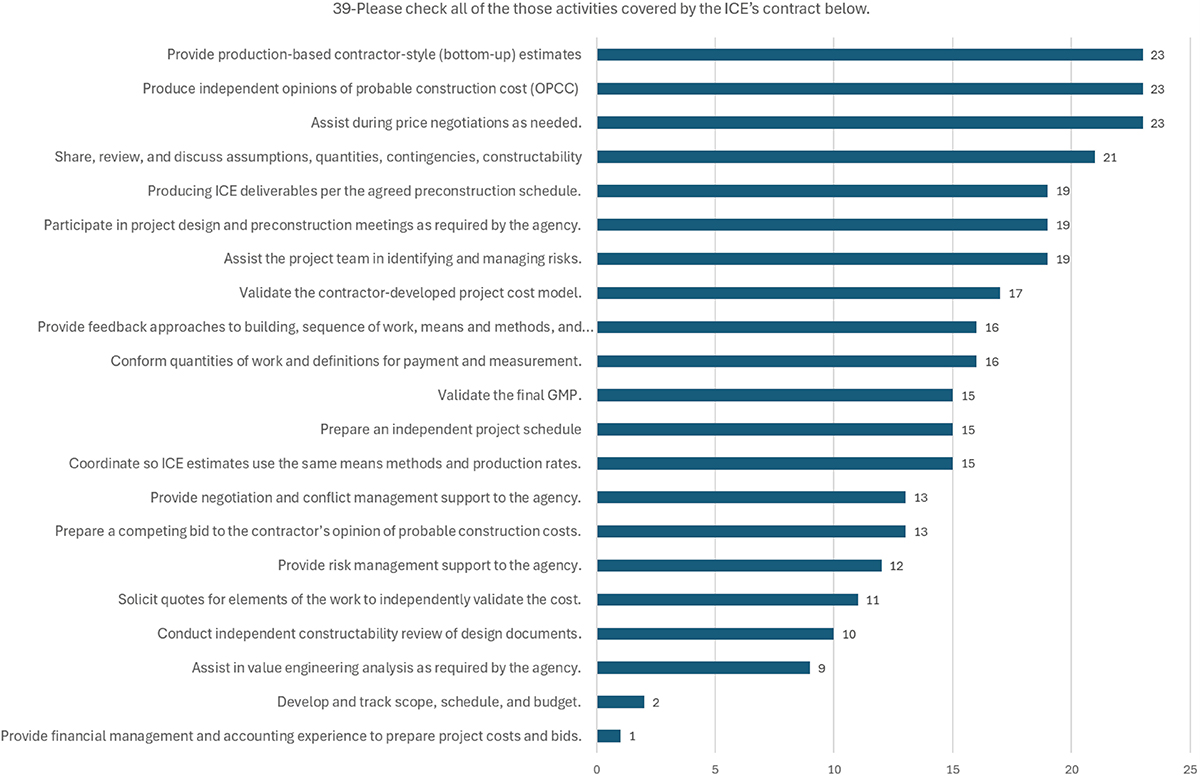
Figure B.1 is drawn from NCHRP Synthesis 653 and identifies the types of services covered by ICE contracts. It shows that all 23 respondents include classic estimating services, and
Source: Gransberg and Pala (2025).
Long Description.
The graph is titled, 39-Please check all the activities covered by the ICEʼs contract below. The horizontal axis ranges from 0 to 25 in increments of 5. The vertical axis lists various categories. The data is as follows: Provide production-based contractor-style (bottom-up) estimates, 23. Produce independent opinions of probable construction cost (OPCC), 23. Assist during price negotiations as needed, 23. Share, review, and discuss assumptions, quantities, contingencies, and constructability, 21. Producing ICE deliverables per the agreed preconstruction schedule, 19. Participate in project design and preconstruction meetings as required by the agency, 19. Assist the project team in identifying and managing risks, 19. Validate the contractor-developed project cost model, 17. Provide feedback approaches to building, sequence of work, means and methods, and overall construction schedules, 16. Conform quantities of work and definitions for payment and measurement, 16. Validate the final GMP, 15. Prepare an independent project schedule, 15. Coordinate so ICE estimates use the same means methods and production rates, 15. Provide negotiation and conflict management support to the agency, 13. Prepare a competing bid to the contractorʼs opinion of probable construction costs, 13. Provide risk management support to the agency, 12. Solicit quotes for elements of the work to independently validate the cost, 11. Conduct independent constructability review of design documents, 10. Assist in value engineering analysis as required by the agency, 9. Develop and track scope, schedule, and budget, 2. Provide financial management and accounting experience to prepare project costs and bids, 1.
the majority include “Share, review, and discuss assumptions, quantities, contingencies, and constructability.” It is interesting to note that 17 DOTs ask the ICE to validate the project cost model, and 15 also ask that the ICE validate the GMP. Hence, the majority of the survey respondents are asking the ICE to validate the contractorʼs pricing rather than prepare a competing bid.
ICE Procurement Checklist
An analysis and synthesis of effective practices showed that there are several key decisions that an agency must make with regard to its procedures for negotiating, validating, and establishing the construction contract price. These include the following:
- Whether to engage an ICE.
- Available pool of possible qualified competitors to provide ICE services.
- Define “contractor experience,” “contractor-style estimate,” and other important terms.
- What is the ICEʼs purpose? Validate OPCCs, contribute to design process, independent schedules, independent constructability review?
- Determine at what points in the design process the contractor and engineer will produce interim estimates (OPCC), and when the final price will be established commensurate to construction contract award.
- If an ICE is used to determine how its input will be used to compare with the contractorʼs and engineerʼs estimates.
- Whether the intermediate OPCCs and final construction cost input will be made available to the ICE, the contractor, and the engineer.
- When there is a difference between the three estimates, how the agency will resolve the discrepancies.
- Whether the agency will set a fixed percentage deviation of the contractorʼs estimate from either the ICEʼs or the engineerʼs estimate that will represent a reasonable conformance to be used for awarding the construction contract.
- Whether an oral presentation is required/desired.
- How the evaluation will be conducted.
- Whether the ICE will be procured as an on-call consultant for multiple projects or for a specific project only.
- Define a “similar project” for qualifications and past performance assessment.
References
AASHTO. (2008). Guide for Consultant Contracting. Washington, DC.
Alder, R. (2007). UDOT Construction Manager General Contract (CMGC) Annual Report. UDOT, Salt Lake City.
Alleman, D. and Tran, D. 2020. “Challenges of Implementing Progressive Design-Build in Highway Construction Projects,” Journal of Legal Affairs and Dispute Resolution in Engineering and Construction, 12(1): 04519036.
Alleman, D., Duval, R. B., and Molenaar, K. R. (2017). “Roles and Responsibilities of Independent Cost Estimator in Construction Manager–General Contractor Highway Construction.” Transportation Research Record: Journal of the Transportation Research Board, No. 2630, pp. 15–22. https://doi.org/10.3141/2630-03.
Anderson, S., Molenaar, K., and Schexnayder, C. (2007). NCHRP Report 574: Guidance for Cost Estimation and Management for Highway Projects During Planning, Programming, and Preconstruction. Transportation Research Board of the National Academies, Washington, DC. https://doi.org/10.17226/14014. [Accessed November, 21 2024].
Arizona Department of Transportation: Intermodal Transportation Division. (2010). Construction Manager at Risk (CMAR) Guide. ADOT Construction Group, Phoenix.
Arkansas DOT (ArDOT). (2023). CM-GC Guidelines and Procedures.
Bagwell, T. and Henley, M. (2020). “The Value of Transparency: What Open Books Contracting Is and Why It Matters,” Hourigan Group Blog, https://www.hourigan.group/blog/value-of-transparency-open-book-contracting. Accessed April 29, 2023.
Barutha, P., Jeong, H. D., Gransberg, D. D., and Touran, A. (2021). “Impact of Collaboration and Integration on Performance of Industrial Projects,” Journal of Management in Engineering. 37(4). https://doi.org/10.1061/(ASCE)ME.1943-5479.0000921.
Clark, L. (2015). “How Does CMAR Differ from Design-Build?” Water Design-Build Council, 825 WDBC Blog.
Clark, L. (2016). “Principles of Open-Book Pricing,” Water Design-Build Council, WDBC Blog.
Gransberg, D. D. and Pala, M. (2025). NCHRP Synthesis 653: Open-Book Pricing Practices for Construction Manager/General Contractor and Progressive Design-Build Projects. Transportation Research Board, Washington, DC. https://doi.org/10.17226/29084.
Gransberg D. D., Pinto-Nunez, M., and Gransberg, N. J. (2024). Best Practices for Employing the Independent Cost Estimate on Construction Manager/General Contractor Transportation Projects, 2024 Transactions, AACE, International, Atlanta, GA.
Gransberg, D. D., Loulakis, M. C., and Gad, G. M. (2022). The Engineerʼs Project Delivery Method Primer: Uniform Definitions and Case Studies. ASCE Press, Reston, VA, pp. 28–42.
Gransberg, D. D., and Shane, J. S. (2013). “Defining Best-Value for Construction Manager/General Contractor Projects: The CMGC Learning Curve.” Journal of Management in Engineering, ASCE. https://doi.org/10.1061/(ASCE)ME.1943-5479.0000275.
Gransberg, D., Shane, J., Anderson, S., Lopez del Puerto, C., Strong, K., and McMinimee, J. (2013). “NCHRP Project 10-85: A Guidebook for Construction Manager-at-Risk Contracting for Highway Projects: Interim Report.” Iowa State University.
Gransberg, D. D., and Shane, J. S. (2010). NCHRP Synthesis 402: Construction Manager-at-Risk Project Delivery for Highway Programs. Transportation Research Board of the National Academies, Washington, DC.
Gransberg D. D., Pittenger, D. M., and Gransberg, N. J. (2023). “Progressive Design-Build in Highway Project Delivery: Promises and Pitfalls,” Presented at the 102nd Meeting of the Transportation Research Board, Washington, DC.
Hill, G. and Hill, K. (2007). “Implied Covenant of Good Faith and Fair Dealing.” The Peopleʼs Law Dictionary. Fine Communications. http://dictionary.law.com/Default.aspx?selected=906 [Accessed August 30, 2023].
Jeong, H. D., Choi, K. C., Ko, T., Gransberg, D. D., and Le, C. (2021). NCHRP Research Report 1025: Contingency Factors to Account for Risk in Early Construction Cost Estimates for Transportation Infrastructure Projects. Transportation Research Board, Washington, DC. https://doi.org/10.17226/26829.
Lopez del Puerto, C., Gransberg, D., and M. Loulakis. (2016). “Contractual Approaches to Address Geotechnical Uncertainty in Design-Build Public Transportation Projects,” Journal of Legal Affairs and Dispute Resolution in Engineering and Construction 9, (1).
MacMahon, P. (2014). “Good Faith and Fair Dealing as an Underenforced Legal Norm,” Minnesota Law Review Vol. 99, (251).
MDT. (2021). Independent Construction Planning Support Services Scope of Services, Helena, MT.
Park, R. (2011). CM/GC Benefits and Challenges. Presentation, FHWA CM/GC Peer Review, Salt Lake City, Utah.
Pinto-Nunez, M., Lopez del Puerto, C., and Gransberg, D. D. (2018). “Analysis of transportation agenciesʼ claim history: partnered versus non-partnered,” Journal of Legal Affairs and Dispute Resolution in Engineering and Construction, 10 (4), https://doi.org/10.1061/(ASCE)LA.1943-4170.0000273.
Public Law No: 117-58 Infrastructure Investment and Jobs Act. 2021.
Rowley, C. (2011). CM/GC Contractorʼs Perspective, Presentation, FHWA CM/GC Peer Review, Salt Lake City, Utah.
Schierholz, J., and D. D. Gransberg. (2013). “Critical Analysis of the Value Added by the Independent Cost Estimate to the Construction Manager/General Contractor Project Delivery Method,” Compendium, Paper #13-0613, 92nd Annual Meeting of the Transportation Research Board, Washington, DC.
Steele, M. D. and Shannon, P. A. (2005). “Detecting Hidden Fees in GMP,” AACE International Transactions, PM.07, pp. 71–74.
Tennessee DOT (TDOT). (2016). Request for Proposals, CM/GC Services, I-240 Overhead Bridges, Project No. 79006-1194-44, Shelby County, TN.
Washington State DOT (WSDOT). (2023). Request for Qualifications, Independent Cost Estimate (ICE) Services for Olympic Regionʼs Progressive Design Build Program. WSDOT, Olympia, WA.
West, N. J. N., Gransberg, D. D., and McMinimee, J. (2012). “Effective Tools for Projects Delivered Using the Construction Manager/General Contractor Method,” Transportation Research Record: Journal of the Transportation Research Board, No. 2268, pp 33–39. https://doi.org/10.3141/2268-05.
West, N. and Schierholz, J. (2011). Summary of Presentations CM/GC Peer Review, Salt Lake City, Utah.
2. OPCC and Open-Book Negotiations

Long Description.
The checklist lists the following in two rows:
Row 1: Relevant Project Stage(s).
Initiation
Planning and Development
Procurement
Preconstruction
Construction
Row 2: Relevant Delivery Methods
Design-Build (Fixed Price)
Public-Private Partnership
Progressive Design-Build
Construction Manager slash General Contractor
The options Preconstruction, Progressive Design-Build, and Construction Manager slash General Contractor are checked.
Overview
During the preconstruction phase of a CM/GC and PDB project, the parties will monitor the development of the expected construction cost. This typically entails an iterative process by which the ICE will validate the contractorʼs construction price, typically at key design milestones. The owner will compare the contractorʼs OPCC for the work with that of the ICE.
Related tools include the ICE, GMP, cost model, risk pools, and contractual off-ramps.
Objective
Monitoring and validating the contractorʼs OPCC as the design progresses provides the owner with an early indication of the likely project cost and whether the design is proceeding within the ownerʼs budget expectations.
Application
OPCC Comparison Methods
Given the variation found across the nation, attempting to categorize DOT open-book negotiating methods is difficult. However, the rules for sharing of the various estimates prepared by the contractor, the engineer, and the ICE at each pricing milestone allows one to differentiate between DOT programs and categorize trends. Each DOT has its own rules for which members of the project team will be allowed to see the estimates prepared by the other entities. NCHRP Synthesis 653 (Gransberg and Pala 2025) identified three distinct methods for employing an ICE and described the associated rules governing which members of the project team are given access to each otherʼs estimates.
- Open, side-by-side comparison of the engineerʼs estimate, the contractorʼs estimate, and the ICE during negotiations. All parties are made aware of the details of all three estimates.
- Closed, side-by-side comparison of the engineerʼs estimate, the contractorʼs estimate, and the ICE during negotiations. The DOT is the only entity that has access to the details of all three estimates.
- Blind bidding. The contractorʼs and ICEʼs estimates are submitted in a manner that does not identify the source, and the DOT then compares the two “bids” to the engineerʼs estimate. The DOT is the only entity that has access to the details, which can be disclosed to the other parties at the discretion of the DOT.
Of these three listed methods, blind bidding was the least used. Proponents of blind bidding maintain that the process removes the perception that the DOT is likely to trust the ICEʼs OPCC over the contractorʼs OPCC. The two bids are compared line by line with the engineerʼs estimate. Major deviations usually indicate a difference in the quantities of work or the pricing of perceived risk. These issues are resolved by comparing and conforming the quantities of work and checking
that the same means and methods were used in both estimates. The major benefit of a blind bid comparison is to facilitate an apples-to-apples comparison of two “contractor-style” OPCCs against the ownerʼs original engineerʼs estimate. The third opinion is missing if the engineerʼs estimate, which is based on historic unit prices, is used as the only measure of the reasonability of the contractorʼs estimate.
The closed side-by-side comparison differs from blind bidding merely in that the DOT is privy not only to the numbers of each OPCC but also to the identity of the preparing entity. However, the details of the contractorʼs, ICEʼs, and sometimes the engineerʼs estimator are not disclosed to all parties. When a significant variation is found, the DOT convenes a reconciliation conference to discuss the causes of the differences. The NCHRP 10-85 study (Gransberg et al. 2013) found that there are two approaches to resolving discrepancies. The first is to restrict discussions among the DOT, contractor, and ICE to confirming the assumptions used for production and risk, prohibiting the discussion of pricing. The approach seeks to conform the estimates of the three entities to a common level for these two critical issues and allow the entities to then reprice around that conformed set of expectations. The second approach allows the discussion of pricing and the logic behind each item with a significant discrepancy. No trend was found with regard to the two approaches.
Open, side-by-side comparison presumes that a dialog amongst the three parties will take place before the OPCC is computed and that the ICE will be party to most, if not all, discussions regarding scope, risk, means and methods, etc. that relate to the development of the OPCC. The approach treats the OPCC process as an opportunity to align the assumptions for production, means, methods, and risk among the three parties and presumes that the result will promote the integrity of a jointly developed cost model, minimizing the need for reconciling the three OPCCs.
Figure B.2 summarizes the three methods identified in NCHRP Synthesis 653 and shows that most DOTs chose the more collaborative open side-by-side approach, which permits the project team to discuss the various aspects of each otherʼs estimates during price negotiations. Each

Source: Gransberg and Pala (2025).
Note: Blank states either do not use CM/GC and/or PDB or no documents were available to review and classify.
Long Description.
The map shows various states in four different categories as follows: 1, Open side-by-side comparison. WA, OR, NV, AZ, AK, MT, MN, AR, MI, OH, VA, TN, NC, MA, CN and ME. 2, Closed side-by-side comparison. CA, KS, GA, FL, DE, and MD. 3, Blind bidding. UT and CO. 4, Unable to Classify. ID, NM, LA, KY, RI, and NH.
DOT has its own internal rules that control the level and depth of the discussions, which are normally included in the project solicitation. Thus, it can be surmised that the open side-by-side approach complements the open-book negotiations process by keeping all aspects of the cost negotiations completely transparent.
Accepting the Contractorʼs GMP
It is important to consider how the ICEʼs OPCC and the engineerʼs estimate impact the ownerʼs decision to accept the contractorʼs proposed GMP. Eight of eleven DOTs that prescribe an allowable variation consider the contractorʼs estimate validated if it falls within 10% of the ICEʼs and/or the engineerʼs estimate. When this prescriptive, allowable variation is met, the DOT can award the construction contract at the contractorʼs proposed GMP. Delaware and Nebraska use 5% as their metric, and Kansas requires 2%. If the cited metric is not met, factors that may affect the price of the project are discussed, and an attempt to resolve the discrepancies is made (West et al. 2012). If the differences cannot be resolved, then the off-ramp is potentially triggered as the contractorʼs proposed GMP is deemed unreasonable. It must be noted that most states do not have a prescribed variation tolerance, preferring to leave the decision as to what is fair and reasonable to the DOT staff.
Impasse is an important feature of open-book negotiations. The issue of exercising an off-ramp when an impasse is reached on the GMP is of great interest to DOTs that are new to open-book negotiations. NCHRP Synthesis 653 (Gransberg and Pala 2025) found that implementing off-ramps is a rare occurrence. In the two instances reported in the survey responses, the reason for the use of the off-ramp was that the scope of the project had grown to exceed the available funding. Neither DOT involved gave reason to believe that the contractorʼs OPCCs were inflated. In fact, subsequent case studies presented in the synthesis demonstrated that the open-book process helped the owner to better understand the current costs of the proposed scope of work. This generally occurred when the ICE and contractorʼs OPCCs were close and the engineerʼs estimate was lower than the two contractor-style estimates. The agreement between the contractor and the ICE gave the DOT confidence that the contractorʼs estimate was not inflated and that the budget was erroneous. The DOTs then sought additional funding rather than canceling the project via an off-ramp. The survey found two most common trigger points are the “contractorʼs price exceeds available funding” (cited by 14 out of 21 survey respondents) and the “inability to agree on pricing” (cited by 14 out of 21 survey respondents).
Supporting Information Requirements
The DOT is in full control of the supporting information it needs to determine if the OPCC is sufficiently supported by current pricing. Focus should be on getting the current pricing on those elements that drive the bottom line. Each DOT has its own needs for documentation, and those are the numbers needed to populate the project cost model used to assemble the OPCC. To avoid conflict, the documentation requirements should be explicit in the solicitation. As Steele and Shannon (2005) write:
- The contract should establish a clear precedence among contract sections and terms. This is typically provided for general terms and conditions, drawings, and specifications but not for cost terms. The priority among contract clauses should be the definition of chargeable costs as actual, reasonable, and necessary costs incurred. The GMP budget should be clearly designated as a budget that does not take precedence over the requirement for evidence of actual costs incurred.
- The contract should establish clear descriptions of what evidence will be required to support incurred costs and should reserve the ownerʼs right to audit the contractor periodically to ensure compliance.
- Ambiguous or contradictory terms and conditions should be clarified or eliminated.
The Arizona DOT (ADOT) uses the following list of required documentation for the OPCCs and final GMP (ADOT 2010):
- Unit prices and quantity take-offs using the Departmentʼs standard pay items.
- Details of all allowances and unit price work shown and specified in the detailed design documents.
- Material costs, equipment costs, labor costs, hourly labor rates, and total cost. Labor costs in the Cost Model shall include employee benefits, payroll taxes and other payroll burdens. The total cost for any portion of the work to be performed by subcontractors shall include subcontractor overhead and profit.
- Production rates, transportation, and other facilities and services necessary for the proper execution of the work, whether temporary or permanent, and whether or not incorporated or to be incorporated into the work.
- All fixed equipment, site improvements, and utility and equipment installations.
- Copies of quotations from subcontractors and suppliers. (The Initial Cost Model is conceptual in nature and probably will not include quotations from subs & vendors. Follow-Up Cost Models may or may not include quotations, depending on the scope and financial significance.)
- Field Office overhead.
- Home Office overhead.
- Bonds, taxes, insurance.
- Construction manager at risk (CMAR) [CM/GC] Contractorʼs fee.
- Memoranda, narratives, consultantʼs reports, and all other information used by the CMAR Contractor to arrive at the Cost Model or GMP. It must include all assumptions, descriptions, and a breakdown of all allowances.
The Montana DOT (MDOT) uses a slightly different list of required information (MDOT 2021):
- Prior to estimate comparison, the Project Team will define the terms and format of which all estimates will be based, i.e., Approach to Pricing.
- Supporting information and calculations documenting the production-based estimating process must be submitted with the estimate. This information may include:
- Detailed prices and quantity take-offs, including all calculations to arrive at quantities.
- Mobilization and traffic control costs.
- Material costs.
- Equipment ownership and operating costs.
- Fully loaded hourly labor rates (including employee benefits, payroll taxes, and other payroll burdens).
- The detailed total cost for any portion of the work projected to be performed by subcontractors.
- Crew composition (labor and equipment) and production rates for all operations.
- All fixed equipment, site improvements, and utility and equipment installations.
- Projected profit markup (construction Phase Multiplier).
- Project overhead, general condition costs, indirect costs.
- Allocated general and administrative expenses not accounted for in the Construction Phase Multiplier, such as bonds, non-exempt taxes, and insurances.
- Memoranda, narratives, consultantʼs reports, and all other information included by the estimator to arrive at the price shown in the Cost Estimate. Include a list of all assumptions and a description of the breakdown of all allowances.
- Provide the draft construction estimate and support documentation to MDT for review, including a conference meeting to walk through the schedule, assumptions, findings, etc.
References
AASHTO. (2008). Guide for Consultant Contracting. Washington, DC.
Arizona Department of Transportation: Intermodal Transportation Division. (2010). Construction Manager at Risk (CMAR) Guide. ADOT Construction Group, Phoenix, Arizona.
Gransberg, D., Shane, J., Anderson, S., Lopez del Puerto, C., Strong, K., and McMinimee, J. (2013). “NCHRP Project 10-85: A Guidebook for Construction Manager-at-Risk Contracting for Highway Projects: Interim Report.” Iowa State University.
Gransberg, D. D., and Pala, M. (2025). NCHRP Synthesis 653: Open-Book Pricing Practices for Construction Manager/General Contractor and Progressive Design-Build Projects. Transportation Research Board, Washington, DC. https://doi.org/10.17226/29084.
Montana DOT (MDOT). (2021). Independent Construction Planning Support Services Scope of Services, Helena, MT.
Steele, M.D. and Shannon, P. A. (2005). “Detecting Hidden Fees in GMP,” AACE International Transactions, PM.07, 2005, pp. 71–74.
Washington State DOT (WSDOT). (2023). Request for Qualifications, Independent Cost Estimate (ICE) Services for Olympic Regionʼs Progressive Design Build Program. WSDOT, Olympia, WA.
West, N. J. N., Gransberg, D. D., and McMinimee, J. (2012). “Effective Tools for Projects Delivered Using the Construction Manager/General Contractor Method,” Transportation Research Record: Journal of the Transportation Research Board, No. 2268, pp 33–39. https://doi.org/10.3141/2268-05.
3. Guaranteed Maximum Price

Long Description.
The checklist lists the following in two rows:
Row 1: Relevant Project Stage(s).
Initiation
Planning and Development
Procurement
Preconstruction
Construction
Row 2: Relevant Delivery Methods
Design-Build (Fixed Price)
Public-Private Partnership
Progressive Design-Build
Construction Manager slash General Contractor
The options Preconstruction, Progressive Design-Build, and Construction Manager slash General Contractor are checked.
Overview
The construction phase of progressive APD projects is often implemented as a GMP contract. Under a GMP contract, the CM/GC or PDB contractor commits to constructing a project for a price (including fee, general conditions, direct costs, and contractor contingency) that will not exceed a certain guaranteed maximum (i.e., the contractor will assume responsibility for cost overruns). Under a GMP, the contractor is entitled to receive the maximum price amount only if its actual project costs equal or exceed the negotiated GMP amount, as amended by any subsequent change orders to cover scope adjustments or quantity changes that were not reasonably inferable at the time the GMP was established.
The timing of when the GMP is set (as compared to the level of design development) can affect the degree of risk assumed by each party; typically, the earlier the GMP is set, the more risk transferred to the contractor.
Objective
A GMP payment mechanism provides owners with some level of:
- Certainty regarding its maximum cost exposure.
- Transparency into how the contractor is pricing and seeking compensation for the work.
GMP agreements are also sometimes implemented with a shared savings clause, allocating underruns between the contractor and the owner. Such a clause can serve to incentivize both the owner and the contractor to work together as efficiently as possible.
Application
GMP Components
Figure B.3, from NCHRP Synthesis 653, is a generic model for identifying the various components of a typical GMP for a CM/GC contract (Gransberg and Pala 2025). For a PDB contract, the Design-Builder would also be compensated for the design fee.
The ownerʼs contingency and the CM/GCʼs risk (or contingency) are unique to each agency and should not be considered to represent all possible options. The components shown in the figure are defined as follows:
- CM/GC Preconstruction Fee: The amount paid to the CM/GC for services provided during the preconstruction phase, which includes negotiating the open-book GMP.
- Design Fee: The amount paid to the designer of record for services provided during the design and preconstruction phase.
- Ownerʼs Contingency: A pool of funds set aside to cover the unknown costs that will arise during project execution.
- CM/GCʼs Risk: An amount of money that was agreed to be the value of the risks the CM/GC will be exposed to during construction. (This could include buyout gaps, overruns due to items that are not fully detailed but are otherwise reasonably inferable as being part of the work, escalation, etc.)
- Construction Services Fee: The agreed value of allowable indirect costs and profit that the CM/GC will be paid in addition to the direct construction costs.
- CM/GC Self-Performed Work Package Costs: The direct costs of the work that the CM/GC will undertake with its own forces.
- Early Work Package/Material Costs: The cost of labor, equipment, and materials for severable work packages that will be released for construction before the design is 100% complete.
- Subcontract Work Package Costs: The direct costs of the work the CM/GC will subcontract.

Source: Gransberg and Pala (2025).
Long Description.
The components on the left are CM slash GC preconstruction fee, design fee, and ownerʼs contingency. The components on the right are CM slash GC profit, CM slash GC overhead slash general condition, CM slash GC self-performed work package costs, early work package slash material costs, subcontractor work package costs, and CM slash GCʼs risk. The components on the right are together marked GMP. Also, the first two components on the right are together marked construction services fee.
Direct Costs
A major component of the GMP is project direct costs, which is the least uncertain as it is based on quantities of work. Direct costs depend on three factors: the level of design development, the amount of work subcontracted, and the allowable amount of self-performed work. “All of these documentable expenditures are set forth without any add-ons—with all the assumptions underlying them clearly stated—to equal a project cost estimate” (Clark 2016). A partial list of typical direct costs is as follows:
- Labor hours and rates,
- Units and estimated quantities,
- Unit costs,
- Equipment estimates,
- Production rate estimates,
- Material costs, and
- Subcontractor costs.
Mark-ups on Direct Cost (Construction Services Fee)
The mark-ups on the direct cost are carried in the construction services fee. They generally include profit and indirect costs. Each agency has its own rules for what allowable costs may be included in the home office overhead, general conditions, and other indirect costs. Similarly, each will also have its own structure for identifying reimbursable cost items in this category.
Federal-aid projects should follow the federal model as expressed in the AASHTO Guide for Consultant Contracting (2008), which provides definitions of three criteria for items to be reimbursable. These criteria are as follows:
- Allowable: “a normal cost that a firm would incur in the normal operation of that type of business.”
- Allocable: “a cost that would be normally charged for the service to be received and benefits the contract.”
- Reasonable: “a cost that does not exceed that which would be incurred by a prudent person in the conduct of competitive business.”
Regardless of local preferences and definitions, it is important to remember that the non-direct costs are incurred by the contractor and must be compensated before the project becomes profitable. This leads one to infer that early determination and agreement on allowable indirect costs will reduce the potential for associated arguments about them during open-book negotiations. Therefore, DOTs should define exactly how and where each allowable indirect cost is included. Sometimes, it is advisable to classify particular costs as direct costs and exclude them from the mark-ups. In other cases, DOTs have mandated a specific amount or percentage of estimated construction costs in the CM/GC or PDB solicitation to account for mark-ups. Communicating the details of how these elements of the GMP will be accounted for before contract award reduces the uncertainty. Pelletier et al. (2019) summarized the reasons for clearly defining the elements of the GMP as follows:
[S]pending time to lock-in the variables can help to align estimator opinions on cost and ultimately control budget overruns. Many of these variables can be defined or agreed upon as part of the process when selecting a CM/GC – the owner should opt to define as many of these variables as practical prior to selecting a CM/GC in order to take advantage of market competition. For the variables that can only be established after selection of a CM/GC contractor, these should be negotiated during early days of the project to avoid disagreements later as the process is advanced. This greater level of definition provides benefit to both owner and contractor by reducing subjectivity in how the work should be priced and allowing the parties to concentrate energy on other important facets of the work.
The importance of clearly defining the elements of the GMP applies to PDB and CM/GC. The Tennessee DOT follows the practice of specifically defining which costs can and cannot
be included in the CM/GC construction services fee in its solicitations. Table B.1, excerpted from a Tennessee DOT CM/GC RFP (2016), is an example of the level of detail necessary to clearly define which costs are allowed in the construction services fee and which costs are to be accounted for elsewhere.
Overhead and Profit
There are three primary methods to account for overhead and profit in GMP contracts for CM/GC and PDB projects. They are as follows:
- The DOT stipulates a percentage of the direct construction costs that will be used to mark up OPCC direct costs.

Long Description.
The table shows the TDOT list of items covered by the CM slash GC fee. The left column is headed Costs NOT TO BE included in CM slash GC. The right column is headed Costs TO BE included in CM slash GC fee percentage. A subheading for column 1 reads Costs for the categories below will be negotiated and included in the direct “Cost of the Work.”
Item, Costs for the categories below will be negotiated and included in the direct “Cost of the Work.” Other indirect and non-reimbursable costs to be included in the CM slash GC fee percentage are listed below. The data by row are as follows:
E.1; Mobilization; Project Principal – all costs.
E.2; Project Manager; Cost Estimator services during Construction Phase –all costs. (Note: Cost Estimator services during Preconstruction Phase are reimbursable as included in the Preconstruction Services Fee.)
E.3; Construction Manager/Superintendent; Project Manager relocation, housing, and subsistence costs.
E.4; All other on-site, construction management staff as approved by the Agency; Construction Manager/Superintendent relocation, housing, and subsistence costs.
E.5; On-site administrative staff, including clerical and secretarial staff; Additional CM/GC staff relocation, housing, and subsistence costs.
E.6; All project direct costs related to Safety; Home, branch, and regional office administrative support staff and all related costs.
E.7; All project direct costs related to Quality Control; Home, branch, and regional office safety support staff and all related costs.
E.8; Project office costs for cleaning, set up/demobilization, maintenance, security, utilities, rent/lease, equipment, and furniture; Home, branch, and regional office quality control support staff and all related costs.
E.9; Materials and equipment handling, including shipping/transport to site and storage costs; Profit.
E.10; Job site temporary toilet facilities and maintenance; blank.
E.11; Construction rental equipment; blank.
E.12; Actual cost of permits; blank.
E.13; All project direct costs related to implementation of Agency-approved DBE [disadvantaged business enterprise] program; blank.
E.14; Construction equipment and vehicles at Proposerʼs internal cost rate, including costs of maintenance and fuel; blank.
E.15; All costs related to cell phones, radios, fax machines, pagers, computers, and software; blank.
E.16; All costs of capital and interest; licenses and taxes required by law; blank.
E.17; Miscellaneous project office costs, including but not limited to, drinking water, printing, reproduction, postage, delivery, and supplies; blank. Source TDOT (2016).
- The DOT requires each competing contractor to specify a percentage of the direct construction costs to account for overhead and profit.
- The DOT negotiates a formula with the contractor to account for overhead and profit.
It must be understood that there are a number of variations to the three methods based on DOT preferences, legal constraints, and other factors. The functional difference is that Method 2 makes the overhead and profit a competitively evaluated factor of the procurement process. Method 1 takes the financial factor and makes it level for all competitors. Method 3 is the most complex and probably the most difficult to administer. NCHRP Synthesis 653 (Gransberg and Pala 2025) found that negotiated approaches that result in either a percentage or a lump sum were in use by 12 of the 19 DOTs that responded to a related survey question. DOT-stipulated or contractor-proposed percentages were used by the remaining 7 DOTs. Steele and Shannon (2005) provide some cautionary information on general conditions costs:
Additional profits built into billing for labor fringe benefits not based on actual cost incurred, fringe benefit factors not adjusted for overtime and payroll tax limits (e.g., FICA, FUI, and SUI limits), fringe benefit costs also billed directly (e.g., small tools, radios, cell phones), and fringe benefit costs estimated but not paid. Hourly billing without consideration for monthly utilization, that is, billing salaried personnel full time without regard to the fact that they missed time on the project. This is often coupled with mark-ups on labor for vacation and training so that the owner is charged a mark-up to cover employeesʼ vacation and training time and also billed full time for the same employees.
It is important to remain pragmatic when it comes to establishing overhead and profit rates. The amount of money at risk is relatively small when compared to the overall project costs. So, creating an arcane and overly intrusive approach to calculating fees will likely have a chilling effect on the number of qualified competitors who are willing to propose.
References
AASHTO. (2008). Guide for Consultant Contracting. Washington, DC.
Clark, L. (2016). “Principles of Open-Book Pricing,” Water Design-Build Council, WDBC Blog.
Gransberg, D. D., and Pala, M. (2025). NCHRP Synthesis 653: Open-Book Pricing Practices for Construction Manager/General Contractor and Progressive Design-Build Projects. Transportation Research Board, Washington, DC. https://doi.org/10.17226/29084.
Pelletier, D., Thomspon, A. DiFiore, B., and Wallace, J. (2019). CM/GC Delivery Method for Federally-Procured Projects: A Case Study on the Independent Cost Estimating Process. Fermi Research Alliance, LLC. Contract No. DE-AC02-07CH11359.
Steele, M.D. and Shannon, P. A. (2005) “Detecting Hidden Fees in GMP,” AACE International Transactions, PM.07, 2005, pp. 71–74.
Tennessee DOT (TDOT). (2016). Request for Proposals, CM/GC Services, I-240 Overhead Bridges, Project No. 79006-1194-44, Shelby County, TN.
4. Cost Model

Long Description.
The checklist lists the following in two rows:
Row 1: Relevant Project Stage(s).
Initiation
Planning and Development
Procurement
Preconstruction
Construction
Row 2: Relevant Delivery Methods
Design-Build (Fixed Price)
Public-Private Partnership
Progressive Design-Build
Construction Manager slash General Contractor
The options Preconstruction, Construction, Progressive Design-Build, and Construction Manager slash General Contractor are checked.
Overview
The cost model is an open and transparent document that indicates the estimated project cost, typically broken down by specification sections and cross-referenced to specific trade packages. The intent is for the model to be structured in a manner that will facilitate the continual estimating of component and system costs via benchmarks, metrics, and/or detailed estimating. The cost model typically defines the CM/GC or PDB contractorʼs costs related to labor, materials, equipment, subcontractor, and supplier quotes, means and methods, production rates, risk, direct costs, mobilization, overhead, and profit.
Related tools include the ICE, the OPCC and open-book negotiation process, the GMP, and risk pools.
Objective
Agreement on a cost model format establishes a common set of assumptions to be adopted by the contractor, ICE, designer, and owner in developing costs. If agreement on the cost model is obtained early in the design process, it can facilitate subsequent reconciliation of OPCC estimates developed by different parties.
Regular updates to the cost model can then be used to demonstrate whether the design is proceeding within the expected cost, or whether adjustments are necessary to bring the project cost back in line with the ownerʼs budget expectations.
Having near real-time access to such cost information while the design is progressing (as can be provided by a contractor as part of its preconstruction phase services) allows the owner and project team to make informed decisions before detailed design work begins, thus helping to minimize design rework. The incorporation into the model of project risk analysis results – to the extent allowances or costs can be assigned to discrete risk events - can then be used to support subsequent risk monitoring efforts as the project advances through the construction phase.
Application
San Francisco International Airport (SFO), in its PDB contract for the International Terminal Building Phase 2, describes cost model requirements under Section 01 33 35 Project Cost Controls included in its Division 1 provisions:
1.02 INITIAL COST MODEL
- After issuance of the Notice to Proceed (NTP) with the Programming Phase, the Airport will provide Contractor with the Initial Cost Model based on the Airportʼs existing Project budget and cost information.
- At completion of the Programming Phase, Contractor shall provide an updated Cost Model, which aligns with the content of the Basis of Design and Contract Budget. The updated Cost Model is to be included in the Basis of Design. The updated Cost Model shall be entered into Primavera Unifier by Contractor for the Airportʼs review and acceptance as described in Article 1.03 below. The Cost Model shall, at a minimum, include the following information:
All items from the initial Contract award;
Estimated base bid amounts for all Trade Packages, organized by CSI;
Trade Package Allowances;
Trade Package Set Reserves;
Builderʼs Fee;
Any trade Work already awarded;
Any other amounts earned to date.
1.03 PROJECT MANAGEMENT INFORMATION SYSTEM
. . . .
- Estimates and forecasts within the Cost Model will need to have the capability to be broken down and reported on in many different formats. These formats may include organizing the estimate by different projects, project funding types, Airport cost element codes, contracts, vendors, Trade Package Sets, Trade Packages, etc. Unifier accommodates this organization of data. Contractor shall collaborate with the Airport to determine the appropriate Work Breakdown Structure that will be used for the development of the Cost Model and all Project cost estimates.
. . . .
1.04 UPDATES TO THE COST MODEL
- Contractor shall update the Cost Model throughout the duration of the Project at the level of each line item (including additional quantities of work as more detail is defined).
- During construction, the Cost Model shall be continuously updated, upon the award of each Trade Package Set or monthly, whichever is earliest, to include any and all Work awarded, earned to date, as well as any updated Trade Package Allowances and Trade Package Set Reserves. The Airport will rely on this information to determine any variances in the current budget and funding for the Project to report to the Airport.
- At the completion of the Project, Contractor shall provide to Airport all final costs. Contractor shall prepare and submit a variance report that compares the accepted Unifier Cost Model to the final actual Project costs, including unused Trade Package Allowances and Trade Package Set Reserves that accrue to the benefit of the Airport. Refer to Document 00 52 00 (Agreement).
- Final Cost Model. When all Parties agree that the design and/or award of Trade Packages is sufficiently adequate to develop and document detailed pricing of the Projectʼs construction, Contractor shall prepare and submit a Final Guaranteed Maximum Price Proposal to the Airport.
5. Risk Pools

Long Description.
The checklist lists the following in two rows:
Row 1: Relevant Project Stage(s).
Initiation
Planning and Development
Procurement
Preconstruction
Construction
Row 2: Relevant Delivery Methods
Design-Build (Fixed Price)
Public-Private Partnership
Progressive Design-Build
Construction Manager slash General Contractor
The options Preconstruction, Progressive Design-Build, and Construction Manager slash General Contractor are checked.
Overview
A risk pool is a budget line item set aside to cover risks that may occur on a project.
Related tools include ICE, the OPCC and open-book negotiation process, GMP, and cost model.
Objective
Establishing risk pools:
- Allows the contractor and ICE to remove contingencies from the bid items when developing an OPCC and GMP.
- Encourages the project team to develop innovative and cost-effective solutions to avoid or mitigate risk.
Application
The CDOT CM/GC Manual (2015) provides guidance on establishing dollar amounts for risk pools as follows:
There is no standard formula to establish the dollar amounts to include in the risk pools for identified risks. The CDOT Project Manager must use some judgment and work collaboratively with the Contractor and the ICE to include sufficient funds to cover the likelihood of the risks occurring without overestimating the contingency such that it falsely limits the budget available for the projectʼs intended scope of work.
To provide guidance to CDOT Project Managers, one way of viewing a simplified approach to risk allocation is to review the probability that a risk may occur. Generally, if the probability of a risk occurring is high, the entire amount of the risk should be considered for the risk pool. If both CDOT and the Contractor are in agreement that the probability of a risk is low, it is often accepted entirely by one of the parties or alternatively included in the risk pool with a reduced amount (relative to its probability of occurrence). Challenges occur, however, when CDOT and the Contractor are not in agreement on the probability of the occurrence of the risk. An approach for the CDOT Project Manager to consider is to accept the risk into the CDOT Risk Pool when the Contractor considers the probability of the risk the Contractor can receive additional compensation for avoiding risks that are unlikely to occur.
The Risk Matrix can be an effective tool to assist in these discussions and in establishing appropriate amounts to include in the risk pools. The risk matrix should show the probability of the risk occurring and the total maximum cost impact if the risk does occur. To establish the contingency, a weighted average or expected value of the risk is then obtained by multiplying the probability of the risk occurring by the cost impact
6. Contractual Off-Ramp

Long Description.
The checklist lists the following in two rows:
Row 1: Relevant Project Stage(s).
Initiation
Planning and Development
Procurement
Preconstruction
Construction
Row 2: Relevant Delivery Methods
Design-Build (Fixed Price)
Public-Private Partnership
Progressive Design-Build
Construction Manager slash General Contractor
The options Preconstruction, Progressive Design-Build, and Construction Manager slash General Contractor are checked.
Overview
Progressive PDMs allow the owner and its industry partners to collaboratively identify and evaluate project risks, negotiate allocation strategies, and ultimately arrive at an associated construction price after advancing the design during the preconstruction stage.
Despite such collaborative efforts, the parties must consider the possibility of failing to arrive at a construction phase price and/or reaching agreement on other final project terms (e.g., final scope, schedule, risk allocation). To address this possibility, CM/GC and PDB contracts should include an “off-ramp” clause to allow the parties to terminate the contract should negotiations fail. (In the event that the parties exercise the off-ramp provision, early work packages should entail completely severable scopes of work.)
Related tools include the ICE, the OPCC, the open-book negotiation process, and the GMP.
Objective
Inclusion of an “off-ramp” provision in the contract mitigates risk to both owners and contractors by providing an option to terminate the contract should open-book negotiations
fail. Such clauses are meant to provide the owner a degree of protection against the CM/GC or PDB contractor providing an unreasonable GMP price. Likewise, they protect the contractor from owners whose budget constraints or expectations do not align with current market conditions.
Application
Alabama DOT (ALDOT), in its term sheet for the West Alabama Highway Design-Build Project (2022), described the off-ramp process as follows:
12. ALDOTʼs Rights in Negotiation
If ALDOT, in its sole discretion, determines that the parties are unable or unwilling to agree upon a Price for any Usable Segment or any other material term of an Amendment/NTP, then ALDOT may, at its election, take one or more of the following actions:
- (a) Terminate the DBA [design-build agreement];
- (b) Direct the Design-Builder to
- (i) cease Preconstruction Work on any Usable Segment for which an Amendment/NTP cannot be negotiated and/or
- (ii) terminate any Work Package Authorization (or portion thereof) that includes Work in such Usable Segment; in each case without suspending or terminating the Design-Builderʼs Work on other Usable Segments or under other Work Package Authorizations; and in which case, the parties will execute a Supplemental Agreement redefining the scope of the “Project” to exclude such Work on the Usable Segment for which the parties have been unable to negotiate an Amendment/NTP for Construction;
- (c) Direct the Design-Builder to proceed under one or more previously executed Work Packages, in which case the Design-Builder shall remain obligated to complete such Work Package(s) in accordance with the Contract Documents and shall be entitled to receive compensation for completion of authorized Work Package(s);
- (d) Direct the Design-Builder to continue to participate in value engineering exercises so that the Design-Builder can submit another reduced-cost Price Proposal for the Usable Segment(with respect to which ALDOT shall have the same rights as described herein); or
- (e) Solicit bids for the balance of the Work, for the relevant Usable Segment or for the Project as a whole, from other contractors, in which case ALDOT shall retain its rights in the Design Documents prepared by the Design-Builder for the Usable Segment and may or may not direct the Design-Builder to continue to perform design services under the then-current compensation arrangement.
Any termination by ALDOT as described in this Section 12 shall not affect ALDOTʼs rights in the Design Documents (see Section 72 (Ownership of Documents) of this DBA Term Sheet).
It should be noted that research has shown that off-ramps are rarely exercised (Alleman and Tran 2020). The decision to execute an off-ramp often involves comparing the proposed GMP with the estimate supplied by the ICE and the available budget (West and Schierholz 2011) and determining if additional funding can be arranged to complete the project (Gransberg and Pala 2024). This decision is often informed and justified by the input provided by the ICE.
References
Alabama Department of Transportation. (2022). RFQ/RFP West Alabama Highway Design-Build Project Volume II – DBA Term Sheet, February 25, 2022.
Alleman, D. and Tran, D. (2020). Challenges of Implementing Progressive Design-Build in Highway Construction Projects, Journal of Legal Affairs and Dispute Resolution in Engineering and Construction, 12(1):04519036.
Colorado DOT. (2015). Construction Manager/General Contractor Manual.
Gransberg, D. D., and Pala, M. (2025). NCHRP Synthesis 653: Open-Book Pricing Practices for Construction Manager/General Contractor and Progressive Design-Build Projects. Transportation Research Board, Washington, DC. https://doi.org/10.17226/29084.
West, N. and Schierholz, J. (2011). Summary of Presentations CM/GC Peer Review. Salt Lake City, Utah.
7. Lean Tools for Collaborative Decision-Making
Long Description.
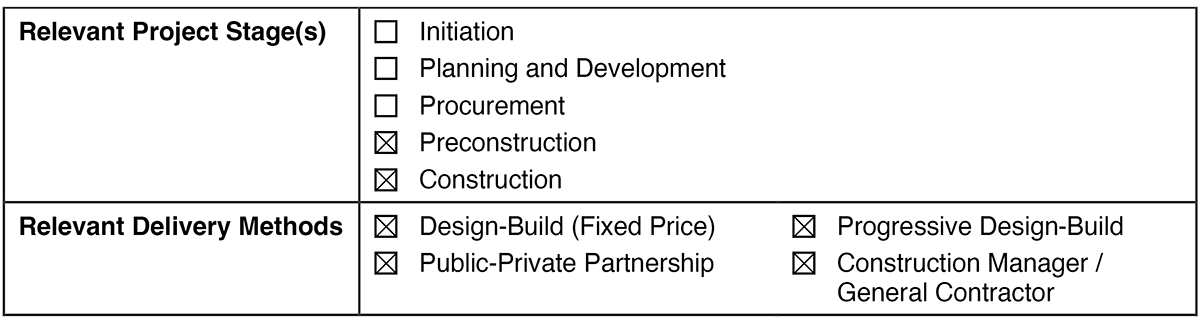
The checklist lists the following in two rows:
Row 1: Relevant Project Stage(s).
Initiation
Planning and Development
Procurement
Preconstruction
Construction
Row 2: Relevant Delivery Methods
Design-Build (Fixed Price)
Public-Private Partnership
Progressive Design-Build
Construction Manager slash General Contractor
All options except Initiation, Planning and Development, and Procurement are checked.
Overview
A growing number of capital construction owners and industry partners are applying “Lean” thinking to the design and construction process. Various tactical tools and practices can be employed individually or in combination during preconstruction to achieve a “Lean” project and a more collaborative and integrated project team.
A related tool is Target Value Design.
Objective
Lean tools and techniques are intended to help project participants achieve reduced construction waste (leading to cost and schedule efficiencies), enhanced productivity, and more effective project management.
Application
An overview of Lean tools commonly used in the implementation of progressive delivery methods is provided in this section.
Organizational Tools
Big Room Approach (Mindset)
A “Big Room” mindset refers to taking a collaborative, cross-functional, and cross-organizational approach to organizing a project teamʼs activities and producing work product (in contrast to typical “siloed” and “up and over” work production cycles).
Big Rooms can entail:
- Co-location (entire team located in one shared space).
- Recurring work sessions (project team convenes in a facilitated half or full day session once per week).
- Hybrid work session (periodic in-person plus virtual project team session).
Conditions of Satisfaction
Conditions of Satisfaction (CoS) are the metrics by which a project will be considered a “success.” For example:
- The project stays within the $X project budget.
- The project is completed by [date].
- The project provides adequate support/storage space and access for concession spaces (X% target depending on use).
Collaborative Work Planning Tools
Last Planner® System
The Last Planner® System is a managerial framework, developed by the Lean Construction Institute, entailing a collaborative process by which project teams (e.g., owner, designer, contractor) plan and execute work activities in a manner that ensures the work is done when and how it is needed to support the efficient and cost-effective delivery of a project. Planning includes:
- Master Schedule alignment (occurring as needed) to align the team on major milestones, major phases of work, basic dependencies and durations, and major constraints or risk factors.
- Phase production plans (occurring as needed) that break down milestones into manageable portions of work to be completed in a sequence driven by the promises and requests made by each team member (see the subsection on “pull planning”).
- “Make-Ready” look ahead plans (revisited weekly) identifying:
- Each item of work that can be performed and completed during the given planning period (typically a 3- to 6-week timeframe);
- Whether factors exist that would constrain performance and completion as planned; and
- Actions to be taken to negate or mitigate any such constraints.
- Weekly work plans showing the day on which activities will be completed
Pull Planning
Pulling planning is a management method for advancing work only when the next-in-line “customer” of that work is ready to use it.
Instead of “pushing” a project through completion, pull planning establishes what is necessary to “pull” it toward completion, based on a “request” received from the downstream “Customer” signaling that the work is needed and is to be “pulled” from the “Performer.”
Pull plans typically address either a specific time period or a group of activities leading to the accomplishment of a defined milestone. Pull plans are prepared by the actual project team members responsible for doing the work, typically during workshop sessions in which:
- Project activities are visualized using a large-scale, hand-written timeline and color-coded “sticky” notes denoting each specific work task.
- As the sticky notes start to fill up the timeline, stakeholders can visualize the order and dependencies of tasks and identify possible roadblocks or constraints that could cause delay.
Decision-Making Tools
A3 Thinking
A3 thinking is a collaborative process management and improvement tool that can be used for problem-solving, decision-making, and reporting. It refers to the use of a one-page report, prepared on an 11″ × 17″ (i.e., A3 size) sheet of paper, that is used to focus project team members on resolving a specific problem and documenting the rationale behind various decisions and solutions. Although an A3 is a collaborative document, a single author or champion will generally oversee its development, driving the process and encouraging contributions from team members. Typical elements of an A3 report include:
- problem statement,
- background,
- future state desired (usually listed as Conditions of Satisfaction),
- gap analysis,
- proposed actions, and
- follow-up steps to review results.
Choosing-by-Advantages
Choosing-by-advantages (CBA) is a decision-making framework (often applied in conjunction with an A3 process and report) for determining and documenting the “best value” decision by systematically looking at the advantages of each option.
This approach can be particularly useful when multiple variables need to be considered before an informed decision can be made (as is often the case when multiple solutions exist, but the best outcome is not readily apparent). CBA typically involves a trained facilitator guiding the project team through the following five phases of decision-making:
- Stage-setting: establish the purpose and context for the decision
- Innovation: formulate an adequate set of alternatives
- Decision-making: choose the alternative with the greatest total importance of advantages
- Reconsideration: change the decision if it should be changed or improved on
- Implementation: make the decision happen, adjust as needed, and evaluate the process and results
An example contract exhibit, developed by the Massachusetts Port Authority (2020) to convey its requirements regarding the use of Lean tools on CM/GC projects, is provided on the following pages.
References
It is beyond the scope of this Guide to describe Lean tools in detail. For more information, interested readers should consult the Lean Construction Institute website (https://leanconstruction.org/) and the following publications:
Hill, K., Copeland, K., and Pikel, C. (2016). Target Value Delivery: Practitioner Guidebook to Implementation. Lean Construction Institute.
Lean Construction Institute (2017). Transforming Design and Construction: A Framework for Change, William R. Seed, Executive Editor.
Massachusetts Port Authority (2020). Lean Design and Construction Contract Provision to Supplement the Authorityʼs Prime Consultant Agreement and the Preconstruction Services Agreement between the Authority and the Construction Manager.
Note: Pages B-25 to B-29 are taken from the Massachusetts Port Authorityʼs Lean Design and Construction Contract Provision to Supplement the Authorityʼs Prime Consultant Agreement and the Preconstruction Services Agreement between the Authority and the Construction Manager.

Long Description.
The title of the document is Exhibit X: Lean Design and Construction.
A list is displayed on the page:
I. GENERAL
A. Application of Exhibit
This Exhibit is a Contract Document and is intended to supplement (1) the Consultant Agreement between the Massachusetts Port Authority (“Authority”) and the Authorityʼs Prime Design Consultant (“Consultant”) and (2) the Preconstruction Services Agreement and the Construction Services Agreement between the Authority and its Construction Manager (“CM”). References herein to the “Project Team” refers to representatives of the Authority, the Consultant, and the CM (as applicable depending on the phase of the Project).
B. Lean Project Delivery
The Authority expects that the Project will benefit by implementing Lean Project Delivery, which includes:
1. collaboration among all members of the Project Team;
2. planning and managing the Project as a network of commitments across organizational boundaries;
3. optimizing the Project as a whole, rather than any particular piece; and
4. promoting continuous improvement throughout the life of the Project.
The Authority intends that the Project Team, to the maximum extent possible, utilize Lean Project Delivery to facilitate design and construction of the Project. Specific Lean Tools available to the Project Team in support of Lean Project Delivery are set forth in this Exhibit.
C. Lean Deployment Plan
This Lean Design and Construction Exhibit provides the basis for development by the Project Team of a Lean Deployment Plan (“LDP”) for the Project. The LDP shall be developed by the Project Team within thirty (30) days after execution of the Agreement to which this Exhibit is appended. The LDP shall be updated, at a minimum, at the start of each Project phase (Project Definition, Preliminary Design, Final Design, and Construction), using a template that the Authority will supply to each Project Team. The Project LDP and all updates shall be subject to Authority approval.
The Designer and CM shall provide personnel with knowledge and experience of the Lean Tools selected for inclusion in the LDP. The Designer and CM each shall designate a person as its Lean representative for purposes of implementing, tracking, and updating the LDP. The list continues on the next page.

Long Description.
The list continues from the previous page. II. REQUIRED LEAN TOOLS
A. Project Planning and Tracking Tools
1. Last Planner® System: For planning its activities and deliverables the Project Team shall use the framework of the Lean Construction Instituteʼs Last Planner System (“LPS”) consisting of: collaborative development of a milestone schedule; phase or progression production plans; “make-ready” look ahead plans; weekly work plans; maintenance of variance and constraint logs; and methods for recording, measuring, and improving the reliability of Project planning and production.
2. Pull Planning Approach: Following the LPS framework, the Project Team shall use a pull planning approach to planning, scheduling, and tracking its work to ensure that preceding activities are not started sooner than is needed to assure the continuous performance of subsequent activities. Where the work of one Project Team member is dependent upon the prior performance of another Project Team member, the Project Team member whose work is dependent shall request of, and receive from, the prior performer a reliable commitment as to when the precedent work shall be finished. As part of the pull planning process, appropriate Project Team members shall agree on the criteria for hand-off and acceptance of items of work.
3. LPS Guide: The Project Team shall follow the Massport Last Planner System Guide, including the following specific elements:
a. Master Schedule Alignment: The Project Team shall collaboratively review the Milestone Schedule to align the team on the major milestones, major phases of work, basic dependencies and durations, and major constraints or risk factors. The Milestone Schedule Alignment shall also include identification of pull planning phases and an action plan for initiating the Last Planner® System on the Project. Master Schedule Alignment update sessions shall be held periodically (usually prior to the beginning of new major phases of work).
b. Phase Production Planning: Phase planning shall be based on the collaborative efforts of all those performing work during a given period and shall indicate when work should be done to meet milestone dates.
c. Make-Ready/Look Ahead Planning: Make-ready look ahead plans shall be developed by the Project Team, identifying (i) each item of work that can be performed and completed during the given planning period; (ii) whether factors exist that would constrain performance and completion as planned; and (iii) the actions to be taken to negate or mitigate any such constraints. The Project Team shall maintain a Constraint Log to track constraints to planned activities and an action plan (what, when, who) for Constraint removal or resolution.
d. Weekly Work Planning: Weekly work plans shall be developed by the Project Team members to show the day on which specific activities will be completed. The weekly work plans shall indicate whether an assignment has been completed as scheduled and, if not, a reason shall be assigned for variance from the plan. The Project Team shall maintain a — the list continues on the next page.
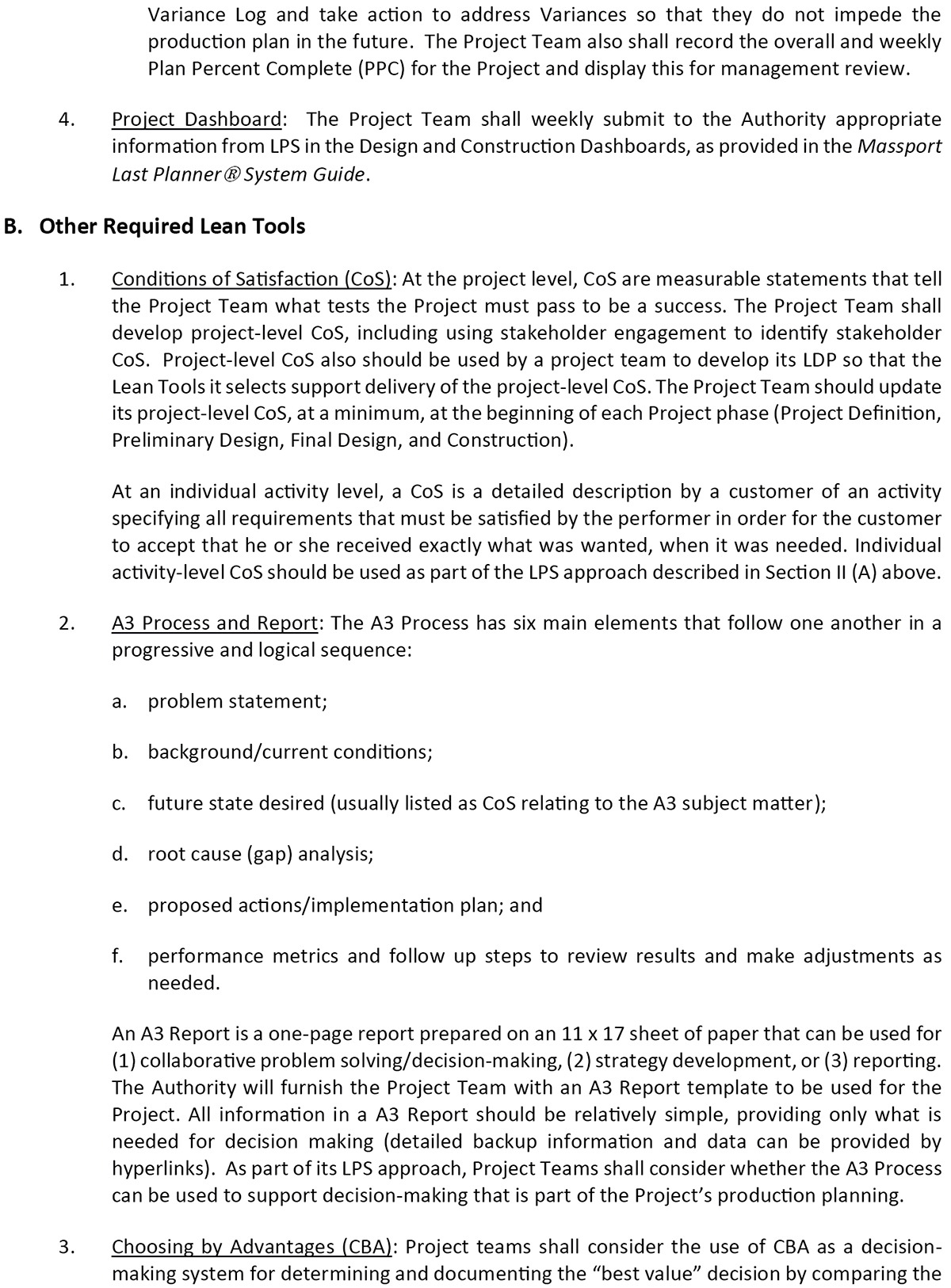
Long Description.
The list continues from the previous page — Variance Log and take action to address Variances so that they do not impede the production plan in the future. The Project Team also shall record the overall and weekly Plan Percent Complete (PPC) for the Project and display this for management review.
4. Project Dashboard: The Project Team shall weekly submit to the Authority appropriate information from L P S in the Design and Construction Dashboards, as provided in the Massport Last Planner® System Guide.
B. Other Required Lean Tools
1. Conditions of Satisfaction (CoS): At the project level, CoS are measurable statements that tell the Project Team what tests the Project must pass to be a success. The Project Team shall develop project-level CoS, including using stakeholder engagement to identify stakeholder CoS. Project-level CoS also should be used by a project team to develop its LDP so that the Lean Tools it selects support delivery of the project-level CoS. The Project Team should update its project-level CoS, at a minimum, at the beginning of each Project phase (Project Definition, Preliminary Design, Final Design, and Construction).
At an individual activity level, a CoS is a detailed description by a customer of an activity specifying all requirements that must be satisfied by the performer in order for the customer to accept that he or she received exactly what was wanted, when it was needed. Individual activity-level CoS should be used as part of the LPS approach described in Section II (A) above.
2. A3 Process and Report: The A3 Process has six main elements that follow one another in a progressive and logical sequence:
a. problem statement;
b. background/current conditions;
c. future state desired (usually listed as CoS relating to the A3 subject matter);
d. root cause (gap) analysis;
e. proposed actions/implementation plan; and
f. performance metrics and follow up steps to review results and make adjustments as needed.
An A3 Report is a one-page report prepared on an 11 x 17 sheet of paper that can be used for (1) collaborative problem solving/decision-making, (2) strategy development, or (3) reporting. The Authority will furnish the Project Team with an A3 Report template to be used for the Project. All information in a A3 Report should be relatively simple, providing only what is needed for decision making (detailed backup information and data can be provided by hyperlinks). As part of its LPS approach, Project Teams shall consider whether the A3 Process can be used to support decision-making that is part of the Projectʼs production planning.
3. Choosing by Advantages (CBA): Project teams shall consider the use of CBA as a decision-making system for determining and documenting the “best value” decision by comparing the — the list continues on the next page.
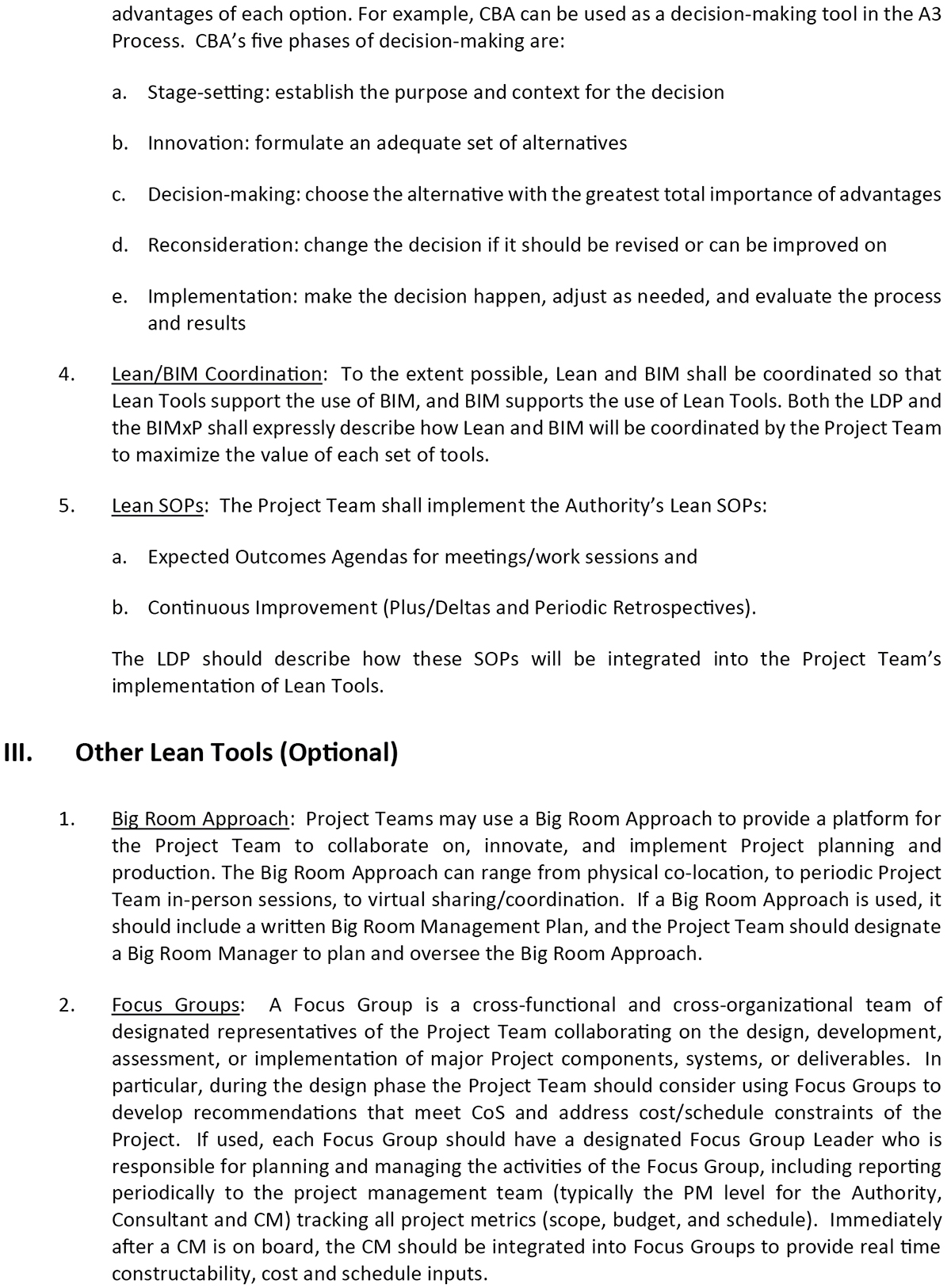
Long Description.
The list continues from the previous page — advantages of each option. For example, CBA can be used as a decision-making tool in the A3 Process. CBAʼs five phases of decision-making are:
a. Stage-setting: establish the purpose and context for the decision
b. Innovation: formulate an adequate set of alternatives
c. Decision-making: choose the alternative with the greatest total importance of advantages
d. Reconsideration: change the decision if it should be revised or can be improved on
e. Implementation: make the decision happen, adjust as needed, and evaluate the process and results
4. Lean/BIM Coordination: To the extent possible, Lean and BIM shall be coordinated so that Lean Tools support the use of BIM, and BIM supports the use of Lean Tools. Both the LDP and the BIM x P shall expressly describe how Lean and BIM will be coordinated by the Project Team to maximize the value of each set of tools.
5. Lean SOPs: The Project Team shall implement the Authorityʼs Lean SOPs:
a. Expected Outcomes Agendas for meetings/work sessions and
b. Continuous Improvement (Plus/Deltas and Periodic Retrospectives).
The LDP should describe how these SOPs will be integrated into the Project Teamʼs implementation of Lean Tools.
III. Other Lean Tools (Optional)
1. Big Room Approach: Project Teams may use a Big Room Approach to provide a platform for the Project Team to collaborate on, innovate, and implement Project planning and production. The Big Room Approach can range from physical co-location, to periodic Project Team in-person sessions, to virtual sharing/coordination. If a Big Room Approach is used, it should include a written Big Room Management Plan, and the Project Team should designate a Big Room Manager to plan and oversee the Big Room Approach.
2. Focus Groups: A Focus Group is a cross-functional and cross-organizational team of designated representatives of the Project Team collaborating on the design, development, assessment, or implementation of major Project components, systems, or deliverables. In particular, during the design phase the Project Team should consider using Focus Groups to develop recommendations that meet CoS and address cost/schedule constraints of the Project. If used, each Focus Group should have a designated Focus Group Leader who is responsible for planning and managing the activities of the Focus Group, including reporting periodically to the project management team (typically the PM level for the Authority, Consultant and CM) tracking all project metrics (scope, budget, and schedule). Immediately after a CM is on board, the CM should be integrated into Focus Groups to provide real time constructability, cost and schedule inputs.
Long Description.
The list continues from the previous page.
3. Target Value Design (TVD): TVD is a design methodology that requires Project values, cost, quality, schedule, and constructability to be integrated components of basis of design criteria. TVD uses cost targets to drive innovation and reduce waste in designing a project that provides optimum value to the Authority. If TVD is used, the Project Team should develop a TVD plan that sets out the strategies for value analysis, including carrying multiple design options forward using Set-based Design and deferring decisions until the Last Responsible Moment to maximize the value of each Project element. Cost and schedule analysis should be the byproduct of the continuous TVD process, including the CM and trade/subcontractors providing ongoing cost and schedule information for portions of the work, systems, and details as they are developed or considered.
4. Miscellaneous Lean Tools: The Authority may, in its discretion, require the Designer and/or the CM to use other Lean Tools, such as Value Stream Mapping, Rapid Improvement Events, Visual Management, and Root Cause Analysis. Project Teams shall supply persons with knowledge of and experience in these Tools if the Authority selects them for use on any particular project.
8. Target Value Design
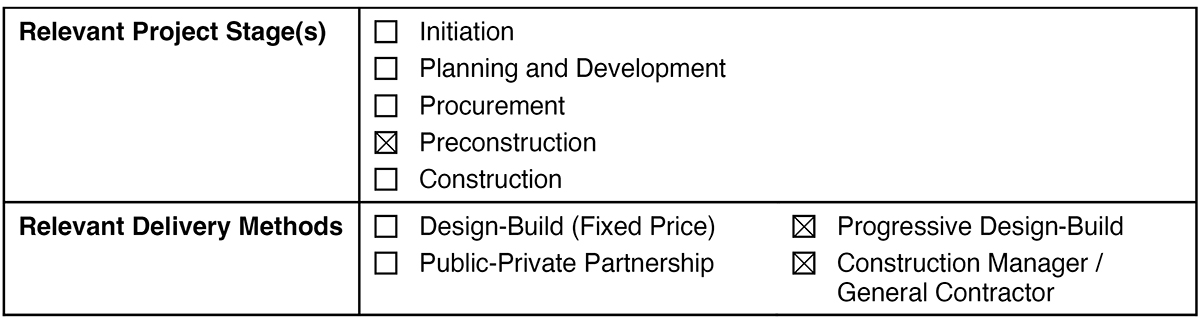
Long Description.
The checklist lists the following in two rows:
Row 1: Relevant Project Stage(s).
Initiation
Planning and Development
Procurement
Preconstruction
Construction
Row 2: Relevant Delivery Methods
Design-Build (Fixed Price)
Public-Private Partnership
Progressive Design-Build
Construction Manager slash General Contractor
The options Preconstruction, Progressive Design-Build, and Construction Manager slash General Contractor are checked.
Overview
In addition to applying some of the Lean design and construction techniques discussed in Tool 7 and maintaining a project cost model, some owners have also begun to explore the use of Target Value Design (TVD) principles as a cost control measure.
TVD is a design methodology that requires project values, cost, quality, schedule, and constructability to be integrated components based on design criteria. TVD uses cost targets to drive innovation and reduce waste in designing a project that provides optimum value to the owner.
Objective
TVD helps ensure the design phase progresses in a manner that:
- Allows the project to be completed within the ownerʼs allowable cost and schedule;
- Promotes common understanding among all project participants of the design and performance criteria for the project; and
- Drives innovation and quality to increase value and reduce waste in all aspects of project delivery.
Application
Sometimes characterized as “Building (or Designing) to a Target Cost,” TVD entails the project team applying a disciplined management approach to the design process, in which cost, schedule, and constructability are viewed as design constraints, and cost targets are used to drive innovation in designing a project that provides the best value to the owner.
The target cost should serve as a “stretch” goal that pushes the team to be truly innovative (as opposed to simply being more efficient in doing things the traditional way). To obtain these TVD benefits:
- Designers must recognize that the design process should not occur in a silo, and that value, cost, schedule, and constructability inputs are essential to achieving an integrated design process.
- The contractor and its key subcontractors must engage in meaningful constructability reviews and provide rapid and accurate cost and schedule evaluations throughout the design process as part of their preconstruction phase services.
A key element of the TVD process entails establishing a “target cost” (and associated schedule) for the project, typically as part of the projectʼs program definition phase. The target cost is set at less than the current estimate or best-in-class past project performance. The intent is for the target to generate the “creative tension” (e.g., more program elements yet less cost) needed to drive innovation and waste reduction in the design and construction process.
Based on this target cost, the project team then applies a “design to budget” process (instead of the conventional process of developing a design, estimating the costs of that design, and then applying value engineering principles as necessary to eliminate budget overruns).
To accomplish TVD in a disciplined manner, the project team typically establishes TVD focus or cluster groups for different building systems or design elements as appropriate, with a target cost allocated to each team. The TVD cluster teams then work to identify options that will reduce capital or lifecycle costs, improve constructability and functionality, and/or enhance operational flexibility consistent with the ownerʼs project goals. During this time the design stays flexible while the project team tests assumptions, based on rapid cost estimates provided by the contractor team, and ultimately selects the best option for the project.
Reference
Hill, K., Copeland, K., and Pikel, C. (2016). Target Value Delivery: Practitioner Guidebook to Implementation. Lean Construction Institute.
This page intentionally left blank.


