Alternative Project Delivery Methods: Assessing and Allocating Risk to Increase Competition (2025)
Chapter: Appendix A: Potential Tools for Fixed-Price APDs

APPENDIX A
Potential Tools for Fixed-Price APDs
- APD Method Guidance Documents
- PDM Decision Tools
- Standard Contract Templates for APD Methods
- Project Pipeline
- Term Sheets for APD Methods
- Roles and Responsibilities Matrix
- Industry Outreach/Forums
- Pre-Procurement One-on-One Meetings
- Alternative Technical Concepts
- Third-Party Coordination
- Risk Register
- Proposerʼs Supplemental Geotechnical Investigation
- Geotechnical Baseline Report
- Reliance (vs. Reference) Documents
- Risk-Sharing Strategies
- Stipends
- Alternate Forms of Security
- Post-Award Scope Validation
- Partnering
- Alternative Dispute Resolution Processes
1. APD Method Guidance Documents
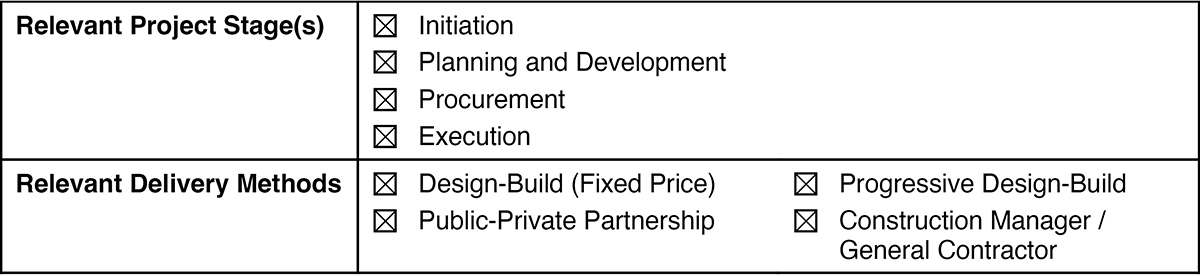
Long Description.
The checklist lists the following in two rows:
Row 1: Relevant Project Stage(s).
Initiation
Planning and Development
Procurement
Execution
Row 2: Relevant Delivery Methods.
Design-Build (Fixed Price)
Public-Private Partnership
Progressive Design-Build
Construction Manager slash General Contractor
All options are checked.
Overview
Several state departments of transportation (DOTs) publish programmatic guidance manuals addressing how they plan, develop, procure, and execute APD methods projects. Such guidelines typically include information touching upon topics such as project selection criteria, risk management practices, roles and responsibilities, and contract administration procedures.
Objectives
By documenting and publishing such information, owners can:
- Promote the consistent planning and execution of APD methods projects;
- Define and communicate roles and accountabilities to internal staff members, the design and construction industry, and other external stakeholders;
- Counter the loss of institutional knowledge (e.g., when long-tenured staff retire or move to new positions); and
- Facilitate communication, training, and the regular re-evaluation of processes and standards.
References
Design-Build Manuals
Note: Website links accessed 1/3/2025.
Alaska DOT and Public Facilities. (2005). Guidebook for Design-Build Highway Project Development,1st Edition. https://dot.alaska.gov/comm/about/assets/DB/Chapters.pdf
Arkansas State Highway and Transportation Department. (2015). Design-Build Guidelines and Procedures. Revision 1. https://www.ardot.gov/wp-content/uploads/2020/11/Design_Build-Procedures_Final.pdf
Caltrans. (2008). Alternative Procurement Guide. https://dot.ca.gov/-/media/dot-media/programs/design /documents/alternativeprocurementguide-a11y.pdf
Colorado DOT. (2016). Design-Build Manual. https://www.codot.gov/business/alternativedelivery/Design-Build-manual
Georgia DOT. (2022). Design-Build Manual. Revision 5.0. https://www.dot.ga.gov/PartnerSmart/DesignManuals /DesignBuild/001-GDOT_Design-Build_Manual.pdf
Idaho Transportation Department. (2014). Design-Build Manual. https://apps.itd.idaho.gov/apps/manuals/DesignBuild/files/Design-BuildPrintable.pdf
Kentucky Transportation Cabinet. (No Date) Design-Build Guidance. https://transportation.ky.gov/Construction/Documents/KYTC%20Design%20Build%20Guidance.pdf
Louisiana Department of Transportation and Development. (No Date) Design-Build Manual. https://dotd.la.gov/media/nncnc4sb/dotd-design-build-manual.pdf
Maryland State Highway Administration. (2013). Design-Build Manual. https://www.roads.maryland.gov/OHD2/SHA_Design-Build_Manual.pdf
Massachusetts DOT. (2012). Design-Build Procurement Guide. https://www.mass.gov/doc/Design-Build-procurement-guide/download
Michigan DOT. (2022). Design-Build Guidelines, 3rd Edition. https://www.michigan.gov/mdot/-/media/Project/Websites/MDOT/Business/Contractors/Innovative-Contracting/MDOT-Design-Build-Guidelines.pdf
Minnesota DOT. (2019). Design-Build Manual. https://www.dot.state.mn.us/designbuild/manual.html
Montana DOT. (2008). Design-Build Guidelines. https://mdt.mt.gov/other/webdata/external/contractplans/contract/AlternativeContracting/db-guidelines.PDF
North Carolina DOT. (2011). Design-Build Policy and Procedures. https://connect.ncdot.gov/letting/Design%20Build%20Resources/01.%20NCDOT%20Design-Build%20Policy%20and%20Procedures.pdf
New York State DOT. (2005). Design-Build Procedures Manual Volume 1. https://www.dot.ny.gov/programs/repository/dbpmtext.pdf
Ohio DOT. (2018). Design-Build Training Workbook. https://dam.assets.ohio.gov/image/upload/transportation.ohio.gov/alternative-delivery/design-build/training/Design-Build-Workbook.pdf
Oregon DOT. (2023). Design-Build Project Development Guide. https://www.oregon.gov/odot/Business/AlternativeContracting/DB-Project-Development-Guide.pdf
Oregon DOT (2023). Design-Build Contract Administration Manual. https://www.oregon.gov/odot/Construction/Documents/DB_contract_admin_manual.pdf
South Carolina DOT. (2017). Design-Build Procurement Manual. https://www.scdot.org/content/dam/scdot-legacy/business/pdf/design-build/Design-Build_Procurement_Manual.pdf
Tennessee DOT. (2022). Design-Build Standard Guidance. https://www.tn.gov/content/dam/tn/tdot/alternative-delivery/design-build/Design-Build_Standard-Guidance_2022-04-28.pdf
Texas DOT. (2017). Design-Build Procurement Overview Manual. https://www.txdot.gov/content/dam/docs/division/ald/resources/adp-procurement-overview-manual.pdf
Virginia DOT. (2022). Design-Build Procurement Manual. https://www.vdot.virginia.gov/doing-business/technical-guidance-and-support/technical-guidance-documents/Design-Build-procurement-manual/
Washington State DOT. (2022). Design-Build Manual. https://wsdot.wa.gov/engineering-standards/all-manuals-and-standards/manuals/Design-Build-manual
Construction Manager/General Contractor Manuals
Note: Website links accessed 1/3/2025.
Arkansas DOT. (No Date). CM-GC Guidelines and Procedures. https://www.ardot.gov/wp-content/uploads/ARDOT-CM-GC-Manual.pdf
Caltrans (2018). Procedures for Construction Manager/General Contractor Pilot Program Project. https://sta.ca.gov/wp-content/uploads/2021/04/Approved-Caltrans-CMGC-Procedures-April-6-2018.pdf
Colorado DOT. (2016). Construction Manager/General Contractor Manual. https://www.codot.gov/business/alternativedelivery/construction-manager-general-contractor-cm-gc-manual
Delaware DOT. (No Date). Construction Manager/General Contractor Procedures. https://deldot.gov/Business/drc/pdfs/projectmanagement/cmgc_procedures.pdf
Georgia DOT. (2023). Construction Manager/General Contractor Manual Rev. 3. https://www.dot.ga.gov/PartnerSmart/DesignManuals/DesignBuild/GDOT_CMGC_Manual.pdf
State of Louisiana. (2020). Construction Management at Risk Manual. https://dotd.la.gov/about/office-of-the-secretary/innovative-procurement/alternative-contracting-methods/construction-management-at-risk/
Montana DOT. (2023). CM/GC Guidance Document Version 3. https://ftp.mdt.mt.gov/other/webdata/external/contractplans/contract/AlternativeContracting/MDT_CMGCGuidance.PDF
North Carolina DOT. (2018). Guidelines For Awarding Construction Manager/General Contractor Contracts. https://connect.ncdot.gov/letting/Design%20Build%20Program/Division%208%20-%20US%20Open/NCDOT%20CMGC%20Guidelines%2012-31-2018.pdf
Oregon DOT. (2020). CM/GC Manual. https://www.oregon.gov/odot/Construction/Documents/CMGC_manual.pdf
P3 Manuals
Note: Website links accessed 1/3/2025.
Arizona DOT. (2022). P3 Program Guidelines.
Colorado High-Performance Transportation Enterprise (2020). P3 Management Manual (Updated November 2020). https://www.codot.gov/programs/ctio/ctio-policy-documents-ada-compliant/hpte-p3-management-manual-update-2020.pdf (Note: Coloradoʼs High-Performance Transportation Enterprise is now known as the Colorado Transportation Investment Office.)
Georgia DOT. (2022). P3 Manual. Revision 2.2. https://www.dot.ga.gov/PartnerSmart/Innovative/Documents/P3%20Manual.pdf
North Carolina DOT. (2014). Public-Private Partnership Policy and Procedures. https://connect.ncdot.gov/letting/Design%20Build%20Resources/03.%20Public%20Private%20Partnership%20Policy%20Adopted%2001-09-14.pdf
Pennsylvania DOT. (2022). P3 Implementation Manual and Guidelines. https://www.pa.gov/content/dam/copapwp-pagov/en/penndot/documents/research-planning-innovation/public-private-partnerships/2022.12.13%20p3_implementation_manual.pdf
Vermont Agency of Transportation. (2019). Public Private Partnership Program Guidelines. https://vtrans.vermont.gov/sites/aot/files/contractadmin/documents/P3/P3%20Guidelines%20Signed.pdf
2. PDM Decision Tools

*Note: In addition to APD methods, this section also discusses the Design-Bid-Build (DBB) method.
Long Description.
Row 1: Relevant Project Stage(s).
Initiation
Planning and Development
Procurement
Execution
Row 2: Relevant Delivery Methods
Design-Build (Fixed Price)
Public-Private Partnership
Progressive Design-Build
Construction Manager slash General Contractor
All options except Procurement and Execution are checked.
Overview
APD methods have unique advantages and disadvantages that should be carefully weighed when considering how to best deliver a particular project. To facilitate such decision-making, some public owners have developed or implemented systematic processes or tools that align project goals or constraints to the unique attributes of a given delivery method (e.g., DBB, DB, CM/GC).
Objectives
Benefits from implementing a more systematic project delivery selection process include:
- Increased transparency and consistency in PDM decision-making,
- Enhanced assurance that an important selection consideration will not be unintentionally overlooked, and
- Consistent documentation for justifying the PDM selection decision to executive leadership and external stakeholders.
References
Table A.1 identifies PDM selection methodologies/algorithms developed by different transportation agencies. The selection processes range from simple checklists or decision trees to more complex risk-based decision support tools that are intended to be implemented in a workshop setting. Most allow for some scalability based on project size or complexity. The decision frameworks consider a range of factors considered to be of importance to the particular owner and/or project, such as project goals (e.g., accelerated schedule, early cost certainty, innovation, lifecycle considerations), any regulatory constraints or policies governing the ownerʼs use of different PDMs, owner preferences (e.g., design control vs. contractor flexibility), and external criteria (e.g., market conditions, resource availability, third-party issues).
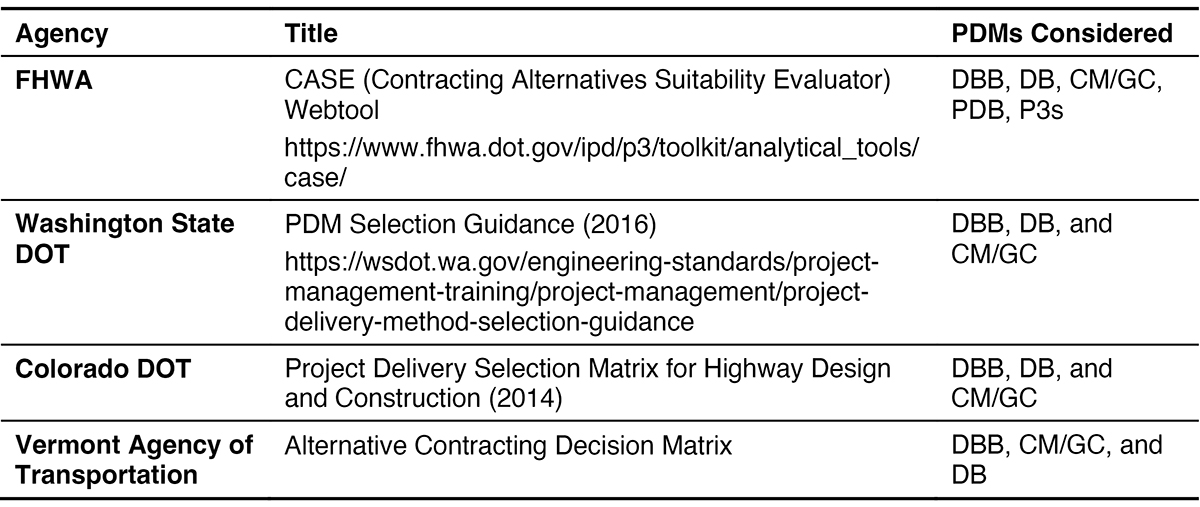
Long Description.
The information in the table is as follows.
Row 1: Agency: FHWA. Title: CASE (Contracting Alternatives Suitability Evaluator) Webtool https colon forward slash forward slash www dot fhwa dot dot dot gov forward slash ipd forward slash p3 forward slash toolkit forward slash analytical underscore tools forward slash case forward slash. PDMs Considered: DBB, DB, CM slash GC, PDB, P3s.
Row 2: Agency: Washington State DOT. Title: Project Delivery Method Selection Guidance (2016) https colon forward slash forward slash w s dot dot w a dot gov forward slash engineering-standards forward slash project-management-training forward slash project-management forward slash project-delivery-method-selection-guidance. PDMs Considered: DBB, DB and CM slash GC.
Row 3: Agency: Colorado DOT. Title: Project Delivery Selection Matrix for Highway Design and Construction (2014). PDMs Considered: DBB, DB, and CM slash GC.
Row 4: Agency: Vermont Agency of Transportation. Title: Alternative Contracting Decision Matrix. PDMs Considered. DBB, CM slash GC and DB.
3. Standard Contract Templates for APD Methods
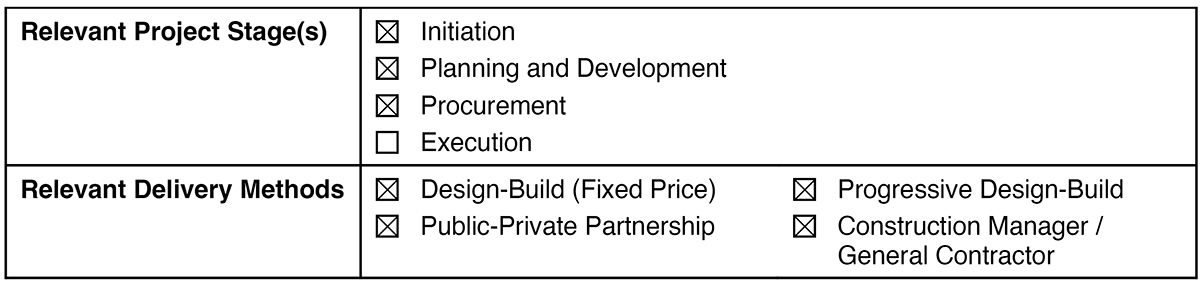
Long Description.
The checklist lists the following in two rows:
Row 1: Relevant Project Stage(s).
Initiation
Planning and Development
Procurement
Execution
Row 2: Relevant Delivery Methods
Design-Build (Fixed Price)
Public-Private Partnership
Progressive Design-Build
Construction Manager slash General Contractor
All options except Execution are checked.
Overview
Many state DOTs have developed a set of standard contract templates that outline the agencyʼs baseline terms and conditions for various APD methods. The agency can then modify and adjust these contract templates to align with a given projectʼs needs.
Objectives
From a DOTʼs perspective, the development of standard contract templates will streamline the effort needed to prepare contract documents for specific projects, while also ensuring that risk allocation and roles and responsibilities related to design, quality management, third-party coordination, and similar requirements that may change under different APD methods are clearly and adequately defined.
From industryʼs perspective, an ownerʼs repeated use of standard provisions, in addition to consistent application and interpretation of these terms by the ownerʼs project management team, can increase their familiarity and comfort level with the ownerʼs processes.
In developing and updating standard contract language, some DOTs will also seek input from their local design and construction industries, a practice that can be used to further align DOT and industry perspectives on risk allocation and other design and construction strategies.
Examples
Texas DOT (TxDOT) has published a DB template (TxDOT 2023) that establishes the general conditions for a variety of potential risks and issues. For example, the provisions related to “Utilities” define multiple terms such as “Unidentified Utilities Deductible,” “Unidentified
Utilities Deductible Cap,” and “Utility Adjustment” while “Section 6.4 Utilities” addresses this item directly with multiple subsections: (a) 6.4.1 Unidentified Utilities, (b) 6.4.2 Public Utility Owner Delays, (c) 6.4.3 Pre-Proposal Commitments, and (d) 6.4.4 Advance Utility Relocations. The “Unidentified Utilities” (Section 6.4.1) states:
The “Unidentified Utilities Deductible” for the Project is, for each facility, the first $[•] of Basic Costs for the Utility Adjustment due to an Unidentified Utility.
The “Unidentified Utilities Deductible Cap” for the Project is an aggregate $[•] for all Unidentified Utilities Deductibles borne by DB Contractor.
[Applicable deductible and cap to be determined on a project-by-project basis. Such deductible and cap could each be “0,” if so determined by TxDOT.]
DB Contractor shall be entitled to a Change Order with respect to certain additional Direct Costs and delays relating to Utility Adjustments, as specified in Section 4.5 of the General Conditions and subject to the restrictions and limitations set forth in Section 4.5 of the General Conditions and in Section 4.6 of the General Conditions, unless otherwise specified in this Section 6.4.
[insert any deviations from the standard terms of the relevant General Conditions sections]
This provision uses a deductible scheme with a cap for adjustment of unidentified utilities although TxDOT may elect for both the deductible and cap to be zero.
Virginia DOT (VDOT) also has published standard template documents for its DB RFPs (VDOT 2016), which includes Part 3 – Lump Sum Agreement, Part 4 – General Conditions of Contract, and Part 5 – Division I Amendments to the Standard Specifications. These parts also establish baseline conditions and terms for its DB projects. Part 4 includes VDOTʼs “Scope Validation” provisions (Section 2.2 Scope Validation and Identification of Scope Issues); Section 2.2.1 Scope Validation Period states:
The term “Scope Validation Period” is the period of time that begins on Design-Builderʼs receipt of Departmentʼs Notice to Proceed and extends for one hundred twenty (120) days from such date of receipt, unless otherwise stated in Exhibit 1. During the Scope Validation Period, Design-Builder shall thoroughly review and compare all of the then-existing Contract Documents, including without limitation the RFP Documents and the Proposal, to verify and validate Design-Builderʼs proposed design concept and identify any defects, errors, or inconsistencies in the RFP Documents that affect Design-Builderʼs ability to complete its proposed design concept within the Contract Price and/or Contract Time(s) (collectively referred to as “Scope Issues”). The term “Scope Issue” shall not be deemed to include items that Design-Builder should have reasonably discovered prior to the Agreement Date.
Subsequent provisions in Section 2.2 from VDOT (2016) describe requirements for seeking relief for any “Scope Issues” as well as how scope validation applies to non-accessible areas of the site during the validation period.
References
TxDOT. (2023). Design-Build Contract Template, Version 6.
VDOT. (2016). Alternative Project Delivery Division Design-Build Standard Template Documents. Part 3 – Lump Sum Agreement, Part 4 – General Conditions of Contract, and Part 5 – Division I Amendments to the Standard Specifications. https://www.vdot.virginia.gov/media/vdotvirginiagov/doing-business/business-opportunities/design-build-firms/2016_VDOT_Design-Build_Standard_Template_Documents_Parts_3,_4_5_acc03162023_PM.pdf
4. Project Pipeline

Long Description.
The checklist lists the following in two rows:
Row 1: Relevant Project Stage(s).
Initiation
Planning and Development
Procurement
Execution
Row 2: Relevant Delivery Methods
Design-Build (Fixed Price)
Public-Private Partnership
Progressive Design-Build
Construction Manager slash General Contractor
All options except Planning and Development, Procurement, and Execution are checked.
Overview
Publicizing information about prospective APD projects, via website posting, announcements at industry outreach forms, or using other publication means, provides advance notice to industry participants regarding the scope, location, and scale of potential projects. Industry can then use this information to consider and plan their future resource needs and build relationships with potential project teaming partners.
To provide industry adequate time to make a pursuit decision and form a team, communication of upcoming projects should take place as early as possible, ideally more than 1 year in advance of formal advertisement, rather than just a few months.
Objectives
Project pipelines can help:
- Raise awareness of, and increase interest in, an agencyʼs upcoming projects and procurement actions.
- Provide industry with ample notice of potential upcoming APD projects, which they can in turn use to inform their own resource development activities.
Example
The Georgia DOT (GDOT) Public Private Partnerships (P3) Program website contains information on existing and upcoming projects in the GDOT pipeline (a biennial listing of P3 projects) with actual or anticipated pre-procurement activities including industry forums, requests for information, outreach materials, one-on-one meetings with key industry participants addressing the status of environmental reviews, right-of-way acquisition, and utility coordination, programmatic risk allocation, and procurement process requirements among other topics. The website can be reached at the following URL: https://www.dot.ga.gov/GDOT/pages/P3.aspx.
5. Term Sheets for APD Methods
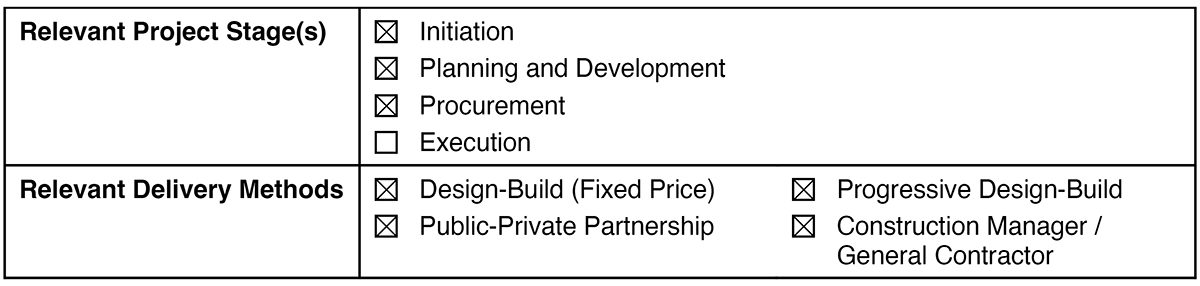
Long Description.
The checklist lists the following in two rows:
Row 1: Relevant Project Stage(s).
Initiation
Planning and Development
Procurement
Execution
Row 2: Relevant Delivery Methods
Design-Build (Fixed Price)
Public-Private Partnership
Progressive Design-Build
Construction Manager slash General Contractor
All options except Execution are checked.
Overview
Term sheets present key contractual and commercial terms and conditions reflecting how the agency intends to structure related provisions in the full contract agreement.
Objectives
The release of a project-specific term sheet in the early stages of the procurement process (i.e., before or as part of a Request for Qualifications step) can help the agency convey to
interested proposers how it expects to treat key project risks and relief events. Prospective contractors can then assess these terms relative to their own perceptions of the project. Any concerns can be communicated to the agency via Requests for Clarification or as part of one-on-one meetings.
The use of a streamlined term sheet can help ensure the parties align on major aspects of a deal before drafting or attempting to negotiate the full agreement.
Examples
Design-Build
TxDOT has developed a standard term sheet for its DB contracts, which it typically includes in its requests for qualifications. The term sheet, a copy of which is provided at the end of this section of Appendix A, organizes information into the following categories:
- Contract Overview
- Price, Security & Payments
- Completion Deadlines, Schedule and Delay
- Contract Rights & Responsibilities
- Environmental & Performance Risks
- Contract Changes & Costs Outside the Contract
- Business Risks
- Other Contract Provisions
Specific items are then addressed within each category. For example, “Contract Changes & Costs Outside the Contract” includes:
- Differing Site Conditions
- Supply Chain Disruptions
- Third Party Agreements
- Railroads
- Hazardous Materials
- Utilities
- Force Majeure Events
- Other Relief Events
Within these categories, 66 items are addressed. For example, the “Third Party Agreements” item states:
DB Contractor is entitled to a Change Order (a) to compensate DB Contractor for certain additional costs incurred and (b) to extend the applicable Completion Deadlines as the result of any delay in a Critical Path, directly caused by modifications to DB Contractorʼs obligations resulting from new third party agreements or modifications to existing third party agreements. DB Contractor shall not be entitled to any relief for any new third party agreements or modifications to existing third party agreements unless the delays and the effects of such delays are beyond the control of the DB Contractor-Related Entities.
Except for project overhead to be calculated in accordance with the [Design-Build Contract] for each day that a Completion Deadline is extended, delay and disruption damages are not recoverable.
(See Other Relief Events section below for relief for modifications to draft third party agreements included in the [Reference Information Documents] as of the proposal due date.)
To prospective DB contractors, this description provides a baseline understanding of how TxDOT intends to handle relief as a consequence of new third-party agreements or modifications to existing third-party agreements.
P3
The Association for the Improvement of American Infrastructure (AIAI) published what is in effect a term sheet for P3s. AIAI notes that the document, entitled “First Principles of Risk Allocation and Certain Key Commercial Terms – Best Practices” was developed:
following consultation with private-sector equity investors, lenders, contractors, designers, and operations/maintenance providers and their public-sector counterparts . . . on certain key risks and commercial terms that are broadly applicable to complex and large-scale P3 Design-Build-Finance-Operate and/or Maintain (DBFOM) projects.
The document, which can be downloaded free of charge through the AIAI website (https://aiai-infra.org/first-principles-of-risk/), can be used as a starting point for parties to discuss and allocate P3 risks.
Note: Pages A-10 to A-36 are taken from the TxDOT Design-Build Contract Term Sheet.

Long Description.
Page 1 of the Texas DOT Design-Build Contract Term Sheet. The title page for the document has a blank space for the name of a project, followed by the title, “Design-Build Contract Term Sheet.” The following text is on the first page: This document provides background information and summarizes the major terms of the Design- Build Contract (“DBC”) for the design and construction of the blank space for project name (“Project”), which may be entered into by the Texas Department of Transportation (“Texas DOT”) and a firm (“DB Contractor”) to be selected based on responses to a Request for Proposals (“RFP”). The DBC is comprised of the Design-Build Agreement (“DBA”) and the DBA General Conditions Items 1 to 9. Capitalized terms used and not defined herein have the meanings set forth in the DBA General Conditions Items 1 to 9. This document is intended as a general description of the anticipated major contract terms of the DBC (which terms are subject to change by Texas DOT in its sole discretion during the procurement process) and is not a restatement or interpretation of the DBC requirements. There are numerous details, exceptions and qualifications associated with the anticipated provisions described below that can only be ascertained by reviewing the DBC itself. The bottom of the page has a footer with Texas Department of Transportation, space for the project name and date on the left, the page number in the middle, and the document title on the right: Request for Qualifications, Design-Build Contract Term Sheet, Version 7.0 – November 2024.
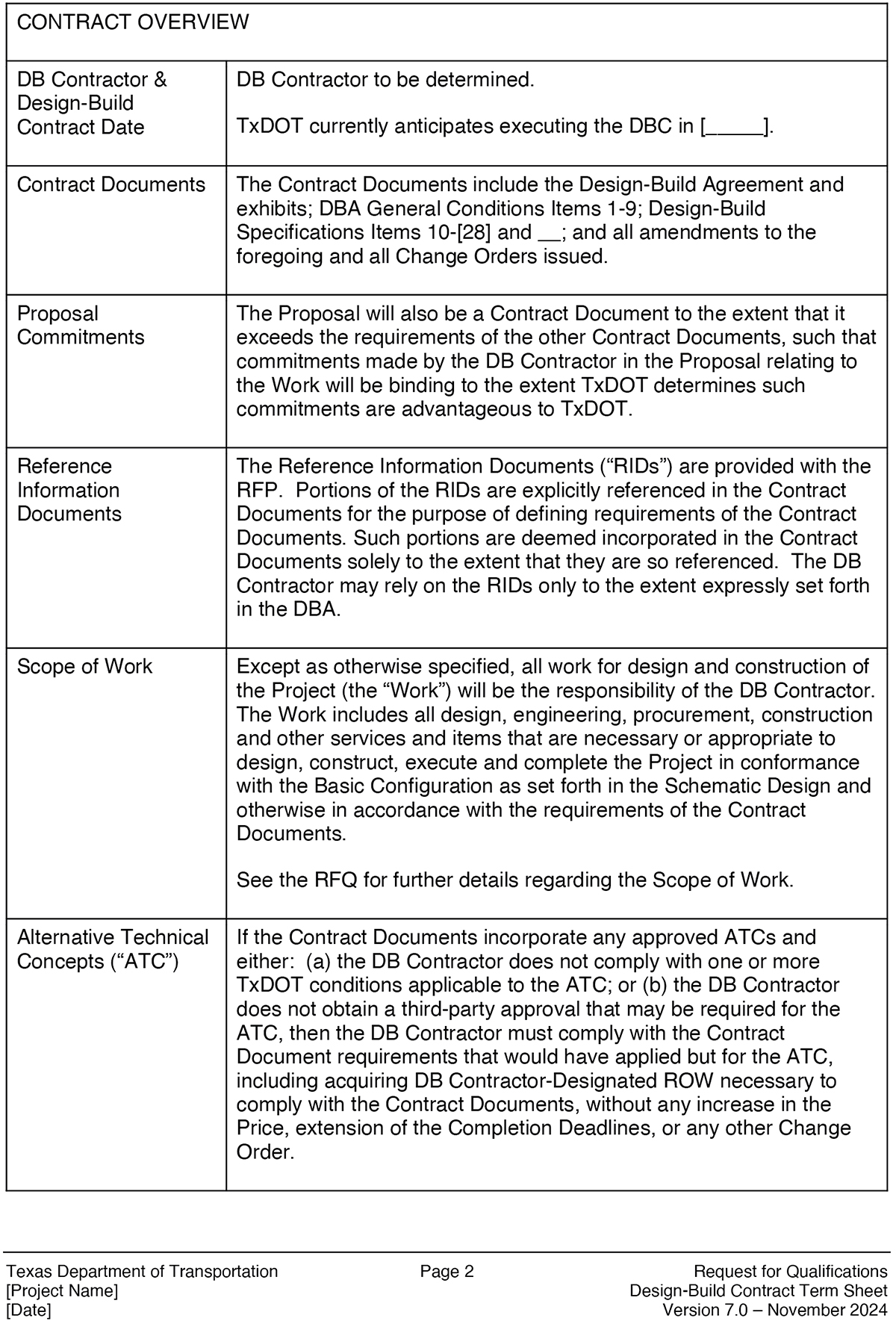
Long Description.
A table provides the following list under the heading Contract Overview. DB Contractor & Design-Build Contract Date: DB Contractor to be determined. Texas DOT currently anticipates executing the DBC in blank space. Contract Documents: The Contract Documents include the Design-Build Agreement and exhibits; DBA General Conditions Items 1 to 9; Design-Build Specifications Items 10 to [28] and ; and all amendments to the foregoing and all Change Orders issued. Proposal: The Proposal will also be a Contract Document to the extent that it Commitments: exceeds the requirements of the other Contract Documents, such that commitments made by the DB Contractor in the Proposal relating to the Work will be binding to the extent Texas DOT determines such commitments are advantageous to Texas DOT. Reference: The Reference Information Documents (“RIDs”) are provided with the Information: RFP. Portions of the RIDs are explicitly referenced in the Contract Documents: Documents for the purpose of defining requirements of the Contract Documents. Such portions are deemed incorporated in the Contract Documents solely to the extent that they are so referenced. The DB Contractor may rely on the RIDs only to the extent expressly set forth in the DBA. Scope of Work: Except as otherwise specified, all work for design and construction of the Project (the “Work”) will be the responsibility of the DB Contractor. The Work includes all design, engineering, procurement, construction and other services and items that are necessary or appropriate to design, construct, execute and complete the Project in conformance with the Basic Configuration as set forth in the Schematic Design and otherwise in accordance with the requirements of the Contract Documents. See the RFQ for further details regarding the Scope of Work. Alternative Technical: If the Contract Documents incorporate any approved ATCs and Concepts (“ATC”): either: (a) the DB Contractor does not comply with one or more Texas DOT conditions applicable to the ATC; or (b) the DB Contractor does not obtain a third-party approval that may be required for the ATC, then the DB Contractor must comply with the Contract Document requirements that would have applied but for the ATC, including acquiring DB Contractor-Designated ROW necessary to comply with the Contract Documents, without any increase in the Price, extension of the Completion Deadlines, or any other Change Order. The bottom of the page has a footer with Texas Department of Transportation, space for the project name and date on the left, the page number in the middle, and the document title on the right: Request for Qualifications, Design-Build Contract Term Sheet, Version 7.0 – November 2024.
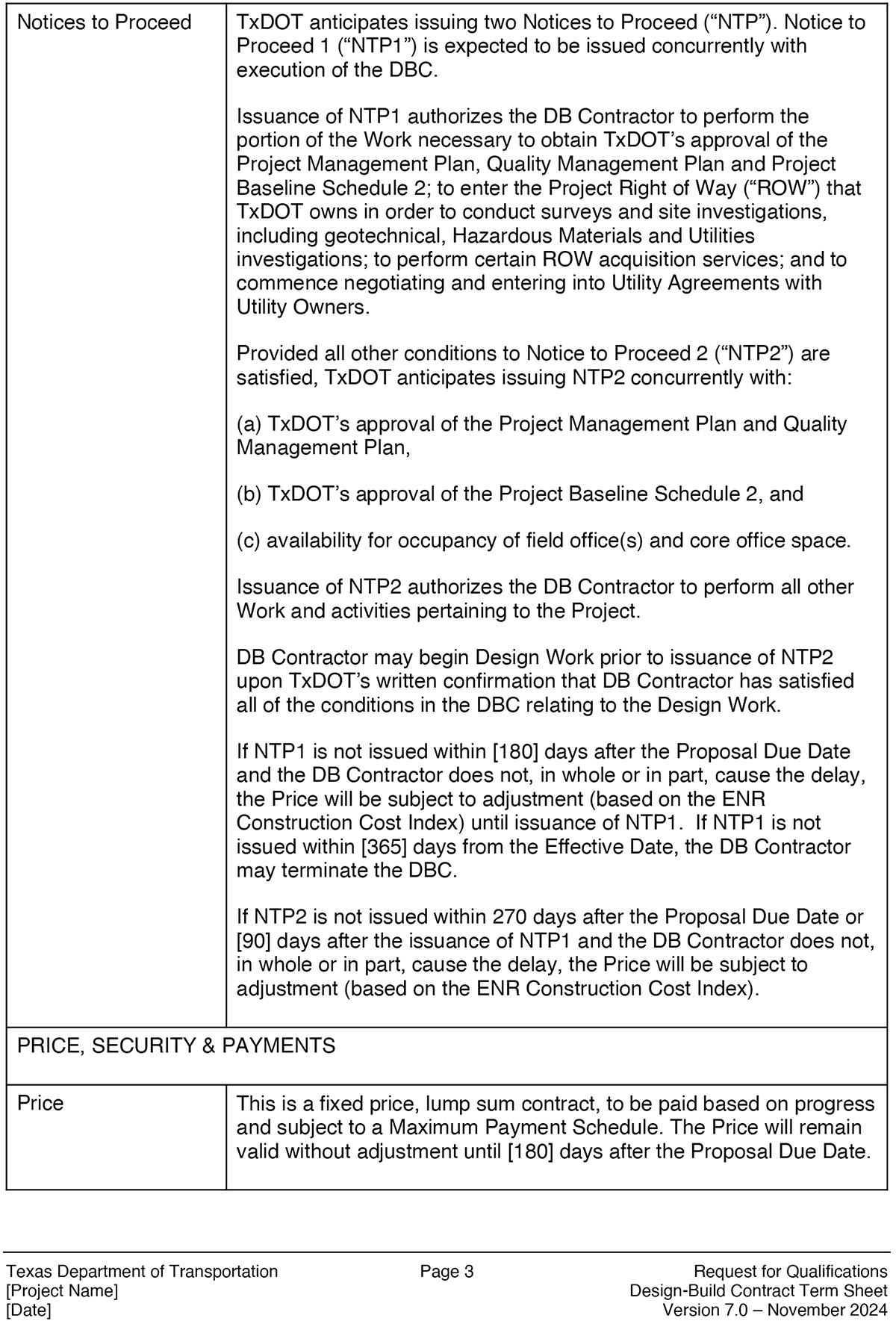
Long Description.
A table continues the list of Contract Overview items.
Notices to Proceed: Texas DOT anticipates issuing two Notices to Proceed (“NTP”). Notice to Proceed 1 (“NTP1”) is expected to be issued concurrently with execution of the DBC.
Issuance of NTP1 authorizes the DB Contractor to perform the portion of the Work necessary to obtain Texas DOTʼs approval of the Project Management Plan, Quality Management Plan and Project Baseline Schedule 2; to enter the Project Right of Way (“ROW”) that Texas DOT owns in order to conduct surveys and site investigations, including geotechnical, Hazardous Materials and Utilities investigations; to perform certain ROW acquisition services; and to commence negotiating and entering into Utility Agreements with Utility Owners.
Provided all other conditions to Notice to Proceed 2 (“NTP2”) are satisfied, Texas DOT anticipates issuing NTP2 concurrently with:
(a) Texas DOTʼs approval of the Project Management Plan and Quality Management Plan,
(b) Texas DOTʼs approval of the Project Baseline Schedule 2, and
(c) availability for occupancy of field office(s) and core office space.
Issuance of NTP2 authorizes the DB Contractor to perform all other Work and activities pertaining to the Project.
DB Contractor may begin Design Work prior to issuance of NTP2 upon Texas DOTʼs written confirmation that DB Contractor has satisfied all of the conditions in the DBC relating to the Design Work.
If NTP1 is not issued within [180] days after the Proposal Due Date and the DB Contractor does not, in whole or in part, cause the delay, the Price will be subject to adjustment (based on the ENR Construction Cost Index) until issuance of NTP1. If NTP1 is not issued within [365] days from the Effective Date, the DB Contractor may terminate the DBC.
If NTP2 is not issued within 270 days after the Proposal Due Date or [90] days after the issuance of NTP1 and the DB Contractor does not, in whole or in part, cause the delay, the Price will be subject to adjustment (based on the ENR Construction Cost Index).
A new heading, for Price, Security, and Payments follows, with the following item listed on this page:
Price: This is a fixed price, lump sum contract, to be paid based on progress and subject to a Maximum Payment Schedule. The Price will remain valid without adjustment until [180] days after the Proposal Due Date.
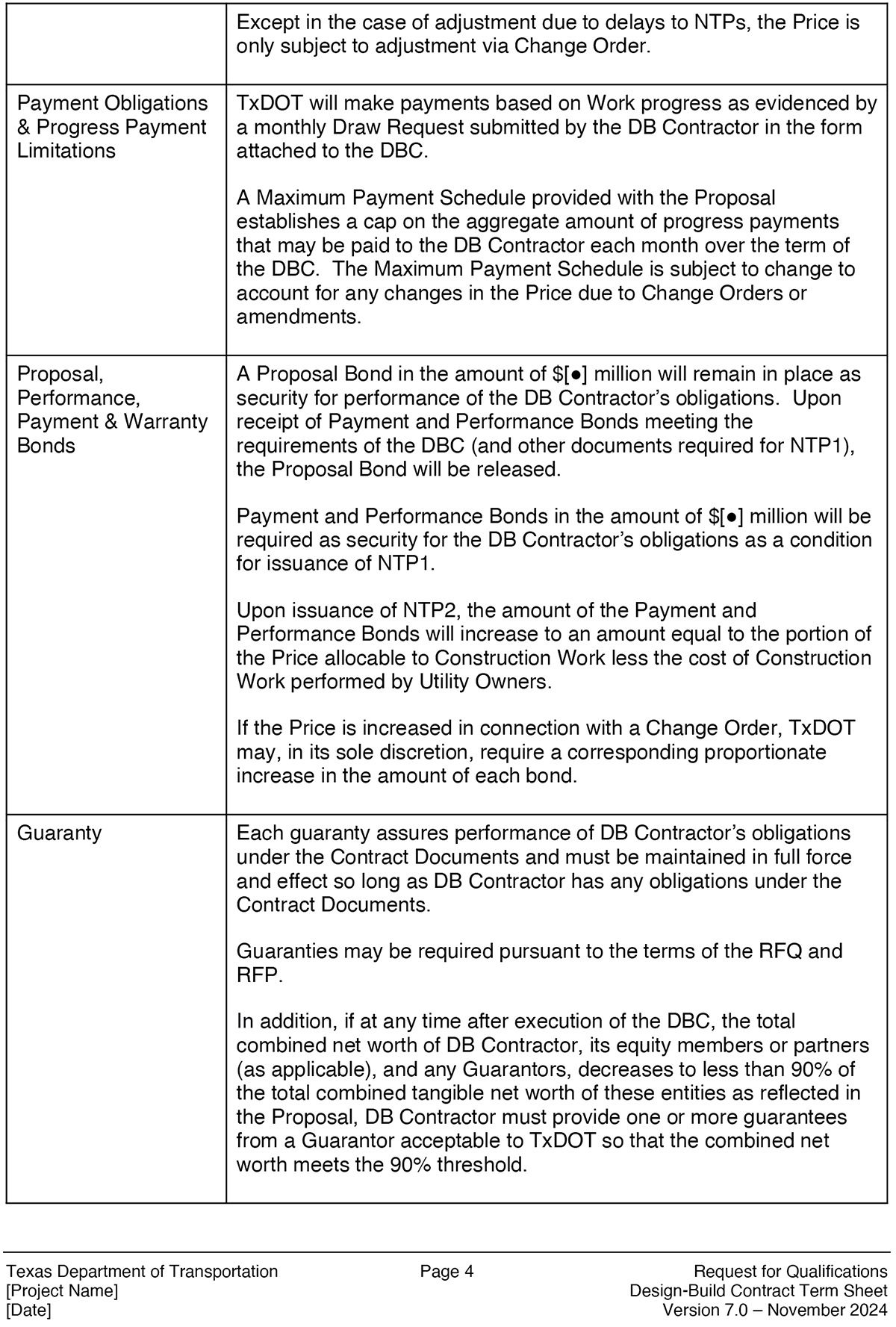
Long Description.
The list of Price, Security, and Payment items continues from the previous page:
Except in the case of adjustment due to delays to NTPs, the Price is only subject to adjustment via Change Order.
Payment Obligations & Progress Payment Limitations: Texas DOT will make payments based on Work progress as evidenced by a monthly Draw Request submitted by the DB Contractor in the form attached to the DBC.
A Maximum Payment Schedule provided with the Proposal establishes a cap on the aggregate amount of progress payments that may be paid to the DB Contractor each month over the term of the DBC. The Maximum Payment Schedule is subject to change to account for any changes in the Price due to Change Orders or amendments.
Proposal, Performance, Payment & Warranty Bonds: A Proposal Bond in the amount of $[X] million will remain in place as security for performance of the DB Contractorʼs obligations. Upon receipt of Payment and Performance Bonds meeting the requirements of the DBC (and other documents required for NTP1), the Proposal Bond will be released.
Payment and Performance Bonds in the amount of $[X] million will be required as security for the DB Contractorʼs obligations as a condition for issuance of NTP1.
Upon issuance of NTP2, the amount of the Payment and Performance Bonds will increase to an amount equal to the portion of the Price allocable to Construction Work less the cost of Construction Work performed by Utility Owners.
If the Price is increased in connection with a Change Order, Texas DOT may, in its sole discretion, require a corresponding proportionate increase in the amount of each bond.
Guaranty: Each guaranty assures performance of DB Contractorʼs obligations under the Contract Documents and must be maintained in full force and effect so long as DB Contractor has any obligations under the Contract Documents.
Guaranties may be required pursuant to the terms of the RFQ and RFP.
In addition, if at any time after execution of the DBC, the total combined net worth of DB Contractor, its equity members or partners (as applicable), and any Guarantors, decreases to less than 90% of the total combined tangible net worth of these entities as reflected in the Proposal, DB Contractor must provide one or more guarantees from a Guarantor acceptable to Texas DOT so that the combined net worth meets the 90% threshold.
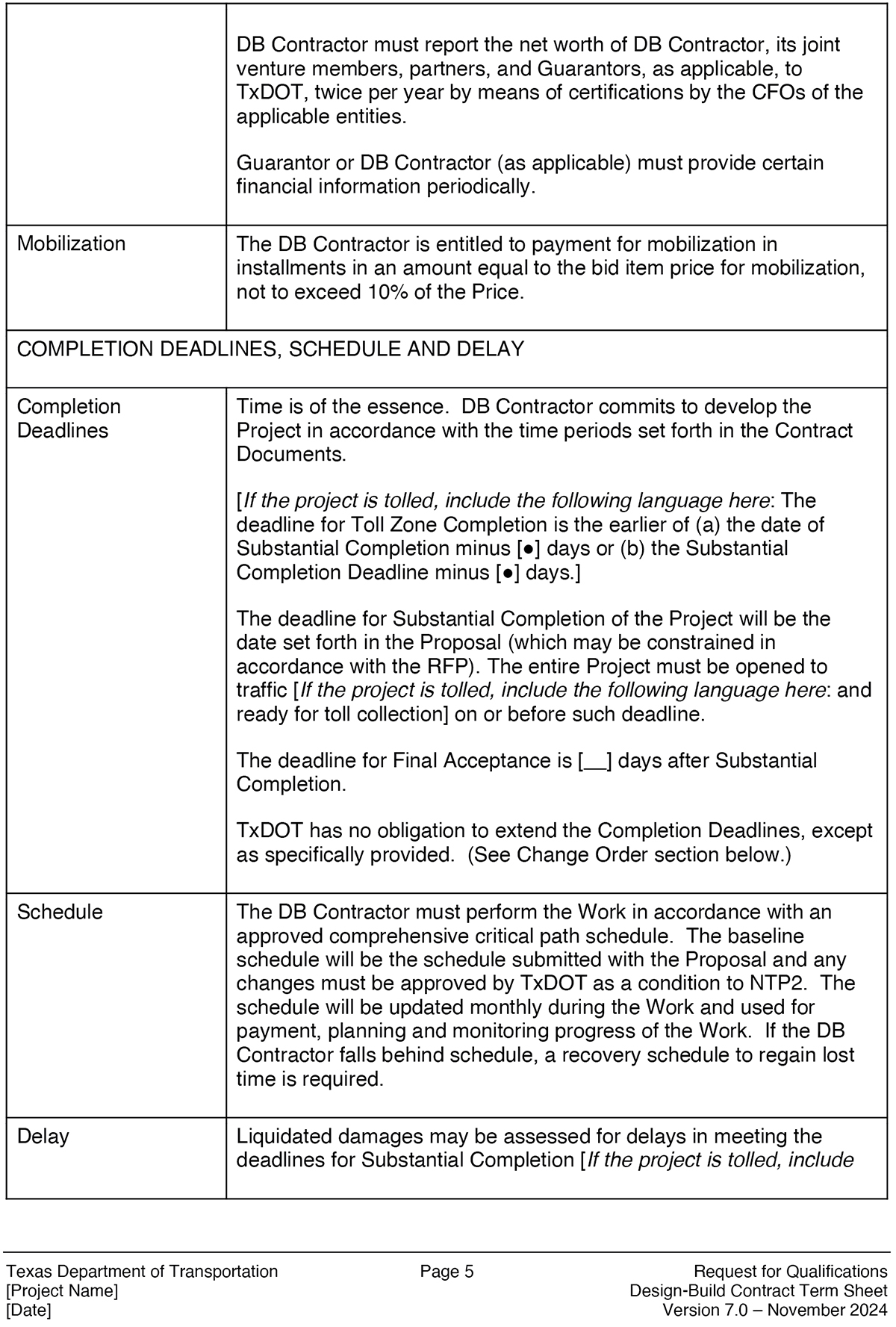
Long Description.
The list of Price, Security, and Payment items continues from the previous page:
DB Contractor must report the net worth of DB Contractor, its joint venture members, partners, and Guarantors, as applicable, to Texas DOT, twice per year by means of certifications by the CFOs of the applicable entities.
Guarantor or DB Contractor (as applicable) must provide certain financial information periodically.
Mobilization: The DB Contractor is entitled to payment for mobilization in installments in an amount equal to the bid item price for mobilization, not to exceed 10% of the Price.
A new heading for Completion deadlines, schedule, and delay lists the following: Completion Deadlines: Time is of the essence. DB Contractor commits to develop the Project in accordance with the time periods set forth in the Contract Documents.
[If the project is tolled, include the following language here: The deadline for Toll Zone Completion is the earlier of (a) the date of Substantial Completion minus [X] days or (b) the Substantial Completion Deadline minus [X] days.]
The deadline for Substantial Completion of the Project will be the date set forth in the Proposal (which may be constrained in accordance with the RFP). The entire Project must be opened to traffic [If the project is tolled, include the following language here: and ready for toll collection] on or before such deadline.
The deadline for Final Acceptance is [ ] days after Substantial Completion.
Texas DOT has no obligation to extend the Completion Deadlines, except as specifically provided. (See Change Order section below.)
Schedule The DB Contractor must perform the Work in accordance with an approved comprehensive critical path schedule. The baseline schedule will be the schedule submitted with the Proposal and any changes must be approved by Texas DOT as a condition to NTP2. The schedule will be updated monthly during the Work and used for payment, planning and monitoring progress of the Work. If the DB Contractor falls behind schedule, a recovery schedule to regain lost time is required.
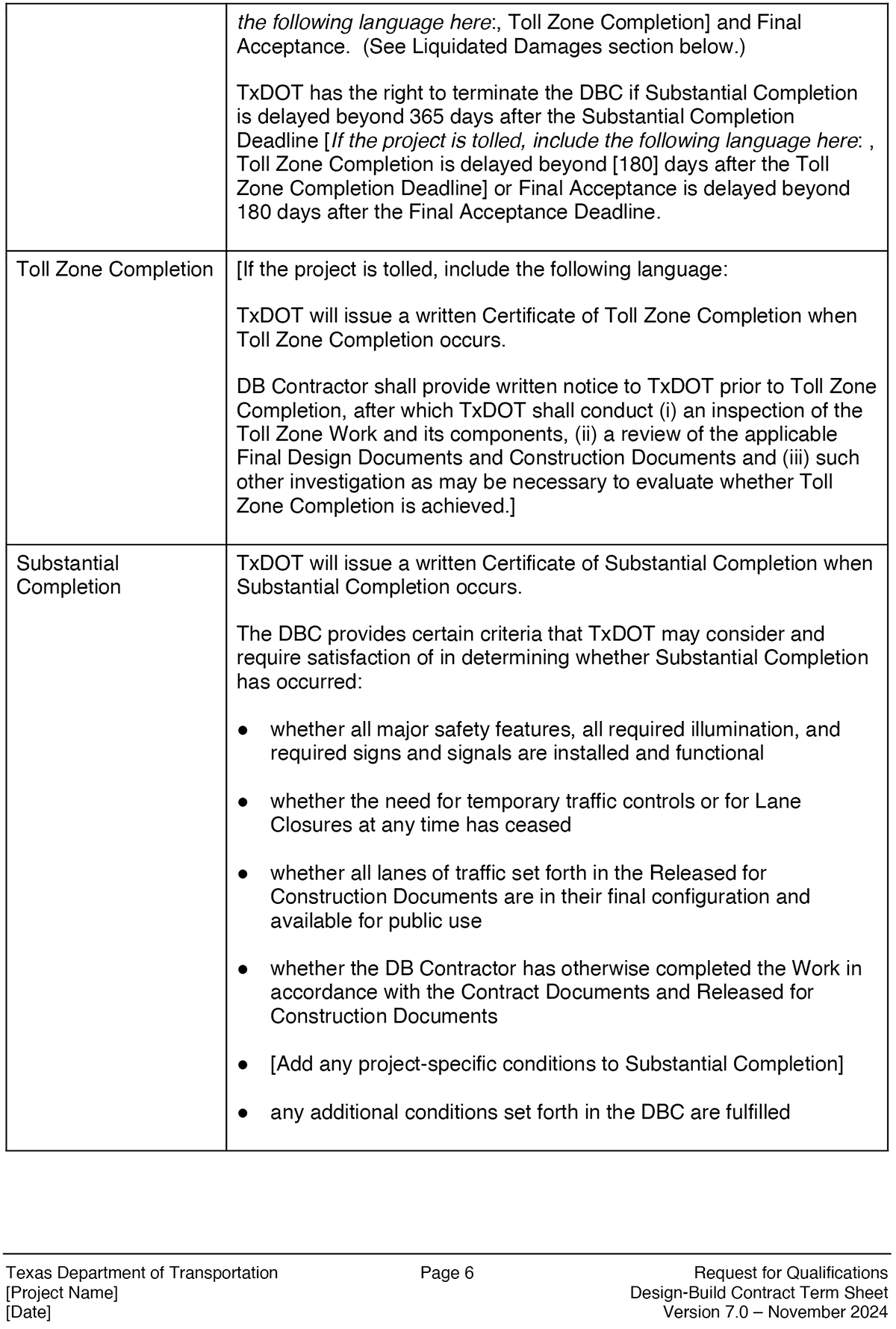
Delay Liquidated damages may be assessed for delays in meeting the deadlines for Substantial Completion [If the project is tolled, include
Long Description.
The list of Completion deadlines, schedule, and delay items continues as follows:
the following language here:, Toll Zone Completion] and Final Acceptance. (See Liquidated Damages section below.)
Texas DOT has the right to terminate the DBC if Substantial Completion is delayed beyond 365 days after the Substantial Completion Deadline [If the project is tolled, include the following language here: , Toll Zone Completion is delayed beyond [180] days after the Toll Zone Completion Deadline] or Final Acceptance is delayed beyond 180 days after the Final Acceptance Deadline.
Toll Zone Completion [If the project is tolled, include the following language:
Texas DOT will issue a written Certificate of Toll Zone Completion when Toll Zone Completion occurs.
DB Contractor shall provide written notice to Texas DOT prior to Toll Zone Completion, after which Texas DOT shall conduct (i) an inspection of the Toll Zone Work and its components, (ii) a review of the applicable Final Design Documents and Construction Documents and (iii) such other investigation as may be necessary to evaluate whether Toll Zone Completion is achieved.]
Substantial Completion Texas DOT will issue a written Certificate of Substantial Completion when Substantial Completion occurs.
The DBC provides certain criteria that Texas DOT may consider and require satisfaction of in determining whether Substantial Completion has occurred:
Whether all major safety features, all required illumination, and required signs and signals are installed and functional; whether the need for temporary traffic controls or for Lane Closures at any time has ceased; whether all lanes of traffic set forth in the Released for Construction Documents are in their final configuration and available for public use; whether the DB Contractor has otherwise completed the Work in accordance with the Contract Documents and Released for Construction Documents; [Add any project-specific conditions to Substantial Completion]; any additional conditions set forth in the DBC are fulfilled.
Long Description.
The list of Completion deadlines, schedule, and delay items continues as follows:
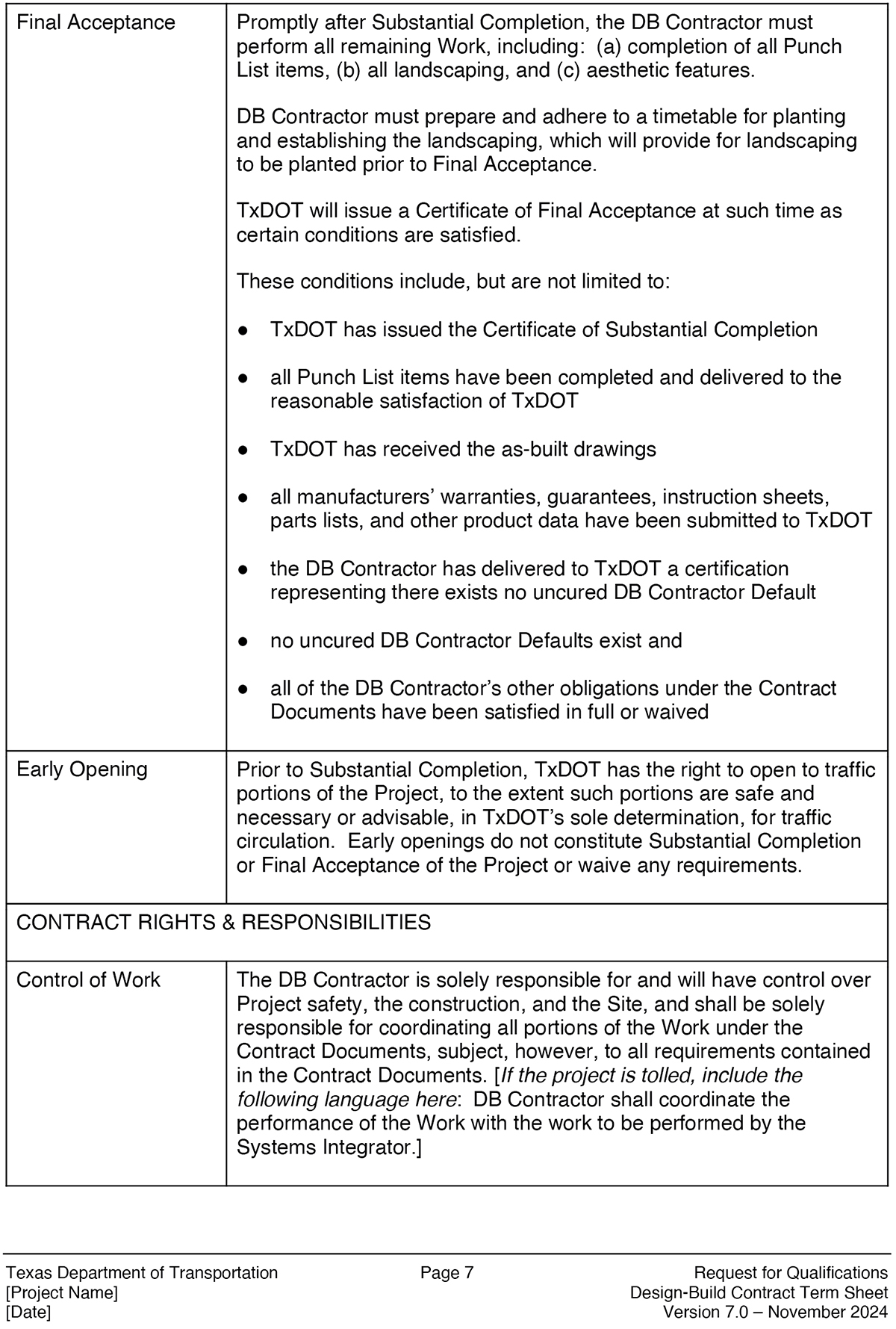
Final Acceptance: Promptly after Substantial Completion, the DB Contractor must perform all remaining Work, including: (a) completion of all Punch List items, (b) all landscaping, and (c) aesthetic features.
DB Contractor must prepare and adhere to a timetable for planting and establishing the landscaping, which will provide for landscaping to be planted prior to Final Acceptance.
Texas DOT will issue a Certificate of Final Acceptance at such time as certain conditions are satisfied.
These conditions include, but are not limited to: Texas DOT has issued the Certificate of Substantial Completion; all Punch List items have been completed and delivered to the reasonable satisfaction of Texas DOT; Texas DOT has received the as-built drawings; all manufacturersʼ warranties, guarantees, instruction sheets, parts lists, and other product data have been submitted to Texas DOT; the DB Contractor has delivered to Texas DOT a certification representing there exists no uncured DB Contractor Default; no uncured DB Contractor Defaults exist and; all of the DB Contractorʼs other obligations under the Contract Documents have been satisfied in full or waived
Early Opening: Prior to Substantial Completion, Texas DOT has the right to open to traffic portions of the Project, to the extent such portions are safe and necessary or advisable, in Texas DOTʼs sole determination, for traffic circulation. Early openings do not constitute Substantial Completion or Final Acceptance of the Project or waive any requirements.
A new heading for Contract Rights and Responsibilities lists the following items: Control of Work: The DB Contractor is solely responsible for and will have control over Project safety, the construction, and the Site, and shall be solely responsible for coordinating all portions of the Work under the Contract Documents, subject, however, to all requirements contained in the Contract Documents. [If the project is tolled, include the following language here: DB Contractor shall coordinate the performance of the Work with the work to be performed by the Systems Integrator.]
Long Description.
The list of Contract Rights and Responsibilities continues as follows:
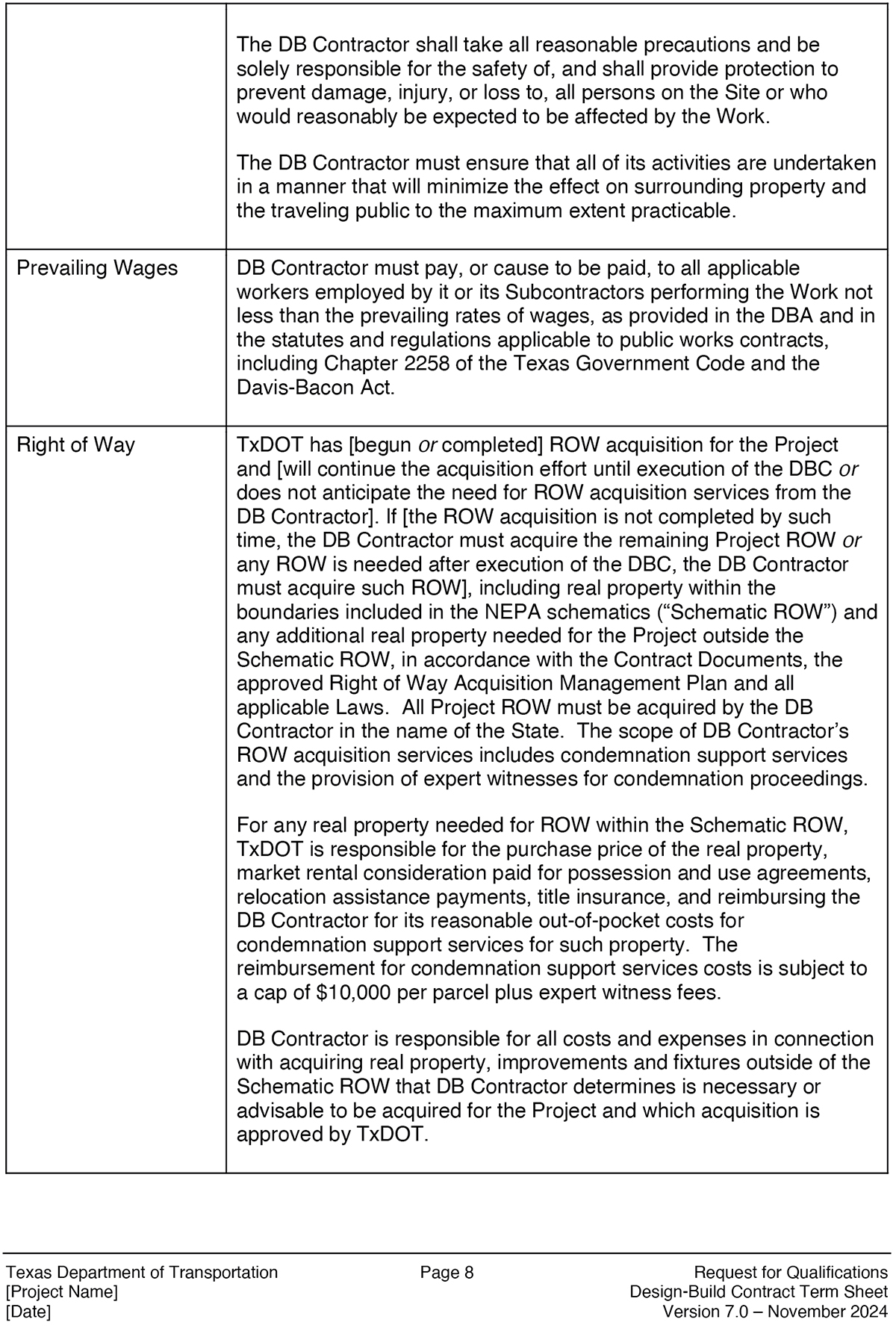
The DB Contractor shall take all reasonable precautions and be solely responsible for the safety of, and shall provide protection to prevent damage, injury, or loss to, all persons on the Site or who would reasonably be expected to be affected by the Work. The DB Contractor must ensure that all of its activities are undertaken in a manner that will minimize the effect on surrounding property and the traveling public to the maximum extent practicable.
Prevailing Wages: DB Contractor must pay, or cause to be paid, to all applicable workers employed by it or its Subcontractors performing the Work not less than the prevailing rates of wages, as provided in the DBA and in the statutes and regulations applicable to public works contracts, including Chapter 2258 of the Texas Government Code and the Davis-Bacon Act.
Right of Way: Texas DOT has [begun or completed] ROW acquisition for the Project and [will continue the acquisition effort until execution of the DBC or does not anticipate the need for ROW acquisition services from the DB Contractor]. If [the ROWacquisition is not completed by such time, the DB Contractor must acquire the remaining Project ROW or any ROW is needed after execution of the DBC, the DB Contractor must acquire such ROW], including real property within the boundaries included in the NEPA schematics (“Schematic ROW”) and any additional real property needed for the Project outside the Schematic ROW, in accordance with the Contract Documents, the approved Right of Way Acquisition Management Plan and all applicable Laws. All Project ROW must be acquired by the DB Contractor in the name of the State. The scope of DB Contractorʼs ROW acquisition services includes condemnation support services and the provision of expert witnesses for condemnation proceedings.
For any real property needed for ROW within the Schematic ROW, Texas DOT is responsible for the purchase price of the real property, market rental consideration paid for possession and use agreements, relocation assistance payments, title insurance, and reimbursing the DB Contractor for its reasonable out-of-pocket costs for condemnation support services for such property. The reimbursement for condemnation support services costs is subject to a cap of $10,000 per parcel plus expert witness fees.
DB Contractor is responsible for all costs and expenses in connection with acquiring real property, improvements and fixtures outside of the Schematic ROW that DB Contractor determines is necessary or advisable to be acquired for the Project and which acquisition is approved by Texas DOT.
Long Description.
The list of Contract Rights and Responsibilities continues as follows:
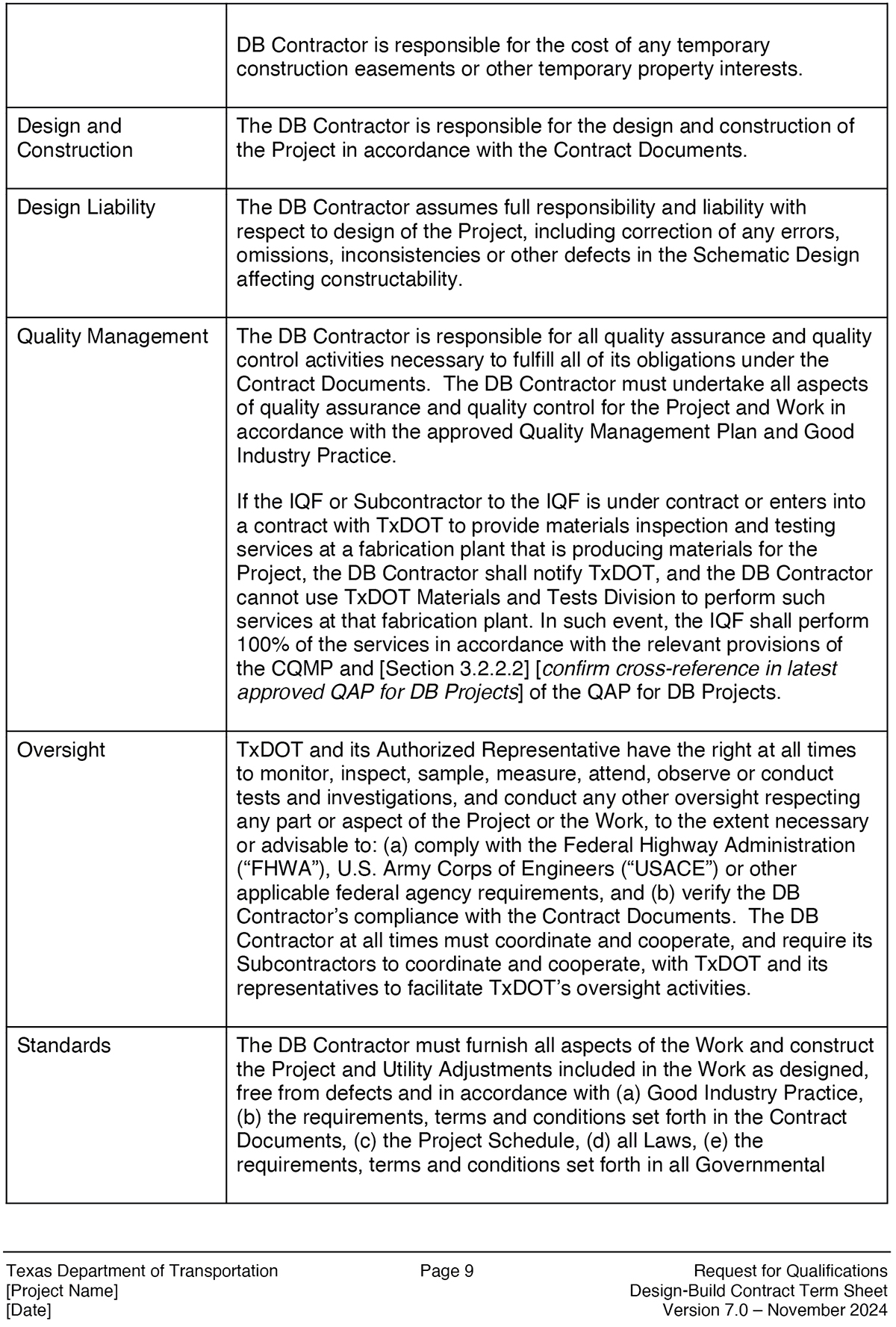
DB Contractor is responsible for the cost of any temporary construction easements or other temporary property interests.
Design and Construction The DB Contractor is responsible for the design and construction of the Project in accordance with the Contract Documents.
Design Liability The DB Contractor assumes full responsibility and liability with respect to design of the Project, including correction of any errors, omissions, inconsistencies or other defects in the Schematic Design affecting constructability.
Quality Management The DB Contractor is responsible for all quality assurance and quality control activities necessary to fulfill all of its obligations under the Contract Documents. The DB Contractor must undertake all aspects of quality assurance and quality control for the Project and Work in accordance with the approved Quality Management Plan and Good Industry Practice.
If the IQF or Subcontractor to the IQF is under contract or enters into a contract with Texas DOT to provide materials inspection and testing services at a fabrication plant that is producing materials for the Project, the DB Contractor shall notify Texas DOT, and the DB Contractor cannot use Texas DOT Materials and Tests Division to perform such services at that fabrication plant. In such event, the IQF shall perform 100% of the services in accordance with the relevant provisions of the CQMP and [Section 3.2.2.2] [confirm cross-reference in latest approved QAP for DB Projects] of the QAP for DB Projects.
Oversight Texas DOT and its Authorized Representative have the right at all times to monitor, inspect, sample, measure, attend, observe or conduct tests and investigations, and conduct any other oversight respecting any part or aspect of the Project or the Work, to the extent necessary or advisable to: (a) comply with the Federal Highway Administration (“FHWA”), U.S. Army Corps of Engineers (“USACE”) or other applicable federal agency requirements, and (b) verify the DB Contractorʼs compliance with the Contract Documents. The DB Contractor at all times must coordinate and cooperate, and require its Subcontractors to coordinate and cooperate, with Texas DOT and its representatives to facilitate Texas DOTʼs oversight activities.
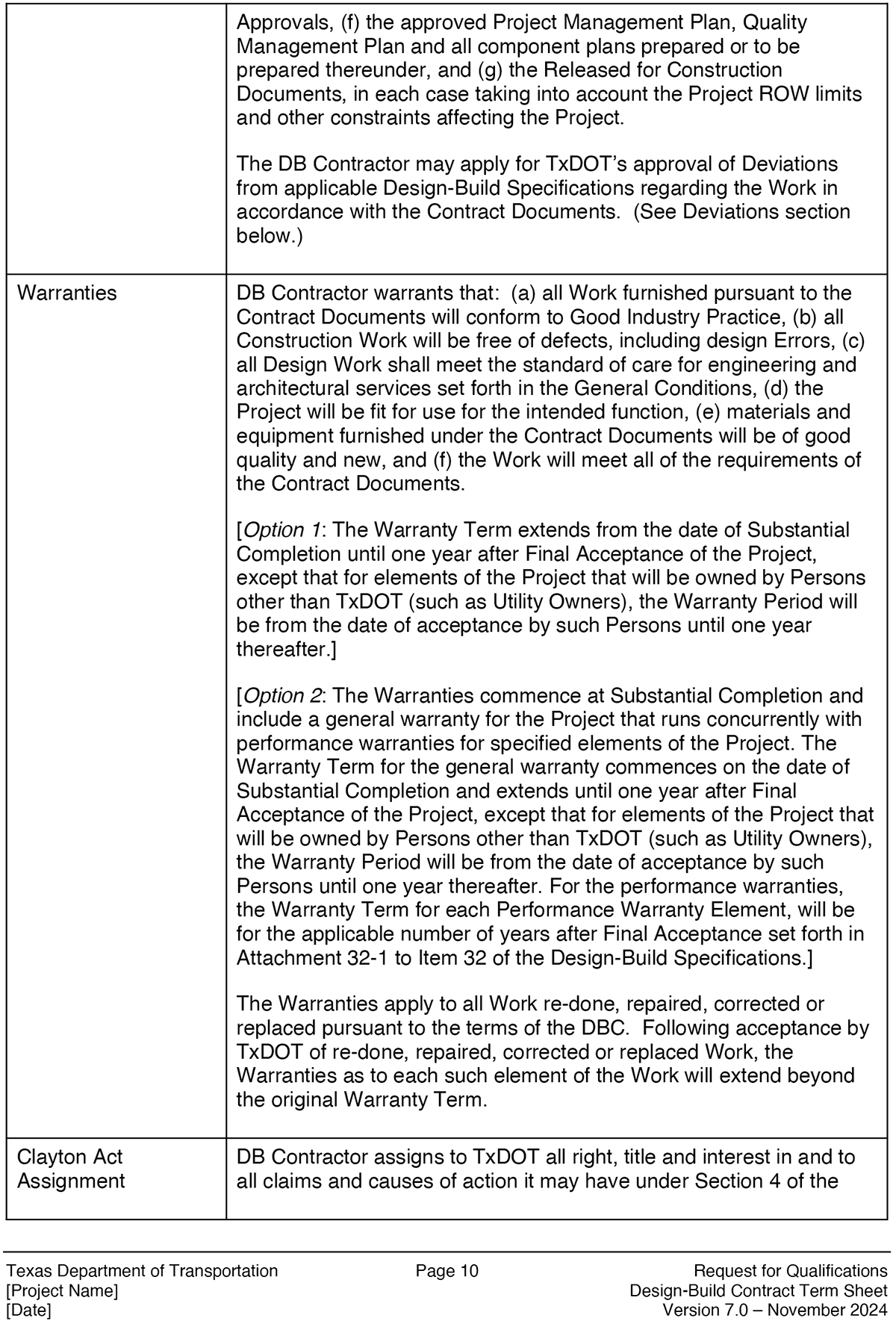
Standards The DB Contractor must furnish all aspects of the Work and construct the Project and Utility Adjustments included in the Work as designed, free from defects and in accordance with (a) Good Industry Practice, (b) the requirements, terms and conditions set forth in the Contract Documents, (c) the Project Schedule, (d) all Laws, (e) the requirements, terms and conditions set forth in all Governmental
Long Description.
The list of Contract Rights and Responsibilities continues as follows:
Approvals, (f) the approved Project Management Plan, Quality Management Plan and all component plans prepared or to be prepared thereunder, and (g) the Released for Construction Documents, in each case taking into account the Project ROW limits and other constraints affecting the Project.
The DB Contractor may apply for Texas DOTʼs approval of Deviations from applicable Design-Build Specifications regarding the Work in accordance with the Contract Documents. (See Deviations section below.)
Warranties DB Contractor warrants that: (a) all Work furnished pursuant to the Contract Documents will conform to Good Industry Practice, (b) all Construction Work will be free of defects, including design Errors, (c) all Design Work shall meet the standard of care for engineering and architectural services set forth in the General Conditions, (d) the Project will be fit for use for the intended function, (e) materials and equipment furnished under the Contract Documents will be of good quality and new, and (f) the Work will meet all of the requirements of the Contract Documents.
[Option 1: The Warranty Term extends from the date of Substantial Completion until one year after Final Acceptance of the Project, except that for elements of the Project that will be owned by Persons other than Texas DDOT (such as Utility Owners), the Warranty Period will be from the date of acceptance by such Persons until one year thereafter.]
[Option 2: The Warranties commence at Substantial Completion and include a general warranty for the Project that runs concurrently with performance warranties for specified elements of the Project. The Warranty Term for the general warranty commences on the date of Substantial Completion and extends until one year after Final Acceptance of the Project, except that for elements of the Project that will be owned by Persons other than Texas DOT (such as Utility Owners), the Warranty Period will be from the date of acceptance by such Persons until one year thereafter. For the performance warranties, the Warranty Term for each Performance Warranty Element, will be for the applicable number of years after Final Acceptance set forth in Attachment 32-1 to Item 32 of the Design-Build Specifications.]
The Warranties apply to all Work re-done, repaired, corrected or replaced pursuant to the terms of the DBC. Following acceptance by Texas DOT of re-done, repaired, corrected or replaced Work, the Warranties as to each such element of the Work will extend beyond the original Warranty Term.
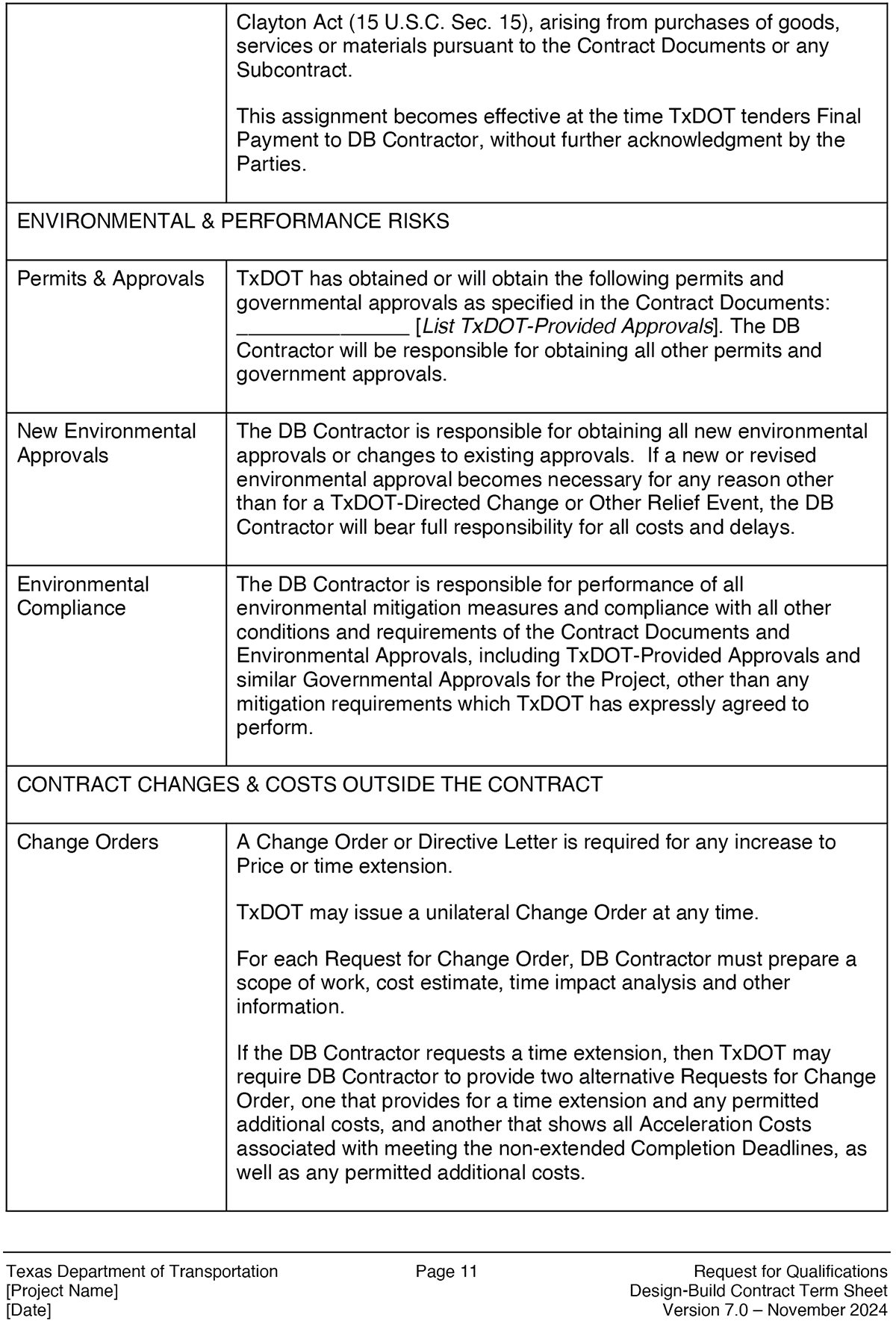
Clayton Act Assignment DB Contractor assigns to Texas DOT all right, title and interest in and to all claims and causes of action it may have under Section 4 of the
Long Description.
The list of Contract Rights and Responsibilities continues as follows:
Clayton Act (15 U.S.C. Sec. 15), arising from purchases of goods, services or materials pursuant to the Contract Documents or any Subcontract.
This assignment becomes effective at the time Texas DOT tenders Final Payment to DB Contractor, without further acknowledgment by the Parties.
A new heading for Environmental and Performance Risks under which the following items are listed:
Permits & Approvals Texas DOT has obtained or will obtain the following permits and governmental approvals as specified in the Contract Documents: blank space to List Texas DOT-Provided Approvals. The DB Contractor will be responsible for obtaining all other permits and government approvals.
New Environmental Approvals The DB Contractor is responsible for obtaining all new environmental approvals or changes to existing approvals. If a new or revised environmental approval becomes necessary for any reason other than for a Texas DOT-Directed Change or Other Relief Event, the DB Contractor will bear full responsibility for all costs and delays.
Environmental Compliance The DB Contractor is responsible for performance of all Compliance environmental mitigation measures and compliance with all other conditions and requirements of the Contract Documents and Environmental Approvals, including Texas DOT-Provided Approvals and similar Governmental Approvals for the Project, other than any mitigation requirements which Texas DOT has expressly agreed to perform. A new heading for Contract Changes and Costs Outside the Contract, under which the following items are listed: Change Orders A Change Order or Directive Letter is required for any increase to Price or time extension.
Texas DOT may issue a unilateral Change Order at any time.
For each Request for Change Order, DB Contractor must prepare a scope of work, cost estimate, time impact analysis and other information.
If the DB Contractor requests a time extension, then Texas DOT may require DB Contractor to provide two alternative Requests for Change Order, one that provides for a time extension and any permitted additional costs, and another that shows all Acceleration Costs associated with meeting the non-extended Completion Deadlines, as well as any permitted additional costs.

Long Description.
The list of Contract Changes and Costs Outside the Contract continues:
Change Orders are subject to strict requirements (including notice & delivery).
Any increase to the Price under any Change Order may not include:
(i) the amount of any insurance available to the DB Contractor, (ii) any deductible or self-insured retention associated with such insurance, or (iii) the amount of any insurance coverage required under the DBC that is deemed to be self-insured by the DB Contractor.
Differing Site Subject to the following limits, the DB Contractor is entitled to a Conditions Change Order for certain additional costs resulting from the existence of Differing Site Conditions. The DB Contractor is fully responsible for costs up to the Differing Site Conditions Deductible ($[X]) incurred for changes in the Work resulting from each separate occurrence of Differing Site Conditions, subject to the Differing Site Conditions Aggregate Deductible Cap ($[X]). Except for project overhead to be calculated in accordance with the DBC for each day that a Completion Deadline is extended, delay and disruption damages are not recoverable.
DB Contractor will be allowed a time extension for certain delays to the Critical Path resulting from Differing Site Conditions. The risk of such delays will be shared between DB Contractor and Texas DOT, provided DB Contractorʼs responsibility for such delays is capped, as set forth in the DBC. If DB Contractor is prohibited from working at a particular location due to the discovery of Differing Site Conditions for which DB Contractor is entitled to a Change Order during the last 12 months prior to a Completion Deadline, then DB Contractor shall be entitled to an extension of the applicable Completion Deadline(s) for any Critical Path delays resulting from such discovery of Differing Site Conditions.
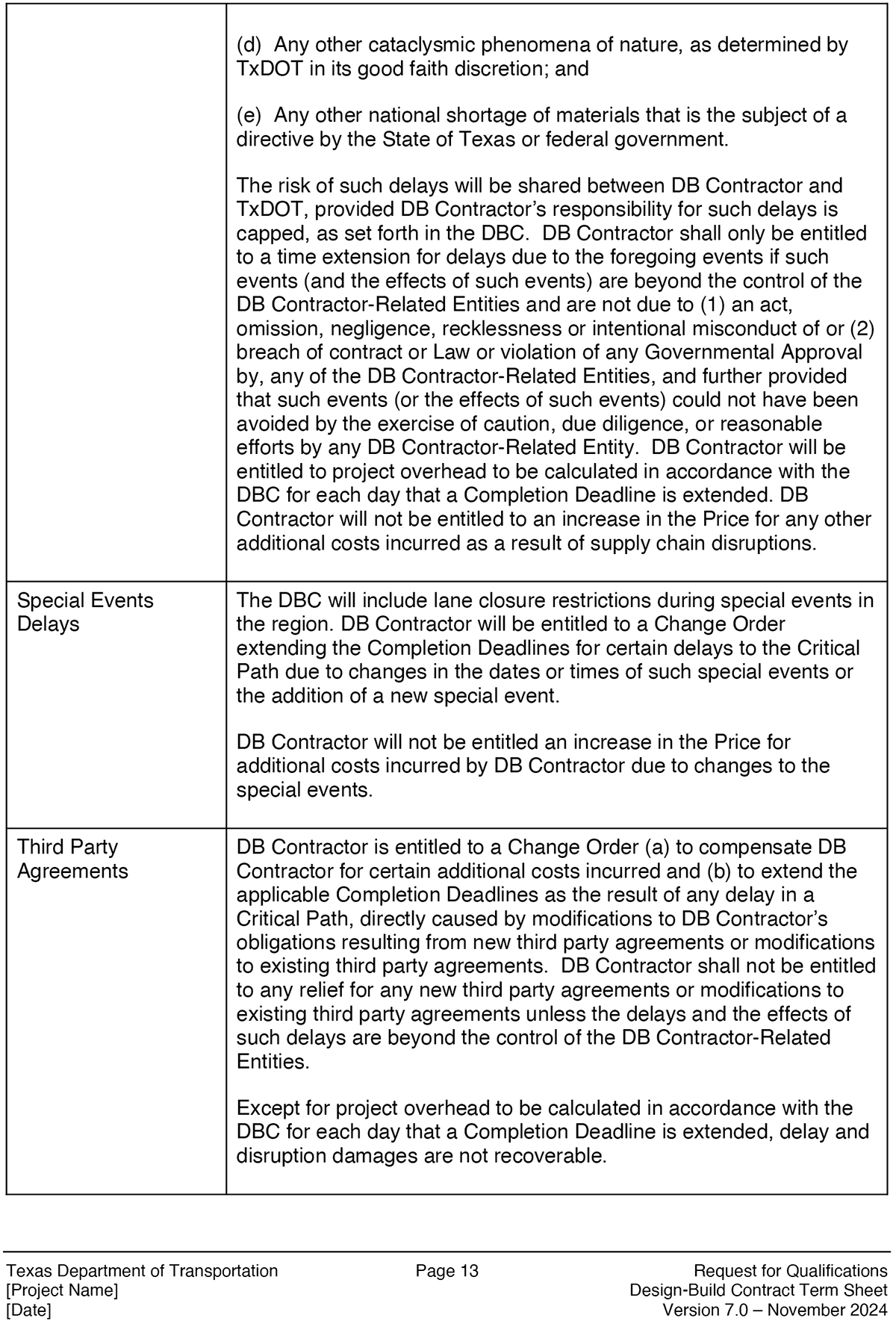
Supply Chain Disruptions DB Contractor is entitled to a Change Order extending the Disruptions Completion Deadlines for delays to the Critical Path resulting from unavailability of materials due to:
(a) Any earthquake, tornado, hurricane or other natural disaster that
(i) occurs in Texas and (ii) has been proclaimed a disaster or state of emergency by the President of the United States, the Governor of the State of Texas, or the Federal Highway Administrator;
(b) Any epidemic in the State of Texas;
(c) Any blockade, rebellion, war, riot, act of sabotage, act of terrorism or civil commotion, in each case that occurs on the soil of the continental United States;
Long Description.
The list of Contract Changes and Costs Outside the Contract continues:
(d) Any other cataclysmic phenomena of nature, as determined by Texas DOT in its good faith discretion; and
(e) Any other national shortage of materials that is the subject of a directive by the State of Texas or federal government.
The risk of such delays will be shared between DB Contractor and Texas DOT, provided DB Contractorʼs responsibility for such delays is capped, as set forth in the DBC. DB Contractor shall only be entitled to a time extension for delays due to the foregoing events if such events (and the effects of such events) are beyond the control of the DB Contractor-Related Entities and are not due to (1) an act, omission, negligence, recklessness or intentional misconduct of or (2) breach of contract or Law or violation of any Governmental Approval by, any of the DB Contractor-Related Entities, and further provided that such events (or the effects of such events) could not have been avoided by the exercise of caution, due diligence, or reasonable efforts by any DB Contractor-Related Entity. DB Contractor will be entitled to project overhead to be calculated in accordance with the DBC for each day that a Completion Deadline is extended. DB Contractor will not be entitled to an increase in the Price for any other additional costs incurred as a result of supply chain disruptions.
Special Events Delays The DBC will include lane closure restrictions during special events in Delays the region. DB Contractor will be entitled to a Change Order extending the Completion Deadlines for certain delays to the Critical Path due to changes in the dates or times of such special events or the addition of a new special event.
DB Contractor will not be entitled an increase in the Price for additional costs incurred by DB Contractor due to changes to the special events.
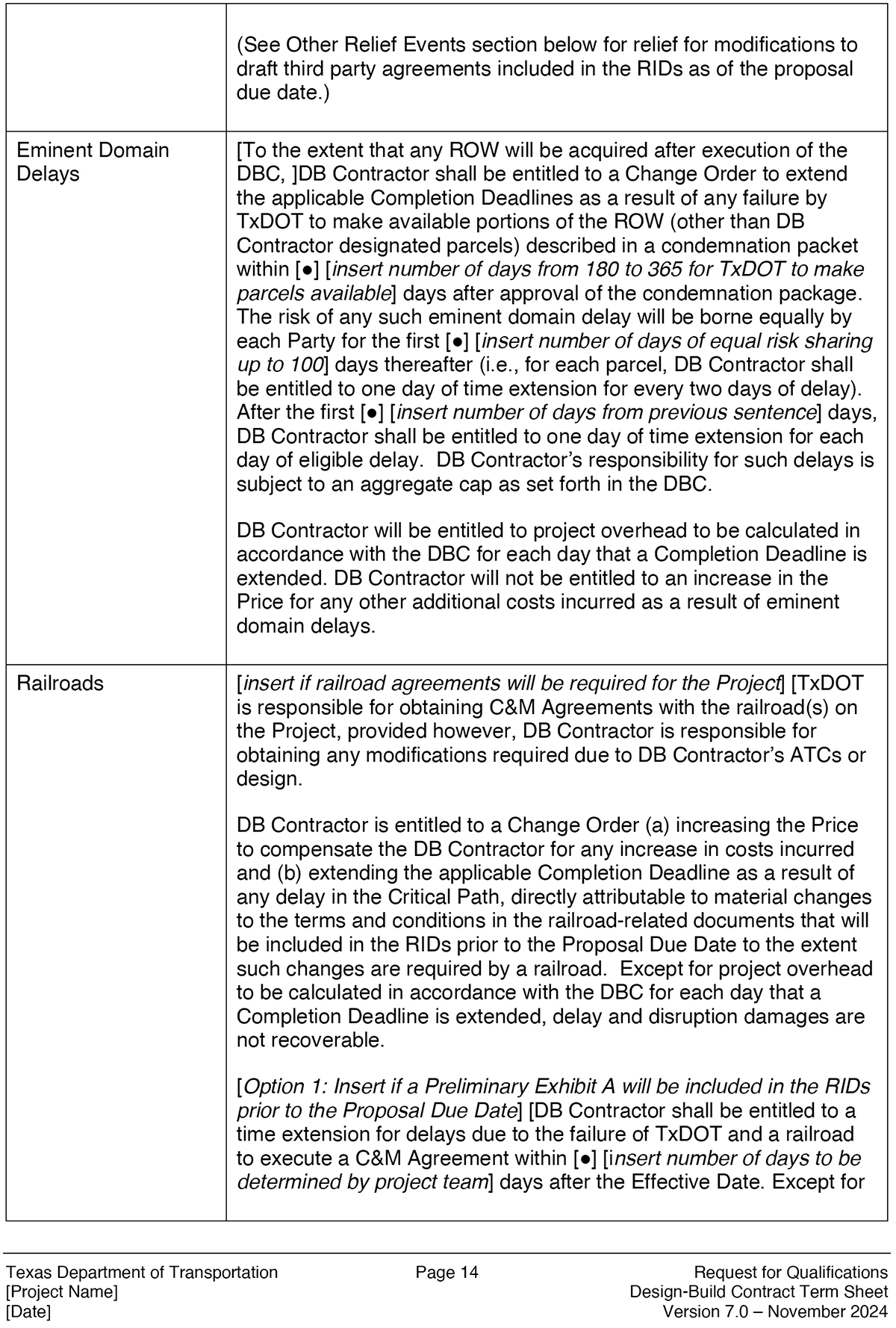
Third Party Agreements DB Contractor is entitled to a Change Order (a) to compensate DB Agreements Contractor for certain additional costs incurred and (b) to extend the applicable Completion Deadlines as the result of any delay in a Critical Path, directly caused by modifications to DB Contractorʼs obligations resulting from new third party agreements or modifications to existing third party agreements. DB Contractor shall not be entitled to any relief for any new third party agreements or modifications to existing third party agreements unless the delays and the effects of such delays are beyond the control of the DB Contractor-Related Entities.
Except for project overhead to be calculated in accordance with the DBC for each day that a Completion Deadline is extended, delay and disruption damages are not recoverable.
Long Description.
The list of Contract Changes and Costs Outside the Contract continues:
(See Other Relief Events section below for relief for modifications to draft third party agreements included in the RIDs as of the proposal due date.)
Eminent Domain Delays: [To the extent that any ROW will be acquired after execution of the DBC, ]DB Contractor shall be entitled to a Change Order to extend the applicable Completion Deadlines as a result of any failure by Texas DOT to make available portions of the ROW (other than DB Contractor designated parcels) described in a condemnation packet within [X] [insert number of days from 180 to 365 for Texas DOT to make parcels available] days after approval of the condemnation package. The risk of any such eminent domain delay will be borne equally by each Party for the first [X] [insert number of days of equal risk sharing up to 100] days thereafter (i.e., for each parcel, DB Contractor shall be entitled to one day of time extension for every two days of delay). After the first [X] [insert number of days from previous sentence] days, DB Contractor shall be entitled to one day of time extension for each day of eligible delay. DB Contractorʼs responsibility for such delays is subject to an aggregate cap as set forth in the DBC.
DB Contractor will be entitled to project overhead to be calculated in accordance with the DBC for each day that a Completion Deadline is extended. DB Contractor will not be entitled to an increase in the Price for any other additional costs incurred as a result of eminent domain delays.
Railroads: [insert if railroad agreements will be required for the Project] [Texas DOT is responsible for obtaining C&M Agreements with the railroad(s) on the Project, provided however, DB Contractor is responsible for obtaining any modifications required due to DB Contractorʼs ATCs or design.
DB Contractor is entitled to a Change Order (a) increasing the Price to compensate the DB Contractor for any increase in costs incurred and (b) extending the applicable Completion Deadline as a result of any delay in the Critical Path, directly attributable to material changes to the terms and conditions in the railroad-related documents that will be included in the RIDs prior to the Proposal Due Date to the extent such changes are required by a railroad. Except for project overhead to be calculated in accordance with the DBC for each day that a Completion Deadline is extended, delay and disruption damages are not recoverable.
[Option 1: Insert if a Preliminary Exhibit A will be included in the RIDs prior to the Proposal Due Date] [DB Contractor shall be entitled to a time extension for delays due to the failure of Texas DOT and a railroad to execute a C&M Agreement within [X] [insert number of days to be determined by project team] days after the Effective Date. Except for
Long Description.
The list of Contract Changes and Costs Outside the Contract continues:
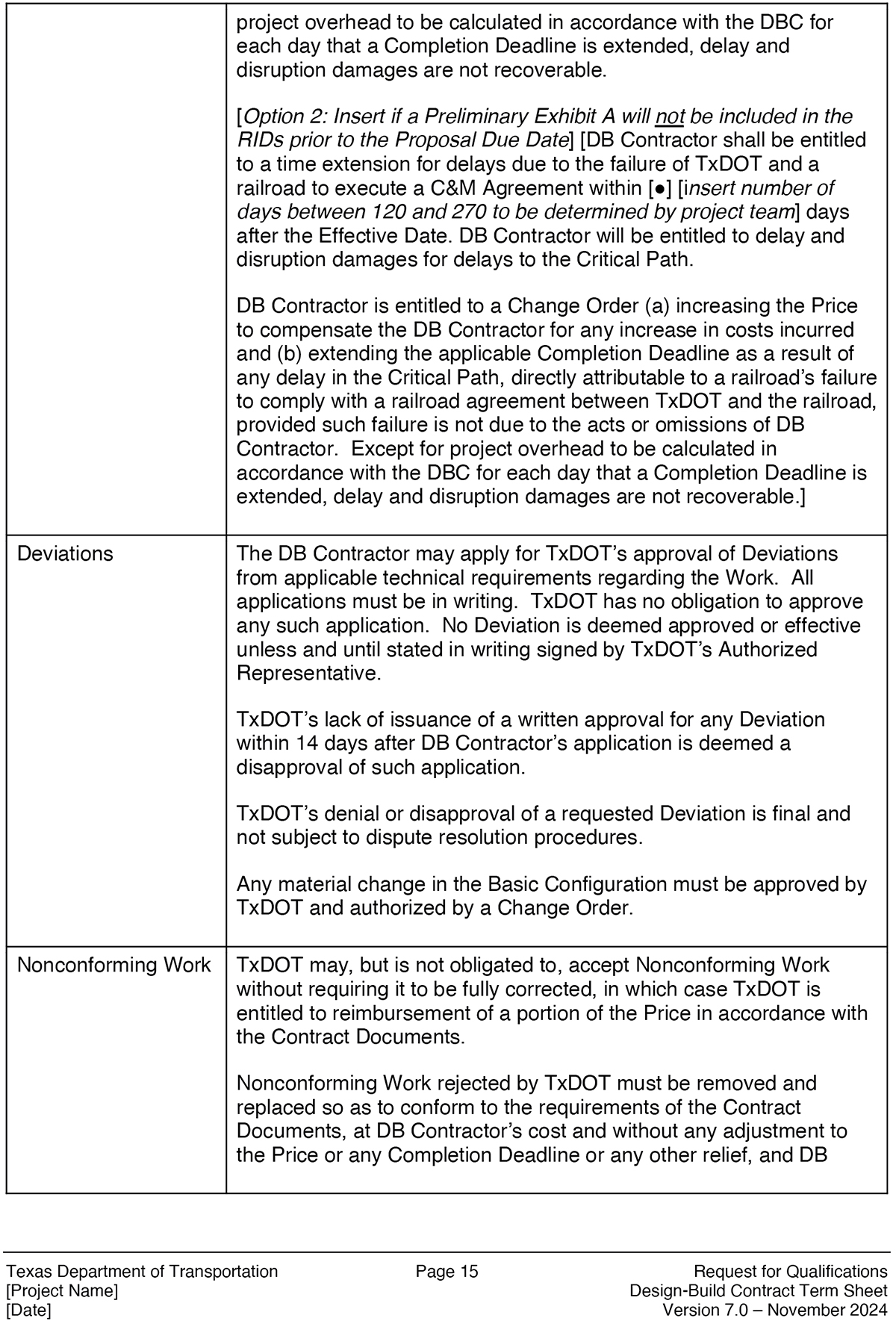
project overhead to be calculated in accordance with the DBC for each day that a Completion Deadline is extended, delay and disruption damages are not recoverable.
[Option 2: Insert if a Preliminary Exhibit A will not be included in the RIDs prior to the Proposal Due Date] [DB Contractor shall be entitled to a time extension for delays due to the failure of Texas DOT and a railroad to execute a C&M Agreement within [X] [insert number of days between 120 and 270 to be determined by project team] days after the Effective Date. DB Contractor will be entitled to delay and disruption damages for delays to the Critical Path.
DB Contractor is entitled to a Change Order (a) increasing the Price to compensate the DB Contractor for any increase in costs incurred and (b) extending the applicable Completion Deadline as a result of any delay in the Critical Path, directly attributable to a railroadʼs failure to comply with a railroad agreement between Texas DOT and the railroad, provided such failure is not due to the acts or omissions of DB Contractor. Except for project overhead to be calculated in accordance with the DBC for each day that a Completion Deadline is extended, delay and disruption damages are not recoverable.]
Deviations: The DB Contractor may apply for Texas DOTʼs approval of Deviations from applicable technical requirements regarding the Work. All applications must be in writing. Texas DOT has no obligation to approve any such application. No Deviation is deemed approved or effective unless and until stated in writing signed by Texas DOTʼs Authorized Representative.
Texas DOTʼs lack of issuance of a written approval for any Deviation within 14 days after DB Contractorʼs application is deemed a disapproval of such application.
Texas DOTʼs denial or disapproval of a requested Deviation is final and not subject to dispute resolution procedures.
Any material change in the Basic Configuration must be approved by Texas DOT and authorized by a Change Order.
Nonconforming Work: Texas DOT may, but is not obligated to, accept Nonconforming Work without requiring it to be fully corrected, in which case Texas DOT is entitled to reimbursement of a portion of the Price in accordance with the Contract Documents.
Nonconforming Work rejected by Texas DOT must be removed and replaced so as to conform to the requirements of the Contract Documents, at DB Contractorʼs cost and without any adjustment to the Price or any Completion Deadline or any other relief, and DB

Long Description.
The list of Contract Changes and Costs Outside the Contract continues:
Contractor must promptly take all action necessary to prevent similar Nonconforming Work from occurring in the future.
Texas DOT-Directed Changes The DB Contractor is entitled to a Change Order providing for Price adjustment and/or a time extension for: changes in the scope of the Work or terms and conditions of the Contract Documents; suspensions of the Work by Texas DOT for more than 48 hours per suspension or 96 hours total; any changes in the Work due to Errors in the Signed and Sealed Engineering Data, unless such Errors were known to the DB Contractor prior to the Effective Date; [If Texas DOT will provide level A SUE, include the following language: any material differences between the actual location of a Utility and the location of the Utility shown on a level A SUE report identified in Appendix 2 to Exhibit 3 of the DBA, unless such Error was known to DB Contractor prior to the Effective Date.]; [Optional language: Notwithstanding the foregoing, Texas DOT shall not be liable for any changes in the Scope of Work that result in less than $10,000 in increased costs and such changes shall not be considered Texas DOT-Directed Changes.]
Hazardous Materials: The DB Contractor is not entitled to any compensation or time extension with respect to: (a) immaterial quantities, (b) Hazardous Materials that could have been avoided by reasonable design modifications or construction techniques, (c) costs that could have been avoided, (d) Hazardous Materials on Additional Properties designated by the D B Contractor, (e) Hazardous Materials encountered during the demolition of buildings, structures, fixtures or other improvements within the Site, other than in improvements on parcels to which access was not provided prior to the Proposal Due Date, (f) Hazardous Materials management costs resulting from DB Contractorʼs acts or omissions, or (g) Hazardous Materials brought onto the Site by the DB Contractor.
The DB Contractor may request a Change Order to extend a Completion Deadline for a delay directly attributable to discovery of Hazardous Materials that changes the duration of a Critical Path. DB Contractor is not entitled to an extension of any Completion Deadline for any delays resulting from the discovery of Hazardous Materials prior to submission of a notice. Continues on the next page.
Long Description.
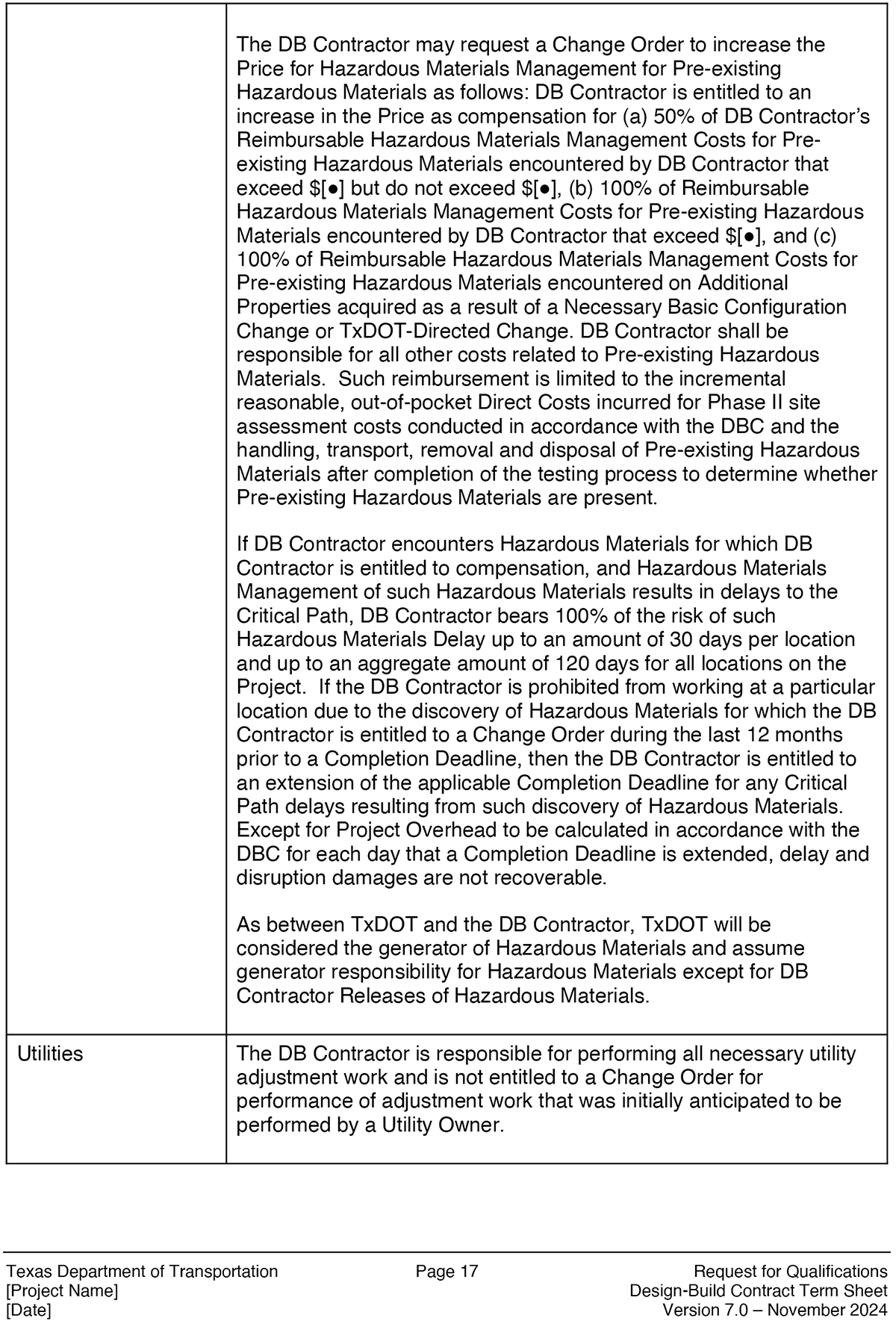
The item on Hazardous Materials from the list of Contract Changes and Costs Outside the Contract list continues on this page.
The DB Contractor may request a Change Order to increase the Price for Hazardous Materials Management for Pre-existing Hazardous Materials as follows: DB Contractor is entitled to an increase in the Price as compensation for (a) 50% of DB Contractorʼs Reimbursable Hazardous Materials Management Costs for Pre- existing Hazardous Materials encountered by DB Contractor that exceed $[X] but do not exceed $[X], (b) 100% of Reimbursable Hazardous Materials Management Costs for Pre-existing Hazardous Materials encountered by DB Contractor that exceed $[X], and (c) 100% of Reimbursable Hazardous Materials Management Costs for Pre-existing Hazardous Materials encountered on Additional Properties acquired as a result of a Necessary Basic Configuration Change or Texas DOT-Directed Change. DB Contractor shall be responsible for all other costs related to Pre-existing Hazardous Materials. Such reimbursement is limited to the incremental reasonable, out-of-pocket Direct Costs incurred for Phase II site assessment costs conducted in accordance with the DBC and the handling, transport, removal and disposal of Pre-existing Hazardous Materials after completion of the testing process to determine whether Pre-existing Hazardous Materials are present.
If DB Contractor encounters Hazardous Materials for which DB Contractor is entitled to compensation, and Hazardous Materials Management of such Hazardous Materials results in delays to the Critical Path, DB Contractor bears 100% of the risk of such Hazardous Materials Delay up to an amount of 30 days per location and up to an aggregate amount of 120 days for all locations on the Project. If the DB Contractor is prohibited from working at a particular location due to the discovery of Hazardous Materials for which the DB Contractor is entitled to a Change Order during the last 12 months prior to a Completion Deadline, then the DB Contractor is entitled to an extension of the applicable Completion Deadline for any Critical Path delays resulting from such discovery of Hazardous Materials. Except for Project Overhead to be calculated in accordance with the DBC for each day that a Completion Deadline is extended, delay and disruption damages are not recoverable.
As between Texas DOT and the DB Contractor, Texas DOT will be considered the generator of Hazardous Materials and assume generator responsibility for Hazardous Materials except for DB Contractor Releases of Hazardous Materials.
Utilities: The DB Contractor is responsible for performing all necessary utility adjustment work and is not entitled to a Change Order for performance of adjustment work that was initially anticipated to be performed by a Utility Owner. Continues on the next page.

Long Description.
The item on Utilities from the list of Contract Changes and Costs Outside the Contract list continues on this page.
The DB Contractor is entitled to a Change Order (a) increasing the Price to compensate the DB Contractor for any increase in costs incurred in performing the Utility Adjustment Work that is directly attributable to a New Utility and (b) extending the applicable Completion Deadline as a result of any delay in the Critical Path directly attributable to performing the Utility Adjustment Work directly attributable to a New Utility.
DB Contractor is entitled to an increase in the Price in connection with certain increases in the cost of the Work due to Unidentified Utilities within the Schematic ROW. The amount of the Price increase in any Change Order issued for each such Unidentified Utility facility is equal to the Basic Costs for that facility, less the Unidentified Utilities Deductible ($[X]) (which deductible amount is the DB Contractorʼs sole responsibility). Notwithstanding the foregoing, DB Contractor is not responsible for a total amount of Unidentified Utilities Deductibles in excess of the Unidentified Utilities Deductible Cap ($[X]).
DB Contractor will be allowed a time extension due to certain delays resulting from the need to relocate Unidentified Utilities, delays caused by uncooperative Utility Owners and delays caused by each Utility Owner that fails to comply with any timelines for the Utility Ownerʼs performance in the executed Utility Agreement. The cumulative risk of such delays will be shared between DB Contractor and Texas DOT, provided DB Contractorʼs responsibility for such delays is capped, as set forth in the DBC. Except for project overhead to be calculated in accordance with the DBC for certain days that a Completion Deadline is extended, delay and disruption damages are not recoverable for such delays.
Subject to the limitations set forth in theDBC, DB Contractor may request a Change Order to (a) increase the Price to compensate the DB Contractor for any increase in costs incurred, including project overhead and disruption damages, and (b) extend the applicable Completion Deadlines as a result of any delay in the Critical Path, directly attributable to changes to the scope of the work for the Utility Adjustment from the scope of the work agreed to by the Utility Owner in a Pre-Proposal Utility Commitment that was made by an authorized representative of the Utility Owner and approved by Texas DOT prior to the due date for proposals for the Project. Except for project overhead to be calculated in accordance with the DBC for certain days that a Completion Deadline is extended, delay and disruption damages are not recoverable for such delays.
[insert if Texas DOT has entered into an ILA for adjustment of municipal Utilities that will be managed by DB Contractor][Texas DOT anticipates entering into an Utility ILA with [X] for the relocation of [X]. DB Contractor will be entitled to a Change Order extending Completion. Continues on the next page.
Long Description.
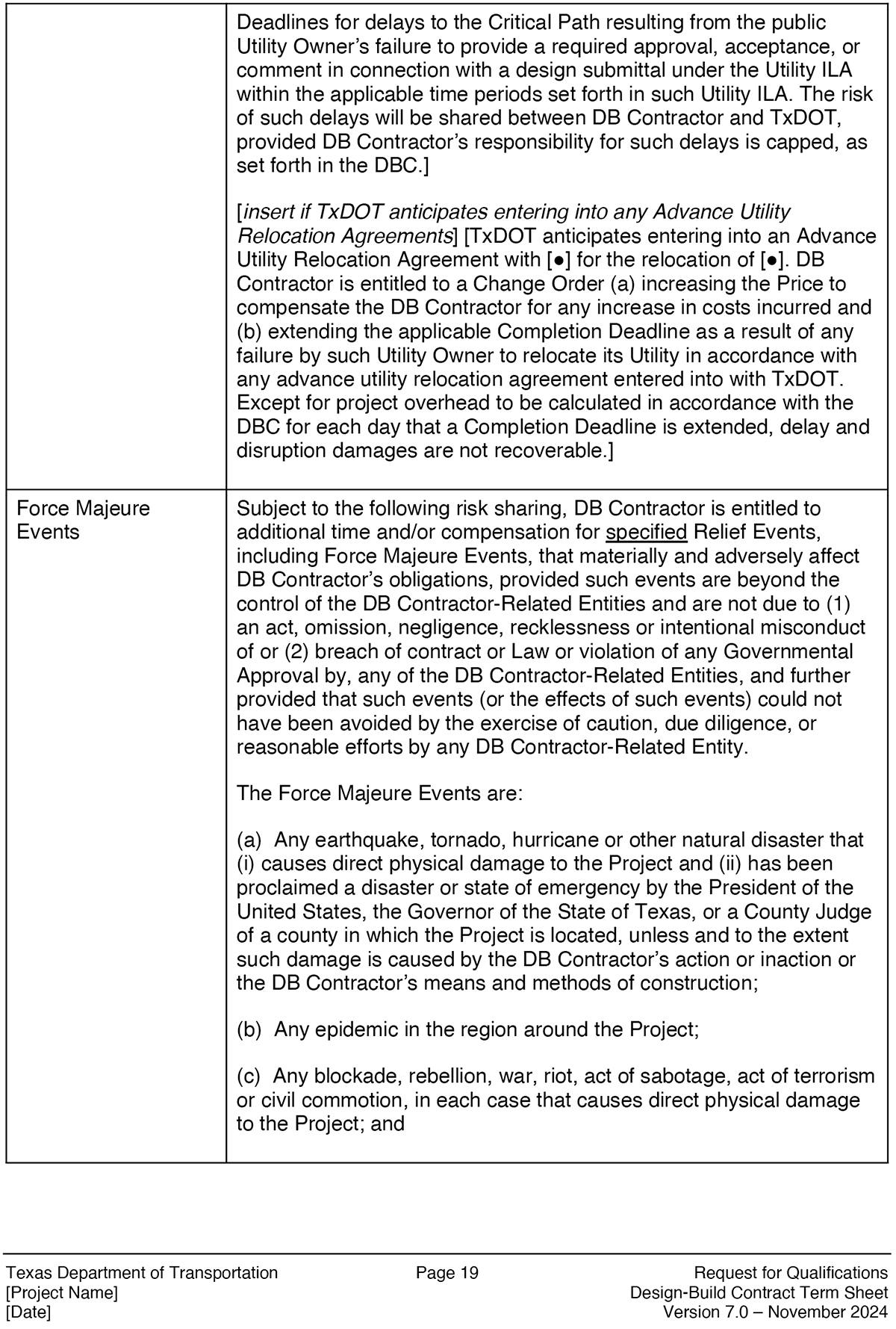
The item on Utilities from the list of Contract Changes and Costs Outside the Contract list continues on this page.
Deadlines for delays to the Critical Path resulting from the public Utility Ownerʼs failure to provide a required approval, acceptance, or comment in connection with a design submittal under the Utility ILA within the applicable time periods set forth in such Utility ILA. The risk of such delays will be shared between DB Contractor and Texas DOT, provided DB Contractorʼs responsibility for such delays is capped, as set forth in the DBC.]
[insert if Texas DOT anticipates entering into any Advance Utility Relocation Agreements] [Texas DOT anticipates entering into an Advance Utility Relocation Agreement with [X] for the relocation of [X]. DB Contractor is entitled to a Change Order (a) increasing the Price to compensate the DB Contractor for any increase in costs incurred and (b) extending the applicable Completion Deadline as a result of any failure by such Utility Owner to relocate its Utility in accordance with any advance utility relocation agreement entered into with Texas DOT. Except for project overhead to be calculated in accordance with the DBC for each day that a Completion Deadline is extended, delay and disruption damages are not recoverable.]
Force Majeure Events Subject to the following risk sharing, DB Contractor is entitled to Events additional time and/or compensation for specified Relief Events, including Force Majeure Events, that materially and adversely affect DB Contractorʼs obligations, provided such events are beyond the control of the DB Contractor-Related Entities and are not due to (1) an act, omission, negligence, recklessness or intentional misconduct of or (2) breach of contract or Law or violation of any Governmental Approval by, any of the DB Contractor-Related Entities, and further provided that such events (or the effects of such events) could not have been avoided by the exercise of caution, due diligence, or reasonable efforts by any DB Contractor-Related Entity.
The Force Majeure Events are:
(a) Any earthquake, tornado, hurricane or other natural disaster that (i) causes direct physical damage to the Project and (ii) has been proclaimed a disaster or state of emergency by the President of the United States, the Governor of the State of Texas, or a County Judge of a county in which the Project is located, unless and to the extent such damage is caused by the DB Contractorʼs action or inaction or the DB Contractorʼs means and methods of construction;
(b) Any epidemic in the region around the Project;
(c) Any blockade, rebellion, war, riot, act of sabotage, act of terrorism or civil commotion, in each case that causes direct physical damage to the Project; and
Long Description.
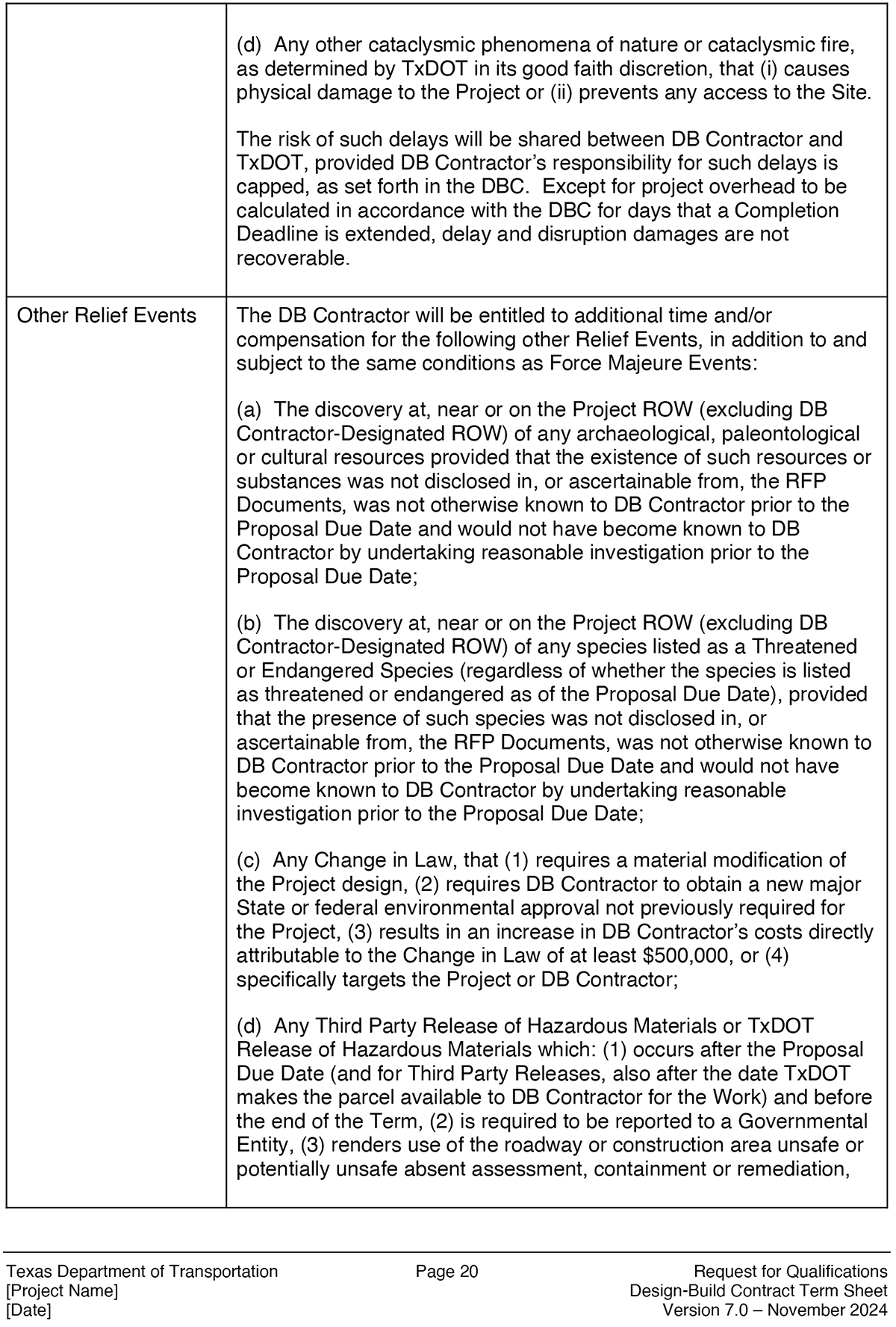
The list of Contract Changes and Costs Outside the Contract continues:
(d) Any other cataclysmic phenomena of nature or cataclysmic fire, as determined by Texas DOT in its good faith discretion, that (i) causes physical damage to the Project or (ii) prevents any access to the Site.
The risk of such delays will be shared between DB Contractor and Texas DOT, provided DB Contractorʼs responsibility for such delays is capped, as set forth in the DBC. Except for project overhead to be calculated in accordance with the DBC for days that a Completion Deadline is extended, delay and disruption damages are not recoverable.
Other Relief Events The DB Contractor will be entitled to additional time and/or compensation for the following other Relief Events, in addition to and subject to the same conditions as Force Majeure Events:
(a) The discovery at, near or on the Project ROW (excluding DB Contractor-Designated ROW) of any archaeological, paleontological or cultural resources provided that the existence of such resources or substances was not disclosed in, or ascertainable from, the RFP Documents, was not otherwise known to DB Contractor prior to the Proposal Due Date and would not have become known to DB Contractor by undertaking reasonable investigation prior to the Proposal Due Date;
(b) The discovery at, near or on the Project ROW (excluding DB Contractor-Designated ROW) of any species listed as a Threatened or Endangered Species (regardless of whether the species is listed as threatened or endangered as of the Proposal Due Date), provided that the presence of such species was not disclosed in, or ascertainable from, the RFP Documents, was not otherwise known to DB Contractor prior to the Proposal Due Date and would not have become known to DB Contractor by undertaking reasonable investigation prior to the Proposal Due Date;
(c) Any Change in Law, that (1) requires a material modification of the Project design, (2) requires DB Contractor to obtain a new major State or federal environmental approval not previously required for the Project, (3) results in an increase in DB Contractorʼs costs directly attributable to the Change in Law of at least $500,000, or (4) specifically targets the Project or DB Contractor;
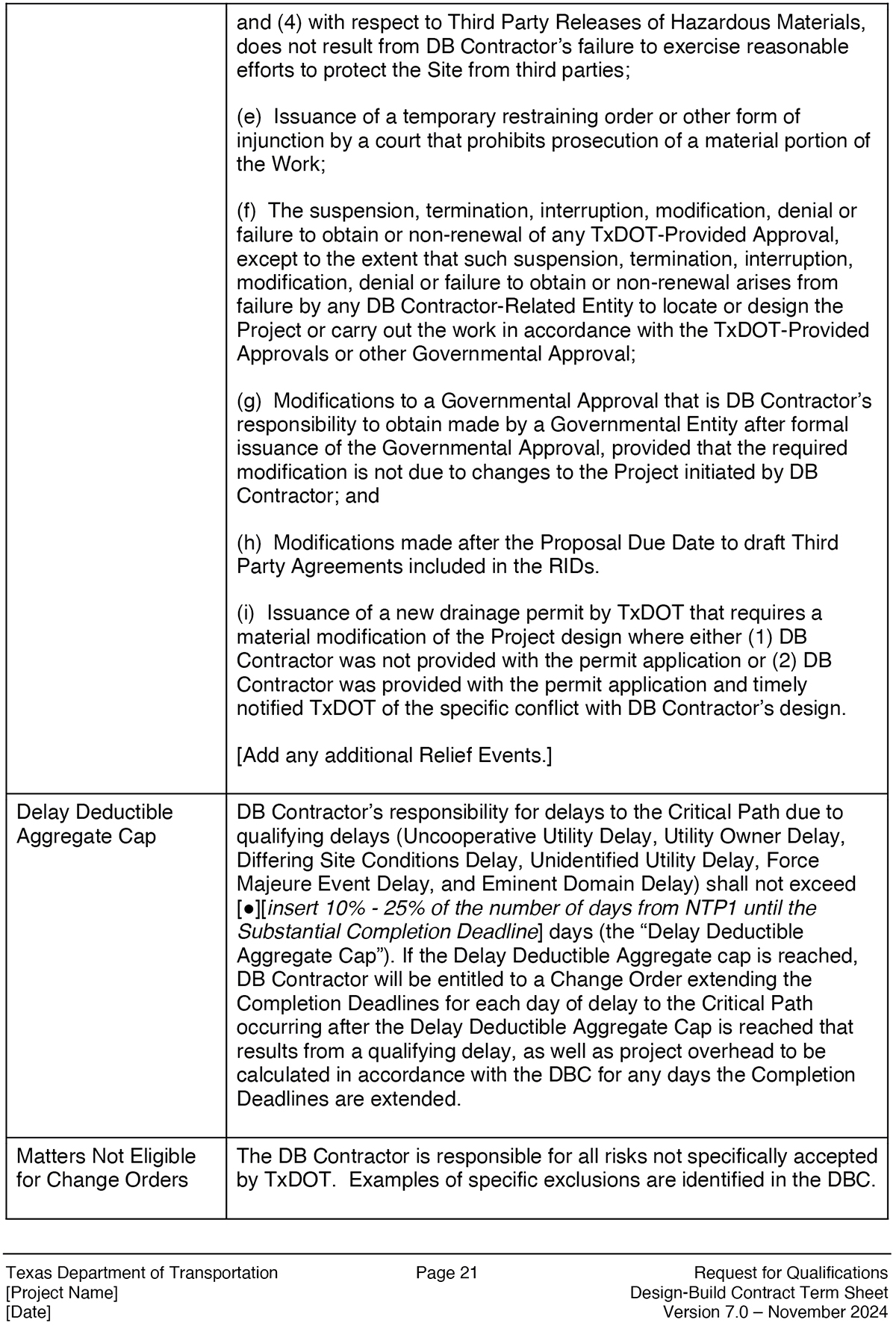
(d) Any Third Party Release of Hazardous Materials or Texas DOT Release of Hazardous Materials which: (1) occurs after the Proposal Due Date (and for Third Party Releases, also after the date Texas DOT makes the parcel available to DB Contractor for the Work) and before the end of the Term, (2) is required to be reported to a Governmental Entity, (3) renders use of the roadway or construction area unsafe or potentially unsafe absent assessment, containment or remediation, Continues on the next page.
Long Description.
The item on Other Relief Events from the list of Contract Changes and Costs Outside the Contract list continues on this page.
and (4) with respect to Third Party Releases of Hazardous Materials, does not result from DB Contractorʼs failure to exercise reasonable efforts to protect the Site from third parties;
(e) Issuance of a temporary restraining order or other form of injunction by a court that prohibits prosecution of a material portion of the Work;
(f) The suspension, termination, interruption, modification, denial or failure to obtain or non-renewal of any Texas DOT-Provided Approval, except to the extent that such suspension, termination, interruption, modification, denial or failure to obtain or non-renewal arises from failure by any DB Contractor-Related Entity to locate or design the Project or carry out the work in accordance with the Texas DOT-Provided Approvals or other Governmental Approval;
(g) Modifications to a Governmental Approval that is DB Contractorʼs responsibility to obtain made by a Governmental Entity after formal issuance of the Governmental Approval, provided that the required modification is not due to changes to the Project initiated by DB Contractor; and
(h) Modifications made after the Proposal Due Date to draft Third Party Agreements included in the RIDs.
(i) Issuance of a new drainage permit by Texas DOT that requires a material modification of the Project design where either (1) DB Contractor was not provided with the permit application or (2) DB Contractor was provided with the permit application and timely notified Texas DOT of the specific conflict with DB Contractorʼs design.
[Add any additional Relief Events.]
Delay Deductible Aggregate Cap: DB Contractorʼs responsibility for delays to the Critical Path due to
qualifying delays (Uncooperative Utility Delay, Utility Owner Delay, Differing Site Conditions Delay, Unidentified Utility Delay, Force Majeure Event Delay, and Eminent Domain Delay) shall not exceed [•][insert 10% - 25% of the number of days from NTP1 until the Substantial Completion Deadline] days (the “Delay Deductible Aggregate Cap”). If the Delay Deductible Aggregate cap is reached, DB Contractor will be entitled to a Change Order extending the Completion Deadlines for each day of delay to the Critical Path occurring after the Delay Deductible Aggregate Cap is reached that results from a qualifying delay, as well as project overhead to be calculated in accordance with the DBC for any days the Completion Deadlines are extended.
Matters Not Eligible for Change Orders: The DB Contractor is responsible for all risks not specifically accepted by Texas DOT. Examples of specific exclusions are identified in the DBC.
Long Description.
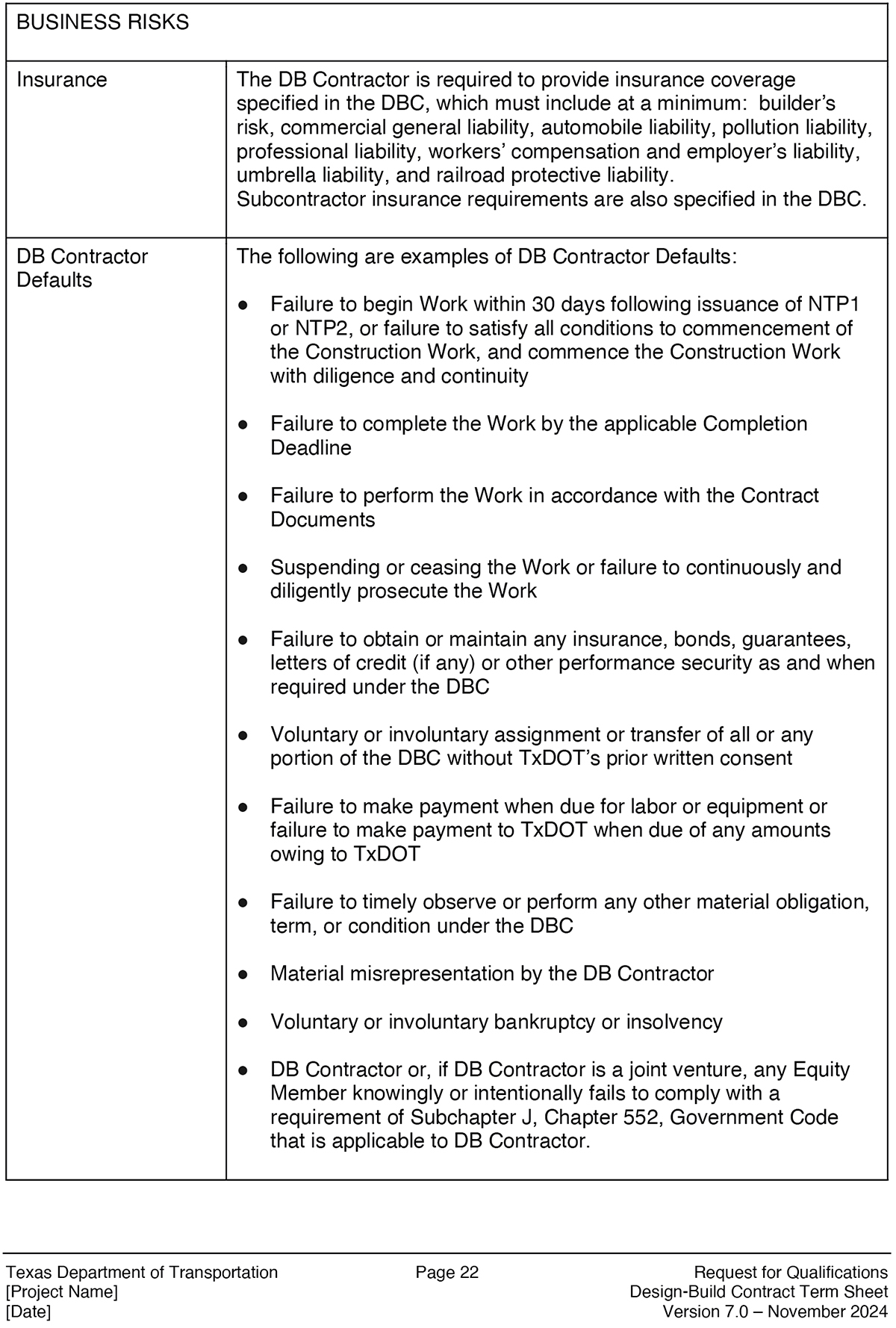
A heading for a list of items related to Business Risks:
Insurance: The DB Contractor is required to provide insurance coverage specified in the DBC, which must include at a minimum: builderʼs risk, commercial general liability, automobile liability, pollution liability, professional liability, workersʼ compensation and employerʼs liability, umbrella liability, and railroad protective liability.
Subcontractor insurance requirements are also specified in the DBC.
DB Contractor Defaults: The following are examples of DB Contractor Defaults:
Failure to begin Work within 30 days following issuance of NTP1 or NTP2, or failure to satisfy all conditions to commencement of the Construction Work, and commence the Construction Work with diligence and continuity; Failure to complete the Work by the applicable Completion Deadline; Failure to perform the Work in accordance with the Contract Documents; Suspending or ceasing the Work or failure to continuously and diligently prosecute the Work; Failure to obtain or maintain any insurance, bonds, guarantees, letters of credit (if any) or other performance security as and when required under the DBC; Voluntary or involuntary assignment or transfer of all or any portion of the DBC without Texas DOTʼs prior written consent; Failure to make payment when due for labor or equipment or failure to make payment to Texas DOT when due of any amounts owing to Texas DOT; Failure to timely observe or perform any other material obligation, term, or condition under the DBC; Material misrepresentation by the DB Contractor; Voluntary or involuntary bankruptcy or insolvency; DB Contractor or, if DB Contractor is a joint venture, any Equity Member knowingly or intentionally fails to comply with a requirement of Subchapter J, Chapter 552, Government Code that is applicable to DB Contractor.
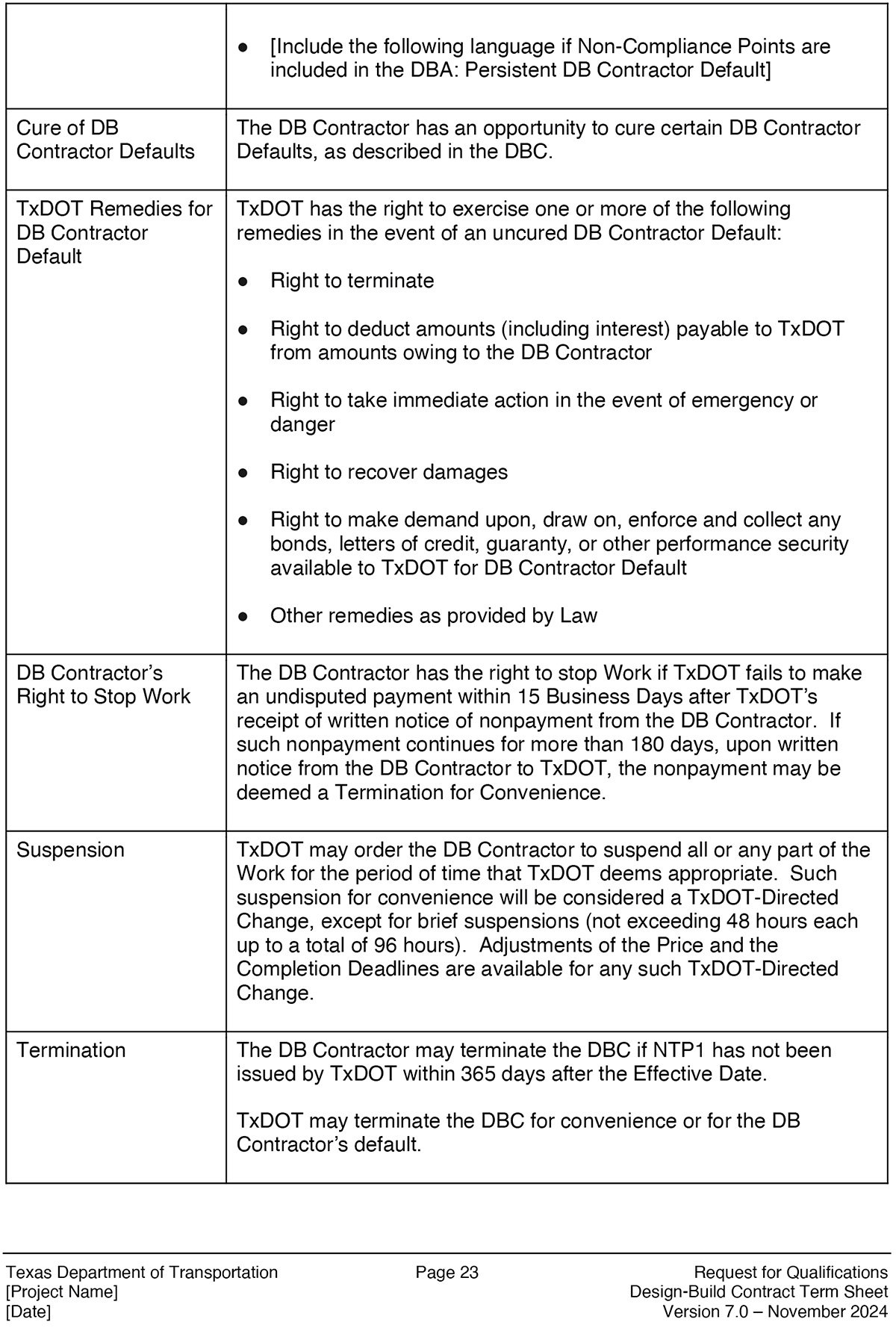
Long Description.
The list of items related to Business Risks continues:
[Include the following language if Non-Compliance Points are included in the DBA: Persistent DB Contractor Default].
Cure of DB Contractor Defaults: The DB Contractor has an opportunity to cure certain DB Contractor Defaults, as described in the DBC.
Texas DOT Remedies for DB Contractor Default: Texas DOT has the right to exercise one or more of the following remedies in the event of an uncured DB Contractor Default: Right to terminate; Right to deduct amounts (including interest) payable to Texas DOT from amounts owing to the DB Contractor; Right to take immediate action in the event of emergency or danger; Right to recover damages; Right to make demand upon, draw on, enforce and collect any bonds, letters of credit, guaranty, or other performance security available to Texas DOT for DB Contractor Default; Other remedies as provided by Law
DB Contractorʼs Right to Stop Work The DB Contractor has the right to stop Work if Texas DOT fails to make an undisputed payment within 15 Business Days after Texas DOTʼs receipt of written notice of nonpayment from the DB Contractor. If such nonpayment continues for more than 180 days, upon written notice from the DB Contractor to Texas DOT, the nonpayment may be deemed a Termination for Convenience.
Suspension Texas DOT may order the DB Contractor to suspend all or any part of the Work for the period of time that Texas DOT deems appropriate. Such suspension for convenience will be considered a Texas D O T-Directed Change, except for brief suspensions (not exceeding 48 hours each up to a total of 96 hours). Adjustments of the Price and the Completion Deadlines are available for any such Texas DOT-Directed Change.
Termination The DB Contractor may terminate the DBC if NTP1 has not been issued by Texas DOT within 365 days after the Effective Date.
Texas DOT may terminate the DBC for convenience or for the DB Contractorʼs default.
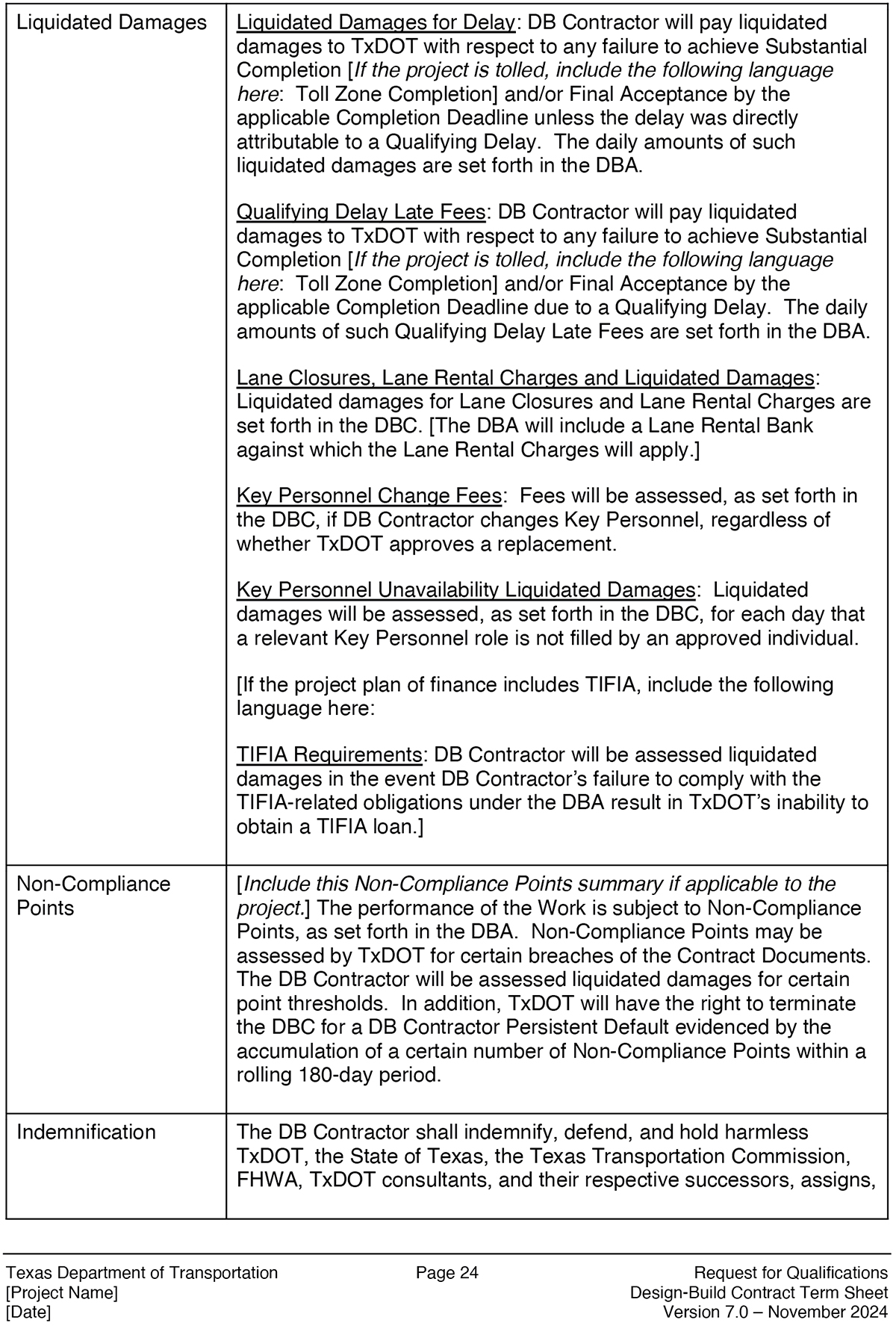
Long Description.
The list of items related to Business Risks continues:
A subheading in the table is Liquidated Damages, under which the following items are listed:
Liquidated Damages for Delay: DB Contractor will pay liquidated damages to Texas DOT with respect to any failure to achieve Substantial Completion [If the project is tolled, include the following language here: Toll Zone Completion] and/or Final Acceptance by the applicable Completion Deadline unless the delay was directly attributable to a Qualifying Delay. The daily amounts of such liquidated damages are set forth in the DBA..
Qualifying Delay Late Fees: DB Contractor will pay liquidated damages to Texas DOT with respect to any failure to achieve Substantial Completion [If the project is tolled, include the following language here: Toll Zone Completion] and/or Final Acceptance by the applicable Completion Deadline due to a Qualifying Delay. The daily amounts of such Qualifying Delay Late Fees are set forth in the DBA..
Lane Closures, Lane Rental Charges and Liquidated Damages: Liquidated damages for Lane Closures and Lane Rental Charges are set forth in the DBC. [The DBA. will include a Lane Rental Bank against which the Lane Rental Charges will apply.]
Key Personnel Change Fees: Fees will be assessed, as set forth in the DBC, if DB Contractor changes Key Personnel, regardless of whether Texas DOT approves a replacement.
Key Personnel Unavailability Liquidated Damages: Liquidated damages will be assessed, as set forth in the DBC, for each day that a relevant Key Personnel role is not filled by an approved individual.
[If the project plan of finance includes TIFIA, include the following language here:
TIFIA Requirements: DB Contractor will be assessed liquidated damages in the event DB Contractorʼs failure to comply with the TIFIA-related obligations under the DBA. result in Texas DOTʼs inability to obtain a TIFIA loan.]
The next item in the list after the Liquidated Damages subheading is Non-Compliance Points: [Include this Non-Compliance Points summary if applicable to the project.] The performance of the Work is subject to Non-Compliance Points, as set forth in the DBA. Non-Compliance Points may be assessed by Texas DOT for certain breaches of the Contract Documents. The DB Contractor will be assessed liquidated damages for certain point thresholds. In addition, Texas DOT will have the right to terminate the DBC for a D B Contractor Persistent Default evidenced by the accumulation of a certain number of Non-Compliance Points within a rolling 180-day period.
Indemnification: The DB Contractor shall indemnify, defend, and hold harmless Texas DOT, the State of Texas, the Texas Transportation Commission, FHWA, Texas DOT consultants, and their respective successors, assigns,
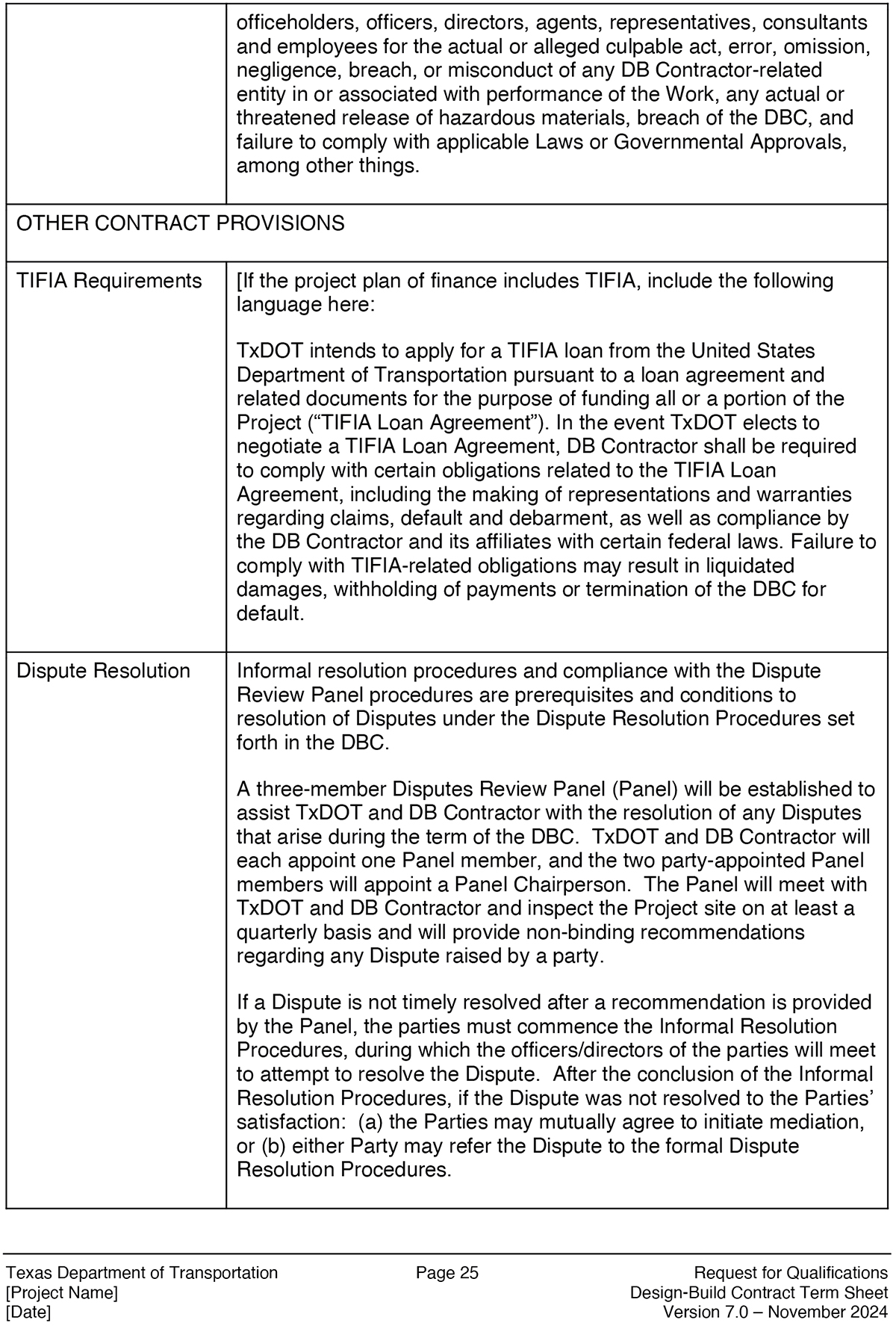
Long Description.
The list of items related to Business Risks continues:
officeholders, officers, directors, agents, representatives, consultants and employees for the actual or alleged culpable act, error, omission, negligence, breach, or misconduct of any DB Contractor-related entity in or associated with performance of the Work, any actual or threatened release of hazardous materials, breach of the DBC, and failure to comply with applicable Laws or Governmental Approvals, among other things.
A heading for a list of items related to Other Contract Provisions:
TIFIA Requirements: [If the project plan of finance includes TIFIA, include the following language here:
Texas DOT intends to apply for a TIFIA loan from the United States Department of Transportation pursuant to a loan agreement and related documents for the purpose of funding all or a portion of the Project (“TIFIA Loan Agreement”). In the event Texas DOT elects to negotiate a TIFIA Loan Agreement, DB Contractor shall be required to comply with certain obligations related to the TIFIA Loan Agreement, including the making of representations and warranties regarding claims, default and debarment, as well as compliance by the DB Contractor and its affiliates with certain federal laws. Failure to comply with TIFIA-related obligations may result in liquidated damages, withholding of payments or termination of the DBC for default.
Dispute Resolution Informal resolution procedures and compliance with the Dispute Review Panel procedures are prerequisites and conditions to resolution of Disputes under the Dispute Resolution Procedures set forth in the DBC.
A three-member Disputes Review Panel (Panel) will be established to assist Texas DOT and DB Contractor with the resolution of any Disputes that arise during the term of the DBC. Texas DOT and DB Contractor will each appoint one Panel member, and the two party-appointed Panel members will appoint a Panel Chairperson. The Panel will meet with Texas DOT and DB Contractor and inspect the Project site on at least a quarterly basis and will provide non-binding recommendations regarding any Dispute raised by a party.
If a Dispute is not timely resolved after a recommendation is provided by the Panel, the parties must commence the Informal Resolution Procedures, during which the officers/directors of the parties will meet to attempt to resolve the Dispute. After the conclusion of the Informal Resolution Procedures, if the Dispute was not resolved to the Partiesʼ satisfaction: (a) the Parties may mutually agree to initiate mediation, or (b) either Party may refer the Dispute to the formal Dispute Resolution Procedures.

Long Description.
The list of items related to Other Contract Provisions continues:
The formal Dispute Resolution Procedures include the contract claims process established pursuant to Texas Transportation Code Section 201.112 and Title 43, Texas Administrative Code, Section 9.2.
The Disputes Review Panel procedures and Dispute Resolution Procedures do not apply to certain Ineligible Matters.
Records and Documnetation Software; The DB Contractor must submit all submittals to Texas DOT through Texas DOTʼs electronic content management system.
Software In addition, the DB Contractor must (i) establish its own electronic content management system in a format that is subject to approval by Texas DOT and (ii) maintain all project records and documents in accordance with Texas State Records Retention Schedule. DB Contractor is required to provide certain contracting information if requested by Texas DOT as a result of a request pursuant to the Public Information Act.
Design Submittals shall be in the most recent version of OpenRoads Designer utilized by Texas DOT.
The DB Contractor may be required to purchase additional software as required for the Project. Escrowed Proposal Documents (“EPD”); The DB Contractorʼs detailed Proposal pricing information (EPDs) be kept at Texas DOTʼs project office in locked fireproof cabinets with the keys held only by the DB Contractor.
EPDs are the property of the DB Contractor and will be considered to be in the DB Contractorʼs possession.
EPDs must be available for joint review by DB Contractor, Texas DOT and Texas DOTʼs consultants, and any dispute resolver(s).
Change Order documentation must be added to EPDs.
EPDs will be maintained until all of the following have occurred: (a) 180 days from the later of Final Acceptance or termination of the DBC, (b) all Claims or Disputes regarding the Work have been settled, (c) all Warranty Terms have expired, and (d) Final Payment has been made and accepted.
DBE Provisions; Subcontractors; Texas DOTʼs Disadvantaged Business Enterprise (“DBE”) Program for design-build contracts is based on Texas DOTʼs standard DBE Program with certain modifications to accommodate the design-build approach. This item continues on the next page.
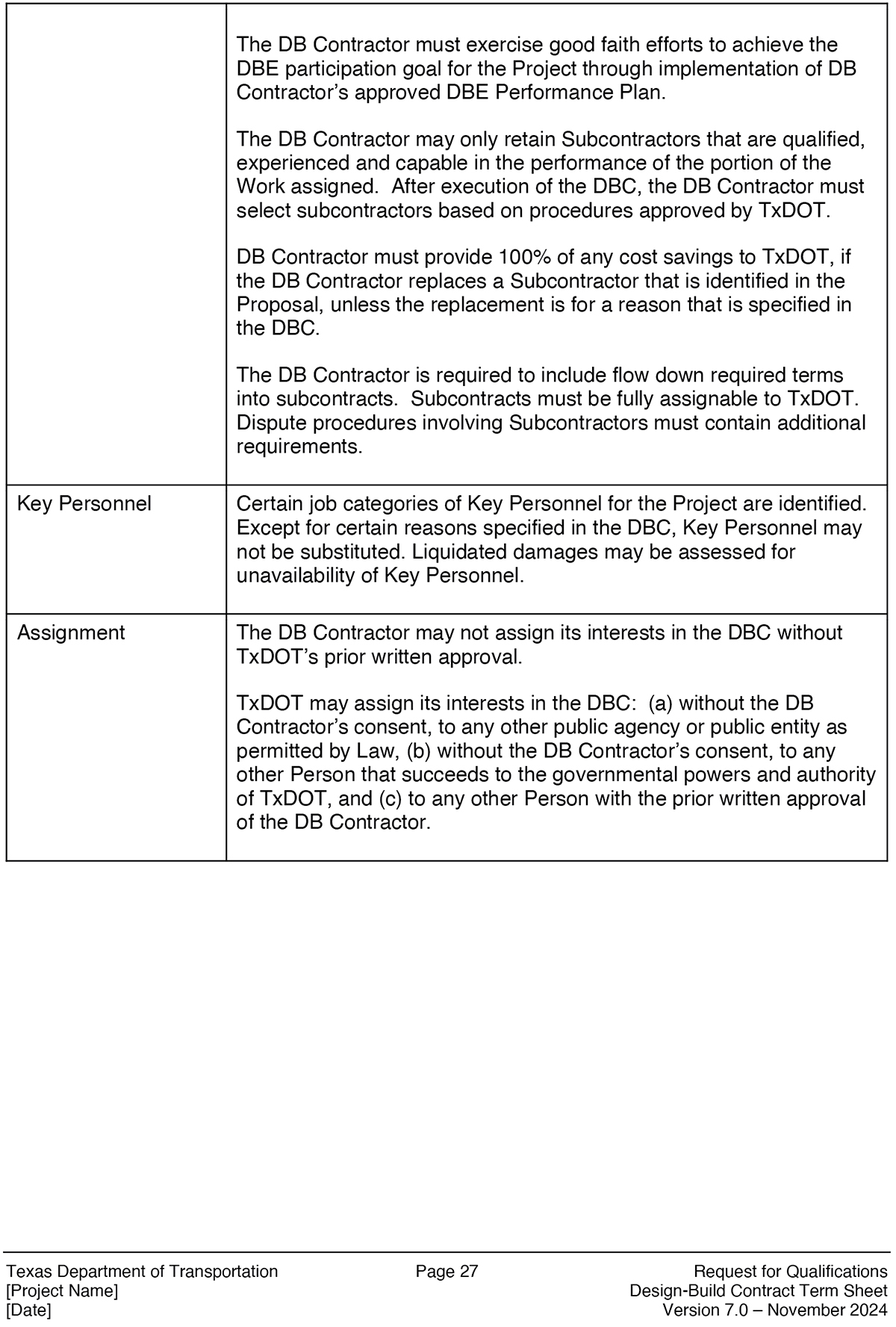
Long Description.
The Other Contract Provisions list item for Subcontractors continues onto this page. The DB Contractor must exercise good faith efforts to achieve the DBE participation goal for the Project through implementation of DB Contractorʼs approved DBE Performance Plan.
The DB Contractor may only retain Subcontractors that are qualified, experienced and capable in the performance of the portion of the Work assigned. After execution of the DBC, the DB Contractor must select subcontractors based on procedures approved by Texas DOT.
DB Contractor must provide 100% of any cost savings to Texas DOT, if the DB Contractor replaces a Subcontractor that is identified in the Proposal, unless the replacement is for a reason that is specified in the DBC.
The DB Contractor is required to include flow down required terms into subcontracts. Subcontracts must be fully assignable to Texas DOT. Dispute procedures involving Subcontractors must contain additional requirements.
Key Personnel: Certain job categories of Key Personnel for the Project are identified. Except for certain reasons specified in the DBC, Key Personnel may not be substituted. Liquidated damages may be assessed for unavailability of Key Personnel.
Assignment: The DB Contractor may not assign its interests in the DBC without Texas DOTʼs prior written approval.
Texas DOT may assign its interests in the DBC: (a) without the DB Contractorʼs consent, to any other public agency or public entity as permitted by Law, (b) without the DB Contractorʼs consent, to any other Person that succeeds to the governmental powers and authority of Texas DOT, and (c) to any other Person with the prior written approval of the DB Contractor.
6. Roles and Responsibilities Matrix
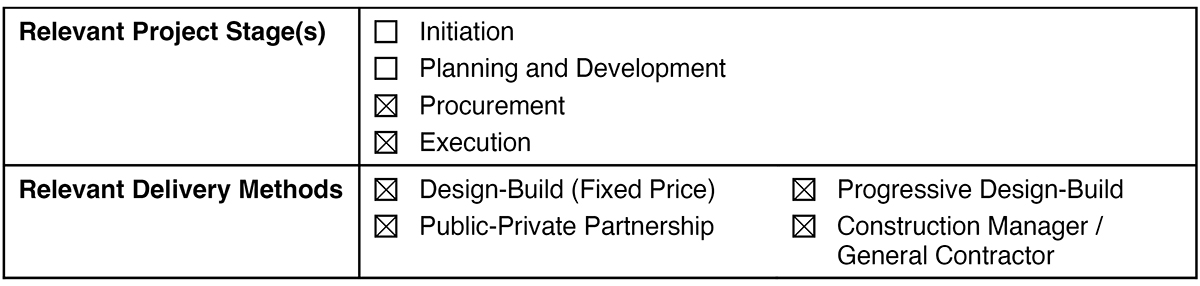
Long Description.
The checklist lists the following in two rows:
Row 1: Relevant Project Stage(s).
Initiation
Planning and Development
Procurement
Execution
Row 2: Relevant Delivery Methods
Design-Build (Fixed Price)
Public-Private Partnership
Progressive Design-Build
Construction Manager slash General Contractor
All options except Initiation and Planning and Development are checked.
Overview
Given the likelihood of traditional roles and responsibilities changing under different APD methods, it can be beneficial for owners to formally define their expectations regarding the party responsible for different tasks, activities, and risks in the solicitation and contract documents. Such information is commonly communicated in the form of a matrix or table that lists key tasks (e.g., obtaining specific permits) and defines the associated party having primary, secondary, or no responsibility for task completion.
Objectives
Including a Roles and Responsibilities Matrix in the procurement and contract documents can help:
- Communicate the ownerʼs expectations regarding each participantʼs role on the project.
- Ensure all proposers are working off the same assumptions as they prepare their proposals and develop project execution strategies.
- Provide a basis for subsequent negotiation of roles and responsibilities.
Example
In the RFP developed for the I-70 Floyd Hill to Veterans Memorial Tunnels Construction Manager/General Contractor (CM/GC) project, Colorado DOT (CDOT) included a matrix to clarify the expectations of CDOT, the design consultant, and the contractor in carrying out various preconstruction phase activities.
As shown in the extract provided on the following pages, the matrix identifies which entity is to assume primary responsibility, secondary responsibility, and/or collaborative responsibility for key preconstruction activities. For example:
- For ROW, specialty and local clearances, CDOT/Others has primary responsibility while the Design Consultant has secondary responsibility.
- For utility coordination, CDOT/Others has primary responsibility, while both the Design Consultant and Construction Manager have secondary responsibilities.
Note: Pages A-38 to A-45 are taken from CDOT Project No. NHPP 0703-446/FBR 0703-457 I-70 Floyd Hill to Veterans Memorial Tunnels Request for Proposals Appendix A: Preconstruction Roles and Responsibilities Matrix.
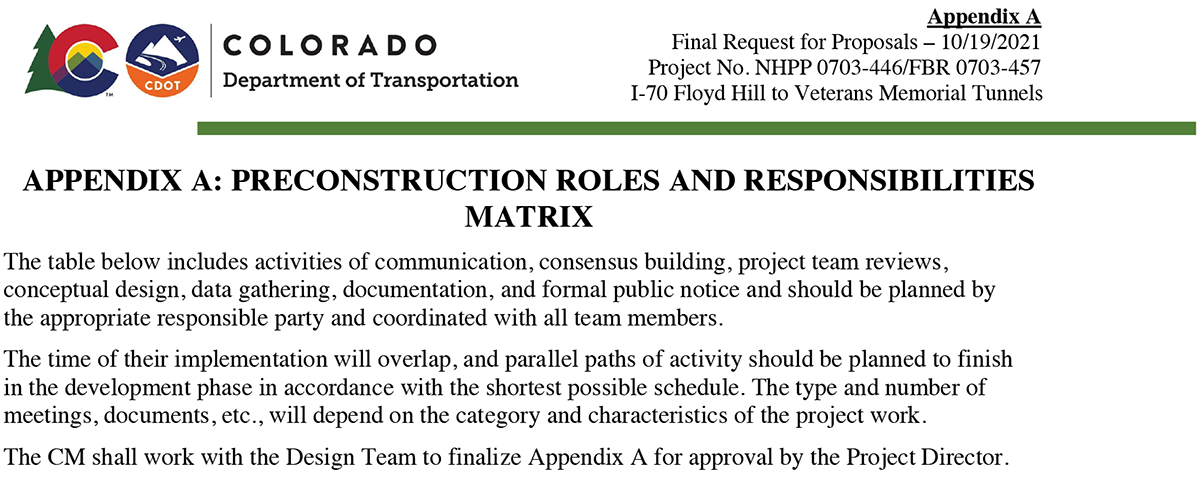
Long Description.
The image header includes a logo for the Colorado Department of Transportation, and the document title: Appendix A to Final Request for Proposals – October 19, 2021. Project Number NHPP 0703-446 / FBR / 0703-457. I-70 Floyd Hill to Veterans Memorial Tunnels.
A heading reads Appendix A: Preconstruction Roles and Responsibilities Matrix. Below the heading is the following text:
The table below includes activities of communication, consensus building, project team reviews, conceptual design, data gathering, documentation, and formal public notice and should be planned by the appropriate responsible party and coordinated with all team members.
The time of their implementation will overlap, and parallel paths of activity should be planned to finish in the development phase in accordance with the shortest possible schedule. The type and number of meetings, documents, etc., will depend on the category and characteristics of the project work.
The CM shall work with the Design Team to finalize Appendix A for approval by the Project irector.
Long Description.
The image header includes a logo for the Colorado Department of Transportation, and the document title: Appendix A to Final Request for Proposals – October 19, 2021. Project Number NHPP 0703-446 / FBR / 0703-457. I-70 Floyd Hill to Veterans Memorial Tunnels.
A table titled Preconstruction Roles and Responsibilities Matrix is presented with the following column headings: Column 1: Construction Management Services. Column 2: Required of Contractor. Column 3: Required of Design Consultant. Column 4: Required of CDOT / Others.
The following legend applies to the data in the table: C = Collaborative Responsibility, 1 = Primary Responsibility, 2 = Secondary Responsibility.
The first section of the table is Phase: Preconstruction. A sub-section is Initial Project Scoping Meeting (Workshop).
The data, by row, are as follows:
A. CM / GC and Partnering Intro Session: 2; 2; 1 B. Project Site Visit and Inspection: 1; 2; 2 C. Project Status, Goals, Elements, Objectives, Design Schedule Review: C; C; CD. Identify Project Risks And Develop Initial Risk Management Plan And Risk Register: 1; 2; 2 E. Review Applicable Environmental Documents (Rod, Fonsi, Etc.): 1; 1; 2 F. Independent Design And As-Built Review: 1; Blank; Blank G. Develop Project Schedule And Tasks: 1; 2; 1 H. Schedule Bi-Weekly Progress, Fir, For, And Milestones Meetings: Blank; 2; 1 I. Identify Design Criteria: Blank; 1; 2 J. Discussion Of Possible Early Delivery And Long Lead Time Items: 1; Blank; 2 K. Analysis Of Project Phasing And Multiple Ps&E Packages: 1; 2; 2 L. Develop Document Review And Naming Convention Standards: 2; 1; 2
The next sub-section is Progress Meetings.
the data by row are as follows:
A. CDOT / PM, CMGC / PM: C; C; C.
B. Project Meeting Minutes: blank, 1, 2.
Below the table are the following notes:
The managers and team members will meet periodically as required (typically at two-week intervals). These progress meetings will be used to coordinate and track the work effort and resolve problems. The meetings will review the following: Activities required to be complete since last meeting (Action Items). Problems and challenges encountered/anticipated and potential solutions. Project Schedule Updates (Design and Construction). Action Items. Coordination and communication required with: Team Members. ▪CDOT Specialty Units. ▪Other.
The CDOT/PM will provide meeting minutes that include details discussed, notes, and all action items relating to the meeting within one week of the meeting.
Long Description.
The image header includes a logo for the Colorado Department of Transportation, and the document title: Appendix A to Final Request for Proposals – October 19, 2021. Project Number NHPP 0703-446 / FBR / 0703-457. I-70 Floyd Hill to Veterans Memorial Tunnels.
The table, titled preconstruction roles and responsibilities matrix, continues on this page. The table has the following column headings, the same as those on the previous page: Column 1: Construction Management Services. Column 2: Required of Contractor. Column 3: Required of Design Consultant. Column 4: Required of CDOT / Others.
The following legend applies to the data in the table: C = Collaborative Responsibility, 1 = Primary Responsibility, 2 = Secondary Responsibility.
A section heading for the table reads Phase: Preconstruction. A sub-section heading below this reads 1. Project Development Process. Row 1 in this sub-section has the following data:: Project Management: 2; 2; 1. A note below this row reads: The CDOT/PM will coordinate all the work tasks being accomplished by all parties to ensure Project work completion stages are on schedule. The C/PM and CMGC/PM shall coordinate all the work tasks being accomplished by their respective teams to make sure Project work completion stages are on schedule
Row 2 in this sub-section has the following data: Communication and Consensus Building: 2; 2; 1. A note below this row reads: The CDOT/PM is responsible for the consensus building and facilitating the communication between all members of the Project team. This does not dismiss the responsibility of all team members to communicate with the CDOT/PM and the CDOT Project Management Team when required.
Row 3 in this sub-section has the following data: Weekly Update Newsletter: NA; NA; NA. A note below this row reads: The CDOT/PM will publish a weekly update newsletter to document the weekly or bi-weekly progress of the schedule, estimate, team meetings, action items, and pertinent information for the FHWA, CDOT management, and Project team members.
Row 4 in this sub-section has the following data: Maintain Updated Contact List: 2; 1; 2. A note below this row reads: Establish and maintain a computerized list of all appropriate interested parties for the communication process. The list will be used for notices regarding public meetings, mailings, newsletters, or other communication as appropriate.
A new subsection heading, 2. Meetings, follows.
Row 1 in this subsection presents the following data: Graphics support and presentations: 2; 2; 1. A note under this row reads: Each Project team member is responsible for the graphics, documents, reports, plans, specifications, and written reviews from each specific scope of work item. Presentation of these documents and their reviews will be available on the shared Project server after the meeting has been adjourned. Row 2 in this subsection presents the following data: Provide Local Office: blank; blank; 1. A note under this row reads: The CDOT/PM will obtain and maintain an office within the Project area to conduct small group meetings and provide displays/information to the public. This office may have work spaces for Project team members, meeting rooms with graphics support and capacity for the entire team to attend. Additional offices or meeting spaces may be considered at the Project Workshop. Row 3 in this subsection presents the following data: PM Updates on Progress: C; C; C. A note under this row reads: The CDOT/P M, CMGC/PM, and the C/PM will all update the team members at the scheduled meetings as to their progress on deliverables, challenges, and the feedback/comments they need.
Row 4 in this subsection presents the following data: Project Discussion: C; C; C. A note under this row reads: The team members need to come prepared to discuss any and all reservations, ideas, and challenges to the Project. Open and honest dialogue is the key to the success of Project delivery.
Long Description.
The image header includes a logo for the Colorado Department of Transportation, and the document title: Appendix A to Final Request for Proposals – October 19, 2021. Project Number NHPP 0703-446 / FBR / 0703-457. I-70 Floyd Hill to Veterans Memorial Tunnels.
The table, titled preconstruction roles and responsibilities matrix, continues on this page. The table has the following column headings, the same as those on the previous page: Column 1: Construction Management Services. Column 2: Required of Contractor. Column 3: Required of Design Consultant. Column 4: Required of CDOT / Others.
The following legend applies to the data in the table: C = Collaborative Responsibility, 1 = Primary Responsibility, 2 = Secondary Responsibility.
A section heading for the table reads Phase: Preconstruction. A sub-section heading below this reads 2. Preliminary Design.
Row 1 under this subsection presents the following data: Preliminary Roadway, Geometric, Structural, Environmental, SWMP, etc. Design: blank; 1; 1. A note under this row reads: CDOT/PM will coordinate all design activities with required CDOT specialty units, the Contractor, the Design Consultant, and other outside entities. Design Consultant is responsible for the civil and structural design, plans, specifications, and estimate packages at each formal review.
Row 2 under this subsection presents the following data: Environmental - gathering data and analysis: blank; 2; 1. Row 3 under this subsection presents the following data: Environmental – mitigation development: 2; 2; 1. Row 4 under this subsection presents the following data: Environmental clearances: blank; blank; 1. Row 5 under this subsection presents the following data: ROW, specialty, and local clearances: blank; 2; 1. Row 6 under this subsection presents the following data: Hazardous material investigation: blank; 1; 1; 2. Row 7 under this subsection presents the following data: CDOT processes (forms, clearances): blank; blank; 1. Row 8 under this subsection presents the following data: Utility coordination: 2; 2; 1. Row 9 under this subsection presents the following data: Conduct field survey of project area: blank; 1; blank. Row 10 under this subsection presents the following data: Field and Project research: 2; 1; 1. Row 11 under this subsection presents the following data: Construction requirements: 2; 1; 1. Row 12 under this subsection presents the following data: Innovation development, proposal, and tracking: 1; 2; 2. Row 13 under this subsection presents the following data: Check and field verify all applicable as-built plans: C; C; C. Row 14 under this subsection presents the following data: Provide construction plans, specifications, and estimates: blank; 1; 2. A note under this row reads: Plot/develop all required information on the plans in accordance with all applicable CDOT policies and procedures and all industry standards for civil, electrical, ITS, and structural design. Row 15 under this subsection reads: Develop construction cost model for Engineer Estimator and ICE: 1; blank; 2. Row 16 under this subsection presents the following data: Develop and calculate quantities: 2; 1; 2. Row 17 under this subsection presents the following data: Risk Register development: 1; 2; 2. Row 18 under this subsection presents the following data: Initiate and Track DBE/ESB and Subcontractor Plan: 1; blank; blank. Row 19 under this subsection presents the following data: Constructability reviews and reports: 1; 2; 2.

Long Description.
The image header includes a logo for the Colorado Department of Transportation, and the document title: Appendix A to Final Request for Proposals – October 19, 2021. Project Number NHPP 0703-446 / FBR / 0703-457. I-70 Floyd Hill to Veterans Memorial Tunnels.
The table, titled preconstruction roles and responsibilities matrix, continues on this page. The table has the following column headings, the same as those on the previous page: Column 1: Construction Management Services. Column 2: Required of Contractor. Column 3: Required of Design Consultant. Column 4: Required of CDOT / Others. The following legend applies to the data in the table: C = Collaborative Responsibility, 1 = Primary Responsibility, 2 = Secondary Responsibility.
A section heading for the table reads Phase: Preconstruction. The subsection labeled 2. Preliminary Design continues from the previous page. Row 19 under this subsection presents the following data: Construction Phasing Plan: 1; 2; 2. Row 20 under this subsection presents the following data: Value Engineering input and participation: 1; 2; 2. Row 21 under this subsection presents the following data: Cost savings reviews: 1; 2; 2. Row 22 under this subsection presents the following data: Preliminary construction schedule: 1; blank; 2. Row 23 under this subsection presents the following data: Long lead time CAP submissions and proposals: 1; blank; 2. Row 24 under this subsection presents the following data: Long lead time negotiations: 1; blank; 2. Row 25 under this subsection presents the following data: Long lead time item procurement: 1; blank; 2. Row 26 under this subsection presents the following data: Opinion of probable construction cost Estimate #1: 1; blank; blank.
A subsection heading reads 30% milestone FIR (Field Inspection Review) Preparation. Row 1 under this subsection presents the following data: Coordinate, complete, and compile the plans with inputs from other branches: materials, hydraulics, environmental, traffic, right of way, maintenance, safety, and Staff Bridge, if applicable: Blank; 1;2. Row 2 under this subsection presents the following data: The 30% milestone plans and specifications shall comply with CDOT requirements and shall include: title sheet, typical sections, general notes, plan/profile sheets, and preliminary: blank; 1; 2.Row 3 under this subsection presents the following data: The plans shall be submitted to the CDOT/PM and the CMGC/PM for preliminary review at least one week prior to the FIR (30% milestone): blank;1; blank. Row 4 under this subsection presents the following data: The plans will be reproduced electronically by CDOT.: blank; 2; 1. Row 5 under this subsection presents the following data: Prepare the Engineerʼs Estimate for work described in the 30% milestone plans based on estimate quantities: blank; blank; 1. Row 6 under this subsection presents the following data: Prepare the 30% preconstruction milestone: blank; 1; 2. Row 7 under this subsection presents the following data: CDOT Form 1048 – Project Scoping Procedures Completion: blank; 2; 1.
A subsection heading reads Field Inspection Review Meeting. Row 1 under this subsection presents the following data: Review 30% milestone P S & E package and provide written reviews, comments, and redlines: 1; blank; 1. Row 2 under this subsection presents the following data: Attend the FIR.: C; C; C. Row 3 under this subsection presents the following data: Provide post-FIR revisions and memo: blank; 1; blank. Row 4 under this subsection presents the following data: Provide list of all deviations from the standard design criteria and written justification for each: blank; 1; 2. Row 5 under this subsection presents the following data: Update DBE/ESB and Subcontractor Plan: 1; blank: 2. Row 6 under this subsection presents the following data: Update Risk Register and Cost Model: 1; blank: 2.
Long Description.
The image header includes a logo for the Colorado Department of Transportation, and the document title: Appendix A to Final Request for Proposals – October 19, 2021. Project Number NHPP 0703-446 / FBR / 0703-457. I-70 Floyd Hill to Veterans Memorial Tunnels.
The table, titled preconstruction roles and responsibilities matrix, continues on this page. The table has the following column headings, the same as those on the previous page: Column 1: Construction Management Services. Column 2: Required of Contractor. Column 3: Required of Design Consultant. Column 4: Required of CDOT / Others. The following legend applies to the data in the table: C = Collaborative Responsibility, 1 = Primary Responsibility, 2 = Secondary Responsibility.
A section heading for the table reads Phase: Preconstruction. The data for row 1 reads: Final Roadway, Geometric, Structural, Environmental, SWMP, etc. Design: blank; 1; blank. A note under this row reads: CDOT/PM will coordinate all design activities with required CDOT specialty units, the Contractor, the Design Consultant, and other outside entities. Design Consultant is responsible for the civil and structural design, plans, specifications, and estimate packages at each formal review. After this note, the remainder of the rows are as follows: Row 1 presents the following data: Environmental - gathering data, analysis, and mitigation development: blank; 2; 1. Row 2 presents the following data: Final environmental clearances: blank; blank; 1. Row 3 presents the following data: Final environmental permits; 2; 2; 1. Row 4 presents the following data: ROW, specialty, and local clearances: blank; 2; 1. Row 5 presents the following data: FIPI justification for sole sourcing: blank; 2; 1. Row 6 presents the following data: Final utility coordination: blank; 2; 1. Row 7 presents the following data: Develop and calculate final quantities: 2; 1; 2. Row 8 presents the following data: CDOT processes (forms, clearances): blank; 2; 1. Row 9 presents the following data: Update Risk Register, formal risk assessment meeting: 1; blank; 2. Row 10 presents the following data: Constructability reviews and reports: 1; 2; . Row 11 presents the following data: Construction Phasing Plan: 1; 2; 2. Row 12 presents the following data: Value Engineering input and participation: 1; 2; 2. Row 13 presents the following data: Final construction requirements: blank; 1; 2. Row 14 presents the following data: Innovation development, proposal, and tracking: 1; 2; 2. Row 15 presents the following data: Cost Savings reviews; 1; 2; blank.. Row 16 presents the following data: 90% preconstruction milestone/Final Office Review (FOR) Construction Schedule: 1; blank; 2. Row 17 presents the following data: Long lead time CAP submissions and proposals: 1; blank; 2. Row 18 presents the following data: Long lead time negotiations: 1; blank; 2. Row 19 presents the following data: Long lead time item procurement: 1; blank; 2. Row 20 presents the following data: Opinion of Probable Construction Cost Estimate #2: 1; blank; 2. Row 21 presents the following data: Provide 90% preconstruction milestone construction plans, specifications, and estimates: blank; 1; 2. Row 22 presents the following data: Develop and calculate final quantities: 2; 1; 2.
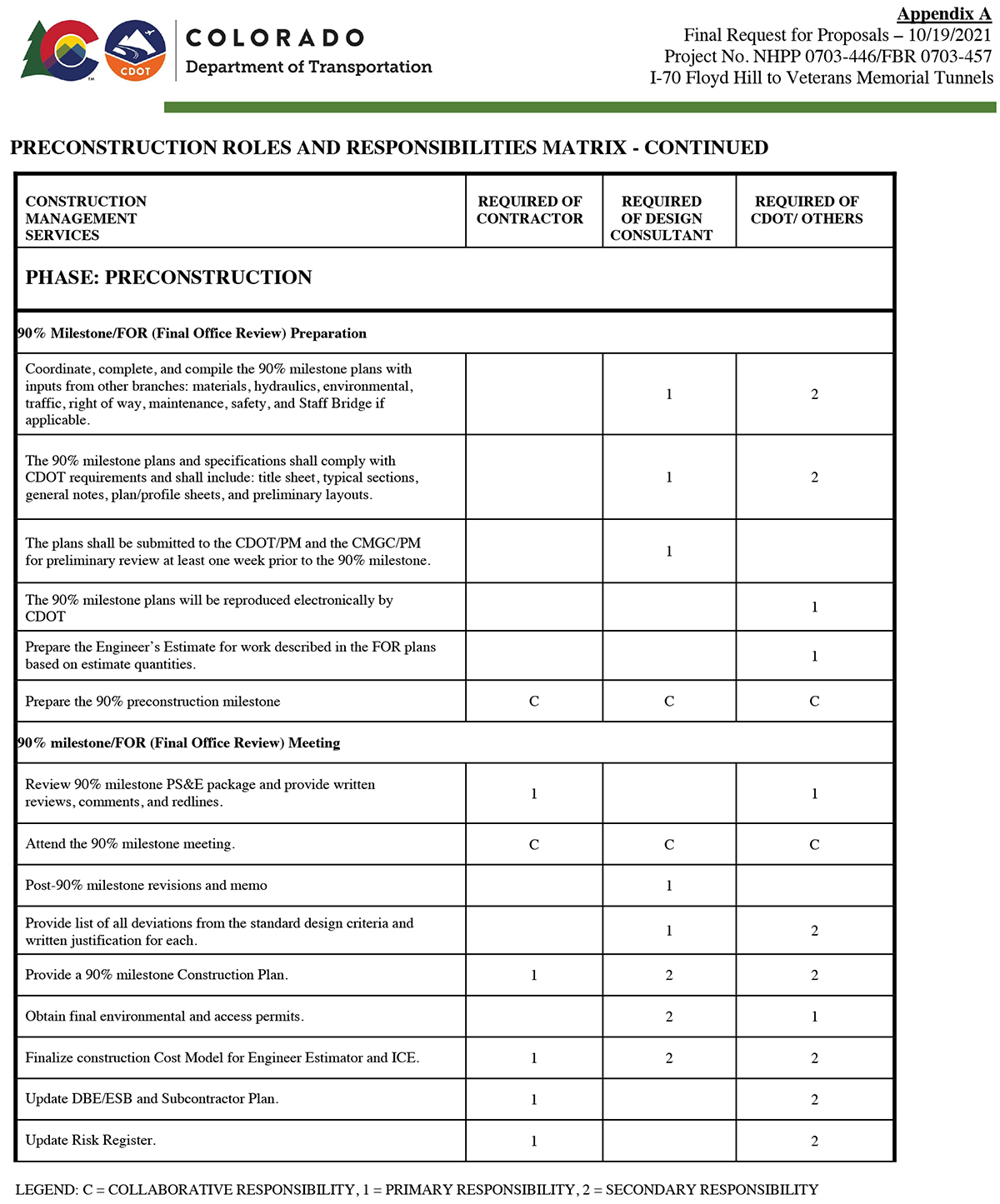
Long Description.
The image header includes a logo for the Colorado Department of Transportation, and the document title: Appendix A to Final Request for Proposals – October 19, 2021. Project Number NHPP 0703-446 / FBR / 0703-457. I-70 Floyd Hill to Veterans Memorial Tunnels.
The table, titled preconstruction roles and responsibilities matrix, continues on this page. The table has the following column headings, the same as those on the previous page: Column 1: Construction Management Services. Column 2: Required of Contractor. Column 3: Required of Design Consultant. Column 4: Required of CDOT / Others. The following legend applies to the data in the table: C = Collaborative Responsibility, 1 = Primary Responsibility, 2 = Secondary Responsibility.
A section heading for the table reads Phase: Preconstruction. A subsection heading reads: 90% Milestone/FOR (Final Office Review) Preparation.
Row 1 under this subsection presents the following data: Coordinate, complete, and compile the 90% milestone plans with inputs from other branches: materials, hydraulics, environmental, traffic, right of way, maintenance, safety, and Staff Bridge if applicable: blank; 1; 2. Row 2 under this subsection presents the following data: The 90% milestone plans and specifications shall comply with CDOT requirements and shall include: title sheet, typical sections, general notes, plan/profile sheets, and preliminary layouts: Blank; 1; 2. Row 3 under this subsection presents the following data: The plans shall be submitted to the CDOT/PM and the CMGC/PM for preliminary review at least one week prior to the 90% milestone: blank ; 1; blank. Row 4 under this subsection presents the following data: The 90% milestone plans will be reproduced electronically by CDOT: blank; blank; 1. Prepare the Engineerʼs Estimate for work described in the FOR plans based on estimate quantities: blank; blank; 1. Row 5 under this subsection presents the following data: Prepare the 90% preconstruction milestone: C; C; C. A subsection heading reads 90% milestone/FOR (Final Office Review) Meeting.
Row 1 under this subsection presents the following data: Review 90% milestone P S & E package and provide written reviews, comments, and redlines. 1; blank; 1.
Row 2 under this subsection presents the following data: Attend the 90% milestone meeting. C; C; C.
Row 3 under this subsection presents the following data: Post-90% milestone revisions and memo. Blank; 1; blank.
Row 4 under this subsection presents the following data: Provide list of all deviations from the standard design criteria and written justification for each. Blank; 1; 2.
Row 5 under this subsection presents the following data: Provide a 90% milestone Construction Plan. 1; 2; 2.
Row 6 under this subsection presents the following data: Obtain final environmental and access permits. Blank; 2; 1.
Row 7 under this subsection presents the following data: Finalize construction Cost Model for Engineer Estimator and ICE. 1; 2; 2.
Row 8 under this subsection presents the following data: Update DBE/ESB and Subcontractor Plan: 1; blank; 2
Row 9 under this subsection presents the following data: Update Risk Register: 1; blank; 2.

Long Description.
The image header includes a logo for the Colorado Department of Transportation, and the document title: Appendix A to Final Request for Proposals – October 19, 2021. Project Number NHPP 0703-446 / FBR / 0703-457. I-70 Floyd Hill to Veterans Memorial Tunnels.
The table, titled preconstruction roles and responsibilities matrix, continues on this page. The table has the following column headings, the same as those on the previous page: Column 1: Construction Management Services. Column 2: Required of Contractor. Column 3: Required of Design Consultant. Column 4: Required of CDOT / Others. The following legend applies to the data in the table: C = Collaborative Responsibility, 1 = Primary Responsibility, 2 = Secondary Responsibility.
A section heading for the table reads Phase: Preconstruction. A subsection heading reads CAP Proposal and Negotiations. Row 1 under this subsection presents the following data: Notify CDOT/PM at a point where CAP proposals can be sufficiently prepared: 1; blank; 2. Row 2 under this subsection presents the following data: Supply cost model and assumptions to ICE and Engineer Estimate: 1; blank; 2. Row 3 under this subsection presents the following data: Supply EBS and Construction Contract Checklist to CM/G C Contractor: blank; blank; 1. Row 4 under this subsection presents the following data: Prepare and submit construction CAP proposals: 1; blank; 2. Row 5 under this subsection presents the following data: Procure independent cost estimate: blank; blank; 1. Row 6 under this subsection presents the following data: Submit an electronic EBS to the CDOT/PM for each phase: 1; blank; blank. Row 7 under this subsection presents the following data: Review the construction CAP proposals and compare to Engineerʼs Estimate and ICE: blank; blank; 1. Row 8 under this subsection presents the following data: Negotiate final CAPs for each phase: C; blank; C. A note under this row reads: CM/G C and CDOT have three attempts to negotiate assumptions and prepare CAP estimates. After the third opening, CDOT reserves the right to prepare the bid package for advertisement.
7. Industry Outreach/Forums
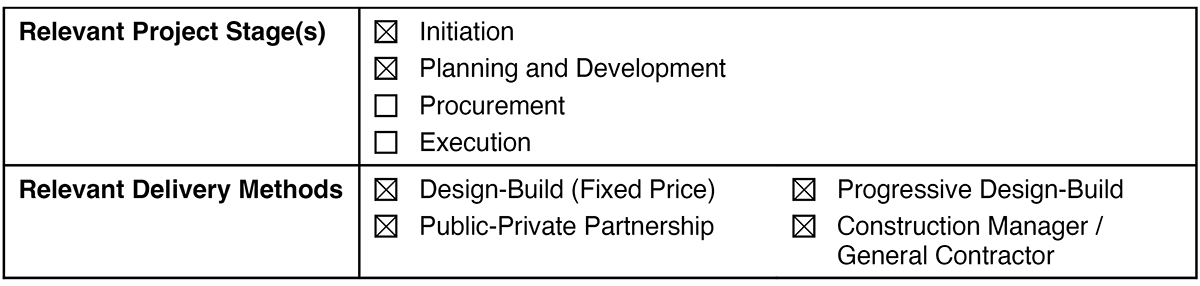
Long Description.
The checklist lists the following in two rows:
Row 1: Relevant Project Stage(s).
Initiation
Planning and Development
Procurement
Execution
Row 2: Relevant Delivery Methods
Design-Build (Fixed Price)
Public-Private Partnership
Progressive Design-Build
Construction Manager slash General Contractor
All options except Procurement and Execution are checked.
Overview
Industry forums are typically informal informational sessions during which a public owner engages with industry representatives to share information regarding upcoming projects (such as anticipated scope, delivery method, timing, budget, risks, etc.).
Objectives
Industry forums and other early outreach mechanisms allow owners to:
- Obtain high-level feedback from industry regarding project feasibility.
- Determine if sufficient industry interest exists to continue to advance project development and procurement activities as planned, or if the proposed delivery, packaging, and/or risk allocation strategies require adjustment to attract adequate competition.
- Better align project scope and objectives with market conditions.
Application
GDOTʼs Design-Build Manual (GDOT 2022) describes industry engagement activities as follows:
2.5 Industry Engagement
An industry forum is used on most DB procurements by GDOT to engage industry groups and potential Design-Build Team members on a specific project. The industry forum is typically conducted after the issuance of the PNA (Public Notice of Advertisement) but prior to the issuance of the RFQ. The purpose of the forum is to present a projectʼs anticipated scope, procurement schedule, and risks, as well as to receive industry feedback, typically through one-on-one meetings with Proposers held immediately following the forum. Interested Proposers are encouraged, but not required, to participate. Any information provided at the industry forum is provided for information only. Announcements for the industry forum will be included in the PNA and on GDOTʼs Design-Build webpage. Following the issuance of the RFQ, a restriction on communications will be enacted, as further defined in the applicable procurement documents. Once the restriction is in place, all project-related communication must be sent to the OAD-CO. This restriction will remain through the duration of the procurement. Other meetings may include ACEC GPTQ Innovative Delivery Sub-committee meeting, Highway Contractors workshops, DBE Industry Engagement events, and Design-Build workshops which are used periodically by GDOT to discuss a number of topics that may include, but is not limited to GDOTʼs Design-Build program, utility coordination, schedule development and/or risk mitigation. Announcements for Design-Build workshops are found on GDOTʼs Design-Build webpage. Finally, any entity interested in learning about Design-Build delivery at GDOT may contact the OAD OA whose information is found on GDOTʼs Design-Build webpage.
Similarly, GDOTʼs P3 Manual (GDOT 2022) describes the typical outreach activities the agency conducts for a P3 project as follows:
5.6 Industry Outreach
5.6.1 Industry Forum
In accordance with the P3 Guidelines, the procurement team will assess and recommend to the Steering Committee, for approval, whether GDOT should conduct a pre-solicitation industry forum for the project in order to engage industry groups and potential Developers. In making this determination, the procurement
team considers, among other things, the degree of market interest, the scope, nature, and complexity of the Project, and the degree of public and political support. GDOT typically conducts the industry forum after issuing a Notice of Intent to Issue (NOI), but prior to issuing an RFQ. The industry forum details are included in the NOI, and typically posted on GDOTʼs P3 webpage at http://www.dot.ga.gov/PS/Innovative/P3. The purpose of the forum is to discuss the projectʼs anticipated scope, schedule, and risks, and to receive industry feedback.
5.6.2 Industry One-on-One Meetings
In addition to a pre-solicitation industry forum, GDOT may meet with interested parties in a one-on-one setting to gauge the degree of market interest, the scope, nature, and complexity the project and seek industry feedback for the project.
5.6.3 Market Sounding(s)
Prior to issuing a NOI, GDOT may engage with the industry to solicit input on market interest and/or high-level commercial or operational terms of a potential project or grouping of projects. The engagement may be by emailed or mailed industry surveys, telephonic contact, or other means.
8. Pre-Procurement One-on-One Meetings

Long Description.
The checklist lists the following in two rows:
Row 1: Relevant Project Stage(s).
Initiation
Planning and Development
Procurement
Execution
Row 2: Relevant Delivery Methods
Design-Build (Fixed Price)
Public-Private Partnership
Progressive Design-Build
Construction Manager slash General Contractor
All options except Initiation, Procurement, and Execution are checked.
Overview
For particularly large or complex projects, some owners offer one-on-one meetings with potential interested parties early in the project development phase to further assess industry interest and determine any issues or concerns (e.g., scope, technical, environmental, etc.) that could be addressed by the owner in advance of procurement activities to modify the projectʼs perceived risk profile.
Objectives
The FHWA report Early Involvement of Private Developers in the Consideration of Long-Term Public-Private Partnership Concession Options (Green et al. 2017) addresses the potential value of individual meetings with potential proposers in advance of and during the procurement process. The early meetings allow owners to gauge industry interest, assess the financial feasibility of the project, and identify possible deal breakers related to commercial terms and risk allocation.
Early engagement with the design and construction community also gives industry the ability to identify appropriate teaming partners and plan the work.
Application
GDOTʼs P3 Manual (GDOT 2022b) describes the typical outreach activities the agency conducts for a P3 project to include pre-solicitation one-on-one meetings as follows:
5.6.2 Industry One-on-One Meetings
In addition to a pre-solicitation industry forum, GDOT may meet with interested parties in a one-on-one setting to gauge the degree of market interest, the scope, nature, and complexity the project and seek industry feedback for the project.
References
GDOT. (2022a). Design-Build Manual, Revision 2.5. Published September 15, 2022. https://www.dot.ga.gov/PartnerSmart/DesignManuals/DesignBuild/001-GDOT_Design-Build_Manual.pdf.
GDOT. (2022b). P3 Manual, Revision 2.2. Published August 3, 2022. https://www.dot.ga.gov/PartnerSmart/Innovative/Documents/P3%20Manual.pdf.
Green, S., Amos, A., Vandegrift, A., Omay, M., Frawley, T., and T. Henkin. (2017). Early Involvement of Private Developers in the Consideration of Long-Term Public Private Partnership Concession Options: A Discussion Paper. Report FHWA-HIN-007, FHWA, Washington, DC. https://www.fhwa.dot.gov/ipd/pdfs/p3/early_involvement_private_sector_p3s.pdf.
9. Alternative Technical Concepts
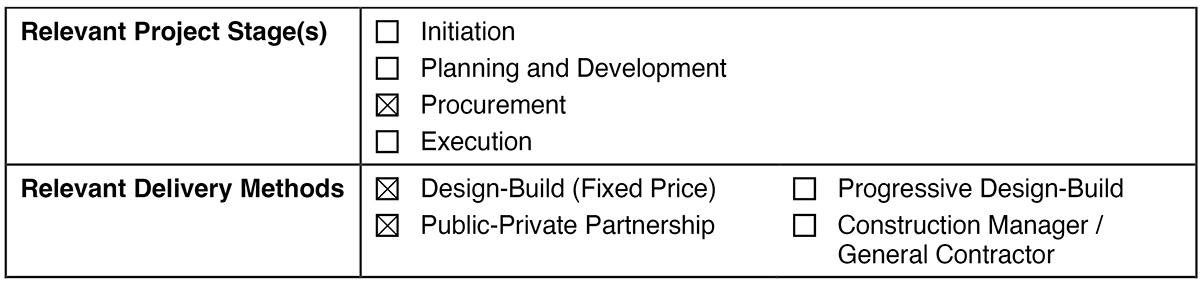
Long Description.
The checklist lists the following in two rows:
Row 1: Relevant Project Stage(s).
Initiation
Planning and Development
Procurement
Execution
Row 2: Relevant Delivery Methods
Design-Build (Fixed Price)
Public-Private Partnership
Progressive Design-Build
Construction Manager slash General Contractor
The checked options are Procurement, Design-Build (Fixed Price), and Public-Private Partnership.
Overview
An alternative technical concept (ATC) is a request by a proposer to modify a contract requirement, specifically for that proposerʼs use in gaining a competitive benefit during the bidding or proposal process. An ATC must provide a solution that is equal to or better than the ownerʼs base design requirements in the solicitation documents. It offers proposers an opportunity to get additional points for their technical proposals, as well as to find ways to reduce their price proposal while still providing a solution that meets the ownerʼs design intent. Ideally, ATCs should be targeted to address solutions to specific risk issues that affect cost, schedule, or quality.
Objective
ATCs have been used extensively by transportation owners for fixed-price DB projects to obtain innovative technical solutions that are equal to or better than the RFP requirements and/or to reduce risks that may affect schedule, cost, end user access, or facility performance.
Application
To encourage proposers to invest the time and resources necessary to develop truly innovative concepts, ATCs should be considered confidential and proprietary to the proposer. Typically, a shortlisted proposer will discuss its ATCs as part of confidential one-on-one meetings prior to submitting its technical proposal.
Owners may use an initial screening process to evaluate proposed ATCs for pre-approval before a proposer develops the ATC further. Owners will also identify specific elements of the project where ATCs will not be considered (e.g., pavement design and materials) or will limit the number or type of ATCs to manage the procurement process and schedule.
An excerpt from a draft RFP for the Maryland Highway Administrationʼs RFP for the US-113 Stipulated Sum Design-Build project follows:
2.08.02.6 Alternative Technical Concepts
The Administration has chosen to use the alternative technical concept (ATC) process to allow innovation and flexibility to be incorporated into the Proposals and considered in making the selection decision, and to avoid delay and potential conflicts in the design associated with deferring of technical concept reviews to the post-award period, and ultimately to obtain the best value for the public.
The ATC process allows Proposers to submit for pre-approval proposed alternatives to the RFP requirements. The Administration will not approve any ATC that entails a deviation from the requirements of the as-issued Contract Documents, unless the Administration determines, in its sole discretion, that the proposed end product based on the deviation is equal to or better than the end product absent the deviation and is permitted by the Permit Approvals.
Any ATC that has been pre-approved may be included in the Proposal, subject to the conditions set forth herein. The ATC process may be used to allow a Proposer to submit technical concepts for review by the Administration to determine if those technical concepts are consistent with the requirements of the RFP documents. The ATC submittal should clearly stipulate this reason for the review.
References
Gransberg D. D., Loulakis M., and G. M. Gad. (2014) NCHRP Synthesis 455: Alternative Technical Concepts for Contract Delivery Methods. Transportation Research Board of the National Academies, Washington, DC. https://doi.org/10.17226/22419.
Gransberg, D. D., Loulakis M., Molenaar, K., DeWitt, S. D., Rueda-Benavides, J., Gad, G., and D. R. Brisk. (2020). NCHRP Research Report 937: Guidebook for Implementing Alternative Technical Concepts in all Types of Highway Project Delivery Methods. Transportation Research Board, Washington, DC. https://doi.org/10.17226/25866.
10. Third-Party Coordination
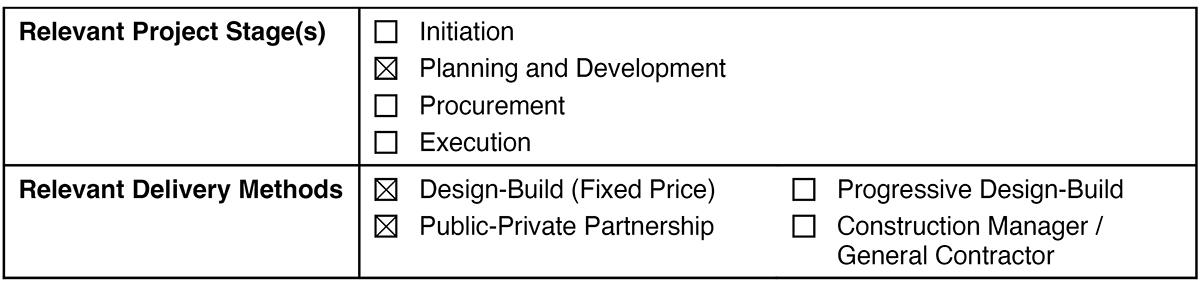
Long Description.
The checklist lists the following in two rows:
Row 1: Relevant Project Stage(s).
Initiation
Planning and Development
Procurement
Execution
Row 2: Relevant Delivery Methods
Design-Build (Fixed Price)
Public-Private Partnership
Progressive Design-Build
Construction Manager slash General Contractor
The checked options are Procurement, Design-Build (Fixed Price), and Public-Private Partnership.
Overview
Third-party outreach and coordination tasks, including identifying interested project stakeholders, developing a third-party engagement plan, and, to the extent possible, entering into agreements or memoranda of understanding (MOUs) with third parties in advance of procurement, will help minimize the risk that conflicts will arise with third parties that may impact the cost and schedule for the project.
Objective
It is generally the ownerʼs responsibility to gain endorsement from third-party stakeholders, Local Agencies, the general public, and other interested parties of the conceptual design prior to procurement.
The status of any outstanding third-party coordination efforts at the time of procurement will help define the necessary contractual requirements that should be incorporated into the solicitation documents to properly convey and allocate associated risks.
Application
Coordination with third parties may involve local agencies, adjacent property owners or jurisdictions, utilities, railroads, or approval/permitting agencies, and can add project complexity and risks of delay and disruption to project execution. Whenever possible, agreements or MOUs with third parties or approval agencies should be made prior to procurement to minimize risk.
Third parties may also ask for or want to make betterments or improvements to their property or facilities as part of the overall project. If a third-party benefit is requested (local property owner, utility, or local agency), the owner should set up the agreement and establish the payment terms and performance criteria prior to procurement. The improvement requested by the third party (or third parties) can be included in the Technical Requirements and appendices for proposers to include in their proposals.
Railroad companies tend to be a particularly challenging third party to manage in design-build projects. They often require advanced designs before formal approval (for example, grade separation structures over their facilities), before executing construction and maintenance agreements. Their approval processes introduce a high level of risk to proposers who need to include the estimated costs and schedules for work that interfaces with the railroad in their proposals. Typically, the risks can be best minimized and managed by the owner advancing elements of the design affecting railroads as much as possible in advance of the procurement phase.
The Minnesota DOT (MnDOT) Design-Build Manual includes the following guidance related to third-party coordination including municipal governments, utilities and railroads:
Municipalities
If municipal agreements are required, they are to be prepared and negotiated in accordance with MnDOT Guideline for the Policy and Procedures for Cooperative Construction Projects with Local Units of Government and the MnDOT Position Statement for the Policy and Procedures for Cooperative Construction Projects with Local Units of Government. It is preferable to have these agreements signed prior to the release of the RFP; if this is not possible the Design-Build Program Manager is responsible for reviewing the situation and determining whether the risk of changes is low enough that the risk to the Design-Build program can be accepted. A Design-Build contract cannot be awarded until all agreements are signed.
Utility Agreements and Coordination
Utility coordination must be performed in accordance with MnDOT Utility Manual, Design-Build Section. Depending on the extent of utilities located within the project corridor, the preparation of utility agreements can be one of the more time-consuming processes of a Design-Build project. Consequently, MnDOT should contact utility owners during the early stages of the project to plan activities and arrange meetings.
MnDOTʼs standard practice on Design-Build projects is to provide subsurface utility engineering (SUE) and to utilize master utility agreements (MUA) between MnDOT and utilities with major impacts. MnDOT conducts an initial SUE and prepares Utility Information Sheets (UISs) for each utility within the project corridor. The UISs are included in the RID (Reference Information Documents) and contain all information known to MnDOT at the time of issuance of the RFP, including descriptions of utilities expected to have conflicts, proposed relocation areas, and utilities not expected to have conflicts. Notification timeframes for major relocation efforts and other high-level issues should be made contractual in the RFP.
MnDOT can follow one of two options for allocating the risk of any misidentified or unidentified utilities. If MnDOT conducts an extensive SUE prior to issuance of the RFP, MnDOT will guarantee the “reasonable accuracy” of the information provided in the RID for underground utilities, the relocation of which are included in the Design-Build teamʼs proposal price. If MnDOT does not conduct an extensive SUE, MnDOT will not guarantee the “reasonable accuracy” of the information provided in the RID for any underground utilities.
MnDOT may enter into MUAs with utility owners to address utility issues on the project, including cost responsibilities. The Design-Build team is required to become a party to the MUA, which sets forth a work order process where MnDOT, the Utility Owner, and the Design-Build team agree to a cost and schedule for each relocation. The Notice and Order, which is issued by the Commissioner under the Minnesota
utility relocation statutes, will be included as an attachment to the MUA. If a Utility Owner does not enter into a MUA with MnDOT, MnDOTʼs Notice and Order process will be required to relocate the utilities. More detailed information on the utility coordination process in Design-Build delivery is provided in the MnDOT Utilities Manual, Design-Build Section.
Railroad Agreements
Railroad agreements are similar to other third-party agreements, but often require long lead time to finalize. For this reason, discussions with railroads should be initiated as early as possible in the project, and agreements with railroads should be in place prior to issuance of the RFP. The Design-Build contract should recognize potential impacts to schedule and cost due to the unpredictability of railroad participation. Key railroad requirements, including the railroadʼs involvement, authority, and review times, should be identified in the RFP. When bridges are involved, it is wise to negotiate a two-dimensional ‘clearance envelope’ with the railroad on a cross-section of the track and make it contractual.
11. Risk Register

Long Description.
The checklist lists the following in two rows:
Row 1: Relevant Project Stage(s).
Initiation
Planning and Development
Procurement
Execution
Row 2: Relevant Delivery Methods
Design-Build (Fixed Price)
Public-Private Partnership
Progressive Design-Build
Construction Manager slash General Contractor
All options are checked.
Overview
A risk register is a project management tool used to identify, evaluate, and prioritize risks, which serves as a central repository for tracking and mitigating risks and assigning responsibility for managing risks. The risk register will be updated during the project to expand, clarify, revise, or retire risks and to include likely risk allocation.
Objective
The purpose of the risk register is to define and document project risks, identify cost and schedule impacts associated with each risk, assign risk responsibilities, and describe mitigation plans. Typically, the projectʼs preliminary risk register is used as an input to support the PDM selection process, and it progressively evolves as the project advances through all of its stages to completion. Including the risk register as part of the RFP package can help communicate the project risk profile to proposers.
Application
Project risk management should be initiated early in the project lifecycle. It should be a continuous process through the life of the project, from project initiation and design development, through the procurement and execution phases of the project.
Early in the project, the owner should begin to identify and document potential risks associated with the project in a risk register to produce a comprehensive list of all the perceived risks to achieving the projectʼs objectives.
A typical outline and template for a risk register may vary, but include the following:
- Risk Tracking Number, Name, and Description.
- Status of the Risk (active or resolved).
- Potential Impacts of the Risk: Often risk impacts are described in terms of how they may affect project schedule and cost, but they can also address quality, safety, and other impacts.
- Risk Level: A subjective assessment of the importance of resolving the risk.
- Response Actions: A detailed description of the strategies chosen to manage the risk.
- Risk Owner: Identification of the party or parties to whom the risk is allocated.
As the project design becomes more advanced, the risk register becomes more detailed, assigning specific costs and schedule impacts to risks, to both help inform mitigation decisions and to determine appropriate cost/schedule contingencies for the project.
At the procurement stage, the current version of the risk register should be included in the procurement documents to share the ownerʼs perspectives on key project risks and initiate dialogue with the industry during one-on-one meetings regarding risks, risk allocation, and mitigation strategies.
The following example demonstrates how Washington State DOT addressed the Design- Builderʼs risk management responsibilities in the RFP for the SR 167/I-5 to SR 509 – New Expressway DB Project. As part of the RFP, WSDOT included the preliminary risk register that its project management team had developed for the Project.
Note: Pages A-53 to A-56 are taken from the WSDOT SR 167/I-5 to SR 509 New Expressway Project RFP.
Pages A-57 to A-59 are taken from the preliminary risk register for SR 167 WSDOT.
Long Description.
A Washington State Department of Transportation logo is placed at the top of the page. The title for the document is Request for Proposal SR 167 / I-5 to S R 509 New Expressway Project. Risk Management 20180806 V 3. The footer at the bottom of the page says Request for Proposal December 23, 2021. Risk Management 2.3-1. The following text is displayed on the page:
2.3 Risk Management
2.3.1 General Effective identification, management, and mitigation of risks are essential to the successful delivery of the Project. Risk is defined as the combination of the probability of an uncertain event and its consequences. A positive consequence presents an opportunity; a negative consequence poses a threat. The Design- Builder shall collaborate with WSDOT to identify, characterize, and manage potential risks to the delivery of the Project including design, construction, and all aspects of completing delivery of the Project.
2.3.2 Performance Requirements The Design-Builder shall perform continuous risk management including comprehensive risk identification, characterization, and assessment; holding risk workshops; developing, managing, and communicating an actionable risk register; and implementing specific risk mitigation actions. The Design-Builder shall complete, in collaboration with the WSDOT Engineer, a comprehensive risk analysis of the Project, including design and construction. The risks shall be analyzed for probability of occurrence and potential impact on scope, schedule, budget, safety, and the environment. Management of these risks shall be in accordance with current industry guidelines and be consistent with WSDOTʼs risk management policies, including: WSDOT Executive Order E 1053.01, “Project Risk Management and Risk-Based Estimating” (Appendix Q) WSDOT Project Risk Management Guide (Appendix Q). 2.3.2.1 Risk Management Plan The Design-Builder shall prepare and maintain a Risk Management Plan throughout the life of the Contract, which shall include the following: 1. Design-Builderʼs risk management policy. 2. Project team membersʼ roles and responsibilities related to risk management and risk response. 3. Risk Identification – ongoing identification of potential risk events and their characteristics. 4. Risk Analysis – development and management of the risk register — continues on next page.
Long Description.
The list continues from the last page: a. Qualitative Risk Analysis – characterizing identified risks for action by assessing their initial probability and consequence (relative scales) as appropriate, and/or b. Quantitative Risk Analysis – performing a more detailed numerical analysis of the probabilities and consequences of the identified risks on overall Project objectives. 5. Risk Response – develop, quantify, and implement mitigation options or actions to reduce the probability, consequence, or both, for identified risks. 6. Risk Monitoring and Control – implement risk mitigation, track the identified risks and actions taken to mitigate those risks, monitor residual risks, identify new risks, re-quantify existing risks, and evaluate the effectiveness of actions taken. 7. Risk management software used. 8. A schedule for planned risk workshops, training, and updates. Scheduling quarterly risk meetings to update the Risk Management Plan and the status of identified risks. The Design-Builder shall be responsible for determining, with WSDOTʼs concurrence, whether a qualitative or quantitative analysis is appropriate. The Risk Management Plan shall be submitted to WSDOT within 30 Calendar Days of Notice to Proceed 1 (NTP1) for Review and Comment. The Design- Builder shall resolve WSDOTʼs comments and submit the final Risk Management Plan to WSDOT within 60 Calendar Days of NTP1. The Design-Builder and the WSDOT Engineer shall evaluate the plan for updates and revisions at least quarterly. Any revisions to the plan shall be submitted to the WSDOT Engineer for Review and Comment. The Design-Builderʼs risk assessments shall be made continuously throughout the Project in collaboration with the WSDOT Engineer. The Design-Builder shall provide WSDOT on a monthly basis, or upon request by WSDOT, a report on risk status and upcoming mitigation strategies. The report shall also provide the Design-Builderʼs risk management lessons learned to date. 2.3.2.2 Risk Management Kick-off Meeting The Design-Builder shall conduct a risk management kick-off meeting within 30 Calendar Days after the final Risk Management Plan has been issued, and shall invite all appropriate Design-Builder team members to the kick-off meeting. At the kick-off meeting, the Design-Builder shall present the approach and identify roles and responsibilities. WSDOT shall be invited to participate in all risk management kick-off meetings, including additional sessions, if needed. 2.3.2.3 Risk Workshops The Design-Builder shall be responsible for planning and conducting risk workshops quarterly, or more often as needed, throughout the life of the Project. The initial risk workshop shall be held within 60 Calendar Days of NTP1. The —text continues on the next page.
Long Description.
The text continues from the previous page — Design-Builder shall include, at a minimum, the Project Manager, Design Manager, Construction Manager, Environmental Compliance Manager, and WSDOT Engineer in the quarterly workshops. The Design-Builder shall invite additional staff as appropriate to the workshop. The Design-Builder shall develop and maintain the risk register as an outcome of the workshop and shall submit it to the WSDOT Engineer for Review and Comment. 2.3.3 Risk Register WSDOT has completed an initial risk register for the Project (Appendix Q). The Design-Builder shall develop and maintain, in collaboration with the WSDOT Engineer, a comprehensive list of risks in a project risk register. The Project risk register shall include the following information: 1. Risk Identification a. Risk event number/identification; priority, active, or inactive b. Summary description of risk event c. Detailed description of risk event d. Responsible party 2. Qualitative analysis results a. Relative probability (1 to 5) b. Relative impact or consequence (1 to 5) c. Risk matrix (graphical representation, 5 x 5 matrix) with scores between 1 and 25. See Appendix Q. 3. Quantitative analysis results a. Probability – usually a percentage (can have a distribution or be conditional) b. Impact or consequence – cost, schedule, other (can have a distribution or be conditional) 4. Risk response plan a. Owner of the risk/action b. Mitigation strategy c. Specific action to be taken d. Related Project activities affected or involved e. Linkage to/impact on other risks or risk mitigation actions 5. Risk monitoring and control a. Risk review dates, status, review comments — the text continues on the next page.
Long Description.
The Design-Builder shall identify specifically how the mitigation strategy, if adopted, will address each identified risk. The Design-Builder shall identify and characterize residual risks that are the result of risk response strategies. The Design-Builder, in collaboration with the W S D O T Engineer, shall classify risks in accordance with WSDOTʼs Risk Breakdown Structure and consistent with the SR 167 Risk Register Template (Appendix Q). The Design-Builder shall coordinate with WSDOT to ensure that appropriate information is provided with risk register submittals. Submittals shall be in a software format that is acceptable to WSDOT. 2.3.4 Submittals The Design-Builder shall submit the following: Project Risk Management Plan and updates Project risk register and updates 2.3.4.1 Miscellaneous Submittals At the request of the WSDOT Engineer, the Design-Builder shall deliver to the WWSDOT Engineer Work-related Submittals that do not fit in the previous categories, but are prepared in accordance with this Section. End of Section
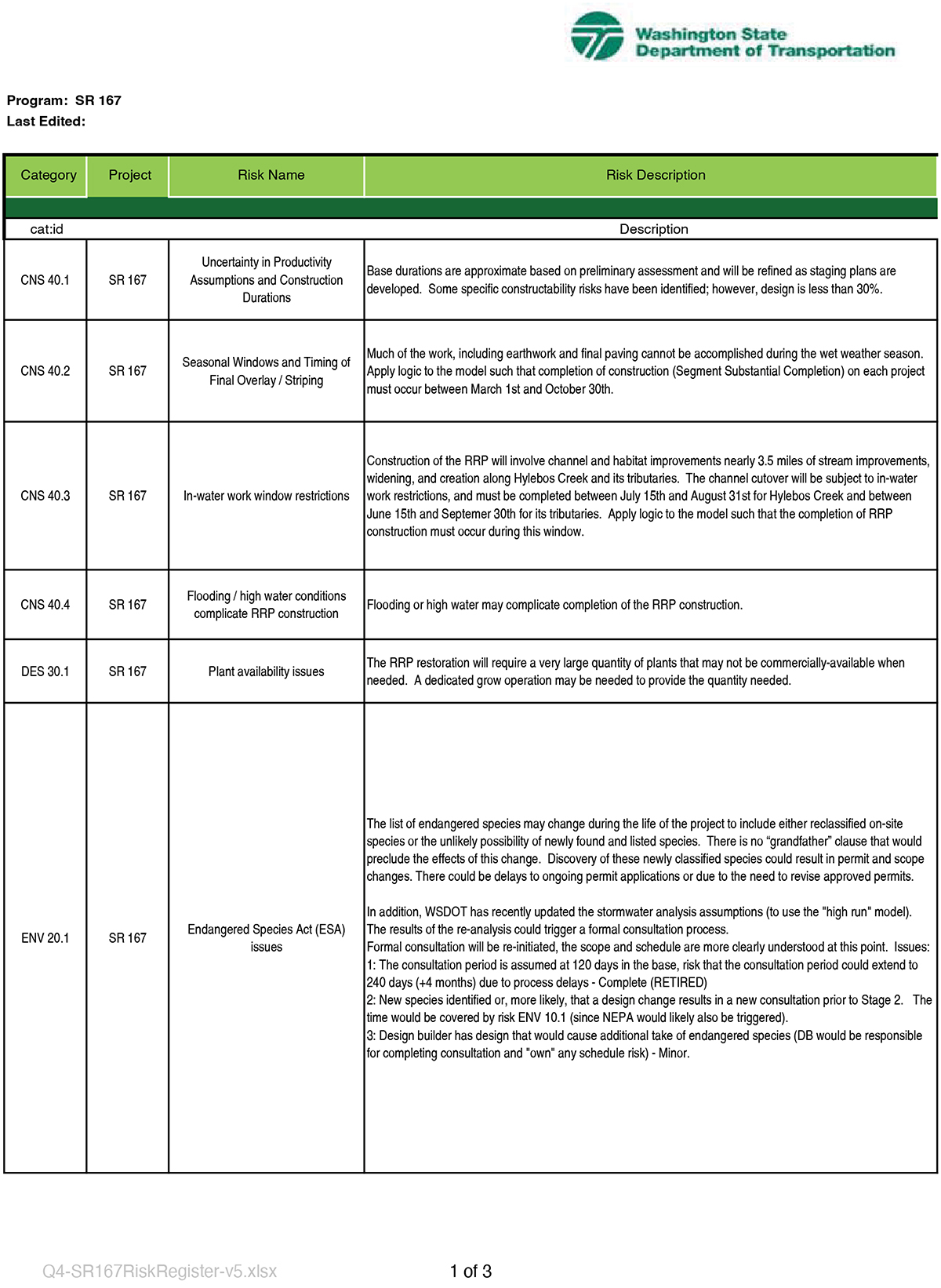
Long Description.
A Washington State Department of Transportation logo appears at the top of the page.
A heading above a table reads Program: SR 167, followed by a space to enter the last edited date.
The table has 4 column headings: Column 1: Category, defined as cat: i d Column 2: Project. Column 3: Risk Name. Column 4: Risk Description.
Row 1, Column 1: CNS 40.1. Column 2: SR 167. Column 3: Uncertainty in Productivity Assumptions and Construction Durations. Column 4:Base durations are approximate based on preliminary assessment and will be refined as staging plans are developed. Some specific constructability risks have been identified; however, design is less than 30%.
Row 2, Column 1:CNS 40.2. Column 2: SR 167 . Column 3: Seasonal Windows and Timing of Final Overlay / Striping. Column 4: Much of the work, including earthwork and final paving cannot be accomplished during the wet weather season. Apply logic to the model such that completion of construction (Segment Substantial Completion) on each project must occur between March 1st and October 30th.
Row 3, Column 1: CNS 40.3. Column 2: SR 167. Column 3: In-water work window restrictions. Column 4: Construction of the RRP will involve channel and habitat improvements nearly 3.5 miles of stream improvements, widening, and creation along Hylebos Creek and its tributaries. The channel cutover will be subject to in-water work restrictions, and must be completed between July 15th and August 31st for Hylebos Creek and between June 15th and Septemer 30th for its tributaries. Apply logic to the model such that the completion of RRP construction must occur during this window.
Row 4, Column 1: CNS 40.4. Column 2: SR 167 . Column 3: Flooding / high water conditions complicate RRP construction. Column 4: Flooding or high water may complicate completion of the RRP construction.
Row 5, Column 1: DES 30.1. Column 2: SR 167. Column 3: Plant availability issues. Column 4: The RRP restoration will require a very large quantity of plants that may not be commercially-available when needed. A dedicated grow operation may be needed to provide the quantity needed.
Row 6, Column 1: ENV 20.1. Column 2: SR 167. Column 3: Endangered Species Act (ESA) issues. Column 4: The list of endangered species may change during the life of the project to include either reclassified on-site species or the unlikely possibility of newly found and listed species. There is no “grandfather” clause that would preclude the effects of this change. Discovery of these newly classified species could result in permit and scope changes. There could be delays to ongoing permit applications or due to the need to revise approved permits. In addition, WSDOT has recently updated the stormwater analysis assumptions (to use the “high run” model). The results of the re-analysis could trigger a formal consultation process. Formal consultation will be re-initiated, the scope and schedule are more clearly understood at this point. Issues: 1: The consultation period is assumed at 120 days in the base, risk that the consultation period could extend to 240 days (+4 months) due to process delays - Complete (RETIRED) 2: New species identified or, more likely, that a design change results in a new consultation prior to Stage 2. The time would be covered by risk ENV 10.1 (since NEPA would likely also be triggered). 3: Design builder has design that would cause additional take of endangered species (DB would be responsible for completing consultation and “own” any schedule risk) - Minor.
The footer below the table displays page number 1 of 3 and the file name Q 4 – SR 1 6 7 Risk Register – v5-x l s x.
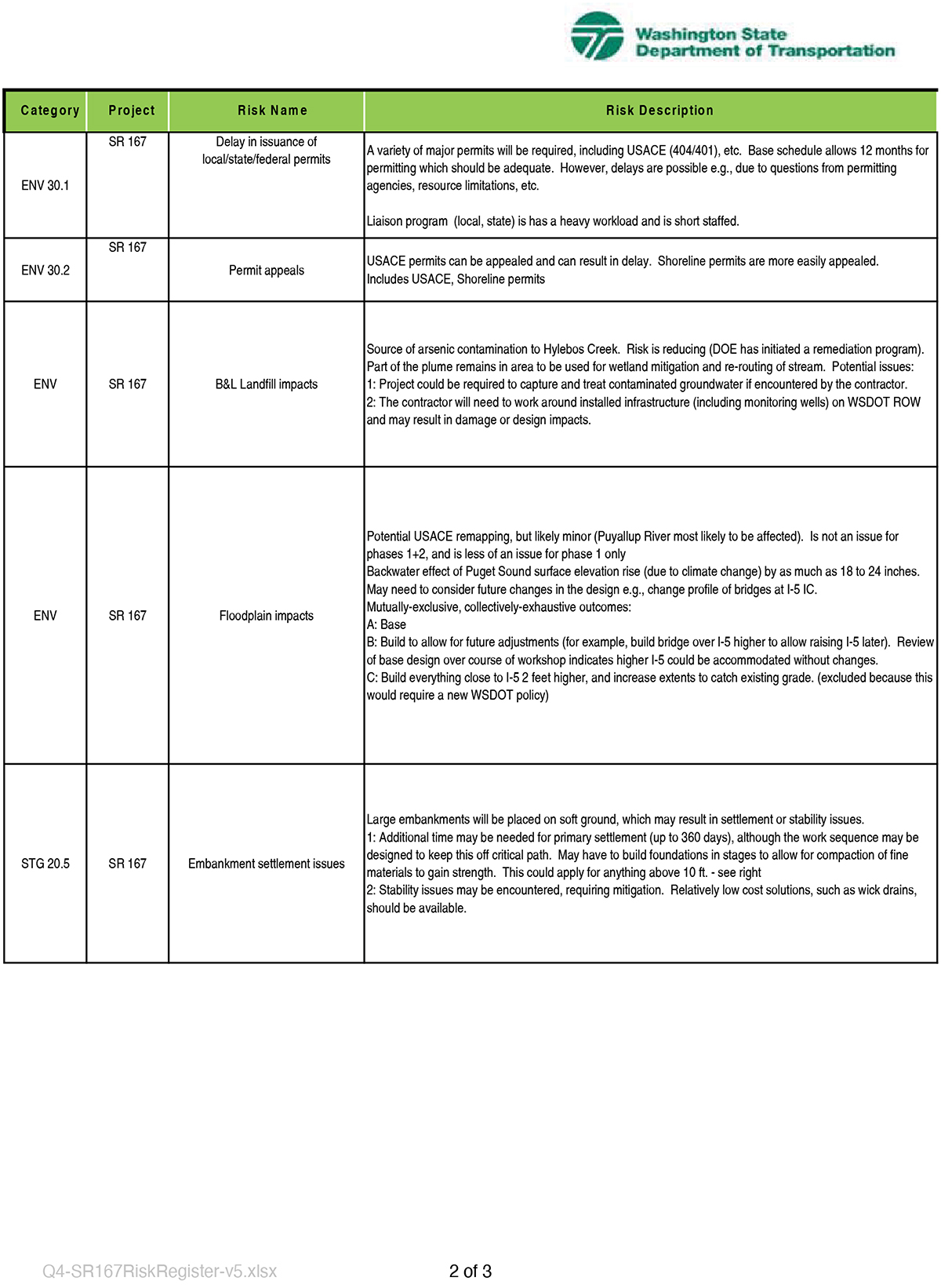
Long Description.
The table continues from the previous page, with the following column headings: Column 1: Category, defined as cat: i d Column 2: Project. Column 3: Risk Name. Column 4: Risk Description.
Row 1, Column 1: ENV 30.1. Column 2: SR 167. Column 3: Delay in issuance of local/state/federal permits. Column 4: A variety of major permits will be required, including USACE (404/401), etc. Base schedule allows 12 months for permitting which should be adequate. However, delays are possible e.g., due to questions from permitting agencies, resource limitations, etc. Liaison program (local, state) is has a heavy workload and is short staffed.
Row 2, Column 1: ENV 30.2. Column 2: SR 167. Column 3: Permit appeals. Column 4: USACE permits can be appealed and can result in delay. Shoreline permits are more easily appealed. Includes USACE, Shoreline permits
Row 3, Column 1: ENV. Column 2: SR 167. Column 3: B&L Landfill impacts. Column 4: Source of arsenic contamination to Hylebos Creek. Risk is reducing (D O E has initiated a remediation program). Part of the plume remains in area to be used for wetland mitigation and re-routing of stream. Potential issues: 1: Project could be required to capture and treat contaminated groundwater if encountered by the contractor. 2: The contractor will need to work around installed infrastructure (including monitoring wells) on WSDOT ROW and may result in damage or design impacts.
Row 4, Column 1: ENV . Column 2: SR 167. Column 3: Floodplain impacts. Column 4: Potential USACE remapping, but likely minor (Puyallup River most likely to be affected). Is not an issue for phases 1+2, and is less of an issue for phase 1 only Backwater effect of Puget Sound surface elevation rise (due to climate change) by as much as 18 to 24 inches. May need to consider future changes in the design e.g., change profile of bridges at I-5 IC. Mutually-exclusive, collectively-exhaustive outcomes: A: Base B: Build to allow for future adjustments (for example, build bridge over I-5 higher to allow raising I-5 later). Review of base design over course of workshop indicates higher I-5 could be accommodated without changes. C: Build everything close to I-5 2 feet higher, and increase extents to catch existing grade. (excluded because this would require a new WSDOT policy)
Row 5, Column 1: STG 20.5. Column 2: SR 167. Column 3: Embankment settlement issues. Column 4: Large embankments will be placed on soft ground, which may result in settlement or stability issues. 1: Additional time may be needed for primary settlement (up to 360 days), although the work sequence may be designed to keep this off critical path. May have to build foundations in stages to allow for compaction of fine materials to gain strength. This could apply for anything above 10 ft. - see right 2: Stability issues may be encountered, requiring mitigation. Relatively low cost solutions, such as wick drains, should be available.
The footer below the table displays page number 2 of 3 and the file name Q 4 – SR 167 Risk Register – v5-x l s x.
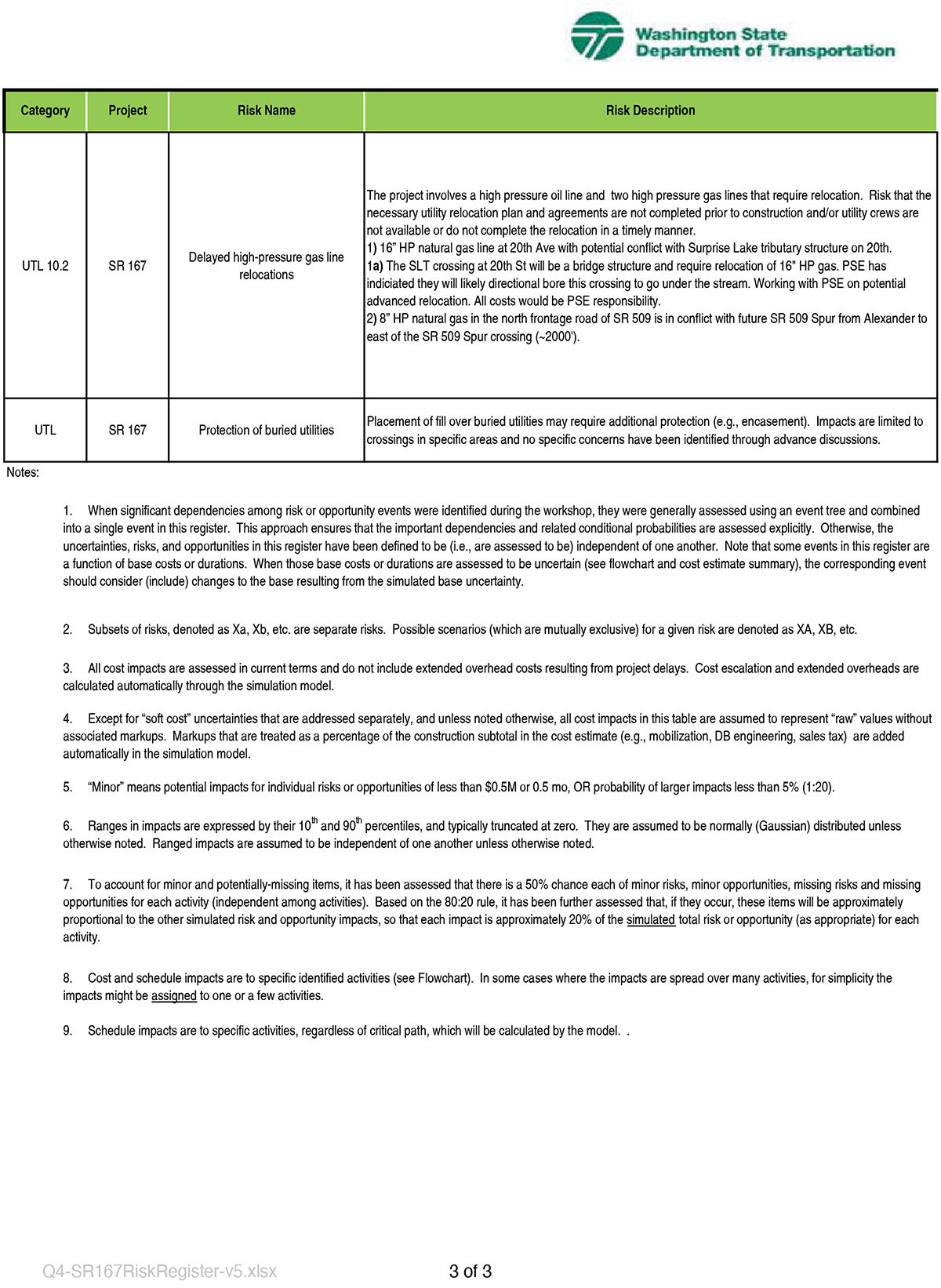
Long Description.
The table continues from the previous page, with the following column headings: Column 1: Category, defined as cat: i d Column 2: Project. Column 3: Risk Name. Column 4: Risk Description.
Row 1, Column 1: UTL 10.2. Column 2: SR 167. Column 3: Delayed high-pressure gas line relocations 1) The project involves a high pressure oil line and two high pressure gas lines that require relocation. Risk that the necessary utility relocation plan and agreements are not completed prior to construction and/or utility crews are not available or do not complete the relocation in a timely manner. 16” HP natural gas line at 20th Ave with potential conflict with Surprise Lake tributary structure on 20th. 1a) The SLT crossing at 20th St will be a bridge structure and require relocation of 16” HP gas. PSE has indicated they will likely directional bore this crossing to go under the stream. Working with PSE on potential advanced relocation. All costs would be PSE responsibility. 8” HP natural gas in the north frontage road of SR 509 is in conflict with future SR 509 Spur from Alexander to east of the SR 509 Spur crossing (~2000ʼ).
Row 2, Column 1: UTL. Column 2: SR 167. Column 3: Protection of buried utilities. Column 4: Placement of fill over buried utilities may require additional protection (e.g., encasement). Impacts are limited to crossings in specific areas and no specific concerns have been identified through advance discussions.
The following notes are listed below the table: Notes: 1. When significant dependencies among risk or opportunity events were identified during the workshop, they were generally assessed using an event tree and combined into a single event in this register. This approach ensures that the important dependencies and related conditional probabilities are assessed explicitly. Otherwise, the uncertainties, risks, and opportunities in this register have been defined to be (i.e., are assessed to be) independent of one another. Note that some events in this register are a function of base costs or durations. When those base costs or durations are assessed to be uncertain (see flowchart and cost estimate summary), the corresponding event should consider (include) changes to the base resulting from the simulated base uncertainty. 2. Subsets of risks, denoted as X a, X b, etc. are separate risks. Possible scenarios (which are mutually exclusive) for a given risk are denoted as X A, X B, etc. 3. All cost impacts are assessed in current terms and do not include extended overhead costs resulting from project delays. Cost escalation and extended overheads are calculated automatically through the simulation model. 4. Except for “soft cost” uncertainties that are addressed separately, and unless noted otherwise, all cost impacts in this table are assumed to represent “raw” values without associated markups. Markups that are treated as a percentage of the construction subtotal in the cost estimate (e.g., mobilization, D B engineering, sales tax) are added automatically in the simulation model. 5. “Minor” means potential impacts for individual risks or opportunities of less than $0.5M or 0.5 mo, O R probability of larger impacts less than 5% (1:20). 6. Ranges in impacts are expressed by their 10th and 90th percentiles, and typically truncated at zero. They are assumed to be normally (Gaussian) distributed unless otherwise noted. Ranged impacts are assumed to be independent of one another unless otherwise noted. 7. To account for minor and potentially-missing items, it has been assessed that there is a 50% chance each of minor risks, minor opportunities, missing risks and missing opportunities for each activity (independent among activities). Based on the 80:20 rule, it has been further assessed that, if they occur, these items will be approximately proportional to the other simulated risk and opportunity impacts, so that each impact is approximately 20% of the simulated total risk or opportunity (as appropriate) for each activity. 8. Cost and schedule impacts are to specific identified activities (see Flowchart). In some cases where the impacts are spread over many activities, for simplicity the impacts might be assigned to one or a few activities. 9. Schedule impacts are to specific activities, regardless of critical path, which will be calculated by the model.
The footer at the bottom of the page displays page number 3 of 3 and the file name Q 4 – SR 167 Risk Register – v5-x l s x.
12. Proposerʼs Supplemental Geotechnical Investigation
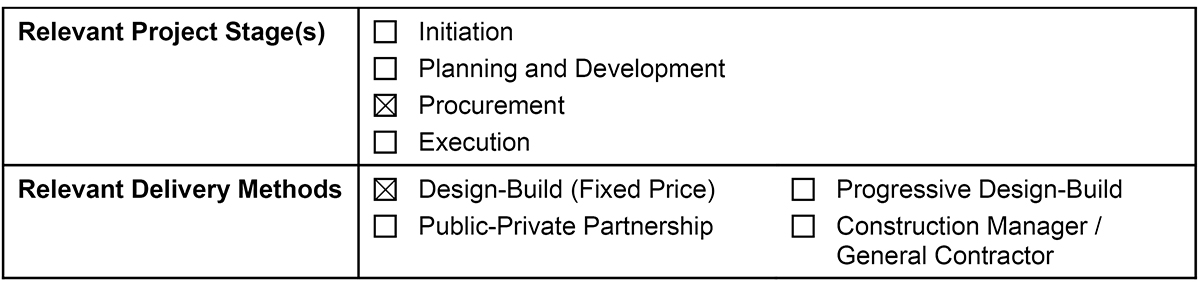
Long Description.
The checklist lists the following in two rows:
Row 1: Relevant Project Stage(s).
Initiation
Planning and Development
Procurement
Execution
Row 2: Relevant Delivery Methods
Design-Build (Fixed Price)
Public-Private Partnership
Progressive Design-Build
Construction Manager slash General Contractor
The options Procurement and Design-Build (Fixed Price) are checked.
Overview
Some Owners have compensated shortlisted proposers or performed additional site/geotechnical investigations at locations requested by proposers during procurement in return for the selected Design-Builder not seeking adjustments for changed or unforeseen subsurface conditions.
Objectives
The intent of offering supplemental investigations is to:
- Provide shortlisted proposers with more geotechnical information during the procurement phase that can result in reduced risk premiums and improve designs, and
- Reduce the likelihood of differing site conditions claims.
Application
In its geotechnical provisions for the Howland Piscataquis Bridge #304 Design-Build Contract, Maine DOT offered proposers the opportunity to request additional borings:
5.1.3 Geotechnical Data
Proposers are responsible for reviewing and analyzing the Preliminary Geotechnical Data Report (GDR). The Preliminary GDR is available for download at the project website: http://www.state.me.us/mdot/hdb /documents.htm. Rock cores that were not submitted for laboratory testing are available for viewing. Arrangements for viewing should be made through the Departmentʼs Contract Representative. Interpretation and interpolation of site conditions between boring locations and between samples shall be at the sole risk of the Proposer.
5.1.4 Additional Geotechnical Data
The Department will contract the services of an independent geotechnical engineering firm, test boring contractor, and testing laboratory to conduct additional geotechnical investigations based on requests by the Proposers to be known as the “Supplemental Boring Program”. The Supplemental Boring Program will consist of a limited number of borings, soil and bedrock samples, and laboratory testing, and is described in Section 6.10.3.
6.10.3 Supplemental Boring Program
The Department recognizes that additional geotechnical information is necessary to finalize the Project designs. Therefore, the Department will conduct a Supplemental Boring Program as part of the procurement process that will allow the Proposers to request additional borings and geotechnical testing. The results of the Supplemental Boring Program will be summarized in a Supplemental Geotechnical Data Report provided by the Department on or about the date specified in Section 1.6.
6.10.4 Use of Geotechnical Information
The use of the geotechnical information provided by or referenced in this document, or encountered elsewhere is at the sole risk of the Proposer. Interpretations and analyses based upon any geotechnical
information are at the sole risk of the Proposer. By submitting a Proposal, the Proposer is acknowledging that it has viewed the site, has read and understood supporting documents, and is willing to rely upon its own site understanding in proceeding with the Project. Furthermore, by submitting a Proposal, each Proposer certifies that, if awarded the Contract, it will not seek recourse with the Department for changed or unforeseen subsurface conditions except as provided in Section 109.2 of the Design-Build General Conditions.
13. Geotechnical Baseline Report
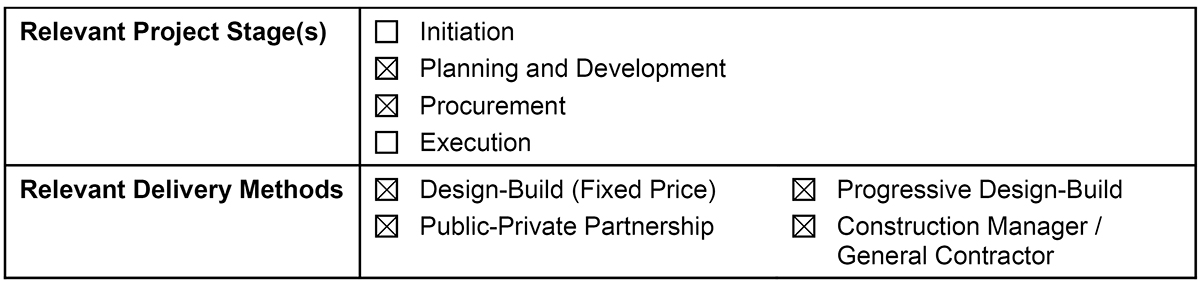
Long Description.
The checklist lists the following in two rows:
Row 1: Relevant Project Stage(s).
Initiation
Planning and Development
Procurement
Execution
Row 2: Relevant Delivery Methods
Design-Build (Fixed Price)
Public-Private Partnership
Progressive Design-Build
Construction Manager slash General Contractor
All options except Initiation and Execution are checked.
Overview
A geotechnical baseline report (GBR) is a document developed by the owner, who collects all the relevant data from similar previous projects and the test results taken for the current project and assembles the information into what will serve as the geotechnical baseline on which bidders are to base their bids. Contractors will use the GBR to select their means, methods, and equipment to perform the work and will reference the GBR if claiming entitlement for differing site conditions.
Typically, the design package used to solicit DB proposals includes a GBR as part of the design reports designated as Reference Information Documents (RIDs) that are provided to bidders for “information only” and thus do not dictate requirements or shift design liability back to the owner.
As part of its risk allocation strategy, however, an owner may also designate the GBR provided to bidders as a “Reliance Document” (i.e., information that bidders may rely upon when preparing their fixed-price proposals and final designs). For example, to avoid high contingency pricing, it may be appropriate to allow proposers to rely on the geotechnical data provided by the owner in a GBR and provide relief (via time extensions and/or additional compensation) in the contract documents for differing site conditions if there is a material change.
Objectives
A GBR decreases geotechnical uncertainty during procurement, which can reduce contingency risk premiums and make proposals more competitive.
Application
NCHRP Research Report 884: Guidelines for Managing Geotechnical Risks in Design-Build Projects (Gransberg et al. 2018) has proposed various innovative geotechnical risk management Strategies, Methods, and Tools. These included the preparation of an owner GBR for bidding (GBR-B) purposes and a separate contractor-produced GBR for construction (GBR-C) produced during procurement. The owner would initially produce a geotechnical data report by collecting all the relevant data from similar previous projects and the test results for the current project, and then prepare a GBR-B. The shortlisted bidders would then gain access to and augment the
GBR-B with additional data, and their unique approach to design to develop a new version: the GBR for Construction (GBR-C), incorporating the contractorsʼ interpretation and approach, and proposed means and methods. The owner would then review the GBR-Cs prepared by bidders and seek clarification on any issues as needed. On the basis of this review, the bidders would have the opportunity to seek adjustment of contract price if appropriate. After award, the selected contractorʼs GBR-C would be incorporated into the DB contract documents and form the basis for risk allocation during the design–construction phase.
As an alternative, the research report also proposed a negotiated GBR interpretation strategy. This involves a negotiated comparison of a GBR-C as described above and a GBR-B (the ownerʼs GBR used for bidding). After award of the DB contract and/or the subsequent completion of the GBR-C, the owner and the Design-Builder compare the two GBRs and agree on how to interpret a final GBR (GBR-F) during construction with respect to the contractʼs differing site condition (DSC) clause. The aim is to mutually agree on what constitutes a “material difference” and, in doing so, share the DSC risk on a project-specific basis.
References
Gransberg, D. D., Loulakis, M., Touran, A., Gad, G., McLain, K., Sweitzer, S., Pittenger, D., Nova, I. C., Pereira, R. C., and Pinto-Nunez, M. (2018). NCHRP Research Report 884: Guidelines for Managing Geotechnical Risks in Design-Build Projects. Transportation Research Board, Washington DC. https://doi.org/10.17226/25262.
14. Reliance (vs. Reference) Documents

Long Description.
The checklist lists the following in two rows:
Row 1: Relevant Project Stage(s).
Initiation
Planning and Development
Procurement
Execution
Row 2: Relevant Delivery Methods
Design-Build (Fixed Price)
Public-Private Partnership
Progressive Design-Build
Construction Manager slash General Contractor
All options except Initiation and Planning and Development are checked.
Overview
Typically, the design package used to solicit DB proposals includes preliminary plans, data, and design reports designated as RIDs that are provided to bidders for “information only” and thus do not dictate requirements or shift design liability back to the owner.
As part of its risk allocation strategy, the owner may also designate some information provided to bidders as Reliance Documents (i.e., information that bidders may rely on when preparing their fixed-price proposals and final designs). For the purposes of change management, the owner will assume responsibility for the accuracy and completeness of information designated as “Reliance Documents.” For example, to avoid high contingency pricing, it may be appropriate to allow proposers to rely on the geotechnical data provided by the owner in a GBR and provide relief (via time extensions and/or additional compensation) in the contract documents for differing site conditions.
Objectives
Reliance Documents provide a baseline for bidders to rely on in preparing their technical and cost proposals that may result in reduced geotechnical risk contingencies for subsurface and site conditions.
Application
Example Reliance Provision: WSDOT I-405/SR 167 Interchange Direct Connector Project 2.7.1 PRELIMINARY GEOTECHNICAL REPORT:
WSDOT has conducted preliminary geotechnical investigations, the results of which are set forth in the Geotechnical Baseline Report (GBR), in Appendix G of the RFP. Each 19 Proposer is solely responsible for reviewing, analyzing, and drawing conclusions from the GBR. To the extent not consumed by testing or observation, soil samples and rock cores obtained to develop the GBR are available for viewing at the WSDOT State Materials Laboratory Geotechnical Branch, 1655 South Second Avenue, Tumwater, Washington, 98512. The GBR shall not be interpreted as being thorough and/or complete. Proposers may rely on the data reflected in the Project boring logs. The Proposers are responsible for determining whether supplementary geotechnical information may be necessary or appropriate in developing their Proposals.
Example Reference Information Only Provision: Michigan DOT Design-Build Project Request for Qualifications – Local Agency Bridge Bundling Pilot Project JN: 209457, 2020
Reference Information Documents (RID) and reference to any website (including the Project Webpage) in this RFQ are provided for reference and background information only. MDOT has not determined whether the RID are without error, complete, pertinent, or of any other value to potential Design-Builders. MDOT makes no representation as to the accuracy, completeness, or pertinence of the RID or information in any referenced website (including the Project Webpage), and, in addition, shall not be responsible for any interpretations thereof or conclusions drawn therefrom. The information contained in the RID or set forth in any referenced website (including the Project Webpage) reflects information as of any date or time identified therein.
The RID provided are in draft format and are being provided for informational purposes only. The RID provided are subject to revision, correction, or alteration. MDOT may not provide notification of such changes. The RID provided will not be used or relied upon for bidding or estimating purposes, nor will they otherwise be considered contractual or binding in nature.
15. Risk-Sharing Strategies

Long Description.
The checklist lists the following in two rows:
Row 1: Relevant Project Stage(s).
Initiation
Planning and Development
Procurement
Execution
Row 2: Relevant Delivery Methods
Design-Build (Fixed Price)
Public-Private Partnership
Progressive Design-Build
Construction Manager slash General Contractor
All options except Initiation, Planning and Development, and Execution are checked.
Overview
The allocation of risk to a particular party (e.g., owner or contractor) means that the party responsible for the risk bears the cost and schedule impact of the risk should it materialize during the project. Risks may also be “shared,” meaning that there are circumstances or conditions where the parties share the consequences of a risk materializing.
Risk-sharing strategies may include a “deductible” scheme whereby the contractor is responsible for costs up to a deductible limit incurred for each separate occurrence, subject to an aggregate deductible cap. Costs may be shared above the deductible cap, or the contractor may be eligible for a change order above the cap.
Alternatively, some owners are now using or considering using “allowances,” with the agency covering the allowance up to the limit, and the contractor picking up costs over the allowance amount (essentially the inverse of having the contractor responsible for an initial deductible
amount and the owner paying for costs above the deductible limit). The contract may also provide incentives for the parties to share the savings if costs (or time) for the work are less than the cap.
By far, the most prevalent sharing approach is the event mechanism: relief events, delay events, and compensation events (which some contracts refer to as “supervening events”). Relief or delay events usually extend a projectʼs construction schedule or its operations period, while compensation events typically involve monetary payment for damages incurred by a party. These event mechanisms are considered a sharing strategy since their relevant contractual provisions outline a process that the parties will follow once a qualifying event occurs to determine whether and what type of relief will be granted. In other words, once a risk materializes, the parties will follow the relevant relief provisions in the contract to determine whether compensation and/or additional time will be granted; neither party knows at the time of contract formation (ex-ante) whether the related risk will surface, or which party will bear it. It could wind up being either (or both).
Objective
Risk-sharing strategies are designed to reduce the uncertainty related to potential cost and time impacts of key risk events, minimize bid premiums related to those risks, and promote increased competition.
Application
The risk allocation and sharing schemes generally define how the risks will be managed by the parties, reduce uncertainties (and risk premiums) for proposers, and incentivize industry to mitigate anticipated risks.
Deductible
A frequently used sharing approach is the deductible. A deductible is a specified quantity that a party must bear before it can ask for compensation or damages from the counterparty. For example, the CDOT Central 70 contract stated:
With respect to any Compensable Costs incurred by Developer in respect of any Relevant Event (other than any No-deductible Event, to which this Section 15.7.1 shall not apply) that occurs during the Construction Period, if the aggregate amount of such Compensable Costs directly resulting from the occurrence of such event is greater than $20,000 (any such event, a “Compensable Construction Period Event”), then, subject to Section 15.7.3, the Enterprises shall compensate Developer . . . (Section 15.7.1)
Allowances
Some owners are moving to the use of allowances for subsurface conditions, as shown in the GDOT State Road and Tollway Authority Project Agreement, I-285/I-20 West Interchange Project:
Discovery of Unexpected Subsurface Conditions and Errors in Authority Boring Data
7.12.1.1 The Authority has allocated an allowance amount of $26,000,000 (“Unexpected Subsurface Condition Allowance”) with respect to the discovery of Unexpected Subsurface Conditions, which sum will be funded by GDOT (not financed by Developer) and made available to the authority to pay amounts that Developer has a right to draw from the Unexpected Subsurface Condition Allowance in accordance with the terms of this Section 7.12.1;
7.12.1.2 except to the extent set forth in Project Agreement (PA) Section 7.12.1.3 (Discovery of Unexpected Subsurface Conditions), the aggregate of any amounts that Developer shall have a right to draw under
this PA Section 7.12 (Discovery of Unexpected Subsurface Conditions) shall not exceed the Unexpected Subsurface Condition Allowance; and
7.12.1.3 Developerʼs right to draw under the Unexpected Subsurface Condition Allowance under this PA Section 7.12 (Discovery of Unexpected Subsurface Conditions) is separate from Developerʼs right to claim any compensation or relief under clause (f) of the definition of “Authority Caused Delay”, clause (e), clause (j), clause (m), or clause (t) of the definition of “Compensation Event”, or clause (g), clause (h), clause (q), clause (t), or clause (z) of the definition of “Relief Event” in accordance with PA Article 13 (Relief Events; Compensation Events).
Colorado DOTʼs CM/GC Manual (Colorado DOT, 2015) provides guidance on bidding contingency regardless of contracting method and defines a “shared-risk contingency pool” for managing risks that have a high level of uncertainty along with a high likelihood of occurring. The amount of the shared risk is defined in the risk register and typically is split equally as shown in the following example provision:
Section 641A of the Project Special Provision is hereby revised as follows:
Add the following to 641A.14:
Additional shotcrete for initial support shall be compensated through a shared risk pool as established in (e) below for structural shotcrete.
- (a) The following Shared Risk Pool (shotcrete) has been established as compensation in the event that the actual volume of shotcrete to reach required thickness is increased due to irregularities in the excavated surface. The quantity will be measured based on the delivered quantity of shotcrete as defined in revision to section 641 in the special provisions. The basis of volume shall be cumulative over the length of the tunnel. In the event that the total Shared Risk Pool is not utilized, the savings will be shared between Contractor and the Owner based on percentages below
Shared Risk Contingency Pool:

Long Description.
The data is as follows: Cost per Cubic Yard, 700.00 dollars. Total Additional Cubic Yards, 350. Total Risk Pool, 245,000 dollars. Contractor Share, 50 percent. Owner Share, 50 percent.
- (b) In the event that the actual volume exceeds that as specified above the same unit rates shall apply.
Relief Events
Article 15 of the ODOT Portsmouth Bypass contract stipulated a representative relief event procedure, which can be summarized as follows:
- The concessionaire must: develop a “time impact analysis,” prove that the event affected the projectʼs critical path, prove that the event could not be avoided by reasonable efforts, and provide evidence of the causes of the event.
- The government then reviews the information and decides whether and how to grant relief.
- If the concessionaire agrees with the governmentʼs decision, then the decision is followed; if the concessionaire disagrees with the government, then the provision indicates:
If the Parties cannot agree on the extent of any delay incurred or relief from Developerʼs obligations under this Agreement, or the Department disagrees that a Relief Event has occurred (or as to its consequences), or that Developer is entitled to relief under this Article 15, the Parties shall resolve the matter in accordance with the Dispute Resolution Procedures. (Portsmouth Bypass, Section 15.3)
While characteristic relief provisions have a variety of stipulations, these are procedural rather than categorical; hence, the parties will expend considerable effort ex-post to address and remedy the situation.
Indexing/Escalation
Other sharing methods include indexing/escalating prices or rates, negotiation, and proportion/proration. For example, the Michigan DOT I-75 Modernization contract provides an example of the proportion/proration sharing method that was employed for interest rates pre-financial close:
If Developer has complied with the submittal requirements under Section 5.7.4 of the ITP, MDOT will adjust the Base MAP to offset a portion of the impact of fluctuations (increases and decreases) in the Baseline Credit Spreads that have occurred during the Interest Rate Protection Period. Subject to the limitations described in Section 5.7.4 of the [Instructions to Proposers] ITP and Schedule 18 (Update to the Base MAP), the credit spread risk/benefit sharing between MDOT and Developer will be implemented on an 85:15 basis, with MDOT assuming 85% of the fluctuation in Baseline Credit Spreads and Developer assuming 15%. (Section 3.7.2)
References
Colorado DOT. (2015). Construction Manager/General Contractor Manual. https://www.codot.gov/business/alternativedelivery/construction-manager-general-contractor-cm-gc-manual.
16. Stipends
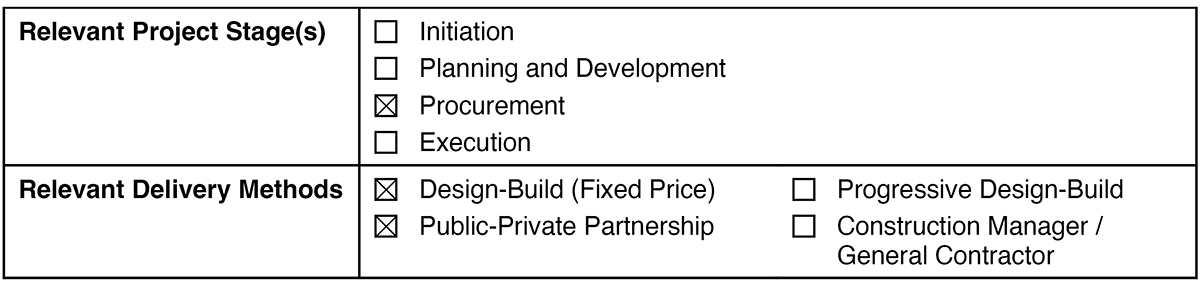
Long Description.
The checklist lists the following in two rows:
Row 1: Relevant Project Stage(s).
Initiation
Planning and Development
Procurement
Execution
Row 2: Relevant Delivery Methods
Design-Build (Fixed Price)
Public-Private Partnership
Progressive Design-Build
Construction Manager slash General Contractor
The options Procurement, Design-Build (Fixed Price), and Public-Private Partnership are checked.
Overview
Developing a responsive technical proposal for a fixed-price DB project can entail a substantial design and planning effort. Offering a stipend to help defray some of the proposal expenses can help attract competition.
Paying a stipend also provides a way for owners to have the ability to use the ideas and intellectual property (including ATCs) of unsuccessful proposers on the project.
Objectives
Stipends promote industry participation and competition and allow for the use of additional ideas from unsuccessful proposers to benefit the project.
Application
In response to industry concerns regarding stipend amounts, WSDOT noted that its current stipend policy, as described in Chapter 2 of the WSDOTʼs Design-Build Manual (WSDOT 2022), recommends a minimum amount equal to 0.30% of the Engineerʼs Estimate regardless of project type or estimated cost:
WSDOT will pay a stipend to all Proposers submitting a responsive proposal to partially offset the proposal preparation cost. Best practice suggests that approximately one-half to one-third of the proposal

Long Description.
The table shows the amount of stipends for WSDOT projects. Column 1 shows the upper limit of the engineerʼs estimates. Column 2 shows the percent of engineerʼs estimate for fish passage design-build projects. Column 3 shows the percent of engineerʼs estimate for other design-build projects. The data for each row are as follows: Row 1. 20, 2.00, 1.50. Row 2. 20 to 50, 2.00 to 1.10, 1.50 to 0.80. Row 3. 50 to 100, 1.10 to 0.65, 0.80 to 0.60. Row 4. 100 to 150, 0.65 to 0.55, 0.60 to 0.50. Row 5. 150 to 200, 0.55 to 0.40, 0.50 to 0.40. Row 6. 200 to 400, 0.40, 0.40 to 0.35. Row 7. 400 to 600, asterisk, 0.35 to 0.30. Row 8. 600 to 1000, asterisk, 0.30 to 0.25. Row 9. More than 1000, asterisk, asterisk. A note for asterisk reads, discuss with HQ Construction. The source for this table is WSDOT
preparation cost be covered by the stipend. The cost of preparing a responsive proposal is directly related to the requirements of the RFP documents and this effort must be recognized when determining the amount of the stipend. In lieu of estimating such costs or soliciting them from Proposers, a minimum stipend amount equal to 0.30 percent of the engineerʼs estimate is recommended.
Information received from Design-Builders and their engineering firms indicated that the current policy is providing compensation for only 20% or less of proposal preparation costs, rather than the 30% to 50% that had been WSDOTʼs intended practice. WSDOT therefore recently adjusted its minimum stipend amounts, scaling them according to project size, as shown in Table A-2.
Example Stipend Provision
WSDOT I-405/SR 167 Interchange Direct Connector Project, Proposer Stipends
WSDOT will pay a Stipend of $700,000 to each Proposer that provides a responsive Proposal. The Stipend will be paid within 45 Calendar Days after award of the Contract or the decision not to award a Contract.
No Proposer shall be entitled to reimbursement of any of its costs in connection with the RFP except as specified in this Section. A Proposer that has submitted a non-responsive Proposal will not earn a Stipend.
In consideration for paying the Stipend, WSDOT reserves the right to use any ideas or information contained in the unsuccessful Proposals in connection with any Contract awarded for the Project or with any subsequent procurement, without any obligation to pay any additional compensation to the Proposer. Each Proposer acknowledges that WSDOT will have the right to inform the successful Proposer, after award, regarding the contents of all Proposals for which stipends have been (or will be) paid, for the purpose of allowing concepts to be reviewed by the selected Design-Builder and incorporated into the Contract as deemed advisable. WSDOT will provide the successful Proposer with all the ATCs as soon as practicable. The Proposer may elect to incorporate these ATCʼs into the Contract in accordance with Section 1-04.4. Furthermore, upon the Proposersʼ receipt of payment, the right to use such work product will extend to other projects undertaken by WSDOT, as WSDOT deems appropriate. WSDOT acknowledges that the use of any of the work product by WSDOT or the Design-Builder is at the sole risk and discretion of WSDOT and the Design-Builder, and it will in no way be deemed to confer liability on the unsuccessful Proposer.
References
WSDOT. (2024). Minimum Stipend Amounts for Design-Build Projects. Construction Bulletin #2024-04. March 25, 2024. https://wsdot.wa.gov/sites/default/files/2024-03/ConstructionBulletin2024-04.pdf.
WSDOT. (2022). Design-Build Manual. https://wsdot.wa.gov/engineering-standards/all-manuals-and-standards/manuals/Design-Build-manual.
17. Alternate Forms of Security
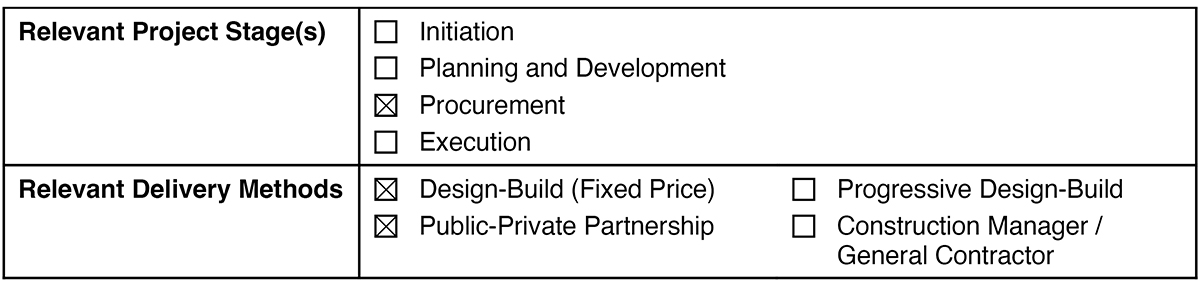
Long Description.
The checklist lists the following in two rows:
Row 1: Relevant Project Stage(s).
Initiation
Planning and Development
Procurement
Execution
Row 2: Relevant Delivery Methods
Design-Build (Fixed Price)
Public-Private Partnership
Progressive Design-Build
Construction Manager slash General Contractor
The options Procurement, Design-Build (Fixed Price), and Public-Private Partnership are checked.
Overview
Alternative forms of security include performance bonds that cover a portion or reduced percentage of the budgeted cost. They also take the form of letters of credit or parent/bank guarantees to promote competition for very large or mega-projects.
Objectives
Use of alternative forms of security or reduced performance bond amounts are used to address surety risks and lower bond premiums.
Application
Contracts for APD projects often shift greater risk to the private sector than do contracts on DBB projects. Sureties ultimately take on these risks if there is a default, and they pay attention to the contract risks—particularly on large and complex projects.
Surety practices have historically been based on the conventional DBB method, where design and construction are performed by separate companies and where sureties have detailed designs completed for which they can more accurately assess the performance risks. On a fixed-price DB project, the lack of detailed designs desired by sureties to evaluate project risk may make it difficult for sureties to offer performance bonds for the full value of the contract. This has led to decisions on several very large projects to allow for less than 100% performance bond amounts (in some cases 50% for performance bonds) to cover construction at different stages of the project, using alternative forms of security, or in some cases descoping large contracts into smaller packages.
In lieu of performance bonds, alternative forms of performance security used for P3s or mega-projects have included parent company guarantees (PCG), a letter of credit (LOC) from a financial institution, or a combination of bonds for construction obligations and other forms of security for non-construction obligations (e.g., extended warranty/performance guarantees, design obligations, major equipment, and operations and maintenance obligations). LOCs are bank instruments requiring payment on demand, and similar to bonds, require payment of a fee as well as security to assure the bank that it will be repaid in the event of a call on the LOC. Due to the nature of LOC, it is a much simpler process to make a demand on a LOC than to enforce a surety bond.
Example Provision
State Road and Tollway Authority Project Agreement, GDOT I-285/I-20 West Interchange Project, Performance & Payment Bonds covering 50% of the work.
16.2.1.1 Developer shall obtain and maintain, or cause to be obtained and maintained by the D&C [Design and Construction] Contractor, and deliver to Authority Performance and Payment (P&P) Bonds,
each in the amount, subject to PA Section 16.2.1.5 (P&P Bonds) equal to 50% of the D&C Amount (excluding the Unexpected Subsurface Conditions Allowance and the price for Independent Administrative Quality Assurance and Independent Design Quality Assurance services under the IQF [independent quality firm] Contracts), identifying Developer (or if D&C Contractor is furnishing, D&C Contractor) as the P&P Obligor, and Authority as the Oblige (or if D&C Contractor is furnishing, Authority and Developer as Obliges) in substantially the respective form attached at PA Exhibit 21 (Forms of P&P Bonds, Warranty Bond), securing Developerʼs obligations to perform the Work and to ensure that payments owing to Claimants are made with respect to such Work. If the D&C Contractor is furnishing the P&P Bonds, then the Design-Build Contract (a) shall obligate the D&C Contractor to perform all of the D&C Work, (b) shall include the D&C Contractorʼs express representation and warranty that the D&C Contractor understands and agrees that its scope of work under the D&C Contract is intended to be coextensive with Developerʼs obligations with respect to the D&C Work, and (c) shall provide that such representation, warranty and agreement are given for the benefit of GDOT as a third party beneficiary.
References
Loulakis, M., Briglia, S., and L. P. McLaughlin. (2012). TCRP Legal Research Digest 40: Issues Involving Surety for Public Transportation Projects. Transportation Research Board of the National Academies, Washington DC.
Travelers Insurance. (2021). Travelers Infrastructure Study: A 17 Year Deep Dive into Heavy Civil Projects in North America.
18. Post-Award Scope Validation
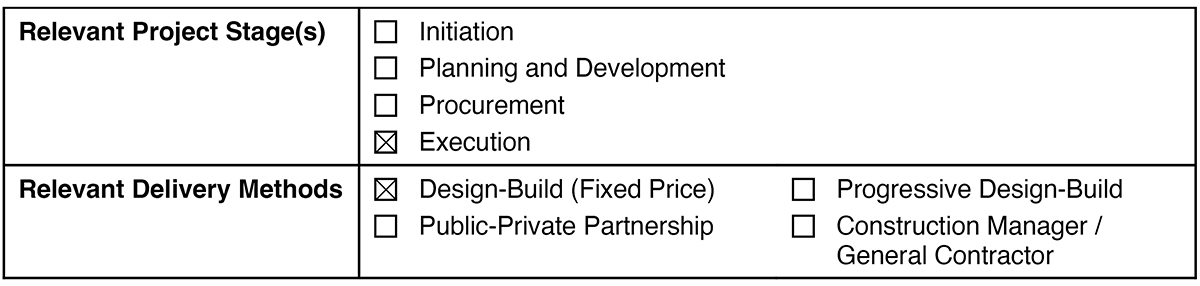
Long Description.
The checklist lists the following in two rows
Row 1: Relevant Project Stage(s).
Initiation
Planning and Development
Procurement
Execution
Row 2: Relevant Delivery Methods
Design-Build (Fixed Price)
Public-Private Partnership
Progressive Design-Build
Construction Manager slash General Contractor
The options Execution and Design-Build (Fixed Price) are checked.
Overview
Post-award scope validation is a risk-sharing strategy that specifies a discrete time period after notice to proceed for a contractor to claim relief for scope issues (errors or omissions) in the contract, resulting in cost and time impacts arising from geotechnical or site conditions. In return for agreeing to the scope validation period, the contractor waives its right to request relief related to scope issues discovered after the expiration of the scope validation period. This strategy in theory provides some relief for changed conditions but limits the ownerʼs exposure to claims for scope issues.
Objective
The intent of a post-award scope validation period is to reduce risks related to scope issues resulting from geotechnical or site conditions.
Application
Example: VDOT (2016) Design-Build Standard Template Documents
Section 2.2.1 Scope Validation Period
The term “Scope Validation Period” is the period of time that begins on Design-Builderʼs receipt of Departmentʼs Notice to Proceed and extends for one hundred twenty (120) days from such date of receipt,
unless otherwise stated in Exhibit 1. During the Scope Validation Period, Design-Builder shall thoroughly review and compare all of the then-existing Contract Documents, including without limitation the RFP Documents and the Proposal, to verify and validate Design-Builderʼs proposed design concept and identify any defects, errors, or inconsistencies in the RFP Documents that affect Design-Builderʼs ability to complete its proposed design concept within the Contract Price and/or Contract Time(s) (collectively referred to as “Scope Issues”). The term “Scope Issue” shall not be deemed to include items that Design-Builder should have reasonably discovered prior to the Agreement Date.
Section 2.2.2 Scope Validation Period for Non-Accessible Areas of the Site
The Parties recognize that Design-Builder may be unable to conduct the additional investigations contemplated by Section 4.2.2 below because it will not have access to certain areas of the Site within the Scope Validation Period set forth in Section 2.2.1 above. Design-Builder shall notify Department at the meeting set forth in Section 2.1.2 of all such non-accessible areas and the dates upon which such areas are expected to become accessible. If Department agrees that such areas are non-accessible, then, for the limited purpose of determining Scope Issues that directly arise from geotechnical evaluations for such areas, the term “Scope Validation Period” shall be deemed to be the thirty (30) day period after the date the specified area becomes accessible for purposes of conducting the geotechnical evaluation. If Department does not agree that such areas are non-accessible, then the Scope Validation Period shall not be extended.
19. Partnering
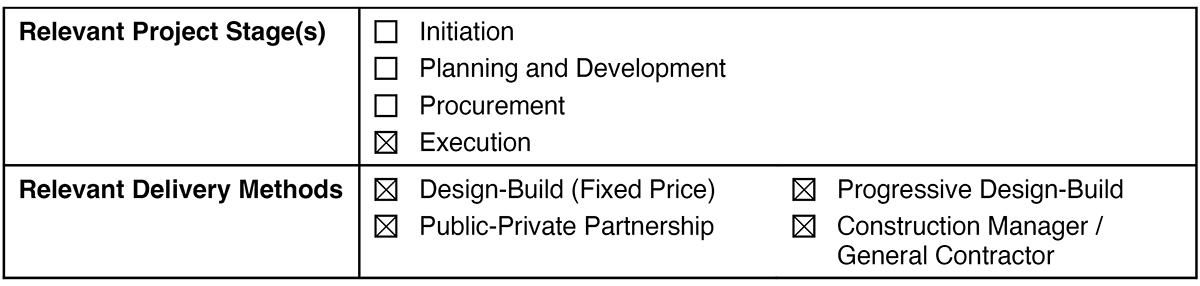
Long Description.
The checklist lists the following in two rows:
Row 1: Relevant Project Stage(s).
Initiation
Planning and Development
Procurement
Execution
Row 2: Relevant Delivery Methods
Design-Build (Fixed Price)
Public-Private Partnership
Progressive Design-Build
Construction Manager slash General Contractor
All options except Initiation, Planning and Development, and Procurement are checked.
Overview
Formal partnering efforts entail implementing a structured and collaborative process designed to promote a “project first” mentality. Partnering practices typically include:
- Active participation by the integrated project team (consisting of representatives from the owner, designer, contractor and stakeholders, as appropriate) in a series of structured and facilitated workshops that are intended to promote the growth of trusting relationships in advance of any potential project issues and, if problems ultimately do arise, to provide a forum in which such issues can be productively discussed and resolved;
- Joint development of a charter agreement that serves to document the commitment of the project participants to work together to solve problems and to collaboratively seek solutions that benefit the project as a whole; and
- Implementation of an issue escalation process designed to help ensure problems are addressed and resolved in a timely manner at the lowest practical level so as not to allow individual project issues to disrupt momentum.
Potential Benefits
Cited benefits of partnering include less adversarial relationships, increased stakeholder engagement and satisfaction, more timely and proactive resolution of issues, and enhanced ability to meet project performance goals in terms of schedule, cost, and quality.
Application
San Francisco International Airport (SFO) has incorporated the use of what it refers to as “Structured Collaborative Partnering” (SCP) as a core element of its “Exceptional Project Delivery Paradigm.” As described in the SFO publication Delivering Exceptional Projects: Our Guiding Principles (Neumayr et al. 2014):
The purpose of SCP is to cultivate solid working relationships before problems and issues arise. By redefining the expectations around how all parties are to work together, structured collaboration can minimize such negative consequences as financial losses, damaged relationships, and unresolved claims.
An example partnering specification extracted from SFOʼs International Terminal Building Phase 2 Design-Build contract is provided on the following pages.
References
Neumayr, G., Mosqueda, J., and Opbroek, K. (2014). Delivering Exceptional Projects: Our Guiding Principles, Version 1.0. SFO, San Francisco, CA.
Note: Pages A-72 to A-78 are taken from SFOʼs International Terminal Building Phase 2 Contract.

Long Description.
The document title on the page is 01 31 33: Partnering Requirements.
Part 1 – General
1.01 Partnering Level
This Project shall incorporate the required partnering elements for Partnering Level 4.
A table with 5 columns follows. Column heading 1: Level; Column heading 2: Estimated Construction Amount; Column heading 3: Complexity; Column heading 4: Political Significance; Column heading 5: Relationships.
Row 1, Column 1: 5. Column 2: $200 million plus. Column 3: Highly technical and complex design & construction. Column 4: High visibility/oversight; significant strategic project. Column 5: New project relationships; high potential for conflict (strained relationship, previous litigation, or high probability of claims).
Row 2, Column 1: 4. Column 2: $50 million to $200 million. Column 2: High complexity – schedule constraints, uncommon materials, etcetera. Column 3: Probable. Column 4: New contractors or CM, new subs.
Row 3, Column 1: 3. Column 2: $20 million to $50 million. Column 3: Increased complexity. Column 4: Likely, depending on the location and other project characteristics. Column 5: Established relationships; new CM, subs, or other key stakeholders.
Row 4, Column 1: 2. Column 2: $5 million to $20 million. Column 3: Moderate complexity. Column 4: Unlikely, unless in a place of importance. Column 5: Established relationships; new subs, new stakeholders.
Row 5, Column 1: 1. Column 2: $100,000 to $5 million. Column 3: Standard complexity. Column 4: Unlikely, unless in a place of importance. Column 5: Established relationships; new subs, new stakeholders.
The text resumes after the table.
1.02 SUMMARY
A. This Document specifies the requirements for establishing a collaborative partnering process. The partnering process will assist the Airport and Contractor to develop a collaborative environment so that communication, coordination, and cooperation are the norm, and to encourage resolution of conflicts at the lowest responsible management level.
B. The partnering process is not intended to have any legal significance or to be construed as denoting a legal relationship of agency, partnership, or joint venture between the Airport and Contractor.
C. This Document does not supersede or modify any other provisions of this Contract, nor does it reduce or change the respective rights and duties of the Airport and Contractor under this Contract, nor supersede contractual procedures for the resolution of disputes.
1.03 PURPOSE/GOALS
The goals of Project partnering are to:
1. Use early and regular communication with involved parties
2. Establish and maintain a relationship of shared trust, equity, and commitment
3. Identify, quantify, and support attainment of mutual goals — the list continues on the next page.
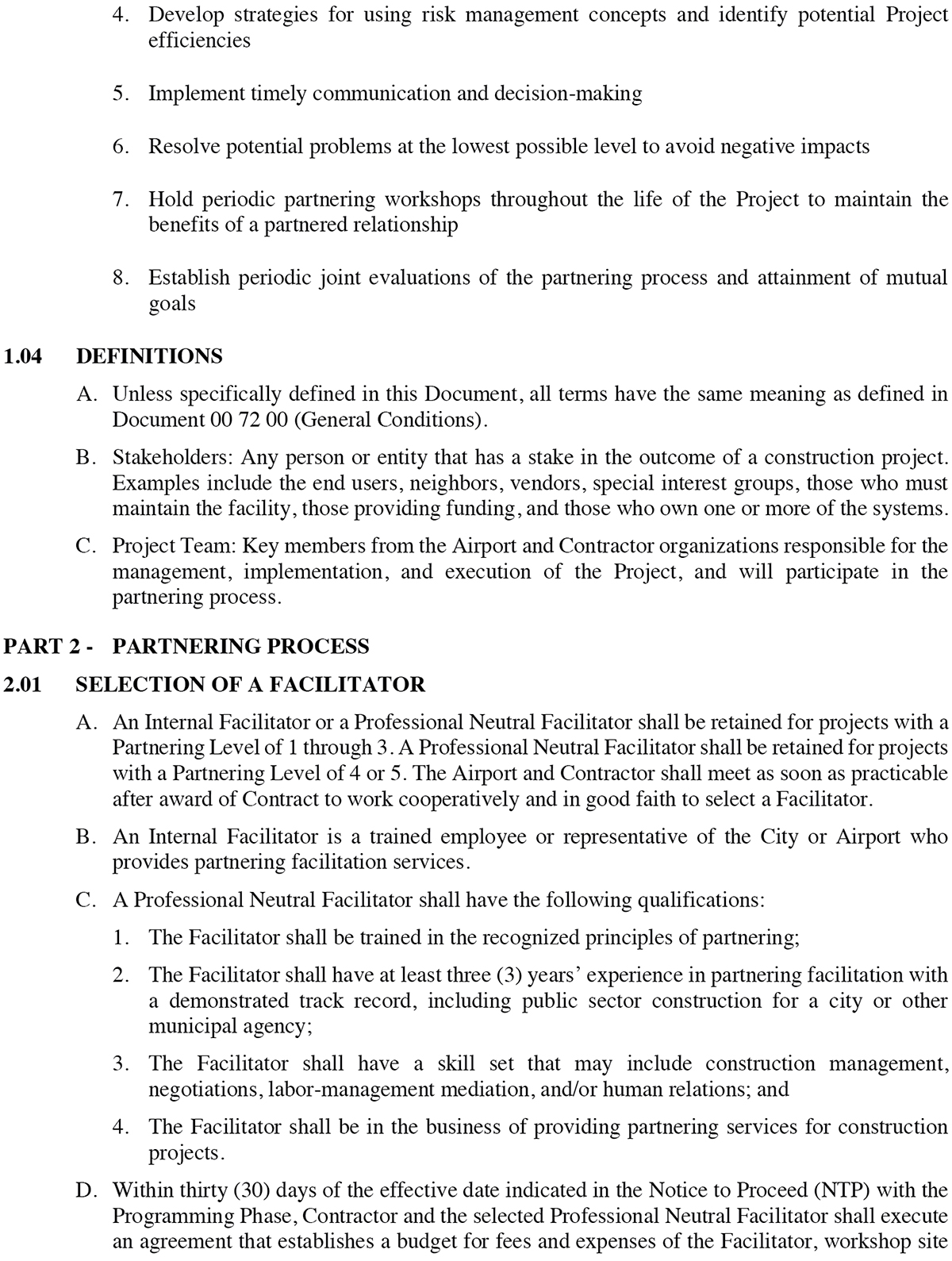
Long Description.
The list continues from the previous page — 4. Develop strategies for using risk management concepts and identify potential Project efficiencies
5. Implement timely communication and decision-making
6. Resolve potential problems at the lowest possible level to avoid negative impacts
7. Hold periodic partnering workshops throughout the life of the Project to maintain the benefits of a partnered relationship
8. Establish periodic joint evaluations of the partnering process and attainment of mutual goals
1.04 DEFINITIONS
A. Unless specifically defined in this Document, all terms have the same meaning as defined in Document 00 72 00 (General Conditions).
B. Stakeholders: Any person or entity that has a stake in the outcome of a construction project. Examples include the end users, neighbors, vendors, special interest groups, those who must maintain the facility, those providing funding, and those who own one or more of the systems.
C. Project Team: Key members from the Airport and Contractor organizations responsible for the management, implementation, and execution of the Project, and will participate in the partnering process.
PART 2 - PARTNERING PROCESS
2.01 SELECTION OF A FACILITATOR
A. An Internal Facilitator or a Professional Neutral Facilitator shall be retained for projects with a Partnering Level of 1 through 3. A Professional Neutral Facilitator shall be retained for projects with a Partnering Level of 4 or 5. The Airport and Contractor shall meet as soon as practicable after award of Contract to work cooperatively and in good faith to select a Facilitator.
B. An Internal Facilitator is a trained employee or representative of the City or Airport who provides partnering facilitation services.
C. A Professional Neutral Facilitator shall have the following qualifications:
1. The Facilitator shall be trained in the recognized principles of partnering;
2. The Facilitator shall have at least three (3) yearsʼ experience in partnering facilitation with a demonstrated track record, including public sector construction for a city or other municipal agency;
3. The Facilitator shall have a skill set that may include construction management, negotiations, labor-management mediation, and/or human relations; and
4. The Facilitator shall be in the business of providing partnering services for construction projects.
D. Within thirty (30) days of the effective date indicated in the Notice to Proceed (NTP) with the Programming Phase, Contractor and the selected Professional Neutral Facilitator shall execute an agreement that establishes a budget for fees and expenses of the Facilitator, workshop site — the list continues on the next page.

Long Description.
The list continues from the previous page — costs, if any, and describes the Facilitatorʼs role for the Project consistent with the requirements of this Document. The scope of the Facilitatorʼs role is for descriptive purposes only and is not a guarantee for payment as the scope of Work will be revised as needed throughout the Project. The agreement shall be terminable at will.
E. The Facilitator shall be evaluated by the Project Team: (1) at the end of the Kick-off Partnering Workshop; and (2) at the Project close-out partnering session.
F. In the event that either Contractor or the Airport is not satisfied by the services provided by the Facilitator, a new mutually acceptable Facilitator shall be chosen in a reasonable amount of time in the same manner pursuant to Paragraph 2.01A, and a new agreement shall be executed by Contractor and the new Professional Neutral Facilitator pursuant to Paragraph 2.01D.
2.02 PARTNERING ELEMENTS
A. All partnering levels require the following elements:
1. Executive Sponsorship. Commitment to and support of the partnering process from the senior most levels of the Airport and Contractor organizations.
2. Collaborative Partnering. A structured and scalable process made up of elements that develop and grow a culture (value system) of trust among the parties of a construction contract. Together, the combination of elements including the Partnering Charter, Executive Sponsorship, partnering workshops, an accountability tool for the Project Team (Scorecards), and the Facilitator create a collaborative atmosphere on each project.
3. Facilitator. Depending on the projectʼs partnering level, the Airport and Contractor shall retain either an Internal Facilitator or a Professional Neutral Facilitator according to the process listed in Article 2.01 to lead workshops.
4. Partnering Charter and/or mission statement. The Airport and Contractor shall create a Partnering Charter that is the guiding focus for the Project Team. It documents the teamʼs vision and commitment to work openly and cooperatively together toward mutual success during the life of the Project. The Partnering Charter helps to maintain accountability and clarity of agreements made and allows for broader communication of the teamʼs distinct goals and partnering process. At a minimum, the Partnering Charter must include the following elements:
a. Mutual goals, including core Project goals, and may also include Project-specific goals and mutually-supported individual goals. The required core Project goals relate to Project schedule, budget, quality, and safety
b. Partnering maintenance and close-out plan, including partnering session attendees and frequency of workshops
c. Dispute resolution plan that includes an Escalation Resolution Ladder
d. Team commitment statement and signatures
5. Partnering Workshops. At a minimum, the following two (2) workshops are required:
a. Kick-off Partnering Workshop. Within forty-five (45) days of NTP, the Airport and Contractor shall meet for the Kick-off Partnering Workshop; determine the workshop site and duration, and other administrative details. At the Kick-off Partnering Workshop, the Airport, Contractor, and Facilitator shall meet to mutually develop a strategy for a successful partnering process and to develop their Partnering Charter. The list continues on the next page.
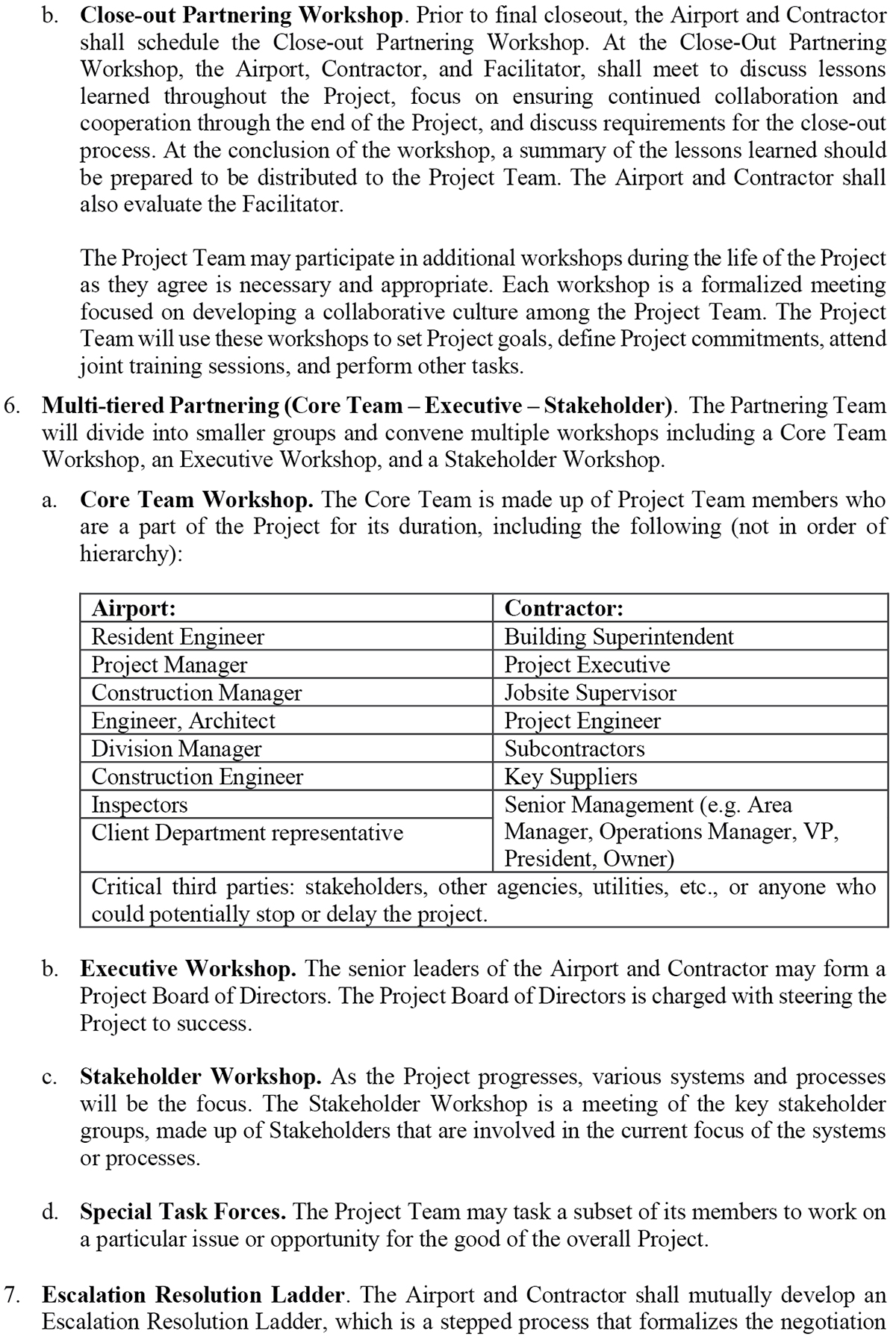
Long Description.
b. Close-out Partnering Workshop. Prior to final closeout, the Airport and Contractor shall schedule the Close-out Partnering Workshop. At the Close-Out Partnering Workshop, the Airport, Contractor, and Facilitator, shall meet to discuss lessons learned throughout the Project, focus on ensuring continued collaboration and cooperation through the end of the Project, and discuss requirements for the close-out process. At the conclusion of the workshop, a summary of the lessons learned should be prepared to be distributed to the Project Team. The Airport and Contractor shall also evaluate the Facilitator.
The Project Team may participate in additional workshops during the life of the Project as they agree is necessary and appropriate. Each workshop is a formalized meeting focused on developing a collaborative culture among the Project Team. The Project Team will use these workshops to set Project goals, define Project commitments, attend joint training sessions, and perform other tasks.
6. Multi-tiered Partnering (Core Team – Executive – Stakeholder). The Partnering Team will divide into smaller groups and convene multiple workshops including a Core Team Workshop, an Executive Workshop, and a Stakeholder Workshop.
a. Core Team Workshop. The Core Team is made up of Project Team members who are a part of the Project for its duration, including the following (not in order of hierarchy):
A table with two columns follows. Column heading 1: Airport. Column heading 2: Contractor.
Row 1, Column 1: Resident Engineer. Column 2: Building Superintendent
Row 2, Column 1: Project Manager. Column 2: Project Executive
Row 3, Column 1: Construction Manager. Column 2: Jobsite Supervisor
Row 4, Column 1: Engineer, Architect. Column 2: Project Engineer
Row 5, Column 1: Division Manager. Column 2: Subcontractors
Row 6, Column 1: Construction Engineer. Column 2: Key Suppliers.
Row 7, Column 1: Inspectors, Row 8, Column 1: Client Department representative. Row 7 and 8, Column 2: Senior Management ( e g Area Manager, Operations Manager, VP, President, Owner)
A note at the bottom of the table reads: Critical third parties: stakeholders, other agencies, utilities, etc., or anyone who could potentially stop or delay the project. The list resumes after the table: b. Executive Workshop. The senior leaders of the Airport and Contractor may form a Project Board of Directors. The Project Board of Directors is charged with steering the Project to success. c. Stakeholder Workshop. As the Project progresses, various systems and processes will be the focus. The Stakeholder Workshop is a meeting of the key stakeholder groups, made up of Stakeholders that are involved in the current focus of the systems or processes. d. Special Task Forces. The Project Team may task a subset of its members to work on a particular issue or opportunity for the good of the overall Project.
7. Escalation Resolution Ladder. The Airport and Contractor shall mutually develop an Escalation Resolution Ladder, which is a stepped process that formalizes the negotiation — the list continues on the next page.
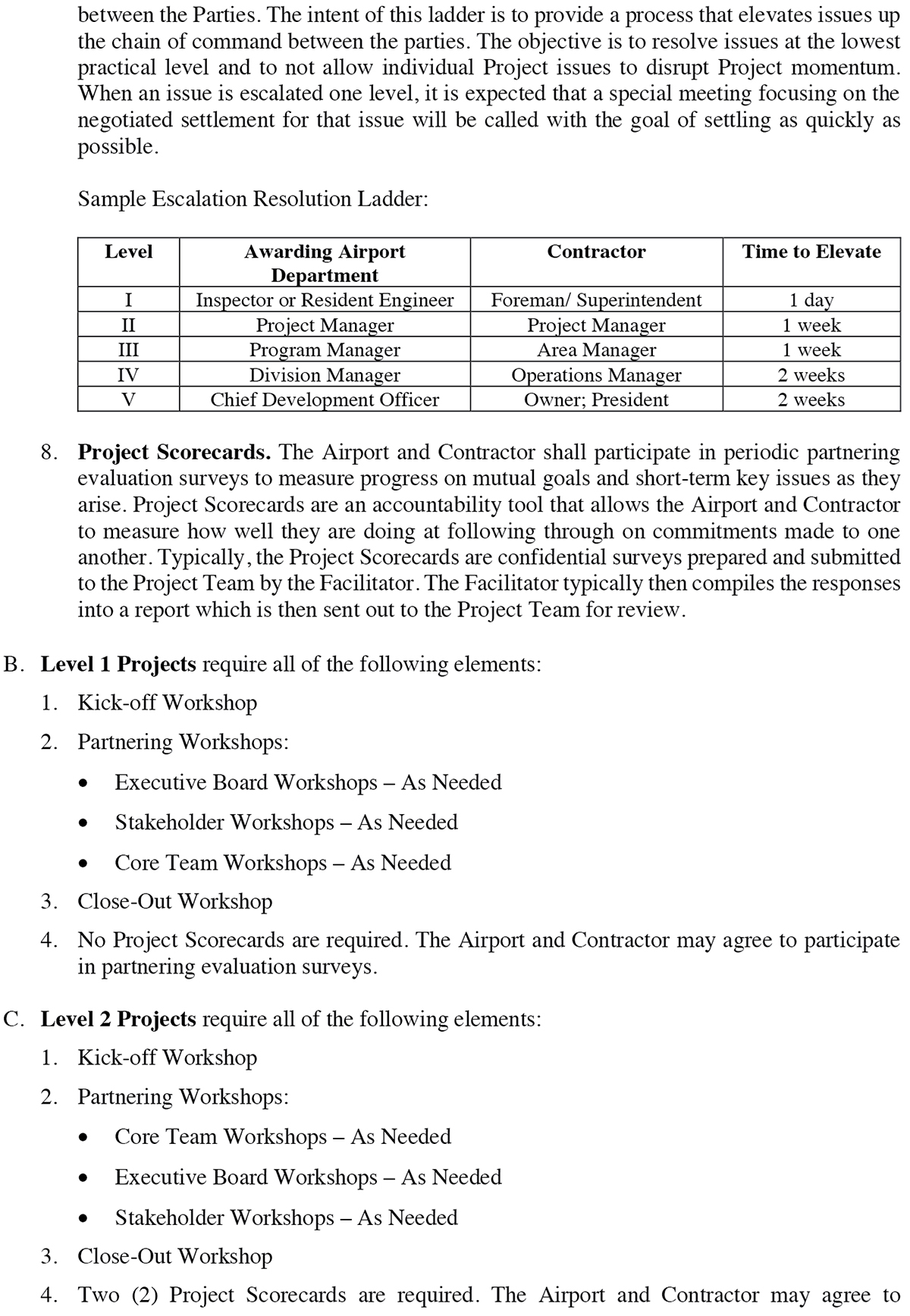
Long Description.
The list continues from the previous page. between the Parties. The intent of this ladder is to provide a process that elevates issues up the chain of command between the parties. The objective is to resolve issues at the lowest practical level and to not allow individual Project issues to disrupt Project momentum. When an issue is escalated one level, it is expected that a special meeting focusing on the negotiated settlement for that issue will be called with the goal of settling as quickly as possible.
Sample Escalation Resolution Ladder:
A table with 4 columns follows. The column headings are: Column 1: Level. Column 2: Awarding Airport Department. Column 3: Contractor. Column 4: Time to Elevate. Row 1, Column 1: I. Column 2: Inspector or Resident Engineer. Column 3: Foreman/ Superintendent. Column 4: 1 day
Row 2, Column 1: II. Column 2: Project Manager. Column 3: Project Manager. Column 4: 1 week
Row 3, Column 1: III. Column 2: Program Manager. Column 3: Area Manager. Column 4: 1 week
Row 4, Column 1: IV. Column 2: Division Manager. Column 3: Operations Manager. Column 4: 2 weeks
Row 5, Column 1: V. Column 2: Chief Development Officer. Column 3: Owner; President. Column 4: 2 weeks. The list continues after the table. 8. Project Scorecards. The Airport and Contractor shall participate in periodic partnering evaluation surveys to measure progress on mutual goals and short-term key issues as they arise. Project Scorecards are an accountability tool that allows the Airport and Contractor to measure how well they are doing at following through on commitments made to one another. Typically, the Project Scorecards are confidential surveys prepared and submitted to the Project Team by the Facilitator. The Facilitator typically then compiles the responses into a report which is then sent out to the Project Team for review. B. Level 1 Projects require all of the following elements:
1. Kick-off Workshop
2. Partnering Workshops:
• Executive Board Workshops – As Needed
• Stakeholder Workshops – As Needed
• Core Team Workshops – As Needed
3. Close-Out Workshop
4. No Project Scorecards are required. The Airport and Contractor may agree to participate in partnering evaluation surveys.
C. Level 2 Projects require all of the following elements:
1. Kick-off Workshop
2. Partnering Workshops:
• Core Team Workshops – As Needed
• Executive Board Workshops – As Needed
• Stakeholder Workshops – As Needed
3. Close-Out Workshop
4. Two (2) Project Scorecards are required. The Airport and Contractor may agree to — the list continues on the next page.
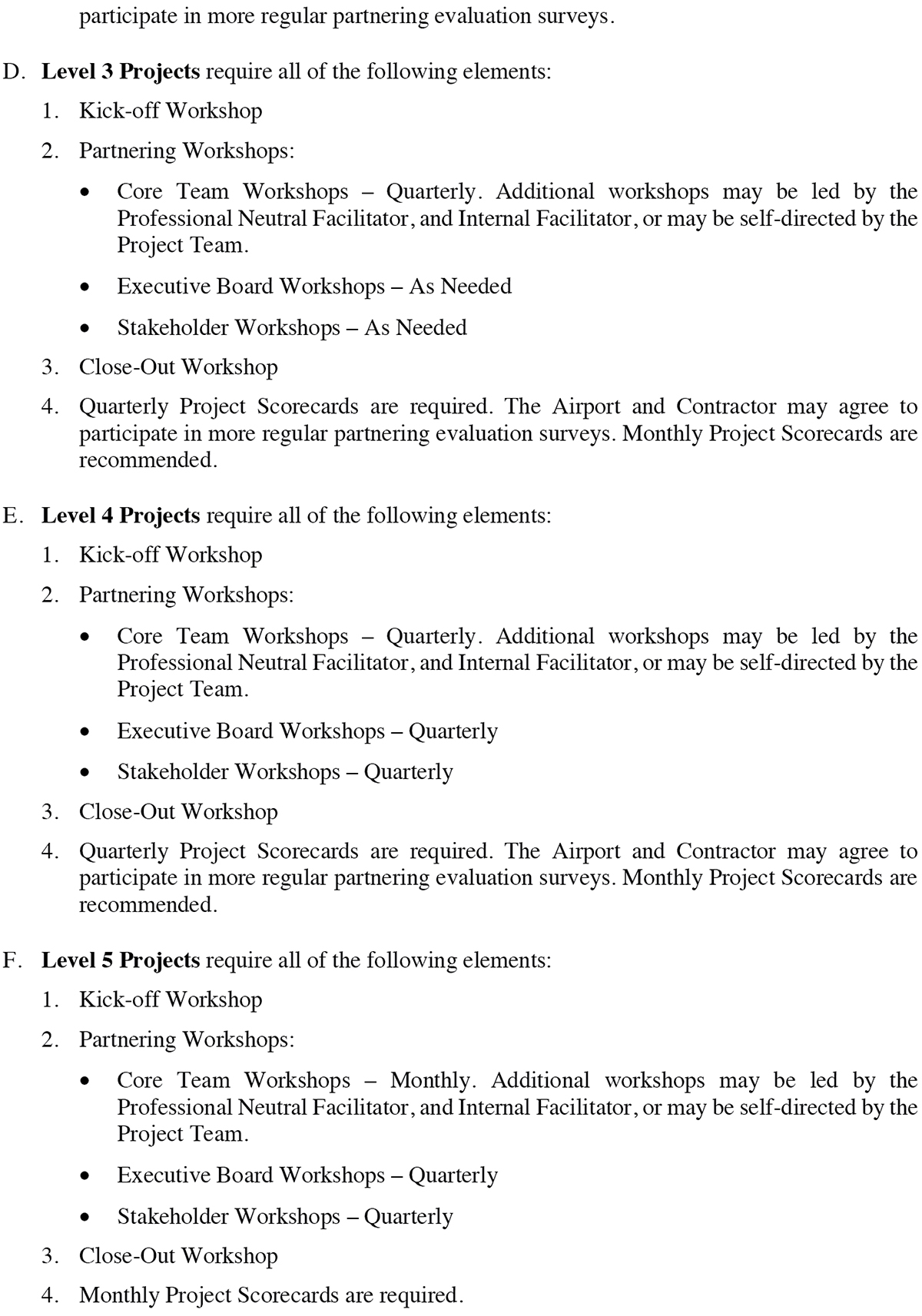
Long Description.
The list continues from the previous page. participate in more regular partnering evaluation surveys.
D. Level 3 Projects require all of the following elements:
1. Kick-off Workshop
2. Partnering Workshops:
• Core Team Workshops – Quarterly. Additional workshops may be led by the Professional Neutral Facilitator, and Internal Facilitator, or may be self-directed by the Project Team.
• Executive Board Workshops – As Needed
• Stakeholder Workshops – As Needed
3. Close-Out Workshop
4. Quarterly Project Scorecards are required. The Airport and Contractor may agree to participate in more regular partnering evaluation surveys. Monthly Project Scorecards are recommended.
E. Level 4 Projects require all of the following elements:
1. Kick-off Workshop
2. Partnering Workshops:
• Core Team Workshops – Quarterly. Additional workshops may be led by the Professional Neutral Facilitator, and Internal Facilitator, or may be self-directed by the Project Team.
• Executive Board Workshops – Quarterly
• Stakeholder Workshops – Quarterly
3. Close-Out Workshop
4. Quarterly Project Scorecards are required. The Airport and Contractor may agree to participate in more regular partnering evaluation surveys. Monthly Project Scorecards are recommended.
F. Level 5 Projects require all of the following elements:
1. Kick-off Workshop
2. Partnering Workshops:
• Core Team Workshops – Monthly. Additional workshops may be led by the Professional Neutral Facilitator, and Internal Facilitator, or may be self-directed by the Project Team.
• Executive Board Workshops – Quarterly
• Stakeholder Workshops – Quarterly
3. Close-Out Workshop
4. Monthly Project Scorecards are required. The list continues on the next page.
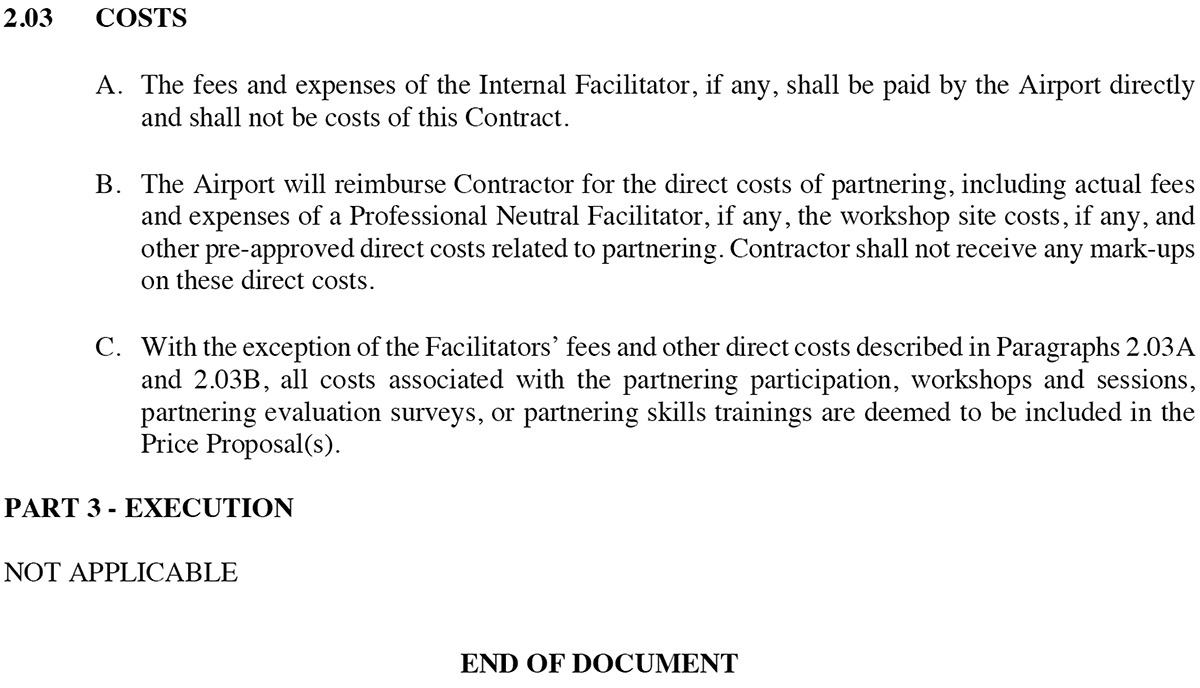
Long Description.
2.03 COSTS
A. The fees and expenses of the Internal Facilitator, if any, shall be paid by the Airport directly and shall not be costs of this Contract.
B. The Airport will reimburse Contractor for the direct costs of partnering, including actual fees and expenses of a Professional Neutral Facilitator, if any, the workshop site costs, if any, and other pre-approved direct costs related to partnering. Contractor shall not receive any mark-ups on these direct costs.
C. With the exception of the Facilitatorsʼ fees and other direct costs described in Paragraphs 2.03A and 2.03B, all costs associated with the partnering participation, workshops and sessions, partnering evaluation surveys, or partnering skills trainings are deemed to be included in the Price Proposal(s).
PART 3 - EXECUTION
NOT APPLICABLE
END OF DOCUMENT
20. Alternative Dispute Resolution Processes
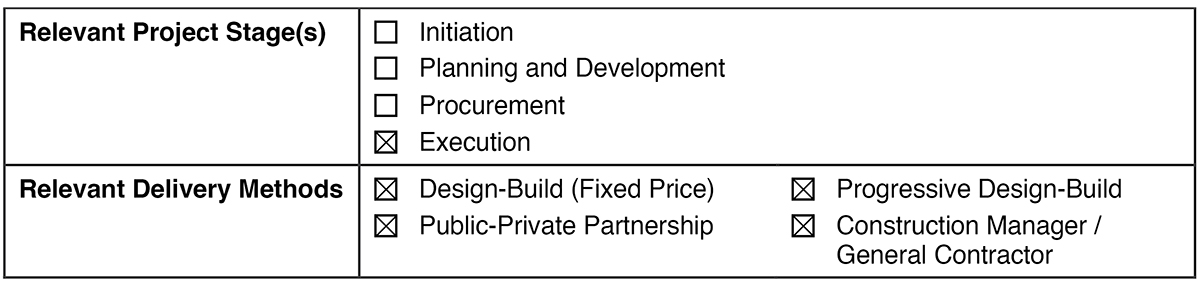
Long Description.
The checklist lists the following in two rows:
Row 1: Relevant Project Stage(s).
Initiation
Planning and Development
Procurement
Execution
Row 2: Relevant Delivery Methods
Design-Build (Fixed Price)
Public-Private Partnership
Progressive Design-Build
Construction Manager slash General Contractor
All options except Initiation, Planning and Development, and Procurement are checked.
Overview
Alternative dispute resolution processes are provisions within the contract that address processes to manage project disputes more proactively and efficiently. The owner and the contractor agree to use their best efforts to resolve disputes using good faith negotiations and the principles of project partnering by developing and implementing a Dispute Escalation Process that provides for the timely resolution of disputes as close to the point of origin as possible. A disputes escalation process may involve the use of stepped negotiations with higher-level personnel as part of the partnering process, mediation of a dispute using a mutually agreed-upon mediator, or a Dispute Review Board established for the project under a three-party agreement to hear claims and offer non-binding decisions or recommendations to resolve disputes during project execution.
For larger complex projects, the owner may employ a sitting Disputes Review Board (DRB) with members selected by both parties that could be called upon to issue non-binding opinions with regards to disputes, both monetary and non-monetary, such as whether a differing condition under an applicable contract provision has occurred. The three-member DRB panel and its procedures must be established and tailored for the individual projects for which a DRB is contemplated.
Objective
Alternative dispute resolution processes are used to resolve disputes more quickly and efficiently, promoting approaches to prevent or resolve conflicts at the project level before they escalate into claims or legal actions.
Application
Example: Sound Transit Heavy Civil GC/CM General Conditions:
A Disputes Review Board (DRB) will be established to assist in resolving claims arising out of this Contract. Disputed claims may be heard by the DRB only after the claims process has been exhausted.
The provisions for establishing a DRB, if a DRB is to be utilized in this Contract, will be provided in the Special Conditions in the Article entitled Disputes Review Board Procedures. The form of the Three-Party Agreement to be used in establishing a DRB will also be provided in that section.
Where no approved DRB is currently established or currently operating, the parties will utilize their best efforts to negotiate resolution of claims in good faith.
Example: Washington State Department of Transportation Progressive Design-Build Contract Appendices SR 3/SR 104/SR 303/SR 307/SR 308 Kitsap County – Appendix 11 Dispute Resolution, 11.1 DISPUTES AND CLAIMS:
When protests occur during this PDB Contract, the Design-Builder shall first pursue resolution in accordance with Section 11.1 (Dispute Resolution Procedures) of this PDB Contract. Unless noted otherwise in this PDB Contract, compliance with all the requirements of Section 11.1 (Dispute Resolution Procedures) of this PDB Contract is a condition precedent to initiating any action pursuant to this PDB Contract.
If the negotiations using the procedures outlined in Section 11.1 (Dispute Resolution Procedures) of this PDB Contract fail to provide satisfactory resolution of the protest, then the Design-Builder shall provide the WSDOT Engineer with written notification of dispute stating that the Design-Builder shall continue to pursue the dispute in accordance with this Appendix. The written notification shall be provided within 14 Calendar Days after receipt of the WSDOT Engineerʼs determination of merit that the Design-Builderʼs protest is without merit pursuant to Section 11.1 (Dispute Resolution Procedures) of this PDB Contract. Any such continuing dispute must first be referred to a Disputes Review Board (DRB) and addressed through the DRB process set forth in this Appendix. The written notification of this continuing dispute shall be provided to the DRB Chair and the WSDOT Engineer via certified mail within 14 Calendar Days after receipt of the WSDOT Engineerʼs written determination that the Design-Builderʼs protest is without merit pursuant to Section 11.1 (Dispute Resolution Procedures) of this PDB Contract. Should the Design-Builder not provide written notification that it intends to further pursue its claim within the 14 day designated time period, the Design-Builder shall be deemed to have irrevocably waived any right to pursue the protest further and the matter shall be considered resolved.


