Innovative Materials in Water Resources Infrastructure: Opportunities for the Corps of Engineers (2026)
Chapter: 3 U.S. Army Corps of Engineers Budget System and Asset Management
3
U.S. Army Corps of Engineers Budget System and Asset Management
This chapter describes the U.S. Army Corps of Engineers (USACE) budget process and asset management system as they apply to the operations and maintenance (O&M) of the Civil Works program’s inland navigation and flood risk management infrastructure. These linked, sophisticated processes are critical to how innovative materials are considered for O&M projects and the prospects for innovative materials to be adopted.
The budget process is overviewed first because of its potential to support the use of innovative materials as well as to impede their consideration. As an example of the latter, budget-conscious districts may use materials and processes for maintenance and repair projects that minimize their upfront costs, potentially to the neglect of alternatives that promise future savings in life-cycle costs (e.g., from extended service life) and costs to system users (e.g., from less downtime). For instance, if district personnel believe that using an innovative material will entail a higher upfront budgetary outlay, and thus potentially detract from the resources available to meet other district needs, they may not be inclined to deviate from conventional materials and processes.1 At the same time, the O&M budget process can present opportunities for justifying the use of innovations, especially with integrated consideration of asset condition as is done by USACE.
Formalized asset management systems have become increasingly important components of the budget processes of infrastructure owners in the public sector because they can inform budgetary prioritizations in ways that consider an asset’s life-cycle costs and impacts on users. Therefore, the
___________________
1 USACE presentation to the committee, February 27, 2025.
second section of this chapter describes USACE’s O&M asset management system. First, the structure and capabilities of the system are explained, including processes used to establish the current condition and functional performance of assets and to assess the severity of the consequences that can ensue from an asset’s failure or underperformance. Second, consideration is given to the system’s capability to consider life-cycle costs and impacts. As will be explained, these important capabilities—asset condition assessments, consequence estimations, and life-cycle management—can be key to understanding where the use of innovative materials and processes may be most desirable and practical.
O&M BUDGET PROCESS
USACE Civil Works program and projects have been authorized historically through the Rivers and Harbor Act2 and Flood Control Act3 and most recently through Water Resources Development Acts (Carter and Normand 2025). The funding for authorized program accounts and projects comes from the annual appropriations process, typically through the Energy and Water Appropriations Act (USACE 2024). This chapter focuses on the O&M program account, which covers repair and maintenance projects that do not rise to the level of being capital investments, which are defined as major rehabilitation projects or new construction over $33 million.4 Funding is distributed across eight business lines that include navigation, flood risk management, environment, emergency management, hydropower, recreation, water supply, and environmental infrastructure (Carter and Normand 2020).5 This report focuses on the navigation and flood risk management business lines, which cover operation, maintenance, and related activities (Carter and Normand 2025).
The process for identifying and prioritizing O&M projects for budget allocation begins 2 years prior to the year that funds are appropriated (USACE 2008). It begins with the facility managers in each district determining their O&M needs, which are then developed into “work packages” that describe the activities to be performed, including cost estimates and proposed schedules (USACE 2019a). Business line managers in each district
___________________
2 See the Rivers and Harbors Appropriation Act of 1899. https://www.govinfo.gov/content/pkg/COMPS-5399/pdf/COMPS-5399.pdf.
3 See the Flood Control Act of 1936, ch. 688, 49 Stat. 1570, codified at 33 U.S.C. ch. 15. https://uscode.house.gov/view.xhtml?path=%2Fprelim%40title33%2Fchapter15&edition=prelim.
4 The $33 million threshold is for 2025 but is adjusted annually for inflation.
5 The USACE budget process also has Civil Works program accounts for Construction General, General Investigations, Mississippi River and Tributaries, Regulatory, General Expenses, Flood Control and Coastal Emergencies, and Formerly Used Sites Restoration Program.
then consolidate and prioritize these work packages for submission to the division office and then to Headquarters for final approval.
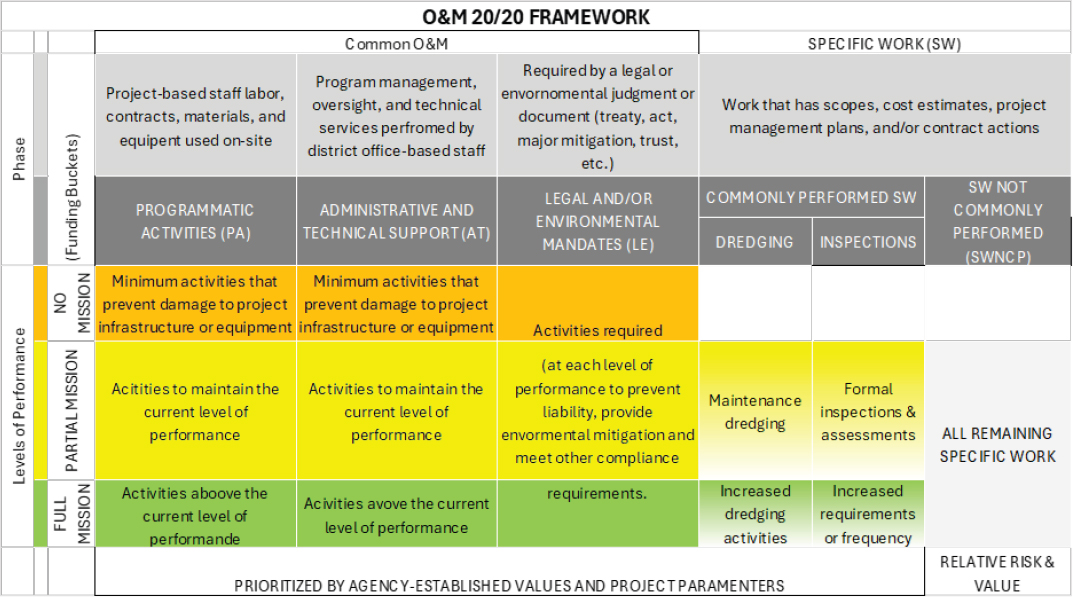
As outlined in Figure 3-1, O&M spending consist of two major types: “common O&M” and “specific work.” Common O&M includes ongoing programmatic activities, such as expenditures for administrative and technical support and for fulfilment of legal and environmental mandates (USACE 2019a). Specific work is further divided into “commonly performed specific work” and “specific work not commonly performed.” The former covers routine activities such as dredging and inspections, while the latter includes irregular repair and maintenance work, such as replacing a worn or damaged lock gate, operating machinery, or pump units. In theory, projects in this latter O&M budget category can provide opportunities for districts to gain experience using innovative or unconventional materials and processes, inasmuch as the projects do not involve large capital outlays (which entail risk) and may require custom solutions.
The budget process begins at the facility level, where the facility manager determines the facility’s O&M needs by business line. These needs are developed into “work packages” that describe what activities are to be performed including cost estimates and proposed schedules (USACE 2019a). The business line manager in each district consolidates and prioritizes the work packages into budget packages and then transmits their requests to their major subordinate command (MSC) or division office for prioritization within the division. Finally, the MSC transmits their needs to the Headquarters business line manager for final prioritization. This process is typically done in the January–June time frame.
The prioritization at each level of the budget process involves subjective decision making by management teams to take into account a range of management considerations regarding available funding, risk ranking of projects, projects not funded in previous years, and other factors. In addition, the annual budget process does not include in a formal way or incentivize life-cycle analyses, as described later in this chapter. Districts can flag projects involving innovative materials in their submitted O&M work packages, but the budget process does not require such an identification or information on how the use of innovative materials is expected to affect project costs. Comments must be searched to identify that a budget package includes innovative materials. Moreover, other prioritization criteria are identified in specific columns in the budget spreadsheet. An explicit metric for innovative features is not included with proposed project submittals, however.
In recognition of the need for more accurate data and analyses to support a budget process that leads to more rationalized project designs and prioritizations, USACE has taken concerted steps—as discussed next—to assess and record the condition of its assets, gauge the relative consequences
SOURCE: USACE 2019a.
from different assets failing or underperforming, and account for the benefits and costs of assets over their lifespan.
THE PARADOX OF FUNDING PILOT PROJECTS IN CIVIL WORKS
A challenge in introducing innovative materials into the construction, maintenance, or repair of water resource infrastructure is building the confidence of USACE managers, engineers, and decision makers. As presented to the committee numerous times, USACE Civil Works operates in an institutional environment where few are willing to be the first to incorporate unfamiliar technologies or materials into critical infrastructure. Pilot or demonstration projects can be helpful for demonstrating viability and building confidence and trust. However, there can be an inherent institutional bias against such projects. This stems from the perceived risk of deviating from proven practices (as outlined in Chapter 1), even when the potential for innovation could offer long-term benefits in durability, sustainability, or performance.
Risk, in this context, is defined as the probability of failure multiplied by the consequences of failure. For water resources infrastructure—such as locks, dams, and levees—the probability of failure associated with a new material may be relatively low, yet the potential consequences can be severe. In the case of a navigation lock, for example, structural failure could disrupt an entire waterway system for months or even years. This not only brings reputational risk to the agency and its leaders but also deprives commercial operators of critical waterborne transportation access—often in regions where viable alternatives do not exist.
As a result, USACE is often forced to test new materials on projects where the consequences of failure are relatively low. This typically steers such evaluations toward “low-use” navigation projects—those handling fewer than 100 million ton-miles annually.6 The paradox is that these same low-use projects that are candidates for demonstrating innovative materials are also the least likely to receive funding. This paradoxical conundrum is the reality confronting groups within USACE trying to advance the use of innovative materials. Further complicating the challenge is that if funding is provided for a low-consequence project, managers may be reluctant to use anything other than proven methods for a project that may have waited many years to be funded. They may also be reluctant to choose the innovative solution if it requires higher upfront costs compared to a conventional method, especially when the difference can be used to immediately address
___________________
6 For context, the level of service for locks is determined by commercial lockage activity. Level 4 locks, for example, serve fewer than 100 commercial lockages per year and are typically restricted to intermittent service or scheduled openings.
other neglected repair and maintenance work. The short-term maintenance focus presents another paradox as implementing solutions with lower life-cycle costs are in the interest of the districts, as it would, over the long term, make available more funds to cover their needs more fully.
ASSET MANAGEMENT SYSTEM
Asset management has become an important component of USACE’s O&M budget process. Now practiced by most infrastructure owners, asset management involves a set of systematic and coordinated practices through which an organization monitors, assesses, and manages the condition, performance, and risks of its physical assets over their lifespan. In the USACE Civil Works program, formal asset management systems were introduced in 2008 to comply with Executive Order 13327 (2004), Federal Real Property Asset Management. Asset management was formally implemented at USACE Headquarters in 2008, and USACE founded the Asset Management Community of Practice in 2009 (USACE n.d.). In keeping with its responsibility for managing an aging civil works infrastructure, USACE’s asset management system supports data-driven strategies for operations, maintenance, capital investment, and disposition decisions.
Key elements of the system, as discussed next, include ongoing assessments of the condition of each asset and the consequences of an asset failing or underperforming its functions. By evaluating condition and consequences across its portfolio of assets, USACE is able to establish a relative risk index for prioritizing spending on repair and maintenance projects when the overall budget is finite.7 The asset management process can also point to opportunities to incorporate innovative materials during O&M or capital projects by identifying opportunities for low-risk demonstrations, where innovative materials proven to perform can extend the life and reliability of water resources infrastructure.
Operational Condition Assessments
The building blocks of USACE’s risk index are its operational condition assessments (OCAs) for individual assets. “Operational condition” refers to the physical condition of asset components, the performance of components in accordance with designed function, and the likelihood of failure in the next 5 years (USACE 2022). USACE maintains a hierarchical database of each business line’s assets and their components. Table 3-1 shows an abbreviated version of this hierarchy for the Navigation Locks and Dams
___________________
7 For more on USACE’s risk management activities, see the Institute of Water Resources’ Risk Management Center at https://www.rmc.usace.army.mil.
TABLE 3-1 Navigation Locks and Dams Asset Management Hierarchy (Abbreviated)
| Type of Structure | Examples of Components for the Structure Type |
|---|---|
| Buildings | |
|
Miscellaneous buildings Secondary lock buildings Primary buildings Lock buildings Dam buildings |
Basic structure Exterior lighting Fire suppression system Roof HVAC system (central) |
| Dam | |
|
Dam gates and operating machinery Dam gate anchorages and support features Dam gate operating machinery Dam gate structures Miscellaneous dam gate features Dam structures Dam piers Dam spillway sections Dam stilling basin features Miscellaneous dam features Miscellaneous dam structures |
Drainage system Control valve (solenoid) Elevator controls Foundation system Horizontal girders (corrosion) Hydraulic cylinder (ceramic) Jib crane Pump unit 2 (electric controls) Sector gear Walkways (paved) Work platforms |
| Lock | |
|
Lock filling and emptying (F/E) systems F/E operating machinery F/E valve anchorages and supports F/E valves Lock gates and operating machinery Lock gate anchorages and support features Lock gate operating equipment Lock gate structure Miscellaneous lock gate features Lock structure Lock walls and other lock structures Miscellaneous lock features Miscellaneous lock wall features Navigation aides and auxiliary facilities Mooring facilities Navigation aides |
Armor stone Barriers and gates Boat ramp (paved) Capstones Check posts Drain valves Esplanade paving Fenders (timber) Hydraulic power Ladders (aluminum) Mooring cells Operating controls Pintle ball Quoin blocks (on gate) Retaining walls Tow haulage system |
| Type of Structure | Examples of Components for the Structure Type |
|---|---|
| Miscellaneous Support Structures | |
|
Emergency maintenance and closure systems Dam closure hoisting machinery/crane and lifting beam Dam closure system Dam service cranes Lock closure hoisting machinery/cranes/lifting Lock closure systems Lock service cranes Valve culvert closure systems Lock and dam bridges Dam bridges Lock bridges Miscellaneous support systems Facility safety and security Fixed dewatering system Instrumentation Real estate |
Adjacent nonfederal hydropower Closure panels Counter weights Dam fencing Dewatering pump Emergency gate units Gage house equipment Gate machinery Inclinometers Lifting cables Lock signage Needle beam Operation camera Railings Staff gages Sump pump |
| Utility/Power/Controls | |
|
Controls/indicators/interlocks/PLCs Dam gate controls and control systems Dam hydraulic power controls F/E system controls and control systems F/E system interlocks Lock gate controls and control systems Lock gate interlocks Lock hydraulic power controls Primary utilities distribution and controls Hydraulic pumping and distribution Primary electrical service and distribution Secondary utilities and distribution Secondary utilities and distribution |
Accumulator Air compressor (primary) Cable trays—building interior Central boiler Check valve Distribution lines Emergency generator Heat exchangers Lighting, galleries, fixtures Lighting and wallpower cable Liquid propane system Meters and regulators PLC software |
NOTE: PLC = programmable logic controller.
SOURCE: USACE Great Lakes and Ohio Rivers Division, June 2025.
business line. It lists the major infrastructure types (buildings, dams, locks) as well as miscellaneous structures and utility and control systems. In total, these structures have thousands of components, examples of which are provided in the table.
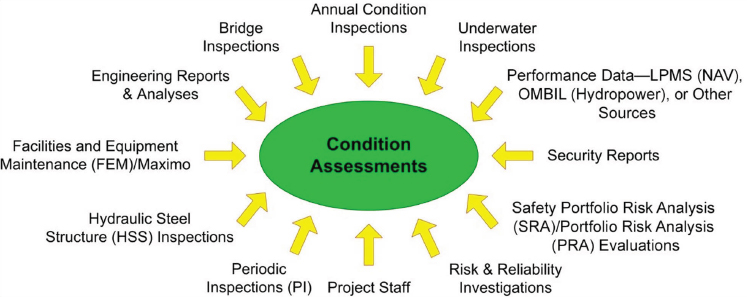
OCAs are conducted every 5 years by multidisciplinary teams of experts, often drawn from multiple districts. To make the assessments, the teams visit asset sites to evaluate the condition of components using visual
inspections and nondestructive scans, such as LiDAR (Korfhage 2024). They also consult a range of performance data and other reports and documentation, as shown in Figure 3-2. After doing so, the teams assign condition ratings for each component according to a scale that reflects the degree of severity of an observed or documented deficiency and its effect on the component’s performance, operational procedures, and maintenance requirements (USACE 2022). A deficiency is a physical characteristic, such as deterioration, damage, or other flaws (USACE 2019b). A component’s age in relation to design life does not factor into the OCA rating. The OCA rating scale is depicted in Table 3-2. Because ratings are developed at the component level, each infrastructure system will undergo hundreds of ratings.
Consequence Ratings
Consequence ratings from the failure or poor performance of assets are used in the prioritization of operation and maintenance projects (USACE 2019b). The data informing the ratings are different for each business line. The flood risk management business line develops ratings for two categories of consequences: the population at risk and immediate economic losses. The highest-consequence ratings are assigned when an asset’s failure could put more than 100,000 people at risk and/or when damages to residential and nonresidential structures could exceed more than $10 billion, as shown in Table 3-3. The navigation business line has consequence ratings based on factors such as personnel safety and short-term adverse impacts on commercial and recreational vessel operations, as shown in Table 3-4.
Risk Matrix
To develop a risk matrix for each asset that can be used to prioritize repair and maintenance work packages during the budget allocation process, OCA ratings are coupled with consequence ratings (USACE 2019a). The output of the analysis is the relative risk value, which represents the individual component’s condition and the consequence of failure and provides an indication of the relative risk of proposed O&M projects. Although this system is used with all materials, an example of evaluation of relative risk for an innovative materials project is provided in Box 3-1, where the relative risk values are on a scale from 1 to 25, with 1 as the highest risk and 25 as the lowest risk. These assigned risk values can be used to identify assets that present a high risk of failure because of the combination of their poor condition and potential for severe consequences if they fail or underperform. The relative risk assignments can also be used to consider how a proposed repair or maintenance work package can reduce risk values.
SOURCE: USACE 2019b.
O&M work packages for assets that have risk values of 1, 2, and 3 (Table 3-5 in red) are therefore likely to receive priority treatment during the budget process. Note, however, that this risk matrix also means that some assets rated with “F” or “D” for condition are not likely to be prioritized because of their low consequence severity rating. Such assets, for instance, may be on waterways with minimal commercial navigation activity. As a result, even when a proposed work package may improve the relative risk from 12 to 25, it may not receive funding due to limited budget availability. The paradox that can result from such decision making is highlighted below. In short, the lower-risk assets that may be the most practical candidates for gaining experience with innovative materials are also likely to be among the projects that are least likely to receive funding priority given USACE’s maintenance backlog and the performance-based budget prioritization process.
Of course, in addition to considering these relative risk values, USACE business line managers must consider other factors in prioritizing work, including public safety, national security, and legal requirements (USACE 2019b). It is the committee’s understanding that business lines have some latitude in formulating prioritization criteria. Indeed, the committee was informed that guidance for prioritizing flood risk management work does state a preference for work packages that incorporate innovative materials.8 The extent to which the navigation business line has similar guidance, formal or informal, is unclear. Box 3-1 provides an illustrative example of the relative risk assessment for a work package.
___________________
8 USACE presentation to the committee, February 27, 2025.
TABLE 3-2 OCA Rating Scale and Definitions
| Rating | Descriptor | Definition |
|---|---|---|
| A | Excellent | Component was recently put into service and shows no signs of wear. |
| B | Good | Component performs its intended function. Any deficiencies are normal wear and not actively progressing at a greater rate than normal wear. |
| C | Fair | Component has a deficiency that is beginning to affect its performance, operational procedures, and/or maintenance requirements. |
| AND/OR | ||
| Component is beginning to show a greater rate of change in degradation that has the potential to cause a functional failure. | ||
| D | Poor | Component has a deficiency that increasingly or moderately affects its performance, operational procedures, and/or maintenance requirements. |
| AND/OR | ||
| Component has a clear mode of failure due to an advanced state of degradation likely with an accelerating trend. | ||
| F | Failing | Component has a deficiency that substantially affects its performance, operational procedures, and/or maintenance requirements and is approaching complete failure. |
| AND/OR | ||
| Component is clearly in the final stages of degradation trending toward complete failure (imminent failure). | ||
| CF | Completely Failed | Component has completely failed and does not perform its intended function. |
| AND/OR | ||
| Component is red-tagged. |
SOURCE: USACE 2019b.
TABLE 3-3 Flood Risk Management Consequence Scale
| Consequences Category 1 Rating Criteria Population at Risk (PAR) | Category Rating |
|---|---|
| PAR ≥ 100,000 | I |
| 50,000 ≤ PAR < 100,000 | II |
| 25,000 ≤ PAR < 50,000 | III |
| 10,000 ≤ PAR < 25,000 | IV |
| PAR < 10,000 | V |
| Consequences Category 2 Rating Criteria Economic Impact | Category Rating |
| Damages to residential and nonresidential structures, their content, and vehicles > $10B | I |
| Damages to residential and nonresidential structures, their content, and vehicles ranging from $1B to $10B | II |
| Damages to residential and nonresidential structures, their content and vehicles ranging from $100M to $1B | III |
| Damages to residential and nonresidential structures, their content, and vehicles ranging from $10M to $100M | IV |
| Damages to residential and nonresidential structures, their content, and vehicles < $10M | V |
SOURCE: Adapted from Patev 2016.
GUIDANCE ON LIFE-CYCLE STRATEGIES
Even before USACE adopted its current asset management system, it had issued guidance for considering lifetime costs of assets and components. For instance, Engineering Regulation (ER) 1110-2-8159 (USACE 1997) states that “Engineering decisions should not be made solely to minimize first costs, nor to maximize reliability regardless of cost. Design engineers shall use life-cycle design as the basis for selection of all project elements such as materials, structural systems, mechanical equipment, and scour protection on all projects.” Furthermore, in 2017, USACE issued ER 1110-1-8173 on Energy Modeling and Life Cycle Cost Analysis “to provide direction and guidance for the application of energy modeling and Life Cycle Cost Analysis (LCCA) in design decisions and alternative analyses for buildings and structures.”
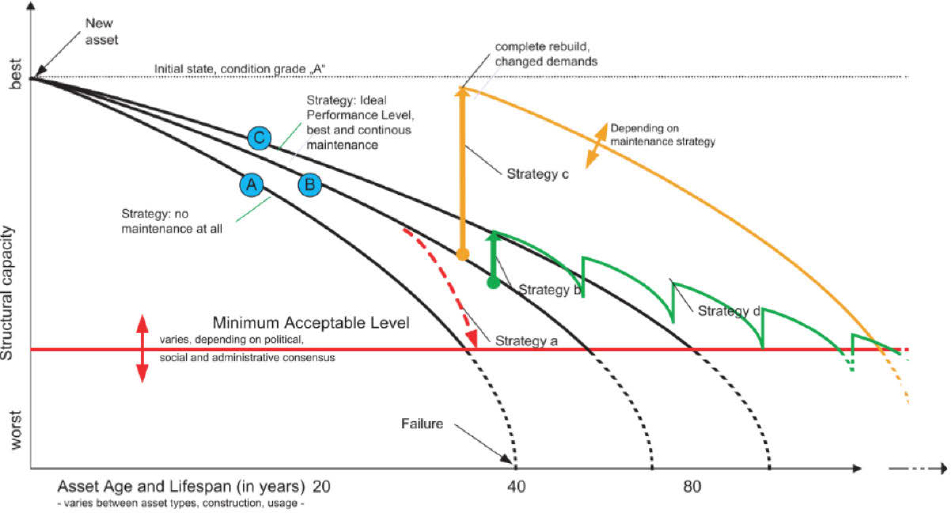
Figure 3-3 was derived from a presentation to the committee by USACE. It shows how life-cycle assessments can inform the development of maintenance and repair strategies that can extend the lifespan of a facility to delay the need for major capital investments for rehabilitation and replacement. In this respect, the use of innovative materials may be part of such a life-cycle–based strategy. It merits noting, too, that life-cycle assessments can
TABLE 3-4 Navigation Consequence Scale
| Consequence Rating Criteria | Consequence Category |
|---|---|
Maximum risk to mission.
|
I |
High risk to mission.
|
II |
Moderate risk to mission.
|
III |
Low risk to mission.
|
IV |
Negligible risk to mission.
|
V |
SOURCE: Adapted from USACE 2025.
TABLE 3-5 Relative Risk Matrix for USACE Water Resources Infrastructure
| Consequence Category | Condition Assessment Classification | ||||
|---|---|---|---|---|---|
| F | D | C | B | A | |
| I | 1 | 3 | 6 | 10 | 15 |
| II | 2 | 5 | 9 | 14 | 19 |
| III | 4 | 8 | 13 | 18 | 22 |
| IV | 7 | 12 | 17 | 21 | 24 |
| V | 11 | 16 | 20 | 23 | 25 |
SOURCE: USACE 2019a.
also be undertaken to account for environmental impacts of the materials and processes that are being considered for use.
Internationally, environmental life-cycle assessment typically uses the acronym LCA. The basic internationally adopted standards from the International Organization for Standardization are ISO 14040:20069 (environmental management, life-cycle assessment, principles and framework) and ISO 14044:200610 (environmental management, life-cycle assessment, requirements and guidelines). These standards refer to environmental and resource use impacts of various materials and processes, starting from extraction or growth (cradle) through use and to end of life (grave). ISO 14040 and ISO 14044 (provide guidance on assessing life-cycle environmental and resource use impacts of materials and processes from extraction to disposition). Although USACE Civil Works does not explicitly mandate the “cradle-to-cradle” approach in water resources infrastructure projects, it
___________________
BOX 3-1
Innovative Materials Project Example: Relative Risk for a Work Package Using Innovative Materials on a Low-Consequence Asset
As discussed in the section on the paradox of funding pilot projects in Civil Works, districts are often reluctant to test innovative materials at facilities that would have a lower relative risk rank because of the higher consequences if the material failed to perform as expected. The example below illustrates the problem this causes for funding work packages that use innovative materials.
Although the work package improves the relative risk from 12 to 25, a work package with a current relative risk rank of 12 is not usually funded. With limited operations and maintenance funding, priority must be given to those packages with a current relative risk rank far lower than 12. Districts are reluctant to test innovative materials at facilities that would have a lower relative risk rank due to the consequences if that material failed. While relative risk is not the only criterion for prioritizing work packages, it is still very difficult to fund any project with a higher current relative risk rank.
has adopted policies and guidelines that promote principles of sustainability and material reuse in its projects.
In addition, growing sources of information on the embodied environmental impacts of materials or components are known as environmental product declarations (EPDs), which are based on the international standard ISO 14025:2006 environmental labels and declarations, Type III environmental declarations, principles, and procedures.11 Although the use phase or end-of-life environmental impacts might be partially available on some current EPDs, typically only some of the embodied impacts are included. Thus, similar to basing purchasing or contracting decisions on first costs, these EPDs are more representative of “first costs of environmental impacts,” and long-term use and resiliency of the component are rarely considered.
___________________
SOURCE: USACE presentation to the committee, February 27, 2025.
SUMMARY
- The USACE Civil Works O&M budgetary process leads generally to emphasis on initial cost and stretching O&M funding to as many projects as possible. Initial costs for O&M projects tend to drive decision making at the district and division levels.
- The USACE Civil Works O&M is grouped in two general categories: common O&M and specific work. Specific work is categorized further into commonly performed specific work (dredging and inspections) and specific work not commonly performed.
- An important component of the O&M budget process is the asset management system which includes a detailed inventory of infrastructure components and their condition. The budget process evaluates the relative performance risk of proposed O&M work packages, which can include the condition of more than one component.
- A paradoxical challenge for funding pilot projects that incorporate innovative technologies is that while engineers prefer to implement innovation on low-risk (i.e., low-consequence) projects, these projects are rarely funded.
- There is USACE guidance that encourages consideration of life-cycle cost but not other life-cycle impacts, and the guidance does not include any formal methods of conducting life-cycle analyses.
REFERENCES
Carter, N. T., and A. E. Normand. 2020. U.S. Army Corps of Engineers: Annual Appropriations Process and Issues for Congress (R46320). Congressional Research Service. https://www.congress.gov/crs-product/R46320.
Carter, N. T., and A. E. Normand. 2025. Process for U.S. Army Corps of Engineers (USACE) Projects (R47946). Congressional Research Service. https://www.congress.gov/crs-product/R47946.
Executive Order 13327. 2004. “Federal Real Property Asset Management.” Federal Register 69(25):5895–5897. https://www.govinfo.gov/content/pkg/FR-2004-02-06/pdf/04-2773.pdf.
Korfhage, A. 2024. “Innovative DamBot Transforms Dam Inspections, Increases Personnel Safety.” October 30. U.S. Army Corps of Civil Engineers, Great Lakes and Ohio River Division. https://www.lrd.usace.army.mil/News/Display/Article/3950998/innovative-dambot-transforms-dam-inspections-increases-personnel-safety.
Patev, R. 2016. “Risk Assessment Methodologies for US Army Corps of Engineers Civil Works Infrastructure.” Presented at the Pipeline Risk Model Work Group, August 9–11. https://www.phmsa.dot.gov/sites/phmsa.dot.gov/files/docs/technical-resources/pipeline/risk-modeling-work-group/65701/uscaeriskassessmentmethodolgoiesrmwg0816.pdf.
USACE (U.S. Army Corps of Engineers). n.d. “Asset Management.” https://operations.erdc.dren.mil/pdfs/assetmgmt-brochure.pdf.
USACE. 1997. “Life Cycle Design and Performance” (Engineering Regulation 1110-2-8159). https://www.publications.usace.army.mil/Portals/76/Publications/EngineerRegulations/ER_1110-2-8159.pdf.
USACE. 2008. “Civil Works Budget & Appropriations Process.” Rock Island District. https://www.mvr.usace.army.mil/Portals/48/docs/CC/WRD/MultipleUnderway/CivilWorksBudgetAppropriationsProcess.pdf.
USACE. 2017. “Energy Modeling and Life Cycle Cost Analysis” (Engineering Regulation 1110-1-8173). https://www.publications.usace.army.mil/Portals/76/Publications/EngineerRegulations/ER_1110-1-8173.pdf.
USACE. 2019a. “Civil Works Direct Program Development Policy Guidance” (Engineer Circular 1130-2-220). https://www.publications.usace.army.mil/Portals/76/Users/182/86/2486/EC_11-2-220.pdf?ver=2019-06-14-151345-087.
USACE. 2019b. “Policy for Operational Condition Assessments of USACE Assets” (Engineer Circular 11-2-218). https://www.publications.usace.army.mil/Portals/76/Users/182/86/2486/EC-11-2-218.pdf.
USACE. 2022. “Guidance for Operational Condition Assessments of USACE Inland Navigation Structures” (Engineer Pamphlet 1130-2-553). https://www.publications.usace.army.mil/Portals/76/Users/154/70/2970/EP%201130-2-553%20Final.pdf.
USACE. 2024. FY 2024 U.S. Army Corps of Engineers Agency Financial Report. https://www.publications.usace.army.mil/Portals/76/FY%2024%20Civil%20Works%20Annual%20Financial%20Report.pdf.
USACE. 2025. “Guidance for Coastal Navigation Structures Operational Condition Assessment” (EP 1130-2-556). January 30. https://www.publications.usace.army.mil/Portals/76/EP%201130-2-556_FINAL_30Jan25.pdf.


