Innovative Materials in Water Resources Infrastructure: Opportunities for the Corps of Engineers (2026)
Chapter: 6 Opportunities for Innovative Materials: 3D-Printed Metals and Concrete
6
Opportunities for Innovative Materials: 3D-Printed Metals and Concrete
Three-dimensional (3D) printing, a form of additive manufacturing, has progressed from a niche bench-scale prototyping technique to a transformative method for producing customized components, structural elements, and even large-scale buildings. As described in Chapter 1, 3D printing has also been the focus of the U.S. Army Corps of Engineers (USACE) research and innovation efforts. This chapter describes key aspects of 3D-printed materials relevant to water resources infrastructure, emphasizing 3D-printed metals and concrete. For each type, the chapter covers its definition, historical evolution, and current implementation in other domains as well as for USACE’s water resources infrastructure. The sections on 3D-printed metals and concrete also include prospective developments, research priorities, and extant research gaps and application uncertainties.
Additive manufacturing is a broad category of technologies in which a digital model guides the adding of material layer by layer to build an object. It refers to the actual process of creating a physical object by laying down successive layers of material, in contrast to subtractive methods such as milling or cutting. For USACE, 3D printing holds considerable promise for advancing both civil and military engineering applications. Potential applications range from the rapid deployment of replacement parts to the construction of sizeable infrastructure. It can be used to manufacture items such as those that support:
- Infrastructure development and maintenance. This includes specialized concrete formwork, custom-designed reinforcement elements, or tool components essential for construction projects.
- Replacement parts. It can produce parts for mechanical systems, pumps, dredgers, or vehicles, especially in remote, challenging environments.
- Scale modeling and prototyping. This includes physical models for hydraulic testing, structure layouts, or demonstration prototypes.
- Construction-scale additive manufacturing. It is possible to produce large-scale printed structures (e.g., walls, barracks, or other facilities) using concrete, geopolymers, or other novel materials.
3D PRINTING OF METALS
Powdered-metal 3D-printing technology, also known as metal additive manufacturing (AM) or metal-powder bed fusion, is a manufacturing method that builds 3D objects, layer by layer, from powdered metal. Unlike traditional manufacturing processes that remove material from a larger block, powdered-metal AM uses a high-energy source, such as a laser or an electron beam, to selectively melt and fuse metallic powder particles together based on a digital design. Another powdered-metal AM technique is binder jetting, where a liquid binder is selectively jetted onto a powder bed to create the object, which is then sintered in a furnace to achieve full density.
Powdered-metal 3D printing can quickly produce complex and lightweight parts, including those with intricate structures or using high-performance alloys such as titanium, aluminum, stainless steel, and nickel-based superalloys, which are often difficult or expensive to make using traditional manufacturing methods. Three-dimensional printing with metals is especially useful for one-of-a-kind, custom parts, which it can produce more rapidly and often at lower cost than traditional manufacturing methods, while reducing material waste. This section describes the evolution of 3D printing with metals, provides examples of applications in various domains, and discusses USACE’s experience along with opportunities and knowledge gaps.
Evolution
While the broader concept of AM traces its roots to the early 1980s with developments such as stereolithography for plastics, the direct application of 3D printing to metals came later. Early experiments in 3D metal printing began in 1981, and Dr. Hideo Kodama of Japan is recognized for developing the first practical rapid prototyping system (Hull 1986). This initial phase focused on creating physical models quickly from digital designs, laying the groundwork for more advanced applications. The evolution of powdered-metal 3D-printing technology began in the late 20th century and continues to accelerate today.
Early Conceptualization and Patenting (1970s–1990s)
Although the development of 3D printing dates to the early 1980s (Hull 1986), the idea of using energy beams to fuse powdered materials, including metals, traces back earlier. Pierre Ciraud filed a patent in 1971 for a process using powdered material solidified by an energy beam (Shellabear and Nyrhilä 2004). Several independent streams of research in the mid-1980s laid the groundwork for modern metal-powder bed fusion. Dr. Carl Deckard at The University of Texas at Austin developed and patented selective laser sintering (SLS) in 1986, initially for plastics, but with clear implications for metal powders (Deckard 1986). Around the same time, the Fraunhofer Institute in Germany began research that led to a patent in 1995 for the direct laser melting of metals, which became known as selective laser melting (SLM).1 The binder jetting process, which uses a liquid binder to selectively join powder particles, was pioneered by Dr. Ely Sachs and collaborators at MIT in 1988 (Sachs et al. 1993).
Commercialization and Diversification (Late 1990s–2000s)
The late 1990s and early 2000s marked the commercialization and diversification of these technologies. EOS GmbH, a German company, launched its first commercial direct metal laser sintering (DMLS) system, the EOSINT M 250, in 1995, making metal AM available for industrial applications, particularly for rapid tooling (Prototal UK 2022; Shellabear and Nyrhilä 2004). The term “DMLS” became synonymous with EOS’s process, which, despite its name, involves full melting rather than just sintering.2 In parallel, electron beam melting (EBM) emerged as a distinct technology. Arcam AB (now part of GE Additive) patented EBM around 2000 and introduced its first commercial EBM machine in 2002. EBM’s use of an electron beam in a vacuum offered advantages for processing reactive and high-temperature alloys such as titanium, reducing oxidation and residual stress (3DEO 2022). These early machines, although groundbreaking, faced limitations in material availability, build speed, and part accuracy (Abdel-Aal 2022).
Industrial Adoption and Advanced Capabilities (2010s–Present)
The 2010s witnessed a rapid acceleration in the capabilities and adoption of metal 3D printing. The expiration of key patents led to a surge in new companies and increased competition, driving down costs and fostering
___________________
1 See https://worldwide.espacenet.com/publicationDetails/biblio?CC=DE&NR=19649865&KC=&FT=E&locale=en_EP.
2 Ibid.
innovation (Abdel-Aal 2022). Significant advances in laser technology (e.g., more powerful fiber lasers for SLM and DMLS), electron beam control, and powder metallurgy have enabled the printing of a wider range of high-performance alloys, including aerospace-grade titanium, nickel-based superalloys (e.g., Inconel®), and various steels.3 This rapid adoption of metal AM was primarily driven by technology improvements in the following four aspects (Abdel-Aal 2022):
- Part quality. Achieving higher densities (often >99%), improved mechanical properties, and better surface finish.4
- Build speed and size. Larger build envelopes and multilaser systems have increased throughput.
- Process control and monitoring. Integration of in situ monitoring sensors and data analytics for real-time quality control and process optimization.
- Post-processing. Development of advanced post-processing techniques (e.g., hot isostatic pressing, heat treatments) to further enhance part properties.
Recently, research has focused on improving build quality (reducing defects and porosity), refining microstructures, and expanding the materials and process capabilities of these technologies. These advances have driven broader adoption of metal AM, particularly in the aerospace industry, which leverages AM for weight reduction, part consolidation, and performance gains (Sonkamble and Phafat 2023).
Table 6-1 summarizes the key features of the three main metal AM technologies. Additionally, there are metal AM processes that use wire feedstock in lieu of powders. There are similarities in the components produced using wire feed systems and the powder feedstock, described above. Another recent development in AM is the additive friction stir deposition process. This process uses solid bar stock metal that is fed through a rotating tool to build a component using consecutive layers of processed materials. The metallic material is not melted and provides some advantages to manufacturing. Engineers at USACE’s Engineer Research and Development Center (ERDC) have partnered with MELD Manufacturing in Christians-burg, Virginia, to explore the potential use of this new process.5
___________________
3 Ibid.
4 Ibid.
5 USACE presentation to the committee, November 21, 2024.
TABLE 6-1 Comparison of Key Powdered Metal 3D-Printing Technologies
| Technologies | Selective Laser Melting | Electron Beam Melting | Binder Jetting |
|---|---|---|---|
| Energy source | Laser | Electron beam | Liquid binder, no direct heat source |
| Environment | Inert gas (e.g., argon, nitrogen) | Vacuum | Ambient air |
| Typical materials | Steels, stainless steel, titanium, aluminum, nickel, cobalt-chrome | Titanium, nickel, cobalt-chrome, aluminum, copper | Stainless steel, tool steel, titanium, copper, ceramics |
| Support structures | Required | Minimal | Not required, as power holds part together |
| Part density | Fully dense | Fully dense (>99%) | Porous (requires post-sintering) |
| Mechanical strength | High | High | Lower (before post-sintering) |
| Surface finish | Excellent | Rough | Moderate (typically requires post-processing) |
| Build speed | Moderate | High | Very high |
| Post-processing | Required (sintering, infiltration, surface finishing) | ||
| Required (support removal, heat treatment, surface finishing) | |||
| Minimal (surface finishing may be needed) | |||
| Cost (relative) | High | High | Lower (scalable) |
SOURCE: Yang 2025.
Examples from Other Domains
Today, metal AM technology is used extensively in many critical applications across domains, including the aerospace, automotive, and energy industries (Kladovasilakis et al. 2025).
Aerospace and Defense Industries
The aerospace and defense sectors were early adopters of metal AM technology because of their need for high-performance, lightweight components (Berece and Pacurar 2025). Key applications include critical engine components such as fuel nozzles, turbine blades, impellers, and inducers. Lightweight brackets, including nacelle hinge, cabin, reflector, and antenna
brackets, are also frequently produced. In the space domain, the technology is used for satellite structures, including custom brackets and housings, and plays a crucial role in space launch systems, manufacturing rocket nozzle liners, rocket ship components, and even entire rocket structures. In addition, metal AM is transforming maintenance, repair, and operations because it enables the direct repair of components such as turbine engine blades and the on-demand production of spare parts, which can extend the lifespan of legacy aircraft systems.
The widespread adoption in this sector stems from a fundamental alignment between the technology’s unique capabilities and the industry’s critical performance requirements. Metal AM allows for significant weight reduction, including examples of a 35% reduction for a thrust component and a 31% reduction for a gooseneck part (Nikon SLM Solutions 2025), that significantly improves fuel efficiency. The technology also enables substantial part consolidation, exemplified by GE Aviation’s fuel nozzles, which combined about 20 traditionally manufactured components into one (IoSCM 2023). Beyond performance, the low-volume, high-mix production profile of aerospace makes AM economically attractive because it eliminates expensive tooling for small production batches. The ability to produce mission-critical parts on demand also addresses critical supply chain vulnerabilities, especially for legacy aircraft.
Automotive Industry
The automotive sector is increasingly leveraging metal AM for both tooling and end products. Applications include engine parts, chassis structures, intricate molds for tires, and connecting parts (nodes) for car chassis (Yang et al. 2024). For tooling, metal AM is extensively used for injection molding inserts with complex conformal cooling channels, as well as for die casting, extrusion dies, jigs, and fixtures. Battery cooling manifolds for electric vehicles are also a key application, benefiting from the design freedom offered by metal AM (Yang et al. 2024).
The automotive industry uses metal AM to lighten weight and optimize designs, which are crucial for improving fuel efficiency and reducing emissions from vehicles. Metal AM also enables rapid iteration of designs and significantly reduces lead times for tooling development, accelerating the overall product development process (Yang et al. 2024). Metal AM has been used to create conformal cooling channels within molds, a feature nearly impossible with traditional manufacturing methods. These channels improve thermal management, leading to significant reductions in cycle times (e.g., a 22% reduction) and improved part quality by minimizing warping and deformation (Zhao et al. 2023). The ability of AM to create internal, complex geometries directly leads to improved thermal control
in molds, which in turn reduces cooling time and improves the quality of traditionally manufactured parts. Thus, metal AM’s strategic value in the automotive sector extends to advanced tooling that improves the efficiency and quality of conventional mass production.
Energy Industry
The energy sector specifically leverages metal AM for critical components such as nuclear parts, turbine blades, pipe manifolds, drill components, and specialized valves (Wickstrom 2025). It is also utilized for custom tooling, heat exchangers with optimized designs for improved thermal efficiency, and on-demand production of spare parts, which can significantly reduce inventory costs and lead times.
Complex and Optimized Designs
The recurring emphasis on “complex geometries” and “optimized designs” across these diverse industrial applications indicates that metal AM’s value proposition includes enabling functional improvements that were previously unachievable, rather than being solely focused on cost or speed. Metal AM supports the creation of internal channels, lattice structures, and intricate shapes that are impossible with traditional methods and that lead directly to improved functionality such as better fluid flow or enhanced heat transfer.
USACE Experiences
As in other industries, metal AM has emerged as a transformative technology for the repair and modernization of USACE’s critical and aging Civil Works infrastructure. USACE’s ERDC has been investigating the use of 3D printing of metal parts for replacement of various metallic water resources infrastructure components.
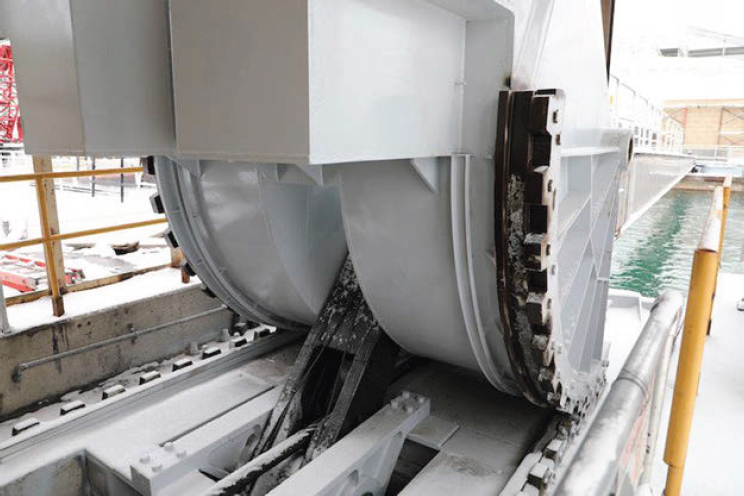
A landmark application demonstrating the profound impact of metal AM technology is the Poe Lock Ship Arrestor Lever Arm project (see Figure 6-1). The Poe Lock, a vital component of the Soo Locks system connecting Lake Huron and Lake Superior, is a critical artery for U.S. domestic commerce. When cracks were discovered in the 60-year-old, 14-foot-long lever arm of its ship arrestor system in February 2023, traditional manufacturing methods projected a replacement lead time of up to 18 months (Lincoln Electric 2025). Such an extended closure would have had extremely negative economic impacts (Gordon and Orr 2015). In response, USACE and ERDC collaborated with Lincoln Electric, leveraging their large-scale wire arc additive manufacturing technology to produce the steel lever arm in
SOURCE: Fox n.d.
just 3 months, representing an 84% reduction in lead time (America’s Engineers 2024). This rapid fabrication allowed for installation in March 2024, during a scheduled winter maintenance window and averting a prolonged shutdown. The component, measuring 12 feet long and weighing 6,000 lb, was the largest U.S. Civil Works component produced by 3D printing. The success of this project demonstrated that metal AM is an important technology for advancing national economic security and resilience, demonstrating its capacity to prevent significant supply chain disruptions and safeguard vital industries.
USACE has also used metal AM technology to produce a pintle system for locks and dams. In 2024, the Joint Manufacturing and Technology Center (JMTC) at Rock Island Arsenal utilized advanced manufacturing techniques and traditional foundry operations to produce a 7,125-lb pintle system for a USACE lock and dam in Pennsylvania (Lawrence and Lalor 2025). The mold for the massive casting comprised 16 distinct pieces that were all sand printed6 at JMTC. Although production of the pintle system used traditional methods, metal AM technology played a critical role in the design, prototyping, and manufacturing of this massive and complex
___________________
6 Sand printing fuses individual grains of sand with a binding agent and can create more complex molds than those using tradition methods.
component. This approach highlights that metal AM enables acceleration of the production of components for aging infrastructure, leveraging the strengths of both established and cutting-edge technologies.
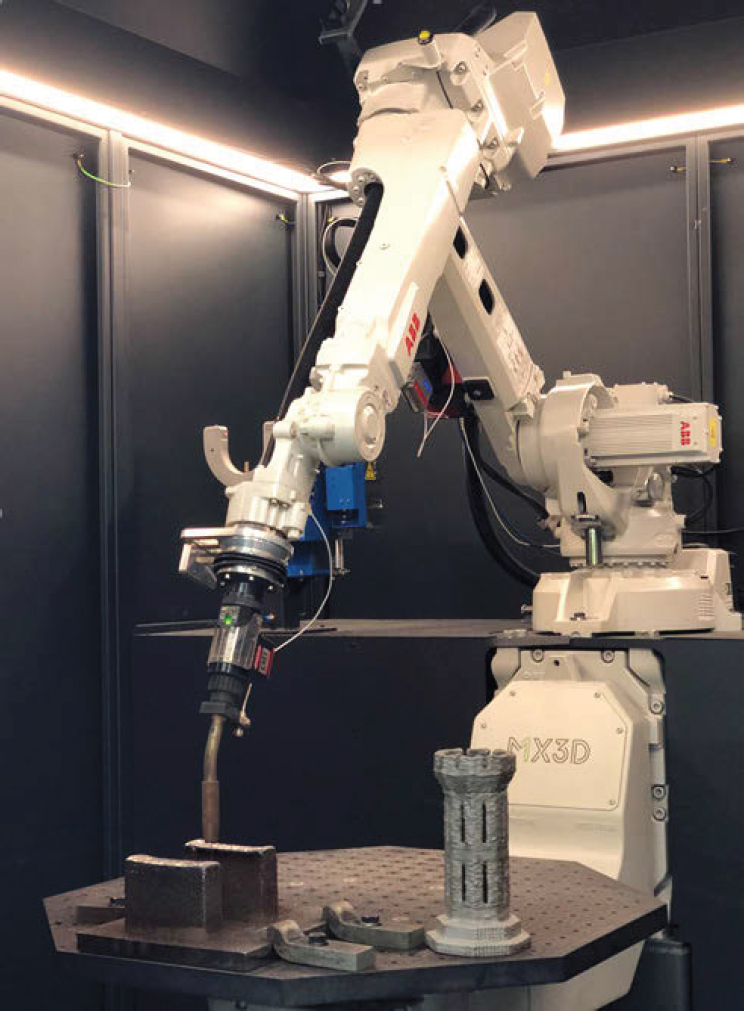
More broadly, large-scale metal AM is strengthening USACE’s water resources infrastructure resiliency by enabling rapid part replacement in inland navigation systems.7 In addition to the two large-scale projects mentioned above, metal AM technology has been widely used in fabricating obsolete or legacy parts in inland navigation systems. Many locks and dams are decades old, and obtaining replacement parts for their legacy systems can be quite challenging, if not impossible, through traditional supply chains. Metal AM allows for the on-demand fabrication of obsolete or custom-designed components, including but not limited to valves, pump components, and manifolds. This is particularly valuable for unique or low-volume parts where retooling for conventional manufacturing would be cost-prohibitive and time-consuming. Components that previously required 18 months or more to manufacture using conventional methods and outsourcing can now be produced in-house by ERDC (see Figure 6-2) in a few weeks. However, ERDC’s 3D production capacity is limited to ad hoc requests and/or experimental prototypes, and there is a need within Civil Works to develop suppliers outside of ERDC.
Opportunities and Associated Gaps
Metal AM clearly presents a transformative opportunity for USACE to enhance national infrastructure readiness and sustainment, particularly for its extensive network of aging locks, dams, and other civil works. The most significant opportunity for increased utilization of AM lies in the dramatic reduction of lead times for critical, unique metal components. This rapid turnaround minimizes downtime in vital navigation systems, preventing significant economic losses and ensuring the continuous support of commerce. Furthermore, metal AM enables the on-demand production of obsolete or custom-designed parts, effectively addressing the challenges of traditional supply chains for unique or low-volume components. This capability also expands design capacity, allowing for the creation of optimized, lightweight, and more durable parts with complex internal geometries that improve performance and efficiency.
Despite these compelling opportunities, the widespread adoption of metal AM within USACE faces several challenges. The effects of AM processes on material properties, such as fatigue strength and overall durability, are not yet thoroughly understood and standardized, and there is a need to
___________________
7 ERDC. “Advanced Manufacturing Technologies (Unbranded).” Video. USACE. https://www.erdc.usace.army.mil/Media/Video-Page/videoid/889485. Accessed July 30, 2025.
develop material-properties testing protocols and qualification processes. Ensuring that 3D-printed parts meet or exceed the rigorous performance specifications of conventionally manufactured components, especially for critical infrastructure under intense stress, requires additional research, testing, and validation. Another significant hurdle is the post-processing requirements for many metal AM parts, which often need heat treatments, surface finishing, and support structure removal to achieve desired mechanical properties and surface quality. This adds complexity, time, and cost to the overall production process. In addition, the initial investment in large-scale metal AM equipment can be substantial. Finally, there is a need for a highly skilled workforce to operate and maintain the 3D-printing systems, as well as to design parts specifically for additive manufacturing. Overcoming these challenges will require continued investment in research and development, the establishment of robust qualification standards, developing robust supply chain and pilot projects for demonstrations, and establishing strategic partnerships with industry and academia.
3D-Printed Metals Summary
- Powdered-metal 3D printing, a form of additive manufacturing, has advanced considerably over the past two decades.
- SLM and EBM technologies for powdered-metal 3D printing have achieved higher reliability and enabled new alloys through process modifications and alloy design.
- Binder jetting technology has moved toward fully dense sintered parts in steels and nickel-based alloys, pointing the way to cost-effective mass production.
- Metal 3D-printing technology is used extensively in many critical applications across domains including the aerospace, automotive, and energy industries.
- ERDC has been investigating the use of 3D printing of metal parts for replacement of metallic infrastructure components and has collaborated with districts on some trial implementations.
- Metal 3D printing presents an opportunity for significant reduction of time required to obtain unique metal components, but additional research is needed to understand long-term strength and durability of these materials in USACE applications.
3D PRINTING OF CONCRETE
Although there have been various innovations related to the makeup of concrete mixtures, the deployment process has remained largely unchanged: concrete is manually mixed at worksites (or premixed and delivered in a
truck), and then manually poured into designated mold patterns to harden. Over the past three decades, however, 3D concrete printing technology has been steadily advancing and coming into use (e.g., see reviews by Rehman and Kim 2021; Robayo-Salazar et al. 2023).
Concrete printing is an additive manufacturing process in which concretes or cementitious materials are deposited layer by layer to build structures directly from a digital model, without the need for traditional formwork. The process typically involves a computer-controlled robotic arm or gantry system that extrudes a specially formulated concrete mix through a nozzle, following a pre-programmed path. This allows for the creation of complex geometries, customized designs, and reduced material waste compared to conventional construction methods. Three-dimensional concrete printing has been explored to date for various applications, including building components (e.g., walls, columns, facades), bridge columns and components, full-scale structures (e.g., houses, footbridges), and infrastructure repairs. By using a robotic system driven by a digital model, 3D concrete printing offers the ability to pour and shape more durable, complex components while decreasing construction timelines (Tu et al. 2023). USACE has been investigating 3D concrete printing in military infrastructure and disaster relief applications (e.g., the Automated Construction of Expeditionary Structures [ACES]) program; Daugherty 2020; Jazdyk 2017). Potential applications of 3D concrete printing in Civil Works are just starting to be explored.
Evolution
In the mid-1990s, a 3D-printing technology termed Contour Crafting® and subsequently patented in 2010 emerged as a modern form of additive or layered manufacturing for construction (Naboni and Paoletti 2015). Initially, this method employed a ceramic paste extrusion process, but it was later adapted for cementitious materials to facilitate the production of large-scale structural elements and entire facilities—exemplified by 3D-printed buildings. The primary components of this technology consist of a concrete mixer, a delivery system (in most cases consisting of a pump and hose), a nozzle, and a robotic arm that directs the nozzle in 3D space. Concrete is deposited layer by layer, and each layer cures sufficiently to support subsequent layers. As used here, the term “concrete” refers to the general class of cementitious materials (i.e., a mixture of aggregates, water, and hydraulic cements). Most 3D-printed concrete applications use mortar, which does not include coarse aggregates, to facilitate the pumping and layer-by-layer placement of concrete.
In the mid-1990s, another concrete additive manufacturing approach called “selective aggregation” was introduced. This process involved placing a matrix of silica sand, and then selectively depositing cement onto the sand
matrix and activating it with steam. The result was a strong, dense material for which production could be automated through computer-aided drafting and analytical modeling tools (Khan et al. 2020). The foundational premise was that structures could be built by joining grains of sand one by one. Drawing on this principle, “D-Shape” technology was developed, wherein sand grains are bound by selectively jetting a liquid adhesive onto the sand matrix. Initially, a polymeric binder was used, but it was later replaced with an inorganic binder due to complications arising from the polymer’s stickiness during machine operation.
In the early 2000s, “free-form construction,” also referred to as “concrete printing,” garnered attention. This technique shares similarities with Contour Crafting but differs in the design of its extrusion nozzle, which can operate at multiple resolutions, enabling the production of both bulk and fine details. Notably, free-form construction allowed the scaling of additive manufacturing for large structural elements, while also integrating additional functionality into these elements, including acoustic, thermal, and ventilation features.
Examples from Other Domains
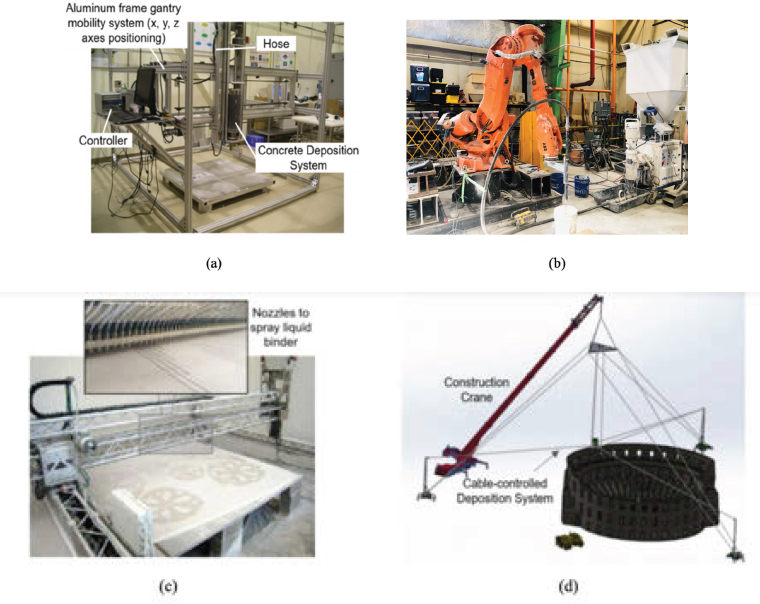
To date, both gantry-style (Bos et al. 2016; Le et al. 2012; Nerella and Mechtcherine 2019) and robotic (Barnett and Gosselin 2015; Lublasser et al. 2018; Zhang et al. 2018) concrete 3D printers have been successfully implemented in research and real-world applications. Figure 6-3 shows different types of construction 3D printers. Figure 6-3a depicts the core structural and functional elements of a medium-scale, four-axis gantry system, as documented at NASA’s Marshall Space Flight Center in Huntsville, Alabama. A conventional gantry-based concrete 3D printer integrates three primary subsystems:
- A multi-axis gantry mobility system for precise x-, y-, and z-axis positioning;
- A concrete extrusion and deposition mechanism; and
- A material processing unit responsible for mixing and delivering the concrete.
Although gantry-based systems have successfully expanded the application of additive manufacturing in large-scale construction, they remain constrained by inherent design limitations. Their dependence on a vertically oriented extrusion process creates difficulties with executing certain geometries, such as those associated with printing overhang structural forms. Because their capacity to fabricate complex, nonplanar features without additional support structures or auxiliary tooling is limited, gantry-style
concrete 3D printers result in the production of layered structures classified as 2.5-dimensional rather than fully 3D geometries.
Robotic arms overcome some of the limitations of gantry-style printers with their increased maneuverability capability. Most of the aforementioned gantry and robotic concrete 3D printers employ an extrusion-based deposition system, in which concrete or mortar premixes are pumped to a print head to form the deposited filament. The terminal section of the print head is a nozzle responsible for shaping the concrete layer according to the desired geometry (Bos et al. 2016). Various nozzle orifice designs have been explored, including circular, elliptical, square, and rectangular configurations. To enhance surface quality, side trowels may be integrated into the nozzle, as implemented in Contour Crafting (Bhardwaj et al. 2019). By contrast, D-shape printers adopt a process analogous to SLS, wherein multiple spray nozzles selectively deposit a binding liquid onto predefined regions of a sand layer during printing (see Figure 6-3c).
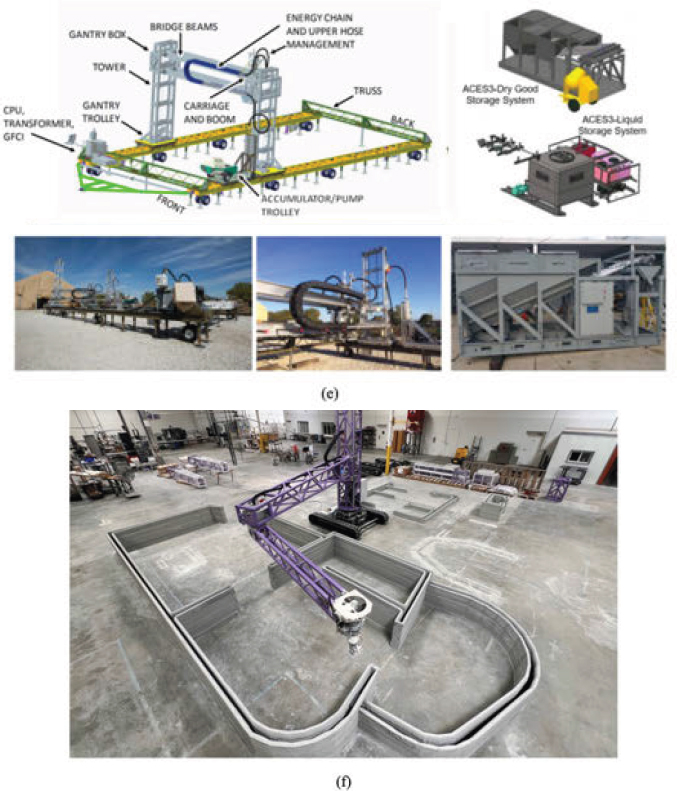
A similar system was developed more recently by Contour Crafting Corporation with funding from the U.S. Army and U.S. Navy that features a rover-type robotic system with a printing head installed on top that operates on a polar coordinate system (see Figure 6-3f). This system, referred to as the “D-Crafter” (D indicating “deployable”) by the manufacturer is capable of printing roughly 2,000 ft2 of structure when stationary. The printing envelop is technically infinite as the rover can self-maneuver and continue printing from another location.
In another recent project, the 3D-printing construction company ICON has completed a 3,800-ft2 barracks for the Texas Military Department at the Camp Swift Training Center in Bastrop, Texas. At the time the largest 3D-printed structure in North America, it was designed to house up to 72 soldiers. This project was another successful demonstration of the beneficial use of rapidly evolving construction-scale 3D concrete printing technology for military applications (Bauguess 2021).
USACE Experience and Opportunities
The application of 3D concrete printing in construction is transitioning from laboratory-scale research to real-world implementation, as evidenced by recent advances in military infrastructure projects. A notable milestone occurred in December 2018, when the U.S. Marine Corps’ 1st Marine Logistics Group, in collaboration with the Marine Corps Systems Command Advanced Manufacturing Operations Cell and USACE, successfully fabricated and assembled a 32-ft-long (9.75 m), 3-ft-wide (0.91 m) pedestrian bridge at Camp Pendleton, California. This structure, composed of 3D-printed modules, was engineered to sustain design loads of 15,000 lb per section (6,804 kg). Subsequent structural testing in 2019 at ERDC’s Construction Engineering Research Laboratory (CERL) validated the bridge’s
SOURCES: (a) Photo courtesy of Michael Fiske (Marshall Space Flight Center) and Jennifer Edmunson (Jacobs Engineering Group Inc.); (d) photo courtesy of Robert Mueller, Kennedy Space Center); (e) figure courtesy of Khan et al. 2020.
capacity to withstand ultimate loads exceeding 45,000 lb (20,412 kg), demonstrating the viability of additive manufacturing for load-bearing applications (Randolph 2019).
D-shape technology has also demonstrated effectiveness in producing large-scale structures (Cesaretti et al. 2014), as parallel efforts have developed field-deployable, large-scale concrete 3D printers. USACE’s CERL, in partnership with NASA’s Marshall Space Flight Center and Kennedy Space Center, collaborated to create the ACES system. This system comprises a mobile robotic gantry and an automated material delivery subsystem, which integrates both a dry-goods delivery system and a liquid-goods delivery system (see Figure 6-3d). Designed for rapid field deployment, the ACES system requires relatively minimal setup time. Notably, the ACES prototype
successfully 3D-printed a concrete barrack (B)-Hut, representing the first habitat structure printed with concrete containing 10-mm (3/8-in) aggregate for enhanced compressive strength (Mueller et al. 2018). This initiative targets a 50% reduction in construction material transport volumes and a 62% decrease in on-site labor requirements compared to conventional plywood-based methods, addressing critical logistical challenges in expeditionary operations. During performance evaluations at CERL’s Champaign facility, the ACES team—supported by the 1st Marine Expeditionary Force and the architectural firm Skidmore, Owings, and Merrill—achieved partial success in printing the exterior walls of a second 512-ft2 structure within a 24-hour period (Post 2018). A separate trial yielded a fully enclosed 500-ft2 (46.5-m2) barracks unit in 40 hours, underscoring the interplay between print speed, material rheology, and structural scale. These efforts highlight the growing emphasis on optimizing process parameters (e.g., robotic deposition rates, layer adhesion kinetics) and material formulations to balance printability, structural integrity, and operational timelines
Such case studies exemplify the paradigm shift in construction methodologies, where 3D concrete printing is being leveraged to enhance logistical efficiency, reduce labor dependency, and enable complex geometries in austere environments.
To date there have not been applications of 3D-printed concrete to water resources infrastructure. As discussed earlier, USACE ERDC work on 3D-printed concrete has focused on expeditionary applications. Research gaps and uncertainties for application of 3D-printed concrete to water resources infrastructure include the lack of a standardized mixture design methodology and related material specifications, testing standards, and design codes. There are numerous opportunities for USACE to contribute to the technology advancement in ways that best align with USACE’s needs. Some of these opportunities are described below.
3D-Printable Mixture Design Method
One of the core challenges in 3D concrete printing is the lack of a comprehensive, standardized mixture design methodology that reliably meets the unique demands of printable cementitious materials. In traditional concrete construction, mixture proportions are determined to satisfy a range of parameters such as workability, compressive strength, durability, and cost-effectiveness. However, when it comes to 3D-printing processes, the concrete must not only meet these conventional requirements but also exhibit specific rheological properties—flowability, extrudability, and buildability—that enable it to be layered without collapsing or excessively deforming. Printable concretes must reach a delicate balance between fluidity during pumping and extrusion and sufficient stiffness immediately after deposition. This need often calls for the use of specialized additives (e.g.,
superplasticizers, accelerators, viscosity modifiers) and precise adjustments in particle size distribution and water-to-cement ratio.
However, there is no single standard method or universally accepted test protocol to guide practitioners in formulating these specialized mixtures. Consequently, each research group or company relies on trial-and-error methods or proprietary recipes that are not necessarily reproducible or transferable across different printers, environments, or application requirements. Furthermore, the lack of a standardized mixture design approach hinders the growth of 3D concrete printing by making it difficult to compare different studies, scale up from laboratory to field conditions, and ensure consistent quality control. Unlike traditional construction materials—where standardized guidelines (e.g., from the American Society for Testing and Materials [ASTM], European Norm, or other organizations) exist to test slump, compressive strength, and durability—no equivalent, widely recognized benchmarks exist for evaluating critical factors such as print stability, interlayer adhesion, or print resolution. As a result, the industry struggles to align on best practices, leaving a significant gap in ensuring reliability and repeatability when moving from small-scale demonstrations to large-scale commercial or structural applications. Nevertheless, there are efforts both by the industry and within the academic community to standardize and develop 3D-printable concretes. There are some limited examples of commercially available prebagged 3D-printing materials by companies such as Laticrete and Quickrete.8
Codes, Material Specifications, and Testing Standards
An essential component to adopting 3D-printed construction, which includes concrete and other materials, is the availability of material specifications, testing standards, and design codes. Currently, there are significant gaps in such documents for 3D-printed construction. However, there are various current efforts to fill these gaps. The first comprehensive document on testing and qualification of 3D-printed construction was developed by the International Code Council (ICC) under Acceptance Criterion (AC) 509, 3D Automated Construction Technology for 3D Concrete Walls.9 This AC, intended for the qualification of 3D-printed walls, specifies testing standards for 3D-printing materials and walls. The AC is mostly performance based, with some performance requirements mainly for the material. There are ongoing efforts by ASTM under the additive technologies committee (F42) to develop material specifications and testing standards to cover various aspects of the 3D-printed concrete technology including but not limited
___________________
8 “M23 3D Printing Mortar.” Laticrete. https://www.laticrete.com/en/products/m23-3dprinting-mortar. Accessed August 4, 2025; Quikrete Companies. 2020.
to fresh and early-age properties, curing and extraction of samples, testing of hardened material properties, and construction documentation.
Regarding the development of design codes, there is an ongoing effort by ICC 3D Automated Construction Technology for 3D Concrete Walls Consensus Committee (IS-3DACT Committee) to develop the first comprehensive standard on 3D-printed construction in the world.10 This comprehensive standard includes material testing and performance requirements, structural design, and field material and structural prequalification testing methods and performance requirements. This is an American National Standards Institute consensus committee, and at the writing of this document, the first public commenting period of the standard had been completed. This standard is also proposed for adoption in the ICC’s International Building Code (IBC) in the upcoming 2027 code release. Note that all 50 states use or have adopted the IBC (ICC 2018).
Concurrent efforts are under way by the American Concrete Institute (ACI) within the ITG-12 Code Requirements Construction of Additively Constructed Walls Committee, which is a closed working group. ACI Committee 564 on 3-D Printing with Cementitious Materials has also recently established a subcommittee on codes and standards review, which is expected to provide valuable guidance documents on various ongoing efforts to standardize and codify this emerging technology. Note that all of these efforts are limited to low seismicity (seismic design categories A and B) due to a lack of test and gaps in understanding of how structures built using the 3D-printed construction would perform under strong earthquakes. This remains one of the biggest challenges in terms of widespread adoption of this technology.
3D-Printed Concrete Summary
- Technologies for 3D printing with concrete have been advancing steadily for the past three decades. Gantry and robotic 3D-printing technologies are prevalent and have been successfully implemented in research and real-world applications.
- To date there have not been applications of 3D-printed concrete to water resources infrastructure. ERDC’s work on 3D-printed concrete has focused on expeditionary applications.
- Despite substantial advances in developing new cement-based materials for 3D printing, questions surrounding the long-term performance and durability of printed materials and structures remain
___________________
10 ICC 1150 Standard for 3D Automated Construction Technology for 3D Concrete Walls. https://www.iccsafe.org/products-and-services/i-codes/code-development/cs/3dact_consensus_committee. Accessed August 1, 2025.
- largely unanswered. Although researchers have explored ways to optimize fresh-state properties and create more robust mixtures, few studies have investigated how these materials behave over extended service lives.
- The absence of standardized protocols and rigorous quality control measures complicates efforts to ensure consistency and reliability across different 3D-printed concrete systems.
- There are ongoing efforts to develop standards and specifications for 3D-printed concrete materials and structures, some of which are being considered for adoption in codes. USACE has opportunities to help shape the evolving standards and codes in ways that best align with USACE needs.
REFERENCES
3DEO. 2022. “The History and Evolution of Metal Additive Manufacturing Techniques.” Blog. https://www.3deo.co/metal-3d-printing/the-history-and-evolution-of-metal-additive-manufacturing-techniques. Accessed July 30, 2025.
Abdel-Aal, H. A. 2022. Additive Manufacturing of Metals: Fundamentals and Testing of 3D and 4D Printing, 1st ed. Access Engineering. https://www.accessengineeringlibrary.com/content/book/9781260464344.
America’s Engineers. 2024. “Infrastructure Innovation: New Poe Lock Arrestor Arm Is the Largest U.S. Civil Works Components Produced by 3D Printer.” April 2. https://americas-engineers.com/infrastructure-innovation-new-poe-lock-arrestor-arm-is-the-largest-u-s-civil-works-component-produced-by-3d-printer.
Barnett, E., and C. Gosselin. 2015. “Large-Scale 3D Printing with a Cable-Suspended Robot.” Additive Manufacturing 7:27–44.
Bauguess, B. 2021. “ICON and TMD Unveil 3D-Printed Barracks to House Women & Men During Military Training in Texas.” ICON Build. August 16. https://www.iconbuild.com/newsroom/icon-and-tmd-unveil-3d-printed-barracks-to-house-women-men-during-military-training-in-texas.
Berece, P., and R. Pacurar. 2025. “Challenges and Trends in Additive Manufacturing for Metallic Applications: Towards Optimized Process and Performance.” Metals 15:525.
Bhardwaj, A., S. Z. Jones, N. Kalantar, Z. Pei, J. Vickers, T. Wangler, P. Zavattieri, and N. Zou. 2019. “Additive Manufacturing Processes for Infrastructure Construction: A Review.” Journal of Manufacturing Science and Engineering 141(9):091010.
Bos, F., R. Wolfs, Z. Ahmed, and T. Salet. 2016. “Additive Manufacturing of Concrete in Construction: Potentials and Challenges of 3D Concrete Printing.” Virtual and Physical Prototyping 11(3):209–225.
Cesaretti, G., E. Dini, X. De Kestelier, V. Colla, and L. Pambaguian. 2014. “Building Components for an Outpost on the Lunar Soil by Means of a Novel 3D Printing Technology.” Acta Astronautica 93:430–450.
Daugherty, C. S. 2020. “ERDC Researchers Are a Driving Force in Construction Scale 3D Printing.” Engineer Research and Development Center, U.S. Army Corps of Engineers. https://www.erdc.usace.army.mil/Media/News-Stories/Article/2356722/erdc-researchers-are-a-driving-force-in-construction-scale-3d-printing.
Deckard, C. 1986. “Method and Apparatus for Producing Parts by Selective Sintering.” U.S. Patent No. 4,863,538.
Fox, C. n.d. “Infrastructure Innovation: New Poe Lock Arrestor Arm Is the Largest U.S. Civil Works Compo.” Engineer Research and Development Center. https://www.erdc.usace.army.mil/Media/News-Stories/Article/3726876/infrastructure-innovation-new-poe-lock-arrestor-arm-is-the-largest-us-civil-wor.
Gordon, G. S., and M. Orr. 2015. “The Perils of Efficiency: An Analysis of an Unexpected Closure of the Poe Lock and Its Impact.” U.S. Department of Homeland Security. https://www.remi.com/wp-content/uploads/2021/08/DHS-OCIA-The-Perils-of-Efficiency-An-Analysis-of-an-Unexpected-Closure-of-the-Poe-Lock-and-Its-Impact.pdf.
Hull, C. W. 1986. “Apparatus for Production of Three-Dimensional Objects by Stereolithography.” U.S. Patent No. 4,575,330.
ICC (International Code Council). 2018. “The International Building Code.” March 20. https://www.iccsafe.org/products-and-services/i-codes/2018-i-codes/ibc.
IoSCM (Institute of Supply Chain Management). 2023. “Industrial Uses and Applications of 3D Metal Printing.” Blog. January 17. https://www.ioscm.com/blog/4-industrial-uses-and-applications-of-3d-metal-printing.
Jazdyk, M. 2017. “3D Printing a Building.” Engineer Research and Development Center, U.S. Army Corps of Engineers. https://www.usace.army.mil/Media/News-Archive/Story-Article-View/Article/1288744/3-D-printing-a-building.
Khan, M. S., F. Sanchez, and H. Zhou. 2020. “3-D Printing of Concrete: Beyond Horizons.” Cement and Concrete Research 133:106070.
Kladovasilakis, N., K. Tsongas, and D. Tzetzis. 2025. “Metal Additive Manufacturing: Design, Performance and Applications.” Materials 18:545.
Lawrence, G., and M. Lalor. 2025. “Transforming Army Sustainment Through Advanced Manufacturing.” U.S. Army. April 18. https://www.army.mil/article/284096/transforming_army_sustainment_through_advanced_manufacturing.
Le, T. T., S. A. Austin, S. Lim, R. A. Buswell, A. G. F. Gibb, and T. Thorpe. 2012. “Mix Design and Fresh Properties for High-Performance Printing Concrete.” Materials and Structures 45(8):1221–1232.
Lincoln Electric. 2025. “Lincoln Electric and U.S. Army Corps of Engineers Honored for Technical Achievement in 3D Printing Innovation.” March 4. https://www.lincolnelectric.com/en/Newsroom/Press-Releases/2025/03/3D-Printing-Innovation.
Lublasser, E., T. Adams, A. Vollpracht, and S. Brell-Cokcan. 2018. “Robotic Application of Foam Concrete onto Bare Wall Elements—Analysis, Concept and Robotic Experiments.” Automation in Construction 89:299–306.
Mueller, J. H., P. Voglreiter, M. Dokter, T. Neff, M. Makar, M. Steinberger, and D. Schmalstieg. 2018. “Shading Atlas Streaming.” ACM Transactions on Graphics 37(6):1–16.
Naboni, R., and I. Paoletti. 2015. Advanced Customization in Architectural Design and Construction. Cham, Switzerland: Springer International.
Nerella, V. N., and V. Mechtcherine. 2019. “Studying the Printability of Fresh Concrete for Formwork-Free Concrete Onsite 3D Printing Technology (CONPrint3D).” In 3D Concrete Printing Technology, edited by J. G. Sanjayan, A. Nazari, and B. Nematollahi, pp. 333–347. Butterworth-Heinemann.
Nikon SLM Solutions. 2025. “The Advantages of Metal Additive Manufacturing: When to Implement and Why It Matters.” May 19. https://nikon-slm-solutions.com/addictive-additive/the-advantages-of-metal-additive-manufacturing-when-to-implement-and-why-it-matters.
Post, N. M. 2018. “Army Researchers Refine 3D-Printed Concrete Barracks.”Engineering News-Record. August 14. https://www.enr.com/articles/45002-army-researchers-refine-3d-printed-concrete-barracks.
Prototal UK. 2022. “The History of Additive Manufacturing: From the 1980s to Today.” Blog. https://prototaluk.com/blog/history-of-additive-manufacturing.
Quikrete Companies. 2020. “Quikrete, Contour Crafting Develop 3D Printed Concrete Mix.” For Construction Pros. May 6. https://www.forconstructionpros.com/concrete/press-release/21132101/the-quikrete-companies-quikrete-contour-crafting-develop-3d-printed-concrete-mix.
Randolph, M. 2019. “Bringing Innovation to Fruition: Marines 3D Print 1st Reinforced Concrete Bridge in Wester.” Marine Corps Systems Command. https://www.marcorsys-com.marines.mil/News/News-Article-Display/Article/1742621/bringing-innovation-to-fruition-marines-3d-print-1st-reinforced-concrete-bridge. Accessed August 8, 2025.
Rehman, A. U., and J. H. Kim. 2021. “3D Concrete Printing: A Systematic Review of Rheology, Mix Designs, Mechanical, Microstructural, and Durability Characteristics.” Materials 14(14):3800.
Robayo-Salazar, R., R. M. Gutierrez, M. A. Villaquiran-Caicedo, and S. D. Arjona. 2023. “3D Printing with Cementious Materials: Challenges and Opportunities for the Construction Sector.” Automation in Construction 146:104693.
Sachs, E. M., M. J. Cima, J. A. Cornie, D. E. Brancazio, and A. Curodeau,. 1993. “Three-Dimensional Printing Techniques.” Manufacturing Review 6(2):118–127.
Shellabear, M., and O. Nyrhilä. 2004. “DMLS-Development History and State of the Art.” Presented at LANE 2004 Conference, Erlangen, Germany, September 21–24. https://laseroflove.wordpress.com/wp-content/uploads/2009/10/dmls_history.pdf.
Sonkamble, V., and N. Phafat. 2023. “A Current Review on Electron Beam Assisted Additive Manufacturing Technology: Recent Trends and Advances in Materials Design.” Discover Mechanical Engineering 2(1). https://doi.org/10.1007/s44245-022-00008-x.
Tu, H., Z. Wei, A. Bahrami, N. B. Kahla, A. Ahmad, and Y. Onuralp Özkılıç. 2023. “Recent Advancements and Future Trends in 3D Concrete Printing Using Waste Materials.” Developments in the Built Environment 16(December):100187.
Wickstrom, S. 2025. “3D Metal Printing: Revolutionizing Manufacturing with Advanced Metal Parts.” UltiMaker. April 8. https://ultimaker.com/learn/3d-metal-printing-revolutionizing-manufacturing-with-advanced-metal-parts.
Yang, A. 2025. “Guide to SLM 3D Printing/Metal LPBF [+Cost Calculator].” Unionfab Blog. May 9. https://www.unionfab.com/blog/2025/02/slm-3d-printing.
Yang, J., B. Li, J. Liu, Z. Tu, and X. Wu. 2024. “Application of Additive Manufacturing in the Automotive Industry: A Mini Review.” Processes 126:1101.
Zhang, X., M. Li, J. H. Lim, Y. Weng, Y. W. D. Tay, H. Pham, and Q.-C. Pham. 2018. “Large-Scale 3D Printing by a Team of Mobile Robots.” Automation in Construction 95:98–106.
Zhao, N., M. Parthasarthy, S. Patil, D. Coates, K. Meyers, H. Zhu, and W. Li. 2023. “Direct Additive Manufacturing of Metal Parts for Automotives Applications.” Journal of Manufacturing Systems 68:368–375.


