Innovative Materials in Water Resources Infrastructure: Opportunities for the Corps of Engineers (2026)
Chapter: 1 Introduction
1
Introduction
This chapter explains the origins and rationale for this study of the use of innovative materials in water resources infrastructure, including the congressional directive that led to its commissioning by the U.S. Army Corps of Engineers (USACE). The chapter also explains the reasons why Congress and USACE are interested in increasing the use of innovative materials.
The study charge and the study committee’s interpretation of its key elements are then discussed. The rationale for the study’s focus on the use of innovative materials for the maintenance and repair of USACE’s inland navigation and flood risk management infrastructure is discussed, along with the reasons for giving particular attention to certain proven but underutilized materials and their application processes. The chapter concludes with an overview of the report’s contents and organization.
STUDY CONTEXT
Overview of USACE Water Resources Infrastructure and Related Challenges
Through its Civil Works program, USACE is responsible for planning, building, maintaining, and operating much of the nation’s water resources infrastructure for navigation and flood risk management. The Congressional Research Service estimated the 2025 value of water resources infrastructure assets managed by USACE as $259 billion (CRS 2025). These assets are managed by six U.S.-based geographic divisions and by districts within the divisions. Ecosystem restoration is also part of the core mission
of USACE Civil Works but was not part of the charge to the committee and is not part of this report.
The maintenance, repair, rehabilitation, and modernization of water resource assets present demanding and costly challenges for USACE, especially considering that the infrastructure assets and their components can be unique, built and manufactured at different periods for certain site-specific needs and conditions, and subject to the stresses of marine environments and to mechanical damage from vessels, fatigue, and climate extremes, among others. Most of the navigation and flood risk management structures were built during the middle decades of the 20th century, meaning that a large majority of them have exceeded or will soon exceed their estimated design service lives of 60 to 75 years (USACE n.d.). Many of these older structures consist of mechanical components, such as lock gates and their operating machinery, that are no longer commercially available and sometimes lacking their original engineering drawings and specifications.1
USACE’s ongoing maintenance, repair, and rehabilitation of its existing water resources infrastructure are commonly referred to by the Corps and in this report as “operations and maintenance” (O&M) activities, whereas the complete replacement and new construction of infrastructure are categorized as capital projects, each funded through different Civil Works accounts. With regard to O&M activities, in fiscal year (FY) 2024, USACE reported that funding shortfalls meant that its navigation and flood risk management assets had deferred maintenance and repair needs that exceeded $5 billion (USACE 2024, 78). In administering its capital projects program, USACE has a longstanding backlog of authorized work that awaits congressional funding (NRC 2013). These unmet investment needs complicate the efficient and reliable operations of USACE’s water resources infrastructure as it ages and becomes increasingly outmoded.
Users and communities in more than 40 states, including nearly all states east of the Mississippi River, directly utilize USACE’s navigation infrastructure, both inland and coastal, for freight transportation and access regionally and nationally (NASEM 2015) (see Figure 1-1). Disruptions to the operation of this infrastructure, including from age- and materials-related component failures, can have significant economic impacts that reverberate across multiple industries and regions (e.g., NASEM 2015). To illustrate the frequency with which significant disruptions occur, according to USACE, in FY 2023 there were more than 40 instances in which mechanical failures at locks on the inland navigation system caused closures for at least 24 hours and 20 instances where the closure lasted a week or longer (USACE 2023b, 25, Table 6). Such lengthy closures can result in substantial delays to carriers, shippers, and other businesses, increasing
___________________
1USACE presentation to the committee, November 21, 2024.
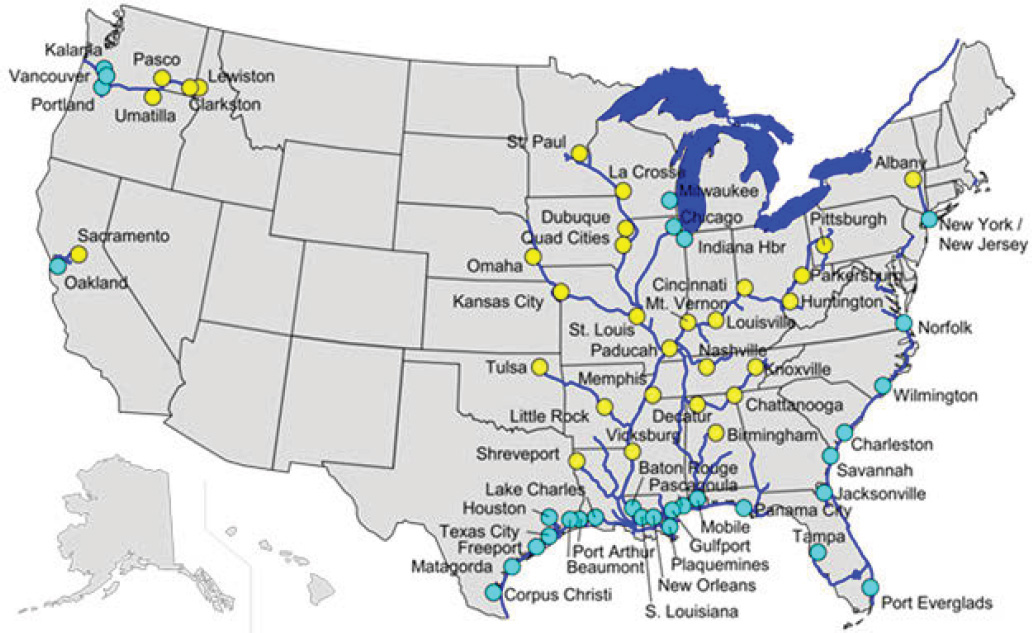
NOTES: Blue dots are cities on the coastal navigation system; yellow dots are cities on the inland system. Some cities, such as New Orleans, are served by both systems.
SOURCE: IWR 2012.
the cost of transporting bulk commodities such as coal, building materials, fuel, chemicals, and agricultural products. In the case of USACE’s flood risk management infrastructure, its dependable functioning is essential for communities to mitigate flooding, supply drinking and industrial process water, and produce hydroelectric power (CRS 2025). In many cases, local communities also rely on navigation and flood risk management infrastructure for recreational activities.
Available funding for O&M of USACE water resources infrastructure and the internal systems employed to allocate the annual funding from Congress are important constraints on the operation and performance of the infrastructure. Annual appropriations from Congress for Civil Works O&M have been well below identified O&M needs for years (CBO 2022; CRS 2025). This results in USACE being able to fund a small fraction of needed O&M projects in any year and the need to prioritize among projects submitted for funding consideration by the USACE districts. Others have also identified these issues, including a National Research Council study that found that there was no comprehensive federal-level guidance for USACE to prioritize O&M needs beyond specific mentions and authorizations in the periodic Water Resources Development Acts (NRC 2013).
Comparing thousands of potential O&M projects for diverse USACE water resources infrastructure facilities to prioritize a small number of projects for funding is a complex and difficult task for which USACE has developed sophisticated, tractable systems (NASEM 2015). For O&M projects, and for capital projects, initial costs tend to drive decision making at both the district and division levels.2 Table 1-1 shows funding thresholds and definitions for various projects.
Established approaches and materials inherently have less risk and more predictable costs than approaches using innovative materials. Furthermore, life-cycle costs generally are not considered because of the large number of potential projects, as USACE only requires detailed comparison
TABLE 1-1 Funding Thresholds for O&M Projects
| Maintenance | Major Maintenance | Major Rehabilitation |
|---|---|---|
| O&M Funding | O&M Funding | CG Funding |
| <$8M | $8M–<$33M | $33Ma |
a The Major Rehabilitation threshold is adjusted each year for inflation and included in the budget Engineer Circular. There are additional requirements to qualify for Major Rehabilitation funding.
NOTE: CG = construction general; O&M = operations and maintenance.
SOURCES: Lenna Hawkins, USACE, June 25, 2025; USACE 2023a.
___________________
2USACE presentation to the committee, February 27, 2024.
analyses for “major” maintenance efforts, usually those exceeding $8 million for O&M projects.3 This makes it more difficult to consider innovative materials that may have higher initial costs but longer durability or other performance characteristics that result in lower life-cycle costs.
To help meet the challenge of maintaining, repairing, and modernizing its water resources and other civil works infrastructure, USACE has charged its Engineer Research and Development Center (ERDC) with conducting basic and applied research on technology-based solutions.4 Across its multiple laboratories for construction, geotechnical, structural, cold-regions, and coastal engineering, ERDC has pursued research on innovative materials and construction methods as well as on nondestructive evaluation and inspection methods, analytical models for predicting the effects of material aging, and health and condition monitoring and sensing. Intent on developing materials and application methods that can increase the durability and facilitate the repair of USACE’s water resources infrastructure, ERDC’s research portfolio includes work on materials ranging from high-performance concrete and cement formulations to fiber-reinforced polymer (FRP) composites, 3D printing of metals and concrete, geosynthetics, and corrosion- and microbial-resistant coatings.5 Increased structural strength, rapid repair, improved resistance to ice and vessel damage, and increased material durability and resilience to changing environmental loads are key goals of this research and development (R&D).6
While ERDC’s work is conducted after consultation with USACE construction managers and asset operators, and often in partnership with universities, private companies, and other government research laboratories, a major challenge for ERDC and USACE generally—as this report will explore—is in moving innovative materials and techniques into field use.7 Indeed, both USACE and Congress have recognized the potential for innovative materials to make significant contributions to maintaining and upgrading the nation’s water resources infrastructure and have therefore committed resources and introduced policies to advance the state of the technology, expand awareness among district engineers, and promote deployment in the field.
___________________
3USACE presentation to the committee, January 15, 2025.
4“U.S. Army Engineer Research and Development Center, ERDC Overview.” https://www.erdc.usace.army.mil/About. Accessed January 29, 2025.
5ERDC presentation to the committee, November 21, 2024.
6Ibid.
7USACE presentations to the committee, February 27, 2024, and January 15, 2025.
Legislative Origins of the Study and Statement of Task
In the Water Resources Development Act (WRDA) of 2016, Congress expressed interest in USACE expanding pursuit of innovative materials for water resources infrastructure. Section 1173 of WRDA 2016 directed USACE to sponsor a National Academies of Sciences, Engineering, and Medicine study on the use and performance of innovative materials in water resources infrastructure.8 Using an FY 2023 appropriation, USACE engaged the National Academies to conduct this study consistent with the direction from Section 1173 of WRDA 2016, although in recognition of the changes that have been made in the interim to ERDC’s materials R&D portfolio, partnerships, and strategic goals. The full study charge, or Statement of Task, is provided in Box 1-1.
STUDY APPROACH
Two of the National Academies’ major program units consulted with USACE in developing the Statement of Task and co-managed the study: the Transportation Research Board and the Division on Engineering and Physical Sciences. The committee appointed to carry out the study comprised experts with the range of skills and backgrounds necessary to assess water infrastructure and materials engineering, including former USACE and state department of transportation engineers, as well as academic and industry specialists in composites, concrete, metals, geotechnical engineering, and life-cycle analysis. The committee met 12 times over an 18-month period. The committee invited experts for briefings during meetings open to the public and convened closed meetings to assess the information gathered and deliberate over this report. Two of the public meetings involved site visits to ERDC laboratories in Vicksburg, Mississippi, and to navigation lock and dam facilities operated and maintained by the USACE Pittsburgh District. More details on the briefers and site visits are provided in the Preface.
To further its understanding of the use of innovative materials in USACE Civil Works, the committee first assembled baseline information on the materials used in water resources infrastructure projects and their performance requirements. The committee then examined USACE’s material selection processes, including the perspectives of Civil Works management, ERDC, and the USACE districts who are responsible for implementing and maintaining the navigation and flood management infrastructure. The information gathered included published reports from numerous offices within USACE and briefings from USACE officials and industry experts.
___________________
8Water Resources Development Act, § 1173 (2016). http://cdm16021.contentdm.oclc.org/utils/getfile/collection/p16021coll5/id/612/filename/613.pdf.
BOX 1-1
Statement of Task
An ad hoc study committee will identify key demands and challenges facing the U.S. Army Corps of Engineers (USACE) related to navigation and flood risk management assets; consider how innovative materials (such as composites and high-performance concrete) can support capabilities critical to meeting these demands and challenges; and make recommendations to inform strategies that USACE can pursue to further the development, demonstration, and deployment of promising materials in new and existing infrastructure.
Among the kinds of demands and challenges that should be considered by the committee are the imperatives of ensuring that the nation’s water resource infrastructure:
- Can be delivered and maintained in a timely and cost-effective manner;
- Functions efficiently and reliably with minimal downtime and delay;
- Is resilient and capable of withstanding increasingly aggressive environmental conditions that risk premature degradation and catastrophic damage;
- Is durable for long service lives, including extended service lives for aging assets; and
- Creates fewer environmental impacts during construction, operations, repair, and maintenance.
The study committee will consider how innovative materials can contribute to meeting the challenges and demands by supporting capabilities such as:
- High strength and durability;
- Resilience to extreme conditions and events;
- Rapid deployment; and
- Low life-cycle emissions and energy use.
The committee will identify types and categories of advanced materials that hold promise, and in each case, will review the status of the materials’ development and the extent to which their capabilities are understood and demonstrated. The committee will highlight critical gaps in understanding as well as factors that may be hindering development and deployment, including barriers arising from standards, common practices, and policies. In doing so, the committee will consider USACE’s research and development strategies to fill these knowledge gaps and overcome barriers to the development and use of innovative materials in water resources infrastructure.
As appropriate, the committee will make recommendations to inform strategies that USACE can pursue in concert with its partners in government, industry, and academia to further understanding of how innovative materials may be used and readied for deployment in water resources infrastructure.
Informed by these meetings, and to carry out its charge efficiently within the available time, the committee made several decisions to clarify terms and focus the study. The first decision was in regard to clarity about what is encompassed by “materials”; the committee adopted a broad definition (see Box 1-2).
First, given the range of innovative materials that are currently or potentially useful in water resources infrastructure, the committee decided to provide a more in-depth review of the following three material types:
- FRP composite materials,
- High-performance concrete and ultra-high-performance concrete, and
- Additively manufactured or 3D-printed materials.
The committee learned from discussions with USACE at all levels that these three material types are of particular interest and have the potential to confer benefits for USACE navigation and flood risk management infrastructure if utilized more often. The first two are specifically identified in the Statement of Task, which emphasizes the importance of considering materials that support high performance and savings in life-cycle costs. The committee also observed that all three material types have been the subject of significant laboratory and, in some cases, demonstration and pilot testing by USACE. Each is also supported by a substantial amount of research and implementation evidence from both the public and private sectors in water resources infrastructure and other domains. Other kinds of innovative materials currently or potentially useful in water resources infrastructure are also discussed in the report, but to a more limited degree. Other innovative materials explored include coatings, lubricants, anchorages, and biogeotechnical materials. For the three material types investigated in depth, the committee chose to include the processes used to manufacture and apply
BOX 1-2
Definition and Scope of “Materials”
The engineering of materials for applications in society involves integrated consideration of properties, structure and composition, synthesis and processing, and performance (NASEM 2019; NRC 1989). Within this framework, the committee adopted a broad definition of “materials” for this study, encompassing substances and the manufacturing processes used to make them. Thus, the word “materials” in this report is used to refer to substances, combinations of substances, and processes employed to manufacture or deploy particular materials.
them. For instance, 3D printing of concrete and metals is a novel or innovative process for applying materials such that these processes and materials must be considered together. To the extent that any innovative material requires a special process for implementation, the same logic holds.
Second, when considering USACE Civil Works activities that are most likely to accrue large and early benefits from the application of innovative materials, the committee recognized the significance of maintenance and repair activities. Because the nation’s water resources infrastructure is already built out, maintenance and repair present many opportunities to make the navigation and flood risk management systems more efficient and resilient through the use of innovative materials (NRC 2011). Furthermore, USACE districts have far more discretion over the use of their O&M-budgeted funds when compared with funds allocated for capital projects, which must be authorized by Congress and executed according to specific plans and timelines (CRS 2024). The committee, therefore, decided to focus the study on O&M repair and maintenance activities in the context that districts can choose to exercise this discretion by using innovative materials, and possibly for more low-risk applications when districts have limited experience with the material.
In considering the districts’ exercise of discretion, the committee observed that USACE has developed sophisticated, tractable budgetary systems to aid in decision making. Congressional appropriations for O&M for water resources infrastructure have been below identified needs for many years (CBO 2022). Accordingly, only a share of needed O&M projects can be funded and performed in any given year, causing USACE Headquarters to have to prioritize among thousands of projects submitted by the districts for funding. The multiple demands on O&M budgets can lead to districts placing more emphasis on minimizing project initial costs than on minimizing life-cycle costs.9 Under these circumstances, a district may be reluctant to propose a project that uses innovative materials if it leads to higher initial costs even when it promises greater durability or other performance characteristics that produce lower life-cycle costs. As previously mentioned, life-cycle costs can be difficult to estimate across the large number of proposed projects, and USACE only requires such analyses for “major” maintenance efforts, usually those exceeding $8 million in budget.10 The study committee therefore decided to take a close look at these and other impediments to the use of innovations by districts for O&M maintenance and repair
___________________
9USACE presentation to the committee, February 27, 2024.
10USACE presentation to the committee, January 15, 2025.
activities and to the policies and processes that have been adopted, or that hold promise, to counter them.11
Finally, when considering the elements of the water resources infrastructure that are most in need of strategic investment in O&M, the committee’s consultations with officials from USACE and ERDC led it to conclude that the dams, locks, and levees that make up the inland navigation system warrant special attention.12 Because of this infrastructure’s advanced age, complexity, and significance to commerce, the committee decided to focus much of its attention, including field visits, on the inland navigation system. The committee observed, however, that many of the O&M challenges for the inland navigation infrastructure are the same for flood risk management and coastal navigation infrastructure.
Report Organization
The remainder of the report consists of seven chapters that describe demands and challenges facing USACE related to navigation and flood risk management assets; the USACE infrastructure monitoring and maintenance operations; the specific types of materials in use in water resources infrastructure; current and potential uses of the three primary innovative material types of interest identified by USACE and the committee as well as other innovative materials; barriers to use of innovative materials and opportunities to overcome these barriers; and experiences of other organizations with use of innovative materials for related kinds of infrastructure. Chapter 2 provides an overview of the inland navigation and flood risk management infrastructure operated and managed by USACE. It also describes the array of materials currently in components of this infrastructure. Chapter 3 describes USACE’s relevant budgetary processes and systems for monitoring and managing the condition of these water resources assets. Chapters 4–7 investigate the priority materials identified by the committee, their current and potential uses in water resources infrastructure, and the body of evidence about their performance and effectiveness. Chapter 4 takes a closer look at the state of advanced composites, specifically FRPs; Chapter 5 examines high-performance concrete; Chapter 6 discusses additively manufactured 3D-printed materials; and Chapter 7 outlines other innovative materials that could be useful to the navigation and flood risk management systems. Chapter 8 identifies the key drivers of, and barriers to, greater utilization of innovative materials in water resources infrastructure, including
___________________
11Although the committee viewed O&M as the most impactful area for innovative materials, that should not preclude innovative materials from also being utilized in new construction projects.
12USACE presentation to the committee, August 29, 2024.
lessons learned from other organizations that have taken deliberate steps to encourage the use of innovative materials related by scale or type to water resources infrastructure and their various mechanisms for implementation. The committee’s summary assessment of the key findings from the report’s chapters and the committee’s recommendations are presented in Chapter 9.
REFERENCES
CBO (Congressional Budget Office). 2022. “Army Corps of Engineers: Budgetary History and Projections.” November. https://www.cbo.gov/publication/58839.
CRS (Congressional Research Service). 2024. “U.S. Army Corps of Engineers Civil Works: Primer and Resources.” February 16. https://crsreports.congress.gov/product/pdf/IN/IN11810.
CRS. 2025. “U.S. Army Corps of Engineers Civil Works: FAQs on Organization and Efficiency Reviews.” https://www.everycrsreport.com/reports/R48322.html.
IWR (Institute for Water Resources). 2012. “U.S. Port and Inland Waterways Modernization: Preparing for Post-Panamax Vessels.” June 20. USACE. https://www.iwr.usace.army.mil/Portals/70/docs/portswaterways/rpt/June_20_U.S._Port_and_Inland_Waterways_Preparing_for_Post_Panamax_Vessels.pdf.
NASEM (National Academies of Sciences, Engineering, and Medicine). 2015. Funding and Managing the U.S. Inland Waterways System: What Policy Makers Need to Know. Washington, DC: The National Academies Press. https://doi.org/10.17226/21763.
NASEM. 2019. Frontiers of Materials Research: A Decadal Survey. Washington, DC: The National Academies Press. https://doi.org/10.17226/25244.
NRC (National Research Council). 1989. Materials Science and Engineering for the 1990s: Maintaining Competitiveness in the Age of Materials. Washington, DC: National Academy Press. https://doi.org/10.17226/758.
NRC. 2011. National Water Resources Challenges Facing the U.S. Army Corps of Engineers. Washington, DC: The National Academies Press. https://doi.org/10.17226/13136.
NRC. 2013. Corps of Engineers Water Resources Infrastructure: Deterioration, Investment, or Divestment? Washington, DC: The National Academies Press. https://doi.org/10.17226/13508.
USACE (U.S. Army Corps of Engineers). n.d. “Value to the Nation: Capital Stock Infrastructure Age.” https://www.iwr.usace.army.mil/Missions/Value-to-the-Nation/Fast-Facts/Capital-Stock/Infrastructure-Age. Accessed October 4, 2024.
USACE. 2023a. “Civil Works Direct Annual Execution Program Guidance” (Engineer Circular EC-11-2-228). https://www.publications.usace.army.mil/Portals/76/EC%2011-2-228_expires%202025%2003%2031.pdf.
USACE. 2023b. Fiscal Year 2023 United States Army Corps of Engineers Agency Financial Report. https://www.asafm.army.mil/portals/72/Documents/Audit/fy23afr.pdf.
USACE. 2024. Fiscal Year 2024 United States Army Corps of Engineers Agency Financial Report—Civil Works. https://www.publications.usace.army.mil/Portals/76/FY%2024%20Civil%20Works%20Annual%20Financial%20Report.pdf.
This page intentionally left blank.


