Technologies and Practices for Plugging and Remediating Orphan Oil and Gas Wells (2026)
Chapter: 1 Introduction
1
Introduction
Estimates indicate that many millions of people in the United States reside within 1 mile of an orphan oil or natural gas well (Kang et al. 2023; Meehan et al. 2025; Peltz 2022). Orphan wells—non-productive wells for which no responsible party in industry can be identified—number well above 100,000 and are the remnants of nearly 170 years of oil and gas production (Merrill et al. 2023; OWPO 2024). The U.S. Geological Survey (USGS) has documented orphan wells in 27 states, but the nationwide count of orphan wells continues to change (Merrill et al. 2023); for example, Arizona has reported orphan wells only in the last few years (Boutot et al. 2022). Close to 60 percent of the 117,672 orphan wells in the USGS dataset are accounted for by only four states (Ohio, Pennsylvania, Oklahoma, and Kentucky; Merrill et al. 2023). Combined with estimates of unidentified or undocumented wells (IOGCC 2024; Jahan et al. 2025), many hundreds of thousands of orphan or undocumented wells may be impacting public health and safety through air pollution and groundwater, land, and water contamination (Kang et al. 2021). Orphan wells can also negatively affect economically productive uses of land and reduce land values (Harleman et al. 2022). The primary goals of wellbore plugging and abandonment are protection of usable water sources, isolation of hydrocarbon-bearing or water injection intervals, prevention of leakage to the surface, and prevention of unintended cross flow (API 2021).
For the most part, the responsibility to regulate hydrocarbon wells resides with state governments. States typically require that the responsible well owner plugs wells and reclaims the surrounding land when the well has reached the end of its productive life and/or is no longer economically viable. However, most orphan wells—because they predate modern regulations—may remain unplugged, were plugged based on standards that are now understood to be inadequate, or have an unknown status. In addition, most also precede modern record-keeping, making it difficult to assess their associated risks and develop a plan to plug them. Beginning in the early 1980s, states began producing
studies and eventually founding orphan well plugging programs to address orphan wells’ potential risks and associated uncertainties.
FEDERAL SUPPORT FOR PLUGGING ORPHAN WELLS
For decades, state governments have led efforts to identify and manage orphan wells. States’ needs and abilities to fund their orphan well plugging programs have varied greatly. The Infrastructure Investment and Jobs Act (IIJA), enacted in 2021, authorized $4.677 billion in new federal funding to plug orphan wells and restore the well sites.1 This funding is available through fiscal year 2030 to state, Tribal, and federal agencies responsible for orphan wells on their respective lands. States may also use these funds to plug orphan wells on private lands. In addition to plugging, remediation, and reclamation, eligible uses of these federal funds include identifying and characterizing undocumented wells; prioritizing which orphan wells will be plugged based on public health and safety, potential environmental harm, and anticipated land use; and remediating and restoring adjacent land impacted by extraction activities. The law also provides states incentives to improve their orphan well regulations.
To manage this funding, the U.S. Department of the Interior established the Orphaned Wells Program Office (OWPO) in 2023. Funding from the IIJA also allowed for the creation of the Consortium Advancing Technology for Assessment of Lost Oil and Gas Wells (CATALOG). CATALOG’s task is to identify and characterize the environmental risks of undocumented orphan wells by developing tools and technologies to identify and verify orphan well locations, measure methane emissions, digitize and extract information from historical records, help regulators prioritize well inspection and characterization, and share information with a wide range of stakeholders. Its work provides additional resources that OWPO needs to support state and Tribal agencies with their orphan well programs.
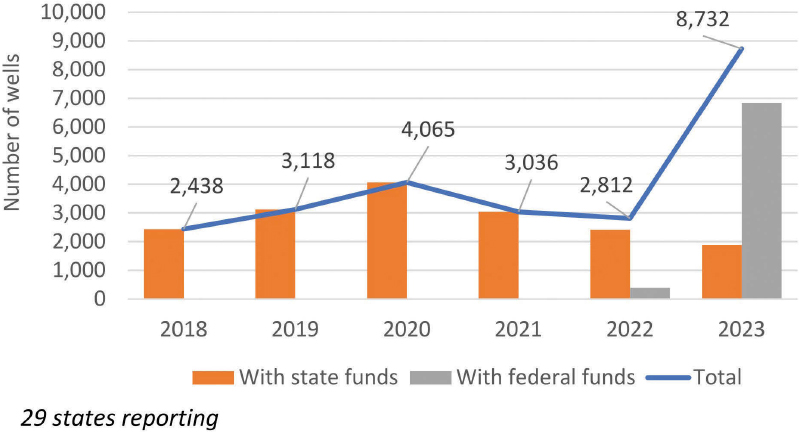
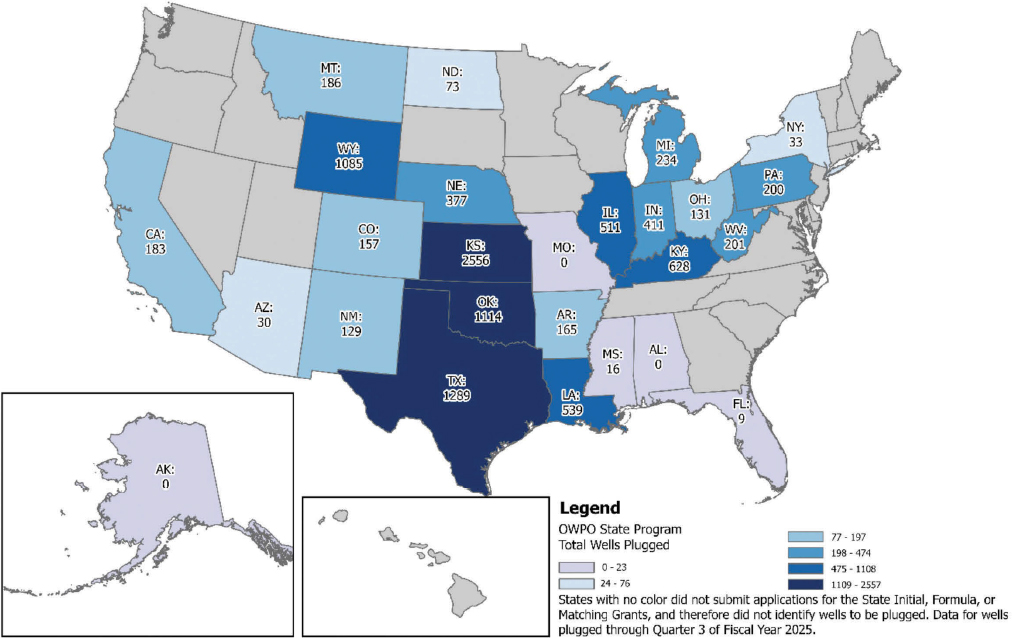
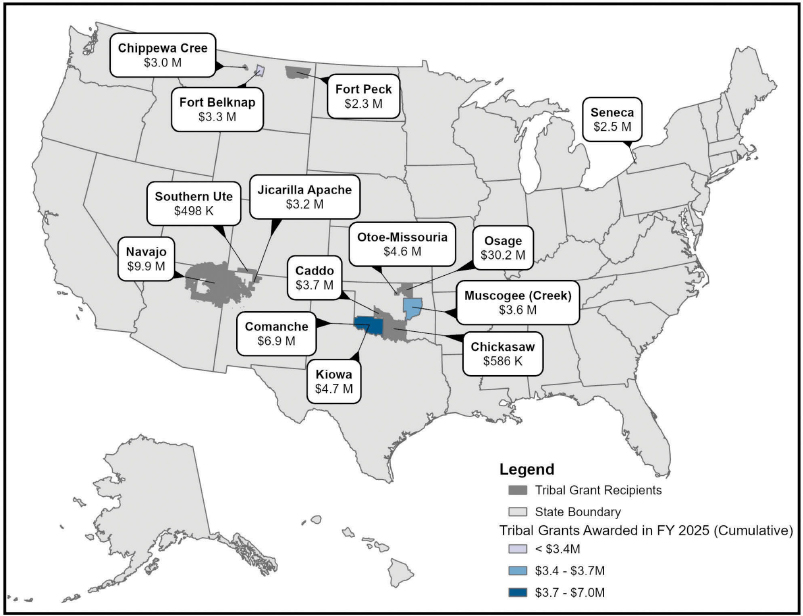
The influx of federal funding led to dramatic increases in the number of orphan wells plugged by states and Tribal governments. Compared to the previous 5 years, the number plugged by states in 2023 more than doubled (see Figure 1-1). Through fiscal year 2025, 10,257 wells have been plugged under state programs; 231 and 30 wells have been plugged under the federal and Tribal programs, respectively (OWPO 2025). Federal funding has also led to an increase in the identification and documentation of additional orphan wells. Plugging efforts will continue: as of September 30, 2025, over 60 percent of state program funds and 40 percent of Tribal program funds are still to be awarded (OWPO 2025). Figure 1-2 maps the number of orphan wells plugged by state governments using these federal funds, and Figure 1-3 shows the distribution of federal orphan well funds awarded to Tribal governments.
___________________
1 42 USC §15907: Orphaned, abandoned, or idled wells on Federal land.
SOURCE: IOGCC (2024).
REPORT APPROACH AND STATEMENT OF TASK
At the request of OWPO, the National Academies of Sciences, Engineering, and Medicine convened an ad hoc committee of volunteer experts to address the regulatory, technical, and environmental challenges and solutions to orphan hydrocarbon wells in the United States (see Appendix A for committee member biographical sketches). OWPO asked the committee to provide advice on regulatory, technical, scientific, and economic considerations for plugging and remediating orphan and abandoned oil and gas wells. OWPO tasked the committee with identifying future research and development areas for the industry and federal agencies to pursue. Questions about how wells become orphaned and what can be done to prevent it are outside the scope of this report. See Box 1-1 for the complete statement of task.
This report follows two related National Academies activities: a commissioned white paper and a public workshop held in July 2024, both of which inform this report. White paper authors Richard Simmers, John Fleming, Marlene Hall, Scott Kell, and Robert Worstall compiled statutory and regulatory standards, methods, and design of plans and requirements for hydrocarbon well plugging activities. The white paper includes a brief history of oil and gas development and the current quantification of U.S. orphan wells. The authors also administered a questionnaire to relevant state agencies on their plugging requirements and practices.
The workshop convened experts from a variety of sectors, including academia, industry, and state agencies, to discuss the costs, challenges, and benefits of plugging, remediating, and reclaiming orphan hydrocarbon wells and well sites. The workshop spanned 2 days, with an agenda that included well site remediation, well monitoring,
NOTES: Initial grants help states quickly scale up their orphaned well programs and make them eligible to apply for future formula and matching funds grants. Formula grants help states strengthen their orphan well plugging, remediation, and reclamation, and are awarded based on states’ orphan well inventory and demonstrated need. OWPO = Orphaned Wells Program Office.
SOURCE: OWPO (2025).
NOTE: FY = Fiscal Year.
SOURCE: OWPO (2025).
prioritization, wellbore procedures, and plugging materials. The white paper and workshop proceedings are available online at the National Academies website.2 These three activities (white paper, workshop, and consensus study) aim to inform OWPO, industry experts, and the public on opportunities for future efforts and resources needed for plugging orphan wells and ensuring the longevity of those plugs.
KEY TERMS AND DEFINITIONS
Many different terms used for hydrocarbon wells describe their regulatory status, physical state, or both. For example, orphan is a regulatory determination, while operating is a physical description. An undocumented well is, by definition, uncharacterized. It might become an orphan well, if designated by the regulatory jurisdiction, or be better categorized as decommissioned once it is plugged. In addition, respective stakeholders
___________________
2 See https://nap.nationalacademies.org/resource/28035/White_Paper_Orphaned_Wells_Workshop_Proceedings.pdf and https://nap.nationalacademies.org/catalog/28035/practices-and-standards-for-plugging-orphaned-and-abandoned-hydrocarbon-wells.
BOX 1-1
Statement of Task
The National Academies of Sciences, Engineering, and Medicine will convene an ad hoc committee of experts to provide advice to U.S. Department of the Interior (DOI) Orphaned Wells Program Office (OWPO) on regulatory, technical, scientific, and economic considerations for plugging and remediating orphaned and abandoned oil and gas wells. The committee will
- Examine current and emerging plugging and abandonment technologies, best practices, equipment, and materials for well characterization, wellbore plugging and barrier placement, wellbore integrity and verification, and durability and lifespan. Information from the National Academies workshop on “Practices and Standards for Plugging Orphaned and Abandoned Hydrocarbon Wells” will be considered in this examination.
- Evaluate unexpected or unique circumstances that necessitate varying criteria and standards, including engineering design, cost, logistics, or technical management.
- Assess available data on potential causes, frequency, consequences, and remediation of plug failures.
- Examine post-plugging monitoring techniques, approaches, and technology that are or will be important for the long-term protection of the environment and public health and safety. Include any identified post-plugging risk management best practices to ensure the long-term protection of groundwater and prevention of methane emissions as well as relevant economic considerations.
- Identify technology, materials, or policies that warrant further research and that may contribute to the success of well plugging and abandonment efforts carried out by industry, states, Tribes, and federal agencies.
may use different terms for the same status or use the same term in slightly different ways. In contexts where multiple categories of wells are grouped together, confusion on the scope of orphan well challenges can occur, including on the variability of risks posed by both current and undocumented wells.
The Interstate Oil & Gas Compact Commission report Idle and Orphan Oil and Gas Wells contains a comprehensive set of state regulations, as well as the key terms states use to categorize their wells (IOGCC 2021). State definitions differ for orphan well, operator, and regulator. Orphaned well is defined in IIJA as one that is “not used for an authorized purpose, such as production, injection, or monitoring; and for which no operator can be located or the operator of which is unable to plug the well and to remediate and reclaim the well site.”3
___________________
3 See 42 USC § 15907(a)(5). The federal definition defers to the term used by the individual state “to describe a well eligible for plugging, remediation, and reclamation by the State.”
The committee developed the key terms and definitions shown in Box 1-2 to offer a clear and simple framework that both encompasses the varied categories of U.S. wells and differentiates between their legal and physical states. These definitions were developed specifically for this report and were based on definitions from OWPO, the IIJA, and the Interstate Oil & Gas Compact Commission (IOGCC 2021).
BOX 1-2
Definitions of Key Terms
Orphan Well (legal category)
A documented well without a responsible party or owner that has yet to be plugged and abandoned. This may also include plugged wells that require remedial plugging. A regulatory decision must have been made to determine the responsible party status.
The definitions are intended to describe a well’s physical state. In this report, it may not be necessary to differentiate between operating and non-operating wells. However, since many regulatory jurisdictions distinguish between these categories in greater detail, the committee determined it would be appropriate to broadly separate them.
Undocumented Well
A well that is not or has not yet been identified, likely drilled prior to regulation. Once identified, an undocumented well would be classified as one of the following categories for tracking and regulation. By nature, numbers of undocumented wells are estimates.
Operating Well
A well permitted and operating for a purpose designated and documented in the regulatory system (e.g., oil and or natural gas production, injections) for which a responsible party/owner exists.
Non-Operating and Unplugged Well
A well permitted but not operating for a purpose designated and documented in the regulatory system (e.g., oil and or natural gas production, injections) for which a responsible party/owner exists. Jurisdictions have different categories of non-operating wells.
Plugged and Abandoned Well (Decommissioned)
A well that has been plugged and properly abandoned according to the regulatory requirements in place at the time. The term is used generally within state regulations and in industry both in the present and historically. Decommissioned well is a more precise term that has been adopted for use in recent standards.
Decommissioned Well
A well that has been permanently sealed and closed to eliminate safety hazards and prevent groundwater contamination.
Plugged Well Failure
The primary goals of wellbore plugging and abandonment are natural resource protection, interval isolation, and leak and cross-flow prevention. Therefore, while the consequences and severity of failing to meet one of the primary goals may not all be the same, if a plugged and abandoned well fails to meet any one of these primary goals, it can be considered a failure. See Chapter 3 for further discussion.
Although they are not used in this report, there are other categories of wells—based on the well’s legal status or physical state—that may be referenced in materials or records related to hydrocarbon well plugging and abandonment. Non-operating wells can take on a different status depending on certain characteristics. An idle well typically refers to one that has not yet been plugged and is not being used for its intended purpose (IOGCC 2021). Temporarily abandoned is a legal status typically defined as a well that has remained idle for a period less than 6 months and, depending on the state regulations, has or has not yet received approval to remain idle (IOGCC 2021). Shut-in wells have not operated for a period longer than 6 months, usually a full calendar year, but are capable of production or injection by activating existing equipment, supplying a power source, or opening valves (IOGCC 2021).
This document uses many other technical terms. See Appendix B for a glossary of terms commonly used by oilfield and well plugging operators, regulators, and researchers.
REPORT SCOPE
OWPO representatives met with the committee during public information-gathering sessions to answer questions on the scope of this report. They noted that the study focus included an examination of current and emerging plugging and abandonment technologies, best practices, equipment, and materials. They also emphasized their interest in root cause analysis of plug failures and how that knowledge can inform other well site activities, including monitoring and remediation.
OWPO, the committee, and National Academies project staff discussed several parameters to bound the study scope. These include focusing mainly on domestic onshore wells; however, where deemed applicable to onshore practices, the scope could include offshore and international plugging practices, data collection and record-keeping, and
materials and technologies. An extensive analysis of opportunities to repurpose wells or well sites also was determined to be beyond the scope. The report discusses repurposing in the context of monitoring (Chapter 4) and reclamation (Chapter 5). Finally, plugging funding mechanisms and financial incentives are not reviewed extensively in this report.
The statement of task and discussion of the report scope reveal the complexity surrounding the plugging and abandonment of orphan wells. This includes variable costs, funding, and financial incentives for plugging and long-term monitoring; inherent and varied characteristics of a well or wells in any given surface and subsurface setting; the large numbers of orphan and undocumented wells and lack of workforce to plug them; and lack of incentives to conduct and share research and advance technology in this space.
To address the statement of task, the committee collected information using a variety of methods. Primarily, it convened several information-gathering sessions with OWPO, industry experts, national laboratories, academics, plugging and abandonment service companies, and state representatives. Additionally, the committee coordinated with state representatives throughout the study and co-located a meeting with the IOGCC 2025 Annual Business Meeting in May. To inform that meeting, the committee drafted and administered a questionnaire to IOGGC 2025 Annual Business Meeting attendees.4 Staff and committee members also reviewed academic literature, state regulatory standards, and industry governing organization standards. Notably, data about orphan wells in the public domain are sparse, with much of the information, especially about older wells, likely lost to history. Therefore, parts of the report are drawn from the judgment and experiences of the committee members.
REPORT ORGANIZATION
The report continues with Chapter 2 detailing the orphan well problem and explaining how the challenges vary by historical period and geographical location. Chapter 2 also introduces the potential threats posed by orphan wells and continuing challenges to creating and executing successful plugging plans.
Chapter 3 presents the process for well plugging; defines plug failures; and analyzes root causes of failures, including geologic factors, well communication, and materials. It also describes an approach to risk management. Chapter 4 reviews contaminants that can occur at a well site, how they are monitored, tools used to monitor different potential contaminants, well integrity monitoring, and the significance of monitoring activities.
Chapter 5 explores the remediation of failed orphaned and abandoned oil and gas wells, including examining whether plugging methods employed today are satisfactory to support potential future subsurface use. Chapter 6 provides a landscape scan of commonly used technologies and materials to plug and remediate wells and reports on emerging technologies and materials that have not yet been used widely in the field.
Each chapter includes conclusions and recommendations relevant to the statement of task.
___________________
4 The questionnaire is located in Appendix C, while anonymized responses are stored in the study’s public access file.


