Technologies and Practices for Plugging and Remediating Orphan Oil and Gas Wells (2026)
Chapter: 2 The Orphan Well Problem
2
The Orphan Well Problem
The orphan well problem has existed since the latter half of the 19th century, when the earliest oil and natural gas wells ceased producing hydrocarbons in commercial quantities. The history of well development is characterized by the overlapping arenas of resource extraction, scientific and technological advancement, and governmental regulation. It was not until the second half of the 20th century that government and industry bodies began to formally recognize and address the problems posed by orphan wells. State regulatory agencies did not establish formal plugging and cleanup programs until the 1980s and 1990s. Figure 2-1 presents a timeline of landmarks in each of these three areas.
This chapter reviews the history of governmental regulation of well development and of well drilling technologies and other oil and gas industry practices. This provides the necessary background to understand the roles and responsibilities of state governments in the problem and helps to explain why locating and documenting orphan wells—as well as developing plans to plug them—poses many varied challenges. The periods of well development, defined by the technologies and regulatory processes at the time, are also reflected in regional variations in today’s orphan well problem.
The chapter then turns to health, safety, and environmental issues linked to the problem, which include the consequences of air pollution and potential for groundwater, land, and water contamination. It reviews and discusses ongoing regulatory and institutional issues with plugging orphan wells, including the lack of records for characterizing and identifying the location of wells, the development of states’ risk management practices for managing well plugging programs, challenges to site access, and cost factors.
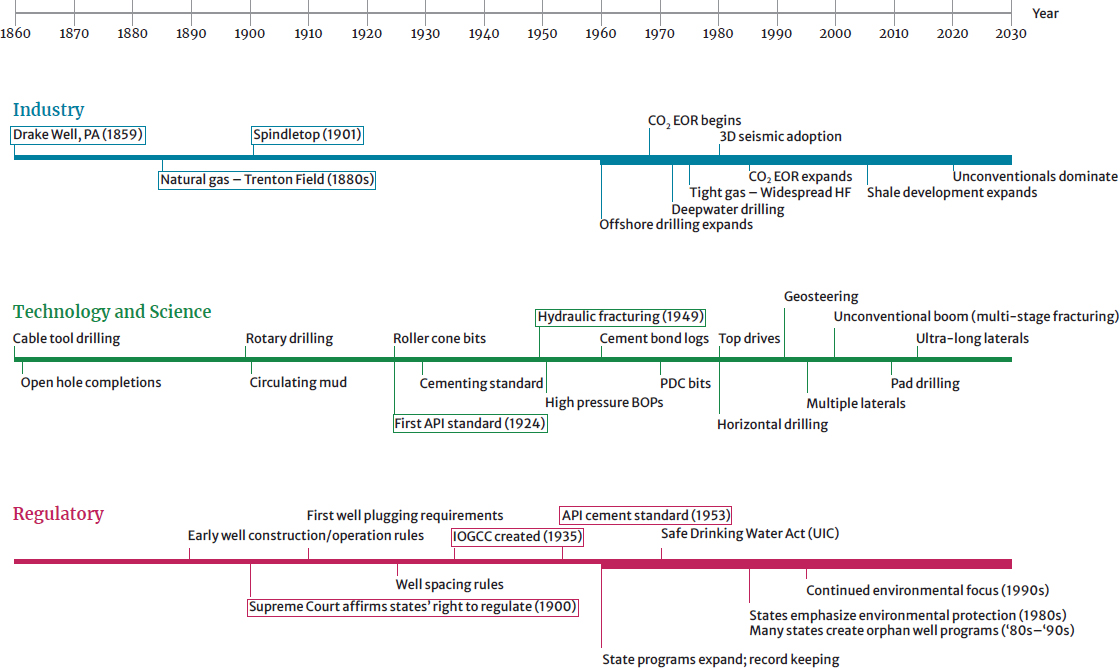
NOTE: API = American Petroleum Institute; BOP = blowout preventer; CO2 = carbon dioxide; EOR = Enhanced Oil Recovery; HF = hydraulic fracturing; IOGCC = Interstate Oil & Gas Compact Commission; PDC = Polycrystalline Diamond Compact; UIC = Underground Injection Control.
HISTORY OF WELL REGULATION
From its expansion in the 1860s until about 1890, the oil and gas industry developed with little government regulation. The industry grew quickly, and because of the rule of capture1 wells were drilled close together. That rule led to drilling many more wells than were necessary as landowners raced to extract oil and gas before it could be captured by their neighbors.
The scientific understanding of geology and petroleum production in the United States advanced at about the same time as the broader understanding of resource management and conservation (Clepper 1966). As in other areas of natural resource management, the first laws regulating the oil and gas industry date to the 1890s; they focused on protecting hydrocarbon resources from waste, since effective resource development was understood to be in the public interest (Chukwuemeka et al. 2023). For example, as the scientific understanding of reservoirs progressed, governments saw the need to institute well spacing to protect correlative rights and ensure the conservation of oil and natural gas resources (Harrison 1970).
The regulation of most onshore oil and natural gas development in the United States happens under the authority of state governments. State regulations continue to help inform industry standards, and compliance is ultimately determined by federal and state regulations (Godoy 2025). Early in the history of regulation efforts, state governments took the lead. Indiana enacted one of the earliest laws in 1893,2 which targeted the conservation of oil and natural gas resources. Following judicial appeal, the U.S. Supreme Court found in 1900 that state governments have the right to regulate resources within their borders (IOCC 1964). Some early state laws requiring the proper plugging and decommissioning of depleted or economically unproductive wells may not have prevented fluid migration between zones or to the surface (Aller 1984). And if a well was left unplugged, no record of ownership may have been established or documented.
As protecting water, land, and air rose in importance during the 20th century, provisions for well construction and the design of surface facilities were added to regulatory programs (IOGCC 2000). Requirements for plugging wells that were no longer productive addressed both resource conservation and environmental protection (NASEM 2025). From the late 1970s through the early 1990s, several states formally established orphan well plugging programs. For example, Ohio’s Department of Natural Resources established the state’s orphan well program in 1977 (George, 2025); New York established its “Oil and Gas Account (Account) in 1982 to address the issue of orphaned and abandoned wells” (NYDEC n.d.-a); Texas established its plugging program in 1984 (Railroad Commission of Texas 2026); and Pennsylvania established its Orphan Well Plugging Program in 1992 from an amendment to the Oil and Gas Act of 1984, which required operators to plug non-producing wells (Guise 2025). These
___________________
1 The rule of capture dates to English common law. It means a landowner who produces oil or gas from a well on one’s own property owns that oil or gas, even if it migrated through the subsurface from neighboring properties (Kramer and Anderson 2005).
2 Indiana. Laws of the State of Indiana, passed and published, at the 58th regular session of the General Assembly, 1893. Indianapolis: Indiana Legislative Council.
efforts have allowed the states to develop personnel with the requisite knowledge and skills for plugging operations that are tailored to the local environment (IOGCC 2000).
In the early 1980s and 1990s, organizations such as the Interstate Oil & Gas Compact Commission (IOGCC) began working with states to study and report on orphan wells, including efforts to document them and assess their numbers. Most oil and gas producing states have statutory entities and regulatory mechanisms for addressing orphan wells (IOGCC 2008), have allocated funding for this purpose, and have designed incentive programs for preventing wells from becoming idle (IOGCC 2000). Allocated funding for plugging orphan wells varies widely across states and is generated from a variety of sources, such as annual fees, permit fees, forfeited bonds, and excise taxes (IOGCC 2021). IOGCC (2021) estimated the number of documented orphan wells as of December 31, 2020, and showed that most orphan wells are located on private lands (Table 2-1). In most cases, orphan wells on private lands fall under the jurisdiction of states for plugging (NASEM 2025; Plants 2024).
Today, wells may become orphaned for reasons beyond the issue of a well’s economic viability in the production of oil or gas; such reasons include operator insolvency or regulatory noncompliance. Most states have implemented financial assurance requirements, such as well or compliance bonds, and established funds dedicated to plugging orphan wells (IOGCC 2000, 2008, 2019, 2021). Currently, state and Tribal agencies’ capacity to manage orphan wells is growing because of funding granted through the Infrastructure Investment and Jobs Act (IIJA). Before IIJA was enacted, federal involvement was mostly limited to regulating oil and natural gas activities on federal lands or offshore; in some jurisdictions, however, states share regulatory responsibility with the federal government. And on some Tribal lands, Tribal governments administer oil and gas regulatory programs directly. In many cases, federal land management agencies contract with states to plug orphan wells in their jurisdictions (Croft 2024). The Bureau of Land Management (BLM 2023), for example, has partnered with both states and small businesses, awarding contracts through the Indian Small Business Economic Enterprise to plug orphan wells using subaward mechanisms through IIJA funding.
TECHNICAL HISTORY OF WELL DEVELOPMENT
Many of the potential problems that orphan wells pose can be traced to the technologies and practices used at the time they were drilled (NASEM 2025). This section discusses the technical history of oil and gas development in the United States, including well types and drilling and completion methods, and then illustrates the impacts of those methods by examining differences in three major producing regions. Differences in the geologic makeup and industry development of those regions influence the number and types of orphan wells, their potential impacts on health and safety, and the challenges associated with plugging and abandoning them.
TABLE 2-1 Known Orphan Wells on State, Private, or Federal and Tribal Lands
| State or province | Total documented orphan wells | State land | Private land | Federal/Tribal land |
|---|---|---|---|---|
| Alabama | 26 | 0 | 26 | 0 |
| Alaska | 14 | 9 | 2 | 3 |
| Arizona | ||||
| Arkansas | 418 | 0 | 418 | 0 |
| California | 2,777 | 200 | 2,394 | 183 |
| Colorado | 276 | 23 | 217 | 36 |
| Idaho | 0 | 0 | 0 | 0 |
| Illinois | 4,355[1] | |||
| Indiana | 1,459 | 17 | 1,441 | 1 |
| Kansas | 5,632 | 0 | 5,632 | 0 |
| Kentucky | 14,367 | 6 | 11,722 | 2,639 |
| Louisiana | 4,260 | 253 | 4,007 | 0 |
| Maryland | 0 | |||
| Michigan | 154 | 5 | 147 | 2 |
| Mississippi | 11 | 0 | 10 | 1 |
| Missouri | 327 | 0 | 327 | 0 |
| Montana | 222 | 21 | 201 | 0 |
| Nebraska | 103 | 10 | 91 | 2 |
| Nevada | 6 | 0 | 0 | 6 |
| New Mexico | 3,375 | 890 | 859 | 1,626 |
| New York | 7,073 | 0 | 6,970 | 103 |
| North Dakota | 341 | 10 | 292 | 39 |
| Ohio | 972 | |||
| Oklahoma | 2,799 | 0 | 2,799 | 0 |
| Pennsylvania | 27,972[2] | 897 | 15,140 | 2,354 |
| South Dakota | 33 | 29 | 4 | 0 |
| Tennessee | 446 | 3 | 437 | 6 |
| Texas | 6,514 | [3] | [3] | ~50[4] |
| Utah | 41 | 6 | 35 | 0 |
| Virginia | 9 | 0 | 9 | 0 |
| West Virginia | 6,309 | 816 | 5,429 | 64 |
| Wyoming | 1,907 | 150 | 1,757 | Unknown |
| Totals – States | 92,198 | 3,345 | 60,366 | 7,115 |
| Alberta | 2,983 | |||
| British Columbia | 754 | 423 | 331 | 0 |
| State or province | Total documented orphan wells | State land | Private land | Federal/Tribal land |
|---|---|---|---|---|
| Northwest Territories | 0 | 0 | 0 | 0 |
| Saskatchewan | 1,277 | 65 | ||
| Yukon | 1 | |||
| Totals – Provinces | 5,015 | 423 | 331 | 65 |
[1] Land ownership is being determined as of the date of publication; preliminary information indicates all documented orphan wells are on private land.
[2] Geographic coordinates and land ownership are not yet determined for 9,581 of these wells.
[3] There are approximately 6,464 wells on state and private lands, of which 176 are in state waters. The number of these wells on other state lands is not currently available.
[4] These wells are located on federal lands. None are on tribal lands.
NOTE: In the 2021 report, IOGCC member states and five Canadian provinces reported the number of known orphan wells on state, private, or federal and Tribal lands.
SOURCE: IOGCC (2021).
Well Types and Drilling and Completion Methods
While hydrocarbons collected from naturally occurring seeps had been used for centuries, no substantial market for petroleum hydrocarbons existed until the widespread adoption of kerosene lamps in the mid-1800s (Yergin 1991). Edwin Drake’s successful drilling of a well in Titusville, Pennsylvania, in 1859 marked the transition from collecting surficial oil from seeps to deliberate exploration and production, altering the country’s energy landscape (Dancy 2018). In the industry’s earliest years, oil production was concentrated in the Appalachian Basin, encompassing western New York, Pennsylvania, Ohio, Kentucky, and West Virginia. By the end of the 19th century, the industry had expanded farther westward, with significant production in California—particularly in the Central Valley and around Los Angeles—and the Midcontinent region, including Oklahoma, Arkansas, Kansas, and Texas.
During the early years of oil and gas exploration and production, wells were rarely plugged, although the equipment may have been salvaged. When they were plugged, tree stumps, logs, mud (clay and water), or other readily available materials were used. Typical wells drilled before the 1930s were drilled with cable tool rigs; most were shallow, were drilled without casing or with driven casing (where the casing is installed or put in place as the drilling happens), were uncemented, had irregular boreholes, and had unknown debris in the wellbore (Heagle and Sealey 2023; King and King 2013). Additionally, they often lacked a cement plug (IOGCC 2008).
Significant discoveries in the early 1900s further shaped the industry (Dancy 2018). Oil discovered at the Spindletop Field in Texas in 1901 and East Texas Field in 1930 had profound impacts on state, national, and global oil markets (Cleveland 2024). Spindletop proved the efficacy of rotary rigs, which were developed by the Baker brothers in the early 1880s (NPS n.d.). First used for drilling water wells, rotary rigs were applied to oil wells in the Corsicana Field, Texas, in 1895. The Spindletop well, with subsurface
depths of 1,139 feet, utilized a steam-driven rotary rig, demonstrating its superior speed and efficiency compared with cable tool methods (Dancy 2018; DeGolyer 1945). By the 1930s, rotary rigs had largely supplanted cable tool rigs for most drilling applications, although the latter continued to be used for shallow wells and in some unconsolidated formations (King n.d.). As drilling technology and materials improved, wells were drilled deeper, and operators began developing plugging procedures to adapt to the changing well types, with their different challenges and requirements.
Technology advancements in the early 2000s led to the widespread adoption of horizontal drilling and hydraulic fracturing, marking a paradigm shift in the industry. This unlocked vast unconventional resources, leading to record production. By the 2010s, the United States became the world’s largest oil producer and a net exporter (Cleveland 2024). Adoption of these technologies expanded production in established areas, such as the Permian Basin, and uncovered new regions, such as the Bakken in North Dakota, Niobrara in Colorado, Niobrara and Powder River in Wyoming, Haynesville in Texas and Louisiana, and Marcellus in Pennsylvania and West Virginia (Cleveland 2024). Horizontal drilling and hydraulic fracturing continue to be applied to other developing basins around the United States.
Regional Differences in Well Types and Completion Methods
Oil and gas basins—large areas that can cover multiple states—differ in ways that influence the characteristics of and challenges associated with each basin’s orphan wells. In each basin, specific geologic conditions, historical drilling and completion practices, and evolving regulatory requirements have created unique legacies that impact orphan wells today. However, basins developed in more recent decades generally have fewer orphan wells and few, if any, undocumented wells.
Appalachian Basin
The Appalachian Basin experienced a rapid and widespread expansion of drilling activity during the second half of the 19th century, under the rule of capture and before regulations governing well construction, operation, and abandonment were enacted. Early wells were drilled with technology such as cable tool rigs and driven casing (MSI n.d.). Location information and well records were also limited in this pre-regulatory period, resulting in higher numbers of undocumented wells than in areas of the country where oil and gas extraction developed later.
In addition, the Appalachian Basin contains a high number of unplugged or inadequately plugged orphan wells. Drilling and completion technologies of the era, including rudimentary plugging materials such as wood and sediment, limited the integrity of the wells. The absence of robust casing and cementing practices and, later, practices of removing steel casing for scrap during events such as World Wars I and II, further complicated well integrity over time (PADEP 2018). Consequently, wells plugged and abandoned at that time have a higher propensity to fail in this part of the country, creating potential pathways for migration of methane, oil, produced water, and other contaminants into groundwater, the surface, and the atmosphere (PADEP 2018).
The history of oil and gas development in the Appalachian Basin led to the current challenge: it is home to a disproportionately large number of legacy wells that are undocumented, orphan, or poorly documented (Boettner 2021). These wells are difficult to locate and assess for plugging, abandonment, and remediation efforts (CERSC 2024). In addition, many are co-located with coal-producing areas, adding complexity and risk to plugging or re-plugging.
Midcontinent Region
The Midcontinent region includes a number of sedimentary basins, most importantly across the states of Oklahoma, Arkansas, Kansas, and parts of Texas. The region emerged as a significant hydrocarbon production area in the late 19th and early 20th centuries (Cleveland 2024). Natural gas was often produced in association with oil, but with no market, it was either vented or flared. Although early wells employed cable tool drilling methods, the region was important for the adoption and popularization of rotary drilling technology, which enabled deeper wells and faster drilling rates (Walters 1991). It brought improved well control (partly due to the use of drilling mud to manage downhole pressure), but the legacy of early, uncontrolled wells and well density driven by the rule of capture contributed to the current orphan well problem.
Well completion3 practices in the Midcontinent region evolved from leveraging natural reservoir pressure to more sophisticated techniques to prolong well productivity. Wells commonly flow under their own reservoir pressure in earlier stages of production, but as pressure declines, artificial methods are needed (Goswami and Chouhan 2015). The introduction of such methods, such as swabbing and gas lift, increased and extended production (Bond et al. 1930). Well stimulation, particularly with nitroglycerin, was a common technique used to increase hydrocarbon flow from tight formations (Beckwith 2013). Within a similar timeframe, material advancements helped to improve well integrity and production control. In 1921, Erle Halliburton adopted cementing materials, which more effectively isolated downhole production zones and added structural support to well casings (AOGHS 2013).
Permian Basin
The Permian Basin, spanning western Texas and southeastern New Mexico, represents one of the most prolific U.S. hydrocarbon-producing regions (Cleveland 2024). Its history dates to the 1920s, with early production primarily targeting shallower conventional zones. These initial vertical wells typically reached depths of a few thousand feet (Enverus n.d.-a). Early completion methods were very similar to those used in other basins at the time, including using nitroglycerin to stimulate production, as demonstrated in the Spraberry Trend in 1949 (Beckwith 2013).
The transformation of completion techniques in the Permian Basin is tied to the evolution of hydraulic fracturing. First commercially introduced in the 1950s, hydraulic
___________________
3 Well completion is the process of bringing an oil or natural gas well into production (EPA 2012).
fracturing underwent a revolution in the early 2000s when it was paired with the advancement of horizontal drilling, becoming a significant factor in achieving economic success with the Permian’s low-permeability unconventional reservoirs (Ahmed and Meehan 2016; Biglarbigi et al. 2000; Cleveland 2024). Modern completion practices in the Permian involve multi-stage fracturing, commonly utilizing plug and perforation or sliding sleeve methods. These techniques involve pumping high-pressure fluid into the wellbore to create and prop open fracture networks within the tight rock formations (Enverus n.d.-b).
The history of oil and gas development in the Permian Basin demonstrates the impact of unconventional plays4 on the industry. The shift in drilling practices and well types—from predominantly shallower, vertical wells to deeper, horizontal wells coupled with hydraulic fracturing—unlocked immense hydrocarbon resources but introduced new and complex challenges for well integrity and management. The large volumes of produced water were often highly saline brines that were commonly disposed of by injection into deep wells, which can increase pore pressure within geological formations and induce seismicity (Karanam et al. 2024; NRC 2013). These factors can compromise the integrity of wells if they are not drilled, completed, and plugged in a manner intended to account for this modern activity. This can be especially true for older wells that were drilled, completed, and plugged prior to the modern regulatory era and therefore prone to creating migratory pathways for contaminants (Karanam et al. 2024). Such failures can release hydrocarbons and produced water into groundwater and surface environments (Vermylen and Zoback 2011). These challenges in the Permian Basin illustrate how modern operations can create new issues for historical wells.
Considerations for Future Well Plugging and Remediations
This chapter describes issues related to orphan wells in the United States that date from the earliest days of the industry to the present. An extensive discussion of who is responsible for well orphaning and how efforts can be made to prevent today’s wells from becoming tomorrow’s orphans is outside the scope of this study. However, a forward-looking approach does require some consideration of wells in use now that one day may become orphaned. These wells include a very large population of marginally productive vertical conventional wells and horizontal and directional wells that target unconventional resources. Box 2-1 outlines the questions and considerations around wells that may become orphaned in the future.
___________________
4 See Appendix B for a complete glossary.
BOX 2-1
Tomorrow’s Orphan Wells
Nationwide, as many as 800,000 active and inactive wells are considered marginal. Marginal wells have registered operators and produce fewer than 15 barrels of oil equivalent per day (EPA 2025). Regulatory agencies have different financial assurance, idle well management and well transfer requirements, and orphan well closure funds designed to prevent these wells from becoming orphan and/or to decommission them with industry funding. However, a robust public debate exists about whether current laws and regulations remain appropriate (Louisiana Legislative Auditor 2024; New Mexico Legislative Finance Committee 2025; Utah Office of the Legislative Officer General 2019). Many states have recently updated or are updating these policies to reduce future orphan well burden; these efforts are supported by incentive funding in the Infrastructure Investment and Jobs Act (42 USC § 40601[c][5]). On federal lands, these requirements are in flux (Stevenson 2025).
In addition to this broad question of the future orphan well burden, most new onshore wells are directional and have long laterals, which adds to the complexity of plugging operations (EIA 2022). The advancement of horizontal drilling and hydraulic fracturing impacted basins and created new plays across the country.a The Bakken in North Dakota; Marcellus in Pennsylvania; Niobrara in parts of Colorado, Wyoming, and Nebraska; Powder River in Wyoming; Haynesville in parts of Texas and Louisiana; and more recently developed areas, such as the Utica in Ohio and Uintah in Utah, are experiencing resurgent activity due to the extraction of unconventional resources (EIA 2025). More than 15,000 new wells were brought online in 2024, of which 11,700 were horizontal (EIA 2025). Close to 13,000 new wells were brought online in 2025, of which nearly 10,900 were horizontal (EIA 2026).
There are still many unknowns about the risks associated with horizontally drilled wells, and each reservoir can be unique, as differences in shale fabric, in situ stresses, and other geologic characteristics can all complicate drilling and completion effectiveness (Lei et al. 2022). Horizontal and directional wells share some of the same risks as older conventional wells, including environmental risks stemming from the emission of methane and other hydrocarbons at the surface due to the loss of wellbore integrity or because of plug failures. However, the committee noted that increased length and lateral curvature of horizontal wells, in addition to the fact that many penetrate overpressured reservoirs, are factors that may pose new challenges if they become orphaned. In addition, larger water volumes are used during hydraulic fracturing operations, and wells are fractured in multiple stages, further influencing well integrity (Jackson 2014).
In unconventional fields, horizontal plugging procedures will need barriers designed to isolate producing intervals based on any expected pressures due to new fracturing (or re-fracturing; Kiran et al. 2017). In addition, because of very low permeability and recovery factors, the producing reservoir may repressurize over time (Wu et al. 2019); barrier designs need to account for these factors.
__________________
a See the Glossary in Appendix B for definitions of play and other industry-specific terms.
HEALTH, SAFETY, AND ENVIRONMENTAL ISSUES LINKED TO ORPHAN WELLS
Orphan wells may be unplugged, be inadequately plugged, or have failed barriers.5 Under certain conditions, orphan wells can pose public health, safety, and environmental threats because they become a potential migratory pathway for hazardous fluids or gases (Kang et al. 2014; Woda et al. 2025). Leaks may be caused by the lack of a barrier or failure of existing barriers, which can break down because of a combination of chemical, geological, or mechanical stresses over time (Yousuf et al. 2021). Chapter 3 includes further discussion on well plugging methods and causes of well plug failures.
Leaking orphan wells can expose nearby inhabitants to air and water pollution, degrade local ecosystems, and impact the ability to use the surface land or to access subsurface resources. Orphan wells can also increase the risk of explosion which, though rare, can occur when gases migrate into an enclosed or unventilated structure, such as a basement. Recent incidents include an explosion in Wheatley, Ontario, in 2021 that injured 20 people and led to the demolition of multiple buildings; the explosion was traced to methane and hydrogen sulfide leaking from nearby wells (CBC News 2024; El Hachem et al. 2025).
Methane and Other Air Pollutants
Methane and other gaseous emissions from orphan wells contribute to air pollution and can accumulate in buildings, exposing occupants to volatile organic compounds (VOCs) and other contaminants, including hydrogen sulfide (Kang et al. 2023). By some estimates, documented orphan wells account for 3–6 percent of total methane emissions from U.S. abandoned wells (Boutot et al. 2022; Kang et al. 2023). Research has shown that methane emissions scale with the number of wells in an area (Kang et al. 2023; OWPO 2024). However, methane emissions also show significant variability based on whether a well is plugged as well as regional differences in geology and other factors (Riddick et al. 2020). For example, researchers did not detect any methane emissions from 128 plugged wells in Colorado (Riddick et al. 2024). Based on the body of literature, methane emissions in one region are not necessarily comparable with those in other regions or in the well population as a whole.
Gaseous emissions from orphan wells can also include other contaminants that are known to impact health. For example, benzene has been detected at levels above Environmental Protection Agency limits at approximately 70 percent of abandoned (unplugged) wells in Pennsylvania (DiGiulio et al. 2023; see also Chapter 4).
Groundwater Contamination
Groundwater impacts have been associated with all types of oil and gas wells, including unconventional and conventional, and unplugged and plugged (Shaheen et al.
___________________
5 For more information on well characteristics and plugging and abandonment practices, see Chapter 3. For definitions of barrier and plug, see the Glossary in Appendix B.
2025; Woda et al. 2025). Contamination can occur in the subsurface, as fluids migrate from the borehole to freshwater formations or aquifers, and in shallow groundwater near the surface (Woda et al. 2025). Examinations of records of groundwater contamination related to oil and gas development in Texas and Ohio found that around 18 percent of the cases were related to orphan wells (Kell 2011).
Unlike surface contamination, subsurface contamination from orphan wells cannot be easily detected, and when the well construction, depth, location, and integrity are unknown, it is especially challenging to connect groundwater impacts to a specific well (Woda et al. 2025). Determining that a well is acting as a migratory pathway can be difficult and expensive, since migration may be occurring but not expressed at the surface. In many cases, flow between formations may not be detected until a well is plugged, and even then it may remain unknown unless the plugging procedure requires well integrity testing and evaluation of potential flow (Woda et al. 2025).
Surface Water and Soil Contamination
Orphan wells generally lack surface equipment intended to contain pressure and fluids, and the potential for surface leakage increases with naturally high reservoir pressure and any activity that leads to repressurization, such as wastewater injection or plugging nearby wells (Karanam et al. 2024). Well conditions at the surface, such as open valves or corroded piping, can also lead to fluids contaminating surrounding soils or nearby surface water (Woda et al. 2025).
Hydrocarbon production and operations equipment can impact surface water and soil near orphan wells (EIA 2024). Oil and produced water are commonly stored in tanks and pits on the well site. Flowlines connecting the well to production equipment (e.g., separators, treaters, and tanks to carry oil, gas, and produced water) are either located on the surface or buried in shallow trenches. Leaks or spills from storage containers, flowlines, or trucks can release oil or produced water directly into the soil and/or surface waters. Both can alter soil, damaging vegetation and negatively impacting land productivity (Konkel 2016). In some cases, naturally occurring radioactive material and trace metals are produced with the oil or produced water (IOGCC 2022; USGS 2023).
Effects of Contamination on Landowners
The presence of an orphan well, including any associated contamination, can limit land uses. Therefore, landowners need to be aware of the potential for unknown or undocumented wells. In addition, landowners have to work around identified wells when using their property for buildings, lawns, livestock, or agriculture. In some instances, the presence of orphan wells has been found to reduce building activity and property values (Harleman et al. 2022).
Equipment that was originally used in well drilling, completion, or production may remain on the property. The committee noted that wells with production equipment (e.g., tanks, treaters, separators and pumping units, and flowlines) could occupy up to several acres (typically less than 1 acre but can be more where large central facilities serving
many wells were constructed). The lack of maintenance, in some cases for many years, may leave this equipment in disrepair and partially full of produced fluids. Oil, produced water, methane, hydrogen sulfide, or other VOCs may leak from corroded tanks, flowlines, and other equipment. This equipment is often a nuisance to the landowner and could be a significant health and safety threat (Kang et al. 2023).
When orphan wells have been recently identified, states will attempt to sell equipment and material for use or scrap to help offset plugging and remediation costs (e.g., Kansas Corporation Commission n.d.). Downhole equipment, including tubing and artificial lift equipment, is of little reuse value because of concerns over potential corrosion and weakening of materials. For sites over 50 years old, the surface equipment may be considered protected historical artifacts, requiring special legal procedures for removal.6
Effects of Contamination on Other Subsurface Uses
Orphan wells can also reduce the economic productivity of the geology, including reducing the safety and efficacy of hydraulic fracturing in shales (Wells and Hester 2018) and subsurface geologic integrity that could otherwise be used for applications such as carbon sequestration. The oil and gas industry uses subsurface geologic formations to dispose of produced water and inject produced water, carbon dioxide, or other fluids to recover any oil and gas remaining in the formations. Emerging technologies—such as carbon capture and storage, geothermal energy, and other energy storage techniques—require injection of carbon dioxide, air, hydrogen, or other fluids into the subsurface to sequester carbon dioxide, store energy, and extract or exchange heat in fluids. These materials have to remain in the injection zone, either permanently or until they are removed intentionally. However, the success of any such future project can be compromised by the presence of unplugged, inadequately plugged, or undocumented wells (Kang et al. 2023).
Migratory pathways created by orphan wells may allow existing formation fluids or injected materials to flow into other formations or to the surface. Before injecting fluids into the subsurface (e.g., produced water disposal wells), federal regulations require that nearby existing wells be evaluated to determine if they could act as a migratory pathway.7 Orphan wells that lack documentation can complicate that evaluation. If any wells are found to potentially act as a pathway, plugging or re-plugging may be required before commencing any new injections.8 It is also possible, however, that the evaluation process for an injection project would fail to uncover any wells until after the project began.
___________________
6 54 USC §§ 300101-307108.
7 40 CFR § 146.6.
8 40 CFR § 146.64.
PLUGGING ORPHAN WELLS
The main goals of plugging oil and gas wells for protection of public and environmental health and safety include physically protecting water sources, isolating hydrocarbon-bearing or water injection intervals, preventing fluid and gaseous leakages to the surface, and preventing unintended cross flow of hydrocarbons into non-hydrocarbon-bearing zones (API 2021). Plugging wells also facilitates other subsurface uses and future resource extraction. Benefits of plugging and properly reclaiming sites have been estimated in the billions of dollars (Chomphosy et al. 2021).
As discussed earlier in the chapter, the history and regional variations of the oil and gas industry are important to anticipating the issues created by these factors and evaluating the best procedures. Geological factors, such as the depth of freshwater zones and production, salt zones, sour gas zones, flowing or creeping shales, or seismicity, create potential well integrity and safety issues. Surface issues including land use, nearby drilling activity, proximity to population centers, precipitation and weather, surface water bodies, and concerns related to wildlife or livestock can also affect the plugging plans and prioritization. Additionally, plans to plug a well must take into consideration cost, regulations, and institutional challenges.
Cost Factors
While funding and financial incentives are not a key subject of the report, the costs of well plugging play a significant role. In the United States, the median cost to plug a well is estimated to be $20,000–$76,000, with some complex, deeper wells costing over $1,000,000 (e.g., California; Raimi et al. 2021; Simmers et al. 2024). In their 2021 applications for U.S. Department of the Interior grants, states listed the average cost of plugging just one well as $167,000 in New Mexico, $157,000 in West Virginia, and $182,000 in California (California Department of Conservation 2021; New Mexico EMNRD 2021; West Virginia Department of Environmental Protection 2021). Long-term monitoring, which is sometimes required, can be costly and difficult to estimate in advance. Well plugging and abandonment does not generate revenue, so parties involved in the funding and work seek to keep costs low and to balance those costs against the range of solutions available to address the many unknown factors that orphan wells present (McKay 2024). Based on committee knowledge, service companies, which are faced with trade-offs throughout the process, may have to decide in the moment to use materials or execute processes that do not appear in the initial well plugging plan. Because of the risk and uncertainty in orphan well plugging, most government agencies include multiple wells in a project to help spread the risk of subsurface uncertainty and construction costs.
Service companies that perform plugging and remediation for orphan wells are required to post performance bonds; in some states, these can be several times the cost of the project itself (Igleheart 2022) and can be prohibitively expensive for small businesses (Niemeyer 2022). Texas passed legislation, effective in September 2025, that allows operators or surface owners to contract with companies to plug or re-plug orphan
wells without assuming the legal plugging liability (Texas Legislature 2025). This law was designed to facilitate the use of private financing to accelerate plugging.
Factors affecting cost include aspects of the well itself, such as depth, age, surrounding geologic complexity, site topography, extent of surface restoration, and whether it produced oil or gas. Fixed-price contracting for well plugging, where a contractor is engaged to plug a set number of wells for a set cost, influences who bids for jobs; those who do bid for such projects have to plan their budgets without fully knowing what is happening in the subsurface. While most government well contracts contain provisions to address unforeseen and unknown downhole circumstances, these uncertainties can dramatically impact pluggers’ ability to complete a project within a planned budget and timeline (Simmers et al. 2024). State regulations and labor costs can vary widely and add uncertainty (Raimi and Cilento 2026; Raimi et al. 2021).
Other factors intersect with cost to make plugging and abandonment operations even more challenging. These include the sheer number of orphan wells that need to be plugged, personnel training gaps, and declining numbers of workers with the expertise to do this type of work (see Chapter 6 for discussion of personnel and workforce factors). In addition, government-funded orphan well plugging uses the same pool of contractors who work for oil and gas companies on a variety of well maintenance tasks. The committee members discussed at length, based on their experience and knowledge, the challenges around research and development: such investments require a financial return and there is limited incentive for companies to develop technologies designed specifically for plugging orphan wells.
New technologies used for well plugging are often developed for a different use in hydrocarbon production, generally by the largest service companies supporting the oil and natural gas industry. This business model requires that companies developing new technology hold the intellectual property for commercialization.
Orphan Well Records
A significant challenge to plugging orphan wells is a lack of well records. The historical lack of reporting along with operator insolvency can mean records do not exist or were submitted irregularly. Data needed to plug orphan wells cost-effectively and safely include location, depth, design, and current conditions; data availability for each of these categories is mixed. For example, Boutot et al. (2022) found dates of last production and depth to be available for only 16 and 49 percent of subject orphan wells, respectively.
Where no records exist for an orphan well, potential sources of information on its likely condition include inferences drawn from the state of nearby wells or anecdotal knowledge from industry professionals. Under some circumstances, the best source is nearby wells that do have records. These wells are likely to have targeted the same production intervals, been drilled within similar timeframes, used similar construction techniques, and faced similar integrity concerns. Anecdotal knowledge from service companies, drilling companies, or long-time local oil and gas industry professionals may also provide details that can help establish expectations for plugging. Efforts to
digitize and make old paper records machine readable can help; such initiatives are underway at the National Energy Technology Laboratory (NETL 2024); state, federal, and Tribal agencies; and local colleges and universities (Ciulla et al. 2024; O’Malley et al. 2024; RBDMS n.d.).
In a public information-gathering session with the committee on July 22, 2025, state representatives and plugging and abandonment contractors explained that for orphan wells, any information that can be determined in advance is beneficial for creating a plugging plan. For example, the ability to reliably estimate potential well depth allows contractors to determine the size of rig needed for safe plugging. Unexpected issues are common, including well integrity problems, unknown equipment, “junk” in the hole, and perforation depths that differ from recorded depths. In some cases, the well may need to be re-entered to determine its configuration and condition. Therefore, flexibility is a necessary aspect of regulations and procedures. Knowledgeable contractors and regulatory staff often need to work together to evaluate new conditions and issues and produce an effective solution.
Identifying Orphan Well Locations
Although states9 now require a monument placed at or a certain distance below the surface to indicate a well’s location, older orphan wells are typically unmarked. In many cases, infrastructure or equipment may remain at the surface, indicating a well’s presence, but those without any surface expression can be difficult to detect. This can happen because the wellhead or surface casing has been removed or, in a mining region, the surface has been stripped. Many wells are buried, masked by vegetation, hidden under buildings, or underwater (Saneiyan and Mansourian 2023). Records are often missing or unverified, making it difficult to differentiate between abandoned and active wells without direct, on-site, or high-accuracy remote investigation.
For wells that still have metal casing, metal detectors work only if the casing is a few inches below the surface, but magnetometers (ground based or aerial) can detect wells dozens or even hundreds of feet below the surface (Nikulin and de Smet 2019). Drone-mounted magnetometers can sometimes detect wells in built-up areas, including over building footprints where ground access is limited (Veloski 2016). Leaking orphan wells without surface casing can sometimes be detected by dead vegetation, especially if they are leaking saltwater. However, it is difficult to use methane detection because only a subset of orphan wells emits methane, and soil over a buried well can obscure emission signatures through oxidation, diffusion, and preferential flow (El Hachem et al. 2025).
Reeder et al. (2023) describe a workflow for well identification that begins with compiling digital data from a range of sources, including production databases, historical maps and photographs, and lidar data. The combination of these data helps identify well sites with higher confidence.
___________________
9 For example, Wyoming: 055-3 Wyo. Code R. §§ 3-19 Well Designations and Markers.
Risk Management and Prioritization
Policymakers and regulators have set criteria and created models for evaluating the risk associated with orphan wells, which can be used to prioritize their plugging. According to IOGCC (2023), 29 states use some form of prioritization. In Wyoming, for example, regulation requires the state oil and gas supervisor to establish and maintain a schedule that prioritizes wells for plugging by assessing their potential to adversely impact public health and safety, surface water or groundwater, surface use, or other mineral resources.10 Pennsylvania uses risk factors such as stray gas migration into homes and private water wells, fugitive methane emissions or hydrogen sulfide releases into the atmosphere, liquid releases into surface water and groundwater resources, casing deterioration through interaction with acidic mine-influenced water, and well communication events during new well completions (NASEM 2025). Other risks commonly considered include proximity to schools, hospitals, homes, other public structures, water supplies, and waterways; well depth, age, and condition; and the likelihood and estimated severity of negative effects on other land uses (IOGCC 2023; Simmers et al. 2024). Once risk assessment has been completed, regulatory bodies will schedule the well for plugging. They consider accessibility issues, such as infrastructure development nearby requiring road and well pad construction; issues in cold climates, such as frost requirements; and other required permits and authorizations if the well is located in wetlands or waterways (NASEM 2025).
The costs of moving a plugging rig and support equipment into an area can be a significant fraction of the total cost of a simple well abandonment. Expanding a plugging project beyond high-priority wells to include lower-priority wells of similar type, geography, and requirements can create efficiency in operations and costs (Raimi et al. 2021). Plugging lower-priority wells nearby also provides emissions benefits and can contain emissions at a broader scale (Gianoutsos et al. 2024).
Site Access for Plugging and Monitoring
State oil and gas agencies generally have the right to enter private property to plug orphan wells (NASEM 2025; Plants 2024). They usually attempt to provide advance notice and accommodate property owner requests as to timing or the placement of access roads. Once a well has been plugged and abandoned, the agencies may generally regain access only with reason to believe it has a problem; monitoring on private property usually requires owner consent (for more on monitoring, see Chapter 4).
Although non-operator landowners are generally not liable for orphan wells on their property, this varies by state. For example, Pennsylvania’s law has some ambiguity,11 and the Pennsylvania Department of Environmental Protection often conducts an investigation to determine potential liability when new orphan wells are reported (Commonwealth of Pennsylvania n.d.).
___________________
10 055-3 Wyo. Code R. §§ 3-16 (f) Temporarily Abandoned or Shut-In Wells.
11 58 Pa.C.S. §§3220.
CONCLUSION
Conclusion 2-1: States have had orphan well plugging programs for decades; these programs have developed core groups of professionals with the expertise and local knowledge to plug orphan wells in their jurisdictions.


