Transforming Transportation: Leveraging the Power of Artificial Intelligence, Digitalization, and Automation (2026)
Chapter: Introduction

Introduction
Artificial intelligence (AI), digitalization, and advanced automation—including autonomous systems—are reshaping public-sector transportation agencies and their core mission to provide safe, reliable, and efficient mobility. As these technologies rapidly evolve, they will offer new ways to deliver this mission and change public expectations for transportation systems.1 They will also reshape how public agencies work with the private sector, which is investing heavily in these technologies to accelerate their development and expand their capabilities. Although the pace of change and impact on specific transportation functions are uncertain, leveraging all three technologies and their synergies will be a major endeavor for transportation professionals and decision makers in the decades ahead.
This publication, which is a product of the Transportation Research Board (TRB) of the National Academies of Sciences, Engineering, and Medicine, examines how AI, digitalization, and advanced automation—including autonomous systems—are opening exciting new possibilities for transportation. Written by a subgroup of the TRB Executive Committee and endorsed by the committee as a whole, it aims to inspire and encourage TRB’s participants and sponsors, as well as the broader community of transportation practitioners and researchers, to take an active role in exploring and advancing these possibilities to improve and potentially transform transportation.
AI, digitalization, and advanced automation are separate but closely connected technological fields. In the case of digitalization—which entails the use of data and digital tools and infrastructure to manage and monitor transportation systems and their construction, operation, and maintenance—its use and range of transportation applications have been expanding for years. However, when coupled with AI, its power, utility, and potential benefits are growing
rapidly. AI is also accelerating the progress of advanced automation and autonomy, which are now developing rapidly across all transportation modes. While these technologies are moving into commercial and consumer markets across the broader economy, there is uncertainty about how quickly they will be deployed and scaled in transportation systems to bring about increasingly safer, reliable, and efficient mobility for people and goods.
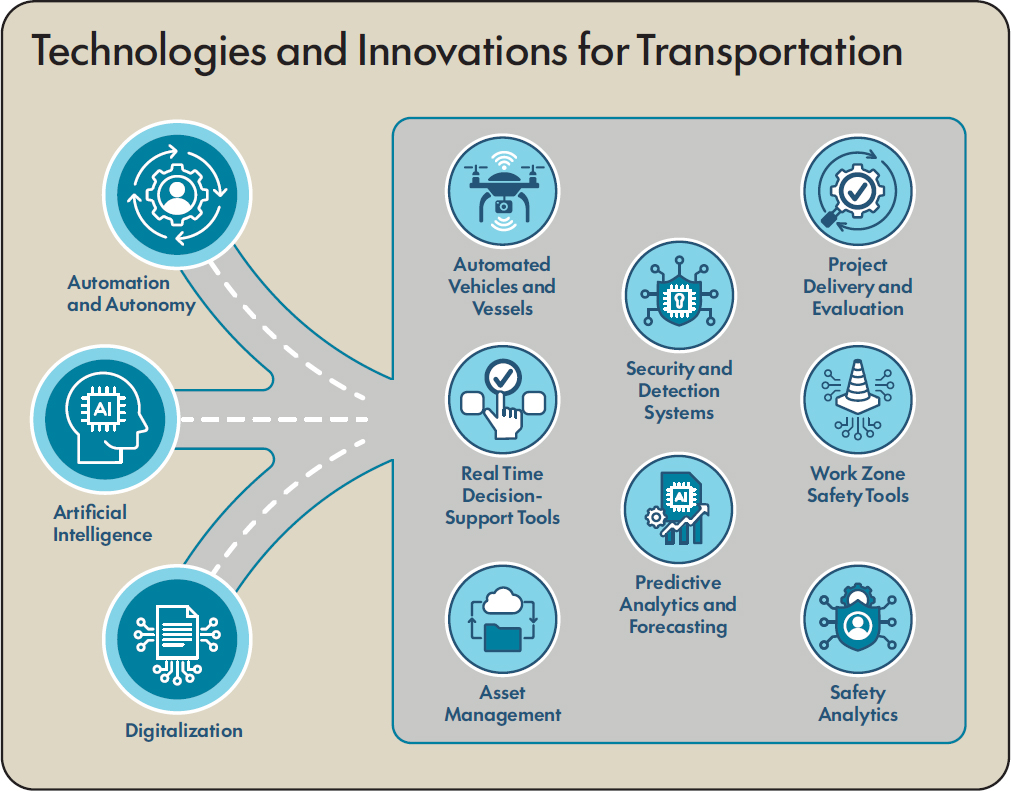
Together, AI, digitalization, and advanced automation offer extraordinary opportunities to strengthen, reshape, and even transform the transportation enterprise, but in ways that will differ across modes and functions. Some opportunities may emerge quickly, such as from pivotal breakthroughs in robotics or autonomous systems, while others may play out gradually, such as by enabling cumulative improvements to the planning, design, construction, maintenance, and operation of transportation networks. Factors like data quality and implementation costs will influence which technologies and applications are most practical to pursue in the near term. And the capabilities provided by technologies that can be deployed early may not always match the most urgent needs. But as they advance and become increasingly integrated, these three allied technologies promise to yield innovations that will serve a growing array of transportation interests. Figure 1, for instance, illustrates how these technologies can work individually and synergistically to address many of the key interests of owners and operators of transportation systems.
Ultimately, success in tapping this enormous potential will be judged by the beneficial impacts on the economy and daily lives of people. Transportation agencies will want to use them to make it safer, easier, and less costly for people to access the places they want to go and for businesses to move their goods and services faster and more efficiently. In short, success will be measured in saved lives, serious injuries avoided, and desired trips made as expeditiously as possible.
The discussion that follows is intended to inspire transportation practitioners to envision the possible uses of AI, digitalization, and advanced automation and to encourage the research community to help realize them. Examples of capabilities, innovations, and candidate applications are therefore given for illustration and illumination. They are drawn from case studies, published reports, and ongoing research exploring multiple possibilities to improve transportation performance to benefit the public.2 They illustrate, for instance, how these technologies can improve traveler and work-zone safety, enhance traffic management, optimize infrastructure maintenance, and expedite project delivery. Some forward-looking examples describe possibilities that await development.
The examples are not meant to be exhaustive, nor are they accompanied by a complete treatment of the potential benefits, costs, challenges, and opportunities. Indeed, there is uncertainty about how a wide range of issues associated with the development and deployment of innovations leveraging AI, digitization, and advanced automation may play out, including the emergence of new and unforeseen challenges. Such uncertainties present fertile ground for research on interests ranging from making sure that automated driving capabilities align with safe systems to ensuring that the surveillance capabilities of digital infrastructure do not neglect privacy concerns. While this publication was not developed to identify, much less discuss, all these uncertainties and interests, it was born
from a recognition that research will be crucial to addressing them.
The publication starts with AI, describing its current capabilities and potential uses for improving transportation. The AI discussion ends with a brief look at emerging agentic AI and the role of AI in safety-critical systems. It then covers digitalization, focusing on digital infrastructure, infrastructure modeling, “building information modeling (BIM),” and digital delivery for construction. This is followed by reviews of recent progress in advanced automation and autonomy across road, air, rail, and marine transportation. For reasons given in Box 1, the discussion is structured to present the technologies one at a time but with recognition that the greatest benefits may derive from their combined powers.
The publication concludes with observations of what may be needed to accelerate the advancement and implementation of these technologies in transportation, including supportive public-sector actions. However, this publication is just a beginning. Discussions and collaborations—within and across transportation modes and
BOX 1
The Combined Power of Artificial Intelligence, Digitalization, and Advanced Automation
This publication, because its purpose is to highlight these three technological areas, presents each technology independently and selects example use cases that best illustrate the technological category. However, many of the discussed applications are examples of the combined power of these technologies working synergistically, as illustrated in Figure 1. For example, autonomous vehicles depend on artificial intelligence (AI) to collect and analyze data and perform perception of surroundings, digitization to provide detailed maps, and automation to control vehicles. Digital twins of infrastructure allow the use of AI and advanced automation to inform design, maintenance, and operation decisions. Moreover, as discussed further in the concluding section, AI and advanced automation applications depend on accurate and reliable digitalization, sometimes at a massive scale. To the extent that the lack of digital data is a roadblock to future applications, AI and advanced automation may also be the solution to creating the necessary scale of free-flowing data.
Future groundbreaking innovations in transportation are also likely to come out of the combined power of AI, digitalization, and advanced automation.
subspecialties—that continue to bring together agency leaders, experts in the technologies, and transportation researchers and practitioners will be necessary. Transforming transportation through research and investments in these technologies will require a multitude of people working on numerous projects and programs, ranging from the highly experimental to implementing proven innovations in the field.


