Transforming Transportation: Leveraging the Power of Artificial Intelligence, Digitalization, and Automation (2026)
Chapter: The Power and Promise of AI

The Power and Promise of AI
This publication uses AI as an umbrella term for a group of technologies that aims to perform tasks that typically require human-like intelligence, such as for learning, reasoning, problem-solving, perception, and understanding language. To highlight the AI possibilities for transportation, this publication examines AI in terms of its capabilities or use cases. Although generative AI, used in large language models, is currently receiving considerable discussion in media and policy circles, many of the capabilities highlighted in this publication can be produced using purpose-built AI models that use established machine learning techniques.3 Figure 2 explains the different types of AI and how they relate to each other. The current usability of the depicted types, however, will differ, as some are now in use or will be ready for implementation in the near term, whereas others are the subject of research that could result in longer-term opportunities.
Harnessing the power of AI for transportation requires matching current or near-future AI functional capabilities with transportation-related tasks or objectives. This could mean exploiting AI’s computer vision and image processing capacities to increase traffic safety or deploying AI’s pattern recognition of time series data to make predictions that improve travel forecasting. It could also mean tapping opportunities to use generative AI, such as for personalization to users’ experience and behavior or the generation of synthetic data to create more robust models of hazard scenarios. Decision-makers will also have to weigh the safety,
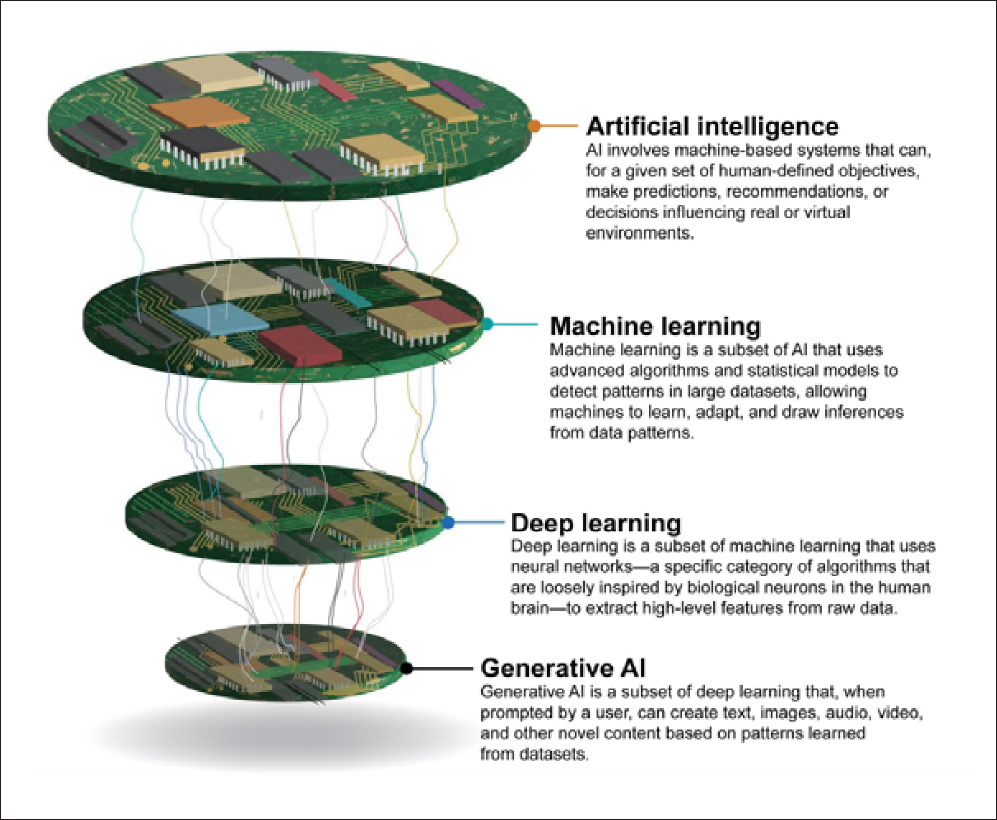
SOURCE: U.S. Government Accountability Office. 2025. “Artificial Intelligence: Generative AI Use and Management at Federal Agencies.” GAO-25-107653.
security, and cost implications of using a cloud-based AI or “edge AI,” where the AI is embedded in or near the infrastructure or tool itself.4 Examples of these and other AI use cases in transportation are shown in Table 1. The possibilities are many, but they will need to be screened for accuracy, fit, and other factors such as cost-effectiveness.5
TABLE 1 Types of Artificial Intelligence (AI) Activities and Uses with Transportation Examples
| AI Activity | Typical Uses | Transportation Examples |
|---|---|---|
| Content creation | Generating new artifacts such as video, audio, narrative, software code, synthetic data | Visualizations of travel data |
| Content synthesis | Combining and/or summarizing parts, elements, or concepts into a coherent whole | Analysis of public input |
| Data governance | Cleaning, processing, and assessing data for quality, accuracy, security, and utility | Data quality for automated vehicles, logistics, and traffic management |
| Decision making | Selecting a course of action from among possible alternatives to arrive at a solution | Determining route for emergency response |
| Detection | Identifying by pattern matching and clustering of large and complex datasets for actionable insights | Infrastructure condition inspection |
| Diagnosis | Finding or recognizing something that meets the definition of a specified condition or problem | Infrastructure condition inspection |
| Digital assistance | Acting as a personal agent for understanding and responding to commands and questions, and carrying out requested tasks in a conversational manner | Customer service |
| Discovery | Recognizing patterns in datasets that a person may not find or find quickly | Research in innovative materials |
| Image or audio analysis | Recognizing attributes within digital images or audio data to extract meaningful information | Safety analysis |
| Information retrieval/search | Finding information about specific topics of interest | Online decision-support tools |
| Monitoring | Observing, checking, and watching over the process, quality, or state of something over time to gain insights into how something is behaving or performing | Security cameras or sensors |
| Performance improvement | Improving quality and efficiency of the intended outcomes | Traffic management |
| Personalization | Designing and tailoring something to meet an individual’s characteristics, preferences, or behaviors | Trip planning for people with disabilities |
| Prediction | Forecasting the likelihood of a future outcome | Travel forecasts |
| Process automation | Performing repetitive tasks, removing bottlenecks, reducing errors and loss of data, and increasing efficiency of a process | Crash reporting in the field |
| Reasoning | Performing tasks involving symbolic logic, deduction, or inference | Research |
| Recommendation | Suggesting or proposing a manageable set of viable options to aid decision making | Emergency preparations for extreme weather |
| Robotic automation | Using physical machines to automate, improve, and/or optimize a variety of tasks | Maintenance activities |
| Vehicular automation | Automating physical transportation of goods, instrumentation and/or people | SAE Level 4 car or bus |
SOURCES: Adapted from Theofanos, M., Y-Y. Choong, and T. Jensen. 2024. AI Use Taxonomy: A Human-Centered Approach. NIST Trustworthy and Responsible AI NIST AI 200-1. Gaithersburg, MD: National Institute of Standards and Technology. https://doi.org/10.6028/NIST.AI.200-1; Kerry, C.F., and S. Mishra. 2025. “The Myth of the Monolith: AI Is Not One Thing.” Brookings, October 9. https://www.brookings.edu/articles/the-myth-of-the-monolith-ai-is-not-one-thing; Vasudevan, M., H. Townsend, T.N. Dang, A. O’Hara, C. Burnier, and K. Ozbay. 2020. “Identifying Real-World Transportation Applications Using Artificial Intelligence (AI): Summary of Potential Application of AI in Transportation.” FHWA-JPO-20-787. https://rosap.ntl.bts.gov/view/dot/50651.
AI Tools and Capabilities Applied to Transportation
Public investments advancing AI applications are coming from federal transportation agencies, university transportation research centers, and state and local transportation agencies. These investments are producing a growing body of explorations, small-scale pilots, and other research and development (R&D) activities that explore what is possible, feasible, and implementable with AI’s current capabilities. Recent federal investments have enabled AI projects on predictive real-time traffic management,6 evaluating pavement condition and safety,7 using mixed-reality vision to enhance infrastructure inspections,8 and using digital twins for safety analysis.9 Among the numerous AI research projects launched by University Transportation Center researchers in 2025 alone are projects on tracking structural changes in infrastructure,10 integrating AI into intersection safety planning and design,11 delivering preventive maintenance for coastal bridges,12 addressing cybersecurity and resilience of vehicle-to-everything (V2X) networks,13 and leveraging AI to use robots to install precast bridge components.14 Additional examples of using AI to improve safety, security, traffic management, project management, and asset management are also discussed in other sections of this publication.
AI APPLICATIONS FOR ROAD AND RAIL SAFETY
Using AI to improve transportation safety has attracted significant excitement, in part because it facilitates accessing new sources and types of data and new types of analysis to support determinations of causation and means of prevention and mitigation. The road and rail examples that follow provide examples of projects using AI to improve transportation safety.
AI-powered video analytics has the potential to overcome the reliance of safety analysis on incomplete and imperfect crash data alone. The city of Austin, Texas, tested the video analytics capabilities of multiple vendors, comparing their ability to identify and analyze near misses involving a range of modes at 26 intersections across the city. The experiment was successful enough for the city to turn to developing best practices.15 Working with the city of Bellevue, Washington, researchers have pilot tested using AI-powered video analytics to improve road safety at intersections by analyzing relationships between vehicle turning movements, intersection design, and traffic safety, especially pedestrian safety. Although the pilot test showed that video analytics of complex intersection environments was feasible, research results that would be implementable for safety would require a significant expansion of the number of intersections analyzed.16
Highway–rail crossings are also attracting interest in using AI to improve safety such as using AI-powered sensors to identify and warn pedestrians and bicyclists at risk of collision.17 Researchers are using video analytics of highway–rail grade crossings to identify the extent and type of safety violations and the factors contributing to them. This information could then be used to implement appropriate engineering, enforcement, or educational efforts to reduce unsafe incidents.18 Additional discussions using AI for rail safety are included in the sections on digitalization and on advanced automation.
Road safety often depends on improving and maintaining road conditions, including the visibility of signs, pavement markings, and road surfaces. Instead of relying on visual inspection or fixed-interval maintenance schedules, AI can be used to produce location-specific maintenance schedules. Agencies could then address the condition of safety-critical elements before they degrade, while not wasting resources on elements that are still performing as intended. For example, the retroreflectivity of pavement markings must be maintained above a certain level to meet minimum performance standards. Recent research has shown that AI-powered models can predict the degradation of retroreflectivity with enough accuracy to be useful for maintenance scheduling.19
AI-POWERED PREDICTIVE ANALYTICS
Because of AI’s ability to reveal patterns and correlations across complex phenomena shaped by many variables, it has become a powerful tool for predictive analytics. AI-powered predictive analytics could improve forecasts of travel demand, anticipate and prioritize safety risks, and improve operations and maintenance, as well as enhance other business functions related to transportation services such as revenue forecasts, future workforce needs, or marketing effectiveness.
Highway travel models in seven states already incorporate AI techniques, specifically boosting and/or decision trees, and research into applying other AI tools to discrete choice models is currently under way.20 The objective and promise of AI-powered travel models are improved predictions more sensitive to changes in the age of travelers, the accessibility of neighborhoods, income, vehicle ownership, and household composition. Researchers are also examining the use of large language models to improve travel modeling and predict traveler behavior.21
AI-powered predictive analytics have the potential to find applications across a wide swath of transportation. For traffic management on highways, predictive analytics has the potential to, for example, guide incident management and even prevention, make it easier to open highway
shoulders for temporary use, fine-tune ramp metering, or enhance setting variable speed limits based on weather or traffic.22 AI-powered predictive algorithms are also being developed to estimate asphalt pavement performance and life.23 Travel safety is another area where predictive analytics have been identified as a way to close gaps in knowledge and adopt better safety interventions. For example, concurrent with the most recent update of the Highway Safety Manual, researchers acknowledged that crash prediction still required additional research, including by specific road and user types and for crash severity.24
AI-POWERED FUNDAMENTAL RESEARCH IN TRANSPORTATION
AI is well established as a research tool that is already advancing knowledge about the fundamental aspects of transportation. Travel behavior trends and changing travel patterns, especially as they relate to changes associated with new technologies, are areas where AI tools and big data, including real-time data, could improve transportation professionals’ understanding in ways that immediately affect policy decisions.25 Examples of such research include examinations of changing freight delivery patterns and trends in telecommuting during and after the pandemic.26 Researchers are also exploring using large language models to increase knowledge about travel behavior.27 The availability of AI research tools also opens up the possibility of using new sources of data, such as Wi-Fi or biometric data, to inform future design choices based on travel behavior.28 AI models could also make it easier to tap into additional sources of safety data, such as hospital emergency room data29 or vehicle telematics.30
AI-powered research tools also support advances in simulation and rapid iteration, which could be applied to other areas of research in transportation such as innovations in construction materials or infrastructure design. AI models have been developed for understanding traffic flow dynamics, such as for predicting queue length31 and detecting shockwaves.32
AI RESEARCH TOOLS IN TRANSPORTATION PLANNING
Certain transportation activities require research as part of regular practice. For example, transportation planning typically involves quantitative and qualitative data gathering and analysis. In addition to the analysis of socioeconomic data as discussed above for travel demand forecasts, AI tools also hold possibilities for public involvement or customer satisfaction activities, especially for analyzing surveys and other qualitative data. Although there is still room for improvement, AI tools have the potential to allow for additional open-ended questions or comments, while still producing analysis results and actionable insights in a timely manner. They could also be used for analyzing more detailed interview and focus group data or for tracking public sentiment, such as expressed on complaint forms or social media platforms.33
Transforming Decision-Support Tools
Transportation professionals have long used decision-support tools designed to make it easier to apply a curated knowledge base to a specific use case. These ubiquitous standards, manuals, and guidebooks are often accessed today with online tools. As with other decision-support tools, an AI-powered decision-support tool presents alternative actions or recommends an action, but only the
human takes the action. As defined here, an AI-powered decision-support tool does not change, on its own, the digital or physical world.
Among the potential benefits of using AI for decision-support tools are improvements to a tool’s knowledge base; data processing for integrating siloed knowledge bases; real-time updates of the data describing specific uses cases or their context; and predictive capabilities. AI-powered decision-support tools could also improve the knowledge and productivity of certain transportation professionals.
STATIC AI-POWERED DECISION-SUPPORT TOOLS
Static decision-support tools, such as the standards and manuals of today that are updated through an established process on a transparent schedule, are critical foundations for planning, designing, and constructing infrastructure projects. They provide a common understanding of expectations across the public and private sectors, and their use establishes legal liability protection. It will be important to integrate the benefits of AI into these tools, such as by incorporating AI-powered research, analysis, or data collection, while also maintaining their larger functions that today are rooted in their stability and their formal update processes controlled by government agencies or industry organizations. A place to start is fostering AI-powered transportation research that will improve a tool’s knowledge base. Developing this research could be an ad hoc process, or it could follow the more coordinated process used in the past decade to address automated and autonomous vehicles in the Manual on Uniform Traffic Control Devices and the Highway Capacity Manual (see discussion below in the section Advanced Automation in Road Transport). The more radical changes to the body of static decision-support tools will be new tools that are built from the ground up using AI or that integrate formerly siloed information.
DYNAMIC AI-POWERED DECISION-SUPPORT TOOLS
Dynamic AI-powered decision-support tools have the potential to collect and analyze data in real time, such as analyzing real-time weather conditions, traffic levels, and the locations and types of crashes to predict their impact on the transportation system and recommend interventions. Decision-support tools, for instance, are critical to integrated corridor management approaches that analyze real-time data to monitor, predict, and manage traffic congestion across freeways, arterials, and transit systems. The tools are suited for adaptive control of signals, ramp metering, and speed limits. Future agentic AI systems may be able to seek out new sources of input data or choose specific use cases.
An agentic AI-powered decision-support tool could also update its own knowledge base, either through analysis of internal data or seeking relevant information from outside the AI model. For the transportation professional, this could mean that the menu of alternatives or the recommended action would change as the knowledge base updates, potentially in real time. The private sector is likely to take the lead in developing these new types of decision-support tools. Already today, there are companies developing tools that, for example, integrate site-specific weather analytics into construction project management tools34 and that are experimenting with generative AI for traffic management.35
Generative AI is the most recent frontier in decision-support tools for transportation. In California, Caltrans is working to develop a new
vulnerable road user (VRU) safety tool that uses generative AI to integrate safety-related data and its VRU safety knowledge base. Among its uses are identifying high-risk locations, risk contributors at specific locations, recommended actions, and predicted effectiveness in reducing fatalities and serious injuries. The initial model ingested 12 datasets related to incidents, infrastructure, land use, and mode use and 29,000 websites or documents containing standards, design manuals, or other guidance documents.36
SUPPORT TOOLS FOR TRAVELERS AND CUSTOMERS
Because private companies serve large customer bases and have access to big data, they have developed many decision-support tools that are now a standard part of travel. These include apps that help drivers plan routes and avoid congestion, provide real-time information for transit users, and support air travel and package delivery. While AI can further improve these tools, their basic capabilities are already well established.
In contrast, some specialized needs have not been met because the user base is small or other barriers exist. One example is Truck Parking Information Management Systems (TPIMSs). The Washington State Department of Transportation (DOT) is testing a predictive TPIMS that uses machine learning to forecast truck parking availability along I-5 up to 4 hours in advance, with the information delivered to drivers through private vendor communication systems.37 Minnesota DOT has launched a similar project.38
The Future with Agentic AI
Agentic AI goes beyond traditional or reactive AI and can operate with limited human supervision. As IBM explains, agentic AI can make decisions, take actions, solve complex problems, and interact with real-world environments beyond the data used to train it. It can also learn as it operates, effectively expanding its own knowledge.39 An agentic AI platform typically includes a lead AI agent that coordinates specialized AI agents and other digital tools or models. A related concept is embodied AI, in which the agent acts through a robot or physical system.
These capabilities enable futuristic scenarios. In transportation, an agentic AI could support the management of snow and ice control by using weather forecasts and real-time conditions for routing trucks and plows, adjusting equipment settings, and updating routes as conditions change. Over time, the system could learn how to optimize operations for local geography and weather for authorities to restore safe travel as quickly as possible.
Agentic AI in transportation could increase labor productivity, streamline operations, and speed up the use of new information in decision making. For example, researchers are exploring an AI agent to increasingly automate the management and interpretation of bridge inventory data and augment what is an otherwise complex manual process.40 Similarly, researchers are developing an AI agent that integrates text, such as crash reports, with image data to perform analyses that lead to safety recommendations.41
At the same time, risks grow as agentic AI takes on more critical tasks. Using AI chatbots to support customer surveys or public engagement poses relatively low risk.42 In contrast, a hypothetical
AI agent for driver safety could analyze public records, traffic camera images, and social media to automatically suspend a driver’s license. In such cases, the benefits to safety would need to be carefully weighed against risks to legal fairness and the economic harm of incorrect decisions. Managing these risks in safety-critical systems is discussed further below.
AI in Safety-Critical Applications
Agentic AI presents the most extreme examples of the risks that accompany deploying AI in transportation. However, for safety-critical systems, the errors associated with AI can still have significant consequences even if the AI is only embedded in decision-support tools that require humans to act. Risks in higher-risk activities are mitigated by human-in-the-loop protocols, where a human operator reviews machine-generated decisions before deployment to ensure well-founded conclusions and safeguard against the creation of additional hazards by actions that conflict with situational context. Thus, integrating AI into safety-critical systems puts a burden on the engineers of such systems to understand the “failure modes” of AI and to design their systems to prevent or mitigate these new types of errors.
A 2025 National Academies’ consensus study found that “current [machine learning] components fall short of safety-critical standards because they rely on statistical assumptions that discount rare events and cannot guarantee consistent performance across all operating conditions.” The study identifies the need for a new approach to safety research that brings together AI and systems engineering experts, including for transportation, and for new standards, regulations, and testing methods.43 Box 2 further discusses a possible approach to overseeing the introduction of automated and autonomous technologies using AI to help ensure their safety benefits.
BOX 2
The Safety Case: A Regulatory Approach that Encourages Innovation
Both Waymo and Aurora, American autonomous vehicles companies, are relying on the “safety case” approach to presenting their safety plans before public officials and the public.44 The safety case approach used by some nations for managing high-hazard industries is much more performance based than the prescriptive regulatory regime in the United States.45 Instead of requiring strict adherence to existing regulations, the safety case obligates proposers to make a definitive case that they will achieve a safety level that is as low as reasonably practicable and requires ongoing monitoring by regulators. By waiving adherence to regulations developed specifically for preceding operations, the safety case may allow for greater innovation. Confidence in safety cases can be built by allowing operations on a small scale coupled with clear evidence of safety benefits before allowing wider operations. Waymo has been sharing safety statistics in peer-reviewed articles as it was allowed to move from having human monitors in autonomous taxis to remote monitoring only. The percentage reductions in crash types in Waymo’s operations compared to those that are human operated are large, statistically significant, and promising.46,47 A similar approach for urban air mobility proposals intended to ultimately evolve to autonomous operations would rely on the safety case coupled with Safety Assurance and Safety Management Systems used in aviation and some high-hazard industries.48


