Transforming Transportation: Leveraging the Power of Artificial Intelligence, Digitalization, and Automation (2026)
Chapter: The Power and Promise of Advanced Automation and Autonomy
The Power and Promise of Advanced Automation and Autonomy
Advanced automation, often enabled by AI, has progressed significantly across transportation over the past two decades. While much attention is given to automated vehicles and vessels, advanced robotics may also transform how infrastructure is built and maintained. These applications do not have to be highly complex. Simpler technologies can also be valuable, such as AI-enabled hearing protection for highway workers that blocks noise while allowing critical safety sounds through.73
Most progress in advanced automation and autonomy for transportation will likely continue to come from the private sector. Transportation agencies will often be in the position of adapting to changes in the vehicles, vessels, and industries that use their infrastructure. Their primary role likely will be to manage and regulate new technologies rather than deploy them directly. Accordingly, collaboration between the private and public sectors needs to be ongoing to ensure the public infrastructure is not only capable of accommodating the future demands of advanced automation but will in fact meet these demands. Regulatory activities will include addressing the use of embodied AI in safety-critical autonomous vehicles, automated driving systems, and other types of uncrewed vehicles and vessels. In some cases, agencies may adopt advanced automation
for their own operations and encourage their contractors to do the same.
Advanced Automation in Road Transport
Advanced automation and autonomy in road-based travel is progressing, albeit not at the pace imagined in the mid-2010s. Applications of these technologies are expanding for private and commercial vehicles, public transit, and road construction and maintenance.
PRIVATE AND COMMERCIAL VEHICLES
Since the 2010s, the private sector has made significant advancements in automated driving, many aspects of which are today maturing, if not mature, technologies. Advanced automation in road vehicles continues to improve along two main tracks: advanced driver assistance systems (ADASs) and autonomous (or self-driving) vehicles (AVs) for specified operational design domains (SAE Level 4 autonomy).74 ADAS functionality is likely to continue to expand, with new or improved capabilities dispersing at varying rates into the private and general commercial vehicle fleets. For AVs, numerous private companies globally have begun to put vehicles into revenue service, transporting passengers or freight. While the number and types of operational design domains are expanding, the vehicles themselves remain in specialized fleets controlled or managed by the technology providers. It is not yet clear when or whether AVs will find paths into personal vehicle or general commercial vehicle markets at scale.75
A mixed fleet means that transportation agencies responsible for road travel will continue to be responsible for constructing, operating, and maintaining road systems traveled by vehicles having a range of capabilities. In addition, agencies tasked with regulating and enforcing driver safety will also be confronted with a multiplicity of “drivers,” as ADAS capabilities test the boundaries of human and automation “co-drivers” and as AVs continue to spread. An example of how even individual technologies can shape vehicle–driver–road functionality is the use of high-definition (HD) maps. AVs that have access to HD maps are much less dependent upon the quality and consistency of the infrastructure than AVs or ADASs that do not use HD maps. However, even AVs with HD maps may be challenged during confrontations with other AVs, ADASs, or human drivers responding unpredictably to unclear or confusing infrastructure. The future use of HD maps is just one dimension of driver automation technologies that may impact agency policies for the design, maintenance, and operation of road infrastructure.76
Shortly after this century’s first burst of self-driving technology improvements became evident in the 2010s, federal and state transportation departments embarked on numerous and significant research efforts on the technology’s ramifications for road transportation that anticipated many of the issues that are still in play today.77,78 Many of the studies were complete in the late 2010s and early 2020s, before there were multiple AV systems in revenue service and before the most recent advances in ADASs. However, because of the early developmental work, some major decision-support tools already address advanced automation. For example, FHWA’s Manual of Uniform Traffic Control Devices, released in December 2023, includes an entire part on “traffic control device considerations for automated vehicles,” which covers “key principles” and considerations for the selection of traffic control devices as well as other topics.79
The Highway Capacity Manual, published by TRB in 2022, includes capacity adjustment factors for connected and autonomous vehicles.80
PUBLIC TRANSIT: BUSES AND MICROTRANSIT
Advanced automation is already shaping the delivery of mass transit and paratransit services. The routing and dispatch algorithms and advances in communication technologies that led to the massive expansion of ride-hailing services in the 2010s have their parallels in the public transit industry. These advances have allowed public paratransit services to offer same-day reservations and even spontaneous rides.81 They have also enabled expanded services areas, especially in rural areas.82 In urban areas, AI-powered cameras notify transit agencies of vehicles blocking bus lanes and bus stops.83 In addition, the communications advances (e.g., real-time arrival apps) have transformed how most riders interact with public transit services.
Driving automation has not transformed public transit yet, but this could be changing.84 The expansion of ADASs has the potential to increase safety, while making the job of human driver easier. Public transit agencies have partnered with AV companies to provide taxi services to their eligible riders.85 AV pilots and partnerships are also occurring in public microtransit services.86 Pilot projects of Level 4 full-size, full-speed AV buses serving fixed routes are also expanding globally. If successful, self-driving buses on fixed routes have the potential to reduce the cost of offering more frequent service for more hours of the day, especially in areas experiencing shortages of human drivers. Transit agencies may still have an agency representative on the vehicle, but their primary tasks are likely to be customer care.87
ROAD CONSTRUCTION AND MAINTENANCE
Construction work zone and maintenance activities have typically been seen as creating challenging environments for automated vehicles. However, new research approaches have sought to test whether the technological capabilities of the travelers’ vehicles can be used to make work zones safer for travelers and workers on site.88 In addition, the technologies behind ADASs and AVs, along with other robotics, are advancing the equipment used for road construction and maintenance.89 Advanced automation may increase safety directly or indirectly, through simplifying the set of skills required to operate the equipment safely. Remote operations that remove the human driver or worker from hazardous environments also can increase safety. Through automated machine guidance and more advanced automated machine control technologies, which use lasers and position location information, contractors can feed the 3D model into their equipment to build exactly what is in the model. FHWA reports that these technologies can increase construction accuracy and precision, reduce surveying costs and time, save fuel owing to fewer passes, and increase safety by requiring fewer people in the vicinity of heavy equipment performing tasks such as setting up stakes and checking grades.90
Along with contractors, transportation agencies may be the major market for various types of advanced equipment, putting them in a position to take a leadership role. For example, Minnesota DOT has invested in research prototyping an ADAS for snowplows that supports drivers in low visibility environments,91 and Colorado and Utah DOTs have equipped snowplows with V2X technologies that allow snowplows to preempt red light signals.92 “InfraROB,” a European Union–funded project, is promoting advances in automation and robotics
for road construction and maintenance activities to reduce repetitive tasks and exposure to hazards by road workers.93
Advanced Automation in Air Transport
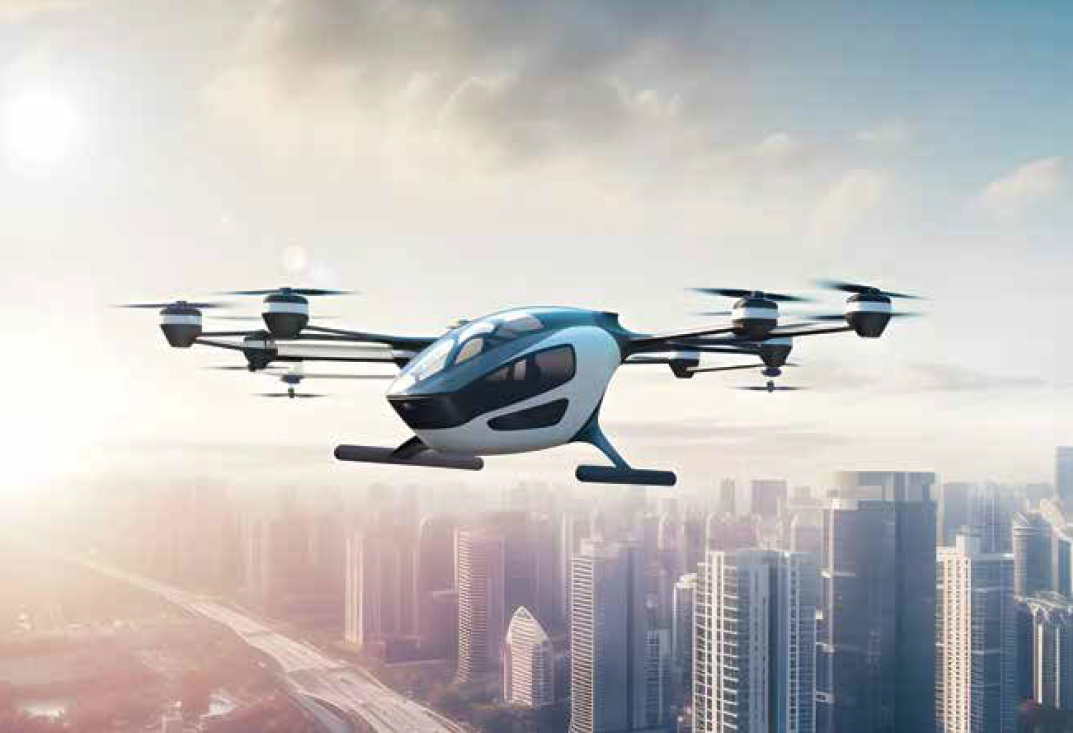
Advances in automation and autonomy are part of the impetus behind increasing interest in Advanced Air Mobility (AAM). AAM is an umbrella term for the diversification in aircraft made possible by recent technological innovations in aircraft design and operation and the associated air- and land-based infrastructure and airspace management needed to support them. Chief among the innovations are advances in vertical takeoff and landing and short take-off and landing capabilities, including reductions in noise. These advances may make it feasible to allow take-off and landing facilities to be inserted into the landscape in more difficult terrain and in more densely built-up areas. Advances in automation and autonomy will be leaned on to lower the cost of these “air taxis” as well as to assure travelers and people on the ground that these aircraft will be operated safely.94 However, yet to be determined is whether the cost reductions and safety assurances are such that small aircraft carrying a relatively small number of passengers making local or regional trips will be affordable and convenient to a larger group of travelers than today’s privately owned or chartered planes, jets, and helicopters. These new air services would also need to be competitive with moving people or freight by motor vehicle, boat, or rail.
Private-sector investment in developing and applying innovative aircraft technologies and potentially airspace management technologies is foundational to future applications of these technologies. However, the federal government, state and local governments, and airport authorities will have significant roles to play in facilitating innovation and implementing new services. The federal government released “The Advanced Air Mobility National Strategy: A Bold Policy Vision for 2026–2036” in December 2025. It exercises federal leadership through six pillars: airspace, infrastructure, security, community planning and engagement, workforce, and advanced automation.95 In addition, the federal government is responsible for certifying the safety of aircraft and integrating new aircraft into the national airspace. At the direction of Congress, the Federal Aviation Administration (FAA) adopted new regulations in October 2024 that use performance-based approaches to safety for innovative aircraft.96 A 2022 National Academies’ report offers guidance on how to ensure the safety of the design and operations of these vehicles.97 When demand for such air services proliferates beyond existing helipads and airports, state and/or local governments will be responsible for locating and regulating the necessary “vertiports” and other associated land uses. State and local governments may also integrate these new air services in their economic development plans.
Airport ground transportation is also likely to be affected by advanced automation and autonomy in motorized vehicles. On the land side, automated and autonomous vehicles will be in the mix as travelers and employees navigate arrival/departure and parking at the airport. Personal mobility devices used by people with disabilities or older adults and that need to be accommodated for travel by air may also evolve. On the air side, advanced automation in ground transportation may also shape how aircraft are maintained and supplied.
Finally, aerial drones (regulated by FAA under the name unmanned aircraft system [UAS]) continue
to find commercial uses. For example, aerial drones are in use for surveying, mapping, inspection, monitoring, security, and other activities related to delivering transportation services.98 Partially autonomous drone delivery services, currently being used during emergencies and for delivery of medicines to isolated places,99 may be breaking out from such niche use cases to more general consumer markets.100 (See below for examples of aerial drones used to support marine and rail travel.) Lessons learned from existing use cases are providing opportunities to better understand human-autonomy teaming, which will be needed for more widespread autonomous operations.101
Advanced Automation in Rail and Marine Transport
Even more than in aviation, advances in automation for rail and marine transport will largely be driven by the private sector. The dominant public-sector role will be regulation and enforcement, which can support or hinder the pace of innovation.
Advanced automation in marine ships and vessels ranges from automated data collection and decision-support tools to autonomous propulsion, navigation, and collision avoidance. To date, human supervision on board or through remote operation centers continues. Like the technology adoption trajectory of motor vehicles, higher levels of autonomy are being deployed first in specific, simpler applications such as for scientific research, inspection activities, or other services with slow speeds on fixed routes close to shore.102 The Coast Guard has the authority to permit testing and operation of autonomous vessels on a case-by-case basis or through establishing “equivalents” to current practice and technology. The International Maritime Organization (IMO), responsible for the regulation of ocean-going ships, developed interim guidelines for testing autonomous shipping technologies in 2019. The IMO is scheduled to finalize and adopt a non-mandatory Maritime Autonomous Surface Ships code in 2026.103 Although the current regulatory framework is focusing on ensuring safety and operational efficiency for use cases in which advanced automation substitutes for human capabilities, future advances in automation may go beyond current practices to leverage additional sources of data or novel technology-based capabilities.104 The Coast Guard announced in September 2025 that it will be investing $350 million in robotics and autonomous systems for its own operations, including an initial $11 million investment in UASs and unmanned ground vehicles as well as underwater robots.105
Advanced automation has been introduced to process and handle cargo at marine ports, especially container ports. In a 2024 report, the U.S. Government Accountability Office reported that terminals in all of the 10 largest U.S. container ports have adopted automation technology to some degree to load, unload, and move containers, while some also use automation for tracking and communicating container movements.106 The report points out that foreign ports have been faster in adopting automation technologies, reflecting factors such as larger container volumes and variations in labor availability, relations, and rules.
The safety implications of advanced automation in rail transportation will be overseen by the Federal Railroad Administration (FRA) or the Federal Transit Administration for transit rail. In addition to the discussions in previous sections on examining roadway–rail crossing safety and deploying digital infrastructure for railyard
security, conducting track inspections using advanced automation technologies has attracted industry interest. FRA recently approved a temporary waiver to allow freight railroads to test automated track inspection technologies, including substituting automated inspections for some visual inspections.107 Research on automated track inspection continues. For example, one study is exploring using aerial drones capable of operating autonomously and without continuous access to the internet for track inspection and intrusion detection activities.108


