The State of Art in Transit Programs (2026)
Chapter: Front Matter
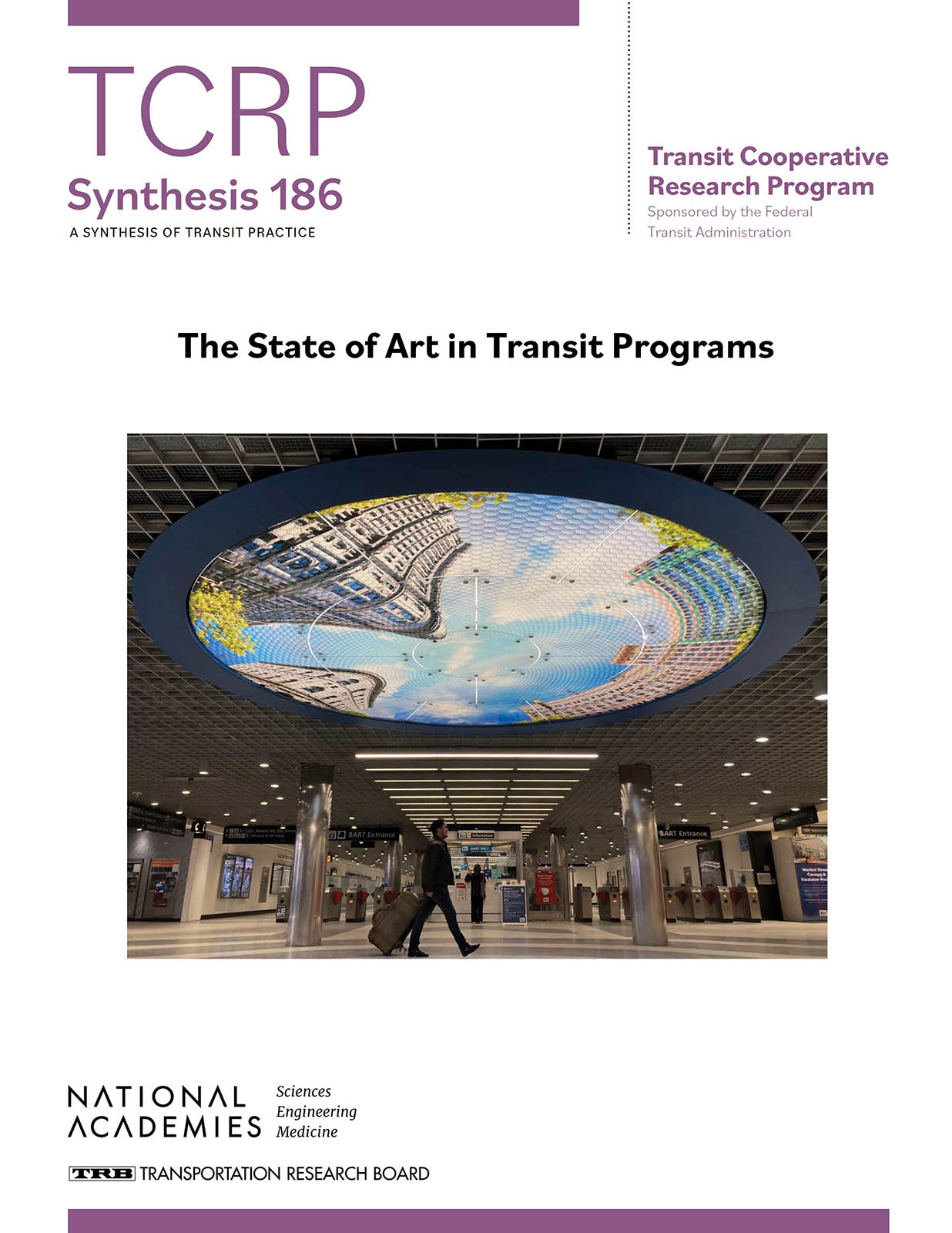
Long Description.
The station shows a wide, well-lit hall with fewer people inside. The hall consists of a large oval-shaped bright LED display on its ceiling.
TCRP OVERSIGHT AND PROJECT SELECTION COMMISSION*
CHAIR
Jameson Auten
Lane Transit District
VICE CHAIR
Ryan I. Daniel
St. Cloud Metro Bus
SECRETARY/TREASURER
Brad Miller
Pinellas Suncoast Transit Authority (PSTA)
IMMEDIATE PAST CHAIR
Jeanne Krieg
Eastern Contra Costa Transit Authority (retired)
MEMBERS
Rashidi Barnes
Eastern Contra Costa Transit Authority
Andrea Burnside
Washington Metropolitan Area Transit Authority
Julia Castillo
Heart of Iowa Transit Authority
April Chan
San Mateo County Transit District
David Harris
New Mexico Department of Transportation
Tim Healy
Sound Transit
Brendon Hemily
Hemily and Associates
Vince Huerta
East Texas Council of Governments
Debra Johnson
Denver Regional Transportation District
Joseph Leader
HDR
Benjamin Limmer
Connecticut Department of Transportation
Bacarra Mauldin
Edward Kizeto, LLC
Jessica Mefford-Miller
Valley Metro
Raymond Melleady
USSC Group
Meghan Merritt
Movitas Mobility
Karen Philbrick
Mineta Transportation Institute, San Jose State University
Elizabeth Presutti
Charlotte Area Transit System
Charles Reeves
Pittsburgh Regional Transit
Catherine Rinaldi
Consultant
Jeffrey Rosenberg
Amalgamated Transit Union
Judy Shanley
Easterseals
Frank White, III
Kansas City Area Transportation Authority
EX OFFICIO MEMBERS
Sean McMaster
FHWA
Marcus J. Molinaro
FTA
Victoria Sheehan
TRB
Paul P. Skoutelas
APTA
Jim Tymon
AASHTO
TOPS COMMISSION STAFF ADVISOR
Arthur L. Guzzetti
APTA
SECRETARY
Monique R. Evans
TRB
_________________________
* Membership as of February 2026.
TRANSPORTATION RESEARCH BOARD 2026 EXECUTIVE COMMITTEE*
OFFICERS
Chair: Joel M. Jundt, Secretary of Transportation, South Dakota Department of Transportation, Pierre
Vice Chair: Randell Iwasaki, President and CEO, Iwasaki Consulting Services, Walnut Creek, CA
Executive Director: Victoria Sheehan, Transportation Research Board, Washington, DC
MEMBERS
James F. Albaugh, President and CEO, The Boeing Company (retired), Scottsdale, AZ
Marsha Anderson Bomar, Strategic Transportation Advisor, GHD, Duluth, GA
Douglas C. Ceva, Vice President, Customer Lead Solutions, Prologis, Inc., Jupiter, FL
Nancy Daubenberger, Commissioner of Transportation, Minnesota Department of Transportation, St. Paul
Garrett Eucalitto, Commissioner, Connecticut Department of Transportation, Newington
Andrew Fremier, Executive Director, Metropolitan Transportation Commission, San Francisco, CA
Martha Grabowski, Professor Emerita, Information Systems, Le Moyne College, Madden College of Business and Economics, Cazenovia, NY
Edward Hassinger, Director, Missouri Department of Transportation, Jefferson City
Shante Hastings, Cabinet Secretary, Delaware Department of Transportation, Dover
Carol A. Lewis, Professor, Transportation Studies, Texas Southern University, Houston
Ricardo Martinez, Adjunct Professor of Emergency Medicine, Emory University School of Medicine, Decatur, GA
Russell McMurry, Commissioner, Georgia Department of Transportation, Atlanta
Craig E. Philip, Research Professor and Director, VECTOR, Department of Civil and Environmental Engineering, Vanderbilt University, Nashville, TN
Steward T.A. Pickett, Distinguished Senior Scientist, Cary Institute of Ecosystem Studies, Millbrook, NY
Leslie S. Richards, Professor of Practice, University of Pennsylvania, Philadelphia
Tracy Larkin Thomason, Director, Nevada Department of Transportation, Carson City
Marc Williams, Executive Director, Texas Department of Transportation, Austin
EX OFFICIO MEMBERS
Derek Barrs, Administrator, Federal Motor Carrier Safety Administration, Washington, DC
Steven G. Bradbury, Deputy Secretary, U.S. Department of Transportation, Washington, DC
Stephen Carmel, Administrator, U.S. Maritime Administration, Washington, DC
Tara Cavalline, Professor, University of North Carolina, Charlotte, and Chair, TRB Technical Activities Council
David Fink, Administrator, Federal Railroad Administration, Washington, DC
Firas Ibrahim, Director, Office of Research, Development, and Technology, Office of the Assistant Secretary for Research and Technology, Washington, DC
Jason Kelly, Deputy Commanding General for Civil Works and Emergency Operations, U.S. Army Corps of Engineers, Washington, DC
Sandra Knight, President, WaterWonks, LLC, Washington, DC, and Chair, TRB Marine Board
Sean McMaster, Administrator, Federal Highway Administration, Washington, DC
Marcus J. Molinaro, Administrator, Federal Transit Administration, Washington, DC
Jonathan Morrison, Administrator, National Highway Traffic Safety Administration, Washington, DC
Seval Oz, Senior Advisor, Office of the Assistant Secretary for Research and Technology, Washington, DC
Niloo Parvinashtiani, Engineer, Mobility Consultant Solutions, Iteris Inc., Fairfax, VA, and Chair, TRB Young Participants Council
Paul Roberti, Administrator, Pipeline and Hazardous Materials Safety Administration, Washington, DC
Paul P. Skoutelas, President and CEO, American Public Transportation Association, Washington, DC
Jim Tymon, Executive Director, American Association of State Highway and Transportation Officials, Washington, DC
_________________________
* Membership as of February 2026.
TRANSIT COOPERATIVE RESEARCH PROGRAM
TCRP SYNTHESIS 186
The State of Art in Transit Programs
A Synthesis of Transit Practice
Naomi Stein
EBP US
Pittsburgh, PA
Daniel Mascoop
EBP US
Boston, MA
Temple Anyasi
EBP US
Washington, DC
Subject Areas
Public Transportation • Administration and Management • Terminals and Facilities
Research sponsored by the Federal Transit Administration in cooperation with the American Public Transportation Association

2026
TRANSIT COOPERATIVE RESEARCH PROGRAM
The nationʼs growth and the need to meet mobility, environmental, and energy objectives place demands on public transit systems. Current systems, some of which are old and in need of upgrading, must expand service area, increase service frequency, and improve efficiency to serve these demands. Research is necessary to solve operating problems, adapt appropriate new technologies from other industries, and introduce innovations into the transit industry. The Transit Cooperative Research Program (TCRP) serves as one of the principal means by which the transit industry can develop innovative near-term solutions to meet demands placed on it.
The need for TCRP was originally identified in TRB Special Report 213—Research for Public Transit: New Directions, published in 1987 and based on a study sponsored by the Urban Mass Transportation Administration—now the Federal Transit Administration (FTA). A report by the American Public Transportation Association (APTA), Transportation 2000, also recognized the need for local, problem-solving research. TCRP, modeled after the successful National Cooperative Highway Research Program (NCHRP), undertakes research and other technical activities in response to the needs of transit service providers. The scope of TCRP includes various transit research fields including planning, service configuration, equipment, facilities, operations, human resources, maintenance, policy, and administrative practices.
TCRP was established under FTA sponsorship in July 1992. Proposed by the U.S. Department of Transportation, TCRP was authorized as part of the Intermodal Surface Transportation Efficiency Act of 1991 (ISTEA). On May 13, 1992, a memorandum agreement outlining TCRP operating procedures was executed by the three cooperating organizations: FTA; the National Academies of Sciences, Engineering, and Medicine, acting through the Transportation Research Board (TRB); and APTA. APTA is responsible for forming the independent governing board, designated as the TCRP Oversight and Project Selection (TOPS) Commission.
Research problem statements for TCRP are solicited periodically but may be submitted to TRB by anyone at any time. It is the responsibility of the TOPS Commission to formulate the research program by identifying the highest priority projects. As part of the evaluation, the TOPS Commission defines funding levels and expected products.
Once selected, each project is assigned to an expert panel appointed by TRB. The panels prepare project statements (requests for proposals), select contractors, and provide technical guidance and counsel throughout the life of the project. The process for developing research problem statements and selecting research agencies has been used by TRB in managing cooperative research programs since 1962. As in other TRB activities, TCRP project panels serve voluntarily without compensation.
Because research cannot have the desired effect if products fail to reach the intended audience, special emphasis is placed on disseminating TCRP results to the intended users of the research: transit agencies, service providers, and suppliers. TRB provides a series of research reports, syntheses of transit practice, and other supporting material developed by TCRP research. APTA will arrange for workshops, training aids, field visits, and other activities to ensure that results are implemented by urban and rural transit industry practitioners.
TCRP provides a forum where transit agencies can cooperatively address common operational problems. TCRP results support and complement other ongoing transit research and training programs.
TCRP SYNTHESIS 186
Project J-07, Topic SB-44
ISSN 1073-4880
ISBN 978-0-309-60362-1
© 2026 by the National Academy of Sciences. National Academies of Sciences, Engineering, and Medicine and the graphical logo are trademarks of the National Academy of Sciences. All rights reserved.
COPYRIGHT INFORMATION
Authors herein are responsible for the originality and accuracy of their materials and for obtaining written permissions from publishers or persons who own the copyright to any previously published or copyrighted material used herein.
The National Academy of Sciences (NAS) grants permission to reproduce written material in this publication for classroom and non-commercial purposes subject to the rights of any third parties and appropriate attribution. Permission is given with the understanding that none of the material will be used to imply NAS, TRB, AASHTO, APTA, FAA, FHWA, FTA, GHSA, or NHTSA endorsement of a particular product, method, or practice. For other uses of the written material, users must request permission from the National Academies Press.
Cover photo: Elysium by Stephen Galloway, Powell Street Bay Area Rapid Transit station
Cover photo credit: Bay Area Rapid Transit
NOTICE
The report was reviewed by the technical panel and accepted for publication according to procedures established and overseen by the Transportation Research Board and approved by the National Academies of Sciences, Engineering, and Medicine.
This document is disseminated under the sponsorship of the U.S. Department of Transportation, FTA, in the interest of information exchange. The U.S. government assumes no liability for the contents or use thereof. Any opinions, findings, and conclusions or recommendations expressed or implied in this document are those of the researchers who performed the research and are not necessarily those of the Transportation Research Board; the National Academies of Sciences, Engineering, and Medicine; or the program sponsors.
The Transportation Research Board does not develop, issue, or publish standards or specifications. The Transportation Research Board manages applied research projects which provide the scientific foundation that may be used by Transportation Research Board sponsors, industry associations, or other organizations as the basis for revised practices, procedures, or specifications.
The Transportation Research Board; the National Academies of Sciences, Engineering, and Medicine; and the sponsors of the Transit Cooperative Research Program do not endorse products or manufacturers. Trade or manufacturersʼ names or logos appear herein solely because they are considered essential to the object of the report.
Published reports of the
TRANSIT COOPERATIVE RESEARCH PROGRAM
are available from
National Academies Press
500 Fifth Street, NW
Washington, DC 20001
(800) 624-6242
and can be ordered through the internet by going to
nationalacademies.org/publications
Printed in the United States of America
The National Academy of Sciences was established in 1863 by an Act of Congress, signed by President Lincoln, as a private, nongovernmental institution to advise the nation on issues related to science and technology. Members are elected by their peers for outstanding contributions to research. Dr. Marcia McNutt is president.
The National Academy of Engineering was established in 1964 under the charter of the National Academy of Sciences to bring the practices of engineering to advising the nation. Members are elected by their peers for extraordinary contributions to engineering. Dr. Tsu-Jae Liu is president.
The National Academy of Medicine (formerly the Institute of Medicine) was established in 1970 under the charter of the National Academy of Sciences to advise the nation on medical and health issues. Members are elected by their peers for distinguished contributions to medicine and health. Dr. Victor J. Dzau is president.
The three Academies work together as the National Academies of Sciences, Engineering, and Medicine to provide independent, objective analysis and advice to the nation and conduct other activities to solve complex problems and inform public policy decisions. The National Academies also encourage education and research, recognize outstanding contributions to knowledge, and increase public understanding in matters of science, engineering, and medicine.
Learn more about the National Academies of Sciences, Engineering, and Medicine at www.nationalacademies.org.
The Transportation Research Board is one of four centers of the National Academies of Sciences, Engineering, and Medicine. The mission of the Transportation Research Board is to mobilize expertise, experience, and knowledge to anticipate and solve complex transportation-related challenges. The Board’s varied activities annually engage more than 5,500 engineers, scientists, and other transportation researchers and practitioners from the public and private sectors and academia, all of whom contribute their expertise in the public interest. The program is supported by state departments of transportation, federal agencies including component administrations of the U.S. Department of Transportation, and other organizations and individuals interested in the development of transportation.
Learn more about the Transportation Research Board at www.TRB.org.
COOPERATIVE RESEARCH PROGRAMS
CRP STAFF FOR TCRP SYNTHESIS 186
Monique R. Evans, Director, Cooperative Research Programs
Waseem Dekelbab, Deputy Director, Cooperative Research Programs
Gwen Chisholm Smith, Manager, Transit Cooperative Research Program
Emily Griswold, Associate Program Officer
Natalie Barnes, Director of Publications
Brian Haefs, Associate Director of Publications
Jeff Strong, Senior Editor
TCRP PROJECT J-07 PANEL
Rachel Dungca, Metro Transit, Minneapolis–St. Paul, Minneapolis, MN (Chair)
Jameson Auten, Lane Transit District, Eugene, OR
Aida Berduo Berry, WSP, Los Angeles, CA
Kevin Bueso, Chicago Regional Transportation Authority, Lake Geneva, WI
Raymond Chan, Arcadis IBI Group, Kettering, OH
Roderick B. Diaz, Southern California Regional Rail Authority, Los Angeles, CA
Enjoli J. Dixon, National Rural Transit Assistance Program, Jefferson City, MO
Beverly Neff, San Diego Metropolitan Transit System, San Diego, CA
Tsopie D. Trottie, Jacksonville Transportation Authority, Jacksonville, FL
Ed F. Watt, WattADR, Rockaway Park, NY
Robert Earl Williams III, Ann Arbor Transportation Authority, Ann Arbor, MI
Tara Echols, FTA Liaison
Alexander Pompa, FTA Liaison
Arthur L. Guzzetti, APTA Liaison
TOPIC SB-44 PANEL
Danielle Bursk, New Jersey State Council on the Arts, Trenton, NJ
Ivonne Chand, MUSE Research, Silver Spring, MD
Ibn Edwards, San Diego Metropolitan Transit System, San Diego, CA
John W. Fuller, University of Iowa, West Branch, IA
Hyesun Jeong, University of Cincinnati, Cincinnati, OH
Cara Marcus, National Rural Transit Assistance Program, Woburn, MA
Laurent Odde, Washington Metropolitan Area Transit Authority, Alexandria, VA
Cathi Petagno, St. Lucie County Board of County Commissioners, Fort Pierce, FL
Chandra Ward, University of Tennessee, Chattanooga, Chattanooga, TN
Jon Schmidt, FTA Liaison
ABOUT THE TCRP SYNTHESIS PROGRAM
Transit administrators, engineers, and researchers often face problems for which information already exists, either in documented form or as undocumented experience and practice. This information may be fragmented, scattered, and unevaluated. As a consequence, full knowledge of what has been learned about a problem may not be brought to bear on its solution. Costly research findings may go unused, valuable experience may be overlooked, and due consideration may not be given to recommended practices for solving or alleviating the problem.
There is information on nearly every subject of concern to the transit industry. Much of it derives from research or from the work of practitioners faced with problems in their day-to-day work. To provide a systematic means for assembling and evaluating such useful information and to make it available to the entire transit community, the Transit Cooperative Research Program Oversight and Project Selection (TOPS) Commission authorized the Transportation Research Board to undertake a continuing study. This study, TCRP Project J-07, “Synthesis of Information Related to Transit Practices,” searches out and synthesizes useful knowledge from all available sources and prepares concise, documented reports on specific topics. Reports from this endeavor constitute a TCRP report series, Synthesis of Transit Practice.
This synthesis series reports on current knowledge and practice, in a compact format, without the detailed directions usually found in handbooks or design manuals. Each report in the series provides a compendium of the best knowledge available on those measures found to be the most successful in resolving specific problems.
FOREWORD
By Emily Griswold
Staff Officer
Transportation Research Board
TCRP Synthesis 186: The State of Art in Transit Programs documents the use of art in public transit systems throughout the United States and Canada. This synthesis includes information on historical and current art in transit programs and describes how agencies develop, implement, and manage the programs.
Under TCRP Project J-07/Topic SB-44, “The State of Art Programs in Transit,” EBP US was tasked with synthesizing information to document what types of art in transit programs exist and explore why and how agencies integrate art into their transit systems. Information used in this study was obtained through a literature review, a survey of active art in transit programs, and interviews to develop in-depth case examples. Chapter 4 provides six case examples that highlight art in transit program funding sources, program management, how agencies engage with artists and communities, and the maintenance and decommissioning of art pieces.
This synthesis is an immediately useful document that records the practices that were acceptable within the limitations of the knowledge available at the time of its preparation. As progress in research and practice continues, new knowledge will be added to that now at hand. The audience for this synthesis is public transit agencies and local municipalities that may be looking at the benefits and challenges of operating an art in transit program.
This page intentionally left blank.