The State of Art in Transit Programs (2026)
Chapter: 4 Case Examples
CHAPTER 4
Case Examples
This chapter presents six case examples to illustrate current practices of art in transit programs. When selecting case examples, the study team sought to cover a range of geographies, transit system sizes, and transit services provided as well as a range of art media and locations; however, given the limited range of survey responses and volunteers for case examples obtained, the completed case examples focus on larger transit agencies with established art in transit programs.
These case examples do not offer representation of smaller or rural agencies, but they provide useful information on processes for integrating art in transit, whether through a formal or an ad hoc program, and on the range of artworks and benefits of art in transit that could be most applicable to bus-focused and smaller transit agencies. In particular, the Metro Transit Public Art in Transit case example describes a popular Bus Stop Beautification Program and other low-cost art installations that integrate art into the transit system and serve to deter vandalism and graffiti. The LA Metro Art case example describes art buses with artistic bus wrappings and interior art cards, and the MARTA Artbound case example discusses partnering with organizers of special events.
Methodology
The six case examples were selected from the 10 programs whose representatives volunteered via the survey. The synthesis topic panel reviewed and approved these selections. With these selections, the study team attempted to provide the broadest range of geographies, transit system sizes, and transit services provided and range of art media and locations, given the options of volunteer case examples. In addition, the team prioritized options that self-identified in the survey as involving art in transit programs that were replicable, contained varied collections, overcame challenges, were innovative, were resilient, were popular, or procured unusual art.
Information for the case examples was gathered during 1-hour interviews using the same interview guide for each example (see Appendix A: Survey Questionnaire and Case Example Interview Guide). The interview guide was broad and allowed the interviewers to focus on areas highlighted as most important or challenging for that agencyʼs program in the survey responses or on topics of most interest identified in the interview by the interviewee. All except one interview was recorded for reference in writing this report and then deleted permanently. Each interviewee reviewed a draft of the relevant case example report before publication.
Each case example consists of the following components:
- Background information on the transit agency and its art in transit program
- Overview of the art in transit programʼs history, focusing on the development of the program, particularly in program management, funding sources, and the kinds and locations of art
- Sections highlighting notable aspects of the art in transit program, such as resilient and flexible funding sources, effective engagement with artists or communities, managing maintenance and decommissioning, and evaluating the benefits of art in transit
- List of documentation and policies that govern the art in transit program
Overview
Agency and Program Characteristics
The six case examples cover art in transit programs for agencies in the United States and Canada. They are the following:
- Los Angeles County Metropolitan Transportation Authority (LA Metro) Art in Los Angeles, California
- Metropolitan Atlanta Rapid Transit Authority (MARTA) in Atlanta, Georgia
- Metro Transit Public Art in Transit in Minneapolis–St. Paul, Minnesota
- Central Puget Sound Regional Transit Authority (Sound Transit) in Seattle, Washington
- South Coast British Columbia Transportation Authority (TransLink) in Metro Vancouver, British Columbia, Canada
- Washington Metropolitan Area Transit Authority (WMATA) in Washington, DC
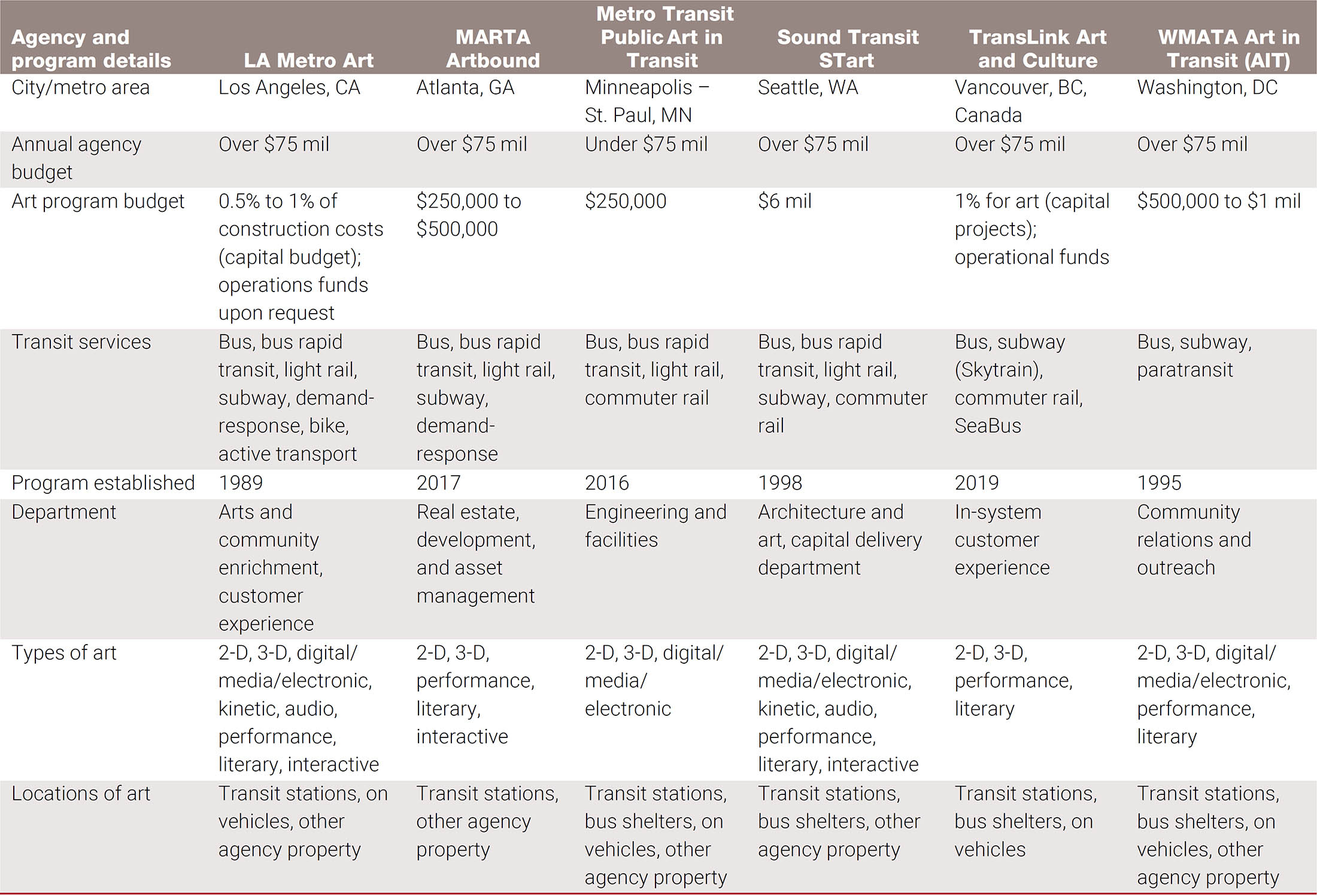
Every agency offers subway/rapid transit service or at least high-capacity light rail service and, except for Metro Transit, has annual budgets exceeding $75 million. Of the six art in transit programs, three were established after 2015, two in the 1990s, and one in the 1970s. Three programs are housed within departments related to customer experience and community outreach, and three are housed within departments related to facilities or the capital program. Although not all programs report their budgets in comparable ways, all programs have budgets of at least $250,000, and many obtain variable funding from capital projectsʼ budgets. These budgets vary annually. All the programsʼ collections contain 2-dimensional and 3-dimensional pieces, and all but one commission literary art and performance art. Many also commission digital/media/electronic art and interactive pieces. All have art located at transit stations, and all but one place art on vehicles and at other station property. Many have art located on bus shelters (Table 4).
Case Example Highlights
The following are notable aspects of each art in transit program that are highlighted in the case examples:
- LA Metro Art
- Percent-for-art policy
- Procuring durable artwork and siting it in places that can be seen externally to improve the systemʼs image and attract new riders
- Engaging artists through a wide range of projects that can accommodate various levels of experience and specialty in support of the regional, world-class community of artists
- MARTA Artbound
- A new program under an agency that does not receive state funding and is experiencing significant financial constraints
- Flexible funding for commissioning, installation, and maintenance
- An evolving organizational structure that maintains sufficient agency support and allows simplifying artist contracting workflows
Long Description.
The column headers of the table are agency and program details, LA Metro Art, MARTA art bound, Metro Transit Public Art in Transit, Sound Transit Start, TransLink Art and Culture, and WMATA Art in Transit (AIT). The data in the table row-wise are as follows: Row 1: City or Metro area: Los Angeles, CA; Atlanta, GA; Minneapolis - Saint Paul, Minnesota; Seattle, Washington; Vancouver, British Columbia, Canada; Washington, DC. Row 2: Annual agency budget: Over 75 million dollars; Over 75 million dollars; Under 75 million dollars; Over 75 million dollars; Over 75 million dollars; Over 75 million dollars. Row 3: Art program budget: 0.5 percent to 1 percent of construction costs (capital budget), operations funds upon request; 250,000 to 500,000 dollars; 250,000 dollars; 6 million dollars; 1 percent for art (capital projects), operational funds; 500,000 to 1 million dollars. Row 4: Transit services: Bus, bus rapid transit, Light rail, Subway, Demand-response, Bike, Active transport; Bus, bus rapid transit, Light rail, Subway, Demand-response; Bus, bus rapid transit, Light rail, Commuter rail; Bus, bus rapid transit, Light rail, Subway, Commuter rail; Bus, Subway (SkyTrain), Commuter rail, SeaBus; Bus, Subway, Paratransit. Row 5: Program established: 1989; 2017; 2016; 1998; 2019; 1995. Row 6: Department: Arts and Community Enrichment, Customer Experience; Real Estate, Development, and Asset Management; Engineering and Facilities; Architecture and Art, Capital Delivery Department; In-System Customer Experience; Community Relations and Outreach. Row 7: Types of art: 2-D, 3-D, Digital or Media or Electronic, Kinetic, Audio, Performance, Literary, Interactive; 2-D, 3-D, Performance, Literary, Interactive; 2-D, 3-D, Digital or Media or Electronic; 2-D, 3-D, Digital or Media or Electronic, Kinetic, Audio, Performance, Literary, Interactive; 2-D, 3-D, Performance, Literary; 2-D, 3-D, Digital or Media or Electronic, Performance, Literary. Row 8: Locations of art: Transit stations, on vehicles, other agency property; Transit stations, other agency property; Transit stations, Bus shelters, on vehicles, other agency property; Transit stations, Bus shelters, other agency property; Transit stations, Bus shelters, on vehicles; Transit stations, Bus shelters, on vehicles, other agency property.
-
- Collaborating with external partners, including business and community improvement districts and organizations running major sports events
- Decommissioning older artwork that was inherited before the programʼs establishment
- Metro Transit Public Art in Transit
- Funding through local municipalities
- Art at bus shelters and other facilities that mitigates vandalism and graffiti, reducing the need for maintenance and earning enthusiasm from other agency departments
- Using a roster of artists and engaging the community through events to reduce the demands on artists and the community
- Sound Transit STart
- Percent-for-art policy with funding that is not restricted to specific projects
- Art as a tool to build community support for transit
- Reducing demands on artists by separating design, fabrication, and installation responsibilities and contracts
- Funding maintenance budget
- TransLink Art and Culture
- Percent-for-art policy
- A new program that has evolved significantly over its brief history, changing departments, the types of artwork procured, and how its collection is maintained and curated
-
- Engaging artists in the procurement and fabrication processes by addressing difficulties that artists have with standard contracting with design-only contracts and using invitational applications rather than only open calls
- Maintaining its collection and decommissioning artworks that were installed before the programʼs establishment and are reaching their 25-year life expectancies
- Focusing on achieving the programʼs aim to “surprise and delight” rather than evaluating the effect on ridership numbers
- WMATA Art in Transit (AIT)
- Incorporating art into an architecture-focused design
- Procuring quality artwork through support from executive leadership and external collaborations, including donations
- The need for updated policies and procedures, particularly regarding maintenance and decommissioning
Common Themes
Notable common themes identified in the case examples include funding, program management, engaging with artists and communities, and maintenance and decommissioning. As case examples were selected using self-reported descriptors that imply success, much of this discussion regards practices or policies that program staff viewed as successful.
Funding
Multiple programs (Sound Transit STart, LA Metro Art, and TransLink Art and Culture) are funded through percent-for-art mechanisms that are fully met. Sometimes this funding is restricted to procuring art for the capital project from which the funds originate. In the case of Sound Transit STart, the funding is tied to voter-approved budgets for system-level capital expansions and may be used broadly within large service regions for any project and for procurement or maintenance. Because these large budgets are estimates and may not make up the ultimate construction expenditure for all the included projects, STartʼs budget ultimately might not make up the full committed percentage of construction costs. In many ways, however, the security of having a fully allocated budget and the ability to plan art procurements from the outset defrays the loss from this funding gap.
Without a fully committed percent-for-art mechanism, other programs (Metro Transit Public Art in Transit, MARTA Artbound, and WMATA AIT) have funded procurements through partnering with local municipalities, business improvement districts (BIDs) and community improvement districts, arts councils, special events organizers, and other local organizations. A reliance on annual discretionary budget approval for program operations can lead to inconsistent funding and difficulties with maintaining planned work. For WMATAʼs transit system, local governments have funded capital projects, such as infill stations, and have allocated a portion of the construction costs to commissioning art under WMATA AIT.
One program, TransLink Art and Culture, receives funding from another internal department, (i.e., funds for Indigenous art provided by TransLinkʼs Indigenous Relations Department).
Program Management
All programs have been provided with significant support from agency executive leadership for establishing and maintaining the programs and for overcoming challenges. In general, representatives of the programs highlighted this support as essential. Art in transit programs are minor components of the transit agencies, and this support enables them to secure funding and
be afforded sufficient attention within larger capital projects. MARTA Artbound and Sound Transit STart describe having dealt with negative feedback for specific artwork. Support from executive leadership, who understood that art may provoke such reactions and that the programs were well-intentioned, was essential to managing these issues successfully.
Engagement with internal departments at the transit agencies has affected the success of these programs. Multiple programs (WMATA AIT, MARTA Artbound, and TransLink Art and Culture) have moved among departments, which has affected the programsʼ operations and contracting options, usually with greater flexibility and improved operations over time. Metro Transit Public Art in Transit has found that maintenance and facilities departments have become enthusiastic about its programs and actively identify potential locations for art.
All programs depend on internal expertise both in arts and in transit operations and contracting and employ full-time staff with this expertise. LA Metro Art also hires project managers per project from a large pool of experienced professionals in the region.
Engaging with Artists and Communities
Most of the programs (LA Metro Art, MARTA Artbound, Metro Transit Public Art in Transit, Sound Transit STart, and TransLink Art and Culture) are working to reduce the demands on artists, especially related to contracting. Sound Transit STart and TransLink Art and Culture are experimenting with design-only contracts to relieve artists from being responsible for fabrication and installation when the general contractor could handle it. Metro Transit Art in Transit maintains a roster of artists, and MARTA Artbound is working to create one to reduce the burden on both the art in transit program with commissioning artists and the artists themselves with submitting proposals for each project. LA Metro Art offers a wide range of projects that can accommodate various levels of artistic experience and specialty.
The programs involve local communities to different degrees and in different ways. Multiple programs (LA Metro Art, MARTA Artbound, Metro Transit Public Art in Transit, Sound Transit STart, and TransLink Art and Culture) intentionally procure art that focuses on representing the local community for some of their commissions. Frequently, these pieces include community participation in their creation, such as oral history projects, poetry events, performances by local artists, and art projects by local community groups.
By virtue of the groups of artists who submit proposals, most artwork commissioned by MARTA Artbound, Metro Transit Art in Transit, and Sound Transit STart is by local artists. Metro Transit Public Art in Transit staff expressed interest in exploring ways to cross-pollinate artistic ideas and provide more opportunities to local artists, such as an artist exchange between art in transit programs for projects of similar sizes and budgets. LA Metro Art also aims to contribute to the regionʼs identity as a global arts capital and to support the regionʼs thriving community of artists and arts professionals. These programs may commission artists to create art that represents local communities, but none of the programs commission artists as community representatives.
Multiple programs (MARTA Artbound and Sound Transit STart) include local representatives, who do not necessarily have experience with art, in selection panels. Other programs (LA Metro Art, Metro Transit Public Art in Transit, and TransLink Art and Culture) have art program staff attend regular community meetings for the larger capital project or run meetings regarding the art commission to receive feedback on artistic goals and proposed artwork and placement. The remaining program (WMATA AIT) includes art professionals and representatives from local arts councils in its Art Advisory Committee and then hosts a community meeting for the broader public once art has been selected and sometimes after it has been installed. All the programs solicit community feedback through their agenciesʼ customer service lines and social media accounts.
Maintenance and Decommissioning
Most of the programs (LA Metro Art, Metro Transit Public Art in Transit, TransLink Art and Culture, and WMATA AIT) have limited to no dedicated maintenance budget. Another program (Sound Transit STart) has limited access to artwork locations for maintenance. In these contexts, the programs prioritize commissioning durable art. Metro Transit Public Art in Transit, TransLink Art and Culture, and WMATA AIT intentionally avoid kinetic, interactive, digital, or light art because of previous experiences of such pieces not being durable.
Many programs (MARTA Artbound, Metro Transit Public Art in Transit, TransLink Art and Culture, and WMATA AIT) have inherited legacy collections that were installed during major capital expansions from the 1970s to 2000s before the programs were established. Many of these inherited artworks were not maintained sufficiently and therefore fell into disrepair. In addition, many of these pieces are installed at stations and other locations that now are undergoing full renovations. In this context, these programs are facing necessary removal of artwork and developing decommissioning policies. All programs follow federal, state, and local regulations regarding removing public artwork, including notifying the artist or the artistʼs estate and providing right of first refusal when appropriate. Frequently, it is difficult to relocate the piece without further destroying it. If the artwork is replaced, the programs typically aim to maintain the original artistʼs intentions with the replacement work. MARTA Artboundʼs experience decommissioning a piece at the Atlanta airport, where the lighting context permanently altered the original pieceʼs artistic intentions, is notable.
None of the programs decommission artwork for reasons other than for state of repair, for safety, or for major changes in the physical context that prevents maintaining the piece. Recognizing that degradation of artwork and changes in the physical context are inevitable, LA Metro Art and other programs do not refer to artwork as “permanent” and instead use terms like “integrated.”
LA Metro Art
Background Information
- Location: Los Angeles, California
- Agency annual budget: $75,000,000+
- Transit services: Bus, Bus Rapid Transit, Light Rail, Subway, Demand-Response, Bike, Active Transportation, Freeway (Limited)
- Program established: 1989
- Department: Arts and Community Enrichment, Customer Experience
- Website: https://www.translink.ca/rider-guide/art-and-culture-program
- Art program budget (Percent for Art): Minimum of 0.5% of construction costs for transit capital projects
- Types of art: 2-Dimensional, 3-Dimensional, Digital/Media/Electronic, Kinetic, Audio, Performance, Literary, Interactive
- Locations: Transit station – Publicly accessible areas and fare-restricted areas, On vehicles, Other agency property
History: Building a Premier Public Art Collection with a “Percent for Art”
Los Angeles is viewed as a global arts capital. In this context, LA Metro aims to leverage the regionʼs “remarkably talented artists [and be . . .] at the national forefront of interweaving art and transit and transforming quotidian commutes into pleasurable journeys” (LA Metro 2021).
As voters have approved additional funding for the transit system, they also understand they are contributing to this arts program and its collection.
1983
The Southern California Rapid Transit District (a predecessor agency to LA Metro) adopts an Art Program Policy as part of the Metro Rail mitigation program contained in the environmental impact report. This policy sets the “percent-for-art” formula, introduced by its vice president and actor George Takei, which directs a minimum of 0.5 percent of construction costs for transit capital projects to art.
1989–1990
In 1989 the Metro Art program begins, and the first art program staff member is hired. The programʼs structure consists of limited permanent staff with temporary staff hired to work on projects as needed. Art is procured using LA Metroʼs standard competitive process. In 1990 the first Metro Rail service opens. Metro Art releases its first commemorative poster and starts its Young Artists Program.
- Funding: Minimum of 0.5 percent of construction costs for transit capital projects
- Management responsibility: Limited permanent staff with temporary staff hired to work on specific projects; art procured using standard, competitive LA Metro procedures
- Art: Commemorative poster, artist engagement
1991–2015
In 1991 Metro Art installs its first integrated public artwork. The Metro Rail system continues to expand, supported by regional taxpayer-funded initiatives, and the Metro Art collection and its programs also expand. This includes the poetry program (1998), the lightbox exhibition program (2001), the Through the Eyes of Artists program (2003) that encourages traveling to neighborhoods and other destinations via Metro, and the performing art program with the Metro Art Passageway Gallery at Union Station (2013). The programs at Union Station (Figure 20), which is owned by LA Metro, are funded through a variety of sources, including property management and an FTA grant. They intend to position Union Station as an iconic cultural destination and increase business interest in and public engagement with the station.
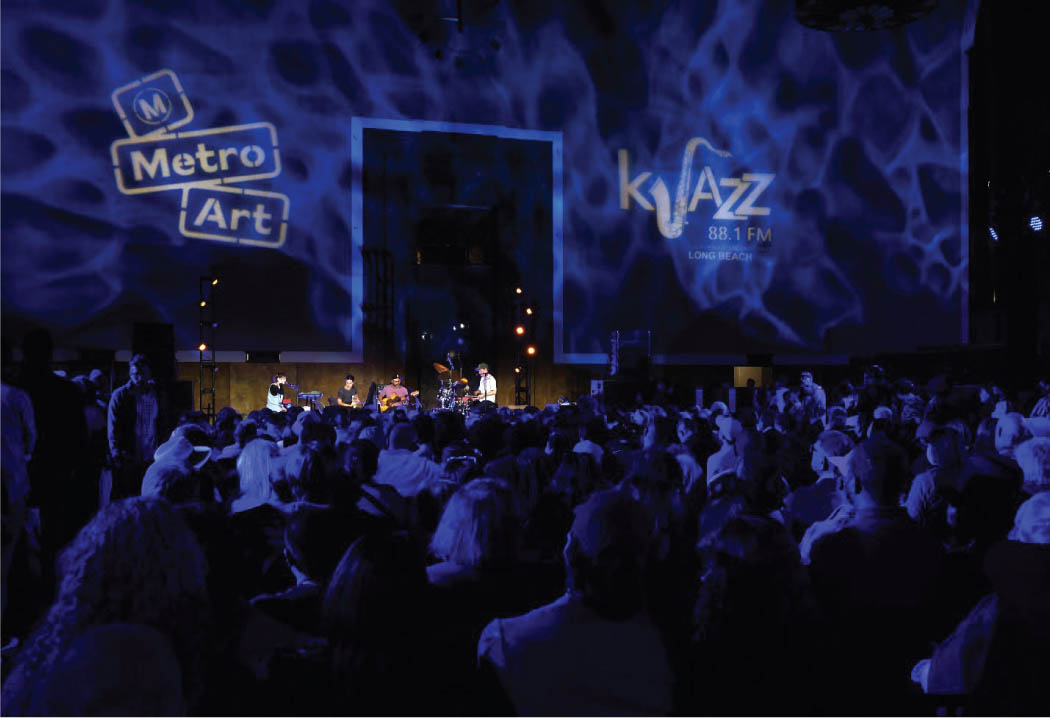
(Photo courtesy of LA Metro Art)
Long Description.
A band is on stage. The audience is seated in a dimly lit venue, featuring Metro Art and K JAZZ 88.1 FM logos projected on the walls.
- Funding: Minimum of 0.5 percent of construction costs for transit capital projects; operational budget
- Management responsibility: Limited permanent staff with temporary staff hired to work on specific projects; art procured using standard, competitive LA Metro procedures; sometimes artwork is licensed for temporary exhibition
- Art: Permanent and temporary installations; visual, performance, literary
2016–2025
The passage of the FAST Act in late 2015 placed new restrictions on the uses of FTA funding. When working with FTA-funded projects, Metro Art uses funding from non-FTA sources to cover costs that are not eligible for use of FTA funds. These funding sources are available, as voters in the LA region continue to pass initiatives for taxpayer funding, including one in 2016 that makes a 1 percent sales tax allocated to LA Metro permanent.
Metro Artʼs collection and programs continue to expand, including with the digital media program (2019) and the Metro Art Bus program (Figure 21) (2022).
- Funding: Minimum of 0.5 percent of construction costs for transit capital projects; operational budget
- Management responsibility: Limited permanent staff with temporary staff hired to work on specific projects; art procured using standard, competitive LA Metro procedures, sometimes artwork is licensed for temporary exhibition
- Art: Permanent and temporary installations; digital/media/electronic, kinetic, audio, performance, literary, interactive; on vehicles
Present (2025)
As the LA region prepares for the “transit-first” 2028 Olympic and Paralympic Games—planned to not allow visitors and spectators to take private vehicles to games—the 2026 World Cup, and the 2025 Super Bowl, LA Metro has many transit capital construction projects underway, and all include percent-for-art projects. To deliver these projects, Metro Art is supported by a large team, which includes temporary employees who are working on construction projects

This bus features Metro riders in portraits created by more than 40 local artists in an immersive street to seat experience spanning the entire exterior and interior of three buses. Rider portraits also are featured on TAP cards (fare media) and on digital displays at rail stations. (Photo courtesy of LA Metro Art)
that will serve Games venues. Metro Artʼs collection expands beyond the rail network to be featured at bus stations, on bus fleet exteriors, onboard artwork exhibitions, in transit facilities, on bridges and overpasses, in plazas, and on TAP cards (fare media).
Metro Art pays special attention to siting art in locations that provide maximum visual effect and are welcoming to riders, and using durable materials adapted for high-use areas and LAʼs environmental conditions (i.e., intense sunlight and marine environment). Recognizing that most public art does not last forever, Metro Art uses the term “integrated” instead of “permanent” (Figure 22). Metro Art is addressing a backlog of required maintenance work. This is discussed more later.
- Funding: Minimum of 0.5 percent of construction costs for transit capital projects; operational budget; some maintenance funding allocated during the annual budget process
- Management and operations: Team of approximately 15 full-time and 10 part-time employees and 20 volunteers
- Art: Showcase of the regionʼs status as a global arts capital; architecturally integrated artwork and temporary installations; visual, digital/media/electronic, kinetic, audio, performance, literary, interactive; on vehicles
Siting and Maintaining Art: Maximum Impact and Longevity
Metro Art considers artwork locations, fabrication materials, and media for art using the following factors:
- Maximum visual impact in the transit environment
- Fidelity to and compatibility with artistic processes
- Durability and longevity in high traffic, pass through, dwell time, and touch zone environments
- Safety: No sharp edges/corners, does not impede egress/ingress
- Environmental: Resistance to fading sunlight, heat gain, and durability in a marine environment, among other factors
- Maintainability and lifecycle costs
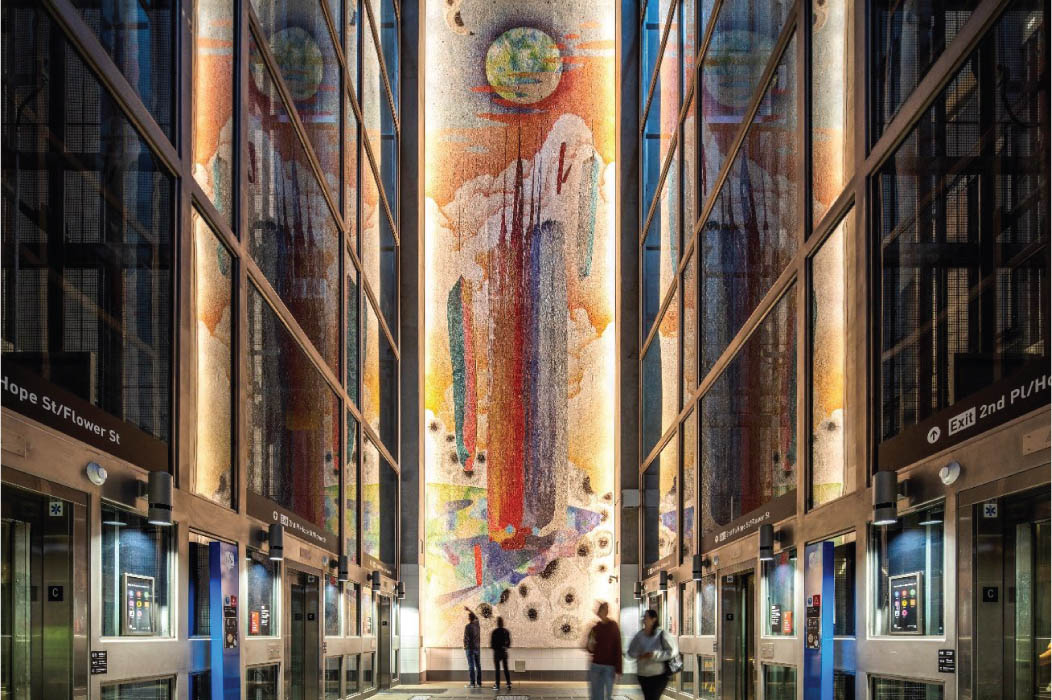
“High Prismatic” is an integrated piece composed of a glass mosaic that rises over 60 feet at the Grand Av Arts/Bunker Hill station. The piece “[reflects] upon the geological, anthropological, and cultural histories of the region served by the station [and] depicts an explosive, colorful eruption rising out of an infinitely roiling landscape toward a spray-tinted, celestial expanse” (Hsiung 2023). (Photo courtesy of LA Metro Art)
In improving the transit experience, Metro Art prioritizes interacting with the broader community beyond riders in fare-restricted areas by siting art in locations, such as visible areas of at-grade stations (even if fare-restricted), above-ground at underground stations, on bus exteriors, and at Union Station with hosted performances. This contributes to a welcoming and attractive experience, elicits support from people who may not yet use the transit system, and supports LA Metroʼs goal to shift transportation mode use to transit from the prevalent passenger vehicles (Figure 23).
As Metro Artʼs collection has aged, it has developed a backlog of conservation and ongoing maintenance needs, which mirrors the situation with the aging parts of LA Metroʼs transit system in general. LA Metro and Metro Art are beginning to address this backlog through capital refurbishment projects. Metro Art also requests funds to address specific issues on a project-by-project basis under a board-approved Phased Art Asset Management Plan.
When maintaining art, Metro Art may coordinate with the original artist if major refurbishment or refabrication is required beyond cleaning graffiti or other minor repairs. In most cases, Metro Art decommissions artwork only when it is damaged beyond salvageability (e.g., station demolition destroying poured pavement art). When decommissioning art, federal and state protections for artists and artworks apply, and the artist frequently has the right of first refusal. Metro Art aims to contact the original artists well ahead of any information becoming public and to honor their intents when reimagining decommissioned artwork; however, engaging the original artist is not always possible, such as when an artist is deceased.
Engaging with Artists and the Community
In addition to supporting LA Metroʼs mission to serve regional mobility needs, Metro Art contributes to the LA regionʼs arts ecosystem and provides opportunities for artists and designers at any stage of their careers, from emerging to established professionals, to showcase their

The Gold Line Bridge, designed by Andrew Leicester, evokes a snake lying across the 210 Freeway in Arcadia and pays tribute to the local landscape and the cultural heritage of the San Gabriel Valley. The piece is oriented externally, under a light rail highway overpass and not visible to the rail passengers. It is, however, visible to drivers, increasing LA Metroʼs attractiveness and serving a core goal of LA Metro to induce mode shifts from passenger vehicles to transit. (Photo courtesy of LA Metro Art)
experiences and specialties in a wide range of art media. Metro Art also conducts targeted outreach to artists and provides technical assistance and workshops for local artists. Metro Art has engaged more than 1,000 artists and designers.
Through open, public, and competitive procurement processes, Metro Artʼs project-specific selection panels of arts professionals (with ties to local communities and the transit riding experience) recommend artists from national, statewide, and countywide calls, depending on the projectʼs funding sources. Some projects, such as larger-scale and architecturally integrated works for station expansions, require yearslong engagements and complicated contracting. Temporary exhibits frequently are commissioned through less complex contracts or licensing agreements, which require lower time commitments from artists (Figure 24).
Community engagement also is a central component of the Metro Art program, and it is undertaken in various ways throughout the life of a project. During a capital projectʼs early planning process, Metro Art conducts cultural asset mapping by meeting with community members to better understand neighborhood history and values. Art advisory groups serve as liaisons between the agency and local communities, and artist selection panels are composed of arts professionals rooted in the communities served. Metro Art also provides a variety of opportunities for the community to engage with commissioned artists and participate in Metro Art events. Throughout Metro Artʼs history, hundreds of local arts and culture organizations have been involved with Metro Art programs.
LA Metroʼs current highest growing ridership demographic is leisure riders, including people traveling to arts, culture, and entertainment destinations. For these customers traveling by transit to arts and culture destinations, Metro Art builds even stronger connections by fostering a full arts experience throughout the entire journey. Together, Metro Artʼs artwork, exhibitions, performing arts, and other programs connect its riders and the broader community to place, showcase the diversity of Los Angeles, and elevate transit to a unique experience on its own in addition to a mode of transportation.
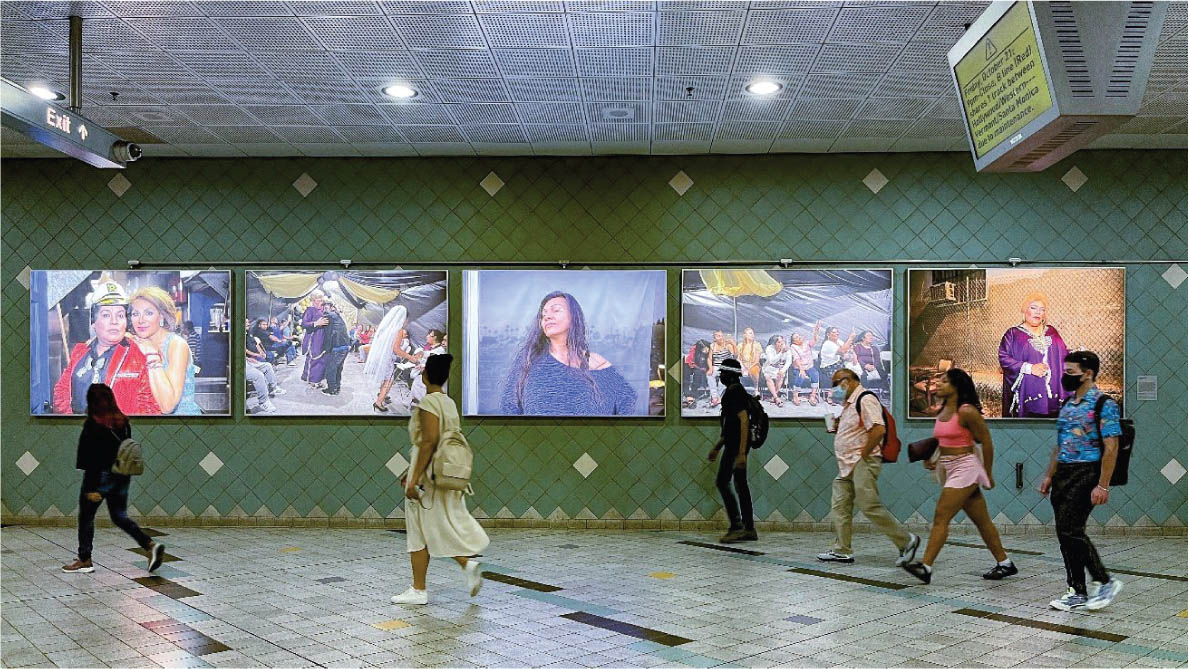
The Lightbox Exhibition Program showcases temporary, less-durable, 2-D media (i.e., posters and photography) and provides less-intensive opportunities for artists to engage with Metro Artʼs program. (Photo courtesy of LA Metro Art)
Long Description.
The station shows a large portrait displayed on the wall, showcasing various individuals in different settings.
Documentation and Procedures
- Metro Art Program Policy
- Metro Systemwide Station Design Policy
- Metro Phased Art Asset Management Plan
MARTA Artbound
Background Information
- Location: Atlanta, Georgia
- Agency annual budget: $75,000,000+
- Transit services: Bus, Bus Rapid Transit, Light Rail, Subway, Demand-Response
- Program established: 2017
- Department: Real Estate Development and Asset Management
- Website: https://itsmarta.com/artbound1.aspx
- Art program annual budget: $250,000–$500,000
- Types of art: 2-Dimensional, 3-Dimensional, Performance, Literary, Interactive
- Locations: Transit station – Publicly accessible areas and fare-restricted areas, Bus shelters, Other agency property (e.g., retaining walls)
History: Establishing a New Program
1970s–2000s
As MARTA builds a rail system, it commissions one artwork (mural or sculpture) per station for $50,000 or 1 percent of the design budget, whichever is less. Some of the artists likely raise additional funds to help increase the impact of their pieces.
- Management responsibility: Project contractor
- Funding: $50,000 or 1 percent of design budget as part of station construction
2015–2016
Inspired by Atlanta airportʼs public art program and other art in transit programs, MARTA creates a steering committee to develop an art in transit program.
- Management responsibility: MARTA Steering Committee
2017–2019
In 2017 MARTAʼs Artbound program launches, first hosted directly under the Chief of Staff and then under the Transit-oriented Development and Real Estate Department in the capital program. MARTAʼs Board Policy on Art in Transit entitles Artbound to request funding of up to 1 percent of eligible capital budget funds. This excludes federal funds but includes the bulk of MARTAʼs revenue from local sales taxes and fareboxes. (MARTA does not receive state funding.)
Artbound commissions multiple sculptures, murals, and other visual art (Figure 25) and starts a performance art program, Artbound LIVE, that pays musicians to perform busking-style at stations throughout the system. The program also develops partnerships with nonprofits and private organizations, including with Atlanta and the Super Bowl committee to commission two murals for the 2018 Super Bowl and with regional business alliances.
- Management responsibility: One staff member under the chief of staff and then the Transit-oriented Development and Real Estate Department (capital program)
- Funding: Entitled to request up to 1 percent of eligible capital funds
- Art: Visual (sculptures and murals); performance (live music, theater, dance, and spoken word)

The mounds were used during a 2018 ribbon-cutting for “Confluence: Burst Forth with A Terrific Noise” by Andrew Catanese, which is a mural at the Midtown station and was commissioned in partnership with the local BID. (Photo courtesy of MARTA Artbound)
2020–2023
Following the onset of COVID-19 and declining tax and fare revenue, MARTA scales back its capital budget and previously planned rehabilitations for original stations that were built in the 1970s.
In line with the Board Policy on Art in Transit, Artboundʼs budget increases to support expanding programs, and its staff increases to three. Its focus transitions to building partnerships with business and community improvement districts. Performance art (Figure 26) and temporary art are funded through MARTAʼs operations budget.
- Management responsibility: Three staff members under Transit-oriented Development and Real Estate Department (capital program)
- Funding: Entitled to request up to 1 percent of eligible capital funds; operating budget (for performance and temporary art)
- Art: Visual (mainly murals) and temporary; performance (live music, theater, dance, and spoken word)
2024–Present (2025)
MARTA is experiencing significant budget shortfalls. Artboundʼs funding requests are fulfilled at 25–50 percent, and its budget is reduced to $500,000 in 2024 and $250,000 in 2025 (i.e., roughly 0.05–0.1 percent of eligible funds of a capital budget of $500 million). Because of this, Artbound
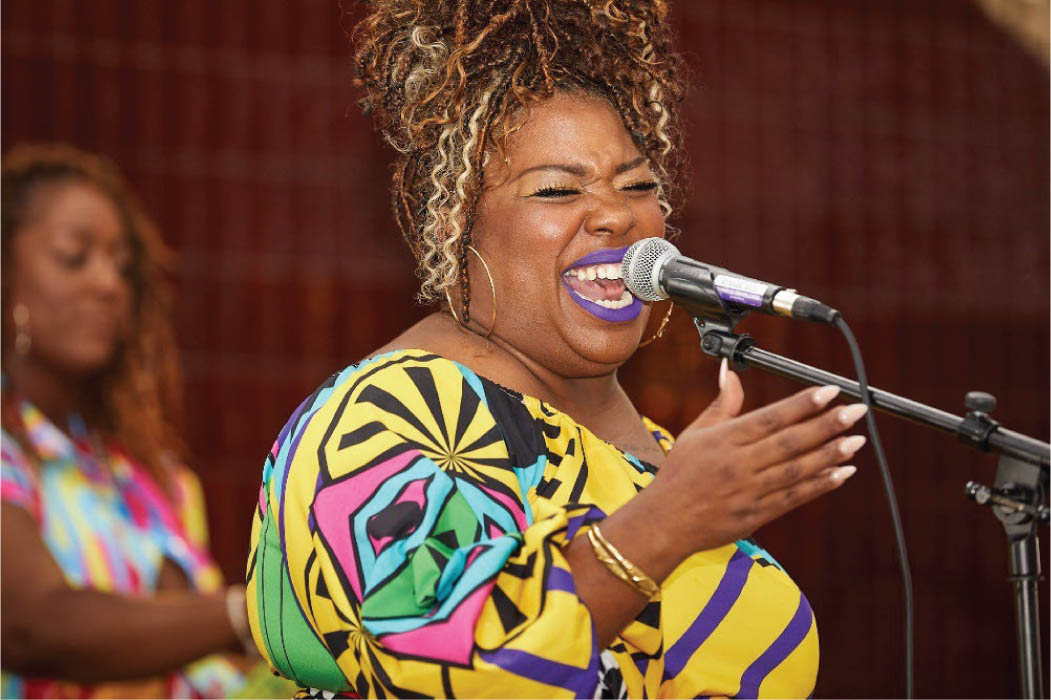
(Photo courtesy of MARTA Artbound)
is unable to maintain existing programs and ends the busking program, curtails a partnership with a local musical theater, and suspends a major mosaic commission. Artbound is continuing partnerships with local BIDs and community improvement districts, pursuing grants, and investigating opportunities for corporate sponsorship, such as with the upcoming World Cup.
Real Estate, Development, and Asset Management (REDAM), Artboundʼs department, is moved to operate under the Operational and Urban Planning Department.
- Management responsibility: Three staff members under REDAM (operational and urban planning program)
- Funding: Entitled to request up to 1 percent of eligible capital funds—significantly reduced allocations; operating budget (for performance and temporary art)—significantly reduced allocations
- Art: Visual (mainly murals) and temporary; performance (live music, theater, dance, and spoken word)
Improving Procedures and Policies and Identifying Needs
While Artbound operates under a board-approved Policy on Art in Transit, it had to develop a variety of other informal practices, procedures, and policies over the first decade of the program.
Organizational Structure: Arts Expertise, Agency Support, Simplified Contracting, and Flexible Funding
Artbound required an administrator with expertise in the arts to understand how to design, fabricate, and commission art and how to coordinate with artists, especially as the program moved among departments and the capital and operational programs. As the program was being established, it reported directly to MARTAʼs chief of staff. Since being removed from this position, Artboundʼs programs and tasks are approved by a manager, and, when needed, approval is escalated to higher-level MARTA management. This structure requires strong advocacy from multiple staff levels to ensure sufficient support for the program. In addition, other departments at MARTA still are inexperienced with Artboundʼs projects, procurements, and contracts, leading to continued challenges with setting these up.
Artboundʼs department now is within the operational and urban planning program after being in the capital program. Under the capital program, Artboundʼs projects were tied to large-scale capital projects. MARTAʼs standardized and lengthy project management rubric for these design-build contracts frequently was challenging for commissioned artists. With smaller contracts under the operational program, Artbound can simplify workflows in ways that make it easier for artists to work with MARTA, even while continuing to receive funding from the capital program and use the standardized design-build contracts.
Artbound also has an advisory council, and criteria for membership were defined after the program was established. These require that each member resides or works in MARTAʼs jurisdictional areas and shows commitment to at least two of the following: arts, the local community, and transit. Many of the members work at local municipalities.
Artboundʼs funding is flexible and can be allocated broadly to commissioning, installing art, and maintaining art of any media throughout MARTAʼs transit system. In addition, the Policy on Art in Transit has been amended to clarify that art excludes advertising.
Siting Art: Working with Partners
Much of Artboundʼs art is commissioned and sited in collaboration with partners, including BIDs and community improvement districts, which frequently provide the funding and sites for art. Coordinating with property owners also can be a challenge, as with an interactive art installation underneath a CSX-owned freight overpass (Figure 27).
Although a significant majority of MARTAʼs ridership travels by bus, Artbound had difficulty installing art at bus shelters and on buses, because the appropriate surfaces for art are owned by an advertising company. Artbound has experimented with integrating art into the bus system in ways that do not involve these sites (Figure 28).
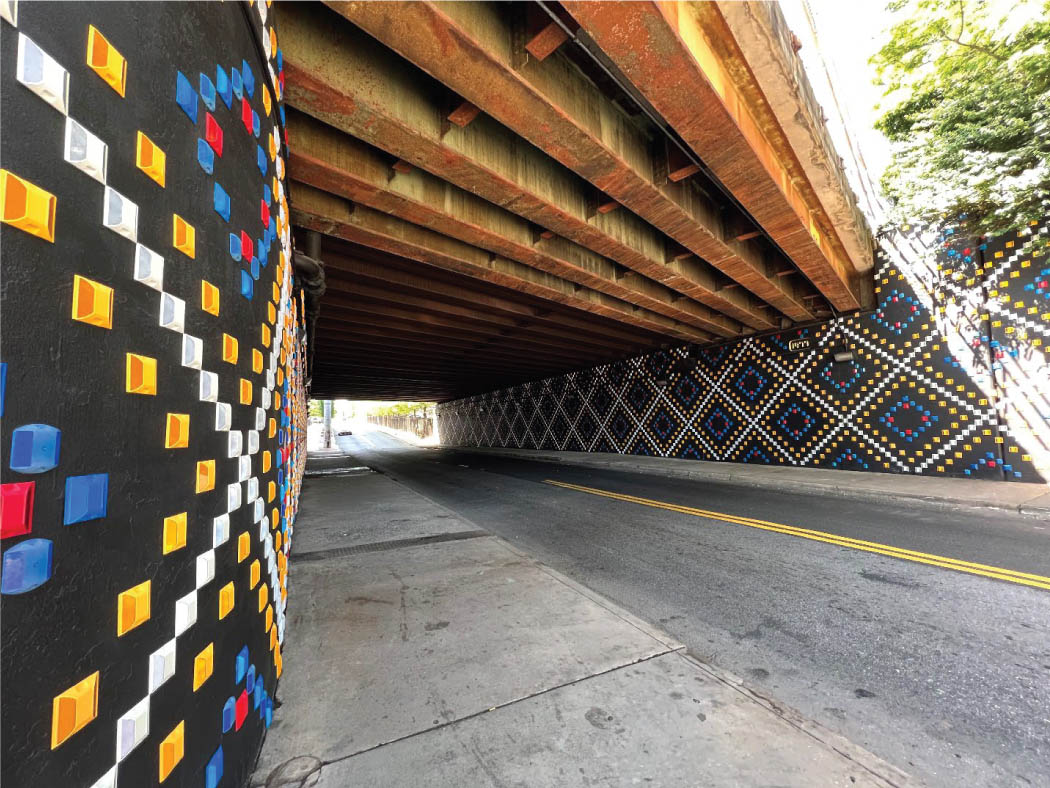
This is a 300-foot installation that includes 20,000 reflectors that transform a pedestrian route through an underpass near a MARTA station into an interactive experience. In collaboration with the surrounding community, oral histories reflecting the past and the present are shared through QR codes. Coordinating with CSX, which owns the freight overpass, and Atlanta, which owns the land, posed challenges in addition to the site being near water runoff pipes and traffic lanes. (Photo courtesy of MARTA Artbound)
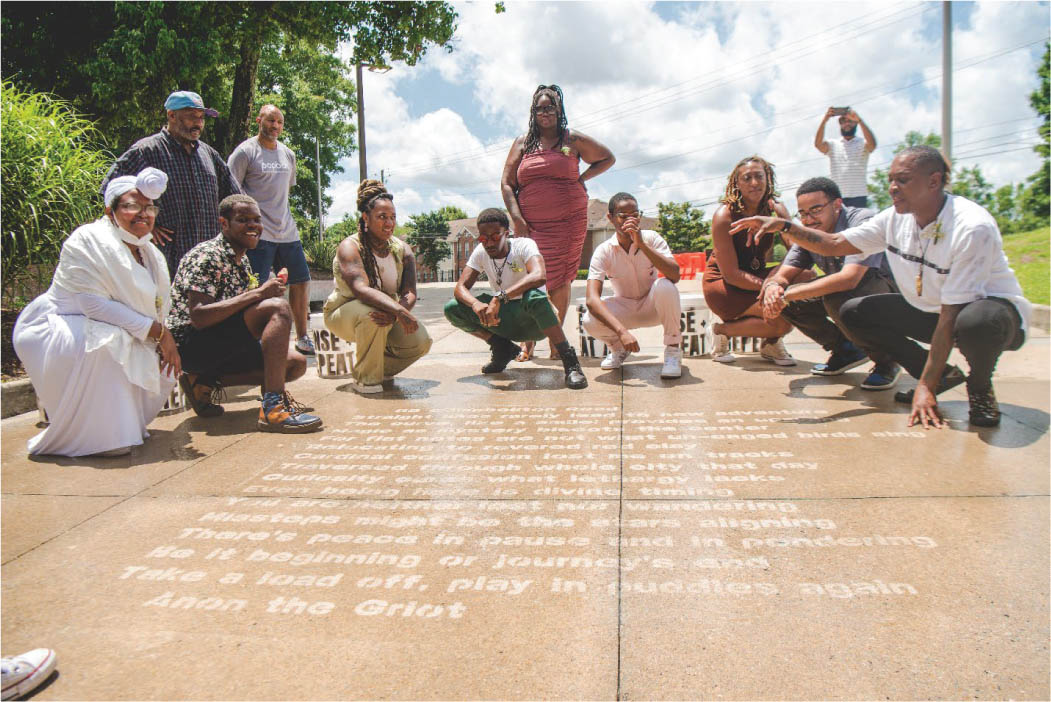
This work was stenciled onto concrete at 10 bus shelters (with one painted in large scale at a train station) and visible only when rained on (or with water poured onto them). The project culminated in a community celebration and poetry slam at a MARTA station. (Photo courtesy of MARTA Artbound)
Commissioning Art: Clarifying the Process
Artbound is continuing to refine its process for commissioning art. Its current guidance is modeled on the processes outlined in Atlantaʼs public art master plan, but, as MARTA is a quasi-governmental institution, Artbound has more flexibility to modify its own processes. Artbound puts out a call for proposals. Because the calls frequently net hundreds of proposals, Artbound staff narrows down the proposals to those that are feasible and from artists with sufficient experience. A selection panel of stakeholders and arts professionals, including Artbound staff, then reviews the shortlist, and panel members may review any of the other submissions, if they wish. Artboundʼs staff is interested in more consistent processes and structures, such as an artist roster maintained in coordination with other regional public art programs, to make commissioning art less time-consuming. For smaller projects, such as a design for the Artbound tote bag, Artboundʼs staff directly chooses the artist.
Most of the artists Artbound commissions are local, because it is easier to coordinate with local artists and because many of the projects require being local, such as for the “Reflection Tunnel” that incorporated community oral history. Artbound aims to ensure that the art it commissions is fundamentally appropriate for the public realm but to not dictate the content further. Artboundʼs experience has shown that micro-managing the content of art can lead to sub-par art and negative feedback from the community. As Artbound refines these processes, the support of MARTA management is essential to allowing the capacity to make mistakes in commissioning art and artists (Figure 29).
Decommissioning Art: Inheriting Older Pieces
Artbound inherited legacy artwork that was installed when MARTAʼs rail system was built in the 1970s and 1980s and was in disrepair by 2017. In this context, the Policy on Art in Transit incorporated decommissioning from the beginning. For artwork that is in disrepair, the decommissioning process involves contacting the artist or heirs of the artist and collaborating on how to proceed. Artbound has not had challenges in these cases, and artists have been understanding of the situation or even surprised that their artworks were still in place. In addition, the decommissioning policy considers the impact of artwork. This factor has been most relevant when the surroundings and context of site-specific artworks change (Figure 30).

The groupʼs work is not frequently featured in institutional environments, so the artists were strongly encouraged to keep the mural family-friendly. Community feedback criticized the childish appearance of the mural, and many felt that the groupʼs animal icons in this context were offensive caricatures of people. (Photo courtesy of MARTA Artbound)
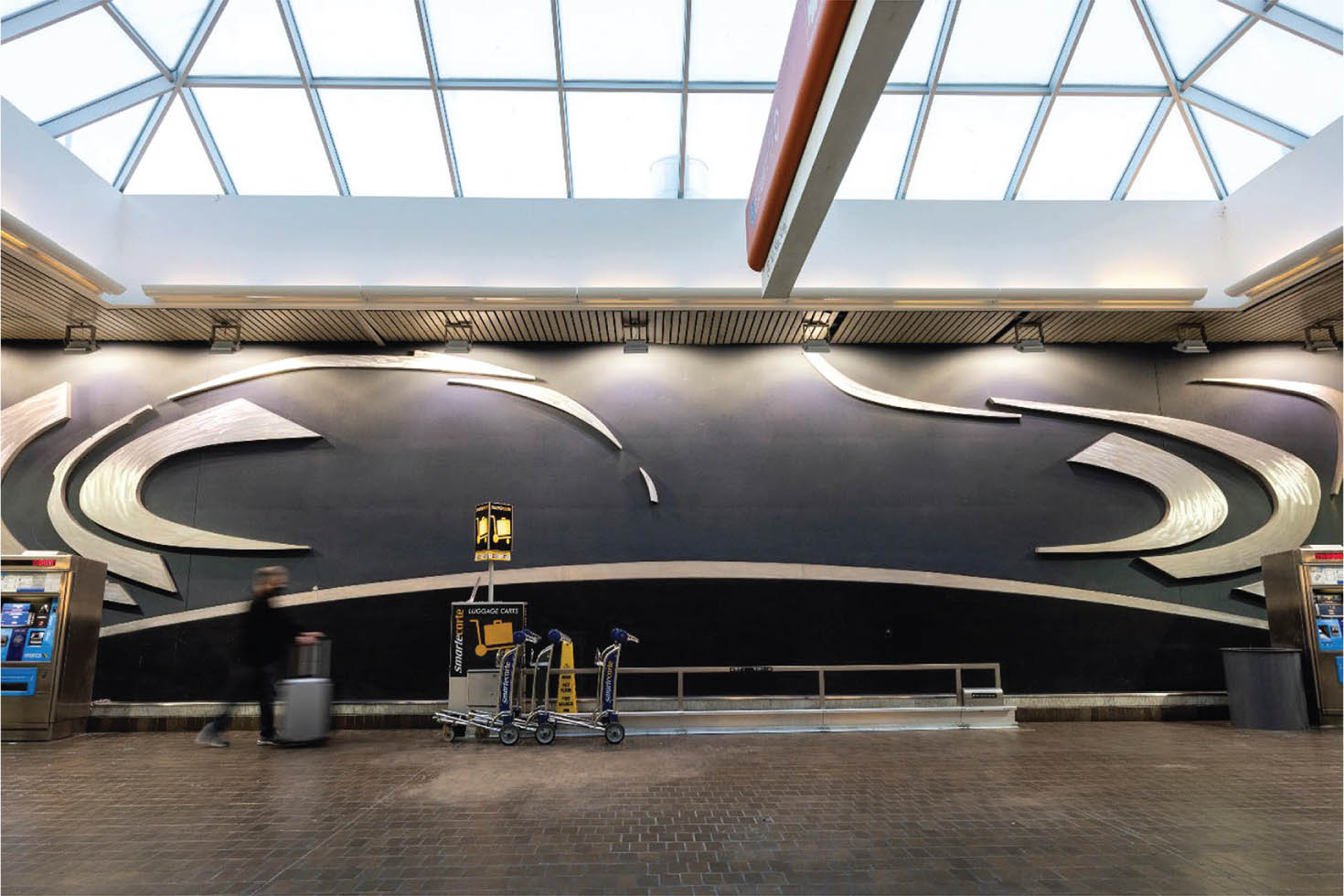
“Solar Prominences” was installed at the Airport Station in the 1980s to reflect a specific lighting design in the room, making the pieceʼs surfaces look on fire. When skylights were installed and LED lights replaced the original high-pressured sodium lights, this piece lost this integral context. In 2024 it was removed and replaced with a new tile mural by local artist Michael Jones. (Photo courtesy of MARTA Artbound)
Evaluating the Impact of a New Program
Artbound and MARTA gathered limited information on customersʼ views of the program. When Artbound interacts with customers, especially during live performance events, customers generally offer positive feedback. MARTA has included questions on art in the system as part of general customer surveys. Responses show almost universal approval and indicate that the art program leads to customersʼ interest in using MARTA, but it is unclear if these responses are representative of all of MARTAʼs general ridership. Artbound is interested in gathering higher-quality information on the impacts of the program, especially in a context where many view art in transit as a luxury.
Documentation and Procedures
- MARTA Board Policy on Art in Transit
- Informal policies as the program has developed
Metro Transit Public Art in Transit
Background Information
- Location: Minneapolis–St. Paul, Minnesota
- Agency annual budget: $5,000,000–$74,999,999
- Transit services: Bus, Bus Rapid Transit, Light Rail, Commuter Rail
- Program established: 2016
- Department: Engineering and Facilities
- Website: https://www.metrotransit.org/public-art-in-transit
- Art program budget: $250,000
- Types of art: 2-Dimensional, 3-Dimensional, Digital/Media/Electronic
- Locations: Transit station – Publicly accessible areas and fare-restricted areas, Bus shelters, On vehicles, Other agency property
History: Changes in Funding, Administration, and Types of Art
2000–2015
With federal funding allocated to art in transit, new construction of Blue Line and Green Line light rail line included projects for art at each station (Figure 31).
After art was installed, the large collection was not maintained sufficiently, and much of it fell into disrepair or was damaged.
- Management responsibility: Project-specific arts administrator (hired for the duration of a capital project)
- Funding: Federal construction grants
- Art: Permanent installations, including kinetic pieces and larger pieces at transit stations
2016–Present (2025)
Given the elimination of federal funding for new art, the Metro Transit staff, who maintained existing art, advocate for a permanent arts administrator position, and Metro Transit hires an arts administrator in 2016. This updated art program is funded through Metro Transitʼs operations funds and partnerships with local governments that enthusiastically support art in transit.
Some large pieces still are commissioned, but the program focuses on smaller and temporary art made of durable materials (and not kinetic or interactive digital) and is sited in maintainable locations (Figure 32).
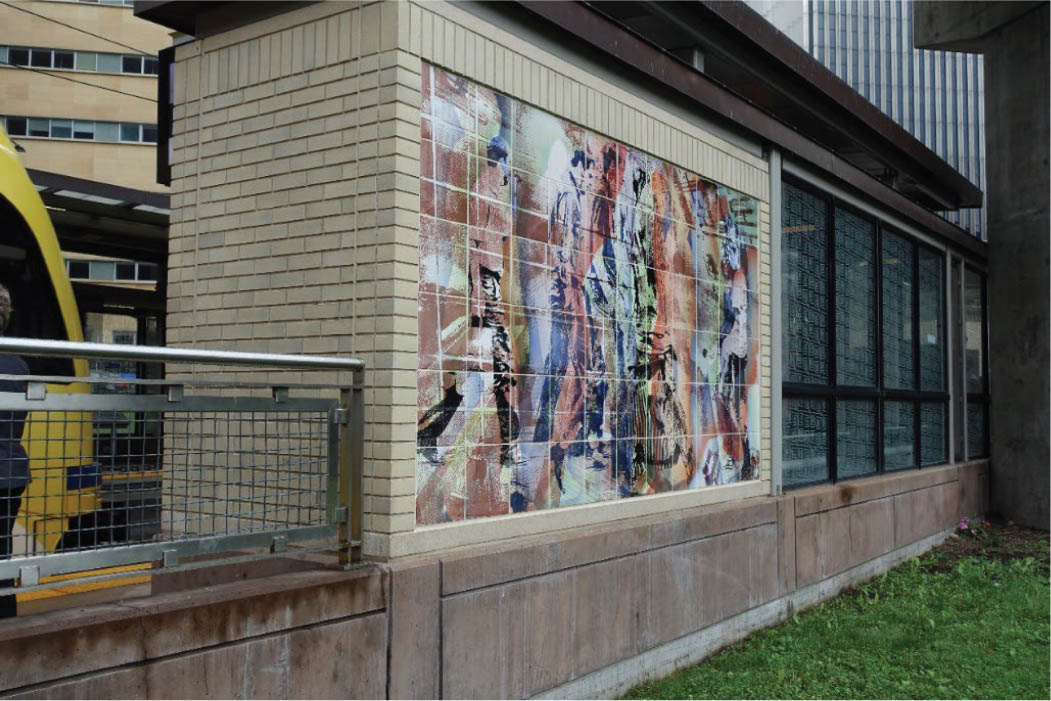
“Downtown” (one component pictured), is a large, 8,000-sq.-ft. mosaic art that was installed at Central Station in St. Paul in 2013. It inspired positive local curiosity during installation and incorporated a neighborhood festival, including a community painting activity. (Photo courtesy of Metro Transit Public Art in Transit)
Long Description.
The mural features abstract patterns with various shapes and textures. It is next to a large glass window and a metal railing. The surrounding area includes a grassy patch.
(Photo courtesy of Metro Transit Public Art in Transit)
Metro Transit commissions art through an ongoing art integration program and through project-specific initiatives with external stakeholders, such as local governments. Art is not commissioned through capital expansion projects.
Because some art has aged or had flaws when installed, Metro Transit has decommissioned pieces. When decommissioning art, the main considerations are if the piece poses a danger to the public, if the location cannot accommodate art anymore, and if the repair of the piece is greater than 50 percent of the original cost. The community is engaged in this process, the artist is contacted regarding reclaiming or moving the art, and the original intent of the piece is considered for future work, such as using different materials for a similar installation.
- Management responsibility: Agency arts administrator
- Funding: Local government
- Art: Smaller temporary and permanent installations, not including kinetic or interactive/digital pieces (which failed in the past) (Figure 33)
Art as a Maintenance Tool and Stakeholder Support
A major component of Metro Transitʼs art collection is its Bus Stop Beautification Program where local artists are selected and paid $900 to design bus shelter art clings (Figure 34). In addition to general beautification throughout a system that has majority-bus ridership, Metro Transit has found that art clings reduce glass breakage by 60 percent and graffiti by 50 percent. This saves

This piece was an original Blue Line interactive art installation that allowed people to communicate with videos of local residents. While the artwork was not durable and quickly broke after its installation in 2004, its connection to local history is a justification for repairing and preserving the piece somewhere that is not high-impact. (Photo courtesy of Metro Transit Public Art in Transit)
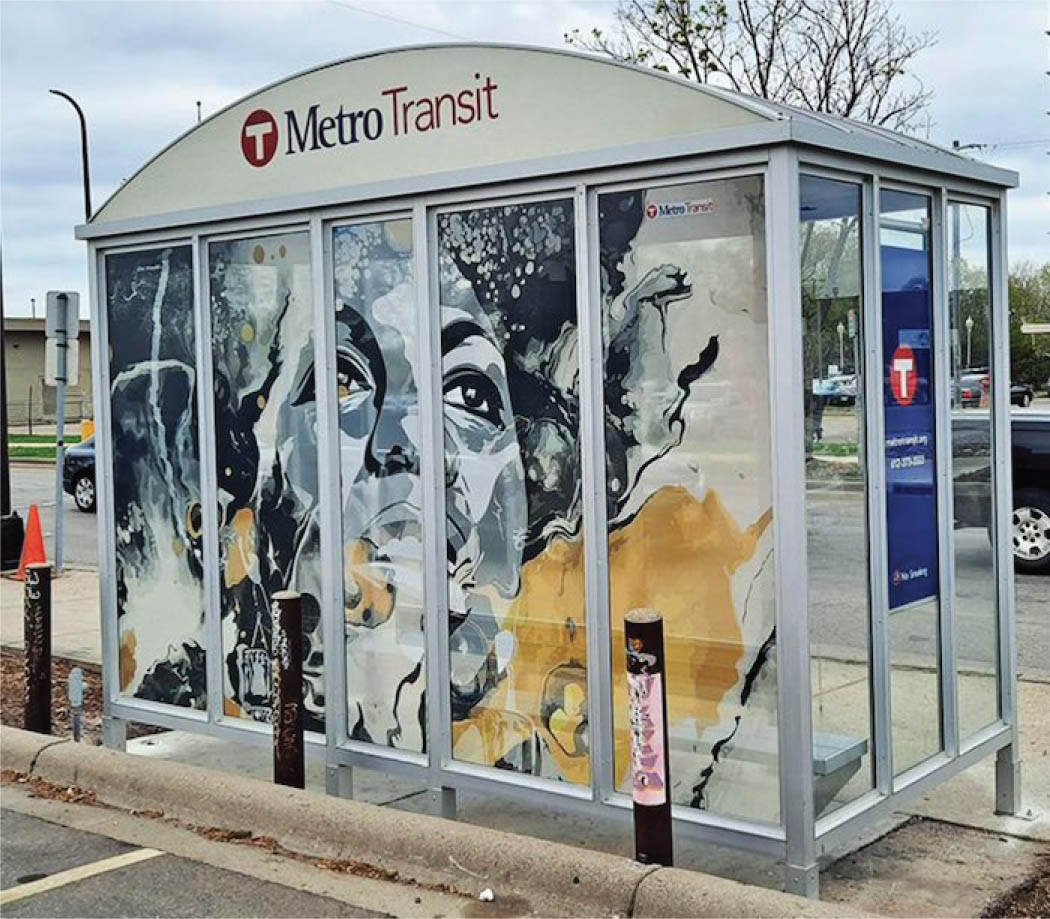
This is one of many installations using glass cling at Metro Transitʼs bus shelters under the Bus Stop Beautification Program. (Photo courtesy of Metro Transit Public Art in Transit)
Long Description.
The shelter’s glass panels display the large mural of Nina Simone’s face, incorporating abstract elements of swirling patterns and textures.
considerable effort and funds in trying to maintain facilities throughout the seven-county service area. In addition, neighborhood communities are enthusiastic about these art installations, and community organizations request them to serve as lower-cost ways of bringing local character to the neighborhoods.
Because of this success, Metro Transit is installing other vandalism-deterring and vandalism-resistant artwork. On the Green Line light rail, Metro Transit replaced copper grid panels with art-designed anodized aluminum at platforms. People frequently kick out the original panels, but they refrain from damaging the artistic panels. A station that was near the central George Floyd protests required extreme efforts to clean, leading to stripping down materials to the metal. Metro Transit commissioned a local artist to create colorful murals on anti-graffiti wallpaper, which has been effective in discouraging graffiti and being easy to clean in the infrequent cases of graffiti (Figure 35). At a station that is set to be redesigned soon, Metro Transit is experimenting with art embedded in polycarbonate instead of glass.
Such positive effects against vandalism have galvanized enthusiasm among internal stakeholders in Metro Transitʼs engineering and facilities departments. Staff who lead construction projects look for opportunities to integrate art on bus shelters, utility cabinets, and other infrastructure. It is this enthusiasm and frequent engagement with maintenance and facilities, planners, and construction managers that increases the programʼs capacity and sustainability. Program staff also would like more enthusiastic engagement from bus drivers and mechanics on art bus wraps, because drivers interact with the public the most and may have better insight into how the public views art.
Community Representation and Artist Roster
Metro Transitʼs Art in Transit program is interested in ways to use art for community engagement; it is apparent that many local communities are exhausted by traditional engagement methods
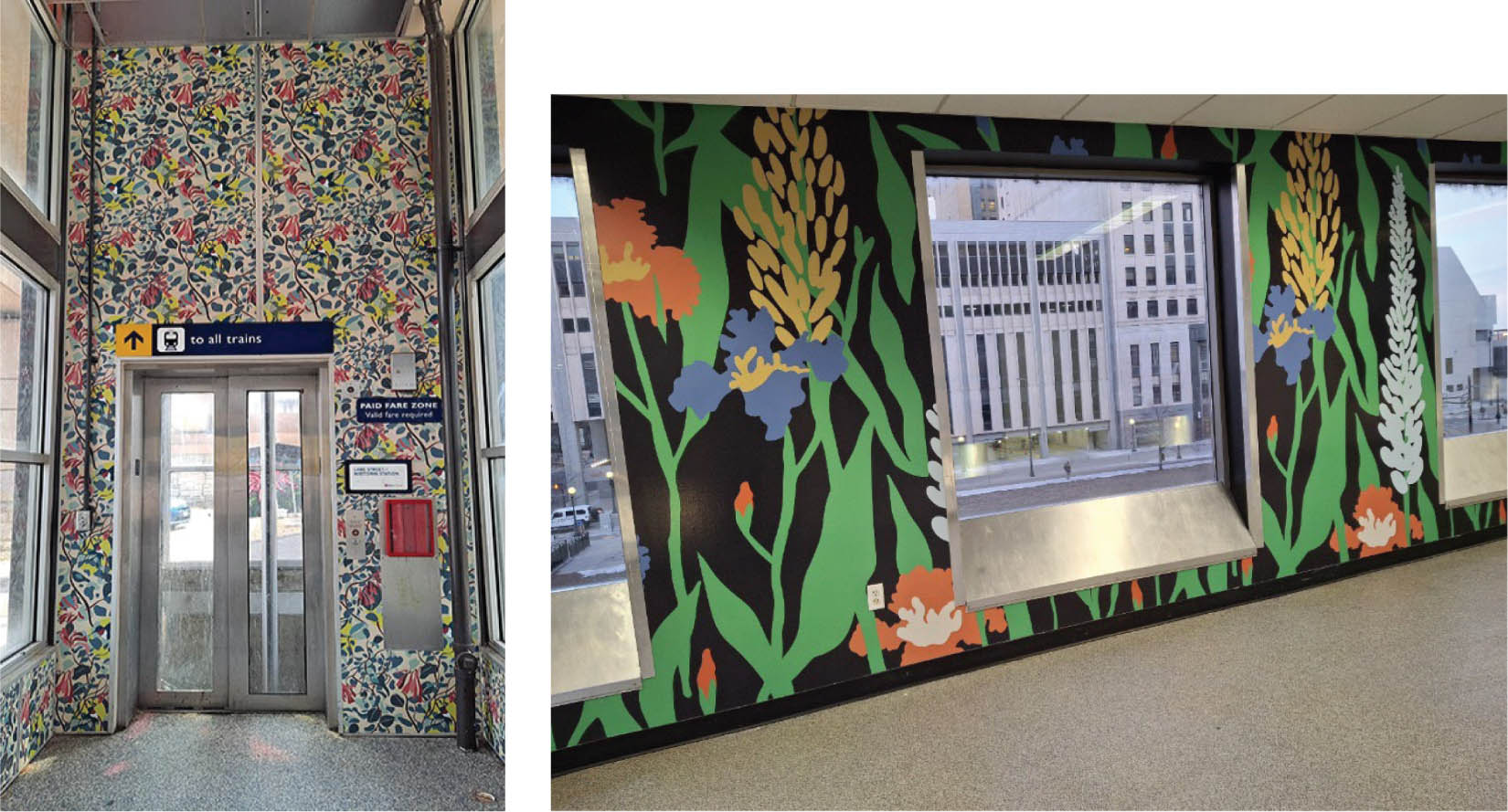
(Photos courtesy of Metro Transit Public Art in Transit)
Long Description.
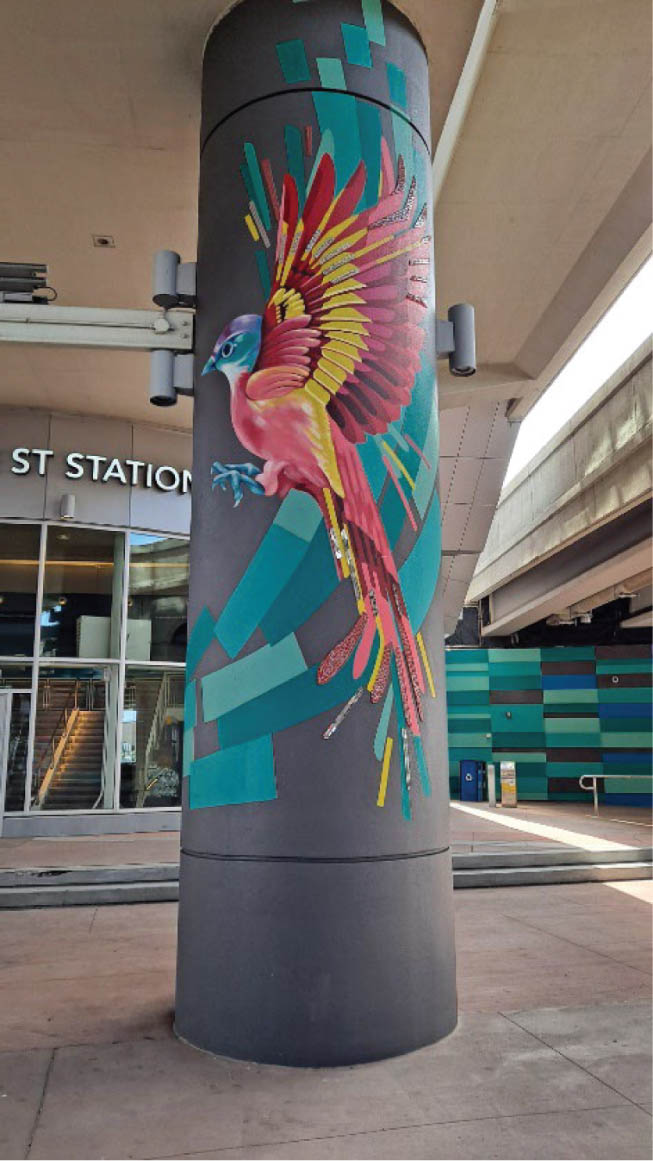
Designs by Nicky Works Studio shows a colorful floral pattern around an elevator at the Lake Street-Midtown Station. Genessis Lopex shows a colorful floral pattern surrounding the windows at the Central Station Skyway, St. Paul. The design in both murals includes various flowers and leaves.
such as surveys and other standard community engagement activities. Because of this, the Art in Transit program is working to bring art into local community festivals to activate engagement.
As another way to reduce demands on both local artists and selection panels, the Art in Transit program maintains a sign-up roster for artists. A selection panel—made up of agency staff, external stakeholders involved in public, and sometimes artists—selects artists from the roster with appropriate skills and background.
Documentation and Procedures
- APTA Best Practices
- Internal guidelines on public art programming
- Americans for the Arts public art cohort
- Connections to other public arts organizations in the Twin Cities and the Metropolitan Council public art policy team
Sound Transit STart
Background Information
- Location: Seattle, Washington
- Agency annual budget: $75,000,000+
- Transit services: Bus, Bus Rapid Transit, Light Rail, Subway, Commuter Rail
- Program established: 1998
- Department: Architecture and Art, Capital Delivery Department
- Website: https://www.soundtransit.org/system-expansion/creating-vibrant-stations/start-sound-transit-art-program
- Art program annual budget: $6,000,000
- Types of art: 2-Dimensional, 3-Dimensional, Digital/Media/Electronic, Kinetic, Audio, Performance, Literary, Interactive
- Locations: Transit station – Publicly accessible areas and fare-restricted areas, Bus shelters, Other agency property
History: Art as an Integral Component of Transit
1998
Sound Transit is founded, and the board establishes an art in transit program as one of its first actions based on a strong history of local governments pioneering percent-for-art programs. Funding is allocated permanently (i.e., “lifetime allocation”), can be used on any site within the taxing subarea where the local funds are generated, and can be used for both procurement and maintenance of art.
- Management responsibility: STart program, artists involved throughout design and construction processes
- Funding: 1 percent of construction expenditures from each voter-approved initiative for Sound Transit build-out
- Art: Permanent, at light rail stations; temporary during construction
2000s–2010s
Two additional voter-approved initiatives provide more funding for expanding Sound Transitʼs transit system, including its art collection.
- Management responsibility: STart program, artists involved throughout design and construction processes
- Funding: 1 percent of construction expenditures
- Art: Permanent, at light rail stations; temporary during construction; and for rotating exhibits
2020s–Present (2025)
STart is experimenting with more flexible contracting methods to lower barriers to entry for artists. As the art collection grows and ages, a larger proportion of STartʼs budget is allocated to maintenance. A new performance art space opens with funding from the local government.
- Management responsibility: STart program, more flexible contract options and decreased demand for artistsʼ involvement beyond design artwork itself
- Funding: 1 percent of construction expenditures; trial initiative with a local government; increased proportion allocated to maintenance
- Art: Permanent, at light rail and bus rapid transit stations (Figure 36); performance
Funding: Allocated and Unrestricted One Percent for Art
STart is funded by a lifetime allocation (currently through 2049) of 1 percent of construction expenditures. This funding can be spent broadly on the program and is not restricted to individual projects or sites. Of this funding, at least 10 percent is allocated for maintenance, increasing in recent years because of higher relative maintenance costs. In the past decades, there have been three additional voter-approved initiatives to build out light rail, which also added to STartʼs budget. Sound Transitʼs board, which is composed of regional elected officials, has fully supported the STart program throughout this history.
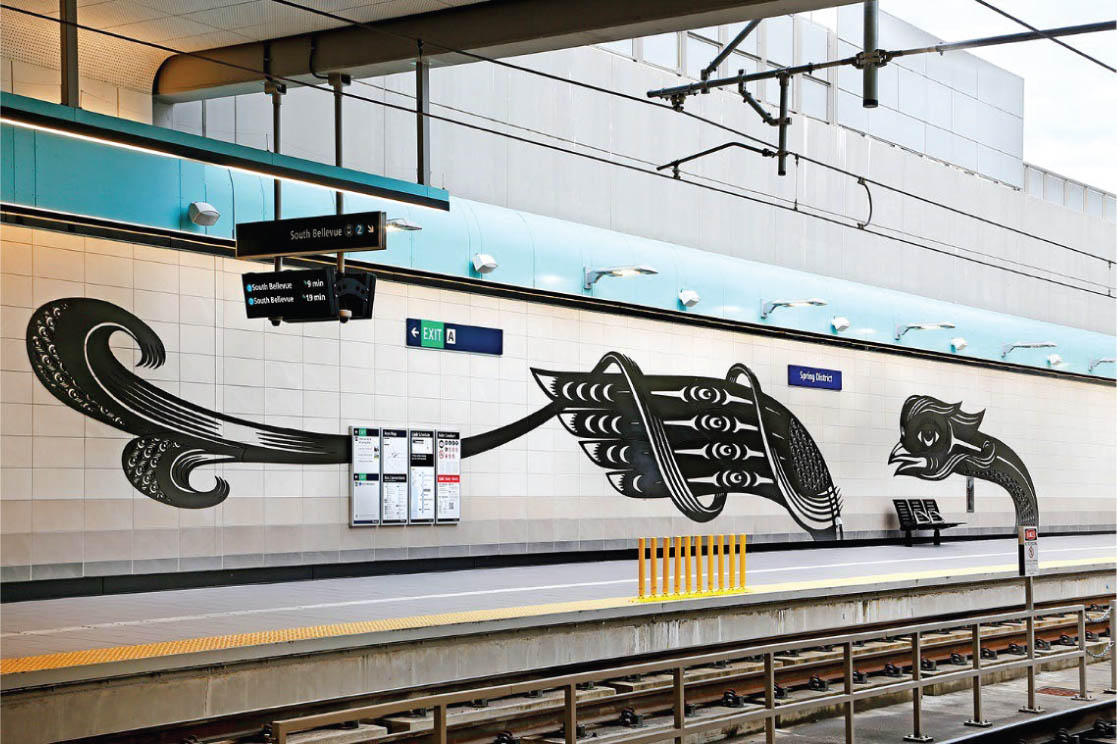
“Dragon and Phoenix” features cut metal murals of a phoenix, reflecting Nooksack culture, and a dragon, reflecting Chinese culture. Each mural spans opposite platform walls. (Photo courtesy of Sound Transit STart)
Funds for STart are allocated from local government sources for Sound Transit that make up most of the agencyʼs funding, such as car registration fees and sales tax. These funds are not tied to particular projects, but they must be used within the regional tax subareas in which the revenue was collected. No restrictions exist on which transit modes the funds support. The art is sited using the criteria that it is public and people using the system or in the neighborhood can see it.
A major factor in the stability of this funding is that it is awarded during the planning stages using estimates of future construction costs. Although this might not match the actual expenditures, it allows STart to begin planning and commissioning art during the project planning without waiting for construction contracts to be awarded. This leads to transformative, integrated art pieces. Once the final construction budget is determined, the budget for the art component may be adjusted proportionally higher but is not guaranteed to be.
Art in Support of an Expanding Transit System
Sound Transitʼs 27-year history has been defined by continued voter-approved funding and expansion initiatives. Including art appears to increase public enthusiasm for expanding the light rail infrastructure. In particular, artwork has contributed to alleviating neighborhood concerns over new transit infrastructure and service, and it has helped to convince stakeholders that transit is an economic engine and contributes to the character and future of the city. STartʼs art installations also have provided useful wayfinding landmarks for customers, many of whom are new light rail riders (Figure 37). As Sound Transit now is developing bus rapid transit routes, art is being used to elevate the stature of future bus rapid transit stations and routes to be on par with the light rail networkʼs image.
Currently, STart receives informal feedback from customers that is mostly positive. STart intends for its art to prompt introspection and emotion, and the most notable negative feedback it has received seems to have come from the public engaging with art in this context (Figure 38). STart also is considering creating a formal customer survey regarding the program.

(Photo courtesy of Sound Transit STart)
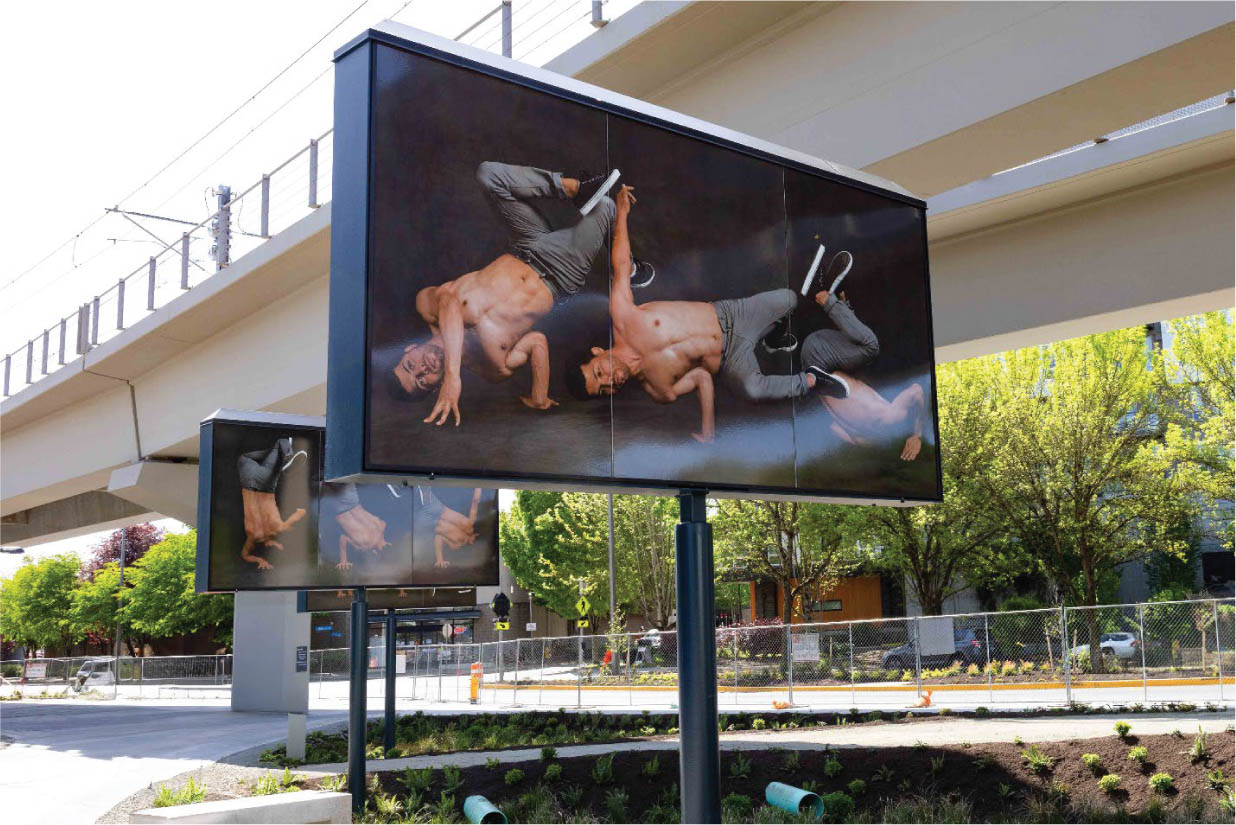
“Johnny Leggz” is part of a larger installation, “Pandemic Portraits,” of billboard-like panels around the Downtown Redmond Station, which opened in 2025. This piece provoked the most notable negative feedback of an artwork that STart has installed, likely because of the shirtless break dancer. The STart program believes that public art should prompt introspection and emotion, and these negative reactions were acceptable in this context. (Photo courtesy of Sound Transit STart)
Engaging Artists and Artist Selection: Separating Design and Fabrication
STart is experimenting with and pioneering various contracting methods to lower barriers to entry for artists and engage them better. When the program first was established, there was enthusiasm to follow best practices and include artists fully into the design team to introduce their perspectives throughout the design process. Today, however, many artists are more interested in simply making art than being involved in the entire design process.
In addition, STart is working on developing more flexible contracting methods that could open up opportunities for a wider range of artists. This includes having Sound Transit itself commission fabricators directly and setting design-build construction contracts that incorporate installing art. This allows selected artists to focus on designing the art without being responsible for higher-budget and more complicated aspects of the transportation construction process. Artists, who wish to contract with their own fabricators or to have full control over their art throughout the project, still have the option of traditional contracting with standard government contract restrictions, such as low-bid contracts. STart understands that nontraditional contracting also requires capable project managers within the STart program itself and good database management of the budget, contracts, projects, and existing conditions.
As Sound Transitʼs light rail system and station design has become more uniform, art media and fabrication methods also have become more standardized. For many artists, these constraints actually have provided opportunities to develop new skills. Given the regionʼs varied topography, however, the light rail system and its stations are not completely uniform, and there continue to be opportunities for varied media and fabrication methods (Figure 39).
Following federal guidelines, STart does not restrict opportunities to local artists and hires on the basis of artistsʼ qualifications. STart maintains a list of prequalified artists, from which
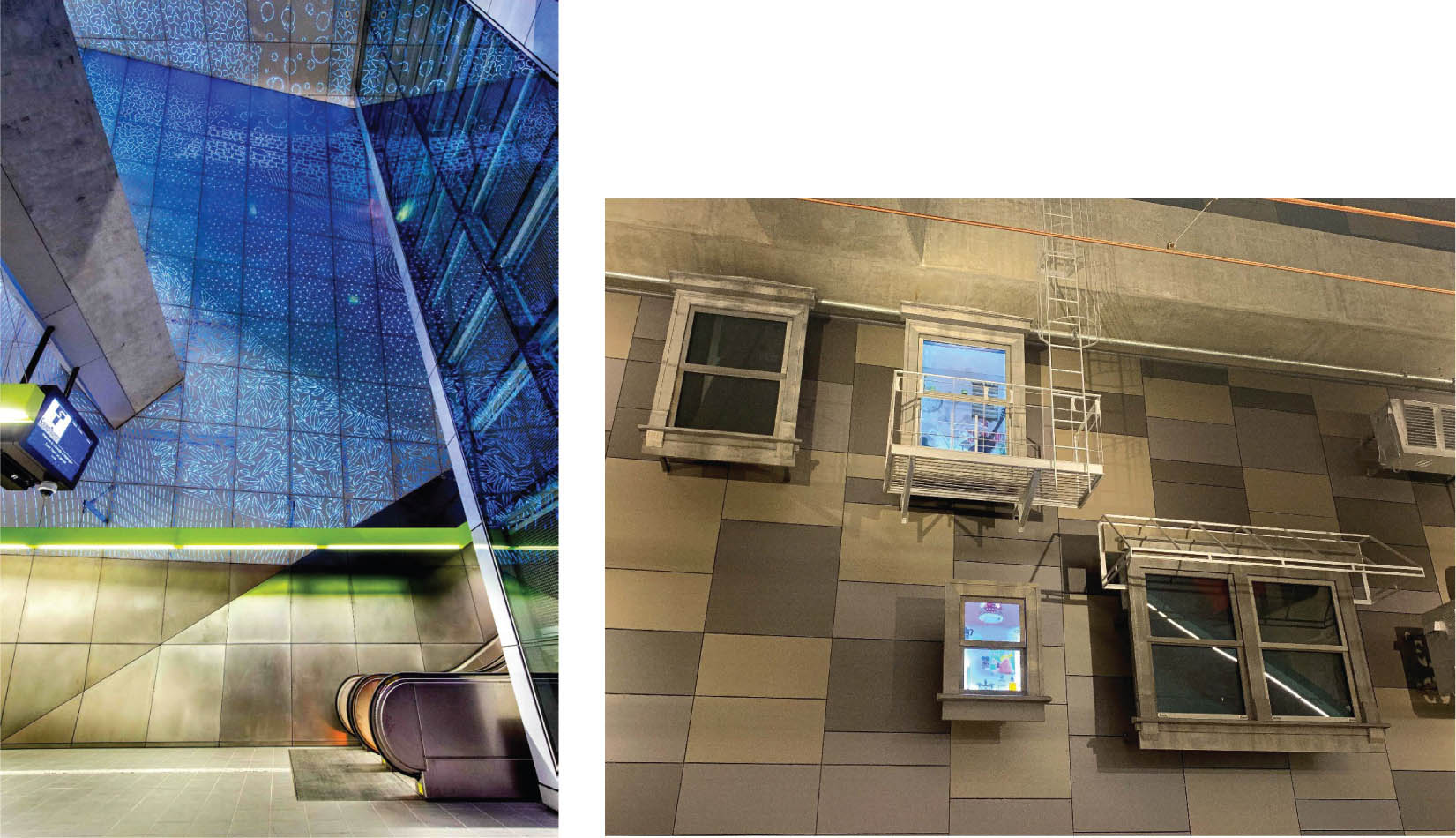
These art pieces are unusual for STartʼs collection: “Subterranium” by Leo Saul Berk (2016) has claimed a 70-foot high smoke baffle chamber using an elaborate backlit pattern through the walls. “Fragment Brooklyn” by Lead Pencil Studio (2021) is on a wall opposite a center platform and presents an array of miniature building facades to create an underground streetscape. In 10 of the windows, elaborate videos present the viewer glimpses of people doing slow-motion activities, such as playing violin or lighting a candle. These projects employ unusual art media and require significant effort to ensure durability. (The latter was fully functional by 2025, 4 years after initial installation in 2021 and 14 years after it was originally planned in 2011.) (Photos courtesy of Sound Transit STart)
Long Description.
Subterraneous shows an escalator descending into a brightly lit area with reflective surfaces and geometric patterns. Fragment Brooklyn showcases a wall that displays multiple windows and digital screens, with a grid-like pattern and metal elements.
it generates a shortlist for a panel, composed of five to seven art design professionals and representatives of community groups and business associations. Shortlisted artists present to the panel before selection. Frequently, panels prioritize artwork that will represent the community; however, a local artist may not always be the most appropriate choice. (STartʼs collection is approximately 75 percent designed by local artists.) Incorporating work by non-local artists allows greater artistic dialogue in the regional public art collection that STart curates.
A Focus on Maintenance and the Decommissioning Process
Because King County Metro operates and maintains Sound Transitʼs light rail stations, STart must obtain a permit and accompaniment from King County Metro to access its artwork. Given this limited access, STart generally is able to clean each piece only once a year and prioritizes installing artwork of the most durable materials (Figure 40).
STart has decommissioned art when surrounding facilities have been redeveloped or when the art has deteriorated beyond repair. The decommissioning process includes notifying the artist and assembling an outside panel to determine how to proceed. Artists do not have a formal appeals process, but STart attempts to accommodate their requests and interests. STart also aims to contact artists when major refurbishments or re-siting are planned. STart does not decommission artwork because of its content.
The portion of STartʼs budget allocated to maintenance has been maintained at approximately 10 percent, but it has increased in recent years because the art collection is growing and aging.
Documentation and Procedures
- Strategic Plan
TransLink Art and Culture Program
Background Information
- Location: Metro Vancouver, British Columbia, Canada
- Agency annual budget: $75,000,000+
- Transit services: Bus, Subway, Commuter Rail, Ferry, Paratransit
- Program established: 2019
- Department: In-System Customer Experience
- Website: https://www.translink.ca/rider-guide/art-and-culture-program
- Art program annual budget: 1% for art (capital projects) and operational funds through public art and Indigenous Cultural Recognition
- Types of art: 2-Dimensional, 3-Dimensional, Performance, Literary
- Locations: Transit station – Publicly accessible areas and fare-restricted areas, Bus shelters, On vehicles
History: A New Program with Significant Evolution
2000
Art is included as part of the architectʼs contract for the SkyTrain Millennium Line, which is constructed by the Province of British Columbia.
- Management responsibility: Project architect
- Art: Permanent installations, including kinetic pieces
- Funding: Construction contract
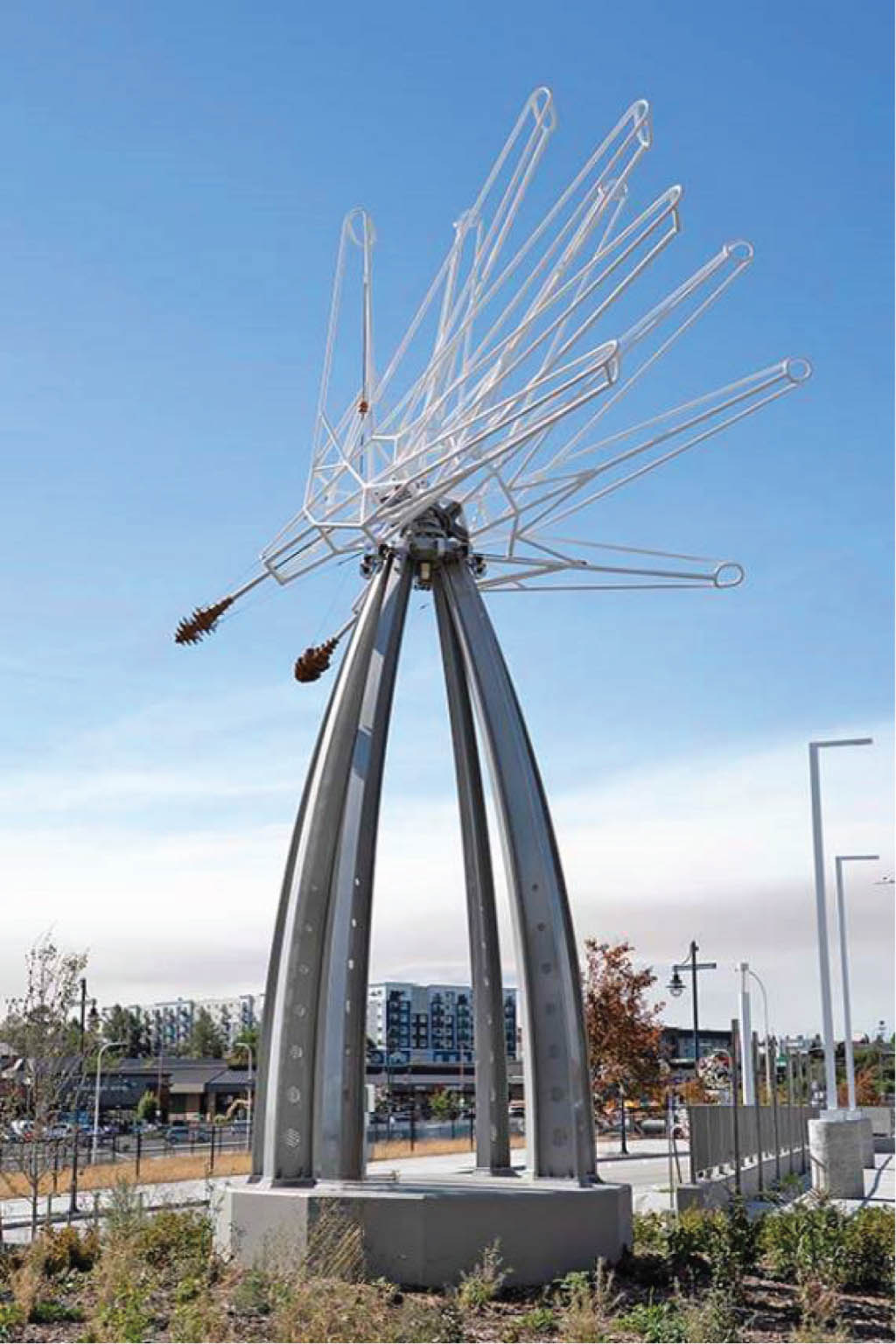
In 2006 this kinetic sculpture was installed in the center of a rotary for a highway ramp that was built to access the Federal Way Downtown regional bus hub. The siting negotiation process between Sound Transit and Washington DOT led Washington DOT to formalize an art plan request process for future projects. Sound Transit now is expanding a light rail line to include a new station at Federal Way Downtown, expected to open in 2025, and the bus facility was replaced by a new one closer to the light rail station. One of the columns for an elevated rail guideway lands at the original location of the sculpture, so the artwork was removed before construction. STart has restored and re-sited the piece at the new stationʼs passenger pick-up/drop-off location. (Photo courtesy of Sound Transit STart)
2013–2018
TransLink begins formalizing its Public Art Program and implements public art projects as part of the Expo Line SkyTrain Station and Bus Exchange upgrades (Figure 41). These upgrades address capacity challenges at stations originally built in 1986, which are now operating over capacity. The art program is housed within the capital programʼs Facility Design (engineering and architecture) group. The program is funded by a 1 percent-for-art policy, which is based on a review of standard practice among municipalities in the region and a study of peer transit agencies in North America. (Currently, this funding quota continues to be fully activated.)
A hired public art consultant advises on the formation of the program and conducts the commissioning of artists and art on a project-by-project basis as part of the capital program. A TransLink staff planner conducts other required internal work for the program. TransLink continues to build out its art collection with a variety of art types, including an annually rotating photography installation through a partnership with a local art organization.
- Management responsibility: Public art consultant with TransLink staff planner, under the Facility Design (engineering/architecture) group in the capital program
- Art: Permanent and temporary installations
- Funding: 1 percent for art (capital projects)
2019
The Art and Culture Program is formalized, and art projects are delivered in-house.
- Management responsibility: Internal Art and Culture staff, under the Facility Design (engineering/architecture) group in the capital program
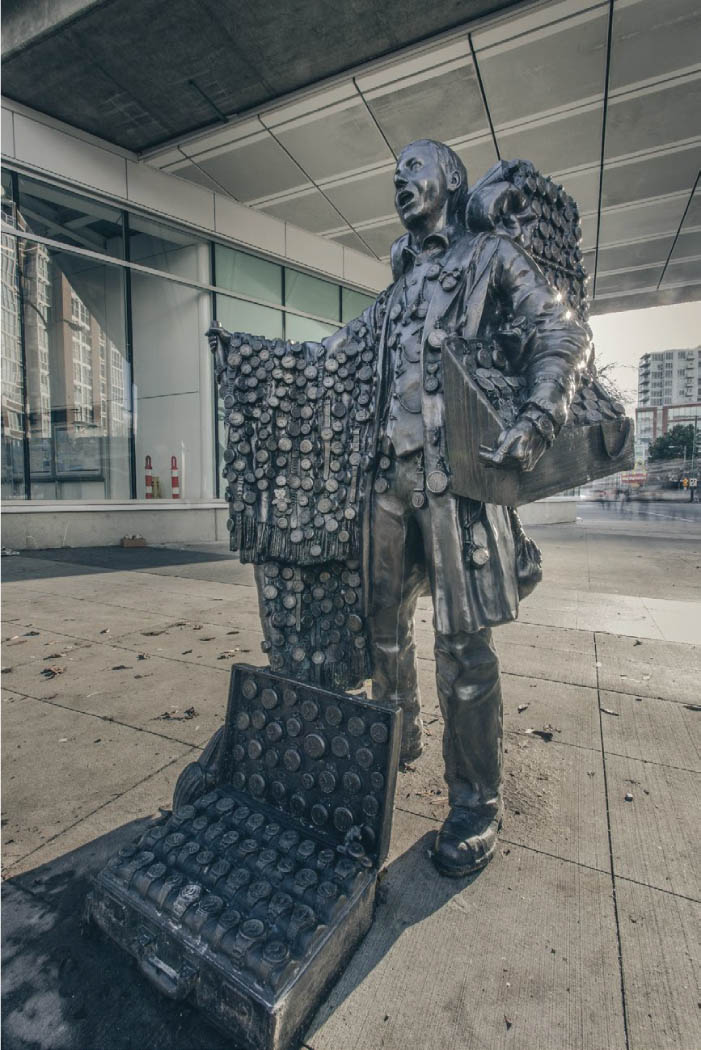
(Photo courtesy of TransLink Art and Culture)
- Art: Permanent and temporary installations
- Funding: 1 percent for art (capital projects), and operational funds through public art
2021
Public Art Program moves into the Customer Experience team under the Marketing and Brand department. The program expands its temporary public art program, creates a new professional music and performance program, revamps the legacy busker program, and begins work and implementation of local Nation art as part of the development of TransLinkʼs Cultural Recognition policy (Figure 42).
- Management responsibility: Internal Art and Culture staff, in the Customer Experience team under the Marketing and Brand department
- Art: Permanent installations, increased number of temporary installations, Indigenous art program, music and performance program, busker program
- Funding: 1 percent for art (capital projects), and operational funds through public art and Indigenous Cultural Recognition
Present (2025)
TransLinkʼs process for integrating art into capital projects is well-developed. The Senior Public Art Planner begins site scoping and artwork integration in collaboration with the architect at the 30 percent detailed design stage and, when appropriate, in earlier design phases led by TransLinkʼs internal Facility Design team. TransLinkʼs internal Engineering and Project Delivery teams work with the Senior Planner to determine the best delineation of work between the general contractor and the artist. A history of successful projects has earned the program strong internal champions across various delivery teams (Figure 43).
TransLinkʼs Public Art Program prioritizes best practices when working with artists, including Indigenous artists, because of lessons learned and streamlined solutions that work effectively across multiple teams. Over time, TransLink worked to improve procurement, payment, fabrication, and installation to best support artists and their work. More details on these practices are later.
As many of the systemʼs first art pieces on the Millennium Line have reached their 25-year life expectancies and degraded, the Art and Culture Program is starting to undertake significant

(Photo courtesy of TransLink Art and Culture)

“The Breath Below” is a 3,600-sq-ft. mosaic wall that was installed in 2024 and occupies a central and visible place in the new Capstan Station on the SkyTrain Canada Line in Richmond. Such a large and central integrated art feature was a new accomplishment for the program and demonstrates the effectiveness of the Art and Culture Programʼs collaborative approach and internal support across delivery teams. (Photo courtesy of TransLink Art and Culture)
repair or decommissioning case by case. This process is discussed later. Experience has also led the program to avoid commissioning kinetic or digital art pieces and instead focus on art that is thoughtfully designed with durable materials.
- Management responsibility: Internal Art and Culture staff, in the Customer Experience team under the Marketing and Brand department
- Art: Permanent and temporary installations (kinetic and digital media are avoided), Indigenous art program, music and performance program, busker program
- Funding: 1 percent for art (capital projects) and operational funds through public art and Indigenous Cultural Recognition
Engaging Artists in the Procurement and Fabrication Processes
The Art and Culture Program prioritizes making the application and commissioning process accessible and manageable for artists, particularly those who might not have prior experience navigating a transit agencyʼs Expression of Interest (EOI) process or managing large-scale public art installations within major capital projects. The program is artist- and art-centered in its approach to identifying site locations and public art opportunities. To support and guide the artistʼs creative thinking within the context of the site, each projectʼs physical and functional parameters are defined and communicated in advance of the proposal stage.
TransLinkʼs Arts and Culture Program runs a two-stage competitive selection process grounded in public art best practices. A selection panel, consisting of three arts professionals (e.g., curators and artists) and two representatives from TransLink, advises the process. The first stage consists of artist-centered EOIs and is designed to be simple and respectful of artistsʼ time. If required, the open artist calls are complemented by informal or formal outreach to individual artists, who are nominated by the selection panel. The selection panel then selects three to four artists for a shortlist. In the second stage, these artists are paid to develop site- and project-specific proposals. From this group, one artist is selected to complete the final commission.
The Arts and Culture Program also recently began applying new approaches to artist contracting and fabrication, including the use of design-only contracts developed in collaboration with the Engineering and Project Delivery teams (Figure 44). In this model, the artist is responsible for the creative design, and a preselected fabricator is contracted through TransLinkʼs general construction contract and manages the fabrication and installation. This approach enables the artist to work closely with the fabricator to realize the artistic vision, without needing to oversee fabrication logistics, manage a separate contract, or navigate the complex critical paths typical of major infrastructure projects.
Design-only contracts are especially effective for artwork that involves materials that are integrated into the facility, such as a mosaic replacing subway tiles already included in the base scope of a project and artwork integrated into bus shelter glazing. These contracts are used case by case and are not applied to 3-dimensional artwork or projects where the artist fabricates the work themselves.
Maintaining and Decommissioning Aging Art
The Art and Culture Program has an established annual cleaning process for artwork, overseen by a professional art conservator and carried out by station cleaning contractors. This approach works effectively to support the long-term care of the collection. Beyond this, the program does not have a dedicated budget for major repairs or replacements of artwork. This poses a challenge, especially as many of the Millennium Line artworks are more than 25 years old and are showing significant signs of wear. Notably, all the kinetic artwork installed during this period failed shortly after installation and never were repaired.
When decommissioning, the process follows public art best practices: An artwork must meet a checklist of criteria, the artwork is appraised, the artist is contacted, and efforts are made to determine whether the piece can be repaired. In one of the two cases where TransLink decommissioned an artwork—because of a station upgrade—the original artist was commissioned to create a new work for installation in a new location. The lack of capital funding for repairs and
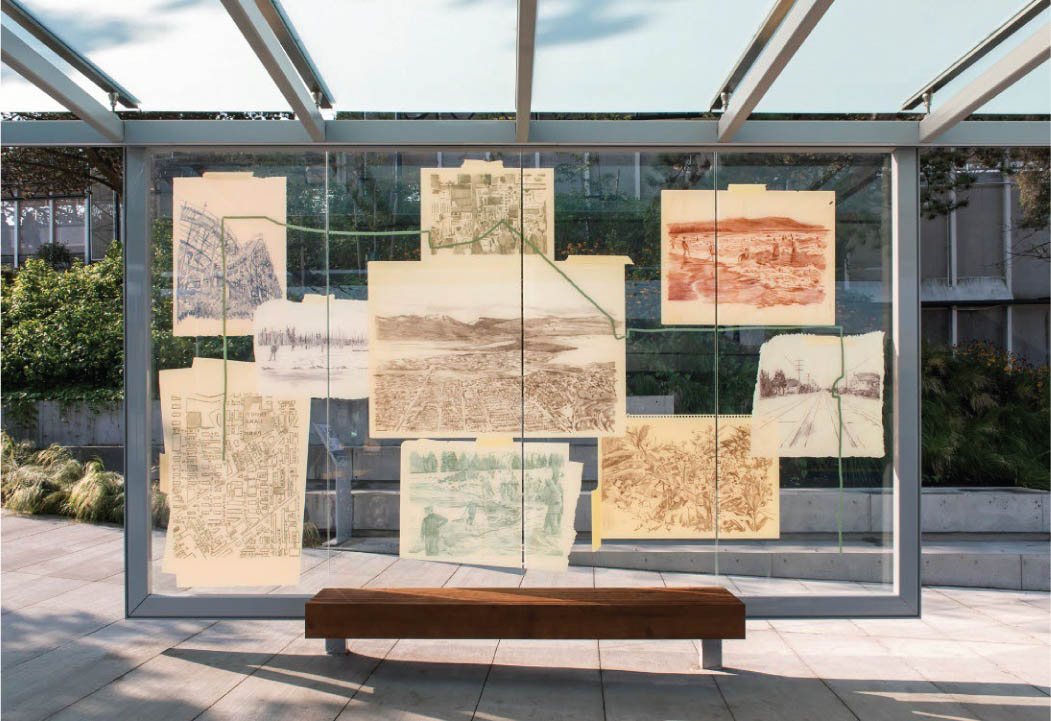
TransLink places artwork at TransLink-owned bus shelters using design-only contracts, because the art is integrated directly into the shelter glazing and can be fabricated and installed most easily by the shelter contractor. (The bus shelters with art are located at “bus exchange” stations, because TransLink does not own bus shelters on municipal property. This piece, “Archival Routes” by Heather Kai Smith (2020) at the Nanaimo bus exchange, is made of ceramic frit on glass.) (Photo courtesy of TransLink Art and Culture)
Long Description.
The sketches vary in style and depict different scenes, including urban and natural landscapes. A wooden bench is positioned in front of the glass wall in an outdoor setting.
replacements, however, means that pieces that meet the criteria for removal often remain in place unless tied to a broader station redevelopment project or deemed a safety hazard.
Creating a Sense of Belonging and Connection to the System
The Art and Culture Program is designed to “surprise and delight” customers and prioritizes the rider experience by fostering a sense of belonging through intentional art, music, performance, and thoughtful design and by sparking “beautiful interpersonal interactions” between customers and artists. By offering low-barrier access to high-quality cultural experiences, the program aims to expand public engagement with art that otherwise may be inaccessible because of cost or geography. Similarly, the program aims to amplify a diversity of voices and narratives (Government of Canada 2025).
TransLink considers both the cost and benefit of placing art on the system. Rather than focusing on direct impacts on ridership numbers, the program looks at the broader effect on customer experience, brand perception, and social and experiential benefits. These include increased feelings of safety, inclusion, and connection within transit spaces. Qualitative and quantitative measures help guide the programʼs future programming while ensuring that the program continues to serve and reflect the regionʼs evolving communities (Figure 45).
Indicators of success include the following:
- Public and panel-based surveys, including through TransLink Listens
- Web page and social media engagement
- Attendance and interaction at public events such as performances, tours, and activations and at community engagement events for capital projects
- Feedback through the Customer Involvement Department
Feedback is positive, and there is public enthusiasm for art within the transit system, especially in Metro Vancouver, where siting art in public space can be complex and highly regulated.
The Art and Culture Program also is exploring additional ways to measure and report its impact more completely.
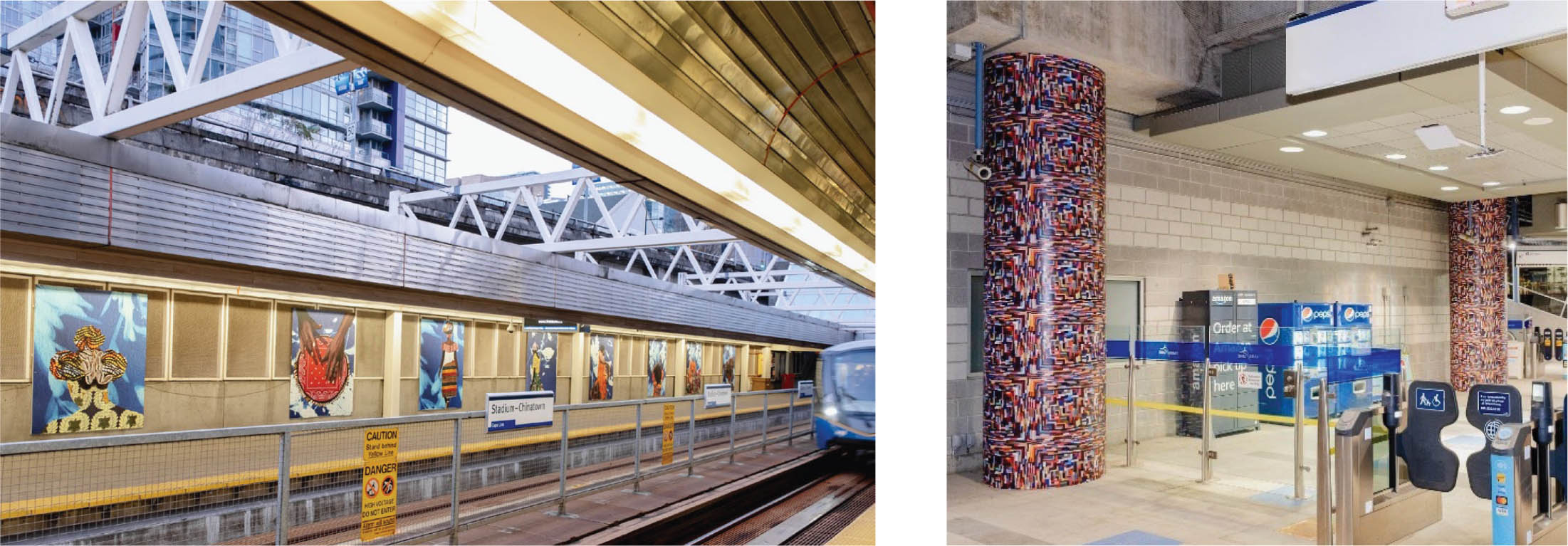
(Photo courtesy of TransLink Art and Culture)
Long Description.
The art piece of ‘Woven Consciousness’ inside the Stadium-Chinatown station platform shows a series of vibrant murals with various figures along the wall. The platform is covered with a roof supported by metal beams. The art piece of ‘Breathe’ shows the ticket gate area inside the VCC-Clark Station. The ticket gate area features a cylindrical pillar adorned with intricate, colorful patterns.
Documentation and Procedures
- Arts and Culture Strategic Plan
- TransLinkʼs Public Art: Procedures and Guidelines Manual
- SkyTrain Design Manual (maintained by the Facilities Team and given to project architects) includes a chapter on art
- Art is integrated into the construction checklist
- Checklist of criteria for decommissioning art
- APTA Best Practices document is used as educational material for internal TransLink stakeholders
- British Columbia Public Art Network (BCPAN) for regional information sharing and support
WMATA Metro Art in Transit
Background Information
- Location: Washington, DC
- Agency annual budget: $75,000,000+
- Transit services: Bus, Subway, Paratransit
- Program established: 1995
- Department: Community Relations and Outreach
- Website: https://www.wmata.com/initiatives/art-in-transit/about-art-in-transit.cfm
- Art program annual budget: $500,000–$1 million
- Types of art: 2-Dimensional, 3-Dimensional, Digital/Media/Electronic, Performance, Literary
- Locations: Transit station – Publicly accessible areas and fare-restricted areas, Bus shelters, On vehicles, Other agency property (including bus garages and office buildings)
History: Incorporating Art into Architecture-Focused Design
1970s
Pre-1975: The DC Metro is designed to have an exemplary architectural environment that intentionally excludes art and advertising.
1975: The Metroʼs board passes a resolution to encourage art in the system.
1976: The Metro opens.
1988–1991
Two campaigns for art, titled MetroArt, are spurred by local art councils and advocates and fulfill the boardʼs 1975 resolution. These establish the Metroʼs Art Advisory Committee and install nine temporary murals and sculptures at subway stations through a competitive process (Figure 46). A private company provides funding of $50,000 for installation, maintenance, and insurance and $1,000 stipends for each artist. While there is controversy over the quality of the art pieces and their compatibility with the systemʼs architecture, some pieces gain exceptional popularity and are made permanent.
The Metro subway systemʼs expansions continue without incorporating artwork into new capital projects.
- Management responsibility: Local art councils and advocates with permission of the DC Commission on the Arts and Humanities for artwork that affects the cityʼs public realm
- Funding: Private sponsorship
- Art: Temporary (mural and sculpture)
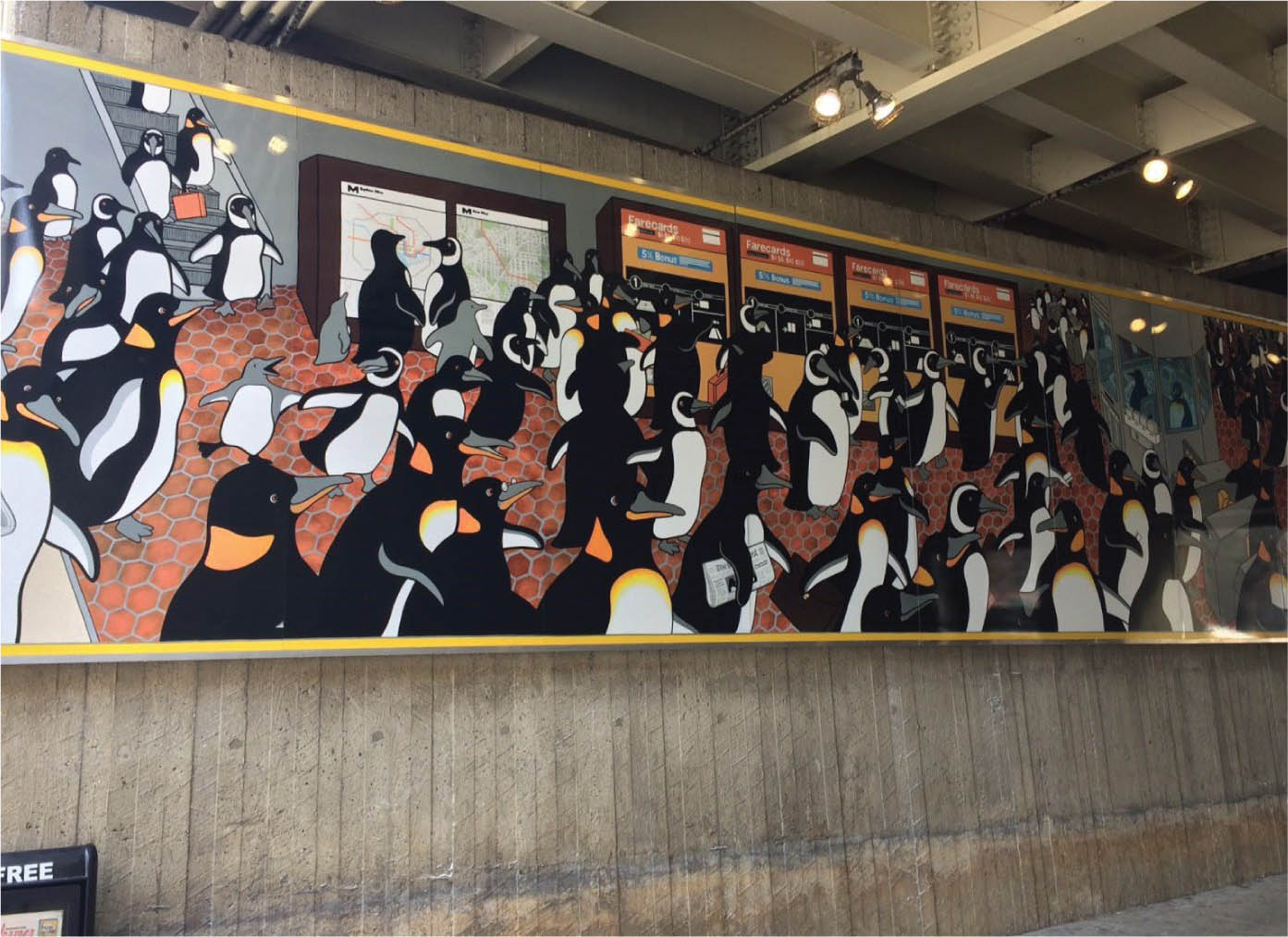
This piece was installed at the Silver Spring station in 1988 for a 1-year display as part of the MetroArt program. It became so popular that WMATA purchased the piece for permanent display, and a penguin eventually became a city mascot for Silver Spring. The piece was replaced with a more durable aluminum replica in 2017. Its absence over the preceding 12 years, while the subway station was renovated and the piece was refurbished, prompted much public disapproval. (Photo courtesy of WMATA AIT)
1995
Metroʼs board decides to introduce art into the entire system, and the Metro Art in Transit program is established. It is housed under the Architecture Office. AITʼs work is directed by Metroʼs board. The Art Advisory Committee, consisting of art council representatives and arts professionals, provides approvals for art selections. A primary method for commissioning is through art councils, the DC Commission on the Arts and Humanities, and federal agencies, commissioning and then donating the artwork to the Metro system.
- Management responsibility: WMATA staff under the Architecture Office and directed by Metroʼs board and the Art Advisory Committee; in partnership with the DC Commission on the Arts and Humanities for artwork that affects city property
- Funding: DC Commission on the Arts and Humanities; local municipalities (Washington, DC, and others); private donations
- Art: Permanent (mural and sculpture)
2002
Board-approved program guidelines are established. As the program has expanded and previous processes have become unwieldy, the guidelines now permit AITʼs manager to oversee individual art projects and function as WMATAʼs technical representative. The board continues to play an active role in developing the program and its projects, approving artwork, selecting artists and encouraging community participation in all art projects.
- Management responsibility: AIT staff with approval from the Art Advisory Committee; in partnership with the DC Commission on the Arts and Humanities for artwork that affects the cityʼs public realm
- Funding: DC Commission on the Arts and Humanities; local governments (Washington, DC, and others); private donations
- Art: Permanent and temporary (mural and sculpture)
2013–2025
Following FTA directives and restrictions on funding, art is now incorporated into the capital construction process as integrated architectural components. This practice persists even after the FAST Act of 2015 (which went into effect fiscal year 2016) no longer allowed federal funding to be used for art. (Many of the Metroʼs network expansions and infill stations are funded by local governments with funds that can be applied to art.) AIT launches its digital art program in 2020.
- Management responsibility: AIT staff with approval from the Art Advisory Committee; in partnership with the DC Commission on the Arts and Humanities for artwork that affects the cityʼs public realm
- Funding: Capital budget (nonfederal); local governments (Washington, DC, and others); DC Commission on the Arts and Humanities; private donations
- Art: Permanent and temporary (mural, sculpture, and digital) (Figure 47)
Present (2025)
AIT no longer relies on the Art Advisory Committeeʼs approval for selecting artwork, and the authority to review and approve AIT projects and initiatives has been delegated from the Board of Directors to AITʼs General Manager. AITʼs collection continues to expand through direct procurements and donations. AITʼs collection continues to expand through direct procurements and donations offering a more diverse collection of artwork from large-scale pieces at stations and other facilities, including office buildings, bus garages, and parking garages (Figure 48). AIT has a digital art program, installs event-specific bus wraps and on-bus posters, and operates music performance programs at specific stations in collaboration with national and local organizations.
With the continued expansion of the program, AIT is experiencing procedural issues and expects to update its guidance in the next year.
- Management responsibility: AIT staff
- Funding: Capital budget (nonfederal funds); local governments (Washington, DC, and others); private donations
- Art: Permanent and temporary (mural and sculpture), digital, performance; integrated in station design
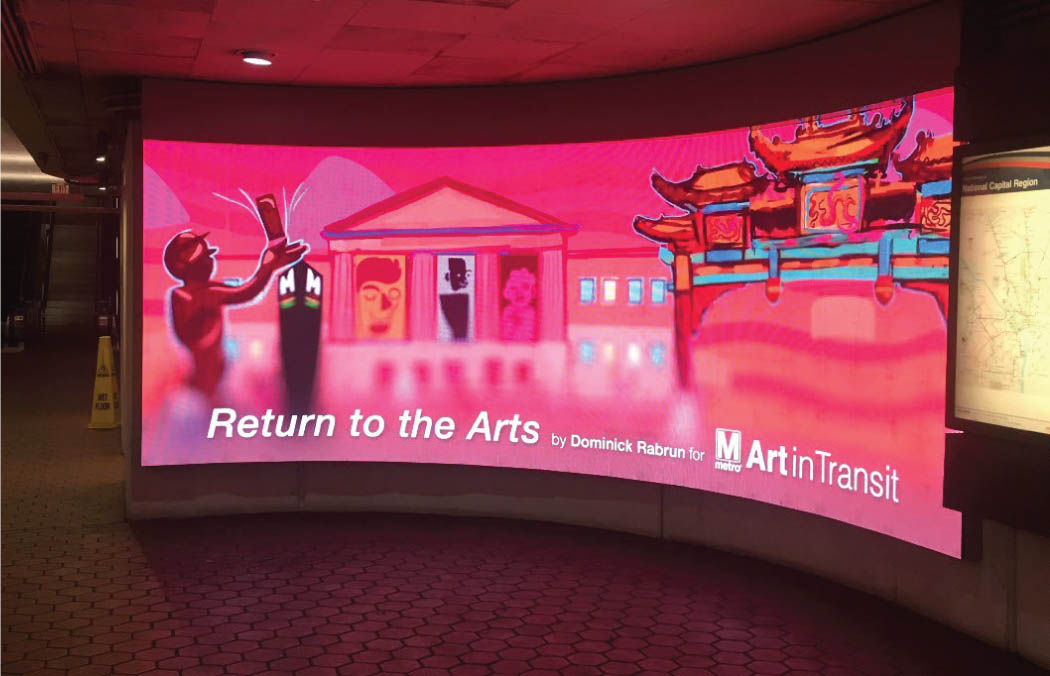
(Photo courtesy of WMATA AIT)
Long Description.
The display shows a man standing in front of a large gallery and a traditional Chinese building with a distinct roof design.

“Holding the Light” consists of two murals of printed and laminated concrete vinyl and paint installed on the façade of WMATAʼs New Carrollton parking garage. (Photo courtesy of WMATA AIT)
Long Description.
The murals of ‘Holding the Light’ feature abstract patterns with various shapes and vibrant colors.
Procuring Art: Quality, Executive Staff Support, and Partnerships
From the initial design of the Metro system and onward, WMATA has emphasized creating an exemplary architectural environment in addition to its primary purpose of providing a safe and efficient transportation option to the public. In this context, art is an extra component that benefits the systemʼs visual environment, customer experience, and safety. Adding art to the system has required the interest of Metroʼs executive staff, which has given special attention to procuring high-quality art that does not detract from the systemʼs iconic architecture (Figure 49). (Until 2018, art was selected with the direct involvement of the Metroʼs board.)
The process for procuring art is the same whether for capital or non-capital projects or at transit stations or non-transit locations. Commissioning art for existing stations, especially those with the systemʼs original architectural design, can be more difficult, especially since newer stations
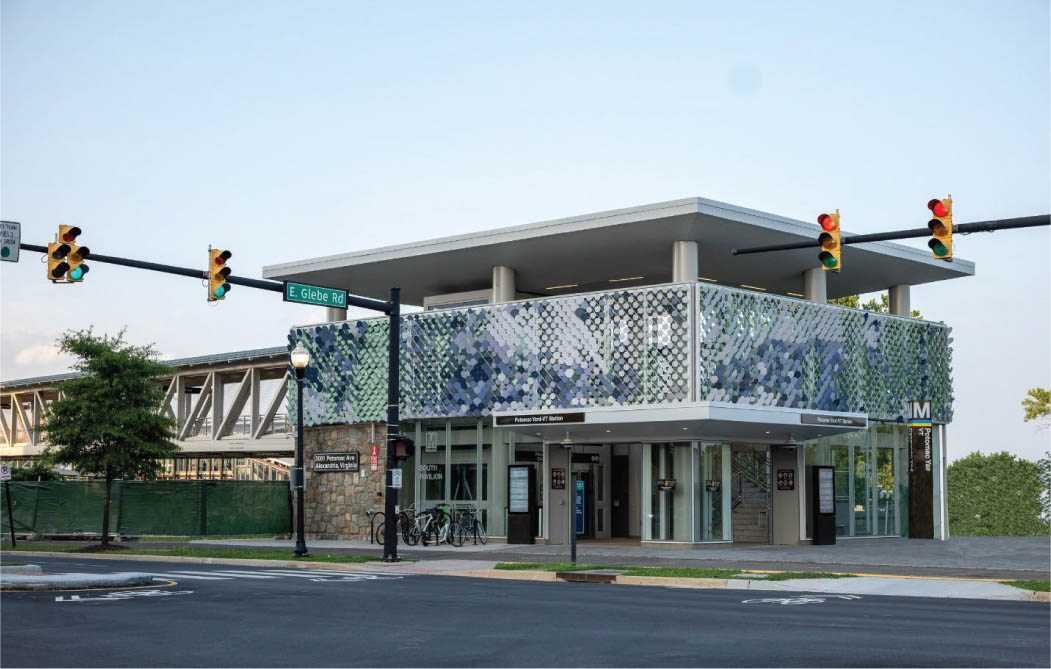
“A Subtle Trip” is a recent, larger-scale, architecturally integrated artwork. The City of Alexandria funded this piece as part of its Potomac Yard Metro station project; the piece won a 2024 Top 100 CODAawards. (Photo courtesy of WMATA AIT)
are designed to integrate art. Because AIT has no dedicated maintenance budget, art must require minimal maintenance, be durable, and accommodate other station infrastructure. (Artists complete a template maintenance form, which is an especially useful resource when art needs to be moved for general station maintenance in its vicinity.) AITʼs increasing experience and the evolving architecture of the system have enabled AIT to commission larger pieces that serve to dress stations and other sites.
Stakeholders outside WMATA have been essential to procuring art for the Metro system (Figure 50). Art councils, the DC Commission on the Arts and Humanities, BIDs, federal agencies, and local governments have commissioned artwork and then donated it to the Metro system. Local governments also have funded capital expansion projects that incorporate art. Until recently, commissioning art for the Metro system required the approval of the Art Advisory Committee, consisting of art professionals and representatives from art councils, and the approval of the DC Commission on the Arts and Humanities when the art could affect public space in the city. As AIT has taken more authority over commissioning art, these external organizations still provide funding for and collaborate on projects.
During the procurement process, AIT engages the broader public once artwork is selected through public presentations. AIT does not have specific tools for gauging the reception of artwork;
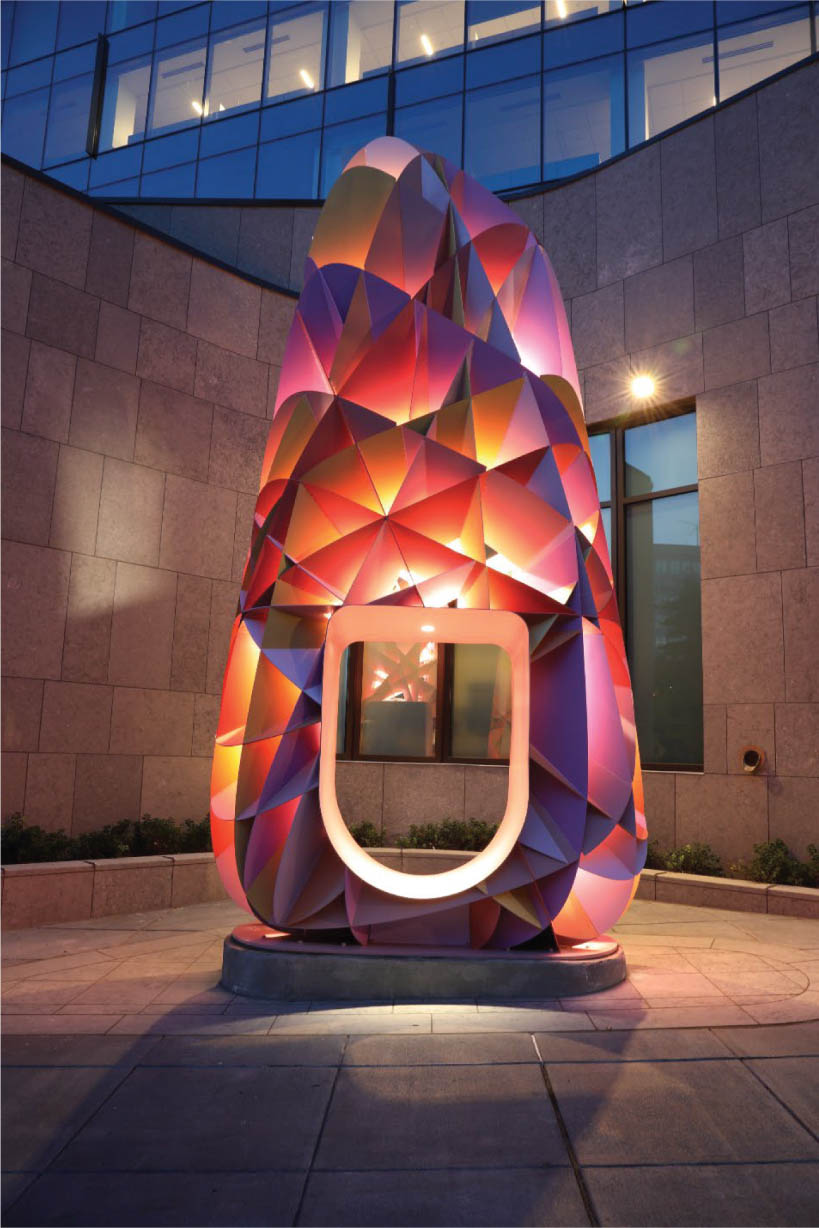
“Hooray” was commissioned for the new WMATA headquarters. The glowing review and feedback from the DC Commission on the Arts and Humanities encouraged increasing the scale of the piece. It won the 2023 CODAawards Merit Award in the institutional category. (Photo courtesy of WMATA AIT)
although, WMATAʼs communications team does receive feedback. General customer surveying also has included questions about awareness of the AIT program. Word of the program has spread among local organizations, leading to great interest in collaborations. In addition, general knowledge of the program has led to requests to beautify temporary infrastructure during construction projects, which often is implemented with the support of BIDs (Figure 51).
Insufficient Policies and Procedures as AITʼs Scope and Collection Expands and Ages
AITʼs guidelines that were set in 2002 are becoming inadequate for the scope of the AIT program and collection, and AIT is planning on creating new guidelines in the next year. AITʼs collection now includes large-scale installations with a wider range of media. Digital art requires different insurance from other visual media, and AIT has determined that challenges associated with the maintenance and programing of light art make it difficult to sustain in the transit environment. Commissioning performance art is a much less involved process, and it is not covered by AITʼs current guidelines.
Although the original 1975 resolution by Metroʼs board describes a basic maintenance crew for artwork, the 2002 guidelines do not formally consider maintenance and rely on WMATAʼs general maintenance team to perform basic cleaning. AIT does not have dedicated funding for maintenance and has performed ad hoc conservation effort through capital funding or via artwork donors through existing partnerships. Artworks are cleaned upon request when WMATA maintenance staff clean stations in general. AIT requested funding for a formal evaluation of its collection and development of maintenance plan to address aging artworks and donated and loaned artwork that might not be the most durable.
AITʼs guidelines also do not consider decommissioning. New contracts include terms for decommissioning; however, older installations from the 1990s and donated pieces do not. If these older pieces were to require decommissioning because of deterioration, AIT would follow

AIT was enlisted to beautify such bus shelters following complaints from the public. Other projects to beautify construction sites include “The Unbroken Stone, Project 1-6” by Johab Silva (2024) at the Rosslyn station, consisting of a printed design on corrugated plastic boards attached to construction barricades. This piece was installed in partnership with the Rosslyn BID and the Museum of Contemporary Art Arlington. (Photos courtesy of WMATA AIT)
Long Description.
The first mural is painted on the exterior of a bus shelter, featuring a large rainbow, clouds, and abstract shapes. The second is a mural inside a station, displaying a series of vibrant, abstract designs on panels.
applicable federal guidelines. AIT is working to return one art piece to its artist, and AIT is examining the removal of additional, older installations from the system. New guidelines should help with decommissioning these pieces properly.
Documentation and Procedures
- Policy on Art in Transit adopted by the board
- Informal policies as the program has developed


