The State of Art in Transit Programs (2026)
Chapter: Appendix A: Survey Questionnaire and Case Example Interview Guide

APPENDIX A
Survey Questionnaire and Case Example Interview Guide
Survey Questionnaire
The State of Art Programs in Transit
The Transportation Research Boardʼs (TRB) Transit Cooperative Research Program (TCRP) Synthesis Topic SB-44 aims to describe the state of art programs in transit in the United States and Canada, including established art in transit programs and individual art pieces in transit covering any type of art (visual, performance, etc.), and what benefits art in transit systems creates for the users of those systems, the communities around the systems, and the artists who participate.
NOTE: For the purpose of this survey, an “Art in Transit program” refers to any initiative to integrate art into a transit system, whether established or ad hoc. Art may be anything created by an artist, including temporary works and performance art but excluding advertising campaigns. (Advertising may have artistic components but is something that is paid for by an organization—private or public—to promote a product, service, event, action, political cause, etc.)
EBP is distributing this survey to staff at any relevant transit agency department, who manage or are involved with selecting, siting, installing, maintaining, curating, assessing, and/or decommissioning art in a transit system. The findings of this survey will be used to characterize the state of art programs in transit and its related benefits and challenges. In addition, we are seeking volunteers to share their experiences through additional interviews to develop case examples featured in the research report.
Please complete this survey as soon as you can (we are still accepting responses after the April 4th “deadline”). It is expected to take approximately 15 minutes to complete. Your participation is completely voluntary, and any information provided will not be used for any other purposes.
If you sign in with a Google account, your progress will be saved for your access before submitting the survey; however, all respondents may edit completed responses using a link generated after submitting the survey.
If you have any questions about this survey or this research project, please contact Daniel Mascoop. We may contact you to clarify your responses.
Thank you!
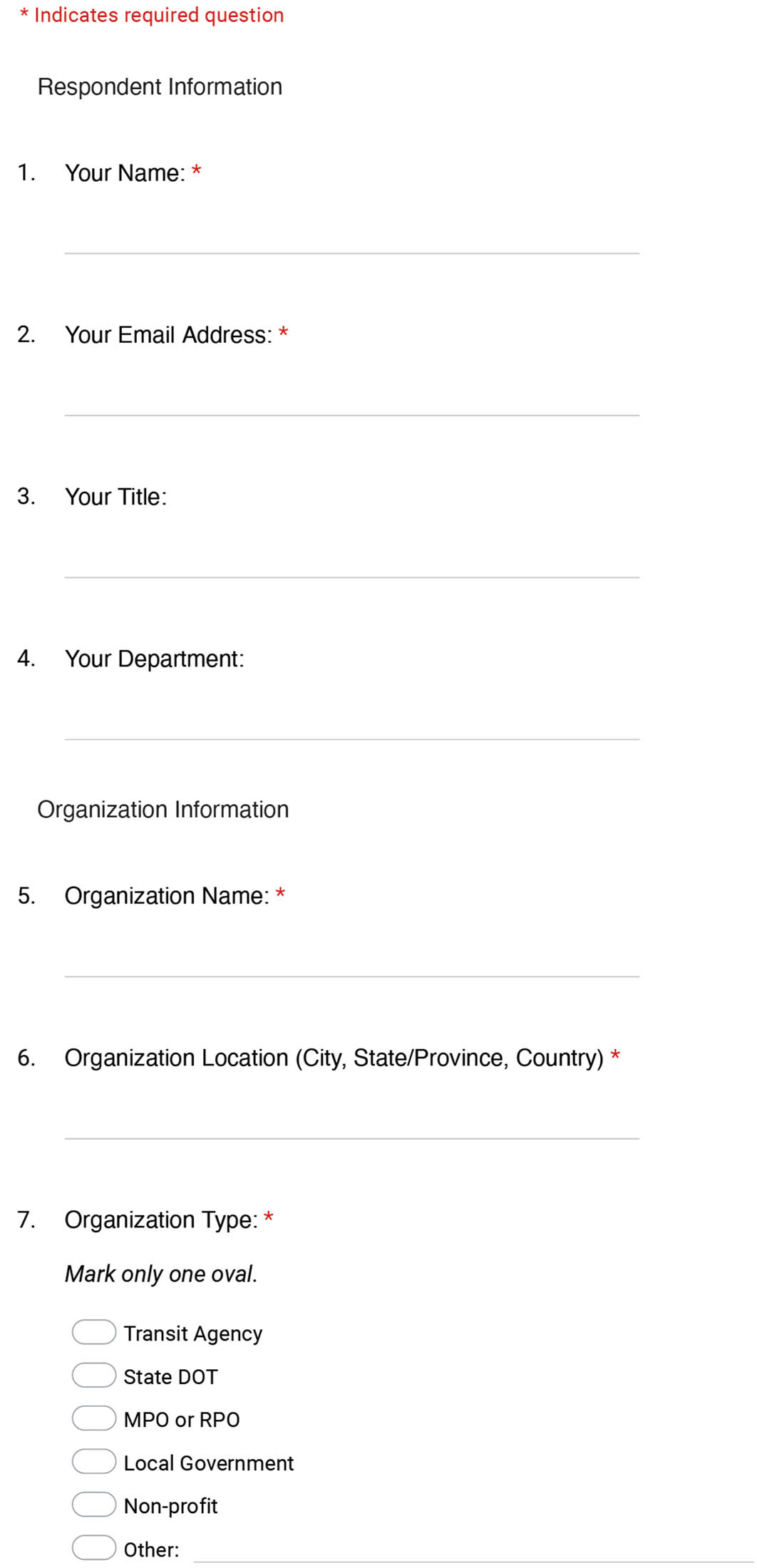
Long Description.
The text in the screenshot reads the following:
An asterisk indicates a required question.
Respondent Information
1. Your Name: asterisk
2. Your Email Address: asterisk
3. Your Title:
4. Your Department:
Organization Information.
5. Organization Name: asterisk
6. Organization Location (City, State or Province, Country): asterisk
7. Organization Type: asterisk
Mark only one oval.
Transit Agency
State DOT
MPO or RPO
Local Government
Non-profit
Other:
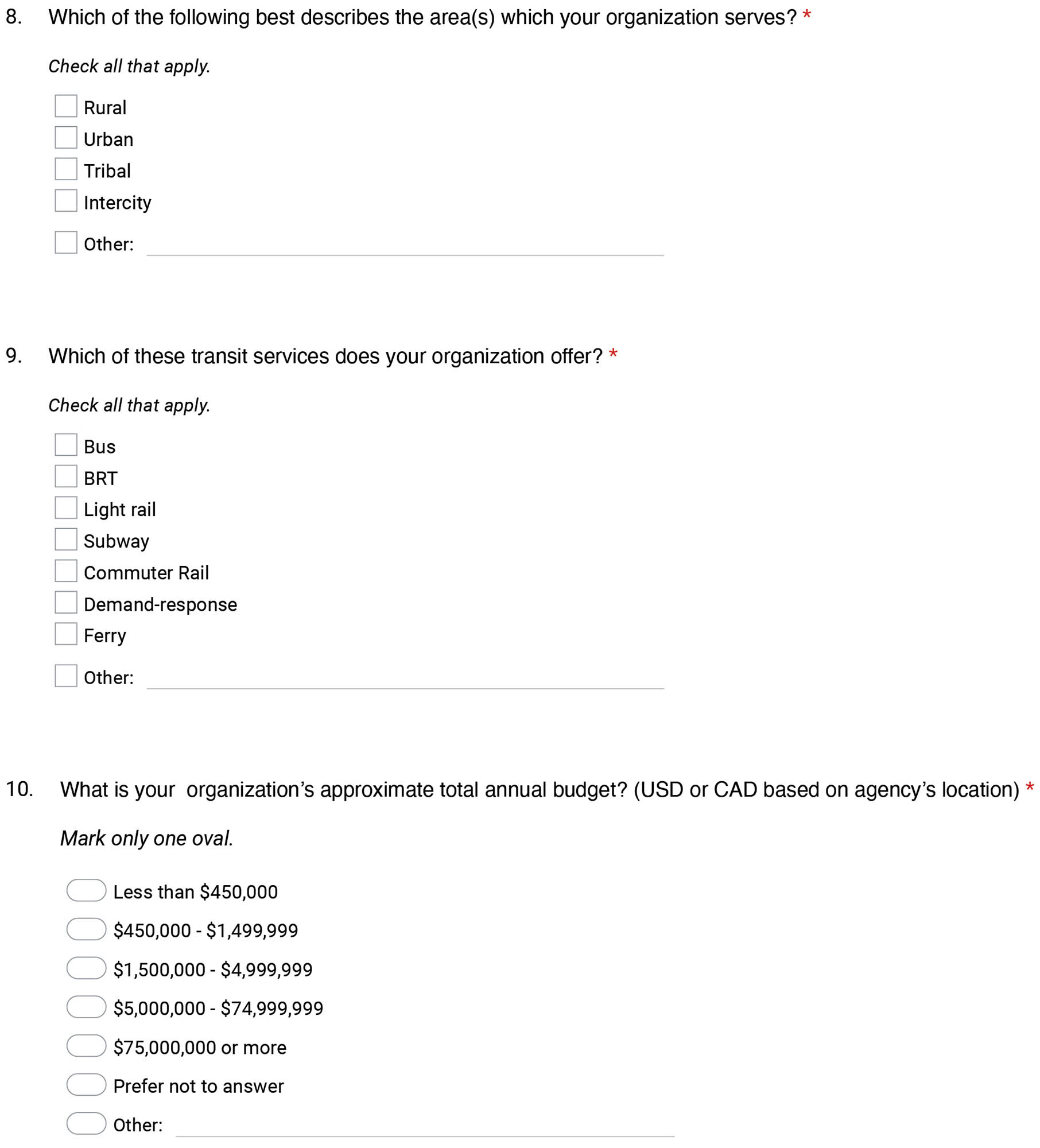
Long Description.
The text in the screenshot reads the following:
8. Which of the following best describes the area(s) that your organization serves? Asterisk
Check all that apply.
Rural
Urban
Tribal
Intercity
Other:
9. Which of these transit services does your organization offer? asterisk
Check all that apply.
Bus
BRT
Light rail
Subway
Commuter Rail
Demand-response
Ferry
Other:
10. What is your organization’s approximate total annual budget? (USD or CAD based on agency’s location) asterisk
Mark only one oval.
Less than 450,000 dollars
450,000 dollars to 1,499,999 dollars
1,500,000 dollars to 4,999,999 dollars
5,000,000 dollars to 74,999,999 dollars
75,000,000 dollars or more
Prefer not to answer
Other:
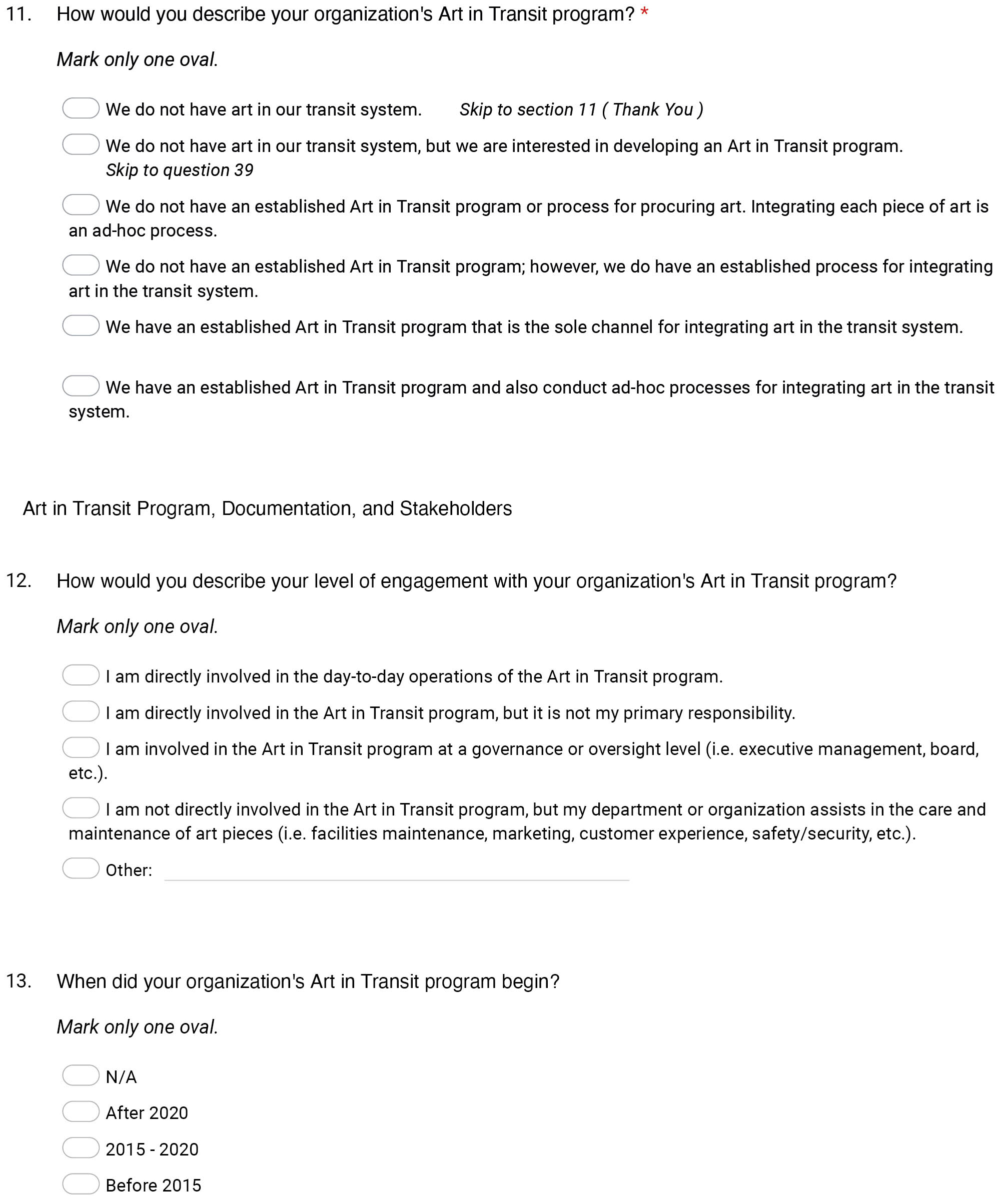
Long Description.
The text in the screenshot reads the following:
11. How would you describe your organization’s Art in Transit program? Asterisk
Mark only one oval.
We do not have art in our transit system. Skip to section 11 ( Thank You )
We do not have art in our transit system, but we are interested in developing an Art in Transit program. Skip to question 39.
We do not have an established Art in Transit program or process for procuring art. Integrating each piece of art is an ad-hoc process.
We do not have an established Art in Transit program; however, we do have an established process for integrating art in the transit system.
We have an established Art in Transit program that is the sole channel for integrating art in the transit system.
We have an established Art in Transit program and also conduct ad-hoc processes for integrating art in the transit system.
Art in Transit Program, Documentation, and Stakeholders.
12. How would you describe your level of engagement with your organization’s Art in Transit program?
Mark only one oval.
I am directly involved in the day-to-day operations of the Art in Transit program.
I am directly involved in the Art in Transit program, but it is not my primary responsibility.
I am involved in the Art in Transit program at a governance or oversight level (that is, executive management, board, etc.).
I am not directly involved in the Art in Transit program, but my department or organization assists in the care and maintenance of art pieces (that is, facilities maintenance, marketing, customer experience, safety or security, etc.).
Other:
13. When did your organization’s Art in Transit program begin?
Mark only one oval.
N or A
After 2020
2015 - 2020
Before 2015.
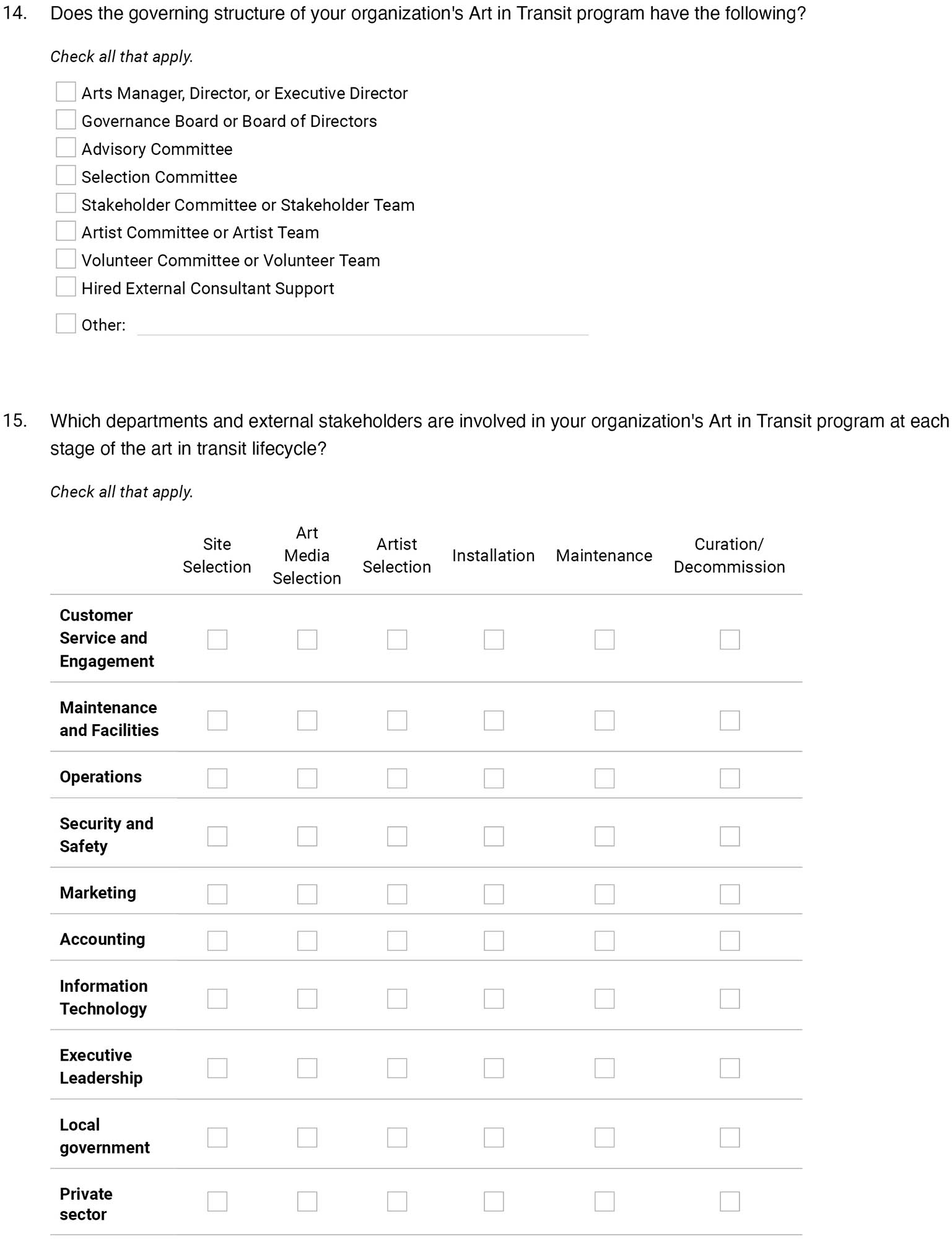
Long Description.
The text in the screenshot reads the following:
14. Does the governing structure of your organization’s Art in Transit program have the following?
Check all that apply.
Arts Manager, Director, or Executive Director
Governance Board or Board of Directors
Advisory Committee
Selection Committee
Stakeholder Committee or Stakeholder Team
Artist Committee or Artist Team
Volunteer Committee or Volunteer Team
Hired an external consultant for support
Other:
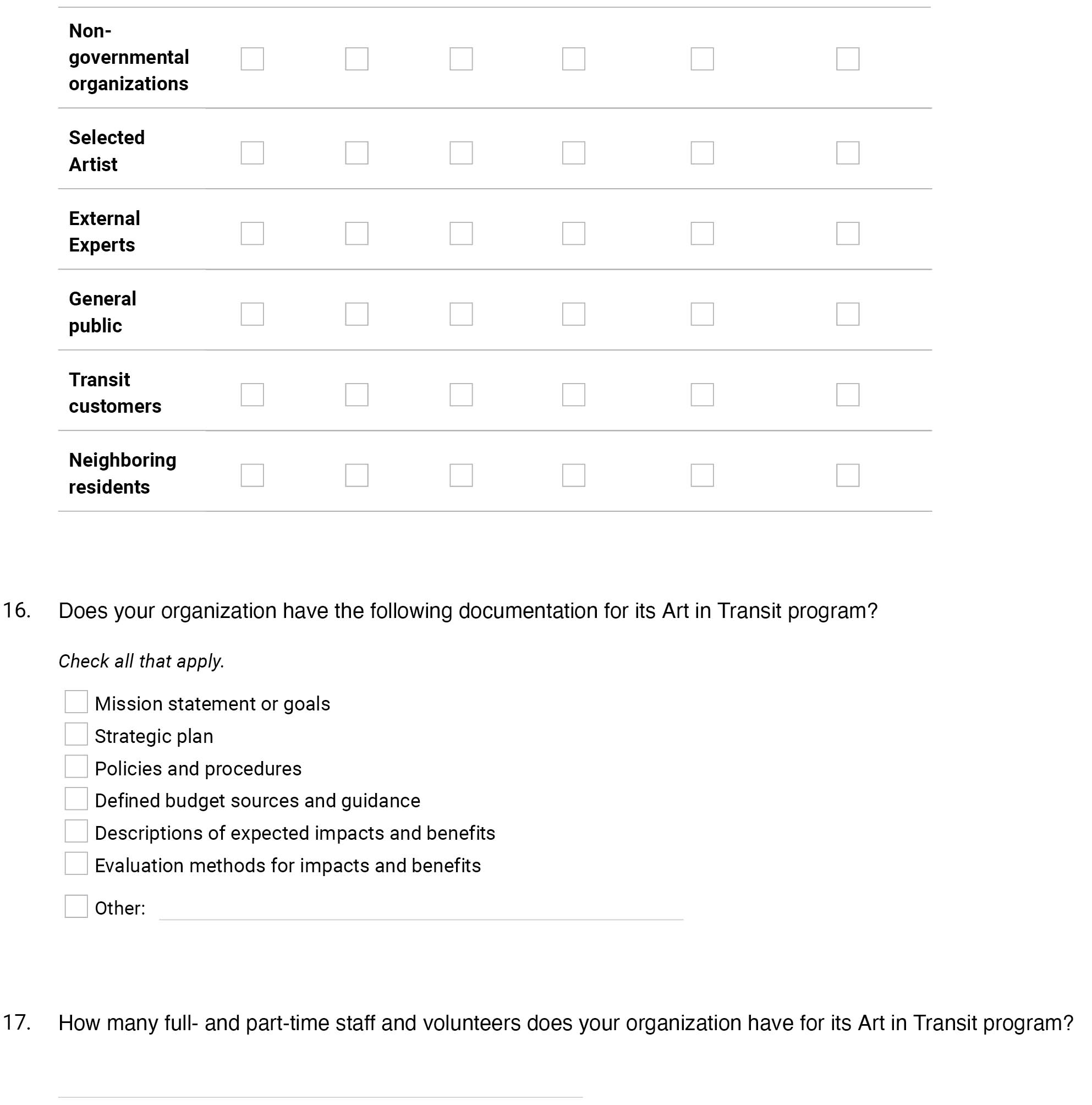
15. Which departments and external stakeholders are involved in your organization’s Art in Transit program at each stage of the Art in Transit lifecycle?
Check all that apply.
The choices given are Site Selection, Art Media Selection, Artists Selection, Installation, Maintenance, Curation, or Decommission.
Customer Service and Engagement
Maintenance and Facilities
Operations
Security and Safety
Marketing
Accounting
Information Technology
Executive Leadership
Local government
Private sector
Long Description.
The text in the screenshot reads the following:
Non-governmental organizations
Selected Artist
External Experts
General public
Transit customers
Neighboring residents.
16. Does your organization have the following documentation for its Art in Transit program?
Check all that apply.
Mission statement or goal
Strategic plan
Policies and procedures
Defined budget sources and guidance
Descriptions of expected impacts and benefits
Evaluation methods for impacts and benefits
Other:
17. How many full- and part-time staff and volunteers does your organization have for its Art in Transit program?
Long Description.
The text in the screenshot reads the following:
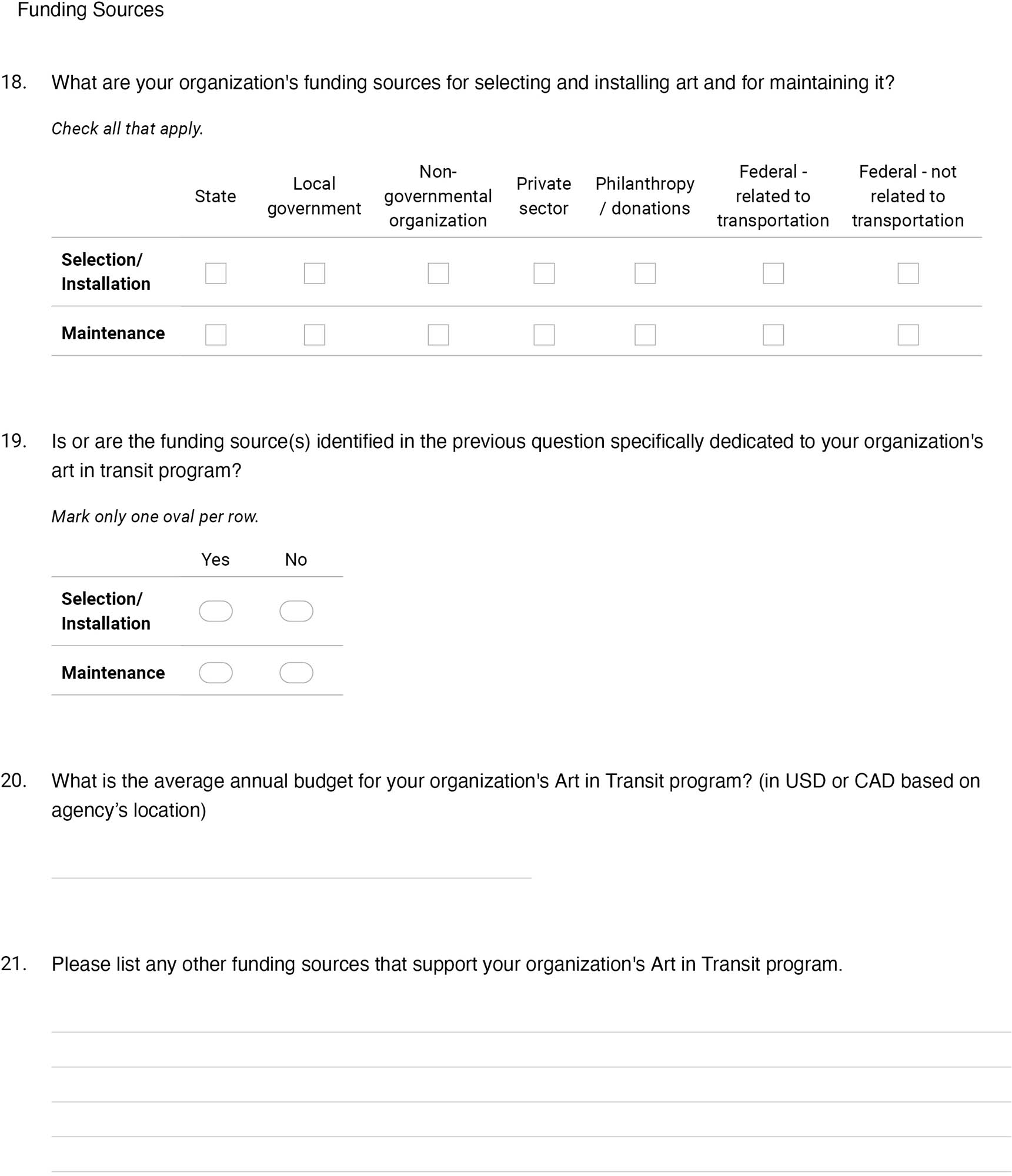
Funding Sources.
18. What are your organization’s funding sources for selecting and installing art and for maintaining it?
Check all that apply.
The choices given are: State, Local government, Non-governmental organization, Private sector, Philanthropy or donations, Federal – related to transportation, and Federal – not related to transportation.
Selection or Installation
Maintenance
19. Are the funding source(s) identified in the previous question specifically dedicated to your organization’s art in transit program?
Mark only one oval per row.
The choices given are: Yes, No.
Selection or Installation
Maintenance
20. What is the average annual budget for your organization’s Art in Transit program? (in USD or CAD based on agency’s location).
21. Please list any other funding sources that support your organization’s Art in Transit program.
Long Description.
The text in the screenshot reads the following:
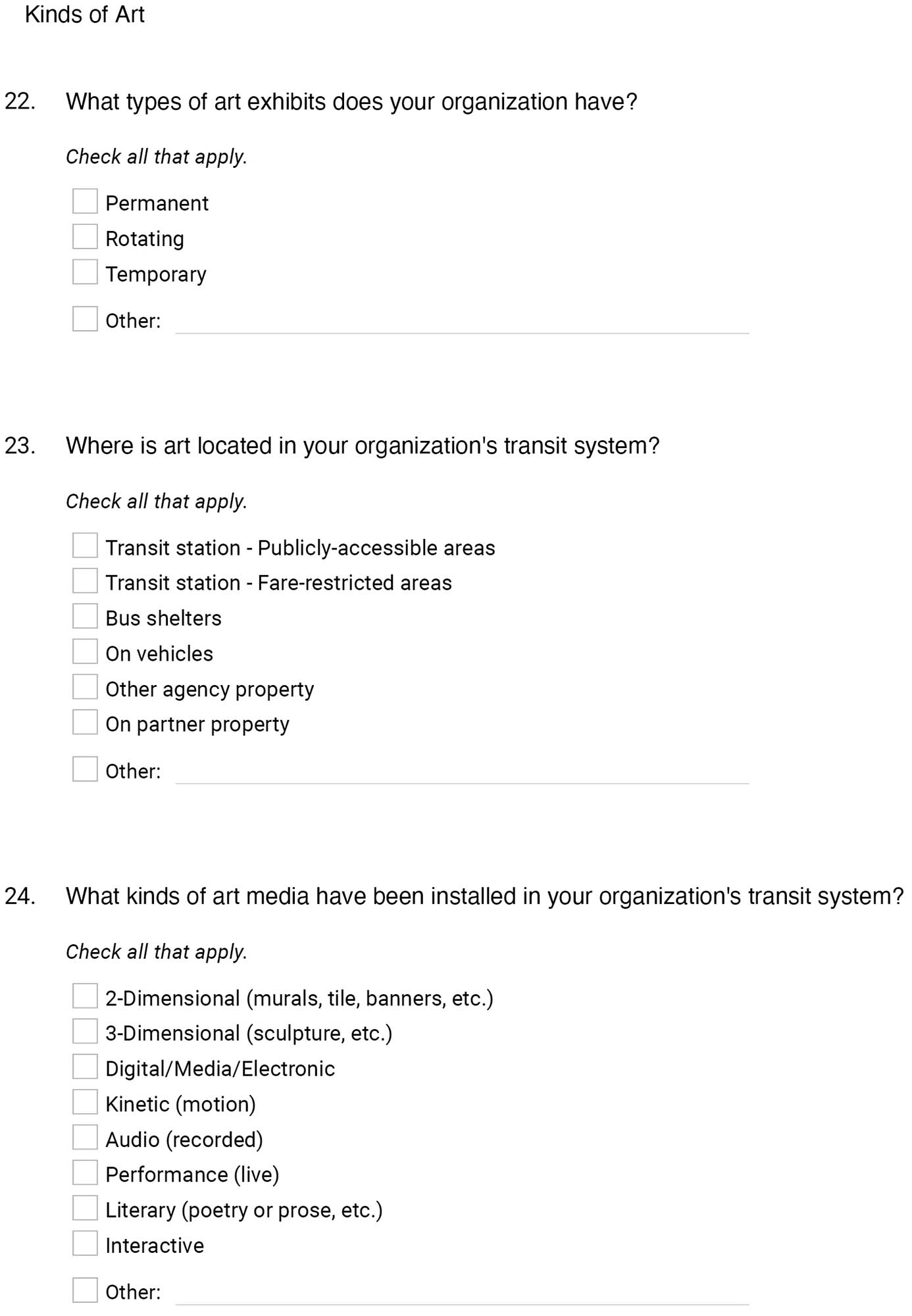
Kinds of Art
22. What types of art exhibits does your organization have?
Check all that apply.
Permanent
Rotating
Temporary
Other.
23. Where is art located in your organization’s transit system?
Check all that apply.
Transit station – Publicly-accessible areas
Transit station – Fare-restricted areas
Bus shelters
On vehicles
Other agency property
On partner property
Other:
24. What kinds of art media have been installed in your organization’s transit system?
Check all that apply.
2-Dimensional (murals, tile, banners, etc.)
3-Dimensional (sculpture, etc.)
Digital, Media, or Electronic
Kinetic (motion)
Audio (recorded)
Performance (live)
Literary (poetry or prose, etc.)
Interactive
Other:
Long Description.
The text in the screenshot reads the following:
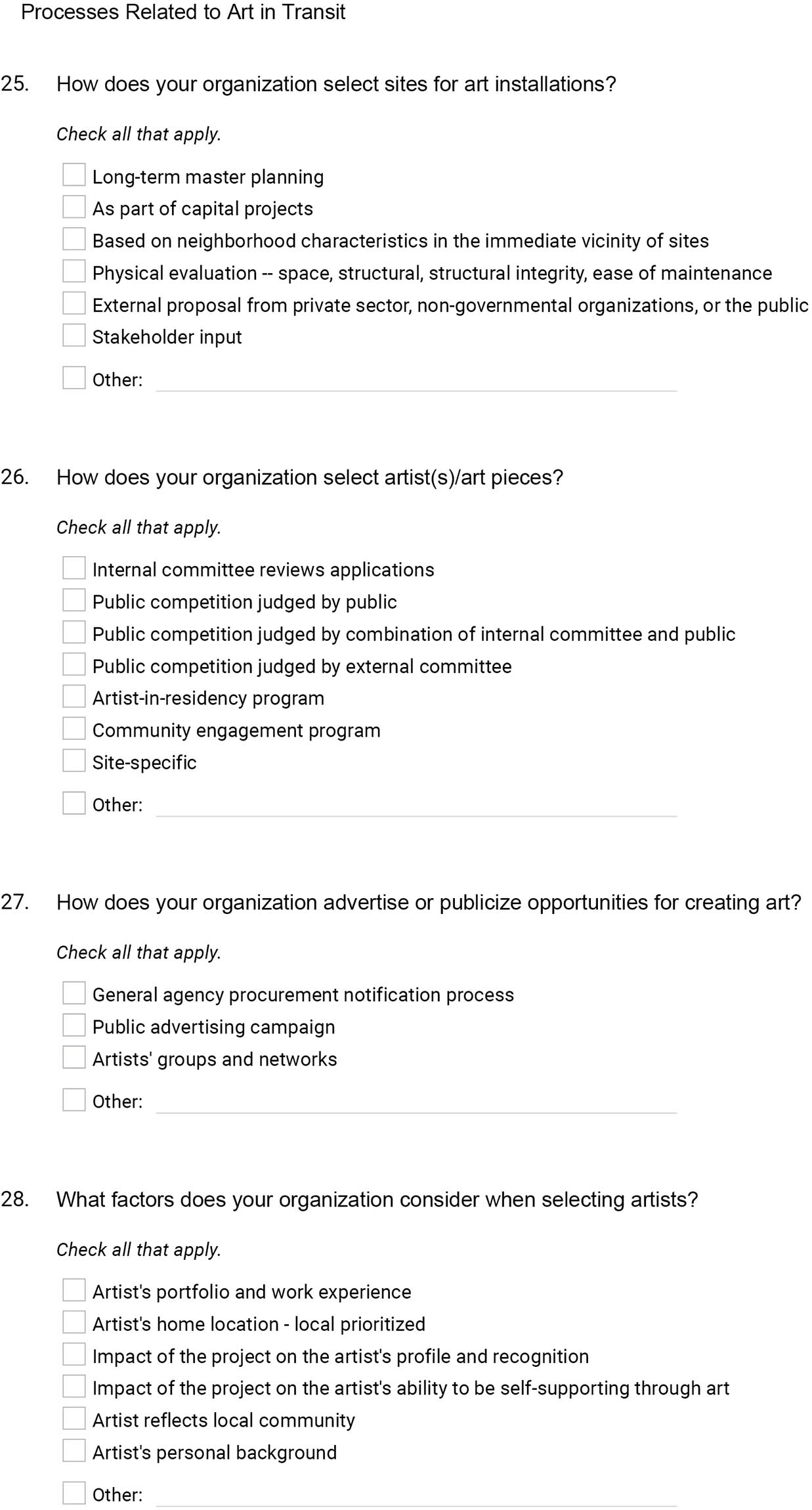
Processes Related to Art in Transit.
25. How does your organization select sites for art installations?
Check all that apply.
Long-term master planning
As part of capital projects
Based on neighborhood characteristics in the immediate vicinity of sites
Physical evaluation – space, structural, structural integrity, ease of maintenance
External proposal from the private sector, non-governmental organizations, or the public
Stakeholder input
Other:
26. How does your organization select artist(s) or art pieces?
Check all that apply.
Internal committee reviews applications.
Public competition judged by the public
Public competition judged by a combination of an internal committee and the public
Public competition judged by an external committee
Artist-in-residency program
Community engagement program
Site-specific
Other.
27. How does your organization advertise or publicize opportunities for creating art?
Check all that apply:
General agency procurement notification process
Public advertising campaign
Artists’ groups and networks
Other:
28. What factors does your organization consider when selecting artists?
Check all that apply:
Artist’s portfolio and work experience
Artist’s home location (local prioritized)
Impact of the project on the artist’s profile and recognition
Impact of the project on the artist’s ability to be self-supporting through art
Artist reflects local community
Artist’s personal background
Other.
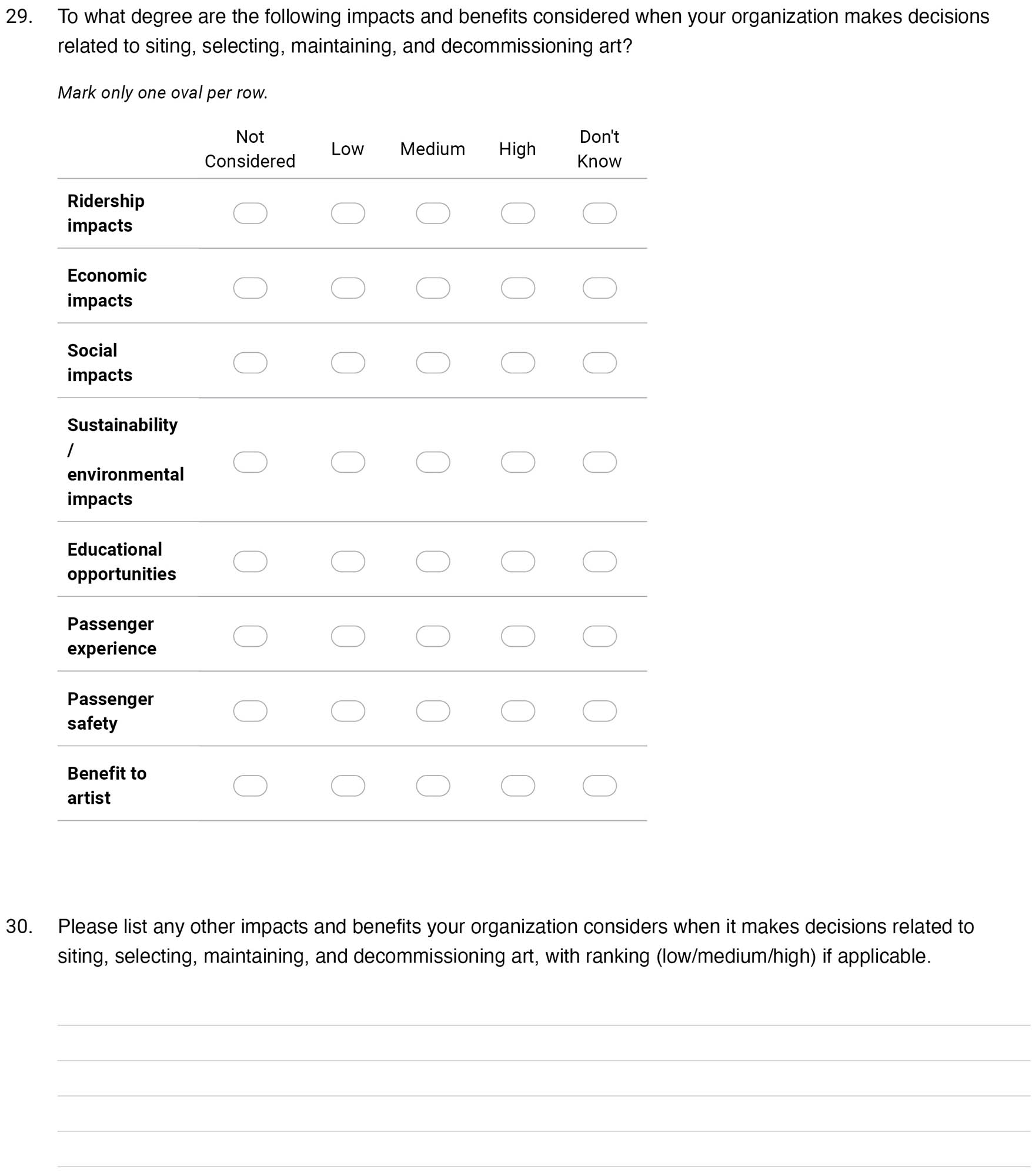
Long Description.
The text in the screenshot reads the following:
29. To what degree are the following impacts and benefits considered when your organization makes decisions related to siting, selecting, maintaining, and decommissioning art?
Mark only one oval per row.
The choices given are: Not Considered, Low, Medium, High, Don’t Know.
Ridership impacts
Economic impacts
Social impacts
Sustainability or environmental impacts
Educational opportunities
Passenger experience
Passenger safety
Benefit to the artist.
30. Please list any other impacts and benefits your organization considers when it makes decisions related to siting, selecting, maintaining, and decommissioning art, with ranking (low, medium, or high) if applicable.
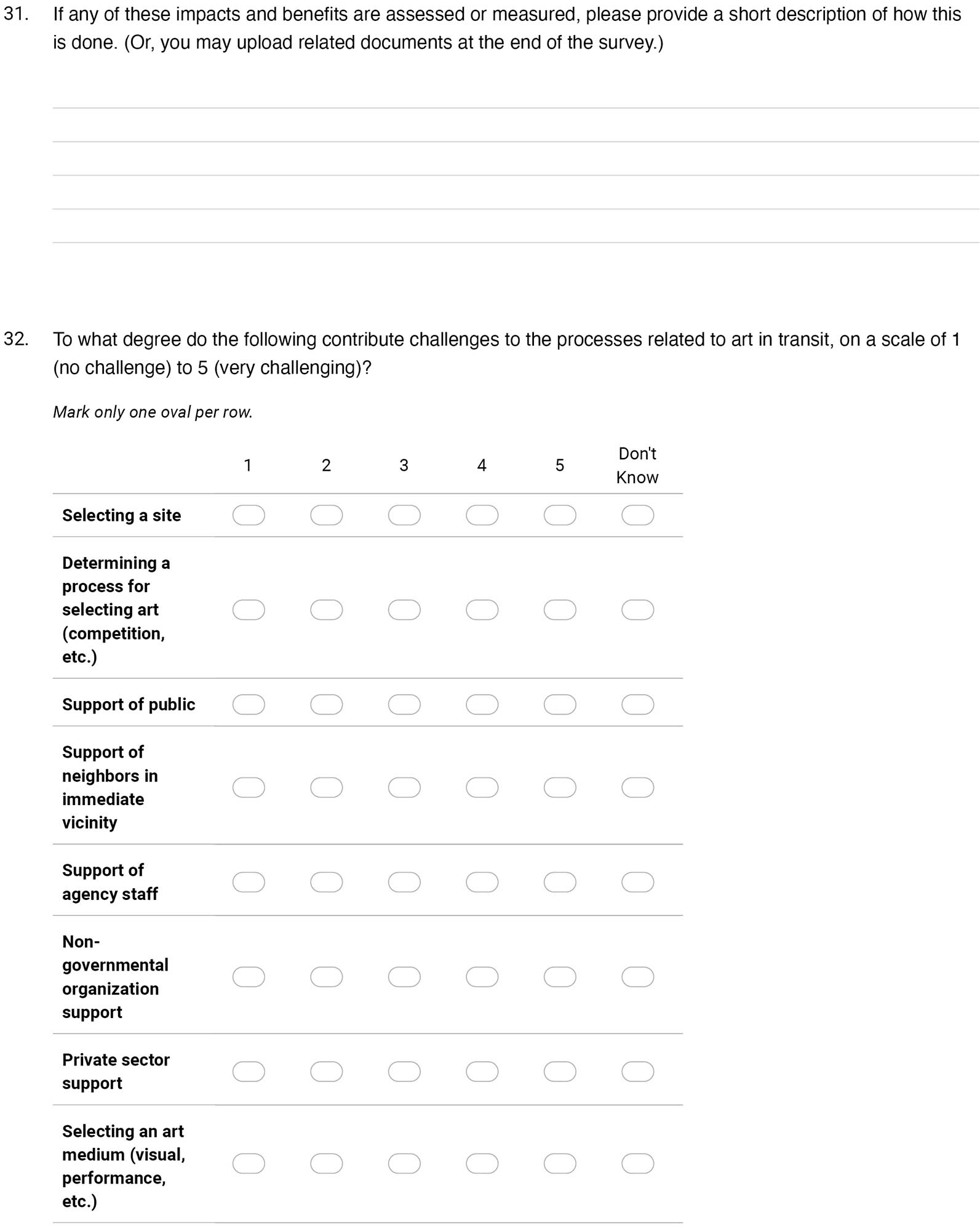
Long Description.
The text in the screenshot reads the following:
31. If any of these impacts and benefits are assessed or measured, please provide a short description of how this is done. (Or, you may upload related documents at the end of the survey.)
32. To what degree do the following contribute challenges to the processes related to art in transit, on a scale of 1 (no challenge) to 5 (very challenging)?
Mark only one oval per row.
The choices given are: 1, 2, 3, 4, 5, and Don’t Know.
Selecting a site
Determining a process for selecting art (competition, etc.)
Support of the public
Support of neighbors in the immediate vicinity
Support of agency staff
Non-governmental organization support
Private sector support
Selecting an art medium (visual, performance, etc.)
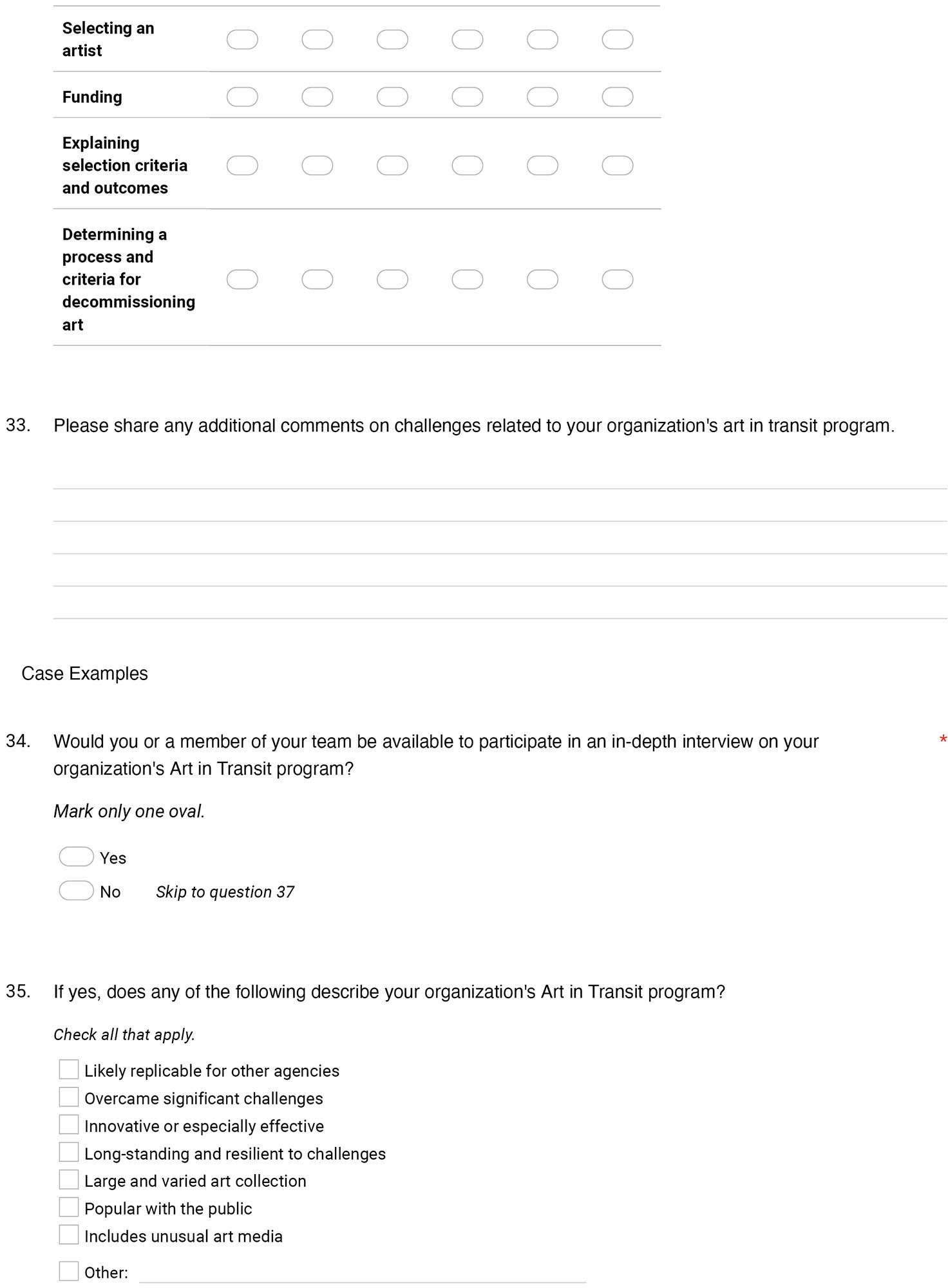
Long Description.
The text in the screenshot reads the following:
Selecting an artist
Funding
Explaining selection criteria and outcomes
Determining a process and criteria for decommissioning art
33. Please share any additional comments on challenges related to your organization’s art in transit program.
Case Examples.
34. Would you or a member of your team be available to participate in an in-depth interview on your organization’s Art in Transit program?
Mark only one oval.
Yes
No, Skip to question 37
35. If yes, does any of the following describe your organization’s Art in Transit program?
Check all that apply.
Likely replicable for other agencies
Overcame significant challenges
Innovative or especially effective
Long-standing and resilient to challenges
Large and varied art collection
Popular with the public
Includes unusual art media
Other:
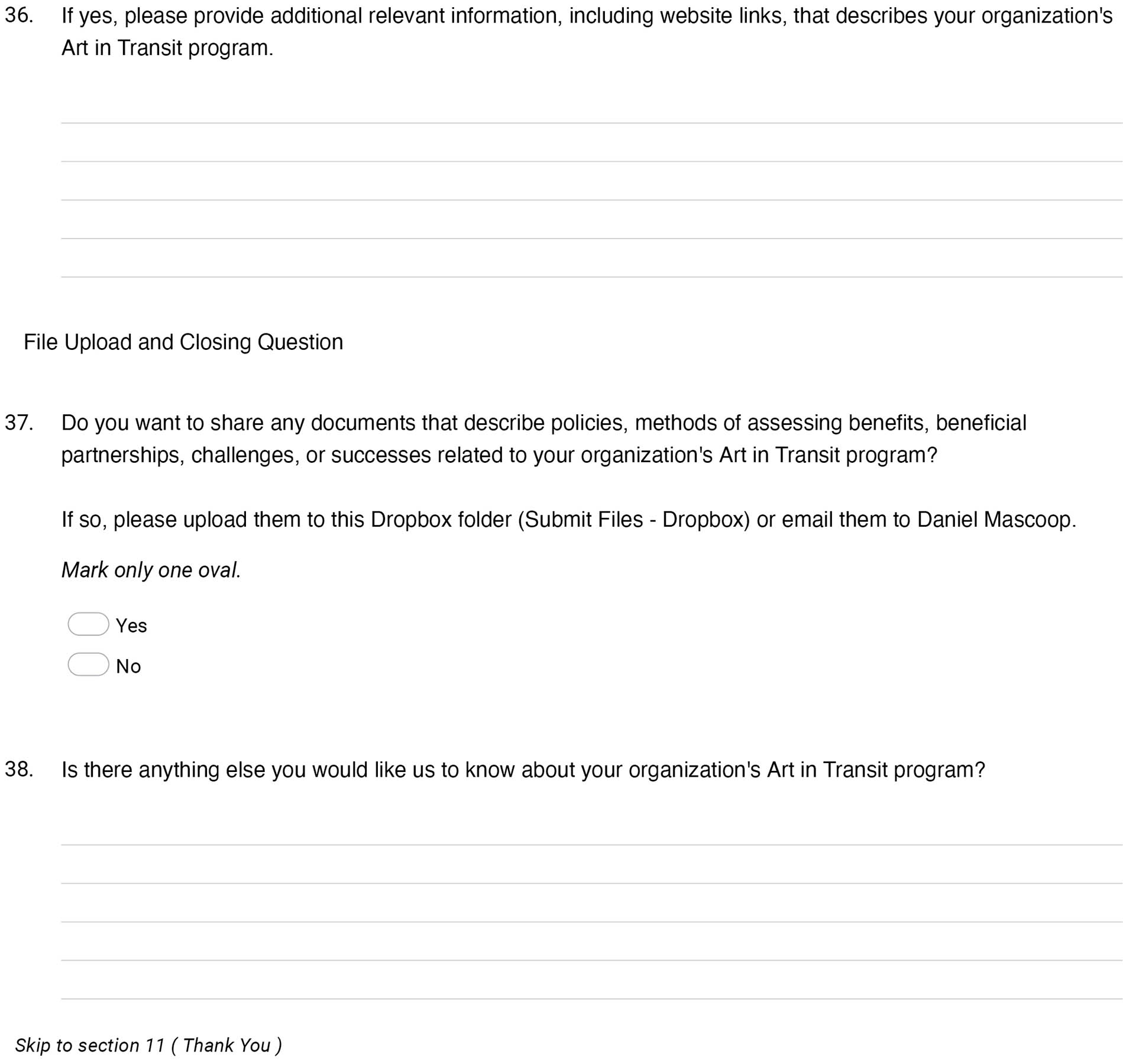
Long Description.
The text in the screenshot reads the following:
36. If yes, please provide additional relevant information, including website links, that describes your organization’s Art in Transit program.
File Upload and Closing Question
37. Do you want to share any documents that describe policies, methods of assessing benefits, beneficial partnerships, challenges, or successes related to your organization’s Art in Transit program?
If so, please upload them to this Dropbox folder (Submit Files- Dropbox) or email them to Daniel Mascoop.
Mark only one oval.
Yes
No.
38. Is there anything else you would like us to know about your organization’s Art in Transit program?
Skip to section 11 (Thank You)
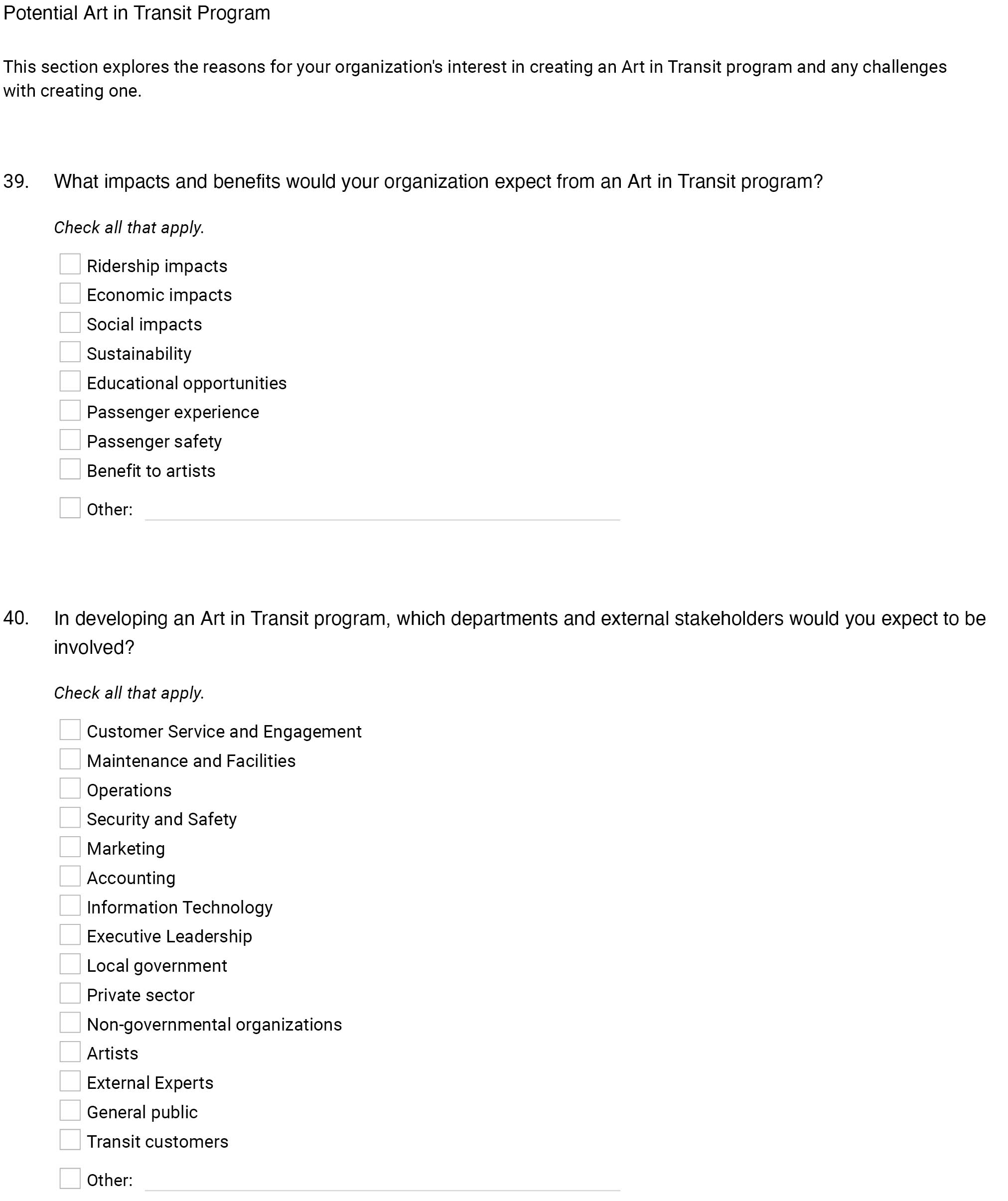
Long Description.
The text in the screenshot reads the following:
Potential Art in Transit Program
This section explores the reasons for your organization’s interest in creating an Art in Transit program and any challenges with creating one.
39. What impacts and benefits would your organization expect from an Art in Transit program?
Check all that apply.
Ridership impacts
Economic impacts
Social impacts
Sustainability
Educational opportunities
Passenger experience
Passenger safety
Benefit to artists
Other:
40. In developing an Art in Transit program, which departments and external stakeholders would you expect to be involved?
Check all that apply.
Customer Service and Engagement
Maintenance and Facilities
Operations
Security and Safety
Marketing
Accounting
Information Technology
Executive Leadership
Local government
Private sector
Non-governmental organizations
Artists
External Experts
General public
Transit customers
Other:
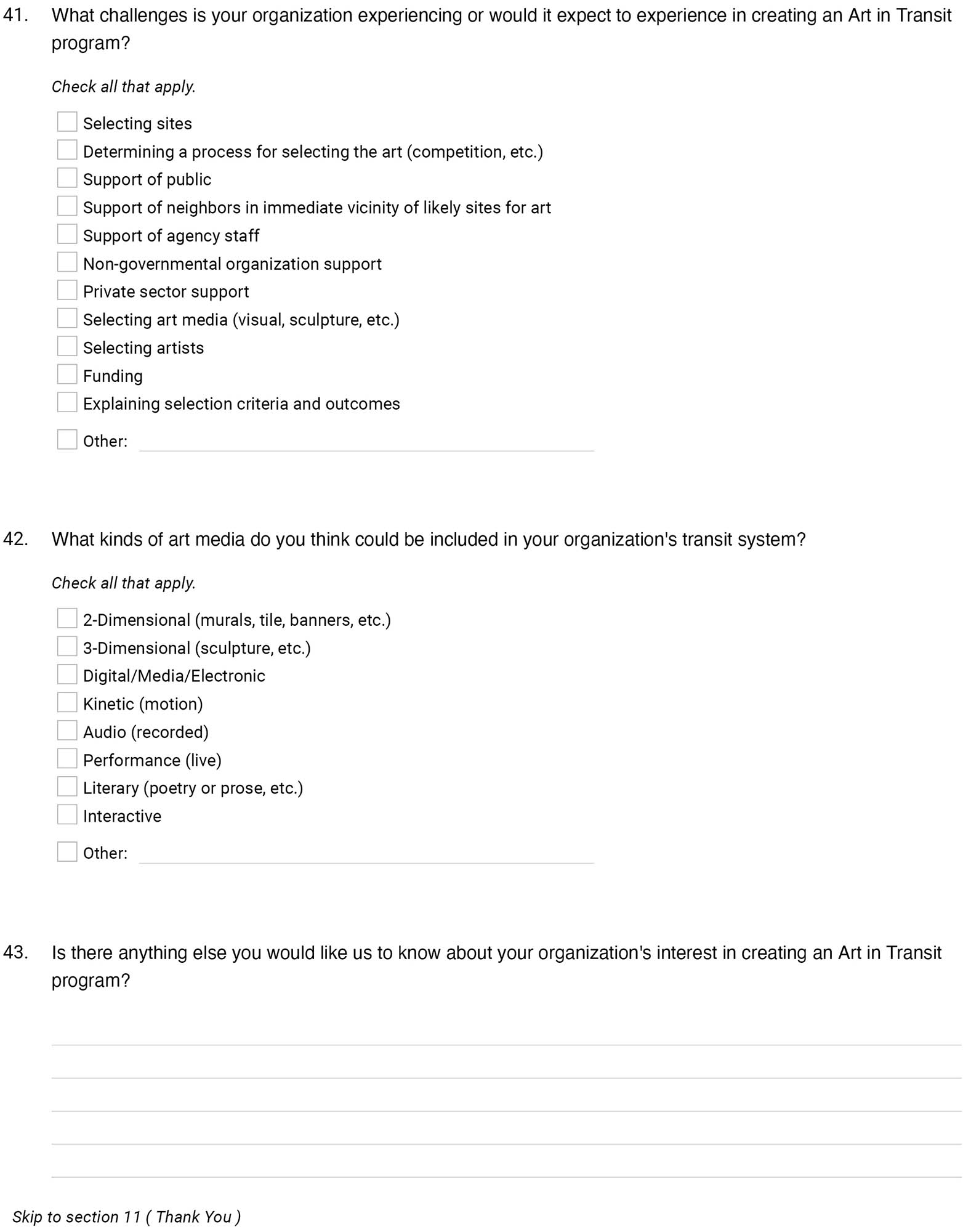
Long Description.
The text reads the following:
41. What challenges is your organization experiencing or would it expect to experience in creating an Art in Transit program?
Check all that apply.
Selecting sites
Determining a process for selecting the art (competition, etc.)
Support of the public
Support of neighbors in the immediate vicinity of likely sites for art
Support of agency staff
Non-governmental organization support
Private sector support
Selecting art media (visual, sculpture, etc.)
Selecting artists
Funding
Explaining selection criteria and outcomes
Other:
42. What kinds of art media do you think could be included in your organization’s transit system?
Check all that apply.
2-Dimensional (murals, tile, banners, etc.)
3-Dimensional (sculpture, etc.)
Digital, Media, or Electronic
Kinetic (motion)
Audio (recorded)
Performance (live)
Literary (poetry or prose, etc.)
Interactive
Other:
43. Is there anything else you would like us to know about your organization’s interest in creating an Art in Transit program?
Skip to section 11 (Thank You).
Long Description.
The text in the screenshot reads the following:
Thank You.
Thank you very much for your time and participation in this survey. If you have any questions about this survey or this research project, please contact Daniel Mascoop. We may contact you to clarify your responses or regarding a case example.
This content is neither created nor endorsed by Google.
Google Forms.
Case Example Interview Guide
Introduction/Buffer (5 minutes – included in outreach email)
Thank you for taking the time to speak with us. Weʼre conducting interviews with transit agencies for the TCRP Synthesis Topic SB-44 that aims to describe the state of art programs in transit in the United States and Canada, including established art in transit programs and individual art pieces in transit covering any type of art (visual, performance, etc.), and what benefits art in transit systems creates for the users of those systems, the communities around the systems, and the artists who participate.
For the purpose of this work, an “Art in Transit program” refers to any initiative to integrate art into a transit system, whether established or ad hoc. Art may be anything created by an artist, including temporary works and performance art but excluding advertising campaigns. (Advertising may have artistic components but is something that is paid for by an organization—private or public—to promote a product, service, event, action, political cause, etc.)
Your participation in this interview is completely voluntary, and any information provided will not be used for any purposes other than for developing a case example for this report. Following the interview, we will send you a draft of the case exampleʼs write-up and highlight missing information or brief clarifying questions that were not collected during the interview.
Many of the topics weʼll discuss relate to each other. If we end up discussing similar stakeholders, challenges, or factors under different topics, thatʼs helpful to show how these issues are important or impactful when considering different aspects of art in transit.
Recording Consent and Start Recording
Basic Information, Survey Responses (pre-filled)
- Organization:
- Interviewee (name, title, department):
- Organization type (agency, DOT, MPO/RPO, local government, non-profit):
- Geographic service area(s) (rural, urban, tribal, intercity):
- Transit service(s) (bus, bus rapid transit, light rail, subway, commuter rail, demand-response, ferry):
- Total annual budget (can be a range):
- How would you describe your organizationʼs Art in Transit Program (select one)?
- We do not have art in our transit system.
- We do not have art in our transit system, but we are interested in developing an Art in Transit program.
- We do not have an established Art in Transit program or process for procuring art. Integrating each piece of art is an ad hoc process.
- We do not have an established Art in Transit program; however, we do have an established process for integrating art in the transit system.
- We have an established Art in Transit program that is the sole channel for integrating art in the transit system.
- We have an established Art in Transit program and also conduct ad hoc processes for integrating art in the transit system.
- Type of art (2-Dimensional (murals, tile, banners, etc.), 3-Dimensional (sculpture, etc.), Audio (recorded), Performance (live), Literary (poetry or prose, etc.), Interactive, Landscape):
- Guidance documents and policies (Mission statement or goals, Strategic plan, Policies and procedures, Defined budget sources and guidance, Descriptions of expected impacts and benefits, Evaluation methods for impacts and benefits):
- Type of exhibits (Permanent, Rotating, Temporary, Onboard):
- Locations (Transit station - Publicly accessible areas, Transit station - Fare-restricted areas, Bus shelters, Other agency property):
- Additional survey question responses.
Management, Funding, Policies (20 minutes)
- Please provide a brief history of your agencyʼs art in transit program.
- When was it founded?
- Management and operations
- What are notable projects or art pieces/media?
- Have there been major changes in governance, funding sources, community engagement, artists selected/employed? (Can be discussed further under following topics)
- Do different art media or types of art installations require (or have) different management structures, processes, or funding sources?
- Temporary vs. permanent
- 2-D vs. 3-D
- Visual vs. performance
- What guidance, regulations, policies, and restrictions guide your agencyʼs art in transit programs?
- Art and artist selection
- Community and stakeholder engagement
- Oversight and funding (State, regional planning agencies, municipal governments, agency funds, NGOs, private sector, philanthropy/donations)
- Does your program make use of any external policy guidance?
- APTA Best Practices for Integrating Art into Capital Projects (revised 2024)
- Creative Placemaking and NEA Our Town program
- Do you think additional guidance would be valuable for your agencyʼs program?
Benefits and Impacts (10 minutes)
- What do you view as the primary benefits and impacts of your agencyʼs art program?
- E.g., Encourages ridership; Improves perception of transit; Conveys customer care; Enhances community livability; Improves customer experience; Improves organizational identity; Deters vandalism; Increases safety and security
- Does it change based on the stage in the lifecycle of art in transit (siting, selecting, maintaining, and decommissioning)?
- What is the role of artists in community engagement? (Also see Question 14.)
- Does your agencyʼs art program view artists themselves as primary community representatives?
- If so, how does your agency select artists who are representative of the community? (Also applies to External Stakeholders below)
Stakeholders (10 minutes)
Internal
- Who (or what role) has been integral for establishing your agencyʼs program or for ensuring that there is sufficient support to maintain it?
- Who is required to ensure that your agencyʼs art program functions?
- What departments or roles at your agency are most integrated with the art program?
- Which could benefit the most from additional integration?
External
- Who/what organizations have been integral for establishing your agencyʼs program or for ensuring that there is sufficient support to maintain it?
- Who/what organizations are required to ensure that your agencyʼs art program functions?
- What external stakeholders are most integrated with the art program?
- What could benefit the most from additional integration?
- What are challenges or strategies related to community engagement? (Also see Question 7.)
- Ensuring the community directly benefits from the engagement?
- Requiring over-participation?
Evaluation and Assessment (10 minutes)
- How do you assess or evaluate success of your program?
- Has any art piece been received especially enthusiastically? How was this reaction managed?
- Has any art piece been received poorly? How was this reaction managed?
- Has any art been decommissioned? If so, how was that process undertaken?
- Impetus for decommissioning?
- Broader infrastructure changes
- Public or external input/request
- Deterioration of art
Wrap-up (5 minutes)
- Are there any lessons learned or words of wisdom youʼd want to share with others seeking to set up their own art in transit programs?
- Is there anything we didnʼt ask that you think is important to discuss?
- Do you have any photos of art in your agencyʼs system youʼd like to or be willing to share (potentially to be used in the report)?
- Are you open to us sending you a draft of the case exampleʼs write-up, highlighting missing information or brief clarifying questions that were not collected during the interview?
This page intentionally left blank.


