The State of Art in Transit Programs (2026)
Chapter: 2 Literature Review

CHAPTER 2
Literature Review
This chapter provides an overview of existing literature that considers art in transit and provides a basis for the following tasks in this study. Each section focuses on addressing specific questions. First, art in transit is defined and examples of historic and current art in transit programs are described. Then, the benefits of art in transit are discussed. These include improved rider experience and economic impacts as well as more process-oriented benefits of integrating the artistic perspective into transit design and planning. Evaluation of these impacts also is discussed. Following this, funding and management policies and procedures from initial program development to commissioning, maintaining, and decommissioning art are discussed. Then, stakeholders and stakeholder engagement are described, highlighting instances where engagement may be most challenging. This is followed by a brief overview of challenges related to art in transit identified in the literature. Finally, a brief bibliography is included in this report to describe relevant reports and other documents from the 1970s to the present.
Methodology
The purpose of this literature review is to identify and synthesize literature that addresses the questions and identify gaps in the existing literature. While this review focuses on the current state of art in transit programs, it also discusses the history of art in transit in general and provides select examples of specific art in transit programs. Discussing this history helps inform our understanding of current conditions and helps fill in information gaps in more contemporary literature.
The search for literature was broad and included reviewing published and unpublished papers and presentations, reports, news articles, and information provided by transit agencies. The sources were not restricted to transit but were prioritized by relevance to art in transit (Figure 1).
Characterizing Art in Transit
What qualifies as “art in transit” and the relationships between art, infrastructure, aesthetics, design, architecture, and even community engagement can be fluid. In addition, art pieces or installations can be permanent or temporary and of a wide range of media (i.e., visual and audio; 3-dimensional and 2-dimensional; performance, digital, literary, kinetic, and interactive; and others). We refine our understanding of art in transit by reviewing the history of definitions employed in policies that establish and restrict funding for art in transit and by identifying existing locations and artworks in transit systems.

Long Description.
The flowchart begins with ‘Related to art in transit’ followed by ‘Related to art and transportation infrastructure’ and ends with ‘Related to public art.’
Defining Art in Transit in the United States Through Funding Guidance
Art has been integrated into mass transit systems globally throughout their histories. For art in transit in the United States, funding guidance set by the U.S. Federal Transit Administration (FTA) can help to define the nature of art in transit systems. In 1977 the U.S. Secretary of Transportation, Brock Adams, issued a policy to incorporate good design, art, and architecture into transportation facilities and services (USDOT 1978). In support of this policy, the U.S. Urban Mass Transportation Administration (UMTA, the predecessor to the FTA) issued a statement that established its support for funding art and design as part of new rail starts, rehabilitations of rail stations, buses and bus shelters, sidewalks, auto-restricted zones, and other facilities. Art and design components could include sculpture, patterned sidewalks, plantings, street furniture, and art and poetry posters in advertising panels onboard vehicles (USDOT 1978). This policy led to initial pilot projects, including the Massachusetts Bay Transportation Authority (MBTA) and Cambridge Arts Councilʼs Arts on the Line program (see the MBTA and Cambridge Arts Council Arts on the Line sidebar).
The FTA reaffirmed its support for art in Circular 9400.1A Design and Art in Transit Projects (1991, revised 1995) and established the following definition: “Art can be interpreted broadly [ . . . ] from free-standing sculpture to wall pieces to functional elements such as seating, lighting, or railings to artists being part of an interdisciplinary team in which the artists contribute to the overall design and specific art pieces may or may not be created.” This definition includes aesthetic and functional elements and indicates that an essential element of art is the involvement of an artist.
MBTA and Cambridge Arts Council Arts on the Line
The MBTA operates public transit throughout Greater Boston, MA, including rapid transit, light rail, bus, bus rapid transit, ferry, and commuter rail. It has a ridership of 795,300 per weekday (APTA 2025).
Arts on the Line, partially funded by UMTA, was a partnership between the MBTA and the Cambridge Arts Council in the 1980s to integrate art at stations for a subway line renovation and extension in Cambridge, Massachusetts. Funding was set at 0.5 percent of the capital projectʼs cost. The design, selection, and installation were overseen by a planning committee and selection panel. They solicited proposals from artists and conducted a competitive selection process, which was developed learning from a conflict during an earlier project where an architect preemptively had selected an artist (Amundsen 1995). These tasks were conducted throughout the capital projectʼs 10-year process and in coordination with other components of the process. The project is considered a pioneer and prototype for public art and art in transit (Raine 1986).
The program did not include maintenance funding, and multiple pieces have fallen into disrepair since their installations. “The Kendall Band” by Paul Matisse, which consists
of three interactive musical sculptures of bells and mallets hanging between subway tracks and controlled by a handle on the platform, quickly broke from overuse and misuse. For decades, Matisse would repair it himself at night while trains were not running. In 2011 the MBTA was renovating the station but would not fund repairing the artwork, so a group of students from the Massachusetts Institute of Technology volunteered to refurbish it (Weigel 2011). The piece, however, broke again in following years and remains broken as of 2025. Similarly, “Omphalos” by Dimitri Hadzi, a stone sculpture outside the Harvard Square station, became a safety hazard as it began to crumble in the early 2010s. The MBTA intended to demolish the piece, but Hadziʼs widow and his former students fundraised and donated money to save it. The MBTA donated the piece to a distant public park in the region, and this group paid for its relocation and repair (Zhang 2013).
The MBTA continues to maintain an art program, but its current state is unclear because the most recent calls for art were in 2015 (MBTA 2025a). The MBTAʼs Green Line Extension, which opened in 2022 and is its most recent major rail expansion, controversially eliminated its art component to help reduce the projectʼs escalating costs, even though art composed less than 0.1 percent of the total project cost (Vaccaro 2015). The MBTA later revived this art component after the projectʼs general funding stabilized (MassDOT 2021).
In the 2010s, U.S. federal transit law changed and withdrew complete support for art and design in transit projects. The law now restricts funds for art on the basis of distinctions between functional and aesthetic design versus primarily aesthetic uses. Updated FTA guidance from 2013 to 2015 advised that it was permissible to use FTA funds to employ an artist as a member of the design team and for other costs associated with art “provided that the artistic elements were integrally related to the facility or served a functional transit-related purpose” (FTA 2025). In 2015 the Fixing Americaʼs Surface Transportation Act (FAST Act) prohibited using FTA funds and any matching local funds for the “incremental costs of incorporating art or nonfunctional landscaping into facilities, including the costs of an artist on the design team” (FTA 2025). In determining eligibility and ineligibility for grant funding, the FTA defines art as “most decorative murals, sculptures, statues, musical installations, or similar objects or elements included for primarily aesthetic purposes” that “do not have a meaningfully functional, structural or transit-related purpose” (FTA 2025). Building on previous definitions, art in transit remains a broad category of aesthetic components that are designed by an artist.
Many transit agencies also have prioritized aesthetic design and architecture that relates to entries, vertical circulation (i.e., stairs, escalators, and elevators), signage, lighting, and waiting platforms. Examples include the Washington, DC, Metroʼs monumental and uniform station architecture; the Bay Area Rapid Transitʼs (BARTʼs) individualized station designs; and the Montréal Metroʼs integration with pedestrian routes and adjacent mixed-use development (Heder 1980). For this study, however, these examples do not qualify under the definition of art.
Existing Art in Transit Programs and the Locations and Types of Artworks
Art in transit also can be defined by identifying and describing existing art in transit programs, the types of art they commission, and where they locate art. This section includes brief descriptions of art in transit programs for the Charlotte Area Transit System (CATS), the Société de transport de Montréal (STM), the New York Metropolitan Transportation Authority
(MTA), and rural transit agencies that have submitted examples of art to the National Rural Transit Assistance Program (National RTAP). This information, along with other similarly highlighted examples of art in transit programs throughout the literature review, also helps address additional research questions and is therefore referred to in the following sections of the literature review.
CATS Art in Transit
CATS operates the public transportation network in the Charlotte, NC, metropolitan area and was established in 1999 to invigorate and expand the cityʼs bus and public transit network throughout the rapidly growing region. It has a ridership of 55,300 per weekday and operates light rail (opened in 2007), streetcar (opened in 2015), bus, and bus rapid transit networks (APTA 2025).
In adherence to guidance from the 1995 FTA Circular 9400.1A, the board of the CATS established the Art in Transit program in 2002 to encourage ridership and create an inviting environment for riders and the public by integrating permanent art into most capital improvement projects, including rail stations, park and rides, bus stops, transportation centers, and maintenance facilities. The program also commissions temporary projects and community art programs, which include bus wraps designed by local high school and college students and selected through a contest (with a scholarship award), seasonal live jazz music events at light rail stations, and an annual contest to design bus passes. The program also collaborates with the City of Charlotteʼs Urban Design Center to incorporate art-based placemaking at bus stops. In addition, the program offers a smartphone app that provides information on its collection and can be used while using transit services or elsewhere (CATS 2025).
In adherence to the 1995 FTA guidance, CATS commits 1 percent of its design and construction funds to the Art in Transit program (CATS 2025; 2011). The system itself is mainly funded through a voter-passed initiative to allocate a percentage of local sales tax (CATS 2011). Additional policies include the following:
- Conducting a peer review selection process informed by community participation,
- Involving artists at the earliest design phase of the project, and
- Establishing oversight by an advisory committee of qualified art professionals.
STM Art
STM operates the public transit system in the metropolitan area of Montréal, Quebec, Canada, including rapid transit, bus, and bus rapid transit networks. Its average weekday ridership is approximately 1,800,000 (APTA 2025).
The original portions of the Montréal Metro were constructed in the 1960s with the intention of hiring multiple architects to design different stations, giving them unique rather than uniform identities. The architects did not design the stations to accommodate art; however, local businesses and other organizations funded public art procurements for pieces that were soon added to multiple stations. The initiativeʼs artistic director advocated for
pieces that depicted the history of Montréal, but one of the artists, whom the program commissioned, successfully insisted on creating an abstract piece. This piece became one of the collectionʼs most popular and notable (STM 2025a).
As the Metro system continued to expand in the 1970s and 1980s, station architects began to integrate art from the earliest design stages, either with their own pieces or through commissioning other artists (STM 2025a). In addition, at this point the system fully realized an interdisciplinary design approach for aesthetic functional elements. A report for the United States Department of Transportation (USDOT) that included a case study on the system described the results as follows:
Metro users can delight in the transportation experience as they see the sensitive design of functional elements and the artful use of ordinary materials. Designers have turned air vents, shafts, grills, benches, and hand-rails into appealing and attention-getting sculptural elements. Stainless steel wall panels, polished to mirror smoothness, reflect changing patterns of movement and color; textured concrete sets off the shimmer of mosaic tiles; and lighting tubes dramatize the awesome volume of interior spaces. The construction is solid: Montréalʼs Metro is designed to look good for 100 years and more. (Rifkind et al. 1983, p. 23)
By the 2000s, the Metroʼs art policy was guided by the Province of Quebecʼs public art policy. From 2007 through 2016, STM prioritized the maintenance and restoration of its art collection. This work is undertaken and funded by the provincial culture and transportation ministries (STM 2025b). Currently, most Metro stations host artwork, including murals, stained glass panels, and sculptures. In addition, STM commissioned an artist to create a series of murals for stations on a bus rapid transit route that opened in the 2020s (STM 2025a).
MTA Arts & Design
The MTA operates the public transportation system in the New York City metropolitan area, including rapid transit, bus, bus rapid transit, and commuter rail. The combined average weekday ridership of its constituent agencies is 10,212,300 (APTA 2025).
The MTA Arts & Design program was founded in 1985 under the MTAʼs Capital Rebuilding Program to “introduce original and integrated artworks into MTA stations and to promote design excellence as part of the MTAʼs effort to rebuild the transportation network” (Cho 2016). The programʼs establishment also was in anticipation of the state legislation expanding its 1982 percent-for-art law to the MTA. The program continues to receive up to 1 percent of capital project funding, including for subway and commuter rail station rehabilitations and capital expansion projects, to commission permanent artwork (MTA 2025b).
The Arts & Design programʼs policies were fully established by the mid-1990s. These policies include an extensive commissioning process that starts with an open call for artists to submit proposals. These are reviewed by a selection panel composed of arts and cultural professionals, community advisors, and representatives from local community boards, that selects four finalists. The finalists attend an orientation and a site visit with the architects and then submit formal proposals. A voting panel then selects the proposal that speaks to the community and is of the highest quality (Cho 2016).
The program currently curates a collection of over 400 art pieces that it calls a “beautiful underground art museum” (MTA 2025a) and is critically and popularly acclaimed. This collection includes site-specific permanent art (on walls and in gates, windscreens,
plazas, and other station architecture), rotating photography exhibits in lightboxes, digital art, musical performances, posters (on subway cars and buses), and literary art through its Poetry in Motion program, which has administered in collaboration with the Poetry Society of America since 1992 (including a 4-year hiatus). The program emphasizes that it provides opportunities to well-established, mid-career, and emerging artists in media that reflect the systemʼs infrastructure, such as mosaic, ceramic tile, bronze, steel, glass, and mixed media (MTA 2025a; 2025b). The program conducts limited maintenance and therefore prioritizes using the most durable materials (Cho 2016).
The Arts & Design program has published a large coffee table book highlighting the more than 100 permanent projects it completed between 2015 and 2023 and provides a free digital guide to its collection through a smartphone app (MTA 2025a).
Rural Transit and the National RTAP Annual Photo Contest
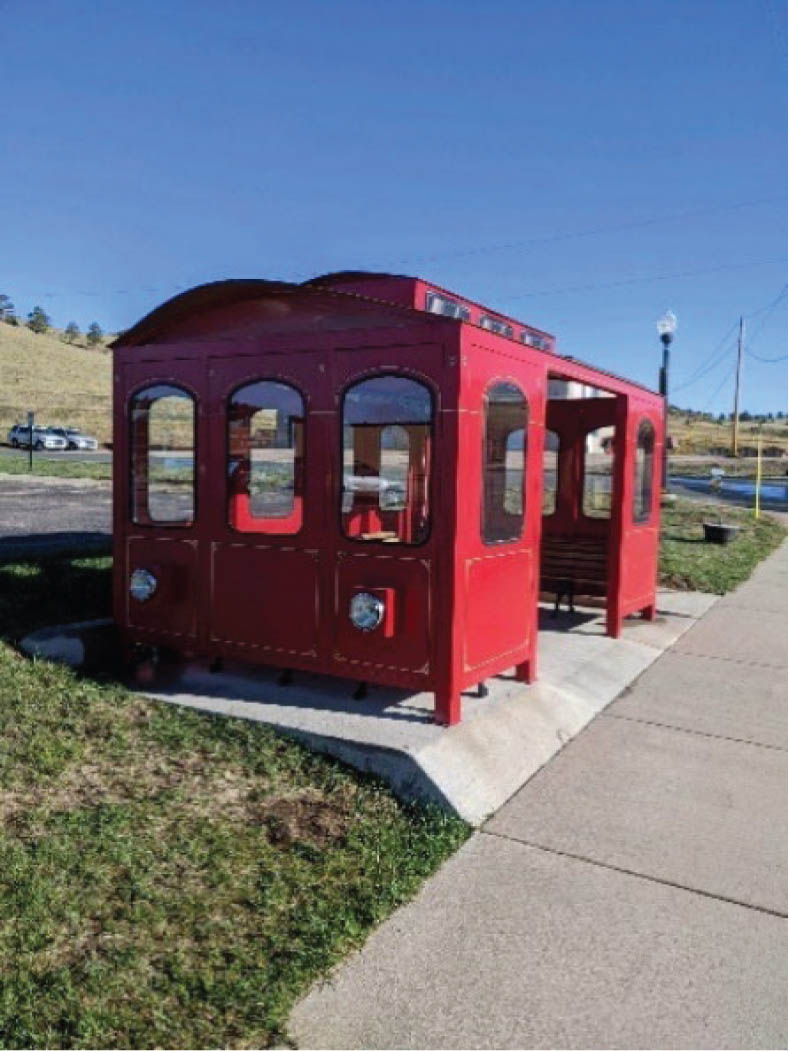
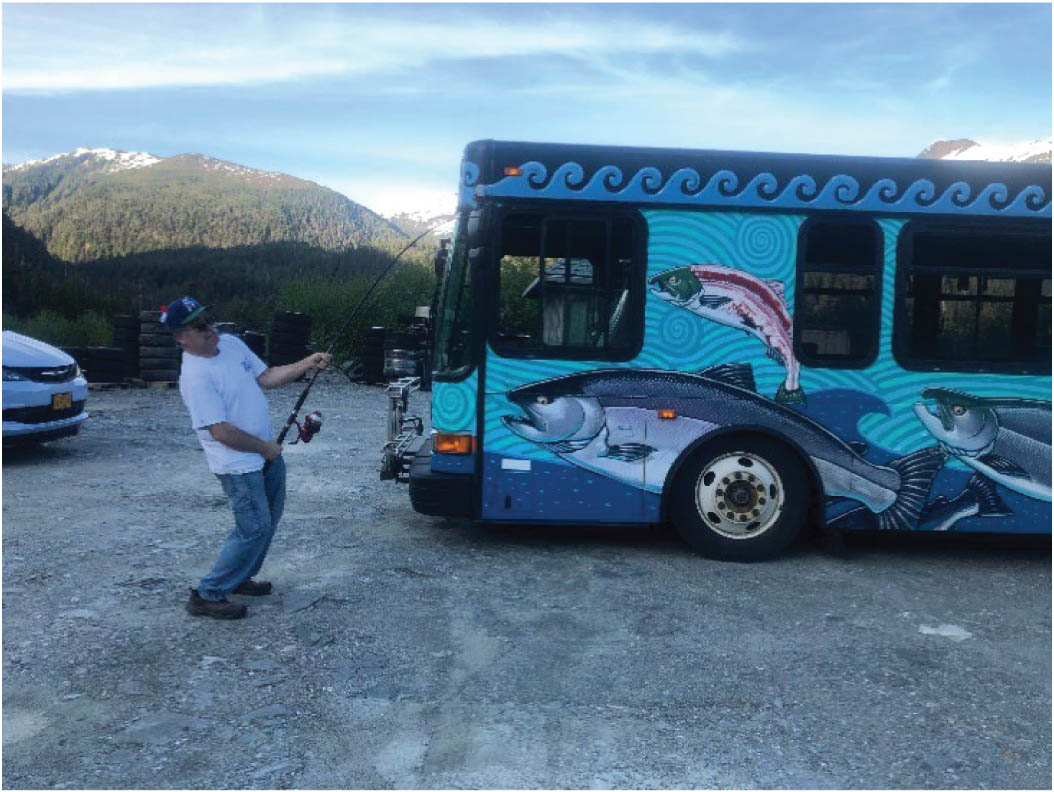
While there is limited available information on art in rural transit, rural transit agencies do include art on their buses and facilities. The following two examples were submitted to National RTAPʼs annual photo contest in recent years:
Cripple Creek Transit in Teller County, CO, built bus stops that were designed to look like trolleys and were solar powered as part of a project funded by the Colorado Department of Transportation and the FTA in 2014 (Figure 2) (National RTAP 2022).
Ketchikan Transit in Ketchikan, AK, installs artistic bus wrappings on its fixed-route bus fleet (National RTAP 2023). Bus wrapping, along with painted murals over bus shelter panels, has a history of being a low-cost and easy-to-manage way to increase ridersʼ comfort and safety and improve the bus systemʼs identity (Figure 3) (Feuer 1996).
Benefits and Impacts
The literature reviewed identifies two main categories of benefits and impacts that art in transit provides. One mainly relates to improving ridersʼ experiences and concomitant economic impacts. The other relates to the role that an artist plays in providing a creative perspective and representing the local community in the transit design and development process through approaches such as process-oriented “creative placemaking.”
Rider Experience and Economic Impacts
The commonly identified benefits of art in transit are summarized best by APTAʼs Best Practices for Integrating Art into Capital Projects document as follows (2024):
- Encourages ridership
- Improves perception of transit
- Conveys customer care
- Enhances community livability
- Improves customer experience
- Improves organizational identity
- Deters vandalism
- Increases safety and security
A 1983 report by Rifkind et al. for USDOT and the National Endowment for the Arts (NEA) focuses on the case for design and art as essential elements in transportation planning to improve
economic development, which ultimately comes from improved rider experience. The report presents the following benefits:
- High-quality design being a better long-term investment to support future expansion and adaptation
- Economic development and rational land use inspired by better-designed and cared-for transportation system
- Commercial revitalization
- Private investment
- Use of wasted resources (i.e., unused land along a right-of-way)
- Offer improved resources for tourism through infrastructure itself being attractive
- Community image-building
- Improved pedestrian circulation and access to adjacent stores and offices
- Increased potential for intermodal travel
- Increased ridership
- Cost efficiency of inexpensive aesthetic improvement marketing transit (and encouraging ridership)
Related to these benefits, art installations also can serve basic functional uses for wayfinding and placemaking, as riders use them as landmarks (USDOT 1978).
Community image-building through art in transit can be especially transformative during difficult planning processes. During the relocation of the southern portion of the MBTAʼs Orange Line from an elevated track to a below-grade right-of-way in a different neighborhood in the 1980s, an oral history art installation became a tool to help residents, who were concerned about gentrification and crime, cope with the change and take pride in the project (Feuer 1996). In such situations, community-based artists and the arts serve as the “translator, cultural ambassador, negotiator, and trust builder” (VanderSchaaf and Kayzar 2021, p. 31).
The Artistʼs Perspective, Social Impacts, and Creative Placemaking
Since USDOT began encouraging art in transit, guidance has emphasized the benefits to transit that are realized from incorporating artistsʼ perspectives into the design and development processes (Feuer 1996). The development of the St. Louis MetroLink exemplifies this integration [see the MetroLink Arts in Transit (AIT) sidebar].
MetroLink Arts in Transit (AIT)
MetroLink is operated by St. Louis Metro Transit under the Bi-State Development Agency, which provides a public transportation network in the Greater St. Louis region in Missouri and Illinois, including light rail (i.e., MetroLink), bus, and streetcar systems. Its average weekday ridership is 64,600 (APTA 2024a).
As the Bi-State Development Agency was designing the MetroLink system, which first opened in 1993, it formed AIT with funding from the NEA, the St. Louis Regional Arts Commission, and UMTA. AITʼs purpose was to integrate art and artists into the system design process as early as the 30 percent design stage. The agency selected artists who then worked with architects and engineers to develop a unifying design theme that was dynamic, discernible to riders, characteristic of St. Louis, helpful with wayfinding, and illuminative of functional elements. The ultimate design theme focused on an arc based on the St. Louis Gateway Arch (Amundsen 1995).
The team of architects, engineers, and artists implemented this design theme through bridge supports and station canopies. They also performed extensive community engagement through school programs, art exhibits, public speakers, and outfitting a bus with a traveling art gallery. Additional artists and landscape architects developed a plan for sites that could accommodate art along the MetroLink right-of-way (Amundsen 1995). This investment in good design and related community engagement helped MetroLink open with ridership at 3.5 times of what was projected (Feuer 1996).
In the 2010s, creative placemaking, spearheaded by the NEA and its Our Town initiative, became an influential, process-focused approach for leveraging artistsʼ perspectives into design and development of public projects, including transit. Creative placemaking emphasizes the social benefits that arts and culture and related community engagement provide for these projects. As described by Transportation for America:
In the transportation context, creative placemaking is an approach that deeply engages the arts, culture, and creativity . . . in planning and designing projects so that the resulting communities better reflect and celebrate local culture, heritage and values. (T4A 2025b)
Creative placemakingʼs process-oriented practices include performance, music, storytelling, digital media, and social practice, which is an immersive, participatory, activist, and community-based field of art (Stone and Nezam 2017).
Creative placemaking asserts that artists represent creative, unconstrained, and non-engineering perspectives inherent in local communities. Artistsʼ perspectives may generate creative solutions for difficult transportation problems, engage stakeholders in more participatory processes, organize advocates for transit, and in turn mitigate the negative effects of historic and contemporary construction and permanent infrastructure on communities (Stone and Nezam 2017; Cidell et al. 2024).
Beyond the artists as community representatives themselves, creative placemaking expects that artists and transit agencies conduct community engagement using arts-focused activities, such as building models during community planning meetings or local oral history projects. These activities serve to prompt community perspectives that are not included in traditional planning and design processes through accessible and fun artistic activities (T4A 2025a). Durable relationships between community members, businesses, and other neighborhood organizations and planners reinforce the movement toward advocacy in planning transit and other transportation infrastructure (VanderSchaaf and Kayzar 2021).
Creative placemaking can be undertaken in a wide range of context and scales (T4A 2025a). For references to additional reports that include case studies on creative placemaking applications in transit, see the Bibliography.
Evaluating the Impacts
Many public art programs and stakeholders have keen interests in evaluating the impacts of art in transit, whether for defending its positive effects with evidence or for sharing effective practices among program managers (Stone and Nezam 2017). Despite this, there is limited research and guidance on the “public life” of artworks in public transit after they have been installed (Yamamoto 2018). This knowledge and practice gap exists in the broader field of public art, including with airport arts programs (Nemon and Kreinbring 2024).
Developing effective methods for evaluating the impacts of art in transit has remained difficult and elusive, partly because of “the potential paradox of using traditional methods and values from the industrial world of worth to evaluate the success of programs based in the inspired world”
(Cidell et al. 2024). In a 1983 report for the NEA, researchers concluded that it is unlikely that data exists to support a cost-benefit model for evaluating art and aesthetic design in transportation that “could satisfy its users on pragmatic or philosophical grounds” (Rifkind et al. 1983, p. 8). Given these difficulties, descriptive or even tautological methods for evaluating the long-term impacts and efficacy of art in transit include tracking public enthusiasm for maintaining and protecting installed artwork from damage or graffiti (Amundsen 1995) and tracking if programs are maintained or replicated by other agencies (Cidell et al. 2024).
To ensure that existing artwork continues to improve customer experience and elicits public support, the Los Angeles County Metropolitan Transportation Authority (LA Metro) has designed an artist-led tour program. This program employs “relational aesthetics” to address customersʼ increasing desires for personalized experiences and deeper engagement throughout life, including from utilitarian services (Yamamoto 2018). When the program was established in 1999, it also served to introduce the public to riding the LA Metro, since most tour attendees had never used public transit. As the LA Metro has become more established in recent years, many tour attendees are regular riders and use the tours to “experience the system in new and interesting ways” (Yamamoto 2018). In addition, improving and maintaining documentation of practices and of public opinion are essential to ensuring art programs and their impacts persist and can be replicated by others (Cidell et al. 2024).
Creative placemaking practitioners also have investigated methods for evaluating the impacts of the approach to arts and culture and community engagement. A 2014 report for the NEA validated candidate indicators on the basis of nationally available data for dimensions of community livability supported by the Our Town initiative. The indicators included the proportion of housing units occupied, violent crime rate, proportion of employees working in arts-and-entertainment-related establishments, and median household income, among many others (Morley et al. 2014). More recent creative placemaking guidance presents evaluation as a complementary process-focused and artist-led approach. Such evaluation approaches illuminate artistsʼ and communitiesʼ innate understandings of the relationships and correlations among arts and culture and social, economic, and physical changes in the long term to the individual, community, and system. Tools, including structured interviews, focus groups, polls and surveys, and digital media impact numbers, help identify qualitative or quantitative outcomes that are specific, measurable, attainable, relevant, and time-bound. Proponents of creative placemaking can use these results to build narratives on the impacts of these programs (Osgood 2019).
Funding and Management of Art in Transit Programs
The APTA Best Practices for Integrating Art into Capital Projects document (2024) presents comprehensive best practices related to funding and management of art in transit programs and provides a basis for this section. Many of the sources and art in transit programs discussed in previous sections provide relevant information for addressing these topics.
Funding
The FTA Circular 9400.1A Design and Art in Transit Projects (1991, revised 1995) established that “funds spent on the art component of projects should be appropriate to the overall costs of the transit project and adequate to have an impact. These costs should be all-inclusive and generally should be at minimum one half of 1 percent of construction costs, but should not exceed 5 percent of construction costs, depending on the scale of the project.” The current APTA guidance affirms this allocation and clarifies that it should cover the design and fabrication of the artwork and installation, if that is not combined with general construction or requires specialized skills (APTA 2024b). The federal FAST Act of 2015 rescinded FTA grant (and any matching local funding) support for art with primarily aesthetic purposes in transit, but the APTA funding allocation guidance remains salient to current art in transit programs and is similar to other existing
public art funding guidance (see the CATS Art in Transit and the MTA Arts & Design sidebars). There has been interest in reversing the FTA grant restrictions through the Saving Transit Arts Resources (STAR) Act, which was sponsored and referred to committee in both the U.S. House of Representatives and Senate 2023–2024 sessions (Americans for the Arts 2023).
As functional and aesthetic design of transit facilities can serve to address adverse effects identified in the environmental review process, the FAST Act permits FTA funding for “the often indeterminate incremental costs associated with functional design elements, including, but not limited to, the use of different types or colors of paint or tile, wayfinding elements intended to direct passengers or staff, or different or alternate construction materials in the design of a transit facility” (FTA 2025). Some transit agencies also have been able to obtain normally restricted funding for art by employing art and artists in community engagement and environmental mitigation processes under the creative placemaking approach (Cidell et al. 2024).
The stated leniency for functional design elements notwithstanding, the FAST Act did have significant effects on art in transit programs, depending on their transit agenciesʼ general funding sources. For example, capital funding for CATS primarily comes from local tax levies, and the agency has continued to fund its art in transit program without changes (see the CATS Art in Transit sidebar). St. Louis Metro Transit established a new community-based board for Arts in Transit separate from the agencyʼs board to “enhance its capacity to secure funding from individuals, foundations, and business entities” following the enactment of the FAST Act (St. Louis Metro Transit 2025). Other agencies, such as the Tri-County Metropolitan Transportation District of Oregon (TriMet) in the Portland, OR, metropolitan area, had robust art in transit programs that now are struggling to obtain sufficient funding after losing access to portions of FTA capital grants (see the TriMet Public Art Program sidebar).
TriMet Public Art Program
TriMet operates the public transportation network in the Portland, OR, metropolitan area. It has ridership of 193,900 per weekday and operates light rail, bus, and commuter rail networks (APTA 2025).
TriMetʼs Public Art Program began during the design phase of the first Westside MAX Blue Line light rail in 1992. Along with hiring design team artists, the program established a volunteer Art Advisory Committee of arts and design professionals to complement broad public participation on the project. Although at that time the FTAʼs support for art in transit had not yet been formalized, TriMet and other transit agencies successfully lobbied the FTA to produce new federal guidelines (Banyas and Priester 1998). New funding guidance allowed and encouraged the allocation of a small portion of transportation grants for artists and art. This pioneering initiative, along with community enthusiasm for the results, led to TriMet formalizing its Public Art Program and percent-for-art policy (i.e., 1.5 percent of eligible construction costs) in 1997 (Markusen and Gadwa 2010). TriMet continued to integrate art throughout the many expansions of the MAX light rail system with site-specific, integrated pieces informed by extensive community engagement. This approach garnered public enthusiasm and helped mitigate the mistrust some neighborhoods had because of adverse effects from past (unrelated) infrastructure development projects (Markusen and Gadwa 2010).
Since the passage of the 2015 FAST Act and without the support of FTA grant funds, TriMet has not included artwork on new capital projects since the art policy had previously applied to federally funded projects. A revised policy was approved in 2023; however, the Public Art Program primarily maintains the existing art collection because of lack of available funding (M. Traver, TriMet Public Art Program, personal communication, June 2025).
Beyond using projectsʼ capital budgets and other internal general funds, transit agencies access other funding sources to help with commissioning art. The NEA, through Our Town grants and other programs, supports public art, including art in transit systems and on adjacent property. These programs also enthusiastically offer grants to rural municipalities and agencies, with 25 percent of Our Town grants being allocated to rural projects (Stone 2024). In addition, nongovernmental organizations (NGOs) and other private businesses and organizations have provided funding for art programs and project-specific commissions (St. Louis Metro Transit 2025; see “STM Art”).
In 2025 the state of funding for public art in the United States is in flux. In May 2025, the U.S. government began canceling previously awarded NEA grants to align its grantmaking “to focus funding on projects that reflect the nationʼs rich artistic heritage and creativity as prioritized by the President” (Veltman quoting the NEA 2025). To meet these new and changing priorities, these programs may need to find new funding sources to maintain previous levels of funding.
As discussed under the review of multiple agenciesʼ programs, art in transit programs may not have dedicated maintenance funding (see the MTA Arts & Design and the MBTA and Cambridge Arts Council Arts on the Line sidebars). APTAʼs guidelines suggest using the agencyʼs operational budget for long-term care and maintenance of its art collection (APTA 2024b).
Art in Transit Program Development and Management
A primary component of APTAʼs recommended best practices is including an experienced transit art program manager to develop and manage an art in transit program (APTA 2024b). The first steps for this program manager to create an art in transit program involve establishing policies on funding, artistic eligibility, an advisory group of art professionals (a method for selecting artists), and community involvement (APTA 2024b). The program manager must be able to bridge the artistic and public sector realms, understand how the art program is included in the agencyʼs general operations and maintenance, identify effective locations for art, attract qualified artists, guide artists through the contracting and design stages, guide fabrication and installation processes, and engage with the public (APTA 2024b).
Art in transit programs may be under a variety of departments. For example, LA Metroʼs art program is housed within the agencyʼs Customer Experience Office (LA Metro 2022), and the Metropolitan Atlanta Rapid Transit Authority (MARTA) Artbound program is housed under the Transit-oriented Development and Real Estate and Art department (MARTA 2025). In a broader perspective of art in mass transportation, a survey of airport arts programs showed they are most often housed within a marketing or communications department and then under executive departments and maintenance departments (Nemon and Kreinbring 2024).
Procuring Art and Selecting Artists
APTAʼs guidelines offer a review of the selection processes for artists and artwork. Its recommended criteria (APTA 2024b) for art are the following:
- Quality of the work, including evaluating artistsʼ portfolios, credentials, and specific proposals
- Site-specificity, including the relationship to adjacent landscape, urban fabric, and surrounding communities
- Durability of materials in the context of heavy public use and relevant environmental conditions
In selecting artists, APTA recommends establishing a structured and justifiable process that is competitive and appropriate for the scope of the project. The process should include an open call to artists and a selection panel of art professionals. A two-phased competitive process can provide
an opportunity both to solicit wide interest and then to pay finalists for the work of developing project-specific proposals (APTA 2024b).
APTAʼs recommended best practices allow for fabrication and installation to be undertaken either by the projectʼs general contractor or by a specialized artisan, if necessary, given the artwork. The art program manager should be present for installation to advise on issues and coordinate among contractors (APTA 2024b).
APTAʼs guidelines recommend maintaining a permanent record of each artwork that includes photographs and a general description of the piece, artistic intent, desired appearance over time, materials, fabricators, installers, and maintenance recommendations (APTA 2024b). Missing knowledge on project management and specific artwork can be a significant issue in managing arts programs, and maintaining such documentation is essential to ensuring that knowledge can persist within the organization (Cidell et al. 2024).
Maintenance and Decommissioning/Deaccessioning
Some art in transit programs discussed in this literature review do not allocate sufficient or any funds to maintaining their art collections (see the MBTA and Cambridge Arts Council Arts on the Line and the MTA Arts & Design sidebars); others have prioritized maintenance (see the STM Art sidebar). A survey of 10 art in transit programs in 2015 found that most did allocate funding for maintenance (Almaguer and Przyblyski 2015). APTAʼs guidelines recommend that an agency uphold a long-term commitment to maintaining its art collection with an operation budget line-item cost (APTA 2024b).
Decommissioning or deaccessioning artwork involves permanently removing it from a collection, and it does occur with public artwork (Walsh 2017). When decommissioning artwork, a major consideration is the 1990 U.S. Visual Artists Rights Act, which grants artists of paintings, drawings, prints, sculptures, or photographic images permanent rights over their artwork. The artwork may not be destroyed, distorted, or mutilated without the consent of the artists, unless the artists previously waived their rights (U.S. Congress 1990).
APTAʼs best practices do not include any guidance on these tasks beyond stating that the transit art program manager be responsible for deaccessioning (APTA 2024b), but Americans for the Arts has hosted conversations about decommissioning public art and how public art should not necessarily be permanent (McKeown 2014). Principles for decommissioning, as presented by the Indy Arts Council (2025) in Indiana, may include the following:
- Creating strong contracts between the artist, site owner, and community
- Defining the intended lifespan of the artwork
- Communicating the intent to remove the artwork and the reasons for doing so
- Presenting a respectful transition plan to the public
- Creating a remembrance that features a picture and history of the artwork
Among art in transit program policies, the MBTAʼs integral art program/policy guidelines appear to address the Visual Artists Rights Act and state potential reasons for decommissioning artwork. The MBTAʼs policy includes the following “terms and maintenance” provisions (MBTA 2025b):
The MBTA reserves the right to remove any art installation at any time with notice. This may include the following reasons:
- If the material becomes dated, falls into disrepair, or no longer is consistent with the goals and mission of the MBTA.
- If the work poses a threat to public safety, or in some other ways poses a potential liability for the MBTA.
- If the Committee deems it necessary for the MBTA to exercise its responsibilities in regards [sic] to public works and improvements.
All artwork created under this program belongs to the MBTA with proper credit due to the artist(s) and/or organization. The MBTA requires that each artist grant the MBTA the right to a royalty-free, perpetual license to use any depictions of the artwork for use in any and all publications. Credit will be published where possible.
Stakeholders and Stakeholder Engagement
This literature review identified the following stakeholders: art in transit programs and staff, agency executive leadership and other departments, artists, NGOs, private businesses, and the broader community. The UMTA 1978 statement in support of art in transportation highlights that “The participation of local arts councils, business firms and other community groups and individuals is considered an essential part of a successful mass transit arts and design program” (UMTA 1978 quoted in USDOT 1978, p. 8).
Regarding engaging these stakeholders, there are notable factors related to support from and cooperation with internal agency stakeholders, when to involve artists, and demanding too much from community engagement participants. These issues are discussed in this section.
Agency Leadership and Internal Stakeholders
In the 2010s, BART produced a progression of comprehensive and clear documents with the intention of revitalizing its art program and adopting significant funding commitments for the program. By the 2020s, the funding commitments had not been fulfilled, and the BART Art Program cannot operate fully despite the formalized policies and plans (see the BART Art Program sidebar). This development demonstrates the importance of an agencyʼs leadership and other internal stakeholders in supporting the agencyʼs art in transit program, and the vulnerability of art programs in a context of overall transit funding pressure.
BART Art Program
BART operates a rapid transit and light rail system in the San Francisco Bay Area with an average weekday ridership of 167,700 (APTA 2025).
Starting in 2013, BART aimed to revitalize its arts program. A 2015 report presents existing conditions at BART, results from a survey of 10 art in transit programs, and recommendations for an art policy (Almaguer and Przyblyski 2015). In 2018 the BART Board of Directors adopted an art policy based on these recommendations. In addition to stating a vision and goals, the policy established funding of 2 percent of most capital improvement costs and 0.25 percent of other capital costs and train procurement budgets, all pooled to fund the program in general (BART 2018). A comprehensive master plan was published in 2019 and reaffirmed this funding strategy, among other strategies (Goldstein et al. 2019).
After the boardʼs authorization of the master plan, the Art Program began to coordinate with the budget and finance department to formalize the funding process. This proved to be difficult to accomplish: The budget and finance department was trying to provide the appropriate allocations and accommodate competing interests for funding from a pool of sources, each with different restrictions.
In 2020, during the COVID-19 pandemic, BARTʼs executive priorities shifted away from revitalizing the Art Program. An infill station project that was set to fully fund its art component was canceled, and other station retrofit projects that incorporated art were
curtailed. In 2025 BART is facing a fiscal cliff and awaiting the results of a voter initiative to provide additional funds for the agency. The outcomes of this vote will determine the scale of funding trade-offs the agency must consider. Until then, the Art Program continues to operate with funding of approximately $200,000 per year from BARTʼs operations budget (also established in the art policy) for conservation and maintenance and temporary programming. For capital projects where public art should have an important contribution to the projectʼs outcome, a budget for art is negotiated. If allocated, such budgets have been well below the 2 percent allocation established in the art policy (J. Easton, BART Art Program, personal communication, May 2025).
Artists
Most literature on art in transit emphasizes including artists in the design process at the earliest stages. Doing so provides benefits to the design of the system and makes integrating art into the transit system easier. In reviewing the public art program for LA Metroʼs first light rail segment in 1996, the FTA notes that waiting until the 60 percent design phase to include artists led to difficulties with budgeting, timely fabrication, and selection of durable materials; it caused costly overengineering for the artwork (Feuer 1996).
Creative placemaking guidance emphasizes that “when artists join a project team at the outset, they can contribute to the process of identifying the problem, organizing support, and collaboratively finding a solution,” in effect, realizing the main benefits of including the artistic perspective in transportation design and planning (Stone and Nezam 2017). Advocates for creative placemaking also describe how artist-in-residence programs are especially effective in entrenching the artistic perspective into transportation department operations. These programs provide sufficient time for relationship-building and bridging between different values held by artists, engineers, and other transportation department staff. They give artists the security to fully contribute their perspectives (Cidell et al. 2025).
Other sources recognize that not all artists are interested or capable of engaging in the transportation design, planning, and community engagement processes completely. One assertion, based in the creative placemaking approach, is that artists “who are interested in public engagement will be most impactful in transportation projects,” and “one shouldnʼt hire a more traditional studio artist who prefers to work solo to suddenly run a community meeting” (Stone and Nezam 2017, p. 53). APTA recommended best practices also emphasize the importance of ensuring that the art program is involved in early project planning, preliminary engineering, and scope development; although, this would be through the art program manager and not necessarily involve the artist (APTA 2024b).
Community
Community engagement also is viewed as essential but potentially demanding. Especially under the creative placemaking approach, community engagement frequently consists of many public meetings and in-person activities (T4A 2025a). Given this process, community members might become disillusioned with or skeptical of future creative placemaking undertakings unless such processes produce direct, immediate, and apparent effects. Focusing on these outcomes and sharing the results with community participants helps ensure that community engagement processes are collaborative and not just extractive (Osgood 2019). In addition, expecting community members to attend multiple meetings and events to participate in placemaking processes may create a prohibitively high threshold to be included in participatory processes.
Challenges
The literature review identifies many challenges related to art in transit. These are summarized in the following list:
- Funding
- Finding sources beyond federal FTA grants or ensuring that artistic components meet FTA definitions for functional and aesthetic design
- Funding maintenance
- Evaluation of Impacts
- Limited information on methods for art in transit and public art in general
- Traditional evaluation methods are often not well suited for work that is intended to have creative outcomes
- Qualitative measures can describe effects that are known to project participants but cannot be quantified
- Maintenance and Decommissioning/Deaccessioning
- Insufficient maintenance can necessitate decommissioning
- Ensuring artwork is made of durable materials
- Establishing decommissioning policies and criteria
- Stakeholders and Stakeholder Engagement
- Support from transit agency leadership and departments beyond the art in transit program
- When/in what planning and construction stages to include artists
- How to conduct community engagement without it becoming an extractive process or posing prohibitively high barriers to participation


