Transportation Planning in Non-Metropolitan/Rural Areas (2026)
Chapter: 3 State of the Practice

CHAPTER 3
State of the Practice
This chapter presents the findings from a national survey of state departments of transportation (DOTs) related to transportation planning practices in non-metropolitan areas. The survey documented how state DOTs coordinate with Regional Transportation Planning Organizations (RTPOs), regional planning entities (RPEs), and/or non-metropolitan local officials.
The survey was launched on February 6, 2025, and it remained open until April 11, 2025. It was distributed to the DOTs of all 50 states and the District of Columbia, with recipients encouraged to forward the survey to the most appropriate individuals within their agencies. The questionnaire, administered through an online survey platform, consisted of 18 core questions focused on capturing a comprehensive picture of non-metropolitan transportation planning practices. Several of these core questions included follow-up sub-questions (labeled as “a,” “b,” “c,” etc.) to gather additional detail. Due to the use of survey logic, respondents were only shown questions relevant to their agencyʼs structure and role in non-metropolitan transportation planning, so not all participants answered every item. For transparency and to facilitate comparison with the survey instrument, this analysis specifies the question number and total number of respondents for each item. The complete survey questionnaire is provided in Appendix A, and complete survey results are presented in Appendix B.
Topics covered in the survey included state DOT governance structures related to non-metropolitan transportation planning, roles and responsibilities in non-metropolitan transportation decision-making, collaboration with local officials, capacity-building efforts (such as guidance documents, training, and technical assistance), multimodal and transit planning, and key challenges and barriers faced by state DOTs as they work in non-metropolitan areas. The following sections synthesize the survey results, providing insights into current practices, areas for improvement, and emerging trends in non-metropolitan transportation planning.
State DOT Governance and Rural Planning Structures
This section examines the governance structures of state DOTs and their approaches to non-metropolitan transportation planning. The survey questions in this category explore whether state DOTs operate under a centralized or decentralized framework, and identify which offices—central, district, or both—are responsible for coordinating with RTPOs, RPEs, and/or non-metropolitan local officials. Additional questions assess the presence and formal designation (federal or state) of various planning organizations, including RTPOs, Councils of Governments (COGs), and Regional Planning Commissions (RPCs), as these agencies cover more than one state in their planning boundaries. These findings provide insight into how state DOTs structure their non-metropolitan transportation planning efforts and the roles of different planning entities in transportation decision-making.
Question 1 of the survey asked respondents if their state has any areas not covered by a metropolitan planning organization (MPO). In other words, does their state have any non-metropolitan areas for which their state DOT would need to engage in collaboration with local officials. Of the 40 state DOT representatives that responded to the survey, 3 indicated that they did not have any non-metropolitan areas in their state. These responses are illustrated in Figure 7. Delaware, New Jersey, and Rhode Island are the three state DOTs that responded “No,” and as such, they were routed to the end of the survey and their participation in the survey was concluded.
Question 2 of the survey asked respondents if their state DOT is centralized or decentralized for planning purposes. For this question, a note was provided to define these terms (see Appendix A). The definitions provided were:
- Centralized: Agency functions and decisions are carried out by staff located at a single office in the state, often referred to as headquarters.
- Decentralized: A range of agency functions and decisions are carried out by staff at offices across the state, sometimes referred to by various terms, including district, regional, satellite, etc. The term “district” is used to represent decentralized offices throughout this questionnaire.
Thirty-seven respondents answered Question 2. The responses were split, with 18 respondents identifying their state DOT as centralized (49%) and 19 identifying their state DOT as decentralized (51%) for planning purposes. These responses are illustrated in Figure 8. It is important to note that while some respondents identified their state DOT as decentralized in Question 1, their later responses indicated practices associated with a centralized structure. Similarly, some who selected centralized provided responses later in the survey that reflected decentralized decision-making or district-level involvement. This suggests that, in practice, state DOT planning responsibilities may not always fit neatly into a single governance model and can involve both central and district offices in various capacities. Additionally, given the complexity of state DOT organizational structures, it is possible that some respondents interpreted the terms differently or may not have full visibility into all aspects of their agencyʼs planning framework. In this report, these responses are reported as provided by the respondent.

Long Description.
The horizontal chart runs from 0 through 36 at intervals of 2. Along the chart, a sequence of US state abbreviations is arranged in a single row representing the response, Yes. From 0 through 2, Alabama and Arkansas. From 2 through 4, Colorado and the District of Columbia. From 4 through 6, Florida and Hawaii. From 6 through 8, Idaho and Illinois. From 8 through 10, Indiana and Iowa. From 10 through 12, Kansas and Kentucky. From 12 through 14, Maine and Massachusetts. From 14 through 16, Michigan and Minnesota. From 16 through 18, Mississippi and Montana. From 18 through 20, Nevada and New Hampshire. From 20 through 22, New Mexico and New York. From 22 through 24, North Carolina and Ohio. From 24 through 26, Oklahoma and Oregon. From 26 through 28, Pennsylvania and South Carolina. From 28 through 30, South Dakota and Tennessee. From 30 through 32, Texas and Utah. From 32 through 34, Vermont and Virginia. From 34 through 36, Washington and West Virginia. After 36, Wyoming. Below this row, a shorter row represents the response No. From 0 through 2, the states represented are Delaware and New Jersey. From 2 through 3, Rhode island. A legend beneath the chart identifies the two categories as Yes and No.

Long Description.
The horizontal chart is marked from 0 through 19. Two rows of US state abbreviations are aligned along the chart to represent two categories. The top row represents Decentralized. From 0 through 1, Colorado. From 1 through 2, Florida. From 2 through 3, Hawaii. From 3 through 4, Idaho. From 4 through 5, Indiana. From 5 through 6, Iowa. From 6 through 7, Kentucky. From 7 through 8, Maine. From 8 through 9, Michigan. From 9 through 10, Missouri. From 10 through 11, New York. From 11 through 12, Ohio. From 12 through 13, Oklahoma. From 13 through 14, Oregon. From 14 through 15, Pennsylvania. From 15 through 16, Tennessee. From 16 through 17, Texas. From 17 through 18, Virginia. From 18 through 19, Washington. The bottom row represents Centralized. From 0 through 1, Alabama. From 1 through 2, Arkansas. From 2 through 3, the District of Columbia. From 3 through 4, Illinois. From 4 through 5, Kansas. From 5 through 6, Massachusetts. From 6 through 7, Minnesota. From 7 through 8, Mississippi. From 8 through 9, Nevada. From 9 through 10, New Hampshire. From 10 through 11, New Mexico. From 11 through 12, North Carolina. From 12 through 13, South Carolina. From 13 through 14, the state represented is South Dakota. From 14 through 15, Utah. From 15 through 16, Vermont. From 16 through 17, West Virginia. From 17 through 18, Wyoming. A legend below the chart identifies the two categories as Decentralized and Centralized.
A follow-up question to Question 2 was displayed to the respondents who identified that their state DOT is decentralized for planning purposes. This question asked which offices (district or central) have planning responsibilities related to coordination with RTPOs, RPEs, or non-metropolitan local officials. Of the 19 state DOTs that were shown this question, 3 selected “District”; 3 selected “Central”; 12 selected “Both Central and District have planning responsibilities relative to non-metropolitan planning coordination”; and 1 respondent chose not to answer this question. These responses are illustrated in Figure 9.
Question 3 of the survey sought to identify which states have areas with populations smaller than 50,000 that carry out planning and programming activities through an RTPO, RPE, or equivalent organization. Since these areas do not meet the population threshold to be served by an MPO, their transportation planning needs may be addressed through alternative regional structures. Ten state DOTs responded “No,” while 26 respondents answered “Yes.” Figure 10 presents a visual representation of these responses.
Only state DOTs that answered “Yes” to Question 3 were shown Question 4. Question 4 asked, “What type of non-metropolitan planning organizations (e.g., RTPOs, RPEs, other entities) does your state cooperate with for transportation planning in non-metropolitan areas?” This question sought to identify the range of entities involved in transportation planning for non-metropolitan areas and the extent of coordination between state DOTs and different Rural Planning Organizations (RPOs). Respondents were given the following list of entities and could select all that applied:
- COGs
- RPCs or equivalent
- Rural economic development agencies
- Rural transit providers
- RTPOs
- MPOs that extend their planning and coordination efforts to include surrounding non-metropolitan areas [areas outside of the MPOʼs metropolitan planning area (MPA)]

Long Description.
The horizontal chart is marked from 0 through 18. States are arranged along the chart and grouped into three categories as Central, District, and Both. The Central category occupies positions 0 through 3 and includes Hawaii, Maine, and Oklahoma. The District category appears from about positions 3 through 6 and includes Missouri, Texas, and Virginia. The Both category spans positions 6 through 18 and includes Colorado, Florida, Iowa, Indiana, Kentucky, Michigan, New York, Ohio, Oregon, Pennsylvania, Tennessee, and Washington. A legend beneath the chart lists the three categories as Central, District, and Both.

Long Description.
The horizontal chart is marked from 0 through 26. States are arranged along the chart in two rows representing response categories as Yes and No. The Yes category spans positions 0 through 26 and includes Alabama, Colorado, Hawaii, Indiana, Iowa, Kentucky, Maine, Massachusetts, Michigan, Minnesota, New Mexico, New Hampshire, Missouri, New York, North Carolina, Ohio, Oklahoma, Oregon, Pennsylvania, South Carolina, South Dakota, Tennessee, Texas, Utah, Vermont, and Washington. The No category appears below and spans positions 0 through 10, including Arkansas, the District of Columbia, Florida, Illinois, Kansas, Mississippi, Nevada, Virginia, West Virginia, and Wyoming. A legend below the chart identifies the two response categories as Yes and No.
Respondents could also select “Other,” and write in an entity or entities not included in the list. The survey showed that state DOTs collaborate with multiple types of non-metropolitan planning organizations, with some states selecting all six options provided (including the “other” option). COGs (n = 16) and RPCs or equivalent (n = 13) were the most commonly selected collaborators, followed by RTPOs (n = 10), rural transit providers (n = 10), and rural economic development agencies (n = 6). Additionally, some state DOTs (n = 8) reported working with MPOs that extend their planning efforts into non-metropolitan areas. Table 3 denotes these selections.
To further understand the nature of these relationships, respondents who indicated coordination with RTPOs were asked whether those organizations were formally designated pursuant to

Long Description.
The table has 28 rows and 8 columns. The column headers in Row 1 are State; COG; RPC; RTPO; Rural transit providers; MPO that extends to non metro; Rural economic development agencies; and Other. Row 2: AL; check mark with superscript s; check mark with superscript s; blank; check mark with superscript s; blank; blank; blank. Row 3: CO; check mark; check mark with superscript s; blank; check mark with superscript s; check mark; blank; blank. Row 4: HI; blank; blank; blank; check mark with superscript s; blank; blank; check mark. Row 5: IN; check mark; check mark with superscript s; blank; blank; check mark; blank; blank. Row 6: IA; blank; blank; check mark with superscript s; check mark with superscript s; blank; blank; blank. Row 7: KY; blank; blank; blank; blank; blank; blank; check mark. Row 8: MA; check mark with superscript s; check mark with superscript s; check mark with superscript f and s, bolded; check mark with superscript s; blank; check mark with superscript s; blank. Row 9: ME; check mark with superscript s; check mark with superscript s; blank; blank; blank; check mark; blank. Row 10: MI; check mark with superscript s; blank; blank; check mark; blank; check mark; blank. Row 11: MN; blank; check mark with superscript s; blank; blank; blank; blank; check mark. Row 12: MO; blank; check mark with superscript s; blank; blank; check mark; blank; blank. Row 13: NH; blank; check mark with superscript s; blank; blank; blank; blank; blank. Row 14: NM; check mark; blank; check mark; blank; blank; blank; blank. Row 15: NY; blank; check mark; blank; blank; check mark; blank; blank. Row 16: NC; check mark with superscript s; blank; check mark with superscript s; blank; blank; blank; blank. Row 17: OH; blank; blank; check mark with superscript f, bolded; blank; blank; blank; blank. Row 18: OK; check mark; blank; check mark; blank; blank; blank; blank. Row 19: OR; check mark with superscript s; check mark with superscript s; blank; check mark with superscript s; check mark; check mark with superscript s; check mark. Row 20: PA; check mark with superscript s; check mark with superscript s; check mark with superscript f, bolded; blank; check mark; check mark with superscript s; check mark. Row 21: SC; check mark; blank; blank; blank; blank; blank; blank. Row 22: SD; check mark; blank; blank; check mark; check mark; blank; blank. Row 23: TN; check mark; blank; blank; blank; blank; blank; blank. Row 24: TX; check mark; check mark; check mark with superscript f and s, bolded; check mark with superscript s; check mark; check mark; blank. Row 25: UT; check mark; blank; check mark; check mark; blank; blank; blank. Row 26: VT; blank; check mark with superscript s; blank; blank; blank; blank; blank. Row 27: WA; blank; blank; check mark with superscript f and s, bolded; blank; blank; blank; blank. Row 28: Total; 16; 13; 10; 10; 8; 6; 5. Notes below the table are as follows. A check mark within the table indicates that the state reported this entity plays a role in rural planning; a superscript f means that respondents indicated their stateʼs RTPOs are formally designated per federal rule pursuant to 23 CFR section 450.210 d; check marks denoting these RTPOs are shown in bold for emphasis; a superscript s means respondents indicated that their stateʼs COG, RPC, RTPO, rural transit agencies, or rural economic development agencies are formally designated in state statute.
Title 23 of the Code of Federal Regulations (23 CFR) § 450.210(d), the federal rule allowing states to formally establish and recognize RTPOs for transportation planning in non-metropolitan areas. [Note: Survey responses may reflect respondentsʼ interpretations of “formal designation” and may not align with federal or National Association of Development Organizations (NADO) definitions of RTPOs.] Additionally, all respondents were asked to indicate whether the COGs, RPCs or equivalents, RTPOs, rural transit providers, or rural economic development agencies they collaborate with are formally designated in state statutes. Figure 11 provides a visual representation of these survey results.
In Table 3, a superscript “(f)” indicates that the entity is formally designated under federal regulation, while a superscript “(s)” signifies formal designation in state statute. This information helps clarify the degree to which these organizations operate under formalized roles and responsibilities, which may influence the consistency and effectiveness of their coordination with state DOTs.
Five states selected “other” in response to Question 4 and provided additional details:
• Hawaii: Kauai Public Works, Kauai Transportation Agency, Kauai Long Range Planning, Hawaii Public Works, Hawaii Mass Transit, Hawaii Long Range Planning, and Maui County
• Kentucky: Area Development Districts[,] 15 total
• Minnesota: [A] Regional Non-Profit Foundation. . . (West Central Initiative)
• Oregon: Area Commissions on Transportation (ACT) - advisory committees used for feedback in planning on a regular basis. There are 12 ACTs in Oregon who advise the Oregon State Transportation Commission.
• Pennsylvania: PA has [one] independent county, Wayne County—The DOT provides the planning for this county
Question 5 asked respondents whether any RTPOs or equivalent non-metropolitan planning organizations in their state covered more than one state. Of the 26 respondents that answered

Long Description.
The map presents the United States with states categorized by regional planning entity status as defined in the legend. States identified as having established RPEs include Oregon, Idaho, Utah, Colorado, New Mexico, Minnesota, South Dakota, Iowa, Missouri, Michigan, Indiana, New York, Vermont, New Hampshire, Maine, Oklahoma, Arkansas, Alabama, South Carolina, North Carolina, Tennessee, Kentucky, Virginia, Hawaii, and the District of Columbia. Federally designated RTPOs areas are outlined in green and appear in Washington, Texas, Ohio, Massachusetts, and Pennsylvania. States identified as having no RPEs are Nevada, Wyoming, Kansas, Illinois, Mississippi, West Virginia, and Florida. Areas identified as no non MPO areas include New Jersey, Delaware, and Rhode island. States that did not respond to the survey are California, Arizona, Montana, North Dakota, Nebraska, Wisconsin, Louisiana, Georgia, Maryland, and Alaska. The legend lists the categories as Established RPEs, Federally Designated RTPOs, No RPEs, No Non MPO areas, and Did not respond to survey.
this question, 2 selected “Yes”: Oregon and Texas. Oregon identified that they had RTPOs or equivalent non-metropolitan planning organizations that covered geographical areas in both Oregon and Washington State as well as Oregon and Idaho. Texas also identified a shared RTPO, or equivalent, with Arkansas. Figure 12 presents a visual representation of these responses.
Roles and Responsibilities
This section of the survey asked questions related to the planning responsibilities of non-metropolitan planning organizations (e.g., RTPOs, RPEs, and other entities) within each state. Question 6 was also only shown to survey participants that indicated in Question 3 that their state had urban areas with populations smaller than 50,000 that carry out planning and programming activities through an RTPO, RPE, or equivalent organization. This question asked respondents to identify which types of plans non-metropolitan planning organizations in their state are required to develop. Respondents could select all that applied from a list of planning products shown in Figure 13.


Long Description.
The horizontal bar chart has a numeric x-axis ranging from 0 through 12 and a vertical list of planning document categories on the left. The following options and the number of responses for each are shown. For RTPs or LRTPs, the states shown are Colorado, Iowa, Massachusetts, Missouri, New Mexico, Ohio, Oklahoma, Oregon, Pennsylvania, South Carolina, Vermont, and Washington, ranging from 0 through 12. For Public involvement plans, the states shown are Hawaii, Iowa, Kentucky, Massachusetts, Missouri, North Carolina, New Hampshire, New Mexico, Ohio, Oklahoma, and Pennsylvania, ranging from 0 through 11. For TIPs, the states shown are Iowa, Massachusetts, New Mexico, Ohio, Pennsylvania, South Carolina, and Washington, ranging from 0 through 7. For Not applicable, the states shown are Alabama, Indiana, Michigan, Minnesota, New York, Texas, and Utah, ranging from 0 through 7. For Other, the states shown are Washington, Tennessee, North Carolina, Missouri, South Dakota, and Massachusetts, ranging from 0 through 6. For Technical reports and studies, the states shown are South Carolina, Maine, Hawaii, and Kentucky, ranging from 0 through 4. For Community development or subarea plans, the states shown are Hawaii, Maine, and Vermont, ranging from 0 through 3. For Air quality or environmental resource plans, the state shown is Massachusetts, ranging from 0 through 1. For Intermodal plans, the state shown is Iowa, ranging from 0 through 1. For Bicycle and pedestrian plans, the state shown is South Carolina, ranging from 0 through 1. For Safety plans, the state shown is Hawaii, ranging from 0 through 1. For Corridor plans, the state shown is Maine, ranging from 0 through 1. Freight plans appears as a listed category with no states shown.
Of the 26 responding state DOTs, 7 indicated that the question was not applicable. Among the remaining 19 state DOTs, the most commonly required planning documents included Regional Transportation Plans (RTPs) or long-range transportation plans (LRTPs) (n = 12), followed by public involvement plans (n = 11) and transportation improvement programs (TIPs) (n = 7). Several states also reported requirements for more specialized plans such as technical reports and studies (n = 4), community development or subarea plans (n = 3), bicycle and pedestrian plans (n = 1), intermodal plans (n = 1), air quality or environmental resource plans (n = 1), corridor plans (n = 1), and safety plans (n = 1). Human Services Transportation plan (n = 2) and Title VI plan (n = 1) were added by respondents through the “other” option. These responses are shown in Figure 13.
Six respondents selected “other” and used the text option, clarifying that while non-metropolitan planning organizations are not legally required to develop certain plans in their state, they often produce them voluntarily or in partnership with the state DOT. For instance, the Tennessee DOT and Massachusetts DOT representatives each explained that their RPOs/RTPOs generate some of these plans and reports (e.g., safety and corridor plans) but are not required to by law. Similarly, the South Dakota DOT representative wrote that while counties and municipalities are required to develop comprehensive plans that include a transportation section, which are often maintained by a COG, COGs are not required to develop these products.
Question 7 asked respondents whether non-metropolitan planning organizations in their state develop transportation performance measures. Of the 26 state DOT representatives that were presented with this question, 25 selected “No” and 1 answered “Yes,” as shown in Figure 14.
The one state DOT that answered “Yes” (Massachusetts) was asked whether these transportation performance measures aligned with state and federal performance measurement requirements—they also responded “Yes” to that question.
Cooperation with Local Officials
This section of the survey explored how state DOTs engage with non-metropolitan transportation planning organizations and/or non-metropolitan local officials.
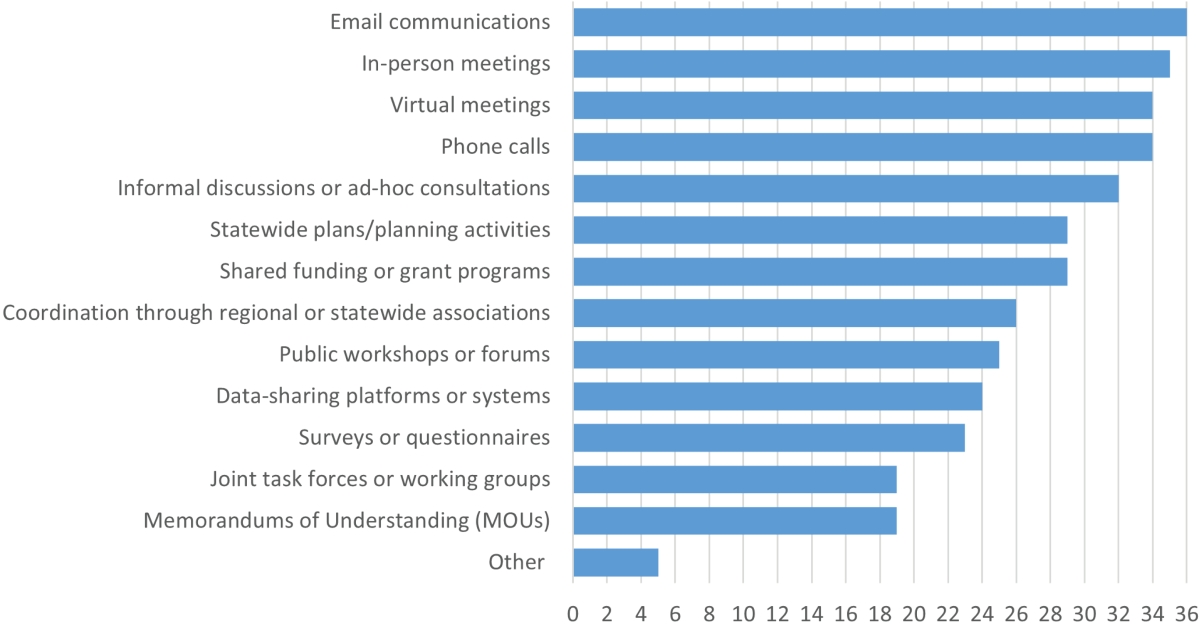
Question 8 asked respondents to identify the mechanisms their state DOT uses to cooperate with non-metropolitan transportation planning organizations and non-metropolitan local officials (or just non-metropolitan local officials if the respondent identified earlier in the survey that they did not have an RPO, RTPO, or similar organization in their state). Respondents could select from a range of formal and informal coordination tools shown in Figure 15.
The most frequently selected methods were email communications (n = 36), in-person meetings (n = 35), virtual meetings (n = 34), phone calls (n = 34), and informal discussions or ad-hoc consultations (n = 32), indicating a strong reliance on direct, interpersonal modes of communication. Shared funding or grant programs (n = 29), statewide plans/planning activities (n = 29),

Long Description.
The horizontal chart is marked from 0 through 26. States are arranged along the chart in a single row representing response categories as No and Yes. The No category spans positions 0 through 25 and includes Alabama, Colorado, Hawaii, Indiana, Iowa, Kentucky, Maine, Michigan, Minnesota, Missouri, New Hampshire, New Mexico, North Carolina, New York, Ohio, Oklahoma, Oregon, Pennsylvania, South Carolina, South Dakota, Tennessee, Texas, Utah, Vermont, and Washington. The Yes category appears at the far right near position 26 and includes Massachusetts. A legend below the chart identifies the two response categories as No and Yes.
Long Description.
The horizontal bar chart has a numeric x-axis extending from 0 through 36 and a vertical list of coordination and communication methods. The following options and the number of responses for each are shown. Email communications extend to the highest value 36. In-person meetings extend to 35, followed by virtual meetings and phone calls, both to 34. Informal discussions or ad-hoc consultations extend to 32. Statewide plans or planning activities and shared funding or grant programs both extend to 29. Coordination through regional or statewide associations reaches 26. Public workshops or forums extend to 25, followed by data-sharing platforms or systems at about 24 and surveys or questionnaires at 23. Joint task forces or working groups and memorandums of understanding reach 19. The category labeled Other has the shortest bar, extending to 5.
coordination through regional or statewide associations (n = 26), public workshops or forums (n = 25), data-sharing platforms or systems (n = 24), and surveys or questionnaires (n = 23) were also widely reported as being used frequently. Joint task forces or working groups (n = 19) and Memorandums of Understanding (MOUs) (n = 19) were also used.
To assess the consistency of coordination practices across different regions, Question 9 asked respondents whether their agency uses the same mechanisms, processes, or procedures when cooperating with RTPOs, RPEs, or non-metropolitan local officials throughout the state. Of the 36 respondents who answered this question, 2 responded “No,” 28 answered “Yes,” and 6 selected “Partly.” The two respondents who answered “No,” as well as two of those who responded “Partly,” noted that coordination practices are tailored to local needs or vary by county, municipality, or RPO. For example, Florida noted that its districts adopt different strategies; one district collaborates with regional planning councils to develop rural transportation plans and conduct extended outreach, while another hosts rural transportation planning workshops. Another example is seen in Indiana, which provides statewide guidance through Planning Procedures Guides and facilitates coordination with local governments, and in some instances RPOs, through its Local Public Agency (LPA) Team. Responses to this question are shown in Figure 16.
Question 10 sought to build on the previous question to understand whether the cooperative practices used with RTPOs, RPEs, and non-metropolitan local officials are aligned with those used for MPOs. Examples of “cooperative practices” for this question include preparing a Unified Planning Work Program (UPWP), using State Planning and Research (SPR) funds, programming Surface Transportation Block Grant (STBG) program flexible funds in rural TIPs, and long-range planning. Of the 36 respondents who answered this question, 11 answered “No,” 7 answered “Yes,” and 18 answered “Partly.” Responses to this question are shown in Figure 17.
Write-in responses from state DOT representatives who answered “No” or “Partly” to Question 10 generally emphasized differences in statutory requirements, funding availability, and

Long Description.
The horizontal chart is marked from 0 through 36. States are arranged along the chart in three response categories as No, Yes, and Partly regarding whether their agency cooperates with RTPOs, RPEs, or non-metropolitan local officials using the same mechanisms, processes, and or procedures across the state. The No category appears at the far left near positions 0 through 2 and includes South Dakota and Utah. The Yes category spans approximately positions 2 through 30 and includes Arkansas, Alabama, District of Columbia, Hawaii, Iowa, Illinois, Kansas, Kentucky, Maine, Michigan, Minnesota, Missouri, Mississippi, New Hampshire, Nevada, New York, North Carolina, Ohio, Oklahoma, Pennsylvania, South Carolina, Texas, Virginia, Vermont, Washington, West Virginia, and Wyoming. The Partly category appears at the far right near positions 30 through 36 and includes Colorado, Florida, Indiana, Massachusetts, Oregon, and Tennessee. A legend below the chart identifies the three response categories as No, Yes, and Partly.

Long Description.
The horizontal chart is marked from 0 through 36. States are arranged along the chart in three response categories: No, Yes, and Partly regarding whether their agencyʼs cooperative practices are the same for RTPOs, RPEs, or non metropolitan local officials as they are for MPO s. The No category appears at the far left near positions 0 through 11 and includes Colorado, Hawaii, Indiana, Kentucky, Minnesota, Nevada, Tennessee, Texas, Utah, West Virginia, and Wyoming. The Yes category spans approximately positions 11 through 18 and includes Kansas, New Hampshire, North Carolina, Oregon, South Carolina, Virginia, and Washington. The Partly category appears from approximately positions 18 through 36 and includes Alabama, Arkansas, District of Columbia, Florida, Iowa, Illinois, Maine, Massachusetts, Michigan, Missouri, Mississippi, New Mexico, New York, South Dakota, Ohio, Oklahoma, Pennsylvania, and Vermont. A legend below the chart identifies the three response categories as No, Yes, and Partly.
the scope of planning responsibilities. Several agencies noted that MPOs are subject to more prescriptive federal requirements, such as performance measures and certification reviews, and receive significantly more funding, particularly through federal transportation planning (commonly referred to as “PL”) funds and Federal Transit Administration (FTA) planning funds or other dedicated federal streams, enabling them to engage in more extensive planning activities. In contrast, non-metropolitan partners often rely solely on SPR funds or occasional grant opportunities, and do not prepare UPWPs or TIPs, though some develop analogous work programs or planning documents guided by the state DOT. Some states contract with regional entities or economic development organizations to support non-metropolitan area project selection and public involvement, but the level of engagement and influence of non-metropolitan entities tends to be more limited as compared to MPOs. While a few state DOTs strive for similar communication and coordination processes, the disparity in resources and regulatory obligations leads to notable procedural and structural differences between metropolitan and non-metropolitan planning practices. For detailed responses from the states that answered “No” for Question 10, see Appendix B.
The 18 respondents that selected “Partly” provided the following additional comments for Question 10:
• Alabama: Work Program
• Arkansas: UPWP[s] [are] not required for [non-]MPOs. TAP funds [are] available for both.
• District of Columbia: Non-metropolitan area cooperative practices are mostly included in our SPR program
• Florida: I donʼt believe there are UPWPs for the non-metropolitan local governments. The Dept. does use SPR funds to assist non-metro local officials with transportation planning.
• Illinois: Local officials can provide input into programming
• Iowa: RPAs create TIPs, TPWPs, LRTPs, and Passenger Transportation plans like an MPO. RPAs do not perform congestion mitigation or performance measures work.
• Maine: We do outreach and engagement in a similar manner, but our RPOs/RPCs do not have a UPWP; rather we contract with them to perform planning functions as an extension of the . . . DOT in their regions.
• Massachusetts: Everything is the same with respect to distribution of financials and guidance. The only difference is related to chairing
• Michigan: Project selection is done by Rural task forces including [County] road commission, cities and villages under 5000 and rural transit agencies. STBG funding is allocated to each rural task force. Each ACUB [Adjusted Census Urban Boundary] that is 5000 to 50000 pop is also allocated STBG funds and is allowed to choose projects. [MDOT] contracts with the Regional economic development agencies to facilitate public involvement, coordination with non-Metro local officials and to facilitate the RTF [Rural Task Force] and small Urban program. We refer to those as work programs[,] but they are developed by MDOT, not by [the] RPAs.
• Mississippi: Only MPOs have UPWPs and TIPs. MDOT provides a portion of its STP [Surface Transportation Program] Funds to those cities with a population greater than 5,000 and less than 50,000, as well as for rural areas of less than 5,000 population through its Office of State Aid Road Construction. Local officials are included in the development of the STIP and Long Range Plan, as are the MPOs.
• Missouri: RPCs donʼt develop TIPs
• New Mexico: MPOs have some statutory requirements that arenʼt applicable to the RTPOs (e.g. performance measures)
• New York: Not those examples specifically but with program and planning - notified of opportunities and projects on the TIP.
• Ohio: In most ways, we have the same requirements for RTPOs [as] we do for our MPOs. The difference[s] would be that capital funds are completely discretionary and not guaranteed, and none of our air quality conformity procedures apply to RTPOs.
• Oklahoma: RTPOs develop a PWP [planning work program] [and] only receive SPR funds. [They] donʼt create an RTIP, but we lean on MPO[s] as the model for most things but with a “state-wide” spin
• Pennsylvania: They are the same, but certification reviews are reserved for TMAs [Transportation Management Areas]
• South Dakota: SECOG [South Eastern Council of Governments] runs the Sioux Falls MPO, so that one COG is similar.
• Vermont: The federal requirements for MPOs [are] far more prescriptive for MPO duties/responsibilities than the state statutes specific to [n]on-MPOs. Also, the funding for MPOs allows them to drive much more deeply into transportation planning needs than the non-MPOs. For comparison[ʼs] [sake], the MPO (we have only [one]) receives about $5M in federal funding annually while the non-RPCs share a portion of a $2.7M pot of SPR (Statewide Planning [and] Research) federal funding. So, although the level of cooperation is similar, the sphere of influence for non-MPOs is less.
Question 11 asked respondents whether their state had specific statutes or legal requirements that outline roles and responsibilities for transportation planning in non-metropolitan areas. This question included the following list of options respondents could choose from:
- Statewide long-range transportation planning
- Transportation project programming
- Corridor planning
- Air quality planning
- Mode-specific planning
- Other
- Not applicable
Nearly half of the 35 respondents (n = 16) who answered this question reported that the most common area with statutory guidance was transportation project programming. This was followed by statewide long-range transportation planning (n = 13) and air quality planning (n = 5), with fewer states having statutory requirements for mode-specific planning (n = 3) and corridor planning (n = 2). Ten respondents indicated that this question was not applicable to their state. Results are shown in Figure 18.
Seven states selected “other” for Question 11 and provided the following additional details:
• Alabama: By agreement
• Maine: Comprehensive planning, public outreach
• Mississippi: Public Participation Process & Plan, Local Consultation Process & Plan, STIP
• New Mexico: NMDOT Planning Procedures Manual
• Pennsylvania: All of our partners (MPOs and RPOs) sign an MOU to perform planning and programming for their respective regions.

Long Description.
The horizontal bar chart has the horizontal axis ranging from 0 through 16 and a vertical list of transportation planning activity categories on the left. The following options and the number of responses for each are shown. For Transportation project programming, the states shown are Florida, Hawaii, Iowa, Kansas, Kentucky, Massachusetts, Michigan, Mississippi, North Carolina, Nevada, New York, Oregon, Pennsylvania, Texas, Vermont, and Washington, extending from 0 through 16. For Statewide long-range transportation planning, the states shown are Arkansas, Colorado, Florida, Hawaii, Iowa, Massachusetts, Michigan, Missouri, Mississippi, Nevada, Pennsylvania, Vermont, and Washington, extending from 0 through 13. For Not applicable, the states shown are Illinois, Indiana, Minnesota, New Hampshire, Ohio, Oklahoma, South Dakota, Utah, West Virginia, and Wyoming, extending from 0 through 10. For Other, the states shown are Alabama, Maine, Mississippi, New Mexico, Pennsylvania, Tennessee, and Virginia, extending from 0 through 7. For Air quality planning, the states shown are Colorado, District of Columbia, Massachusetts, Michigan, and North Carolina, extending from 0 through 5. For Mode specific planning, the states shown are Iowa, New York, and Vermont, extending from 0 through 3. For Corridor planning, the states shown are Arkansas and Hawaii, extending from 0 through 2.
• Tennessee: We outline roles/responsibilities in these documents, but there are not specific statutes or legal requirements tied to them for RPOs
• Virginia: Code of VA, Section 15.2-4207 [Section 15.2-4207 of the Code of Virginia outlines the purpose and authority of planning district commissions]
Question 12 asked whether respondents were aware of any unique state policies or programs that facilitate transportation planning in non-metropolitan areas. Of the 35 respondents who answered this question, 23 answered affirmatively and provided the following additional information about those policies:
• Colorado: Transportation Planning Regions (TPRs) were formed to assist in the statewide planning process. Each TPR is responsible for preparing a long range Regional Transportation Plan (RTP) to identify goals and future needs for their communities. They were established in 1992 after the Colorado General Assembly enacted legislation in 1991 that directed CDOT to provide strategic statewide transportation planning. The term TPR is inclusive of these types: non-MPO TPRs, MPO TPRs, and TPRs with both MPO and non-MPO areas. There are 10 rural TPRs in Colorado.
• Florida: Several state-funded grant programs for rural and/or non-metropolitan communities. Match waivers for certain eligible communities.
• Illinois: Specific Human Services Transportation Planning Regions to carry out coordinated planning for FTA 5310/5311 funding.
• Iowa: The RPAs were created by state statute. Iowa in general has been viewed as a gold standard for regional transportation planning.
• Kansas: Statewide “Local Consultation” process for project selection.
• Kentucky: We fund a transportation planner at each Area Development District to carry out assigned tasks.
• Maine: MaineDOT Cooperative Planning Process for Non-Metropolitan Local Officials
• Michigan: The rural task force program selects local projects for area outside of the MPOs.
• Mississippi: Local Consultation Process & Plan
• Missouri: Regional Planning Commissions coordinate through the Missouri Association of Councils of Governments
• Nevada: Formal rural consultations
• New Mexico: NMDOT Planning Procedures Manual
• North Carolina: Strategic Transportation Investment Law for developing our STIP
• Ohio: In the last [two] state budgeting periods, the legislature has committed dedicated capital improvement funds to our 8 RTPOs.
• Oregon: Area Commissions
• Pennsylvania: Our [RPOs] are a subset of the Local Development Districts enacted by congress in the 1960s
• South Dakota: SPR for Locals Program
• Tennessee: Any policies we have for RPO area transportation planning are TDOT-specific policies, not officially in law (to my knowledge). But we have an RPO program in Tennessee that is managed by the TDOT Planning Division, with a number of policies for how our RPOs operate.
• Texas: [Texas Administrative Code: Title 43 Part 1 §16.102. Rural Transportation Improvement Program (RTIP)]
• Utah: We have ongoing funding to help high growth areas outside of MPOs with planning studies, resources, tools, etc.
• Vermont: Our cooperative relationship with the non-MPOs (entitled the Transportation Planning Initiative) is spelled out in state statute.
• Virginia: Rural transportation planning program through an agreement with SP&R funds.
• Wyoming: WYDOT administers the STP_U urban program that allocates approximately $5.7 million annually to communities over 5000 population. It requires the formation of an Urban System Advisory Committee to undertake planning activities and administer construction projects
Capacity Building
To better understand how state DOTs support non-metropolitan partners in developing planning capabilities, the survey included a series of questions focused on capacity building—specifically, the provision of technical assistance, training, guidance materials, and coordination practices for non-metropolitan areas. Question 13 asked respondents to identify which types of technical assistance their state DOT provides to RTPOs, RPEs, or non-metropolitan local officials to build their planning capacity. They were given the following list to choose from:
- Training
- Staff support
- Access to data or datasets that can assist in their transportation planning efforts
- Financial support
- Software or tools
- Other
In response to Question 13, state DOT representatives reported providing a wide range of technical assistance to RTPOs, RPEs, and/or non-metropolitan local officials to help build planning capacity. The most common form of support was access to data or datasets (n = 32), followed by financial support (n = 27), training (n = 24), software or tools (n = 20), and staff support (n = 16). Five respondents selected “other” forms of assistance. Results are shown in Figure 19.
The 5 respondents that selected “other” provided the following additional information for Question 13:
• Florida: Funding for planning support
• Massachusetts: Funding focused on technical assistance for planning studies and completing federal grant applications

Long Description.
The horizontal bar chart has the horizontal axis ranging from 0 through 34 and a vertical list of technical assistance categories on the left. The following options and the number of responses for each are shown. Access to data or datasets that can assist in transportation planning efforts extends from 0 through 32, representing the highest count. Financial support extends from 0 through 27. Training extends from 0 through 24. Software or tools extends from 0 through 20. Staff support extends from 0 through 16. Other extends from 0 through 5.
• Mississippi: Local planning studies
• Tennessee: We fund the RPO program through SPR with our development districts paying a 10% match to house the programs at their offices. We provide the RPO staff with an annual conference, access to our data, access to tools such as MetroQuest and Social Pinpoint, and whatever support they need from TDOT.
• West Virginia: Letters of support
Question 14 asked whether state DOTs coordinate with RTPOs, RPEs, or non-metropolitan local officials to provide or develop training opportunities. Of the 34 respondents who answered this question, 29 reported providing guidance documents, 24 offered in-person training programs or conferences, and 23 provided online training. These results are shown in Figure 20. One respondent (Tennessee) selected “other” and elaborated, noting that their state DOT maintains a transportation funding database and a SharePoint site with a training calendar, resource materials, and information about free webinars and transportation conferences specifically for RPO staff.
Respondents that selected anything other than “Not applicable” to Question 14 were asked a follow-up question to identify the topics that were covered during these training opportunities. Respondents were provided with the following list of topics to choose from:
- Geographic Information Systems (GIS)
- Public participation
- Title VI/EJ (Environmental Justice)
- Complete streets and access management
- Long-range transportation planning
- Transportation modeling
- Transportation funding/finance
- Data usage (e.g., data collection, analysis, and formatting)
- Transportation programming
- Scenario planning
- Air quality
- Policy and regulations
- Environmental planning/National Environmental Policy Act (NEPA)
- Economic development planning
- Multimodal planning
- Land use planning
- Performance measurement/management
- Congestion management

Long Description.
The horizontal bar chart has the horizontal axis ranging from 0 through 34 and a vertical list of training opportunities on the left. The following options and the number of responses for each are shown. Guidance documents extend from 0 through 29, representing the highest count. In person training programs or conferences extend from 0 through 24. Online training extends from 0 through 23. Not applicable extends from 0 through 4. Other extends from 0 through 1.
- Transportation technology [e.g., Intelligent Transportation Systems (ITS), autonomous vehicles, connected vehicles, electric vehicles]
- Transportation Systems Management and Operation (TSMO)
- MPO administrative functions (e.g., invoicing, procurement, HR, DBE (Disadvantaged Business Enterprise) requirements)
- Other
Responses to this question show that state DOTs offer training and technical assistance on a broad range of planning topics for RTPOs, RPEs, and non-metropolitan local officials. From the 28 responses from state DOTs, the most frequently offered training topics were transportation funding/finance (n = 20), policy and regulations (n = 18), complete streets and access management (n = 17), transportation programming (n = 17), multimodal planning (n = 17), and long-range transportation planning (n = 16). Other common topics included public participation (n = 15), GIS and Title VI/Environmental Justice (each n = 13), performance measurement/management (n = 12), and data usage (n = 11). Less frequently addressed topics were MPO administrative functions (n = 10), TSMO (n = 9), transportation technology (n = 9), transportation modeling and environmental planning/NEPA (n = 7 each), air quality (n = 6), land use planning (n = 5), economic development planning (n = 5), congestion management (n = 4), and scenario planning (n = 3). The results of this question are shown in Figure 21.

Long Description.
The horizontal bar chart has the horizontal axis ranging from 0 through 28 and a vertical list of training or technical assistance topic areas on the left. The following options and the number of responses for each are shown. Transportation funding or finance extends from 0 through 20, representing the highest count. Policy and regulations extends from 0 through 18. Complete streets and access management extends from 0 through 17. Transportation programming extends from 0 through 17. Multimodal planning extends from 0 through 17. Long-range transportation planning extends from 0 through 16. Public participation extends from 0 through 15. GIS extends from 0 through 13. Title VI or Environmental Justice extends from 0 through 13. Performance measurement or management extends from 0 through 12. Data usage extends from 0 through 11. MPO administrative functions extends from 0 through 10. TSMO extends from 0 through 9. Transportation technology extends from 0 through 9. Environmental planning or NEPA extends from 0 through 7. Transportation modeling extends from 0 through 7. Air quality extends from 0 through 6. Land use planning extends from 0 through 5. Economic development planning extends from 0 through 5. Congestion management extends from 0 through 4. Scenario planning extends from 0 through 3. Other extends from 0 through 2.
Question 15 asked how state DOTs coordinate with RTPOs, RPEs, or non-metropolitan local officials on training opportunities and provided the following options:
- Steering committees
- Statewide polling
- Discussions at statewide or regional association meetings
- Discussions at individual RTPO or RPE meetings
- Email all RTPOs or RPEs, use a listserv, SharePoint, or similar platform
- Other
- Not applicable
The most common coordination approach selected by the 35 respondents who answered this question was discussions at statewide or regional association meetings (n = 29); followed by discussions at individual RTPO or RPE meetings (n = 21); and email communications, listservs, or platforms like SharePoint (n = 21). Fewer respondents reported using steering committees (n = 10) or statewide polling (n = 8). The results of this question are shown in Figure 22.
Five respondents selected “other” for this question and described the following alternative coordination methods:
• Florida: Specific outreach to non-metropolitan communities.
• Nevada: Through the NVLTAP [Nevada Local Technical Assistance Program]
• South Dakota: LTAP
• Texas: Ad hoc individual discussions
• Vermont: Each non-MPO RPC has a transportation advisory committee that we regularly coordinate with on all transportation planning issues.
Transit and Multimodal Planning
A series of questions asked respondents to identify how their state DOT integrates transit and multimodal transportation options into non-metropolitan transportation planning and project development efforts. Question 16 asked respondents if their state DOT has any responsibilities for rural transit planning. Follow-up questions were given to those responding “Yes” to Question 16, asking the extent to which these activities are integrated with other planning processes, and how multimodal elements such as bicycle, pedestrian, and transit infrastructure are considered in non-metropolitan planning processes.

Long Description.
The horizontal bar chart has the horizontal axis ranging from 0 through 34 and a vertical list of coordination method categories on the left. The following options and the number of responses for each are shown. Discussions at statewide or regional association meetings extend from 0 through 29, representing the highest count. Discussions at individual RTPO or RPE meetings extend from 0 through 21. Email all RTPOs or RPEs, use a listserv, SharePoint, or similar platform extends from 0 through 21. Steering Committees extends from 0 through 10. Statewide polling extends from 0 through 8. Other extends from 0 through 5. Not applicable extends from 0 through 5.
When asked whether their agency has any responsibilities for rural transit planning (Question 16), many (n = 25) selected “Yes,” while 8 respondents reported that their state DOT does not hold this responsibility. The results for this question are shown in Figure 23.
Among those who answered affirmatively, many provided additional information about their roles, which highlighted both programmatic responsibilities and collaborative approaches with local and regional partners. To aid in the interpretation of these open-ended responses, the NCHRP Synthesis 663 authors grouped them into four broad, thematic categories developed after reviewing the responses: (1) federal and state program administration, (2) coordinated or strategic planning, (3) stakeholder engagement and advisory structures, and (4) conditional or general oversight. These categories were not part of the survey instrument and were not shown to participants. Rather, they are analytical constructs that have been applied during the synthesis process to help organize and summarize commonalities across the qualitative data. See Table 4 for state responses.
As a follow-up question to Question 16, respondents were asked whether rural transit planning was integrated with state DOT, RTPO, or RPE processes in non-metropolitan planning efforts. Three states responded that they were not, while 22 responded that they were. The results of this question are shown in Figure 24.
States that answered in the affirmative to this question were also asked how rural transit planning was integrated with non-metropolitan transportation planning efforts. Respondents were given the following options to select from:
- Coordinated meetings
- Joint project development
- Shared funding sources
- Joint training opportunities
- Other
Of the 22 respondents that answered this question, the most frequently selected answer was coordinated meetings (n = 17). Other common responses included shared funding sources (n = 13), joint training opportunities (n = 11), and joint project development (n = 11). The results of this question are shown in Figure 25.
The seven respondents that selected “other” for this question provided the following additional information:
• Florida: Technical assistance and coordinate with them on their TAM [Transit Asset Management] Targets
• Nevada: NDOT doesnʼt help with planning, only funding
• New Mexico: Ask NMDOT Transit Bureau
• South Dakota: Inter-city Bus Plan, Human Coordinated Services Plan
• Tennessee: Including rural transit providers at RPO meetings, giving opportunities to them to present on their services and needs
• Vermont: Many [n]on-MPOs have seats on Boards of Directors of Public Transit Agency providers
• Washington: As needed coordination

Long Description.
The horizontal chart is marked from 0 through 32. States are arranged along the chart in a single row representing response categories as No and Yes. The No category spans positions 0 through 8 and includes Arkansas, District of Columbia, Hawaii, Kansas, New York, Oklahoma, Utah, and Virginia. The Yes category spans positions 8 through 33 and includes Alabama, Colorado, Florida, Iowa, Illinois, Indiana, Kentucky, Maine, Massachusetts, Michigan, Minnesota, Mississippi, Missouri, Nevada, New Hampshire, New Mexico, North Carolina, Ohio, Oregon, Pennsylvania, South Dakota, Tennessee, Vermont, Washington, and Wyoming. A legend below the chart identifies the two response categories as No and Yes.

Long Description.
The table has 5 rows and 2 columns. The column headers in Row 1 are Category and Responses. Row 2: Category: Federal and state program administration: These responses reference state DOT responsibilities tied to managing or administering federal and state transit funding; Responses: Illinois: Yes, HSTP Coordinators for FTATitle 5310 or 5311 funding; Indiana: Federal Section 5311 Program; Massachusetts: Mass DOT Rail and Transit Division administers FTA 5311 funds to RTAs in the state; Nevada: FTA funding for rural transit; South Dakota: South Dakota DOT manages the application and distribution of rural transit planning funding; Tennessee: The state DOT funds rural transit across the state, mostly through Human Resource Agencies, sometimes through development districts; Wyoming: Administration of transit planning studies through FTA transit planning pass through funding; Florida: Rural NTD National Transit Database. Row 3: Category: Coordinated or strategic planning: These responses mention involvement in formal planning processes, particularly those that include or support coordinated plans or strategies for rural transit; Responses: Alabama: Human Service Coordinated Transportation Plan; Florida: Transit Asset Management Plan for rural agencies; Iowa: Oversees the development of Passenger Transportation Plans, which are conducted by RPAs and rural transit agencies; Kentucky: The Kentucky Transportation Cabinet has responsibilities for rural transit planning, with KYTC through the Office of Transportation Delivery overseeing rural transit planning activities; Michigan: Our Office of Passenger Transportation assists the rural transit agencies in developing their plans and submitting projects; Ohio: ODOT plans for the rural counties that currently are not covered by either an MPO or RTPO, currently 8 of Ohio’s 88 counties; Oregon: Coordinated plans and rural transit routes, The Point; Washington: Intercity Bus Plan. Row 4: Category: Stakeholder engagement and advisory structures: These responses reflect state DOT efforts to collaborate with local officials or advisory bodies; Responses: Minnesota: Regional Transit Coordinating Councils, marketing, and education; Colorado: CDOT has a Transit and Rail Advisory Committee; Mississippi: MDOT consults with local officials that may be affected by proposed projects, works closely with local officials in selecting projects for the STIP, and includes members of MAS, MML, and local officials on advisory teams for all statewide plans. Row 5: Category: Conditional or general oversight: These responses indicate more general or conditional involvement in rural transit; Responses: Pennsylvania: Yes, as long as it aligns with Urban Transit Systems; Wyoming: Upon request from 43 Local Transit Authorities.

Long Description.
The horizontal chart is marked from 0 through 24. States are arranged along the chart in a single row representing response categories as No and Yes indicating whether rural transit planning is integrated with their state DOT, RTPO, or RPE processes in non-metropolitan planning efforts. The No category spans positions 0 through 3 and includes Illinois, Wyoming, and Indiana. The Yes category spans positions 3 through 25 and includes Alabama, Colorado, Florida, Iowa, Kentucky, Maine, Massachusetts, Michigan, Minnesota, Mississippi, Missouri, Nevada, New Hampshire, New Mexico, North Carolina, Ohio, Oregon, Pennsylvania, South Dakota, Tennessee, Vermont, and Washington. A legend below the chart identifies the two response categories as No and Yes.

Long Description.
The horizontal bar chart has the horizontal axis ranging from 0 through 16 and a vertical list of methods of integrating rural transit planning on the left. The following options and the number of responses for each are shown. For Coordinated meetings, the states shown are Alabama, Colorado, Florida, Iowa, Kentucky, Maine, Michigan, Minnesota, Missouri, Mississippi, North Carolina, New Hampshire, Ohio, Oregon, Pennsylvania, Tennessee, and Vermont, extending from 0 through 17. For Shared funding sources, the states shown are Alabama, Colorado, Iowa, Massachusetts, Michigan, Mississippi, North Carolina, New Hampshire, New Mexico, Nevada, Ohio, Oregon, and Pennsylvania, extending from 0 through 13. For Joint training opportunities, the states shown are Alabama, Colorado, Florida, Iowa, Michigan, Minnesota, Mississippi, New Hampshire, Oregon, South Dakota, and Tennessee, extending from 0 through 11. For Joint project development, the states shown are Alabama, Colorado, Iowa, Maine, Mississippi, North Carolina, New Hampshire, New Mexico, Oregon, South Dakota, and Vermont, extending from 0 through 11. For Other, the states shown are Florida, New Mexico, Nevada, South Dakota, Tennessee, Vermont, and Washington, extending from 0 through 7.
Question 17 asked how multimodal transportation options (e.g., transit, bicycle, and pedestrian) were incorporated into non-metropolitan transportation planning and project development. Respondents were given the following options:
- Included in long-range plans
- Considered in project development
- Funded through specific programs
- Other
- Not incorporated
Among the 34 respondents to this question, the majority indicated that multimodal elements are considered in project development (n = 29). Many also noted that these elements are funded through specific programs (n = 28) or included in long-range plans (n = 22). The results of this question are shown in Figure 26.

Long Description.
The horizontal bar chart has the horizontal axis ranging from 0 through 28 and a vertical list of methods of incorporating multimodal transportation options on the left. The following options and the number of responses for each are shown. For Considered in project development, the states shown are Alabama, Colorado, District of Columbia, Florida, Hawaii, Iowa, Illinois, Indiana, Kansas, Massachusetts, Maine, Michigan, Minnesota, Mississippi, New Mexico, New Hampshire, Nevada, New York, North Carolina, Ohio, Oklahoma, Oregon, Pennsylvania, Tennessee, Texas, Utah, Vermont, Washington, and Wyoming, extending from 0 through 29. For Funded through specific programs, the states shown are Arkansas, Alabama, Colorado, District of Columbia, Hawaii, Iowa, Illinois, Indiana, Kansas, Maine, Minnesota, Mississippi, New Mexico, New Hampshire, Nevada, New York, North Carolina, Ohio, Oklahoma, Oregon, Pennsylvania, South Dakota, Tennessee, Utah, Virginia, Vermont, Washington, and Wyoming, extending from 0 through 28. For Included in long range plans, the states shown are Colorado, Florida, Hawaii, Iowa, Massachusetts, Michigan, Minnesota, Missouri, Mississippi, New Mexico, New Hampshire, Nevada, North Carolina, Ohio, Oklahoma, Oregon, Pennsylvania, Tennessee, Texas, Utah, Vermont, and Washington, extending from 0 through 22. For Other, the states shown are Alabama, Indiana, Kentucky, Maine, and Tennessee, extending from 0 through 5.
The five respondents that selected “other” to Question 17 provided the following additional information:
• Alabama: Statewide Plan.
• Indiana: Special state grant and initiatives.
• Kentucky: Various Statewide Rural Transit Programs/Plans.
• Maine: Comprehensive Plan reviews.
• Tennessee: Our Active Transportation Office analyzes our annual resurfacing projects to determine what multimodal improvements could be made and the Office of Community Transportation shares local planning documents with TDOT project managers to consider potential multimodal improvements as described in their plans. We also have a Transportation Planning Grant, [through] which rural communities can have a bike/ped plan, corridor study, community mobility plan, etc.
Challenges and Barriers
The final survey question (Question 18) asked state DOT representatives to identify challenges or barriers to cooperation, communication, planning, or funding transportation projects in non-metropolitan areas. A clear theme emerged around capacity and funding limitations at the state and local levels. The most frequently selected issue, reported by 23 respondents, was the limited number of staff within RTPOs, RPEs, or other non-metropolitan planning agencies. Closely following that were challenges related to federal grant requirements for local or state matching funds (n = 21) and funding limitations for transportation projects in non-metropolitan areas (n = 20). These top responses highlight a systemic resource gap that impedes effective planning and project delivery in rural contexts.
Other notable concerns included the limited number of state DOT staff dedicated to non-metropolitan planning (n = 19), and limited funding for cooperation or communication activities (n = 16), both of which further illustrate the capacity constraints faced across agencies. Additionally, limited time for consistent cooperation or communication (n = 15) was a major concern, suggesting that even when willingness exists, bandwidth is lacking.
Several responses pointed to interagency coordination difficulties, such as miscommunication or unclear roles (n = 11), procedural or bureaucratic differences (n = 11), and public or stakeholder engagement challenges (n = 11). Less frequently selected challenges were administrative processes at both the state level (n = 8) and within local entities (n = 5), regulatory oversight complexities (n = 5), and reluctance to cooperate (n = 7), which may stem from historical tensions or institutional barriers. A few (n = 4) indicated that their unique challenges were not listed among the options provided, while 3 mentioned difficulties in providing technical assistance.
Overall, the responses underscore that while procedural and communication hurdles exist, the most pressing barriers revolve around limited human and financial resources. A breakdown of each answer can be seen in Figure 27.
Summary of Survey Results
This section summarizes the results of the survey on coordination practices of state DOTs and non-metropolitan transportation planning agencies in their state. Forty states (39 states and the District of Columbia) completed the survey, providing a snapshot of the current state of practice (see Figure 28). Key findings from the survey are described here.
State DOT Governance and Rural Planning Structures
- Of the 40 survey respondents, 3 DOTs (Delaware, New Jersey, and Rhode Island) indicated they had no non-metropolitan areas and were routed out of the survey.

Long Description.
The horizontal bar chart has the horizontal axis ranging from 0 through 24 and a vertical list of challenge categories on the left. The following options and the number of responses for each are shown. Limited number of RTPO, RPE, or other non metropolitan agency staff dedicated to non metropolitan planning activities extends from 0 through 23, representing the highest count. Federal grant requirements for matching funds from state or local sources extend from 0 through 21. Funding limitations for transportation projects in non metropolitan areas extend from 0 through 20. Limited number of DOT staff dedicated to non metropolitan planning activities extends from 0 through 19. Limited funding for cooperation or communication activities extends from 0 through 16. Limited time for frequent, consistent cooperation or communication extends from 0 through 15. Miscommunication or lack of clarity on roles, responsibilities, or goals extends from 0 through 11. Bureaucratic or procedural differences, in other words, differing internal processes, regulatory requirements, or approval timelines that can slow down coordination, extend from 0 through 11. Difficulties with public engagement and or stakeholder engagement extend from 0 through 11. Administrative processes or business protocols of the state extend from 0 through 8. Reluctance, resistance, or unwillingness to cooperate or communicate extend from 0 through 7. Administrative processes or business protocols of RTPOs, RPEs, or non metropolitan planning entities extend from 0 through 6. Oversight of regulatory compliance, in other words, complicated and or overlapping rules and guidelines that govern transportation planning extend from 0 through 5. Difficulties providing technical assistance to RTPOs, RPEs, or non metropolitan entities extend from 0 through 3. Something that is not listed here extends from 0 through 4.

Long Description.
The map depicts the United States with states grouped by color into three categories related to regional planning entities. States with established RPEs include Hawaii, Washington, Oregon, Idaho, Utah, Colorado, New Mexico, Texas, Oklahoma, Arkansas, South Dakota, Minnesota, Iowa, Missouri, Michigan, Indiana, Kentucky, Ohio, Pennsylvania, New York, Vermont, New Hampshire, Massachusetts, Maine, Virginia, North Carolina, South Carolina, Tennessee, Alabama, and the District of Columbia. States without RPEs include Nevada, Wyoming, Kansas, Illinois, West Virginia, Mississippi, and Florida. States without non MPO areas include Rhode Island, New Jersey, and Delaware. States that did not respond to the survey include California, Montana, North Dakota, Nebraska, Wisconsin, Arizona, Louisiana, Georgia, Maryland, Connecticut, and Alaska. A legend on the map identifies the four categories as states with RPEs, states without RPEs, states without non MPO areas, and states that did not respond to the survey.
- Among the remaining 37 respondents, planning governance was nearly evenly split between centralized and decentralized models, although many reported hybrid practices in implementation.
- Twenty-six states reported the presence of and collaboration with RPEs such as RTPOs, COGs, and RPCs in their state.
- COGs and RPCs were the most commonly involved entities in statewide non-metropolitan planning coordination, with 16 and 13 states, respectively, reporting engagement.
- Several RPEs, including RTPOs, COGs, and RPCs, are formally designated either under federal regulations (for RTPOs), through state statutes, or both, highlighting varying levels of institutional recognition across states.
- Two states (Oregon and Texas) reported that some non-metropolitan planning organizations span multiple states.
Roles and Responsibilities
- Out of the 26 state DOTs with non-metropolitan planning organizations, 19 indicated that these organizations are required to produce specific planning documents.
- The most commonly required products were RTPs or LRTPs, public involvement plans, and TIPS. Some states also noted requirements for specialized plans like corridor or safety plans.
- One state (Massachusetts) reported that its RPOs develop performance measures, and that they align with state and federal requirements.
Cooperation with Local Officials
- State DOTs indicated a range of communication and coordination methods to engage with non-metropolitan local officials and planning organizations. The most common approaches
included in-person meetings, virtual discussions, email exchanges, and participation in shared planning activities.
- Most state DOTs (28 out of 36 responding) indicated that they use consistent coordination processes across all regions of their state, although several noted that they adapt these practices based on regional characteristics or partner preferences. These interactions often relate to project prioritization, planning updates, and data sharing, and are sometimes supported through formalized agreements or guidance documents.
- Seven states reported using the same coordination practices for both MPOs and non-MPOs. Most cited differences in available resources, planning capacity, federal requirements, and program responsibilities as reasons for divergence.
Capacity Building
- The most cited technical assistance provided by state DOTs included access to data, financial support, training, software/tools, and staff support. A few states reported other forms, such as support for grant applications or planning studies.
- Training delivery methods included guidance documents, in-person events, and online training. One state noted maintaining a SharePoint site with training resources and event calendars.
- Popular training topics included transportation funding/finance, policy and regulations, complete streets and access management, multimodal planning, and long-range planning. Topics like congestion management, scenario planning, and economic development planning were less frequently covered.
- Coordination methods for training included discussions at statewide or regional meetings, individual RTPO or RPE meetings, and digital communications like listservs or SharePoint. Fewer state DOTs used steering committees or statewide polling. Some states cited unique coordination approaches such as Local Technical Assistance Programs (LTAPs) and local advisory committees.
Transit and Multimodal Planning
- Twenty-five of 33 state DOTs reported some level of responsibility for rural transit planning, often tied to FTA 5311 funding, coordinated planning, stakeholder engagement, or general oversight.
- Of those 25, 22 states reported integrating rural transit with state DOT, RTPO, or RPE planning. Common methods include coordinated meetings, shared funding, joint training, and joint project development.
- Most state DOTs reported incorporating transit, bike, and pedestrian options into non-metropolitan planning through project development, program funding, and long-range plans.
Challenges and Barriers
- The most frequently reported challenges were limited staffing at RTPOs, RPEs, or similar agencies; lack of local or state match for federal grants; and overall funding limitations for transportation projects in non-metropolitan areas of their state.
- Other common barriers included limited state DOT staff assigned to non-metropolitan planning coordination, lack of funding for cooperation and communication, and insufficient time for consistent engagement.
- Several respondents also cited interagency miscommunication or unclear roles, procedural differences, and public engagement difficulties, with fewer noting administrative burdens, regulatory complexity, or institutional reluctance to cooperate as challenges.


