Plasma Science: From Fundamental Research to Technological Applications (1995)
Chapter: Strongly Coupled Nonneutral Plasmas
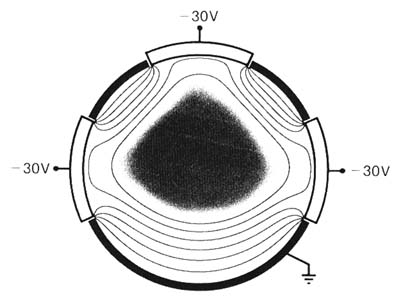
FIGURE 2.2 Shown is the cross section of a magnetized pure-electron plasma confined in a Penning trap. These plasmas were found to exhibit unexpectedly long confinement times. This good confinement is consistent with a recently developed theory that argues that such states are stable equilibria. The plasma is distorted into a triangular shape by the application of electrical potentials (indicated in volts) to sections of a cylindrical electrode structure. The calculated equipotential contours (solid lines) illustrate that the plasma edge follows such a contour. Note that the electrons are closer to the negative electrodes, as expected for a state of maximum electrostatic energy, and as predicted by the theory. (Reprinted, by permission, from J. Notte, A.J. Peurrung, J. Fajans, R. Chu, and J.S. Wurtele, Physical Review Letters 69:3056, 1992. Copyright © 1992 by the American Physical Society.)
particle dynamics are characterized by well-defined single-particle constants of the motion at low beam intensity, where self-field effects are negligibly small, at higher beam intensity the particle orbits can become chaotic and sensitive to the detailed properties of the beam density and current profiles. We do not have a basic understanding of the influence of stochastic effects on the charge homogenization in periodic focusing quadrupole configurations or on the suppression of coherent free-electron-laser emission at high beam intensity.
Strongly Coupled Nonneutral Plasmas
Strongly coupled pure ion plasmas present another set of scientific opportunities. The evolution of the spatial ordering to the body-centered-cubic structure
