Plasma Science: From Fundamental Research to Technological Applications (1995)
Chapter: Ground-Based Techniques
TOOLS FOR SPACE PLASMA PHYSICS
Space-Based Techniques
The mainstay of progress in space plasma physics has been in situ and remote sensing experiments from space. They provide the means for systematically monitoring large regions of space plasma. The inability to distinguish space from time changes in measurements from a single spacecraft underlies the future thrust toward flying constellations of identically instrumented and electronically coordinated satellites to study a given phenomenon or a limited region of space. The success of such efforts will depend strongly on the implementation of self-contained "smart" electronics to facilitate real-time complementarity and software techniques for onboard selection, digestion, and compaction of the plethora of data from multiple sources.
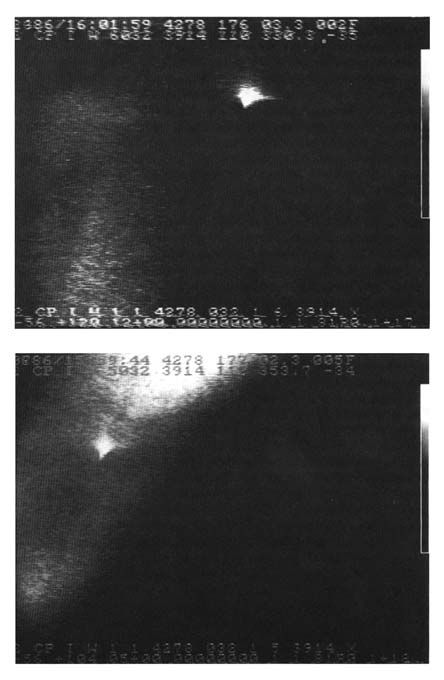
Active experiment techniques are used to create a controlled disturbance and study its effect on the environment. (See Figure 6.1.) Active experiments have a broad range of objectives. These include (1) simulation of natural processes occurring in space plasmas, (2) measurement of physical properties such as reaction rates of atmospheric constituents and collisional cross sections, (3) use of space as a laboratory without walls to study fundamental plasma physics, (4) probing the natural environment as is done in experiments tracing magnetic field lines by electron beams, and (5) improving communication systems by studying the propagation of electromagnetic waves. For the study of space plasma processes the attraction of active techniques is twofold: there is no need to wait for a phenomenon to occur naturally, and the source characteristics are known and can be controlled. In this way, active experiments are similar to laboratory experiments except that the former have the advantage that the space plasma for most purposes can be considered boundless. The disadvantage is that it is difficult to obtain measurements with high spatial resolution. To remedy this problem, multiplatform experiments have become more common in recent years.
Ground-Based Techniques
Although the magnetosphere is an enormous region in space, we benefit largely from the dipolar origin of the field, which causes all the geomagnetic field lines of the magnetosphere to intersect the Earth, and most of them in the polar regions. This focusing of field lines provides a tremendous benefit observationally because arrays of ground-based instrumentation are relatively inexpensive to deploy and operate and they can provide important correlative data as well as a global context within which to interpret satellite data.
Ground-based data also provide a long-term database that permits understanding of the secular variations and changes in the solar-terrestrial "climate."