Plasma Science: From Fundamental Research to Technological Applications (1995)
Chapter: Plasma Sources
Collisionless Heat Transport.
Laboratory experiments have now explored the important question of how heat is transported in collisionless plasmas. These measurements involve the application of high-power microwave beams to generate hot electron tails in a nonuniform plasma. The qualitative features of this effect and the important scaling properties have been identified. They have helped to clarify the relevant theoretical issues in this area.
Strong Langmuir Turbulence.
One of the significant advances in the understanding of nonlinear plasma behavior has been the development of the concept of plasma-wave collapse and the associated spiky turbulence that frequently accompanies it. Several laboratory experiments, aimed at uncovering the microscopic dynamics of Langmuir-wave collapse, have used both electromagnetic driving and electron beams to trigger the collapse, of extended wave packets, which in turn produces strongly localized fields and density depletions or cavitons. More recently, the ionosphere has been used to demonstrate the ubiquitous nature of these phenomena and the important role they play when a plasma is driven by large-amplitude perturbations.
Experimental Techniques and Capabilities
Opportunities for advances in experimental physics are often linked to the development of new technologies. The effect of these technologies is twofold. First, they enable the creation of experimental conditions that permit the demonstration and isolation of important physical effects. In plasma science, this frequently involves both new means of plasma production and new means of plasma confinement. In addition, new technologies frequently lead to new diagnostic techniques and new means of processing data, which not only result in improved accuracy and precision but often result in new perspectives on the underlying physics.
Plasma Sources
Over the past 20 years, there has been substantial progress in the development of improved, quiescent plasma sources. Some of the first, "high-quality" plasmas used in basic research were created in Q machines (Q stands for "quies-
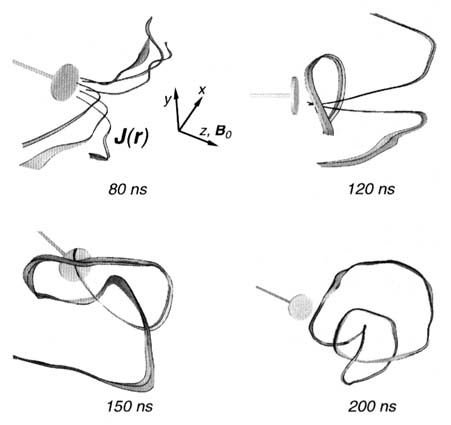
FIGURE 8.2 Experimental study of the penetration of a pulsed current into a magnetized plasma. Shown are the characteristic field lines, sheets, and tubes of the current density, J(r), at different times after a 100-ns (FWHM) current pulse is applied to a disk electrode (shown). These data are extracted from a dataset of 10,000 point measurements at each time step. Typical experiments involve studying 1000 such time steps. At 80 ns, the current penetrates a short distance from the positive electrode into the plasma, before turning back to the negative electrode located at the back endwall of the vacuum chamber. Little helicity is observed in this fountain-like current flow. As the current propagates (120 ns) two distinct current systems are observable: a closed azimuthal Hall current in regions where Jz ÷ 0 and field-aligned solenoidal plasma currents between the positive and negative electrodes. At 150 ns a current tube starts off-axis, where Jz ≠ 0 and JB ≠ 0, and exhibits strong helicity; i.e., it twists and knots in the right-hand direction. After the end of the applied current pulse, at 200 ns, the current lines detach and propagate away from the electrodes, and shown is a closed, singly-knotted, twisted current tube. Experiments like this, which illustrate the fully three-dimensional nature of the dynamics of the plasma response resulting from such a current pulse, have recently been made possible by the advent of fast, relatively inexpensive laboratory computers with large data handling capabilities. (Courtesy of R. Stenzel and M. Urrutia, University of California, Los Angeles.)

