Plasma Science: From Fundamental Research to Technological Applications (1995)
Chapter: Magnetic Reconfiguration.
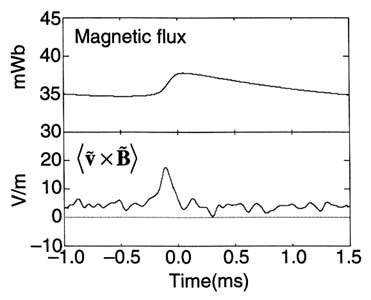
FIGURE 8.4 Demonstration of the dynamo effect in a laboratory plasma. The dynamo effect is the spontaneous self-generation of magnetic fields within plasmas, a process common in astrophysical bodies such as the Sun. Shown is a "dynamo event" in which magnetic flux is suddenly generated in a toroidal laboratory plasma. By measuring the local electromotive force, ⟨ v × B ⟩/c, generated by fluctuations in plasma velocity and magnetic field, it was established that this force is responsible for generation of the magnetic flux. The fluctuating flow and field were measured with Langmuir and magnetic probes inserted into the plasma edge. This particular dynamo mechanism has long been thought to be an important source of astrophysical magnetic fields. (Reprinted, by permission, from H. Ji, A.F. Almagri, S.C. Prager, and J. S. Sarff, Physical Review Letters 73:668, 1994. Copyright © 1994 by the American Physical Society.)
dynamo experiments, for example by establishing a rapid fluid flow in a large vat of liquid sodium. Such experiments can provide new and fundamental insights into the nature of dynamo action and provide a quantitative basis for refined theories of many important physical processes.
Magnetic Reconfiguration.
Many plasma instabilities and processes are inherently three-dimensional. Laboratory experiments now allow these processes to be explored in detail. Important topics include the dynamics of three-dimensional current systems, current and wave filamentation, current sheet formation, the effect of magnetic forces on plasma currents, helicity generation, and helicity conservation. These processes have far-reaching consequences in the understanding of solar flares, solar magnetospheric physics, and fusion physics.
