Plasma Science: From Fundamental Research to Technological Applications (1995)
Chapter: Ion Plasmas in Electron-Beam Ion Traps
which utilize the ponderomotive force from high-frequency electric fields to confine the ions. At low temperature, Coulomb repulsion between the ions causes the ions to crystallize into simple geometrical configurations (Coulomb clusters) whose shapes can be predicted theoretically. These clusters and ordered one-dimensional chains of ions have now been observed and studied in Paul traps. (See figure 2.1a.) As the number of ions is increased, experiments have observed polymorphic phase transitions to more complex lattice structures: first a zigzag arrangement, then a helical chain, and finally a cylindrical shell structure, similar to the spheroidal shells observed in Penning traps. These phase transitions have also been studied theoretically.
Such linear lattice structures also are predicted to occur in chains of ions confined and cooled in a heavy-ion storage ring. In the rest frame of the ions circulating in such a storage ring, the confining forces are nearly the same as those in the linear Paul trap described above.
The theoretical density limit for the confinement of a magnetized, single-component plasma occurs when the square of the plasma frequency is one-half the square of the cyclotron frequency (Brillouin, in 1945). This "Brillouin density limit" has been achieved in pure ion plasmas by using laser radiation to exert torques on the plasma and thereby to compress it. In a "cold" one-component plasma column, the radially outward space-charge and centrifugal forces on a fluid element balance the inward magnetic confining force (i.e., the Lorentz force). This places a limit on the maximum plasma density that can be confined for a given value of magnetic field (i.e., the Brillouin density limit). The rotation frequency at the Brillouin limit is such that the Lorentz force on the plasma particles is just canceled by the Coriolis force, and the plasma is effectively unmagnetized when viewed in the rotating frame. Therefore, at the Brillouin limit, it is possible to study in detail a fundamentally new plasma regime in which the confined plasma is effectively "unmagnetized.''
Ion Plasmas in Electron-Beam Ion Traps
The electron-beam ion trap configuration, which was invented in the last decade, uses a magnetically compressed electron beam, with energies in the range of several hundred keV, to ionize, trap, and excite highly charged ions of a wide variety of elements for atomic physics measurements. Electron-beam ion trap devices are capable of producing high-resolution x-ray spectra of nearly stationary ions that have been excited by monoenergetic electrons. One can also vary the energy of the electron beam on a time scale fast compared to that for changes in the ionization states of the ions. Thus, the ions can be excited with electrons of one energy and probed with electrons of a different energy.
These devices have been able to produce one-electron (i.e., hydrogen-like) ions up to nuclear charge Z = 92. In the last few years many important measurements have been made utilizing electron beam ion trap devices for atomic phys-
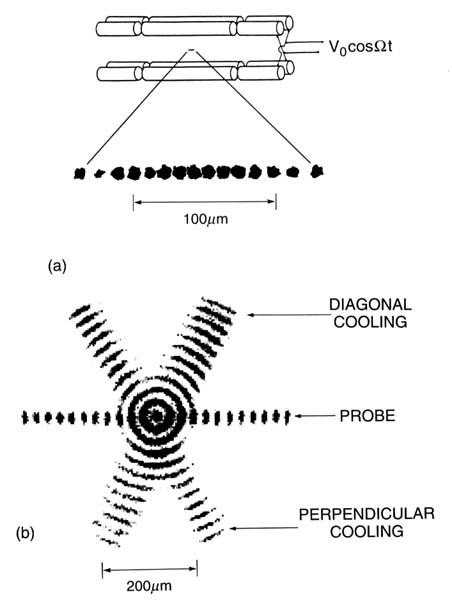
FIGURE 2.1 Correlated behavior observed when small, single-component ion plasmas are laser cooled to temperatures of a few tens of millikelvin. Such laser-cooled ion plasmas are being used to improve the performance of atomic clocks and frequency standards. (a) A crystallized chain of 15Hg+ ions, confined in an rf trap by the electrode structure shown. (b) Be+ ions confined in a Penning trap, imaged by passing three crossed laser beams through the plasma. The bright fringes are the intersections of the laser beams with the plasma's lattice planes, which take the form of approximately spheroidal shells. The plasma rotates about its symmetry axis (normal to the figure), which obscures the image of individual ions within each shell. (Courtesy of J. Bollinger and D. Wineland, National Institute of Standards and Technology, Boulder, Colo.)

