Public Transit Workforce Development for Zero-Emission Vehicles (2025)
Chapter: 3 Assess Workforce Readiness

CHAPTER 3
Assess Workforce Readiness
Another important initial task is to determine how well-prepared the existing workforce is at operating and maintaining ZEVs, thereby establishing a baseline understanding. Materials provided here include a variety of approaches used to identifying skill gaps, along with various methods available to close these gaps. Identifying these gaps and closing them allows ZEV training to be targeted to maximize resources and the effectiveness of the training delivered.
The need for more ZEV-trained staff is reinforced by the results of the industry survey. Fifty-eight percent of respondents with ZEVs in service answered that their transit agency does not have vehicle operators on staff with relevant ZEV skills, and 48% of respondents do not have technicians trained to maintain ZEVs. Understanding that many of the ZEVs are under warranty, with OEMs typically conducting the repairs, the need for workforce skills will greatly increase when the warranty coverage—extended or otherwise—expires.
Fifty-five percent of respondents with ZEVs in service or with plans to purchase ZEVs reported that their transit agency has initiated or completed some zero-emission training for their workforce. Although some transit agencies may be relying on OEMs to complete repairs under warranty and can postpone training to some extent, all transit agencies must prepare their technicians to take over responsibilities after the warranty period ends. For operators, training is essential to the proper use of these vehicles.
As shown in Figures 6 and 7, the industry survey results indicate that relatively few transit agencies have staff who are sufficiently trained in ZE skills. When asked to estimate the percentage of staff who are sufficiently trained, “none” was chosen by 38% for vehicle operators and by 36% for maintenance technicians, and “less than 25 percent” was chosen by 33% for vehicle operators and by 33% for maintenance technicians.
Another issue affecting technician workforce readiness is the variation in components and systems on ZEVs because bus OEMs typically use electric propulsion and control systems from a variety of vendors. Participants in the stakeholder focus group reported that technicians could be entirely trained to maintain a ZEV from one manufacturer but would need additional training to work on ZEVs from another manufacturer. The question of how much training is necessary and which components vary significantly enough to require additional training has been a challenge for transit agencies, especially as some ZEV manufacturers have recently gone out of business and the level of after-sale support is uncertain.
Approaches and Resources
Skills-Gap Analysis
The use of a skills-gap survey, an analysis where technicians assess their own skills in a variety of subject areas, is a key strategy to use in determining maintenance training needs. This is
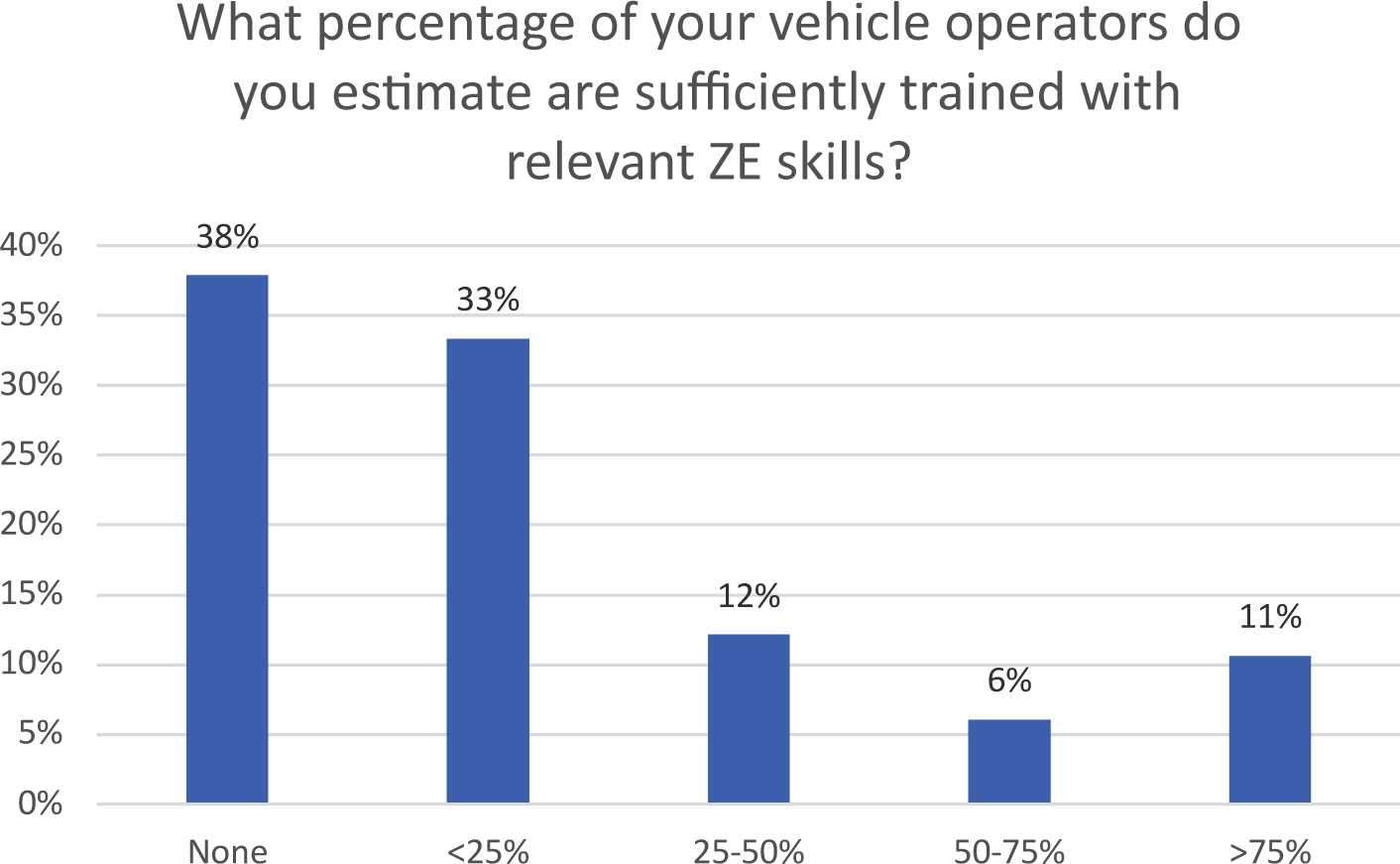
N = 66. Source: TCRP Project J-11/Task 46 industry survey, summer 2024.
Long Description.
The bar graph is titled 'What percentage of your vehicle operators do you estimate are sufficiently trained with relevant Z E skills?' The horizontal axis represents percent, none, less than 25 percent, 25 to 50 percent, 50 to 75 percent, and greater than 75 percent. The vertical axis represents percent ranging from 0 to 40 percent in increments of 5 percent. The data shows: None, 38 percent; less than 25 percent, 33 percent; 25 to 50 percent, 12 percent; 50 to 75 percent, 6 percent; and greater than 75 percent, 11 percent.
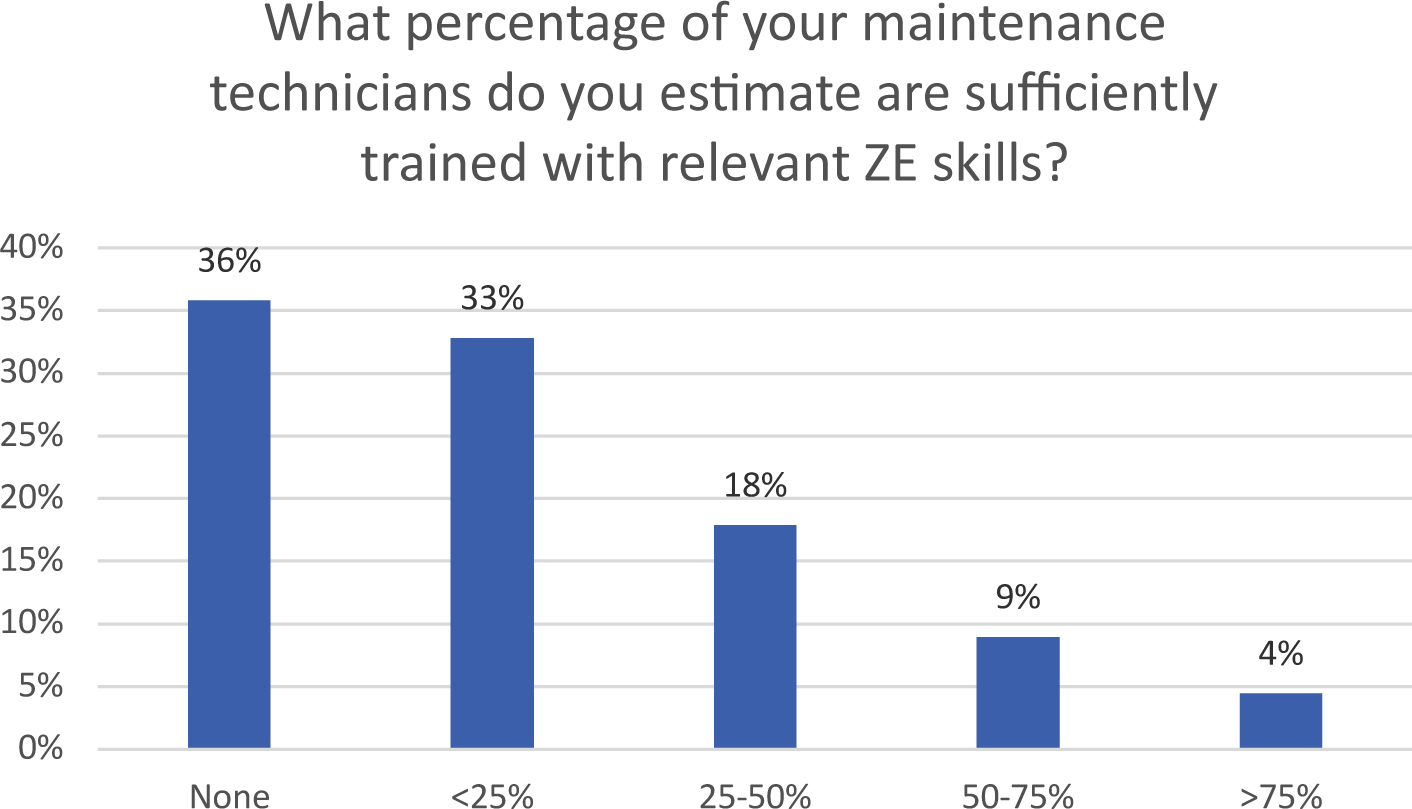
N = 67. Source: TCRP Project J-11/Task 46 industry survey, summer 2024.
Long Description.
The bar graph is titled 'What percentage of your maintenance technicians do you estimate are sufficiently trained with relevant ZE skills?' The horizontal axis represents percent, none, less than 25 percent, 25 to 50 percent, 50 to 75 percent, and greater than 75 percent. The vertical axis represents percent ranging from 0 to 40 percent in increments of 5 percent. The data shows: None, 36 percent; less than 25 percent, 33 percent; 25 to 50 percent, 18 percent; 50 to 75 percent, 9 percent; and greater than 75 percent, 4 percent.
especially important for establishing workforce readiness given the lack of a universally accepted testing or certification process for determining if transit-specific ZEV skills have been acquired by the workforce. The results of a skills-gap survey and subsequent analysis of the data collected serve to pinpoint skill deficiencies for each technician, indicating how much training is needed and what subjects need to be covered. The surveys can also demonstrate the effectiveness of training programs by having technicians take the same survey following the training. Without conducting a skills-gap analysis, transit agencies may be unaware of how much training is needed for their technicians and whether the training provided has been effective.
Despite its usefulness, only 13% of survey respondents had performed a skills-gap analysis at their transit agencies. Of the few respondents who had performed a skills-gap analysis,
75% answered that it was conducted by transit agency staff. One respondent had a skills-gap analysis performed by an OEM, and another transit agency had the analysis performed by a contracted organization.
A review of zero-emission fleet transition plans also showed this strategy to be uncommon. Fifteen percent of plans touch on assessing the skills of the current workforce. Among those plans that address assessment of the skills of the current workforce, the most common methods are assessing the existing credentials of workers (11%), followed by surveys and interviews of staff (8%). Only 6% of plans indicate that the transit agency has performed a formal skills-gap analysis, although 20% noted that they intend to perform one in the future. Most plans more implicitly address skills gaps by identifying training plans or needs.
As shown in Figure 8, one survey respondent (13%) that performed a skills-gap analysis answered that “no gaps were identified.” The common gaps identified were ZEV fundamentals skills, high-voltage and safety-related skills, and advanced electrical and multiplexing skills (63% each).
There are various approaches that transit agencies can take to fill in the gaps identified by a skills-gap analysis. Figure 9 shows the actions that industry survey respondents took. The most common actions taken in response to skills-gap analysis were revising training (63%) and providing additional training (50%).
A skills-gap analysis gives transit agencies a road map to identify training needs, helping to prioritize courses/topics based on each survey respondent. ITLC has prepared a sample skills-gap survey that can be used as is or modified for the specific skill requirements at a given transit agency (see Appendix E). There are several examples throughout this report of transit agencies making good use of skills-gap analyses and other strategies, with overviews provided in the report body and details found in the case studies and profiles (Appendix B).
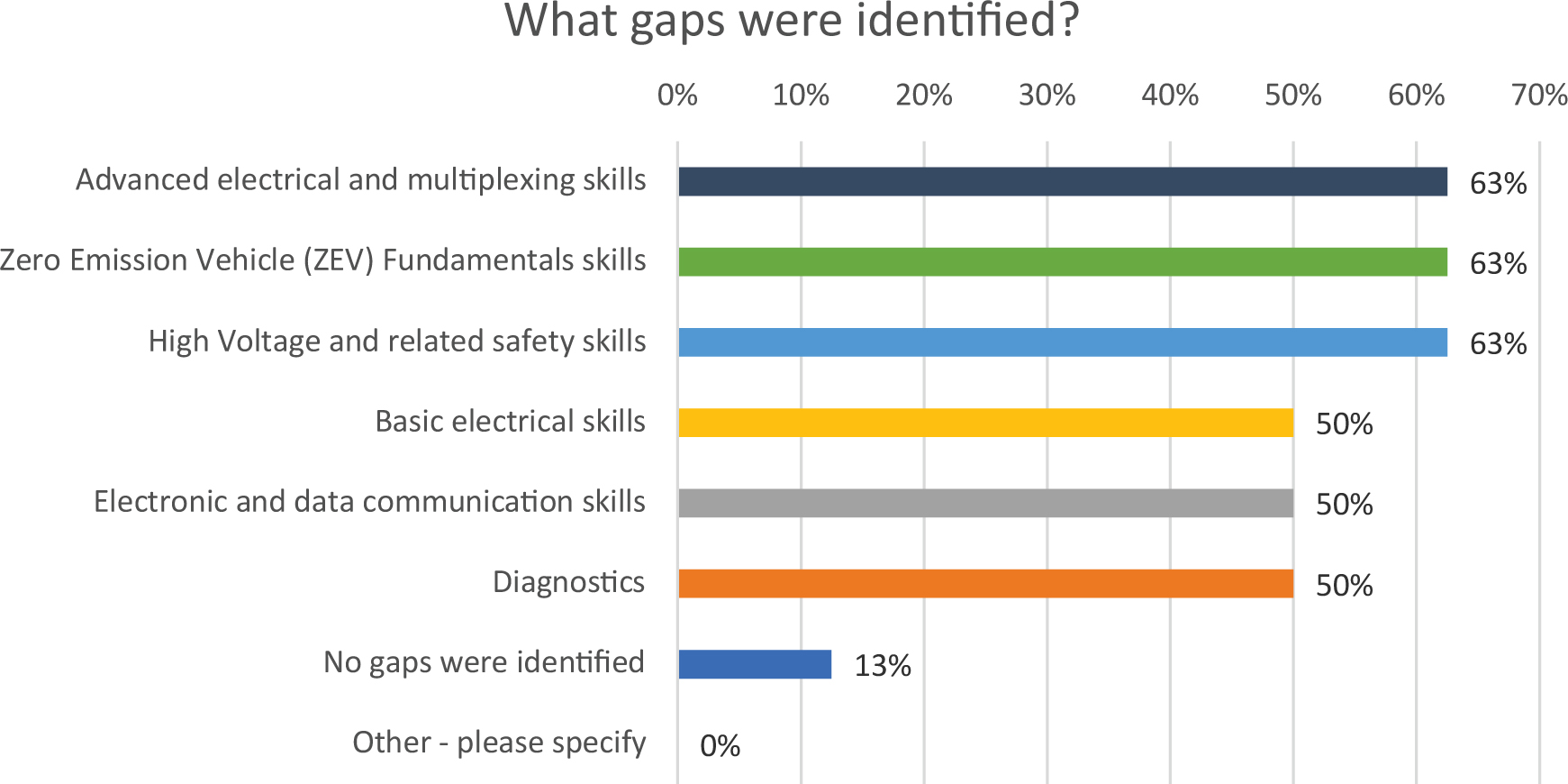
N = 8. Source: TCRP Project J-11/Task 46 industry survey, summer 2024.
Long Description.
The horizontal axis represents percent ranging from 0 to 70 percent in increments of 10. The vertical axis represents skills. The data shows: Advanced electrical and multiplexing skills, 63 percent; zero emission vehicle fundamentals skills, 63 percent; high voltage and related safety skills, 63 percent; basic electrical skills, 50 percent; electronic and data communication skills, 50 percent; diagnostics, 50 percent; no gaps were identified, 13 percent; and other, please specify, 0 percent.

N = 9. Source: TCRP Project J-11/Task 46 industry survey, summer 2024.
Long Description.
The horizontal axis represents percent ranging from 0 to 70 percent in increments of 10. The vertical axis represents actions. The data shows: Revised training, 63 percent; Added additional training material, 50 percent; Retrained staff, 38 percent; New offsite OEM trainings, 38 percent; Developed partnerships, 25 percent; Implemented an apprenticeship program, 13 percent; No actions were taken, 13 percent; and Other, please specify, 13 percent.
Qualification Processes
Given the lack of a nationally recognized procedure to qualify technicians for ZEV maintenance, transit agencies can also assess whether technicians are prepared to work on ZEVs by developing their own qualification process. Some example approaches are provided in the following:
- Los Angeles Department of Transportation recommends that technicians obtain certificates from NFPA 70E: Standard for Electrical Safety in the Workplace, and High-Voltage OSHA 1910.269 8-Hour Qualified Training courses, and a few transit agencies note specific training and credential requirements for electricians for their zero-emission fleets.
- IndyGo, in Indianapolis, created a new classification of maintenance technician who specializes in high-voltage technology and zero-emission vehicle maintenance. To qualify for the new high-voltage technician classification, technicians must pass a written test on electrical skills and receive a score of at least 75%. IndyGo hired an outside firm to create this test. Technicians with experience maintaining hybrid buses were given the new test because of the relevant experience and training gained through that work. However, when only a small percentage of technicians passed the test, several deficiencies were revealed. The test was determined to be unnecessarily difficult, covering aspects unrelated to job tasks that HV techs would be performing. In addition to being too long, the test included irrelevant questions, and technicians found it difficult to stay engaged enough to correctly answer approximately 100 questions. The test was then revised to meet IndyGoʼs needs.
- Hampton Roads Transit, in Virginia, relies on a position qualification standard to assess the level of ZEV skills.
- SARTA, in Ohio, technicians progress through a series of levels that denote their ability to service specific vehicle types. Technicians begin with simple tasks and progress to more complex ones. Guidance and direction from a supervisor are provided for each new task until the technicians are able to confidently and successfully complete tasks on their own. As part of training and assessment, technicians are assigned both familiar and unfamiliar work to allow shift supervisors to see how their skills are advancing. Annually, supervisors meet with the maintenance manager to complete an evaluation for each technicianʼs progression, which
- determines whether they will remain at the same level until the necessary skill set is reached or they have the ability to advance. Supervisors then meet with technicians to discuss positive areas, constructive feedback, and what technicians can do to help advance themselves.
Given the variation in approaches, the transit industry would benefit from guidance to define a universally accepted procedure for determining how technicians are qualified/certified to maintain and repair ZEVs in a way that is consistent among all transit agencies.
Measure ZEV Availability
ZEV availability can be an indication of whether operators and technicians are well-prepared and trained. At CTDOT/CT Transit, when BEBs were first added to the fleet, there were lengthy periods during which the vehicles were out of service. The fact that BEBs now enjoy 98% availability is a testament to the transit agencyʼs workforce readiness. It should be noted that lack of available vehicles could be caused by other factors such as ongoing mechanical problems and shortages of parts.


