Public Transit Workforce Development for Zero-Emission Vehicles (2025)
Chapter: 7 Build Foundational Electrical Skills

CHAPTER 7
Build Foundational Electrical Skills
Before technicians can become proficient in the complex aspects of maintaining high-voltage ZEVs, they must first have a solid understanding of foundational low-voltage electrical applications. This chapter not only emphasizes the need for building basic electrical skills but also provides a variety of resources available to assist transit agencies in training for this essential task.
A 2020 report from FTA and NTI found that many transit agency technicians lack knowledge of, or confidence in, electric and electronic systems. With the adoption of new transit technologies that include ZEVs with high-voltage systems and more advanced digital applications and computer controls, it is essential that technicians keep pace with these technologies. However, incumbent workers, including older workers with less experience with technology, may lack these skills.67 Participants in both focus groups noted that, before more advanced skills can be mastered, technicians must acquire foundational electrical/electronic skills. These fundamental skills are common to the automotive industry as a whole, and training can be provided through several sources such as the transit agency itself, technical schools, community colleges, and online sources. With those foundational skills in place, technicians will still need vehicle-, component-, system-, and technology-specific training, most often from the OEM of the vehicle or component.
The survey results made it clear that most transit agencies feel their maintenance workforce needs additional training to build foundational electrical skills, advanced electronic and multiplexing skills, and skills related to BEB and FCB familiarization. See Figure 14.
According to the focus group participants, many transit technicians lack basic electrical/electronic skills. Without this foundational training, technicians will not be able to fully absorb and put into practice training that is specific to vehicles, components, technologies, or systems with more advanced electrical and electronic applications. The need for fundamental electrical/electronic skill development as a prerequisite to high-voltage ZEV training cannot be overemphasized.
Approaches and Resources
Prioritize Basic Electrical/Electronic Training
Basic electrical/electronic skills are required for many occupations outside vehicle maintenance in the public transit industry. Because of this, a wealth of training material has already been developed. Community colleges often offer courses as part of their catalogue, and there are many online courses and resources. To ensure that technicians receive the necessary training, however, transit agencies will need to prioritize this subject.
Recognizing that electrical and electronic skills are typically rare among new hires and incumbent technicians, IndyGo worked with several outside firms to obtain access to e-learning modules on a number of topics. All technicians are required to take courses on basic electrical/
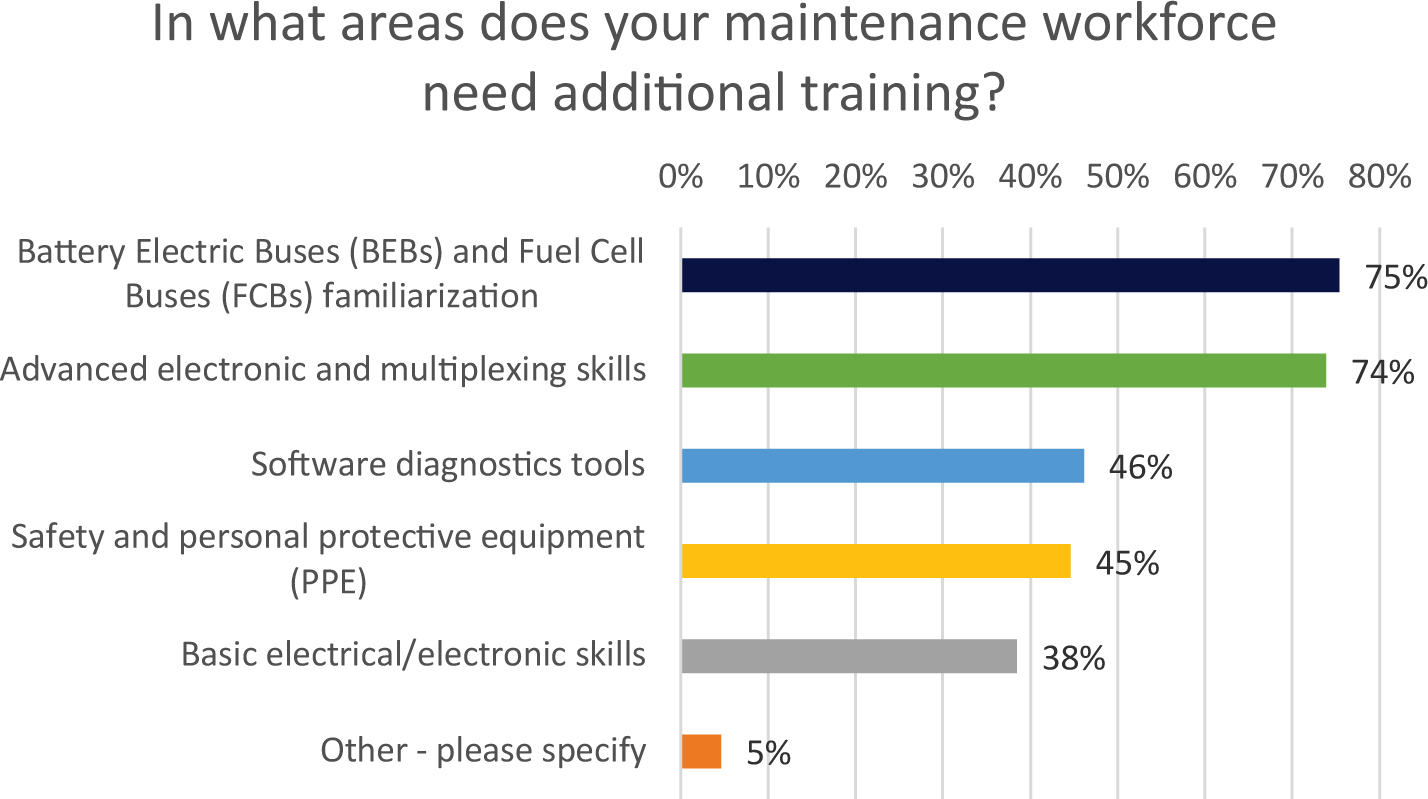
N = 64. Source: TCRP Project J-11/Task 46 industry survey, summer 2024.
Long Description.
The horizontal axis represents percent ranging from 0 to 80 percent in increments of 10 percent. The data shows: Battery electric buses (BEBs) and fuel cell buses (FCBs) familiarization 75 percent; Advanced electronic and multiplexing skills, 74 percent; Software diagnostics tools, 46 percent; Safety and personal protective equipment (PPE), 45 percent; Basic electrical or electronic skills, 38 percent; and Other please specify 5 percent.
electronic theory, tools, and practical application. For technicians who wish to reach the high-voltage technician classification, these courses provide the foundational knowledge required for more advanced and specialized courses.
Use Existing Interactive Resources
Because basic electrical applications are found in many other industries, there are numerous existing training materials available, especially those that use computer simulations that engage students to learn. One such example, offered by TPC, is a three-dimensional (3D) cloud-based troubleshooting simulation training program.68 The immersive 3D environment is designed to teach the skills needed to diagnose and resolve electrical issues correctly and efficiently. Another source is Veejer Enterprises.69 Its Electrical Shortcut series offers computer-based simulations helpful in pinpointing electrical problems to save valuable testing and troubleshooting time and to prevent changing parts unnecessarily.
In addition, companies such as Fluke manufacture digital multimeters, an essential instrument for diagnosing electrical system faults, and offer web-based online training on proper use of this instrument. Online courses such as Digital Multimeter Basics include references to basic electrical theory, explanations, and other supporting resources. The benefit of this and other web-based electrical training is that the tasks are accomplished through computer simulations, which eliminates electrical safety concerns and potential damage to equipment.70
Use Related Technologies as a Bridge
King County Metro has electricians on staff to support its electric trolley system, and while there are differences in the skills needed, many are transferrable. Through transferrable skills and training from its OEMs, the agency plans to equip its electricians to take on maintenance work for ZEVs and related infrastructure. Because King County Metro operators had been driving diesel-hybrid buses for some time before battery-electric buses entered service, operators were familiar with regenerative braking and electrical components. The agency incorporated important new aspects of ZEVs (such as aligning coaches for pantograph charging) into existing modules, and as with other fleet types, added a qualification for the bus type.
Similarly, technicians and operators at SARTA had prior experience with diesel-hybrid buses, and this provided relevant foundational experience with regenerative braking for operators and electrical systems for technicians.
Student Engagement
Basic electrical training is more effective when students are engaged in the learning process. Hands-on and lab exercises coupled with online computer simulations are especially helpful.
APTAʼs Recommended Practice: Training Syllabus to Instruct/Prepare for the ASE Transit Bus Electrical/Electronics Test
This RP provides guidelines for establishing standardized bus maintenance training related to the National Institute for Automotive Service Excellence (ASE) certification program syllabus for the electrical/electronics systems used in transit buses and coaches.71 MTA in Flint, Michigan, used APTAʼs recommended training syllabus to structure and develop a foundational electrical and electronic skills training program.
Hiring Process
The skill requirements of SARTAʼs fleet have led the transit agency to screen for baseline electrical knowledge more rigorously in the recruitment process. Rather than equipment-specific skills, it has been crucial to identify candidates with a robust ability to interpret schematic diagrams and troubleshoot electrical systems. SARTA representatives indicated that they look for people who have general comfort with digital technology and an ability to analyze complex systems.
Many of SARTAʼs technicians have been recruited from a local vocational automotive training program and have sufficient baseline electrical and computer skills. They can then be trained through a combination of OEM-supplied and on-the-job training to become familiar with transit bus applications.


