Public Transit Workforce Development for Zero-Emission Vehicles (2025)
Chapter: 6 Establish Training Resources and Capacity

CHAPTER 6
Establish Training Resources and Capacity
Developing the workforce skills to operate and maintain ZEVs will require significant changes to a transit agencyʼs existing training program for both incumbent and new workers. Additional training is also required to keep pace with the many technological advances to reduce exhaust emissions from traditional ICE vehicles. The increase in training hours and the development of new training programs represent a significant additional cost and effort for transit agencies. Included in the following are the various methods that transit agencies can use to secure the staffing and funding needed to enhance training.
A review of transit agency plans to add ZEVs found that most do not describe how training for ZEVs will be funded nor mention whether they have a budget dedicated to training. Those that address funding noted FTA and other grants as the funding source.
Among industry survey respondents who indicated that their transit agency has dedicated funding for zero-emission workforce development, half are using local funds/tax dollars to fund training, and a third are using procurement set-asides. The industry survey also asked whether investments in training have changed to support the purchase of ZEVs:
- Twenty-five percent of respondents reported that the training budget at their agency has increased in some phase of implementing the ZEVs,
- Another 25% of respondents reported that other changes have been made (e.g., revised training program and related requirements),
- Eight percent reported that training time has increased, and
- Forty-two percent reported that no changes have been made.
Survey respondents were asked to describe in more detail how training and investment priorities have changed; several themes emerged from the responses:
- Transit agencies are adding more staff to support the training for employees that operate and maintain ZEVs.
- Transit agencies are increasing training time, particularly related to safety.
- Regardless of the source of funding, costs associated with increased training and the purchase of specialized tooling and diagnostic equipment must be factored into the budget.
Adding more training to operate and maintain ZEVs may be more challenging for smaller transit agencies with limited training resources and small or non-existent training departments. Despite being a larger transit agency, IndyGo has struggled to develop the resources necessary to reduce its reliance on the OEM of its ZEVs. During an interview, an IndyGo representative gave the modest estimate of at least a year for an experienced diesel technician to become fully trained to maintain ZEVs. OEMs reported in the focus group that technician training is frequently purchased subsequent to the procurement process, which was thought to be an indication that transit agencies often underestimate the amount of training that technicians will need.
Training the workforce to operate and maintain ZEVs requires transit agencies to have adequate resources, time, and capacity to provide the training needed to build requisite skills. The next section provides information on types of resources available to smaller and other agencies.
Approaches and Resources
Grant Programs
Zero-emission projects funded through fiscal year (FY) 2022–2024 Grants for Buses and Bus Facilities and Low-No Emission Program received an additional 5% of funding that was set aside for workforce development activities, which is significant. The majority (67%) of industry survey respondents responded “yes” when asked if their agency has dedicated funding for ZEV training programs. Those that responded “yes” were asked to identify the funding source(s). Grants/workforce development funding and FTAʼs Low-No funding (5% requirement for ZEV training) were selected by the majority (67%) of respondents.
To fund the development and implementation of training programs, MTA in Flint, Michigan, has used a combination of funds from Low-No grants, Urbanized Area Formula grants, and historical grant and local funding for FCBs. Delaware Transit Corporation also used workforce development funding from Low-No grants, and set aside a portion of its general operating budget.
Partnerships with Local Colleges, Universities, and Trade/Tech Schools
Analysis of transit agency plans indicates that many agencies (31%) partner with local educational institutions, such as colleges and technical schools, as part of their training plans, and 13% of plans use an apprenticeship program that may be coordinated with an educational institution. Other partnership examples include:
- Centennial College in Toronto, Ontario, which has a 2-week EV training program to which transit agencies can send their technicians. ATU International has been involved in the development and delivery of the training.62
- At MTA in Flint, Michigan, maintenance employees in certain classifications can apply for tuition reimbursement for courses aimed at state certification or enhancing their job-related technical skills.
Regional and Industry-Based Partnerships
Pooling of resources between multiple transit agencies and taking advantage of available industry training programs rather than creating new training programs can help transit agencies save resources and reduce costs. However, focus group participants noted that transit agencies are generally not aware of all the resources already available to them.
- One partnership example is California Transit Works! (CTW), which is made up of frontline workers and managers from transit agencies and unions. Despite its name, membership in CTW is open to all transit agencies and unions throughout the country. It is focused on building training programs, including those for ZEVs.
- Another partnership is the CTTC, which has provided technical training to public transit agencies in California since 2004. Originally founded by transit agencies in the state, this
- nonprofit corporation is composed of community colleges, universities, transit agencies, and other partners collaborating to design, develop, and deliver technical training for the transit workforce. Courses are reserved for CTTC member agencies. CTTC works with its members to identify areas of training that are needed and then partners with community colleges to develop the training and deliver it across the state. ZEV training has become a focus for CTTC in recent years as transit agencies in the state add ZEVs to their fleets to meet state mandates.
While large consortiums of transit agencies like CTTC may not be feasible in every state or region, several survey respondents noted that collaborating with other transit agencies has been a useful strategy, particularly to improve ZEV maintenance practices and training. For example:
- AC Transit in Oakland, California, has offered other transit agencies the opportunity to send their technicians to attend training courses. AC Transit is also partnering with a consultant to develop its Zero-Emission Bus University, or ZEBU, which will include classrooms and simulations of operational and maintenance procedures and emergency situations.63
- SARTA, in Ohio, hosts a Hydrogen Center of Excellence, which allows other agencies across the region to visit SARTA and see its FCBs. Visitors can drive a bus, view it on a lift, and interact with SARTAʼs technicians.
- SunLine Transit Agency in Thousand Palms, California, hosts a West Coast Center of Excellence in Zero-Emission Technology. The center serves as a warehouse for ZEV data and data collection and offers training for transit agencies.
- Delaware Transit Corporation (DTC) sent maintenance staff to a transit agency in Florida, identified as having experienced technicians, so that DTCʼs technicians could shadow the other agencyʼs staff and engage in on-the-job learning.
- CTDOT/CT Transit in Connecticut reached out to several transit agencies also adding ZEVs to their fleets, especially those further along in their process, such as AC Transit. In doing so, they that found transit agencies are willing to share training materials like curriculum and videos. The concept of partnering with a local community college was recommended as a result of this outreach.
Labor unions are an important partner in the integration of ZEVs and can offer meaningful insight into workforce training for operating and maintaining ZEVs. ATU Local 1091 leadership reported that it had a productive relationship with management at IndyGo, which allowed an open line of communication between them and resulted in improved training programs and operating procedures. The union president was able to communicate the experiences, concerns, and needs of the workforce directly to IndyGo management.
In Seattle, Washington, King County Metroʼs apprenticeship program benefits from joint sponsorship between labor and management. In addition to union locals, labor unions generally are a resource and partner, setting the priorities that locals follow. ATU International offers training programs through online workshops, regional meetings, and training sessions at the ATU headquarters. These training resources cover a range of topics and include sessions on the state of ZEV adoption in the United States and Canada, ZEV funding programs and procurement, and training and safety requirements.64
Train the Trainer
One way to increase the return on investment for ZEV training and build local capacity is to procure TtT programs instead of, or in addition to, direct training. As stated earlier, most transit agencies include training from OEMs in their ZEV procurement. Participants in the industry stakeholder focus group recommended prioritizing the purchase of TtT programs over direct training because this type of training offers a sustainable solution rather than a quick fix. The up-front costs of TtT programs are higher and may require transit agencies to increase the size of their training department. However, TtT courses allow subsequent training to be completed by in-house trainers, which gives transit agencies greater flexibility and the ability to train new staff as they are hired rather than wait to schedule a training session with the OEM. Many respondents to the industry survey reported that their transit agency has made use of TtT programs to train ZEV operators (57%) and ZEV technicians (44%), but this method was less commonly selected than OEM-provided training.
In addition to the fact that the TtT model can be more cost-effective and gives transit agencies the ability to perform additional training whenever needed, transit agencies report that it is one of the most successful training approaches. Figure 13 shows how industry survey respondents ranked various training models.
Gradual Introduction of In-House Training
IndyGo staff report that in-house training is preferable to OEM-provided training because it is more efficient and cost-effective. However, the development of in-house training has been gradual. Because IndyGo was among the first transit agencies to introduce ZEVs, there were few examples to rely on and little information available that could be used to estimate the amount of training, hands-on learning, and time needed to develop capable ZEV technicians. When IndyGo first introduced ZEVs into its transit fleet, it relied on OEM training out of necessity. The training procured from the OEM and the opportunities to complete repairs on ZEVs and develop experience over time have provided the transit agency with a number of well-trained and qualified technicians who are able to facilitate classroom training or on-the-job learning for new technicians in the high-voltage classification.
Foundational Material Serves as a Useful Start
The TWC has a complete training course available that supplies transit agencies with ready-to-use materials to familiarize technicians with BEB technology, maintenance, and safety fundamentals. This course includes classroom materials, instructional videos, hands-on exercises, and assessments that prepare technicians for product-specific training offered by bus manufacturers.65 The training course is based on a three-part webinar series developed by ITLC in coordination with major bus manufacturers to help transit bus technicians gain a fundamental understanding of BEB technology.66 These resources serve as an essential starting point for training technicians.
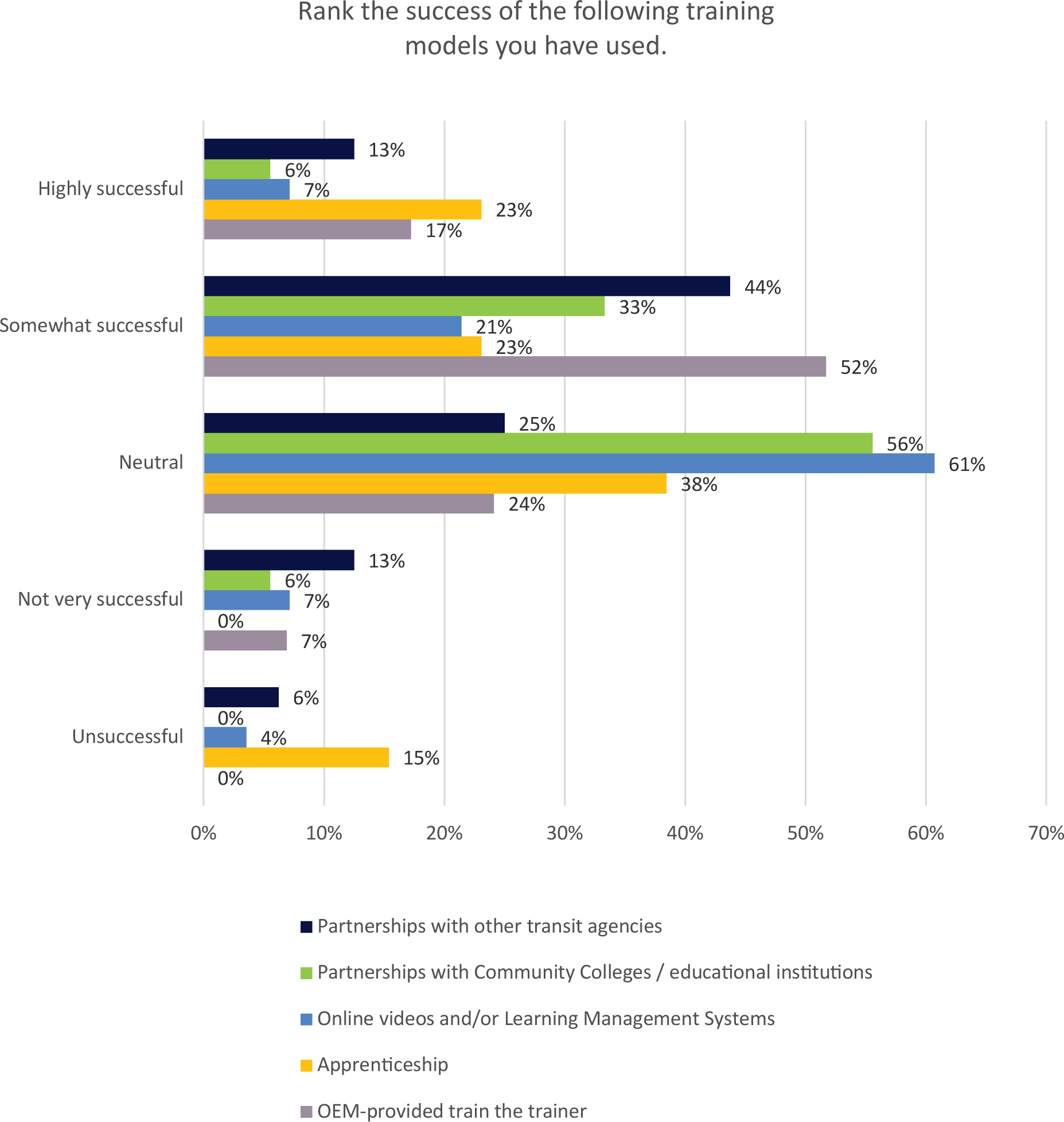
N = 18. Source: TCRP Project J-11/Task 46 industry survey, summer 2024.
Long Description.
The data shows: highly successful, Partnerships with other transit agencies, 13 percent, Partnerships with community colleges or educational institutions, 6 percent, online videos and or learning management systems 7 percent, Apprenticeship 23 percent, and OEM provided train the trainer, 17 percent; Somewhat successful, Partnerships with other transit agencies, 44 percent, Partnerships with community colleges or educational institutions, 33 percent, online videos and or learning management systems 21 percent, Apprenticeship 23 percent, and OEM provided train the trainer, 52 percent; Neutral, Partnerships with other transit agencies, 25 percent, Partnerships with community colleges or educational institutions, 56 percent, online videos and or learning management systems 61 percent, Apprenticeship, 38 percent and OEM provided train the trainer 24 percent; Not very successful, Partnerships with other transit agencies, 13 percent, Partnerships with community colleges or educational institutions, 6 percent, online videos and or learning management systems 7 percent, Apprenticeship, 0 percent and OEM provided train the trainer 7 percent; and Unsuccessful, Partnerships with other transit agencies, 6 percent, Partnerships with community colleges or educational institutions, 0 percent, online videos and or learning management systems 4 percent, Apprenticeship, 15 percent and OEM provided train the trainer 0 percent.


