Public Transit Workforce Development for Zero-Emission Vehicles (2025)
Chapter: Appendix E: Skills-Gap Survey Example

APPENDIX E
Skills-Gap Survey Example
Long Description.
APPENDIX E
Skills Gap Survey Example
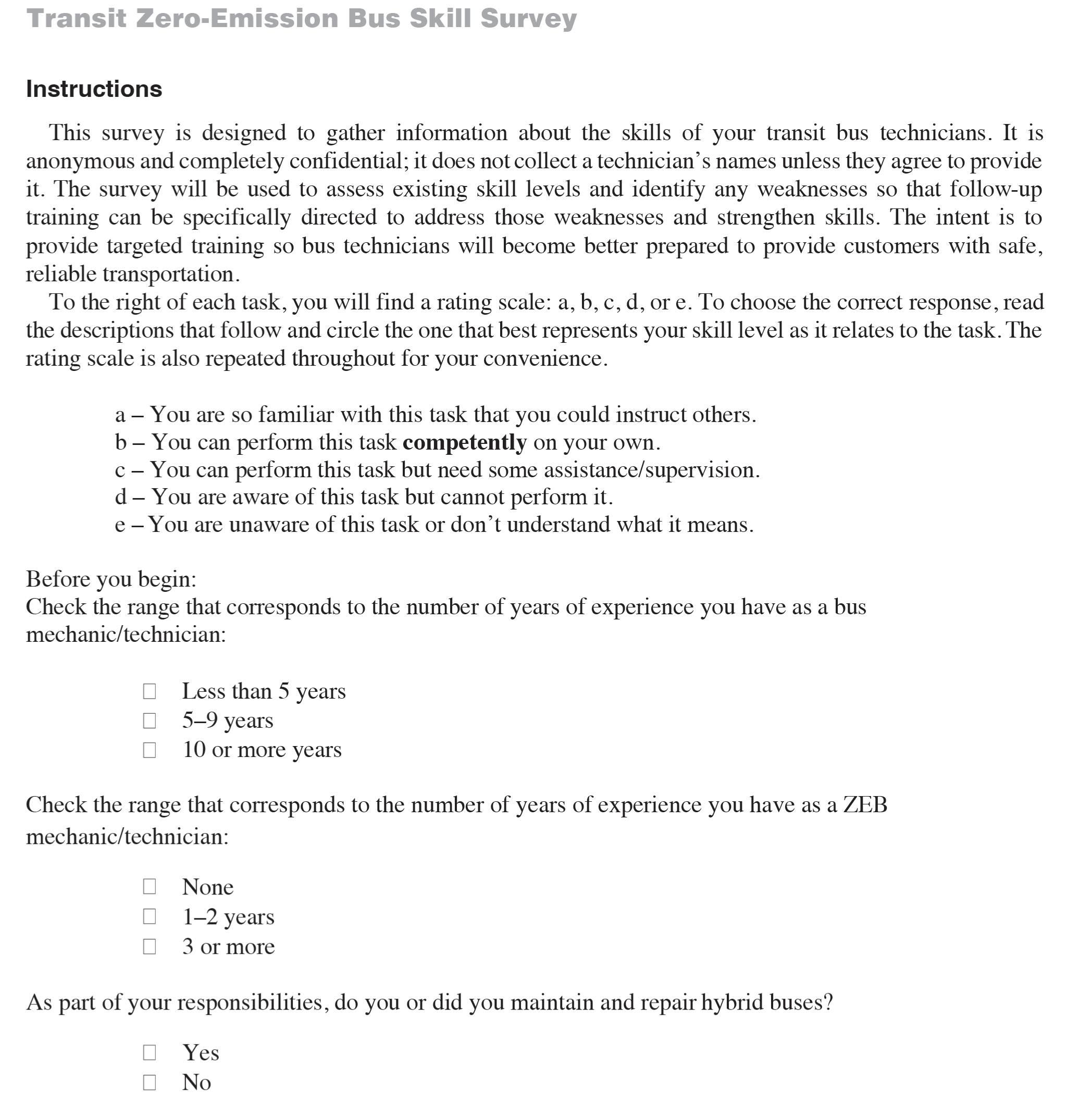
Transit Zero-Emission Bus Skill Survey
Instructions
This survey is designed to gather information about your ZEB skills as a transit bus technician. It is anonymous and completely confidential; it does not ask for your name unless you agree. The survey will be used to assess your existing skill levels so that appropriate training can be provided to strengthen those skills. The intent is to provide targeted training so bus technicians will become better prepared to provide customers with safe, reliable transportation.
To the right of each task, you will find a rating scale: a, b, c, d, or e. To choose the correct response, read the descriptions that follow and circle the one that best represents your skill level as it relates to the task. The rating scale is also repeated throughout for your convenience.
a – You are so familiar with this task that you could instruct others.
b – You can perform this task competently on your own.
c – You can perform this task but need some assistance/supervision.
d – You are aware of this task but cannot perform it.
e – You are unaware of this task or don’t understand what it means.
Before you begin:
Check the range that corresponds to the number of years of experience you have as a bus mechanic/technician:
- Less than 5 years
- 5 through 9 years
- 10 or more years
Check the range that corresponds to the number of years of experience you have as a ZEB mechanic/technician:
- None
- 1 through 2 years
- 3 or more
As part of your responsibilities, do you or did you maintain and repair hybrid buses?
- Yes
- No
Long Description.
a – You are so familiar with this task that you could instruct others.
b – You can perform this task competently on your own.
c – You can perform this task but need some assistance/supervision.
d – You are aware of this task but cannot perform it.
e – You are unaware of this task or don’t understand what it means.
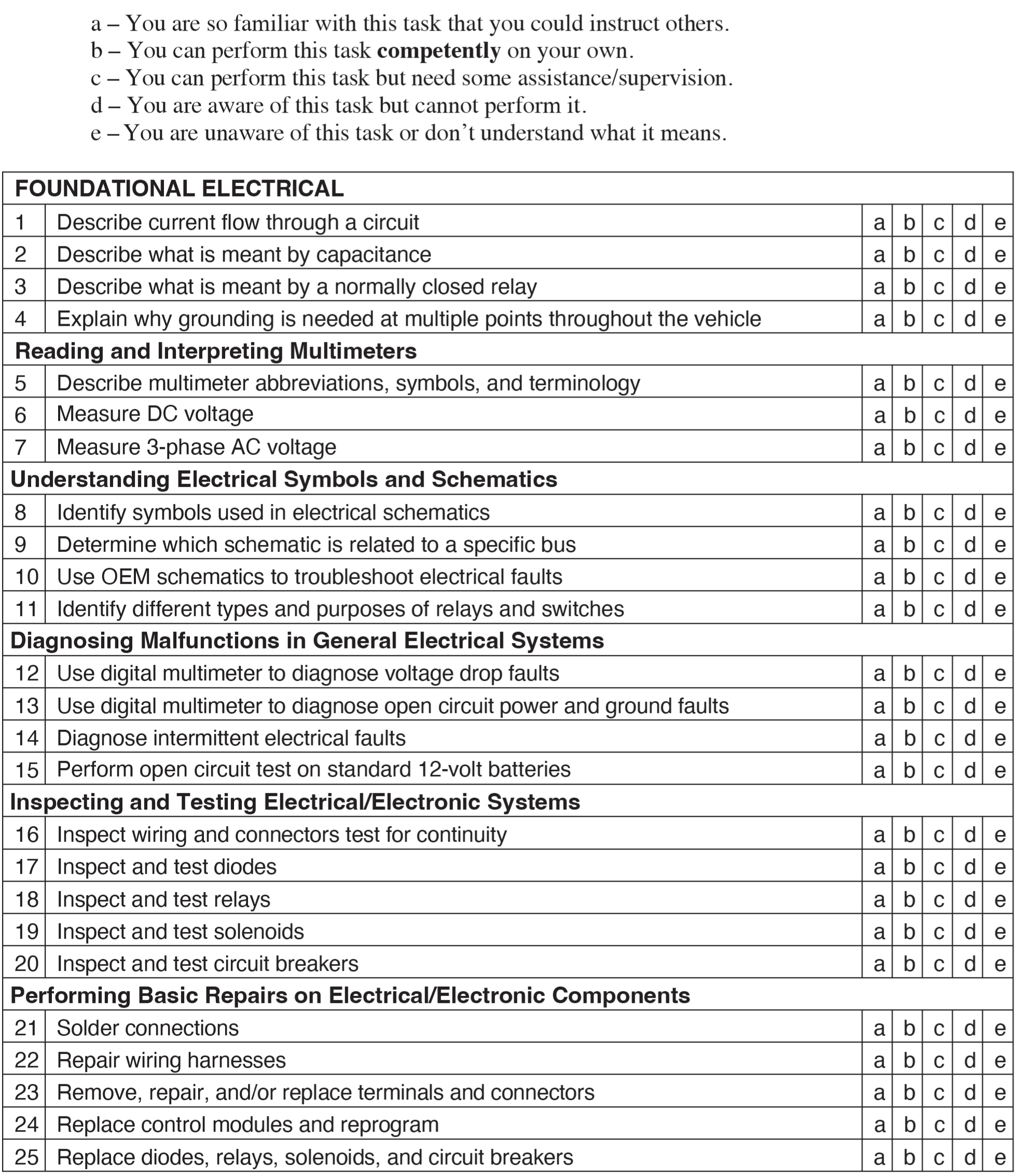
Row 1: Column 1: Foundational Electrical; Row 2: Column 1: 1; Column 2: Describe current flow through a circuit; Column 3: a; Column 4: b; Column 5: c; Column 6: d; Column 7: e. Row 3: Column 1: 2; Column 2: Describe what is meant by capacitance; Column 3: a; Column 4: b; Column 5: c; Column 6: d; Column 7: e. Row 4: Column 1: 3; Column 2: Describe what is meant by a normally closed relay; Column 3: a; Column 4: b; Column 5: c; Column 6: d; Column 7: e. Row 5: Column 1: 4; Column 2: Explain why grounding is needed at multiple points throughout the vehicle; Column 3: a; Column 4: b; Column 5: c; Column 6: d; Column 7: e. Row 6: Column 1: Reading and interpreting multimeters. Row 7: Column 1: 5; Column 2: Describe multimeter abbreviations, symbols, and terminology; Column 3: a; Column 4: b; Column 5: c; Column 6: d; Column 7: e. Row 8: Column 1: 6; Column 2: Measure D C voltage; Column 3: a; Column 4: b; Column 5: c; Column 6: d; Column 7: e. Row 9: Column 1: 7; Column 2: Measure 3 phase A C voltage; Column 3: a; Column 4: b; Column 5: c; Column 6: d; Column 7: e. Row 10: Column 1: Understanding Electrical Symbols and Schematics. Row 11: Column 1: 8; Column 2: Identify symbols used in electrical schematics; Column 3: a; Column 4: b; Column 5: c; Column 6: d; Column 7: e. Row 12: Column 1: 9; Column 2: Determine which schematic is related to a specific bus; Column 3: a; Column 4: b; Column 5: c; Column 6: d; Column 7: e. Row 13: Column 1: 10; Column 2: Use OEM schematics to troubleshoot electrical faults; Column 3: a; Column 4: b; Column 5: c; Column 6: d; Column 7: e. Row 14: Column 1: 11; Column 2: Identify different types and purposes of relays and switches; Column 3: a; Column 4: b; Column 5: c; Column 6: d; Column 7: e. Row 15: Column 1: Diagnosing malfunctions in general electrical systems. Row 16: Column 1: 12; Column 2: Use digital multimeter to diagnose voltage drop faults; Column 3: a; Column 4: b; Column 5: c; Column 6: d; Column 7: e. Row 17: Column 1: 13; Column 2: Use digital multimeter to diagnose open circuit power and ground faults; Column 3: a; Column 4: b; Column 5: c; Column 6: d; Column 7: e. Row 18: Column 1: 14; Column 2: Diagnose intermittent electrical faults; Column 3: a; Column 4: b; Column 5: c; Column 6: d; Column 7: e. Row 19: Column 1: 15; Column 2: Perform open circuit test on standard 12-volt batteries; Column 3: a; Column 4: b; Column 5: c; Column 6: d; Column 7: e. Row 20: Column 1: Inspecting and Testing Electrical or Electronic Systems. Row 21: Column 1: 16; Column 2: Inspect wiring and connectors test for continuity; Column 3: a; Column 4: b; Column 5: c; Column 6: d; Column 7: e. Row 22: Column 1: 17; Column 2: inspect and test diodes; Column 3: a; Column 4: b; Column 5: c; Column 6: d; Column 7: e. Row 23: Column 1: 18; Column 2: Inspect and test relays; Column 3: a; Column 4: b; Column 5: c; Column 6: d; Column 7: e. Row 24: Column 1: 19; Column 2: Inspect and test solenoids; Column 3: a; Column 4: b; Column 5: c; Column 6: d; Column 7: e. Row 25: Column 1: 20; Column 2: Inspect and test circuit breakers; Column 3: a; Column 4: b; Column 5: c; Column 6: d; Column 7: e. Row 26: Column 1: Performing basic repairs on electrical or electronic components. Row 27: Column 1: 21; Column 2: Solder connections; Column 3: a; Column 4: b; Column 5: c; Column 6: d; Column 7: e. Row 28: Column 1: 22; Column 2: Repair wiring harnesses; Column 3: a; Column 4: b; Column 5: c; Column 6: d; Column 7: e. Row 29: Column 1: 23; Column 2: Remove, repair, and or replace terminals and connectors; Column 3: a; Column 4: b; Column 5: c; Column 6: d; Column 7: e. Row 30: Column 1: 24; Column 2: Replace control modules and reprogram; Column 3: a; Column 4: b; Column 5: c; Column 6: d; Column 7: e. Row 31: Column 1: 25; Column 2: Replace diodes, relays, solenoids, and circuit breakers; Column 3: a; Column 4: b; Column 5: c; Column 6: d; Column 7: e.

Long Description.
a – You are so familiar with this task that you could instruct others.
b – You can perform this task competently on your own.
c – You can perform this task but need some assistance/supervision.
d – You are aware of this task but cannot perform it.
e – You are unaware of this task or don’t understand what it means.
Row 1: Column 1: Multiplex systems. Row 2: Column 1: 1; Column 2: Explain ladder logic and interpret ladder diagrams; Column 3: a; Column 4: b; Column 5: c; Column 6: d; Column 7: e. Row 3: Column 1: 2; Column 2: Repair faults by locating rungs and reading ladder logic diagrams; Column 3: a; Column 4: b; Column 5: c; Column 6: d; Column 7: e. Row 4: Column 1: 3; Column 2: Interpret combinations of inputs and outputs to determine electrical faults; Column 3: a; Column 4: b; Column 5: c; Column 6: d; Column 7: e. Row 5: Column 1: 4; Column 2: Operate laptop computer or tablet for multiplex diagnostic purposes; Column 3: a; Column 4: b; Column 5: c; Column 6: d; Column 7: e. Row 6: Column 1: 5; Column 2: Check or repair or replace communications cable; Column 3: a; Column 4: b; Column 5: c; Column 6: d; Column 7: e. Row 7: Column 1: 6; Column 2: Use LEDs to troubleshoot multiplex systems; Column 3: a; Column 4: b; Column 5: c; Column 6: d; Column 7: e. Row 8: Column 1: 7; Column 2: Use service tools to diagnose communication or data links; Column 3: a; Column 4: b; Column 5: c; Column 6: d; Column 7: e. Row 9: Column 1: Battery Electric Bus technology. Row 10: Column 1: 1; Column 2: Explain the basic differences between BEBs and diesel-powered buses; Column 3: a; Column 4: b; Column 5: c; Column 6: d; Column 7: e. Row 11: Column 1: 2; Column 2: Explain the function of an energy storage system; Column 3: a; Column 4: b; Column 5: c; Column 6: d; Column 7: e. Row 12: Column 1: 3; Column 2: Explain the function of an inverter; Column 3: a; Column 4: b; Column 5: c; Column 6: d; Column 7: e. Row 13: Column 1: 4; Column 2: Explain the function of a D C to D C converter; Column 3: a; Column 4: b; Column 5: c; Column 6: d; Column 7: e. Row 14: Column 1: 5; Column 2: Explain the function of a high voltage junction box; Column 3: a; Column 4: b; Column 5: c; Column 6: d; Column 7: e. Row 15: Column 1: 6; Column 2: Explain the function of a traction motor; Column 3: a; Column 4: b; Column 5: c; Column 6: d; Column 7: e. Row 16: Column 1: 7; Column 2: Explain the purpose of regenerative braking; Column 3: a; Column 4: b; Column 5: c; Column 6: d; Column 7: e. Row 17: Column 1: 8; Column 2: Explain manual service disconnect (MSD) ; Column 3: a; Column 4: b; Column 5: c; Column 6: d; Column 7: e. Row 18: Column 1: Fuel cell bus technology. Row 19: Column 1: 1; Column 2: Explain the operation of a fuel cell and the chemical reaction that creates an electrical charge; Column 3: a; Column 4: b; Column 5: c; Column 6: d; Column 7: e. Row 20: Column 1: 2; Column 2: Describe how the electrical output created by the fuel cell is used to charge the ESS batteries; Column 3: a; Column 4: b; Column 5: c; Column 6: d; Column 7: e. Row 21: Column 1: 3; Column 2: Explain the requirements surrounding state of charge for the ESS; Column 3: a; Column 4: b; Column 5: c; Column 6: d; Column 7: e. Row 22: Column 1: 4; Column 2: Explain the fueling procedures for an FCB; Column 3: a; Column 4: b; Column 5: c; Column 6: d; Column 7: e. Row 23: Column 1: 5; Column 2: Describe the system architecture of an FCB; Column 3: a; Column 4: b; Column 5: c; Column 6: d; Column 7: e. Row 24: Column 1: Battery thermal management system. Row 25: Column 1: 1; Column 2: Explain why a BTMS is needed to heat or cool the energy storage system; Column 3: a; Column 4: b; Column 5: c; Column 6: d; Column 7: e. Row 26: Column 1: 2; Column 2: Explain how the BTMS heats or cools the ESS; Column 3: a; Column 4: b; Column 5: c; Column 6: d; Column 7: e. Row 27: Column 1: 3; Column 2: Explain the operation of a battery chiller to regulate optimum battery temperatures; Column 3: a; Column 4: b; Column 5: c; Column 6: d; Column 7: e. Row 28: Column 1: 4; Column 2: Differentiate between the battery coolant loop and the electronics coolant loop; Column 3: a; Column 4: b; Column 5: c; Column 6: d; Column 7: e.
Long Description.
a – You are so familiar with this task that you could instruct others.
b – You can perform this task competently on your own.
c – You can perform this task but need some assistance/supervision.
d – You are aware of this task but cannot perform it.
e – You are unaware of this task or don’t understand what it means.
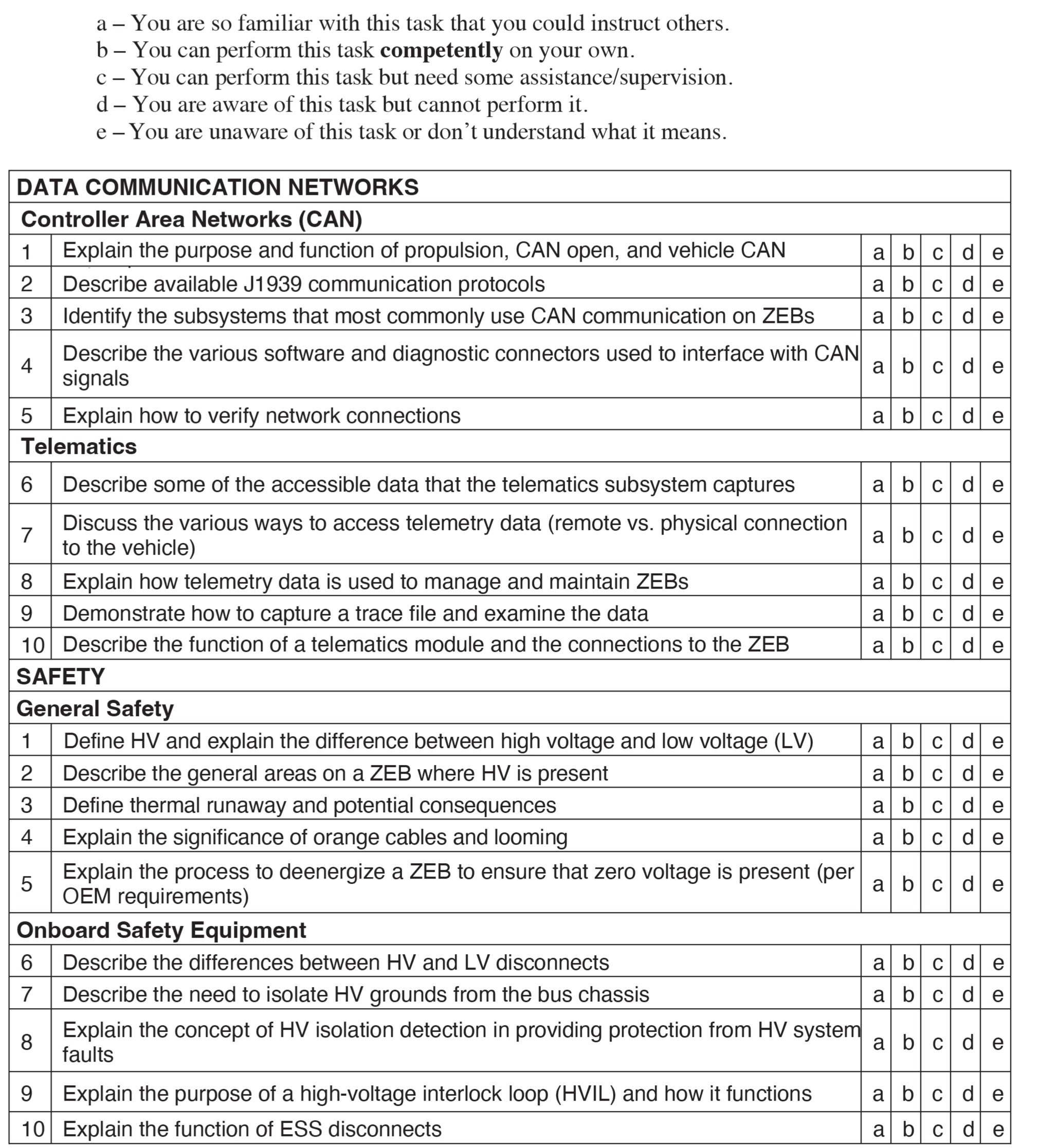
Row 1: Column 1: Data communication networks. Row 2: Column 1: Controller area networks (CAN). Row 3: Column 1: 1; Column 2: Explain the purpose and function of propulsion, CAN open, and vehicle CAN; Column 3: a; Column 4: b; Column 5: c; Column 6: d; Column 7: e. Row 4: Column 1: 2; Column 2: Describe available J 1939 communication protocols; Column 3: a; Column 4: b; Column 5: c; Column 6: d; Column 7: e. Row 5: Column 1: 3; Column 2: Identify the subsystems that most commonly use CAN communication on ZEBs; Column 3: a; Column 4: b; Column 5: c; Column 6: d; Column 7: e. Row 6: Column 1: 4; Column 2: Describe the various software and diagnostic connectors used to interface with CAN signals; Column 3: a; Column 4: b; Column 5: c; Column 6: d; Column 7: e. Row 7: Column 1: 5; Column 2: Explain how to verify network connections; Column 3: a; Column 4: b; Column 5: c; Column 6: d; Column 7: e. Row 8: Column 1: Telematics. Row 9: Column 1: 6; Column 2: Describe some of the accessible data that the telematics subsystem captures; Column 3: a; Column 4: b; Column 5: c; Column 6: d; Column 7: e. Row 10: Column 1: 7; Column 2: Discuss the various ways to access telemetry data (remote versus physical connection to the vehicle); Column 3: a; Column 4: b; Column 5: c; Column 6: d; Column 7: e. Row 11: Column 1: 8; Column 2: Explain how telemetry data is used to manage and maintain ZEBs; Column 3: a; Column 4: b; Column 5: c; Column 6: d; Column 7: e. Row 12: Column 1: 9; Column 2: Demonstrate how to capture a trace file and examine the data; Column 3: a; Column 4: b; Column 5: c; Column 6: d; Column 7: e. Row 13: Column 1: 10; Column 2: Describe the function of a Telematics module and the connections to the ZEB; Column 3: a; Column 4: b; Column 5: c; Column 6: d; Column 7: e. Row 14: Column 1: Safety. Row 15: Column 1: General safety. Row 16: Column 1: 1; Column 2: Define H V and explain the difference between high voltage and low voltage; Column 3: a; Column 4: b; Column 5: c; Column 6: d; Column 7: e. Row 17: Column 1: 2; Column 2: Describe the general areas on a ZEB where H V is present; Column 3: a; Column 4: b; Column 5: c; Column 6: d; Column 7: e. Row 18: Column 1: 3; Column 2: Define thermal runaway and potential consequences; Column 3: a; Column 4: b; Column 5: c; Column 6: d; Column 7: e. Row 19: Column 1: 4; Column 2: Explain the significance of orange cables and looming; Column 3: a; Column 4: b; Column 5: c; Column 6: d; Column 7: e. Row 20: Column 1: 5; Column 2: Explain the process to deenergize a ZEB to ensure that zero voltage is present (per OEM requirements); Column 3: a; Column 4: b; Column 5: c; Column 6: d; Column 7: e. Row 21: Column 1: Onboard safety equipment. Row 22: Column 1: 6; Column 2: Describe the differences between H V and L V disconnects; Column 3: a; Column 4: b; Column 5: c; Column 6: d; Column 7: e. Row 23: Column 1: 7; Column 2: Describe the need to isolate H V grounds from the bus chassis; Column 3: a; Column 4: b; Column 5: c; Column 6: d; Column 7: e. Row 24: Column 1: 8; Column 2: Explain the concept of H V isolation detection in providing protection from H V system faults; Column 3: a; Column 4: b; Column 5: c; Column 6: d; Column 7: e. Row 25: Column 1: 9; Column 2: Explain the purpose of a high-voltage interlock loop (HVIL) and how it functions; Column 3: a; Column 4: b; Column 5: c; Column 6: d; Column 7: e. Row 26: Column 1: 10; Column 2: Explain the function of ESS disconnects; Column 3: a; Column 4: b; Column 5: c; Column 6: d; Column 7: e.

Long Description.
a – You are so familiar with this task that you could instruct others.
b – You can perform this task competently on your own.
c – You can perform this task but need some assistance/supervision.
d – You are aware of this task but cannot perform it.
e – You are unaware of this task or don’t understand what it means.
Row 1: Column 1: Personal protective equipment. Row 2: Column 1: 11; Column 2: Identify the conditions under which HVPPE is required when working on ZEBs; Column 3: a; Column 4: b; Column 5: c; Column 6: d; Column 7: e. Row 3: Column 1: 12; Column 2: Identify and explain the need for all applicable H V P P E, including arc flash suits, face shields, balaclava, insulated shoes, insulated gloves, and ear plugs; Column 3: a; Column 4: b; Column 5: c; Column 6: d; Column 7: e. Row 4: Column 1: 13; Column 2: Explain the process for inspecting and testing insulated gloves; Column 3: a; Column 4: b; Column 5: c; Column 6: d; Column 7: e. Row 5: Column 1: 14; Column 2: Explain the purpose of using an insulated shepherd’s hook (also known as a hot stick); Column 3: a; Column 4: b; Column 5: c; Column 6: d; Column 7: e. Row 6: Column 1: 15; Column 2: Explain the purpose of establishing arc flash and shock boundaries and related distancing requirements when servicing ZEBs; Column 3: a; Column 4: b; Column 5: c; Column 6: d; Column 7: e. Row 7: Column 1: Insulated Tools. Row 8: Column 1: 16; Column 2: Identify common tools that require insulation when working on ZEBs; Column 3: a; Column 4: b; Column 5: c; Column 6: d; Column 7: e. Row 9: Column 1: 17; Column 2: Explain how to identify unsafe insulated tools; Column 3: a; Column 4: b; Column 5: c; Column 6: d; Column 7: e. Row 10: Column 1: 18; Column 2: Explain why insulated tools are needed and under which conditions; Column 3: a; Column 4: b; Column 5: c; Column 6: d; Column 7: e. Row 11: Column 1: BEB Charging systems. Row 12: Column 1: Plug in (conductive). Row 13: Column 1: 1; Column 2: Describe two primary functions associated with a manual, plug-in (depot) charge; Column 3: a; Column 4: b; Column 5: c; Column 6: d; Column 7: e. Row 14: Column 1: 2; Column 2: Describe the purpose of the charger to vehicle communication; Column 3: a; Column 4: b; Column 5: c; Column 6: d; Column 7: e. Row 15: Column 1: 3; Column 2: Explain the advantages and disadvantages associated with plug-in chargers; Column 3: a; Column 4: b; Column 5: c; Column 6: d; Column 7: e. Row 16: Column 1: 4; Column 2: Describe the concept of smart charging and the various advantages associated with it; Column 3: a; Column 4: b; Column 5: c; Column 6: d; Column 7: e. Row 17: Column 1: 5; Column 2: Describe the basic precautions that must be taken before repairing or servicing; Column 3: a; Column 4: b; Column 5: c; Column 6: d; Column 7: e. Row 18: Column 1: Overhead (conductive). Row 19: Column 1: 6; Column 2: Describe the two most common overhead, pantograph style charging methods; Column 3: a; Column 4: b; Column 5: c; Column 6: d; Column 7: e. Row 20: Column 1: 7; Column 2: Explain the advantages and disadvantages associated with overhead, pantograph style charging; Column 3: a; Column 4: b; Column 5: c; Column 6: d; Column 7: e. Row 21: Column 1: Inductive. Row 22: Column 1: 8; Column 2: Describe inductive charging; Column 3: a; Column 4: b; Column 5: c; Column 6: d; Column 7: e. Row 23: Column 1: 9; Column 2: Explain the advantages and disadvantages associated with inductive charging; Column 3: a; Column 4: b; Column 5: c; Column 6: d; Column 7: e. Row 24: Column 1: ZEB maintenance. Row 25: Column 1: Special equipment and procedures. Row 26: Column 1: 1; Column 2: Identify unique service tools and other service information; Column 3: a; Column 4: b; Column 5: c; Column 6: d; Column 7: e. Row 27: Column 1: 2; Column 2: Identify the type of digital multimeter needed for HVZEB applications; Column 3: a; Column 4: b; Column 5: c; Column 6: d; Column 7: e. Row 28: Column 1: 3; Column 2: Explain the basic inspection and maintenance of A C and D C high voltage cables; Column 3: a; Column 4: b; Column 5: c; Column 6: d; Column 7: e. Row 29: Column 1: 4; Column 2: Explain the differences and importance of grounding and bonding; Column 3: a; Column 4: b; Column 5: c; Column 6: d; Column 7: e. Row 30: Column 1: Maintenance intervals and general tasks. Row 31: Column 1: 5; Column 2: Demonstrate an ability to locate OEM documentation on ZEB maintenance intervals and tasks; Column 3: a; Column 4: b; Column 5: c; Column 6: d; Column 7: e. Row 32: Column 1: 6; Column 2: Describe common preventive maintenance subsystems inspections; Column 3: a; Column 4: b; Column 5: c; Column 6: d; Column 7: e. Row 33: Column 1: 7; Column 2: Demonstrate the ability to locate and access ZEB service and parts documentation; Column 3: a; Column 4: b; Column 5: c; Column 6: d; Column 7: e.
This page intentionally left blank.
Abbreviations and acronyms used without definitions in TRB publications: |
|
A4A |
Airlines for America |
AAAE |
American Association of Airport Executives |
AASHO |
American Association of State Highway Officials |
AASHTO |
American Association of State Highway and Transportation Officials |
ACI–NA |
Airports Council International–North America |
ACRP |
Airport Cooperative Research Program |
ADA |
Americans with Disabilities Act |
APTA |
American Public Transportation Association |
ASCE |
American Society of Civil Engineers |
ASME |
American Society of Mechanical Engineers |
ASTM |
American Society for Testing and Materials |
ATA |
American Trucking Associations |
CTAA |
Community Transportation Association of America |
CTBSSP |
Commercial Truck and Bus Safety Synthesis Program |
DHS |
Department of Homeland Security |
DOE |
Department of Energy |
EPA |
Environmental Protection Agency |
FAA |
Federal Aviation Administration |
FAST |
Fixing Americaʼs Surface Transportation Act (2015) |
FHWA |
Federal Highway Administration |
FMCSA |
Federal Motor Carrier Safety Administration |
FRA |
Federal Railroad Administration |
FTA |
Federal Transit Administration |
GHSA |
Governors Highway Safety Association |
HMCRP |
Hazardous Materials Cooperative Research Program |
IEEE |
Institute of Electrical and Electronics Engineers |
ISTEA |
Intermodal Surface Transportation Efficiency Act of 1991 |
ITE |
Institute of Transportation Engineers |
MAP-21 |
Moving Ahead for Progress in the 21st Century Act (2012) |
NASA |
National Aeronautics and Space Administration |
NASAO |
National Association of State Aviation Officials |
NCFRP |
National Cooperative Freight Research Program |
NCHRP |
National Cooperative Highway Research Program |
NHTSA |
National Highway Traffic Safety Administration |
NTSB |
National Transportation Safety Board |
PHMSA |
Pipeline and Hazardous Materials Safety Administration |
RITA |
Research and Innovative Technology Administration |
SAE |
Society of Automotive Engineers |
SAFETEA-LU |
Safe, Accountable, Flexible, Efficient Transportation Equity Act: A Legacy for Users (2005) |
TCRP |
Transit Cooperative Research Program |
TEA-21 |
Transportation Equity Act for the 21st Century (1998) |
TRB |
Transportation Research Board |
TSA |
Transportation Security Administration |
U.S. DOT |
United States Department of Transportation |

Transportation Research Board
500 Fifth Street, NW
Washington, DC 20001