Public Transit Workforce Development for Zero-Emission Vehicles (2025)
Chapter: 5 Cultivate OEM Support

CHAPTER 5
Cultivate OEM Support
The majority of transit agencies rely on OEMs to provide ZEV training because they are the organizations that manufacture and support ZEVs and related equipment. However, several transit agencies question the quality and effectiveness of that training. This chapter explores the importance of building strong OEM relationships to obtain more useful training. Included are examples of effective OEM relationships, sample procurement language to obtain adequate ZEV training, using OEM warranty work as training opportunities, and understanding OEM limitations.
The industry survey confirms that most transit agencies procure training when purchasing vehicles and rely on OEMs to ensure that their operators and technicians receive adequate training.
- Ninety-three percent of respondents reported that OEM training was included in their ZEV procurement.
- Over 70% of respondents that had initiated ZEV training for technicians reported that OEMs provided the training.
- Sixty-five percent of those with ZE training for operators reported that OEMs provided the training.
The number of hours of training procured varied widely.
- A third of respondents (33%) purchased 80 to 240 hours.
- Twenty-two percent purchased 240 to 500 or 500 to 2,400 hours.
- Eleven percent purchased 20 to 40 hours or 40 to 80 hours.
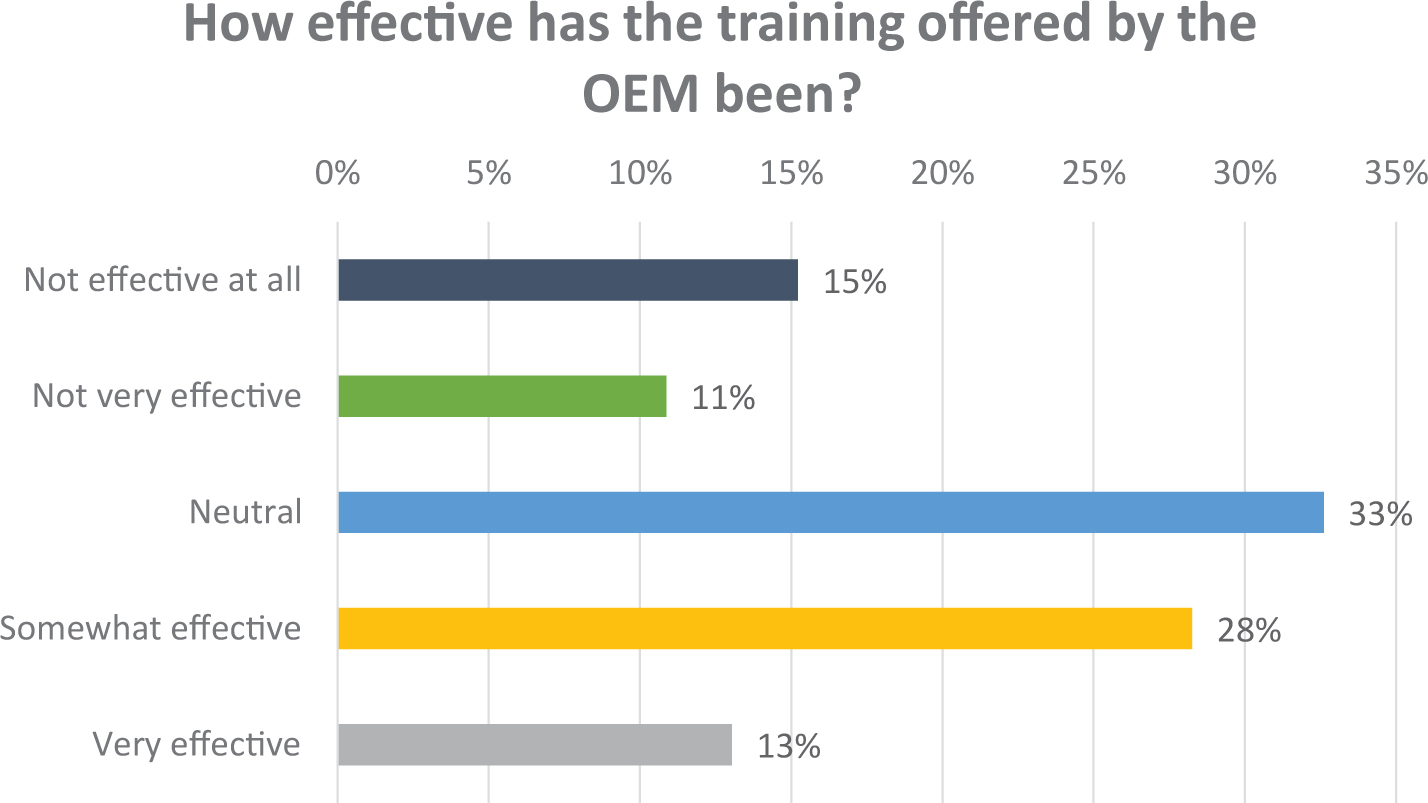
Industry survey respondents reported varying degrees of satisfaction with OEM-provided training, as shown in Figure 11.
A 2020 FTA/National Transit Institute (NTI) study indicated that relying on long-term OEM contracts for maintenance and repairs can impede transit agency employees from developing the skills needed to perform work in-house.54
The industry survey indicates that transit agencies have had a range of experiences with OEM-provided training. Most respondents (93%) indicated that OEM training was included in their procurements but reported a wide range OEM engagement in ZEV training. Thirty-three percent of respondents were neutral on the effectiveness of OEM training, followed by 28% who responded that OEM training was somewhat effective, and 26% who found OEM training to not be very effective or not effective at all.
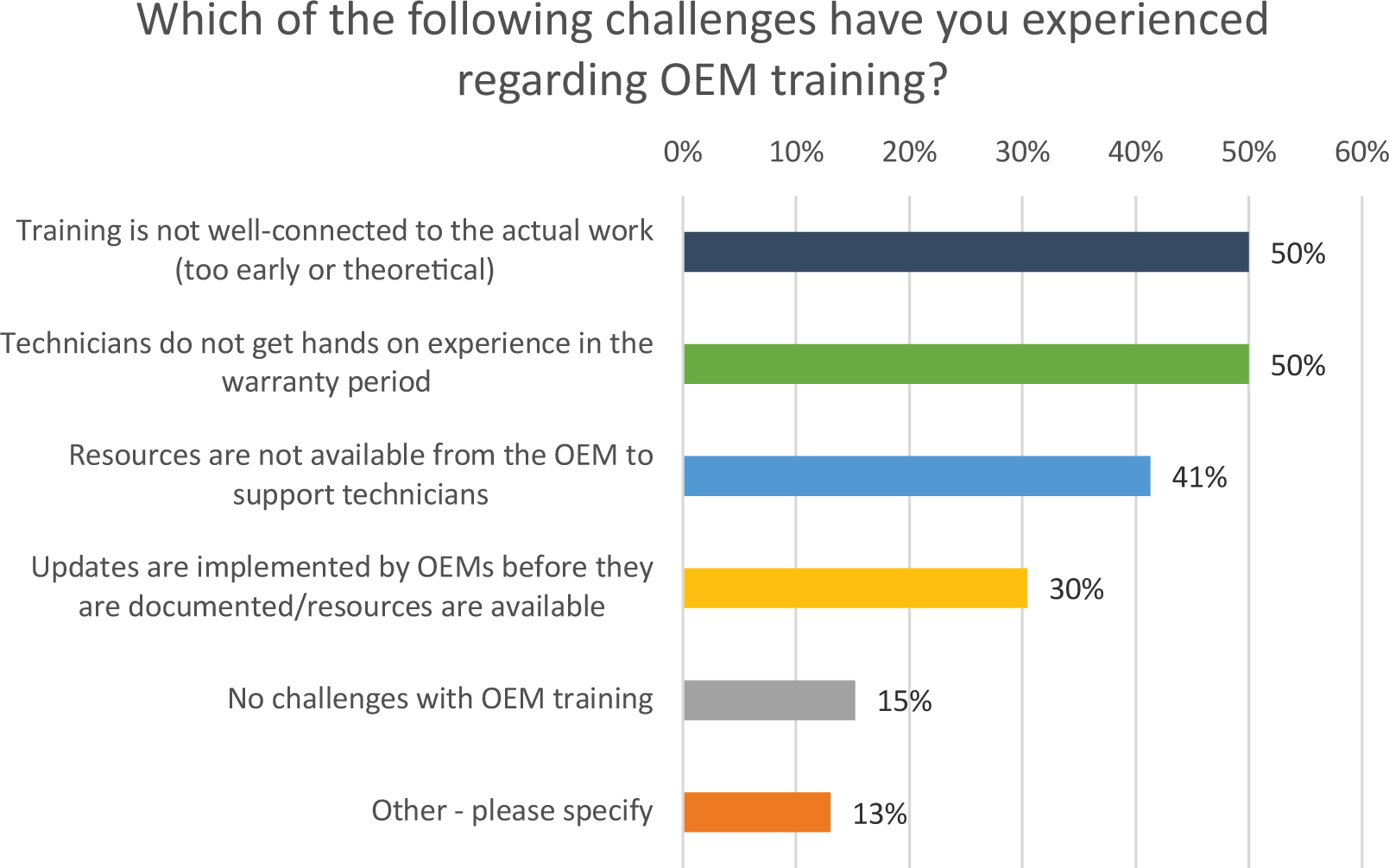
The most common challenges with OEM training center around training content and support. As shown in Figure 12, when survey respondents were asked to select which challenges they had experienced, the most common responses were that training is too theoretical or otherwise not connected to the actual work (50%), technicians do not get enough hands-on experience
N = 46. Source: TCRP Project J-11/Task 46 industry survey, summer 2024.
Long Description.
The horizontal axis represents percent ranging from 0 to 35 percent in increments of 5 percent. The data shows not effective at all, 15 percent; not very effective, 11 percent; neutral, 33 percent; somewhat effective, 28 percent; and very effective, 13 percent.
N = 46. Source: TCRP Project J-11/Task 46 industry survey, summer 2024.
Long Description.
The horizontal axis represents percent ranging from 0 to 60 percent in increments of 10 percent. The data shows: Training is not well-connected to the actual work (too early or theoretical), 50 percent; Technicians do not get hands on experience in the warranty period, 50 percent; Resources are not available from the OEM to support technicians, 41 percent; updates are implemented by OEMs before they are documented or resources are available, 30 percent; No challenges with OEM training, 15 percent; and Other please specify, 13 percent.
during the warranty period (50%), and there is a lack of available support resources from OEMs (41%). Additionally, when asked if OEMs are providing sufficient software support, documentation, data, and other resources, 76% reported that they are not. The research team also learned during the focus groups that some OEMs do not feel that it is their responsibility to offer basic electrical training, while others do provide this foundational training.
Due to the prevalence of transit agencies procuring training from OEMs, OEMs clearly have an important role to play in transit workforce ZEV training. For 15% of transit agencies, the OEM relationship has been generally positive, and there were no issues to report. However,
most transit agencies (85%) identified at least one way in which OEM training could be improved. The findings point to a need for more effective OEM training.
Recent changes to the American transit bus market may affect an OEMʼs ability to provide training, and by extension, may affect a transit agencyʼs ability to train its workforce to operate and maintain ZEVs by relying on OEMs for training. Three ZEB OEMs have left the market. It is too soon to know what impact this will have on ZEB training as the businessesʼ responsibilities to their customers are not clear and were not investigated as part of this study.
APTAʼs Standard Bus Procurement Guidelines (SBPG) is the recommended and most common request for proposals (RFP) document used by transit agencies to procure transit buses using federal funding.55 Section TS 5.6 of the SBPG addresses training, but limited guidance is offered. Transit agencies are directed to insert their own language, which is understandable given the wide variety of propulsion types and other alternatives.
Understanding that training is an essential element of introducing ZEVs, many transit agencies choose to enhance their RFPs for new bus purchases to include specific training requirements. The level of specificity varies among transit agencies. Typically, those that include training as part of the RFP leave it to the selected OEM to determine how the training requirements are to be fulfilled. The bus manufacturer provides all of the requested training or subcontracts to a third-party provider, such as the supplier of a specific component or system (e.g., air conditioning, propulsion, multiplexing).
In other cases, a transit agency may have extremely detailed training requirements and may request the OEM to identify the source of each training segment and itemize the cost for each. This allows the transit agency to pick and choose which training will be provided by the OEM and which training it might want to procure outside the bus procurement, depending on the content and cost. Transit agencies that do not include training as part of the bus RFP procurement process either procure training separately or do without.
An analysis of FTA grant applicant plans showed that more than 60% of transit agencies report the use of OEM-provided training, generally included as part of the procurement contract; about half of those using OEM training report using a train-the-trainer (TtT) approach (32%). Thirty-four percent of transit agencies are, or will be, developing an in-house training program, although this is less common than using OEM training. OEMs reported in the focus group that direct training for operators is less commonly requested and that most transit agencies opt for the TtT approach.
Approaches and Resources
OEM Resources
OEMs typically have resources that are useful for identifying needed ZEV skills. Although there is variation in the quality of OEM training material, transit agencies can use these resources as a base.
IndyGo, for example, relied heavily on OEM resources when first introducing ZEVs into its fleet. The OEM provided a full syllabus outlining what technicians needed to learn. Using this syllabus and other materials provided by the OEM, IndyGo has been able to structure its own in-house training program.
Examples of Effective OEM Relationships
Given the key role of OEMs in providing both training and ongoing maintenance of ZEVs during the warranty period, the procurement process necessarily involves making decisions about
the OEMʼs role in training. Transit agencies can establish agreements with OEMs to supply maintenance training, foundational electrical training, high-voltage and safety training, TtT deliveries, course materials, and other support to ensure that transit agency staff are prepared to maintain ZEVs.56 Regarding maintenance responsibilities, a 2018 survey found that around 70% of transit agencies performed more routine preventive maintenance on electric bus propulsion systems in-house, while less than half performed more substantial maintenance and repairs of these systems and infrastructure in-house, with slight majorities relying on OEM or third-party maintenance for these tasks.57
Decisions made during the procurement process regarding the use of OEM or third-party trainers and maintainers, as well as the degree of involvement by frontline transit agency workers, have implications for the success of ZEV deployment and for how ZEV adoption affects incumbent workers. In one example, Shreveport, LA-based SporTran completed two procurements within the span of a few years, one of which involved BEBs. Transit agency leadership and worker representatives have since acknowledged that insufficient worker/labor union engagement in the bus procurement process led to operational challenges, while involving workers in the BEB procurement through OEM focus groups contributed to a smoother adoption and deployment process.58
OEMs can coordinate training with other OEMs or other parties (transit agencies, community colleges, etc.) to make the combined training more effective. Examples include:
- Several OEMs have partnered with their major suppliers, especially those that provide the electric propulsion system, to work together on training module development. However, because there is always different software (especially for identifying faults), the training on those components has to be done by the individual OEM.
- One OEM is working with colleges, governmental agencies, and a licensing body for technicians. The Quebec government has funded the creation of the program, and the OEM is working with the colleges to create training modules and an apprenticeship/licensing program.
- OEMs, transit agencies, and ATU International are working with Centennial College in Ontario to help it build a certification program for ZEB technicians.59
Sample Procurement Language for ZEV Training
A report entitled Providing Training for Zero-Emission Buses, issued as a collaboration between ITLC and Jobs to Move America (JMA), offers transit agencies comprehensive training language specifically for ZEVs that can be inserted as is or modified as needed into a transit agencyʼs RFP. The ITLC/JMA publication, along with the best transit agency examples reviewed, offers useful procurement guidance that includes the following essential training elements:
- A listing of training requirements that leaves no ambiguity as to the level of training and related documentation to be provided to both operators and technicians as part of the bus procurement.
- Delivery of training that coincides with bus delivery as well as termination of the warranty period to provide refresher training when technicians take full responsibility for maintenance and repairs.
- A requirement that repair and maintenance activities made during the warranty period by the OEM be used as an exercise to train transit agency technicians.
- Each course to be provided by the OEM includes course name, description, target audience, length (in hours), and number of sessions.
- Courses intended for bus operators include driving techniques to extend battery life, unique pre-trip inspection requirements, use of controls, and so forth.
- In addition to specific ZEV training, courses intended for technicians include technical training pertaining to all other aspects of the bus (e.g., brakes and doors).
- The vehicle OEM and any OEM component vendors provide a list of all required special tooling and diagnostic equipment and related pricing.
- The OEM provides a TtT program for all subject areas listed in the RFP.
- OEMs also provide a recommended list of all required insulated tooling and high-voltage PPE.
- The OEM supplies all software information, including source codes for any programmed module or component.60
OEM Warranty Work as Training Opportunity
Several OEMs in the focus group emphasized to transit agencies that, when warranty work is being performed, they should have someone observe and learn. However, the downside is that technicians may not use the skills learned until the warranty expires, which can be for a lengthy period afterward, especially for extended warranties.
Conditions under which transit agencies are allowed to make their own repairs under warranty and receive appropriate compensation for that work were unclear to the OEMs that participated in the focus group. When asked to estimate the percentage of transit agencies performing their own warranty work, responses ranged from zero to 50%, although the consensus was that most do not. Transit agencies are expected to do more of their own warranty work as technicians become trained and acclimated to the technology.
When the first 31 ZEVs were delivered to IndyGo, the OEM sent a team to Indianapolis and rented a nearby facility where they could make repairs and store commonly replaced parts. This allowed the OEMʼs maintenance team to be readily available. When possible, IndyGo has worked to ensure that technicians are available to observe repairs made by the OEM under warranty. Both Delaware Transit Corporation and Grant Transit Authority are making use of the warranty period as a training exercise—technicians observe the repairs and work alongside the OEM technicians when appropriate.
Understand OEM Limitations
Although there is great reliance placed on OEM training, there are limitations. These include a lack of robust curriculum and difficulty arranging the training to meet logistical demands. Some OEMs are stretched thin and would benefit from greater training capacity.
As noted earlier, most transit agencies procure training when purchasing vehicles and rely on OEMs to ensure that their operators and technicians receive adequate education. However, that reliance may not be a perfect convenience, as indicated by the 2021 Transit Vehicle Innovation Deployment Advisory Panel, part of the FTA-established Transit Vehicle Innovation Deployment Centers (TVIDC) program. The panel highlighted that the reliance on OEM training is most prevalent during the initial deployment of ZEVs. As such, a disadvantage is that the training does not tend to be ongoing after deployment or when new employees are brought in, nor is the training standardized across the industry or across OEMs.61
When asked to describe key resources and support from OEMs that could benefit from further development, survey respondents identified accessible training resources, support for partnership and apprenticeship programs, better diagnostic and troubleshooting resources, and providing training resources early in the process. In addition:
- Many respondents highlighted the need for more OEM support on a variety of training topics, including safety and the various battery types, improved training manuals, and more online resources.
- Some respondents would like to see more support and materials from OEMs for building course curricula at community colleges.
- Several respondents discussed the need for more and better diagnostic and troubleshooting resources, including access to software.
- Finally, some respondents highlighted the importance of OEMs providing these resources and training prior to buses being delivered so that staff can familiarize themselves with them ahead of time.
Developing a strong working relationship with OEMs can help to overcome some of these limitations.
At SARTA, in Ohio, working relationships with specific OEM staff who the agency can call directly have been valuable in addressing difficulties regarding repair delays and scheduling training.
At CTDOT/CT Transit, cultivating the relationship with the OEM helped to overcome initial hesitation around sharing proprietary materials. Given the limited ability of some OEMs to provide training when needed, CTDOT/CT Transit used some of its training funding for a videographer and media development, which has allowed the agency to use the videos for training anytime it is needed and when the workforce is available, providing more training flexibility.
Transit agencies implementing new types of ZEVs can expect limited OEM material availability. As an early adopter of hydrogen fuel-cell technology, SARTAʼs staff received 8 hours of initial training on the first FCBs the agency purchased. SARTA worked to develop maintenance processes and technical instruction and assessment with vehicles that were actively deployed in the fleet. Over time, these training and operational processes have been formalized, in part through collaboration with OEMs. Improved OEM-provided documentation and training obtained through subsequent vehicle procurements have supported SARTA in identifying critical practices, skills, and training requirements. This has included formalizing PPE policies and taking advantage of more robust 10-day OEM-provided training.


