Eclipse: The Celestial Phenomenon That Changed the Course of History (2001)
Chapter: 1. From the Depths of Time: The Earliest Recorded Eclipses
1
From the Depths of Time: The Earliest Recorded Eclipses
Zeus, the father of the Olympic Gods, turned mid-day into night, hiding the light of the dazzling Sun; and sore fear came upon men.
Archilochus, referring to the total solar eclipse of 648 B.C.
Eclipses have had a profound and startling effect upon the cultural development of humankind. Let us begin by asking which Eclipse has exerted the greatest influence over our affairs.
In this opening chapter we will describe various famous historical eclipses, such as those that presaged several great battles in antiquity, interpreted by one side as an auspicious omen, by the other as a portent of doom. We will also mention the eclipse that seems to have followed the death of Jesus Christ on the cross, and left a strong impression upon His followers and foes alike. But in my opening paragraph I was not asking about any such eclipse in the sky.
With a little sleight of hand, I capitalized the word Eclipse there. The most famous Eclipse of all time was an eighteenth-century British racehorse by that name, which happened to be
born at the time of a solar eclipse visible in England in 1764. He continues to affect everyday life because every thoroughbred carries a few of his genes.
Never beaten in a race, after retirement from the track Eclipse spent almost 20 years at stud. After his death in 1789, the great horse’s skeleton was mounted at the Royal Veterinary College in London, at least one hoof was turned into a snuffbox, and in several countries there are annual races called the Eclipse Stakes. In the United States a set of annual awards recognize the top thoroughbreds in various categories, and these are called the Eclipse Awards. For the actual horse, then, it is a postmortem mixture of abasement and honor.
But those are trivialities. Is horseracing as a whole so important as to justify my claim? While I am not an aficionado of the so-called Sport of Kings, I recognize its significance. In terms of economic turnover, horseracing and the associated activities (like gambling) are reckoned to represent one of the largest industries in many nations. In Britain, Ireland, and France it is an especially large slice of the economy. One has only to visit the Kentucky Derby or the Happy Valley racecourse in Hong Kong to see that the equine Eclipse has a continuing sway upon human activity, 200 years after his death.
If you look up the word “eclipse” in a dictionary of quotations, among the entries the following will often appear: “Eclipse first, and the rest nowhere.” Those words are often uttered as a prognosis on any sporting contest in which the outcome is a foregone conclusion. Dennis O’Kelly, the owner of Eclipse, famously coined the phrase when he wagered that he could place the first three horses in a race.
CELESTIAL SHOWTIME
When it comes to celestial displays, “Eclipse first, and the rest nowhere” also represents a succinct summary of the opinion of the eclipse enthusiast. Many people routinely book flights and accommodation a year ahead to ensure they are in the right place at the right time to experience a total solar eclipse, then feverishly check the next scheduled performance in this free-to-view continuing astronomical extravaganza to begin planning their next trip.
Is it really a case of “the rest nowhere” when it comes to heavenly displays? I think not, and would argue that a meteor storm (when the sky briefly lights up with myriad shooting stars for perhaps an hour) is not only more spectacular, but also less frequent, occurring only once per decade or so. But there is something that distinguishes a total solar eclipse.
All those on the correct side of the planet may witness a meteor storm, when a stream of tiny comet-derived rocks intercepts the Earth. Every year there are several distinct meteor showers, half a dozen of which are worth watching for even the casual observer, such as the Perseids on August 12 and the Geminids around December 13. Every so often a greater concentration of meteors is anticipated, as with the Leonid meteor storm (keep watching the sky in the early hours of November 17/18 for each of the next few years). But the shooting stars may be seen from a large area of the planet, whereas the track of a total solar eclipse is narrow, leading to exclusivity. Would diamonds be regarded so highly if they were common, to be found under every upturned boulder?
A total solar eclipse occurs through the combination of sev-
eral unlikely circumstances. It happens that the angular diameters of the Sun and the Moon as viewed from the Earth are about the same. Those apparent sizes vary, though, because the distance from the Earth to the Sun changes during the year, and the separation between the Moon and us also oscillates each month. To get totality, the Moon must be near enough and the Sun far enough such that the lunar disk can completely block the Sun. The next condition is that the Moon must cross the plane of the Earth’s orbit very close to the direction of the Sun. If that happens then the Moon’s shadow is cast somewhere onto the Earth and a partial solar eclipse occurs over a wide area, but complete blocking—a total eclipse—is experienced only within a narrow band by a fortunate few. A total solar eclipse occurs somewhere around the globe about once every 18 months, but as the track of totality is usually less than 100 miles wide, you should expect to wait for several centuries in any random location for the next one. Such eclipses have rarity value, a prize worth chasing around the globe, and many people do just that, chalking up their eclipses in exotic locations and showing anyone interested their best photographs of the event.
There is another type of eclipse: a lunar eclipse. These occur when the terrestrial shadow envelops the Moon, and again it may be either total or partial. Unlike solar eclipses, the viewing constraints are not so stringent: you just need to be somewhere on the night side of the Earth at the appropriate time, and half the human race might see a particular lunar eclipse.
Solar eclipses have been interpreted as evil omens by many civilizations because the life-giving sunlight is obscured for a few minutes, producing a profound effect upon all under the celestial shadow. Lunar eclipses, although they last far longer, are not so
unmistakable. Despite this fact, such eclipses have also been taken very seriously indeed by many societies because rather than going black, the Moon instead darkens to the color of blood as it is eclipsed, instilling fear and dread into the superstitious witness.
Lunar eclipses are not prized for their scarcity, but because they are seen often they provided the opportunity for early civilizations to build an understanding of the basic cycles, leading to detailed predictions of when and where eclipses (both solar and lunar) were due.
THE APPEARANCE OF ECLIPSES
Hackneyed though the thought may be, it is true that a picture is worth a thousand words. Let’s stop our verbal description of eclipses and take a look at some pictures. We need to familiarize ourselves with the beasts that are the lead characters (I can hardly call them “stars”) in our story.
The Sun is not simply a bright yellow disk in the sky. Actually, it is a hugely complicated heat-generating engine that solar physicists are still a long way from understanding completely. Car bumper stickers say “Solar Power Not Nuclear Power,” but solar power is nuclear power. The Sun is a gigantic nuclear reactor, fusing hydrogen nuclei together to produce helium and liberating vast amounts of energy in consequence.
Nor is the Sun constant. Its appearance alters substantially, with sunspots being seen much of the time, moving across its face as it rotates. The numbers and forms of sunspots vary over an activity cycle lasting a little more than 11 years. Figure 1–1 shows two extreme examples of the Sun’s guises, with no major sunspots at the minimum of its cycle, but an extremely pockmarked profile
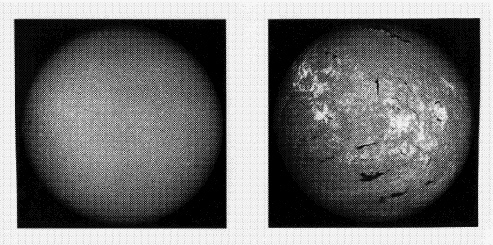
FIGURE 1–1. Two views of the Sun that show how it can change. Near the minimum of the solar activity cycle (left), no major blemishes are seen. Close to the maximum (right) the Sun appears pockmarked with sunspots.
being presented at the maximum. At such a time—the last peak was in 2000—the Sun tends to jettison larger amounts of matter through the outward-flowing stream of charged particles called the solar wind, resulting in vivid auroras being seen on Earth and sometimes in the disruption of radio communications.
Similarly the Moon is not quite so simple as one might think. Figure 1–2 shows two full moons. They differ in several respects. Firstly, the apparent size of the lunar disk alters because its orbit about our planet is noncircular, and when the Moon is closer to us it appears bigger. One of these full moons happened to be when it was near perigee, making the angular size of the disk larger; the other was at apogee, with the result that it appears smaller.
Secondly, the brightness distributions over the two images are not quite the same. This has various causes. One is that full moon
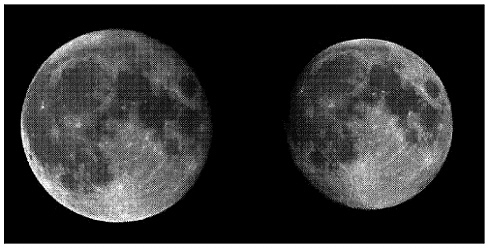
FIGURE 1–2. Contrasting full moons seen near perigee (left) and apogee (right) indicate how much the apparent size of the Moon varies each month.
occurs when the Sun, Earth, and Moon are aligned in terms of the celestial longitude (looking down from above they are in a straight line), and say 12 hours before that point the Moon may appear full, but the alignment is not yet precise. Another reason for sunlight reaching the lunar surface at an angle, producing brightness variations, is that full moon generally occurs either above or below the Earth’s orbital plane. (If the Moon crosses that plane at full moon then a lunar eclipse results.)
Thirdly, various wobbles cause more than just 50 percent of the lunar surface to be visible from Earth. Notice that the two vistas shown in Figure 1–2 are somewhat different.
Since we are concerned here with eclipses, next some eclipse images. Figure 1–3 shows a total solar eclipse, the Moon obscuring the whole solar disk. Some sunlight can still be seen through
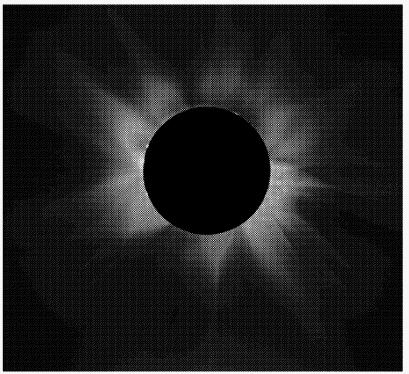
FIGURE 1–3. A total solar eclipse photographed in perfect conditions. The large bright areas are coronal streamers. Close to the solar disk, bright prominences are visible, in particular on the left; these appear pink in real life.
various mechanisms. Around the circumference of the Moon is the corona, the term derived from the Latin and thence Spanish word meaning “crown” or “garland.” This is a solar structure, far beyond the Moon, made visible only during an eclipse. Basically it is the tenuous glowing atmosphere of the Sun. The corona appears white to the eye. Vividly seen here are various coronal streamers.
Another distinct phenomenon that may be glimpsed during a total solar eclipse is the existence of transitory prominences, huge
red clouds of glowing gas thrown up above the solar surface. These are also apparent in Figure 1–3, as bright spots close to the edge of the Moon. These prominences are often more obvious to the naked eye than in a photograph, and old-time eclipse-watchers were very familiar with them, terming them the “red flames.” An example of this is the nineteenth-century sketch of totality shown in Figure 1–4. Before the advent of photography, this was the only way to record what was seen.
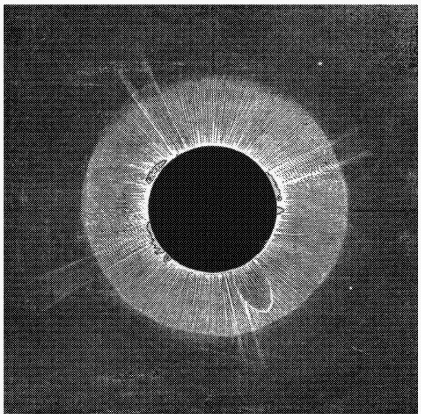
FIGURE 1–4. A total solar eclipse sketched by a nineteenth-century astronomer. To the naked eye the prominences jutting above the solar surface often appear more noticeable than they are in a photograph.
Figure 1–5 shows an eruptive prominence on a grand scale, without the benefit of an eclipse. This blob of superheated gas, 80,000 miles long, was thrown off the Sun in 1996 and its behavior was captured in ultraviolet light with a sensor on board the SOHO (Solar and Heliospheric Observatory) satellite. This series of images stretches over five hours, the prominence moving outwards at more than 15,000 miles per hour.
If the profiles of both the Moon and the Sun were perfectly circular, then as totality was reached the area of the solar disk visible would diminish until finally there was just one spot left in the line of sight, and then that would be abruptly blanked out. The effect would be that a dim corona would surround the dark Moon, with a single bright spot momentarily witnessed before it, too, disappeared. This so-called diamond ring effect is shown in Figure 1–6.
In reality neither the Sun nor the Moon is precisely circular,
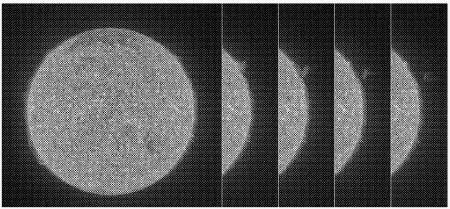
FIGURE 1–5. A five-hour sequence of ultraviolet images of the Sun obtained with the SOHO satellite show a developing eruptive prominence at upper right.
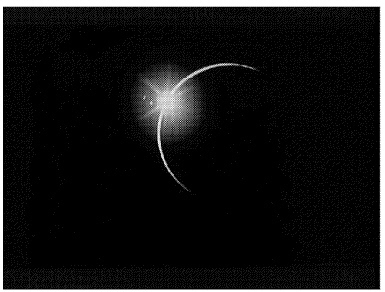
FIGURE 1–6. The diamond ring effect is seen just as totality starts and ends. This shows an example, but it’s a bit of a cheat. This was an artificial eclipse of the Sun by the Earth, photographed by the Apollo 12 astronauts on their way back from the Moon late in 1969, produced when their spacecraft slipped into the terrestrial shadow.
and under some circumstances a series of bright spots may also be seen around the limb. These are due to light squeezing through the valleys between craters and mountains at the edge of the Moon. These spots are called Baily’s beads after the nineteenth-century British astronomer Francis Baily who first described their form and origin in 1836. Baily’s sketch is shown in Figure 1–7. The edge of the Moon is certainly crinkled, as one can see in Figure 1–8; during an eclipse the mountains of the Moon are cast in sharp relief, as seen in Figure 1–9.
We have seen how the basic aspects of solar eclipses appear in the sky; let us now return to our discussion of how humans have reacted to such events over the eons.
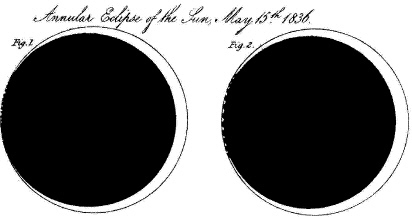
FIGURE 1–7. Baily’s beads, from his original description in 1836.
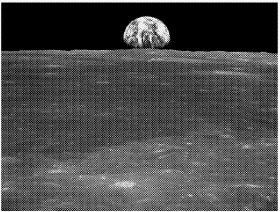
FIGURE 1–8. The lunar limb is not a smooth arc, but is lined with mountains and craters as shown in this photograph obtained by the Apollo 11 astronauts in orbit around the Moon in 1969.
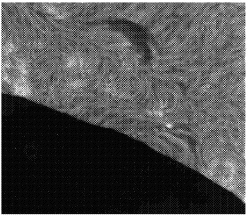
FIGURE 1–9. The mountainous edge of the Moon is obvious in this segment photographed during an eclipse. Note also the appearance of the solar surface.
EARLY HUMAN EXPERIENCES OF ECLIPSES
How long have members of our species witnessed eclipses and wondered at their origin and implications? This is not a question we can answer with assurance, but we can guess.
Sequences of marks scratched on animal bones dating back 30,000 years are suggestive of the changing phases of the Moon from one cycle to the next. Certainly the varying brightness of that orb as it waxes and wanes would be important if you were reliant upon it to find your way at night, as was all humankind for most of our history. The snuffing out of moonlight for several hours when it was expected to be full would be a matter of some concern to such people. That’s what happens during a total lunar eclipse. The fact that the Moon turns the color of blood would also leave a strong impression, making observers speculate about the significance of such an episode.
Lunar eclipses occur at a rate of about 15 per decade, a little less than half being total (that is, the entire lunar disk is enveloped by the Earth’s shadow). All inhabitants of the side of the planet facing the Moon would be able to witness it, as long as clouds do not intervene.
Even if a typical human back then lived for only 30 years, still some dozens of lunar eclipses would have been seen by each individual, and primeval societies must have been familiar with them. Remember that early humans did not live in cities with artificial lighting, so they were much more attuned to the sky, and dependent upon its cycles. Nowadays rural people are rather more aware of celestial events than city-dwellers, and in the past the average person’s acquaintance with the firmament above was developed to a greater extent than it is today.
To ancient peoples a lunar eclipse would provoke some consternation, but a solar eclipse would be even more amazing, and worrying. Total solar eclipses intrinsically occur more often, but may be seen from only a restricted part of the globe because the track of the lunar shadow drawn across the ground is typically only 60 to 100 miles wide. Outside that track, the solar eclipse is partial, dimming the sunlight but not obstructing it altogether. In a typical decade there are seven or eight total solar eclipses, but you have to be in the right place at the right time to experience any of them. The zone of partiality may cover half of one side of our planet, but the startling totality track is much more restricted.
ANCIENT ECLIPSE RECORDS
The records of early civilizations are littered with references to eclipses. This should not be a surprise, in that only the most notable events in any year, or decade, or even century, will have been remembered by later generations and recorded for posterity in some way. The sorts of things passed down to us would be human signposts such as the births and deaths of kings, and the great battles and wars in which they were involved, plus unusual natural phenomena like disastrous floods and earthquakes and the appearances of bright comets and eclipses. The mass media of today are swamping us with the trivialities of life; the documents of the past, painstakingly chiseled into rock or inked onto papyrus scrolls, were limited to only the most prominent events.
One of the great early civilizations was that of the Babylonians, and their knowledge of astronomy is especially notable (see Figure 1–10). The ebbs and flows of that people, and the changes that occurred in the lands around the mighty Tigris and Euphrates
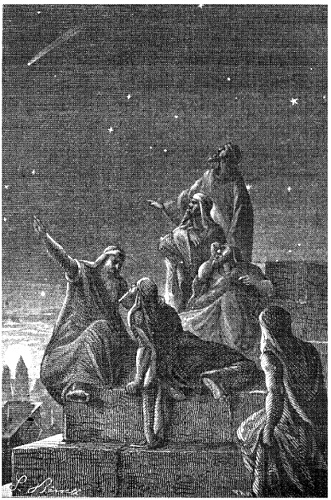
rivers, greatly affected humankind’s eventual understanding of eclipses. The Babylonians scratched their records into clay tablets and these have proven a unique repository of information for studies of ancient eclipses.
It was not only the Babylonians who were interested in eclipses. Elsewhere other civilizations were in awe of such events. In China, India, Arabia, ancient Greece, and medieval Europe, eclipses were seen and not forgotten; their dates and characteristics were written down and stored, invaluable records to be translated much later and put to disparate scholarly uses.
CALIBRATING CALENDARS USING ECLIPSES
When we know how to convert the dates of ancient eclipses to our modern calendar, the records provide useful information about the Earth’s spin history, and the trend over the past 2,700 years is now well delineated. But the converse is also true. If one has a definite report that an eclipse was recorded from a certain place in a certain year then one can calibrate the calendar the locals were using.
Consider the calendar of the Roman Republic. After about 400 B.C. the Romans were using a scheme whereby in most years there were 12 months adding up to 355 days, rather than the actual solar year which averages close to 365.25 days. That leaves a deficit of over ten days a year. Every so often the leaders of the Senate were supposed to declare an additional month of 22 or 23 days, to be inserted into February, but they were quite lax in this regard for various reasons. One was that the thirteenth month was considered unlucky, hence the common fear of the number 13 (triskaidekaphobia). The major reason, though, was that they were
able to manipulate the year length to their own advantage for taxation or electoral purposes. The outcome was that the date on the Roman calendar seldom bore any clear relation to the season. The end of May would come, but still it was winter. Looking back it would be almost impossible for historians to be able to say what occurred when, if it were not for eclipses.
In 168 B.C. the Romans defeated the Greeks in the Battle of Pydna, a town on the western side of the Gulf of Salonika. The battle was pivotal for the eventual Roman control of Greece because it quelled the Macedonians. (These were the people who in the latter half of the fourth century B.C. had produced Alexander the Great, and under him conquered an empire stretching from the eastern end of the Mediterranean all the way to India.) The Romans recorded this battle as occurring, on their haphazard calendar, on September 3. From this, one might imagine that it took place in early fall. In fact we know that the Battle of Pydna was fought near midsummer’s day. The great writers Livy and Pliny recorded that a lunar eclipse was predicted by the tribune Sulpicius Gallus and seen on the night before the conflict, giving courage to one side while the other was filled with dread. Perhaps the Roman generals chose the date on the basis of the prediction, telling their troops ahead of time that there would be an eclipse as a sign of divine favor.
Knowing that the year was 168 B.C. we are able to back-calculate the date of the eclipse and check its visibility from Greece. Using the regular calendar introduced by Julius Caesar over a century later, and projecting it backwards, the eclipse was on June 21. This nicely confirms the basis of the story related by Livy and Pliny: on a sensible, well-regulated calendar the battle was indeed fought close to midsummer’s day.
From that eclipse we find that the Roman republican calendar in that year was 74 days out of synchronization with the seasons. The discrepancy at times had been even greater. A solar eclipse in 190 B.C. shows that the calendar then was ahead of the seasons by 119 days. When Julius Caesar introduced his eponymous calendar to begin in 45 B.C. (our modern calendar is the same except with a slight adjustment to the frequency of leap-year days), he had to add 80 days to 46 B.C. to make up for the short-comings of his predecessors.
THE ADVANTAGE OF ECLIPSE FOREKNOWLEDGE
It seems incongruous that the Romans profited from the eclipse of 168 B.C., because their opponents, the Greeks, were much more proficient in scientific matters. The Greek knowledge of eclipses was largely derived not internally, but from the Babylonians after 330 B.C. The Babylonians had been subsumed into the empire built by Alexander the Great when he defeated the Persians, who had been occupying Mesopotamia through much of the fourth century B.C. as part of their own empire.
After conquering Egypt, Alexander had marched east and pushed the Persians out of Babylonia, pursuing them north into Assyria. When he eventually caught up with King Darius III and defeated him in a decisive battle at Gaugamela in 331 B.C., it was on the day after a lunar eclipse. Alexander interpreted this as an omen blessing the Greek endeavor. One wonders how he knew the eclipse was due. One possibility is information provided by the expert Babylonian astronomers. Perhaps they found Alexander and his people a preferable occupier to the Persians.
ECLIPSES IN THE BIBLE
Total solar eclipse tracks are narrow. To be able to say with surety, looking far back in time, that a certain eclipse was visible from a specific location requires that we know how the spin of the planet has varied over the past several millennia. Although we only have definite eclipse records dating back to 700 B.C., the trend can be extrapolated for perhaps another thousand years. This opens the possibility of identifying dates for a few of the eclipses mentioned in the Old Testament.
One of the best-known allusions to an eclipse occurs in the book of Genesis. Referring to Abraham in Canaan, the text says, “And when the Sun was going down…great darkness fell upon him.” It is possible to identify this description with a computed solar eclipse occurring on May 9, 1533 B.C., which would have occurred at about 6:30 P.M. local time (indeed, when the Sun was going down).
In the biblical account, a great comet was seen the following year, a fact in itself of interest to modern astronomers. To investigate the dynamical history of comets, long temporal baselines of observations are important. For Halley s Comet, observations back to 240 B.C. are known, and earlier records would be useful. The comet of 1532 B.C. is not linked with any recently observed object, but maybe it will reappear soon.
The most famous solar eclipse in the Bible is that of Joshua. This has long puzzled scholars, because it describes the Sun as stopping still during an eclipse, and even moving backwards. In terms of a date, this appears to have been the solar eclipse of September 30, 1131 B.C. But in regard to the phenomenon reported (the Sun halting or retreating), we are pretty sure that
Joshua was wrong. Similar claims have been made for several other eclipses, for example one that affected a fifteenth-century civil war in Ireland. This is merely a visual illusion produced by the Moon overtaking the Sun, the latter seeming to slip backwards in consequence.
Various events around 760 B.C., culminating in a major earthquake that damaged Solomon’s Temple in Jerusalem and caused a huge destructive wave in the Sea of Galilee, clearly had a considerable effect upon the people of Judea. The fact that the rumble was felt over 800 miles away allows us to estimate that the tremble was about magnitude 7.3 on the Richter scale. In the Bible there are eight separate allusions to a solar eclipse around that time, which may be identified as June 15, 763 B.C. We are told the eclipse was followed closely by a bright comet. If this was Halley’s Comet (we cannot be sure due to the sparsity of the information) then we know from a backwards extrapolation of its orbit that the comet indeed would have been visible in August of 763 B.C., five centuries before the earliest definite observation cited above. The combination of these pieces of biblical information leaves us pretty sure that the earthquake happened four years later, in 759 B.C.
That year’s identification stems from our ability to back-calculate the eclipse. Clearly eclipses (and periodic comets) are important phenomena in that the modern understandings of astronomers and mathematicians enable historians to assign definite dates to events in the distant past. For example, when was Jesus crucified?
THE CRUCIFIXION ECLIPSE
Astronomers have long speculated about how their science might fix the date of the birth of Jesus, given the Star of Bethlehem story.
My own favored dating involves multiple conjunctions of the planets Jupiter, Saturn, and Mars that we know occurred in 7 and 6 B.C. The Magi would therefore have been alerted to some impending event—the coming of the Savior had long been awaited by the Jews—which suspicion was confirmed in their minds by the appearance of a bright comet early in 5 B.C. We know from Chinese records that the comet was visible for over 70 days and moved across the sky in accord with the Magi following it from the environs of Babylon first westwards to Jerusalem, and then the final handful of miles south to Bethlehem. Various other aspects of the biblical story fit in with this picture and lead to a deduction of the Nativity occurring in mid-April of 5 B.C.
But what of the end of the mortal life of Jesus, when he was crucified in his thirties? When did that melancholy event take place? Various commentators have discussed how the range of possible dates can be restricted, based upon facets mentioned in the Gospels, such as the temporal relationship of the Crucifixion to Passover. Because Passover is at full moon, and the Crucifixion was on a Friday, only certain dates are feasible. The chief candidates are April 7, A.D. 30, and April 3, A.D. 33.
The essential clue of an eclipse was missed until quite recently. In 1983 Colin Humphreys (now at Cambridge University) and Graeme Waddington (of Oxford University) recognized that the date of the Crucifixion might be identified in this way. They noted that in various places in the Bible, and other early written accounts, allusions are made to the Moon being dark and “turned to blood” when it rose in the evening after the Crucifixion, which sounds like a lunar eclipse. Mention is also made of the Sun being darkened earlier that day. This may have been due to a dust storm caused by the khamsin, a hot wind from the south that blows through the region for about 50 days commencing around
the middle of March, in accord with the expected time of year. Such dust storms and their sun-dimming effects are well known.
Under such circumstances—a lunar eclipse whilst there was much dust suspended in the air—one would expect the Moon to appear the dark crimson of blood. With that in mind Humphreys and Waddington computed the dates of all lunar eclipses possibly visible from Jerusalem between A.D. 26 and 36. And they found one on April 3, A.D. 33, one of the two possible dates mentioned above, occurring as the Moon rose a couple of hours after Jesus died, in accord with the Gospels.
This all relates back to the quote from the New English Bible with which Paul Davies began his Foreword to this book. Over the eons, memories of events in quite separate years can become confused or melded in the mind and then are written down in a way that deviates from historical reality. The Gospels were not written until the last decades of the first century A.D., a generation and more after the period described, and since then successive copying and translation have moved away from the original text.
It happens that the Sun was not in eclipse at the time of the Crucifixion, but would have been darkened by the khamsin dust. This is obvious simply from knowledge of Jewish custom: Passover is at full moon, and the definite biblical link between the Crucifixion and Passover makes a lunar eclipse the only possibility. On the other hand, there had been a solar eclipse thereabouts in recent times. On November 24, A.D. 29, the path of totality had passed just north of Jerusalem, over Damascus, Beirut, and Tripoli. Jerusalem itself would have been severely darkened. This would have left a strong local memory, but the date excludes it from being at the time of the Crucifixion: the year is too early, and Passover is
not in November. It seems clear that over some decades the memory of lunar eclipse and dust-dimmed Sun in A.D. 33 became combined with the total solar eclipse in A.D. 29, leading to the false idea that the Sun was eclipsed at the Crucifixion. The computed lunar eclipse, then, allows us to allot a date to the Crucifixion. It was on the third day of April in the year A.D. 33.
ECLIPSES AS PORTENTS OF DOOM
The ancients often interpreted eclipses as omens. To a modernday rationalist, the notion that an eclipse could be a celestial portent for things to come would seem absurd. Nevertheless they could have an effect, through psychological action: men buoyed by belief in their righteousness bolstered by an eclipse are more likely to win in combat against those who take the eclipse to augur evil. Self-fulfilling prophecies do exist.
For example, a lunar eclipse in 413 B.C. affected the Battle of Syracuse. Both the Carthaginians and the Greeks had settled parts of the south coast of Sicily, resulting in conflicts from time to time. As part of the Peloponnesian War between Athens and Sparta, skirmishes took place far afield, and the Athenians had a major force stationed near Syracuse, ready to move on the offensive. Just then the eclipse was seen and taken to be an unlucky omen. With advice from his soothsayers, the commander, Nicias, delayed departure for almost a month, handing the enemy an advantage. The upshot was that the Athenians were heavily defeated, and Nicias was killed in the fight.
Now step forward to the ninth century A.D. On the first day of that century Charlemagne was crowned emperor of what was to become the Holy Roman Empire. He died in 814, but be-
tween 807 and 810 a peculiar set of solar and lunar eclipses had been visible from his kingdom, and their natural cause was explained to him. The trouble started with his son and successor, the first in the very long line of kings of France called Louis. It seems that Louis associated his father’s demise with the preceding eclipses, interpreting them as ill-starred portents. When a total solar eclipse occurred on May 5,840, Louis imagined that the finger was being pointed at him. He took fright and never recovered, believing that his days must be numbered. Sure enough, he died a month later. In the aftermath of his early death there was much warring between his three sons, all claimants to the throne. This resulted in the division of much of Charlemagne’s empire into the areas we now know as France, Italy, and Germany.
Jumping ahead 800 years, by the seventeenth century both eclipses and comets commonly were held to be signs of awful things to come. This pervading gloomy belief shows itself in the writings of the sages of the day. Consider three of the literary giants of the era. First, William Shakespeare in King Lear.
These late Eclipses in the Sun and Moon
Portend no good to us.
Next, John Milton in Paradise Lost:
As when the Sun new risen
Looks through the horizontal misty air
Shorn of his beams, or from behind the Moon
In dim eclipse disastrous twilight sheds
On half the nations, and with fear of change
Perplexes monarchs.
Thirdly, poet Samuel Butler thought that a remarkable man was one who could envision the future without making use of eclipses and comets:
He could foretell whatsoever was
By consequence to come to pass.
As Death of Great Men, Alterations,
Diseases, Battles, Inundations.
All this without the Eclipse of Sun,
Or dreadful comet, he hath done
By inward Light, a way as good.
There is no doubt, then, that there was a common view that eclipses were unlucky phenomena, even deadly. Nowadays an eclipse may be greeted as a great opportunity, but for the greater part of our history they have been subjects of fear and terror. Obviously being able to predict their occurrences well ahead of time would have been a valuable tool.
SUPERSTITIOUS NONSENSE?
We may scorn superstitions such as eclipses, but few people are not afflicted by some irrational belief. The atheist may gesture at religion as a case in point. A baseball player may always put on his left sock first, or insist on being the last out of the tunnel onto the diamond. Professors of logic may avoid walking under ladders or look askance at black cats. Recognizing that superstitions exist can lead to personal advantages: if you must enter lotteries, choose among your numbers 13 and multiples thereof, because relatively few others will do so, and so you would not have to split any prize you won.
The same is true of eclipses. They will bring you luck, either good or bad, if your personal belief system veers in either direction, or if you understand the superstitions of others and act accordingly.
One oft-told tale is of a pair of Chinese astronomers who were brought bad luck by an eclipse. No one is quite sure which ancient society should be accorded recognition as having provided our oldest eclipse record. There are several possible claims for Babylonian and Hindu observations between 1400 and 1200 B.C., but if the story of the Chinese astronomers Hsi and Ho is based on fact then old Cathay possesses the earliest instance. This pair were joint royal astronomers, but they spent too much time studying alcohol and not enough following the Sun and Moon. Solar eclipses were imagined to be the result of the Sun being devoured by a dragon. It was thought necessary to know about such an event in advance so as to organize teams of people to beat drums, yell, and shoot arrows into the air, such a commotion reckoned essential to driving off the dragon. The inebriated duo failed to predict the eclipse, and the emperor was much displeased. Hsi and Ho were even less happy with the outcome: they lost their heads. Our back-calculations show that in the epoch in question, the twenty-second century B.C., several eclipse tracks crossed China, making at least the core of the tale feasible. The favored date is October 22, 2137 B.C., but we cannot be certain on such flimsy evidence.
One might imagine that such a superstitious belief—that eclipses are signs of divine displeasure—must surely be a thing of the distant past. But that is not the case. The first eclipse of the third millennium came eight days after its proper dawning, on January 9, 2001. This was a lunar eclipse that was total as viewed
from most of Asia, Africa, Europe, and the eastern seaboard of North America. In Nigeria, much of which has recently come under the influence of Islamic fundamentalists, the eclipse caused great consternation, its advent blamed on sinners. In the northeast of the country there were a rampages by gangs of youths, with more than 40 hotels and drinking houses burnt down in the city of Maiduguri. Similar destruction took place in other towns. “The immoral acts committed in these places are responsible for this eclipse,” explained one of the leaders of the riots.
Five months later, on June 21, 2001, the first total solar eclipse of the new millennium was also witnessed in Africa, but further to the south. As the track passed over Angola, Zambia, Zimbabwe, Mozambique, and finally the southern part of the island of Madagascar, thousands of international tourists watched the spectacle they had traveled so far to see. Likewise many millions of local inhabitants gazed skywards in awe, having been briefed by their governments to expect this natural event and warned not to look directly at the exposed Sun. Others, however, were not so confident of the outcome. Some huddled in their mud huts with doors and windows tightly barred, convinced that any light glimpsed from the eclipsed Sun would strike them blind. Elsewhere much wailing and gnashing of teeth accompanied what was regarded as the “rotting of the Sun,” from which the world would never recover. It did, of course, quite promptly.
That is not to say that superstitions regarding eclipses are restricted to such places. Take a look sometime at the astrology columns in sundry daily newspapers and weekly magazines, avidly consumed by many millions of readers in our “scientific” Western countries.
THE HUMAN SIGNIFICANCE OF ECLIPSES
Eclipses may have been viewed as being either propitious or portentous by civilizations past and present, but they have influenced our development beyond affecting the outcomes of battles or the deaths of monarchs. Everyone is familiar with the concept of the Sabbath, the one day of rest in seven, taken on disparate days by different religions (Sunday for most Christians, Saturday for Jews and Seventh-Day Adventists, Friday for Muslims). The sabbatical leave (one year in seven, traditionally) of academic staff at older universities is another example.
This is a later adaptation of the original meaning of the Babylonian word sabattu, which was considered to be the “evil day” of the moon goddess Ishtar, a time when she was thought to be menstruating, at full moon. This may have come about because of the aforementioned fact that during a lunar eclipse—which can only occur at full moon—the Moon’s disk takes on a blood-red hue. Thus the original meaning of the Sabbath was full moon, a monthly rather than weekly event.
It was much later that the seven-day week developed, through a reinforcement during the Jewish Exile in Babylonia (in the sixth century B.C.) between the astrological seven-day cycle employed there and the Judaic Sabbath cycle, in its present meaning. That’s where our week comes from: it started out as an eclipse myth.
This provides one example of how eclipses have affected our timekeeping systems. We will see later that the design of our calendar also derives largely from eclipses. It was eclipse records that provided the yardsticks against which the length of the year could be reckoned to a precision of a few minutes, more than a millennium before the construction of the first mechanical clocks.
THE SHAPE OF THE EARTH
Notwithstanding the claims of your local Flat Earth Society, it is a well-established fact that the Earth is round. One might ask, though, when this realization came about.
We credit the idea that the Earth and other planets orbit the Sun to the medieval Polish astronomer Nicolaus Copernicus. It took some time thereafter for various churches to accept that our planet is not a stationary center to the universe. As early as 270 B.C., however, Aristarchus of Samos had suggested that the Earth and other planets circuit the Sun, and to him it was clear that we inhabit a spherical body moving through space. Despite his thinking, it was the cosmology of the second-century A.D. Greek astronomer Ptolemy, with the planets, Sun, and stars circuiting the Earth on convoluted paths, was to hold sway until Copernicus showed the way ahead 1,400 years later.
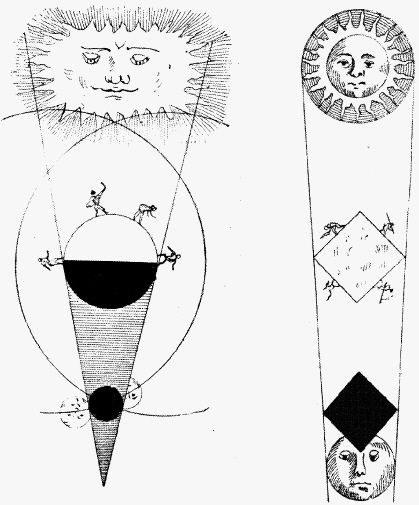
Leaving the orbits of the celestial bodies aside, the shape of the Earth provided a problem that has an obvious solution (the view from a mountaintop shows its curvature), and yet was much argued about. Eclipses were central to the debates of Pythagoras, Aristotle, and the other Greek philosophers on this question. If the Moon were eclipsed when it passed into the shadow of the Earth, then the shape of that shadow must represent the profile of the planet. Figure 1–11 shows an amusing representation of the argument: if the Earth were square or flat, with edges that sailors could fall off perhaps, then the shadow edges should be flat. They aren’t.
ECLIPSE ETYMOLOGY
Before leaving Greece, we should note that the word eclipse has a Greek origin. In that language ekleipsis means to “leave out,” “forsake,” or “fail to appear.” As with many scientific terms, the less-cultured Romans adopted the Greek word, the Latin becoming eclipsis. That word (or the variant ellipsis) is directly used in English to imply a place where something is missed out, such as when a printer employs either a dash or three dots in a row. Our word eclipse, which can be used as either a noun or a verb, has gone through various spellings in English since about 1300. Variants include eclips, esclepis, enclips, eclypse, and ecleps.
An astronomical term that is extensively employed is ecliptic, referring to the apparent path of the Sun across the sky. It gets its name because that is where eclipses occur: the Moon must be crossing the ecliptic if it is to line up with the Sun, either in front of or behind the Earth. This term has also been in use for many centuries; for example, in 1391 Chaucer wrote about “the Ecliptik lyne.” The word may also be used to refer to the plane of the terrestrial orbit.
CHASING ECLIPSES
Random locations on the Earth’s surface are traversed by a total solar eclipse track about once per four centuries, on average. Such figures prompt eclipse enthusiasts to travel far and wide in pursuit of their few minutes of heavenly pleasure. With relatively cheap jet travel available, some have experienced totality in a dozen exotic locations, or more. Even seven decades ago the eclipse bug had infected many people, such as Rebecca R.Joslin writing in
1929: “Now eclipses are elusive and provoking things…visiting the same locality only once in centuries. Consequently, it will not do to sit down quietly at home and wait for one to come, but a person must be up and doing and on the chase!”
In any distribution there are usually wide deviations from the average, like professional basketball players being taller than the norm, and football linebackers heavier. The path of the total solar eclipse of August 11, 1999 passed from the northwestern Atlantic across central Europe, the Middle East, and then India. On March 29, 2006, a similar event (actually with a wider track and duration of totality) will occur, the path beginning in northeastern Brazil, crossing the Atlantic and then Africa, heading northeast to pass over central Asia, and finishing just short of Mongolia. Those paths have to meet somewhere, and the lucky location is close to the Black Sea coast of central Turkey. No doubt hotel owners and tourist agencies there rubbed their hands in glee when they discovered this: two total eclipses within seven years!
Eclipse chasing for amusement is not a new phenomenon, as seen in Figure 1–12, which captures enthusiasts in Spain in 1900, testing their filters and cameras shortly before totality began. (Spain did rather well, eclipse-wise, around that epoch, with tracks crossing the Iberian Peninsula in 1842, 1860, 1870, 1900, and 1905.) The importance of not looking directly towards a solar eclipse with unshielded eyes had long been recognized by then, and various filters were used, or optical devices like telescopes or binoculars employed to project an image onto a screen as in Figure 1–13.
The use of eclipses by professional astronomers had begun somewhat earlier. By the late nineteenth century, teams from observatories in the developed world were conducting expeditions
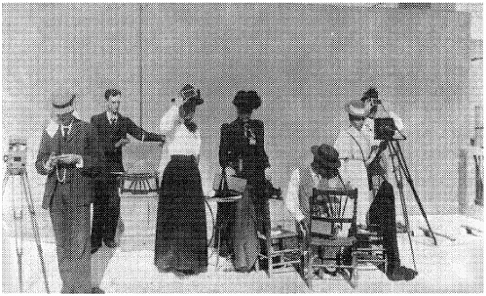
FIGURE 1–12. Well-prepared eclipse enthusiasts await the total solar eclipse in Spain in 1900.
in chase of total solar eclipses to the far-flung corners of the globe, not all of them terribly hospitable. In the first decades of the twentieth century astronomers several times trekked to the Far East to observe eclipses, often with unfavorable weather. Figure 1–14 shows the equipment set up under the palms on Flint Island, in the Coral Sea to the east of New Guinea, where operations were hampered by giant land crabs that tried to make off with anything edible, including the astronomers’ boots.
WHAT COMES NEXT
Before we can move on, we need to develop an understanding of how eclipses work. Eclipse predictions were made millennia ago,

FIGURE 1–13. How to avoid blinding yourself while trying to observe the Sun with a telescope. This nineteenth-century drawing shows how to project an image onto a screen, an invaluable technique for eclipse watchers.
but a full mathematical model for the orbit of the Moon requires 1,500 separate terms, a quite recent attainment of the science of celestial mechanics. We are able to ascertain in advance accurate eclipse paths only by using high-powered computer codes. (Just as well, else observers would not know where to head for, bearing

FIGURE 1–14. An eclipse expedition in 1901 to Flint Island in the Coral Sea provided a most uncomfortable experience for astronomers; huge land crabs disrupted their preparations.
their telescopes and other paraphernalia.) That poses a bit of a puzzle. How, say, might the Romans have known in advance about the lunar eclipse in 168 B.C., used to their advantage in defeating the Greeks at Pydna? The answer lies with cycles. Eclipses, both solar and lunar, occur in cycles that may be recognized from long-term records. Once one understands the cycles, eclipse prediction is easy.
To unveil the cycles, one could patiently record eclipses for the next several decades. A more sensible approach would be to look up the available information on the dates, times, and locations of eclipses over the past few centuries and then try to deci-
pher the code. That is just what the Babylonians, Greeks, and others did more than two millennia ago, so it is not impossible, but it is tedious.
Instead one could tackle the project backwards. Starting with our modern knowledge of the Moon’s orbit about the Earth, and the Earth’s orbit about the Sun, we may deduce when eclipses will occur, and with what sorts of repetition cycles. Remember we are way ahead of the ancients, who thought that the rest of the universe revolved around the Earth. We know about orbits and how to make the relevant calculations. Such analyses can be explored in detail in the Appendix.
In Chapter 2 we will consider the orbits of the Moon and the Earth and show how our calendar depends upon them, before looking at some general features of eclipses and their cycles. Then in Chapter 3 we will delve deeper into the history of eclipses, solar and lunar, and explore their significance in the chaotic course of civilization.