Eclipse: The Celestial Phenomenon That Changed the Course of History (2001)
Chapter: 7. Eclipses and the Size of the Sun
7
Eclipses and the Size of the Sun
Observe due measure, for right timing is in all things the most important factor.
Hesiod, a Greek poet of the eighth century B.C.
The name of Edmond Halley has already appeared several times, in connection with the eponymous comet, his rediscovery and titling of the saros cycle of eclipses, and his suggestion that the salt of the sea could tell the age of the Earth. Now we are going to renew our acquaintance with him.
Having brought up his name, I should note that both parts of it have provoked modern dispute. Halley himself used two spellings for his given name: Edmond and Edmund. Whichever one might use is a matter of choice. Regarding his surname, the arguments have centered upon its pronunciation: “Hal-ee,” “Haw-lee,” or “Hay-lee”? The average person tends to go with the final version (mainly through familiarity with Bill Haley and the Comets, of “Rock Around the Clock” fame in the 1950s). However, the presence of the double “1” in Edmond Halley’s patronymic indicates that one of those initial two pronunciations is actually more likely to be correct. The first is that most favored among astronomers. (I won’t confuse the matter further by worrying over
whether the second syllable should be “lay” or “lie” rather than “lee.”)
HALLEY AND ANCIENT ECLIPSES
However we spell or say his name, Halley’s interest in eclipses provides a bridge between the subjects of Chapters 6 and 7. In the previous chapter we saw that ancient eclipse records have allowed scholars to investigate how Earth’s rotation rate has slowed over the past few millennia, with various astronomical and geophysical ramifications. More than three centuries ago Halley was interested in this apparent slowdown—he was the first to notice it—but from a rather different perspective.
In his era, appointments to university positions in Britain were heavily influenced by religious considerations. Various factors counted against Halley when he was an applicant in 1691 for the Savilian astronomy professorship at Oxford University. He even held the heretical view that comets (such as that bearing his name) could smash randomly into the Earth, causing great devastation. This did not fit in well with ecclesiastical views on divine providence. Mostly, though, his opponents were disquieted by his notion that the world might be older than the biblical chronology would indicate.
Learning from his failed application, Halley gained the religious-bias initiative in the following years through his study of ancient eclipses. In October 1693 he read a paper to the Royal Society “…concerning a Demonstration of the Contraction of the year, and promising to make out thereby the necessity of the world coming to an end, and consequently that it must have had a beginning, which hitherto has not been evinced from any thing,
that has been observed in Nature.” What Halley showed was that the times of eclipses spread over millennia could only be explained if the number of days within a year were reducing. This must indeed be the case, because the absolute duration of the year stays constant, but the days are lengthening, as we saw in the preceding chapter.
Halley’s interpretation of this apparent elongation of the year, based on Christian dogma, was that the age of the world must be finite. The universe, he said, must have been a divine creation ex nihilo a handful of millennia before. The academic selection panel—the members were not only from within the University of Oxford, the Archbishop of Canterbury for example being among them—regarded this most favorably. They looked upon religious correctitude as being of the utmost importance, and Halley’s careful demeanor during the 1690s had the end result that he was successful in obtaining appointment to the Savilian Chair of Geometry in 1704.
Halley was skilled at computing the past tracks of totality over foreign lands after his earlier work. Looking forward, he recognized that in 1715 a total solar eclipse would sweep across southern England and Wales, the first time that London had been so-visited since 1140 (and 878 before that). He turned his hand and mind to computing its precise course, and organizing observations.
A detailed predictive map that Halley prepared is shown in Figure 7–1. A pamphlet that was widely disseminated at the time, showing such a map, was entitled The Black Day or a prospect of Doomsday exemplified in the great and terrible eclipse which will happen on the 22nd of April 1715. If the simple information that
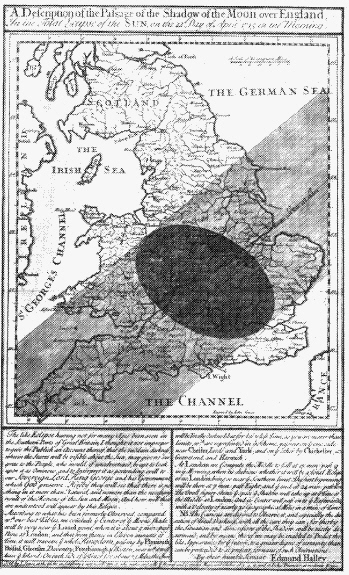
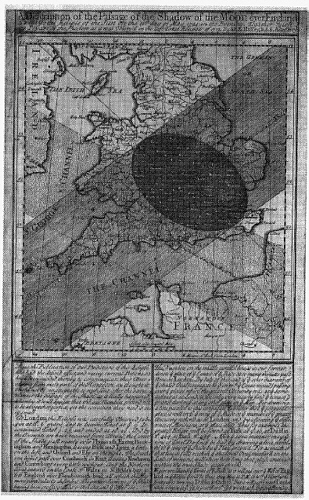
FIGURE 7–1. The ground track over England and Wales of the solar eclipse of 1715, as computed ahead of time by Edmond Halley. In reality the track was slightly wider. This was by just a few miles at the northern extreme, but with a southeasterly displacement of about 20 miles for the southern boundary (compare this pre-eclipse prediction with the post-eclipse map, also drawn by Halley, as shown in Figure 7–2).
an eclipse was to occur didn’t rustle up public interest, that pamphlet was sure to do so.
THE CAPITAL ECLIPSE OF 1715
A total solar eclipse has not crossed England’s capital city since that day in 1715. Nor will London see such an event again for some time to come. Three centuries ago, the eclipse ran from about eight until ten in the morning, with totality lasting for a few minutes at around ten past nine. At least, that was the time in London. Not only did the shadow reach other locations at different absolute instants of time, but also in those days there was no standard time in Britain, each town keeping its own clock time according to the Sun’s position, making the nationwide comparison of observations difficult. Regarding the date of the eclipse, we will come to that at the close of this chapter.
Nowadays any eclipse is gazetted well in advance, so that amateur and professional observers alike are well prepared, but that was not the case in Halley’s era. He wrote to a wide variety of potential observers. From the rectors of village churches and the like he received a flood of useful information, allowing him to determine the path of totality with admirable accuracy. Not only that, but the comparative timings for the duration of the eclipse were very useful check readings, as these would be longest near the central line, dropping to zero at the edges of the path, and the duration would also vary along the track due to the Earth’s curvature.
The amateur observers did well then—but what about the professionals? In Cambridge, the Plumian Professor of Mathematics, Roger Cotes, tried to time the eclipse but was distracted by
what he termed “too great Company,” and so he did not obtain the necessary data. Halley himself was in London for the eclipse, gathered with various other fellows of the Royal Society. That is just as well, because Oxford was clouded out. Under Halley’s guidance, his group obtained useful timings.
If central London were clear, as it was, then one would anticipate that the astronomers at the Greenwich Observatory must also have made detailed observations. They may well have done so, but in a spirit of fine scientific collaboration the Astronomer Royal, John Flamsteed, refused to allow Halley direct access to the Greenwich data, which were never published. Halley succeeded Flamsteed as Astronomer Royal in 1720, and it is surprising that he did not himself dig out the 1715 eclipse observations thereafter, although to be fair he was always busy with new scientific tasks.
Be that as it may, what Halley really needed was not lots of observations from just one place, but rather information from a wide geographical scatter. That way he would be able to determine the width of the ground track. If some curate standing in his churchyard saw a brief instant of totality, and yet the verger sent to the crossroads in the village a mile to the east did not, then Halley would know that the edge of the shadow had passed between them. Thus the precise positions of the observers, plotted onto a map, were important.
This is just what Halley got. Some dozens of reports were supplied by correspondents scattered over England and Wales, enabling him to determine the northern and southern extremities of the track to within a mile or so. For example Halley was soon writing: “From these observations we may conclude that this Limit came upon the coast of England, about the middle between Newhaven and Brighthelmston [Brighton] in Sussex.” Similarly
he found that in Wales the northern limit “…entred on Pembrokeshire about the middle of St Brides Bay.”
Comparing these points with Halley’s pre-eclipse prediction (Figure 7–1) we see that he was inaccurate, by only 3 miles for the northerly limit, but by 20 miles for the southerly. The ground track that Halley determined from the observations is shown in Figure 7–2; it was about 183 miles wide, 23 more than his prior estimate.
That might initially seem peculiar. One could understand the track being uniformly displaced in one direction or another due to slight timing errors, but how could its width be wrong? The answer lies with the lack of precise evaluations of astronomical distances in that era. Later in this book we will discuss how James Cook was sent to the South Pacific in 1769 specifically to watch the transit of Venus across the face of the Sun, as part of an attempt to measure more accurately the mean solar distance from the Earth. Halley was one of those who invented the technique employed in that episode. Back in 1715, Halley could not be sure of the distances and sizes of either the Sun or the Moon, and in consequence he substantially underestimated the width of the eclipse track.
THE IMPORTANCE OF KNOWING THE SUN’S SIZE
No area of science has made recourse to historical information more often than astronomy, and Halley’s 1715 eclipse compendium is a wonderful example, as we shall see. First, though, I must sketch in a little of the background.
Halley was only 19 years old when he first made observations of sunspots, publishing the results in his second scientific paper.
That was in 1676. Using the naked eye, the ancient Chinese had observed large sunspots many centuries before that, when dust storms blew in from central Asia, blanketing parts of northern China. Such solar blemishes had similarly been noticed from Europe, but it was only when telescopes appeared in the seventeenth century that continuous monitoring of these dark markings on the Sun’s surface was feasible.
Using a telescope an image of the Sun can be projected onto a screen (as in Figure 1–13). By following the movement of specific sunspots from day to day Halley and his contemporaries determined that, near its equator, the Sun takes about 25 days to spin. Not being a solid body, it does not rotate rigidly, but different speeds are apparent depending on the latitude, such that nearer its poles the Sun takes closer to 35 days to turn once.
Sunspot numbers have routinely been kept through to the present from Galileo’s time, a hundred years earlier than the eclipse in question, and it was studies of these numbers that revealed the apparent 11-year periodicity in solar activity. There is evidence that the overall climate of the Earth follows the same cycle. In the early decades of the twentieth century another British astronomer, Edward Maunder, noted there had been a deficit of sunspots during the latter half of the seventeenth century; this is now known as the “Maunder Minimum.” This coincides with a pronounced cooling of the climate known as the “Little Ice Age.” The River Thames froze over, for example, and fairs were held on London’s ice-covered waterway. This correlation may just have been a coincidence, but it seems to warrant more than merely a suspicion that the two phenomena are related.
This makes one wonder how else the Sun might be varying in its properties, sunspot numbers being just one diagnostic, and
how the Earth’s climate might alter in response to any such change. If the Sun had expanded, say, then one might also expect it to cool a little, and so not emit so much energy in the form of sunlight. There would then be a concomitant drop in the mean temperature of our planet. Certainly, astronomers observe other stars pulsating in and out, their power output varying radically, and because our climate balances on a knife edge a fairly slight alteration in the Sun’s power could have major repercussions.
Studies of stellar evolution indicate that since it “switched on” over 4.5 billion years ago, the energy output of the Sun has increased by about 30 percent. In fact, this understanding is so well established that the jargon phrase “Early Faint Sun Paradox” is bandied about within circles of scientists interested in the evolution of the terrestrial environment, and in particular those studying how life developed on our planet. The point here is this: If the Sun were initially so much fainter, as is believed to be the case, then the Earth would have been a frigid world. Under such circumstances, how did even the simple mono-cellular slime, which was the sole occupant of the planet between about 3,800 and 570 million years ago, manage to evolve and survive?
This increase in solar output has not terminated. In our earlier description of solar evolution it was noted that the Sun is expected to continue to behave in a similar fashion to the present for another five billion years or so. Over that time, though, its power output is expected to double. If that increase were steady and uniform then over five thousand years (a suitable time scale for human civilization) the solar energy reaching the Earth might increase by one or two parts in a million. Such changes are dwarfed by other natural variations, like the way in which the Earth’s orbit evolves and the orientation of its spin axis shifts. But what if the
Sun’s output oscillates significantly or alters abruptly on timescales of only decades or centuries? Astronomers certainly see other stars acting in this way.
Such modern concerns as the anthropomorphic “greenhouse effect” would obviously be affected by changes in the solar output, so we’d better be sure we know how the Sun behaves over extended periods. Perhaps historical measures can assist. At last, then, we come to the significance of Halley’s compilation of reports of the 1715 eclipse.
A MODERN REANALYSIS OF HALLEY’S RESULTS
In the late seventeenth and early eighteenth centuries astronomers at the Paris Observatory made micrometer measurements of the apparent solar diameter, and in the 1980s French scientists compared these with modern values. They concluded that, if the old measures were correct, then three centuries ago the Sun was about one part in 480 larger than it is now. That is an appreciable fraction from the perspective of the possible climatic effect.
The problem is this: How accurate were those observations made 300 years ago, barely a century after the telescope was first used to peruse the Sun? If they were good, then the Sun must be shrinking, which might cause it to heat up, flooding the Earth with an increased flux of sunlight, thus adding to the greenhouse effect. Alternatively, if those early measurements of the Sun’s size made from Paris were imprecise, then we might be able to discount such a possibility.
What was needed to solve this question was some alternative determination of the solar diameter from a few centuries back, but of greater precision. The precision attainable from direct measure-
ments, however, was limited by the available technology, whether the telescopes used were French, Italian, or British. Some analogue determination of greater accuracy was required: an indirect measure.
Halley’s detailed account of the reports he received of the eclipse from far-flung parts of Britain provides just such an analogue, as was realized in 1988 by Leslie Morrison and Richard Stephenson (whose work on old eclipses has already been mentioned), along with their colleague John Parkinson. If the Sun had been larger by almost 0.2 percent in 1715, then the limits of totality would have been about 6.5 miles narrower, just over 3 miles at both northern and southern edges. Coupled with our modern knowledge of the distances and orbits of the Sun and Moon, the actual observations of totality (or lack of it), which Halley preserved verbatim, enabled this team to determine the edges of the track to within a few hundred yards. As the Moon has not changed size, the small residual uncertainty implies that the Sun has not shrunk by as much as one part in 20,000 since 1715.
Halley’s remarkable records of the observations of the eclipse of 1715 remain not only an exemplar of a great eighteenth-century scientist at work, but also the best evidence we have that the Sun has not greatly altered in size over the past several centuries.
ANOTHER ECLIPSE OVER THE BRITISH ISLES IN 1724
Much of southern England had waited from 1140 until 1715 for an opportunity to witness a total solar eclipse, about twice the average waiting time for random locations in the Northern Hemisphere. The inhabitants did not need to wait much longer, though,
for the next show. On May 11, 1724 the shadow of totality swept diagonally across the southern halves of Ireland and Wales before proceeding in a southeasterly direction across most of England below Birmingham, as in Figure 7–2. Only Cornwall and Kent (the southwestern and southeastern tips of England) missed out beyond the southern limit, the northern edge of totality just missing Oxford and London, which still awaits a repeat of the Capital Eclipse of 1715.
Before leaving these eighteenth-century eclipses, a peculiarity should be mentioned. When the path of the 1724 shadow left Britain and crossed the English Channel into France, the date suddenly jumped from May 11 to May 22. Similarly the great eclipse of April 22, 1715, was seen on that date in Britain, but elsewhere it was May 3rd already.
What am I getting at? My point is that in Halley’s day Britain was still using the Julian calendar, the 11-day jump necessary to fall in line with the Gregorian calendar not being made until 1752. The same is true for the American Colonies ruled by Britain in those days. Although history books may tell you that George Washington was born on February 22, 1732, in fact he was born on February 11, 1731 (because New Year for the British was not until March 25). Great Britain and Scandinavia were the last places in Western Europe to reform their domestic calendars, whereas in Eastern Europe it took some countries until the 1920s to make the change, by which time the discrepancy had grown to 13 days.