Eclipse: The Celestial Phenomenon That Changed the Course of History (2001)
Chapter: 16. An Eclipse Whodunit
16
An Eclipse Whodunit
He who doubts from what he sees
Will ne’er believe, do what you please.
If the sun and moon should doubt
They’d immediately go out.
William Blake, Auguries of Innocence
In this book we have examined both the astronomy and the history of eclipses and seen along the way that these natural phenomena occasionally have represented pivotal junctures in the development of civilization. The interpretation of eclipses affected the outcome of strategic battles in ancient times, and even today these celestial events are regarded superstitiously by many. Witness the way in which they are noted in newspaper astrology columns, and how the lunar and solar eclipses in January and June 2001 prompted civil unrest in Africa.
A scientific (rather than superstitious) argument over a specific eclipse in medieval times so far has not been mentioned. This was the total solar eclipse that passed over parts of the British Isles shortly before the Synod of Whitby in A.D. 664. The major outcome of that great synod, which turned largely on a debate related to that eclipse, was that seven previously warring fiefdoms became united to form what we would now recognize as the nation of
England. If it were not for that, then the history of the world would be quite different, and this book would have been written, if at all, in some alternative language.
It is clear, then, that the eclipse of 664 was important. The peculiar thing is that the circumstances of the eclipse were misrepresented, both at the synod and in later accounts of what took place. If this dishonest dealing had not occurred then the outcome would likely have been rather different. Just how this was done is not yet clear, providing us with an eclipse whodunit at least the equal of most detective novels. Just who was responsible for this subterfuge at the synod, frustrating the opposition and, in consequence, altering the course of history?
THE MYSTERY OF WHITBY
The picturesque little fishing port of Whitby stands on the northeast coast of England, about 200 miles due north of London. Whitby owes its historical significance largely to the ruined abbey that stood there for centuries, having been founded in A.D. 658. Six years later, with the Abbess Hilda overseeing the hospitality for her guests, a great synod was hosted in Whitby, a meeting of ecclesiastical authorities that was in effect to decide the future of the Christian Church throughout the British Isles.
The Synod of Whitby in A.D. 664 has, over the intervening 13 centuries, achieved not only considerable significance in Church history, but also a popular reputation as a mysterious affair. For example, in Absolution by Murder: A Sister Fidelma Mystery, author Peter Tremayne sets his fictional thriller against the factual backdrop of the synod. As the jacket blurb for this 1994 novel explains, “When the Abbess Etain, a leading speaker for the Celtic
Church, is found murdered suspicion inevitably rests on the Roman faction.” No such murder actually occurred (and Hilda was the only woman recorded as being directly involved in the synod), but the circumstances invoked by Tremayne are realistic, there being some considerable dispute between those two opposing parties.
Although no murder took place, astronomical truth was assassinated at Whitby, for which there is more than mere circumstantial evidence to suspect the Roman faction. In short, there is a real-life mystery about what transpired at the Synod of Whitby; the full truth still needs to be teased out from the various clues through the eons. In 664 the Roman party carried out a religious sting, fooling the King of Northumbria into rejecting the Celtic overtures and transferring his allegiance to the Roman Church.
EARLY CHRISTIANITY IN THE BRITISH ISLES
The present name of Whitby attests to links with lands across the North Sea. In Scandinavia many place-names end with “-by” (pronounced bee not bye), meaning “village,” in the same way that other English locations often end with “-ton,” a diminutive of “tow”. Just to the south of Whitby lie Scalby and Newby, the meaning of the latter name in particular being obvious. Back in the seventh century, before the Viking marauders began to arrive, Whitby was known as Streanaeshalh. That’s an unfamiliar mouthful, so let us keep to the later name of the town and monastery. Rather than looking over the North Sea, the Whitby connection with which we are concerned here causes us to cast our gaze to the Mediterranean and the warmer climes of Italy, Greece, and Turkey. It is from those regions (using their modern names) that Christianity diffused to the British Isles.
Although Julius Caesar had twice ventured into southeastern England, the Roman conquest did not occur until about a hundred years later. Then, the emperor Claudius pacified most of the region we now call England, pushing the Celts, Picts, and other races back into the far corners of the isles, into Scotland, Wales, Cornwall, and Hibernia (Ireland). Trouble persisted with those peoples, eventually resulting in such steps as the construction of Hadrian’s Wall.
In these early centuries of the Roman occupation, the state religion was pagan, based upon various deities associated with the planets (which term included the Sun and the Moon in that era). For example, Mithraism lauded the god of the Sun as being supreme, and the winter solstice—when the Sun stands still in terms of the rising point on its annual oscillatory path up and down the eastern horizon—was the major celebration each year, the festival of the unconquered Sun. The date of Christmas was derived by transfer from that pagan feast to the Christian holiday (literally, holy day) soon after the emperor Constantine the Great became sympathetic to Christianity in the early part of the fourth century.
As Christianity became the official state religion of the Roman Empire during the fourth century, missionaries spread to Britain and began converting the indigents to that faith. At the same time there was a gradual withdrawal after A.D. 350 of Roman influence from Britain, the final tie being cut in about 410. The cause for this withdrawal can also be traced back to the long-dead Constantine. He had shifted the imperial headquarters from Rome to Byzantium, causing its name to be changed to Constantinople, as it remained until the city’s name was changed to Istanbul in 1930. With the seat of power removed to the east, the Italian peninsula was left largely unguarded as the Gothic hordes swept west
from their homelands at the periphery of the Black Sea. The people still in Rome pleaded for assistance, but their cries fell on the deaf ears of those now largely Hellenized, living happily in Constantinople, and lording it over the Eastern Empire. As a result the Western Empire finally collapsed by 476, Rome having been sacked several times by barbarian tribes during that century.
In consequence Britain was no longer part of the domain of the Roman State. Affairs in those islands, however, could still be influenced by the Roman Church. That Church had other problems to deal with, such as surviving within a city (Rome) and country (what we now call Italy) occupied successively by various non-Christian rulers such as the Goths and the Huns. With the disintegration of order in Britain, the peoples known as the Jutes, Angles, and Saxons invaded from mainland Europe, and anarchy reigned as the Picts and the Scotti rampaged down from the north and the west. In Britain, as well as elsewhere in the west of Europe, famine and disease were rampant, and town life collapsed as the society previously organized as part of the Western Roman Empire simply disintegrated.
That society had previously produced a sufficient economic excess to support scholars, and in addition for the armies to hold back would-be invaders. With the collapse of the Empire, from the late fifth century Europe entered the Dark Ages. That term is commonly applied so as to reflect our scant knowledge of what happened during that era, in the absence of records kept by the learned men who were earlier employed as part of the bureaucratic system. One of the few places anywhere that scholars could work and maintain written records was in the Church and its associated monasteries.
Christianity had hitherto made little progress in the British
Isles, although there were outcrops of believers here and there. One important concentration was in Ireland, where missionaries from Crete and other parts of the eastern Mediterranean had arrived by the early fifth century. We will see later that the origin of those missionaries is significant. This early arrival of Christianity in Ireland led to the establishment of several monasteries, and Irish annals that show records of phenomena such as eclipses, comets, auroras, and volcanic clouds (from eruptions in Iceland) exist, dating back as far as A.D. 442. The Church in Ireland, totally disconnected from the Holy See in Rome, seems to have thrived in this era. Many of the bellicose peoples who had been penned into Ireland rebounded into Britain with the fall of the Roman dominion, and at length church missionaries followed eastwards across the Irish Sea in their wake.
One of these missionaries was Saint Columba (521–597), who traveled to Scotland. The organization that made its presence felt in the north of Britain at this stage is nowadays referred to as the Irish, Celtic, or Columban Church. Various monasteries were founded in northern Britain, and two of the most preeminent centers were those on the tiny island of Iona (in the Inner Hebrides, off the western coast of Scotland) and on another island called Lindisfarne (just off the coast of Northumbria, the northeastern part of England). The locations of these monasteries are shown in the map in Figure 16–1. In remote places such as these the torch of learning was carried forward through the Dark Ages.
To the south, in England, heathenism still reigned in the various kingdoms ruled by the Jutes, Angles, and Saxons, and pagan gods were worshipped. This began to change from about A.D. 597 when the first Roman Church missionaries arrived in Kent in the southeastern corner of England a short maritime hop from conti-
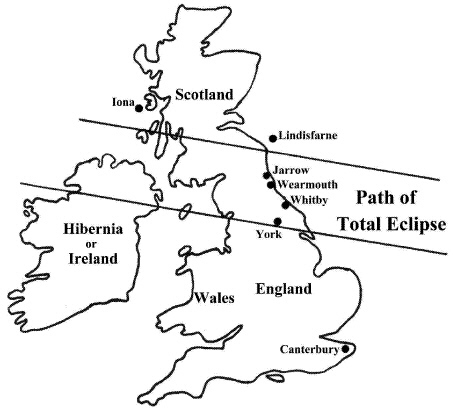
FIGURE 16–1. This map indicates the ground track across the northern parts of the British Isles of the total solar eclipse that occurred on the first day of May in A.D. 664. Several early ecclesiastical centers and monasteries are also shown.
nental Europe. At that time the Roman Church, under Pope Gregory the Great, was enjoying some stability after the Eastern Empire under its leader Justinian had reasserted itself in Italy from the middle of the sixth century. The Church had started a concerted effort to spread Christianity through Germany and the countries along the Danube, and Saint Augustine was sent west in an attempt to convert the heathens then occupying most of Brit-
ain. Augustine established the cathedral at Canterbury and set about his task, although he did not get far because he died in 604, but the changes he initiated were important.
Augustine converted the Jutes of Kent to the Roman Church, and served as the first Archbishop of Canterbury. The next targets for his successors were the constantly warring Angles and Saxons of the other six kingdoms within England (the Essex, Wessex, and Sussex of the Saxons, and the more-northerly East Anglia, Mercia, and Northumberland of the Angles). There was a problem, though, in that the Celtic Church was likewise trying to assert itself, using traditions and practices somewhat different from those of the Roman Church. One of the disputed matters might seem absurd to us now: it was the form of the tonsure, the way in which monks shaved the tops of their heads. The great fighting-ground, though, was the subject of when Easter should be celebrated each year.
THE SIGNIFICANCE OF EASTER
One of the great sources of schism in the early Christian churches was argument over the calculation of the date of Easter. This is called the computus. In principle its statement in the present epoch is easy: in any year Easter is the first Sunday after the full moon occurring next after the spring equinox.
The much-misunderstood problem is that the full moon and the equinox referred to in that statement are not defined by the Moon and the Sun in the sky, but rather by theoretical constructs invented for ecclesiastical usage. The “equinox” for Church purposes is stipulated to be the whole of March 21, whereas the astronomically defined instant of the equinox—when the Sun crosses the celestial equator—varies over a 53-hour range from March 19
to 21. The “ecclesiastical moon” is an imaginary body that is assumed to follow the 19-year Metonic cycle containing 235 lunar months (as discussed in Chapter 2), but with eight separate corrections, each of a single day interposed over a 2,500-year grand cycle. The “ecclesiastical sun” is likewise corrected with three single day jumps in a 400-year cycle: this is why a century year is not a leap year unless it is divisible by 400 (as was the case for the year 2000).
To give an example of how misleading the verbal statement above might be, astronomical full moon could occur on March 20 and the equinox on March 19, but still the ecclesiastical rules delay Easter Sunday by a month because the equinox is assumed to be March 21. Equally well, sometimes Easter occurs on the day when the Moon is full in the sky, even though the verbal statement seems to prohibit such an event.
The above is the contemporary position, stemming from the reform of the calendar promulgated by Pope Gregory XIII in 1582. That reform resulted in an Easter computus now used throughout the Western (Catholic and Protestant) churches, but not by most of the Eastern Orthodox churches. The latter persist in using the earlier Julian calendar and different rules, meaning that their Easter may agree with that of the West but equally well may be one, four, or five weeks later in many years. That is exasperating enough in itself, but if we step back to the first centuries of Christianity we find that the situation was even more confused.
At the time Constantine transferred his sympathies to Christianity in A.D. 312 there was a wide range of Easter practices being employed. This was because of both the slow communications in those days, and the lack of basic agreement between the various factions of the early Church spread around the Mediterranean and
Middle East. Various ecumenical councils were convened where the bishops from different regions met and discussed liturgical and doctrinal matters. These culminated in the Council of Nicaea in A.D. 325, held in a town now called Iznik, across the Bosporus about 60 miles southeast of Constantinople. The Nicene Fathers—the 319 bishops who attended—drew up the Nicene Creed, the formal statement of the underlying tenets of the Christian faith.
It has been much misstated that the Nicene Fathers laid down the rules for Easter, this construed as fact even in present-day papal missives. In reality all they did was this:
-
They agreed with an earlier council that all Christendom should celebrate Easter on the same day (an ideal that has never been achieved).
-
They made a statement that is covertly anti-Semitic (the major concern was avoiding the Jewish Passover, for reasons of self-identification similar to having the Christian Sabbath on Sunday, rather than Saturday as do those of the Judaic faith).
-
They referred the actual computation of Easter to the Church of Alexandria, in deference to the long Egyptian tradition of calendrical calculations based on celestial observations (for example, when Julius Caesar reformed the calendar in 46 B.C. he did so under the advice of an Egyptian, Sosigenes).
Despite this step forward by the Nicene Fathers there was still no agreement as to how Easter should be calculated. For two centuries the Roman Church refused to accept the dates stipulated by the Alexandrine Church. Both churches used the 19-year Metonic cycle, but while the Alexandrians assumed that full moon for ecclesiastical purposes should be taken to be the fifteenth day after new moon, the Romans insisted on the sixteenth.
Elsewhere other churches used their own schemes, producing their own Easter (or Paschal) tables that would be distributed throughout their dioceses to show when the various feasts should be held for some decades into the future. In particular some used an 84-year cycle, consisting of 4 Metonic cycles plus an 8-year addition. The latter stems from an ancient Greek invention called the octaeteris, whereby rather than having a single leap-year day every four years, the months instead followed the Moon with three extra of those lunar months being inserted into an eight-year cycle. The first Olympics starting in the eighth century B.C. followed this cycle, alternating between gaps of 49 and 50 lunar months rather than the quadrennial system we adopted for the modern Olympics.
It was this 84-year system that the first Greek missionaries brought to Ireland around A.D. 400, and was then employed by the Celtic Church. Not only was the cycle different, but also the rules allowed Easter Sunday to fall on the fourteenth day after new moon, making coincidence with Passover a possibility. Avoidance of such a perceived abomination had been the major concern of the Nicene Fathers.
The early Celtic Church, however, was disconnected from the Roman Church. After many quarrels with his Alexandrine counterpart, in A.D. 525 the Roman Pontiff asked Dionysius Exiguus, a learned monk from southwestern Russia who lived and worked in a monastery in Rome, to consider the Easter question and draw up Paschal tables for the next several decades. This Dionysius did, in fact largely adopting the Alexandrine full moon rule, but with a 19-year cycle.
It is from Dionysius’s calculations that the erroneous year count of the Christian Era (the Anno Domini system) was later
derived. He computed Easter dates forward for 95 years (5 cycles), from A.D. 532 to 626 inclusive, as the pope had requested. Dionysius also back-reckoned for 28 cycles (that is, the 4-year leap cycle of the Julian calendar multiplied by the 7-days-a-week cycle), each of 19 years, making 532 years in all. This took him back to the year we call A.D. 1. Let us look Dionysius’s chronology, to see how it all came about. According to his thinking, the year A.D. 1 began with the circumcision of Jesus (when Jewish boys are considered to begin their lives). The Nativity was then eight days earlier (circumcision on the eighth day for Jewish male babies is stipulated in the Bible), on the traditional date of the winter solstice, December 25. Given the human gestation period it follows that the Incarnation, or Annunciation, when the Angel Gabriel told Mary that she would bear the Son of God, was nine months earlier, on March 25. That is the traditional (but not astronomically accurate, even at that time) date of the spring equinox. Dionysius reckoned the years for his Easter table, a count with each labeled the Anno ab Incarnatione, from March 25, 1 B.C. He seems to have been wrong by about four years, mistakenly thinking that the reign of Augustus Caesar should be counted from the year 27 B.C. This was when Augustus adopted that name, rather than 31 B.C. when, under the name Octavian, he became the de facto emperor by defeating Mark Antony and Cleopatra at the Battle of Actium. Dionysius then misinterpreted a biblical statement that Jesus was born in the 28th year of the reign of Augustus, resulting in the four-year error that has persisted ever since.
Leaving that digression aside, the important point is that the Roman Church used Easter tables based upon a continuation of Dionysius’s computus from A.D. 532 right through until the Gregorian reform of 1582. When Saint Augustine arrived in Kent
at the end of the sixth century, he brought with him Easter tables that were copied for spreading throughout the expanding domain of that Church, and continued over further 19-year cycles after Dionysius’s own calculations expired in 626. The distant Celtic Church on the other hand maintained the 84-year cycle it had inherited from Greek sources much earlier.
A simple but important point must be made here. In this era reference to the “Roman Church” should be differentiated from the present-day “Roman Catholic Church.” Although the latter derives from the former, here we are discussing affairs almost a millennium before the Reformation. (That was when the various Protestant churches split off from the Catholic Church: in England as a result of King Henry VIII’s disputes with the Pope and in Germany through Martin Luther nailing his list of complaints to the church door.) By the term “Roman Church” reference is made to what might also be called the “Western Church” in contradistinction to the traditions through which the present Eastern Orthodox churches came about.
THE SITUATION IN NORTHERN BRITAIN
After the withdrawal of Roman governance and the incursions by numerous barbarian bands, various pagan religions were followed in England. Bordering on Scotland, Northumbria under King Oswald had become an adherent to the Celtic Church from about 633 onwards. In 642, though, King Penda of the more-southerly Mercians defeated Oswald in battle, and promptly dismembered him. The latter’s followers collected various parts of his body and distributed them to several churches (his head went to Lindisfarne and is now in Durham), leading to a cult of Oswald and eventually
to his sainthood. Heathenism dominated in Northumberland until Penda died in 655.
A new king, named Oswy or Oswiu, then seized the throne, and the region reverted to Christianity, in particular the Celtic Church. To the south, Mercia also became Christian. Previously there had been a pagan buffer zone between the spread of Celtic influence in Scotland and that of the Roman Church much further south, but now that buffer was gone and internecine confrontation was inevitable as each church vied with the other to spread its influence.
Heeding the Nicene Creed, the Celtic Church made some attempt to understand the doctrine of the Roman Church and sent at least two delegates to Rome to obtain information and instruction. These men were rich Northumbrian nobles; dictionaries of the saints recall them as Saint Benedict Biscop (628–689) and Saint Wilfrid (633–709). Benedict Biscop departed first in 653 (he made five visits in all), accompanied on that trip by Wilfrid who, after a protracted stay in France, returned in 658. After much discussion with the Pope on doctrinal questions, they were convinced of the rectitude of the Roman computus and returned with many valuable ecclesiastical items such silken cassocks and extensive collections of Church documents, including Easter tables calculated according to the rules adopted by Dionysius.
With Benedict Biscop and Wilfrid having been won over to the opposite side, much argument ensued on the Easter question, although there were other grounds of debate, such as the form of the tonsure as mentioned earlier and also the role and power of the bishops.
These matters were brought to a head in the 660s, apparently due to the fact that Oswy was married to a Kentish lady, Queen
Eanfleda, whose personal priest ensured that she followed the Roman rules for Easter. In one year it happened that the fourteenth day of the month counted from new moon was a Sunday and so the Celtic Church scheduled Easter for that day, whereas the Roman computus put it a week later because the fifteenth was the earliest day permissible under its rules. This meant that the Easter Sunday feasting of the Celts coincided with the Palm Sunday of the Roman Church, a day of atonement, resulting in King Oswy attending the festivities while his consort was fasting and so unable to join him.
The upshot of this was that Oswy decided that the matter must be brought to a resolution, and so he called the Synod of Whitby in 664. Our surviving accounts present what happened at the synod as being a triumph of reason over an inferior computus (but then the winner always gets to write the history). It seems that Wilfrid championed the cause of the Easter calculation of Dionysius, and the argument finally swung that way when he claimed the authority of Saint Peter, which much impressed Oswy, since he did not want to offend the keeper of the keys to the gates of Heaven.
The outcome was that the Roman Easter system became accepted throughout much of the previous Celtic domain, although the monks of Iona in the Western Isles held out on the 84-year cycle until 715. In the region we now call England, the Roman Church held sway throughout. Between 669 and 690 Theodore of Tarsus, Archbishop of Canterbury, was instrumental in bringing together the seven feudal kingdoms, united now in religion, to form what became the English nation.
The Synod of Whitby was a pivotal event then in both the history of the British Isles and the evolution of the calendar. It was
the acceptance and preservation in Britain of the Easter tables invented by Dionysius Exiguus—while most of Europe was in chaos during the Dark Ages—that led to the dating system we use today. Because of this, it is important that we understand what took place at the synod.
The simple and conventional account given above is not the whole story of the synod, and scholars have suspected for some centuries that there was more to the transactions than first meets the eye. Just in the past few years some more light has been cast on the happenings through astronomical investigations. It seems that the Roman party accomplished a sneaky but successful subterfuge.
THE ECLIPSE OF A.D. 664
It might be imagined that King Oswy must have been a good and pious man, who had recognized the problem with the differing Easter dates through a domestic issue, had called experts together to discuss the matter, and had then made a wise decision based upon the arguments presented. There are several misconceptions there that need to be demolished.
As a matter of fact Oswy was a bloodstained monarch who had carried out many unchristian acts, including the murder of his cousin Oswin. Oswy had then founded various abbeys in the north of England not so much out of goodwill, but more as an act of expiation. There were already monasteries at York, Ripon, Lastingham, and Lindisfarne. In association with the last of those Oswy had built new establishments at Hartlepool and Gilling, plus Whitby as has already been mentioned, and another dozen abbeys in the region, all long-since lost in the mists of time. Each was administered as part of the Celtic Church until the synod led to their transfer to the Roman tradition.
This was a major transitory step and following the synod the delegates of the Celtic Church, abashed and defeated, hastily beat a retreat to Iona, after a 30-year ascendancy in Northumbria. As aforementioned there is an extensive account of the actual debate at Whitby that has been handed down to us, but again we need to remember that the victor writes the history, and so we might perhaps look for other definitive evidence of the circumstances, such as astronomical clues.
One thing that is not known for sure is the date of the synod, which seems remarkable: if it were so pivotal, why did no one mark down precisely when it occurred? Some historians have even argued that it was held in 663 rather than 664, but on a mistaken basis. We know that it was during the latter year, and the recent recognition of the significance of that year has led to the possibility of a good guess at the date being made.
Another great event occurred in the British Isles in A.D. 664: a total eclipse of the Sun. This is the earliest such eclipse to have been definitely recorded in England, the path of totality also crossing the northern parts of Ireland (Figure 16–1). As a recent research paper by Dublin academics Daniel McCarthy and Aidan Breen points out, it seems remarkable that the possible link between the synod and the eclipse had not previously been examined because the events occurred close in time and both involved the Moon.
Were the records perhaps fudged deliberately to obscure the connection? It seems certain that the Synod of Whitby was held at some time towards the middle of 664, but on an indeterminate date. The non-recording of the date of the synod, blurring its association with the eclipse, may have been part of a plan designed
to fool potential opponents of the Roman Church. This is a suggestion I will argue below.
We know when the eclipse occurred because we can compute such things with utmost accuracy, given other eclipse records that allow the deceleration in the Earth’s spin rate over the past few millennia to be ascertained. It was on the first day of May. We know the track that the eclipse took across northern England, as shown in Figure 16–1. Whitby is close to the center, but most of the major monasteries in the north of England were also within the path of totality. As part of his act of expiation, Oswy had only recently established many of those monasteries and they all practiced according to the rites of the Celtic Church.
SIGNS OF THE APOCALYPSE
History also records another major event in England in A.D. 664: an outbreak of the bubonic plague, which seems to have come soon after the eclipse. Not only that, but there were other matters of concern. Frequent auroras had been observed, reflecting strong solar activity, also making sense of reports that the sky seemed like fire during the eclipse: extreme solar prominences would fit in with this picture. To people like Oswy, recently converted to Christianity and told by missionaries and the Bible what to expect as signs of the Last Days, it must have seemed that the Apocalypse was at hand, God displaying his anger and demanding that they should change their ways. Let us imagine how Oswy might have reacted.
What could have brought God’s wrath down upon them? Oswy would have made hasty inquiries and found that the pitch darkness of the total eclipse occurred only within a band occupied
by his own monastic establishments following the Celtic Church. At the southern limit to the path of totality was the ancient monastery of York. Along with Christian centers to the south, York had long since converted to the Roman Church. To Oswy, the message was clear: God was telling him that the Celtic Church was the wrong sect to follow.
The apparent sequence of terrifying eclipse, auroras, pestilence, and then the synod seems too unlikely to have occurred by chance. That is, in the atmosphere of dread following the eclipse, it appears that Oswy hurriedly called the Synod of Whitby in an effort to assuage the vengeance of God. Oswy must have thought that his own establishment of several new monasteries under the “false doctrine” of the Celtic Church had provoked divine anger. Under such circumstances the outcome of the synod would have been preordained, and the accounts of the proceedings largely a charade to provide a covering story.
Why was the synod held at Whitby, a brand-new abbey, rather than one of the older, established monasteries like Lindisfarne? Because Whitby was right at the center of the path of totality, perhaps singled out in Oswy’s mind as a place indicated by God. Oswy’s discomfort in this respect would have been heightened by the fact that his daughter had been installed at Whitby as a novice under the tutelage of the Abbess Hilda.
The role of the eclipse in this connection, the fact that it must have predated the synod, and its involvement in provoking Oswy’s transfer of allegiance, are confirmed by a letter to King Oswy from Pope Vitalian in 665, in which the Pontiff wrote: “…we know how you have been converted to the true and Apostolic Faith by the shielding right hand of God.” The conversion in question was not from heathenism to Christianity, but from the Celtic Church
to that of Rome. The “shielding right hand of God” here is the Moon, which had obscured the Sun in a swathe passing across Oswy’s new monasteries. The story is complete; but there is a fly in the ointment.
THE FALSIFIED RECORD
The link between the eclipse and Oswy’s instigation of the Synod of Whitby seems clear. The subsequent history of Britain, and a wide variety of other matters, hinges upon his decision to switch allegiance to the Roman Church. Above, though, I wrote “it seems remarkable that the possible link between the synod and the eclipse had not previously been examined because the events occurred close in time and both involved the Moon.” How did the synod involve the Moon? The answer here is simple: through the dependence of the Easter computus upon the lunar phase.
The central argument at the synod revolved around whether the 84-year cycle used by the Celtic Church or the 19-year cycle of the Roman side provided a better representation of the lunar brightness variation, coupled with the assumed full moon date (fourteenth or fifteenth day after new moon). It seems pretty obvious that the recent eclipse that had spawned the synod provided a rather concrete test. How did the opposing parties’ lunar tables compare?
We are sure that the eclipse occurred on May 1, both from modern astronomical calculations and also accounts of it preserved in monastic annals from Ireland and elsewhere in mainland Europe. But the surviving English account has it on May 3. This could not have been a simple slip of the quill because the ancient dating system passed on from the era of the Roman republic was
still in use. In that system there is no possible ambiguity, no chance of a simple mistake having been made. Some deliberate manipulation must have taken place.
The explanation for this erroneous English account seems to be that the Roman Easter table had a date for the new moon given as May 3, and that is what was recorded as the date of the eclipse after the fact despite it having actually occurred on May 1. A solar eclipse can only occur at conjunction, and the sighting of the new moon is typically not until 30 hours later (refer, for example, to Figure A-6 in the Appendix). But new moon can only be seen just after sunset: if it is not quite visible one evening, you must wait another full day until your next chance. (Similarly, if you miss an hourly train by 5 minutes, then you must wait another 55 minutes for the next departure.) A tabulated date for new moon on May 3 could therefore be consistent with the eclipse having occurred on the first day of that month. This is all known with hindsight and modern technical knowledge though. At the time it seems that the Roman party purported the eclipse to have occurred on May 3, in accord with their lunar tables.
The May 1/3 discrepancy has long been a puzzle to chronologists, having been pointed out at least as early as 1590. Under the circumstances it might not be too strong a statement to say that the record seems to have been falsified, and we would like to know how this came about. Who was responsible?
THE ROLE OF THE VENERABLE BEDE
Earlier a brief account was given of how Dionysius Exiguus developed a year numbering system, counting from March 25, 1 B.C., which was later taken up and developed into the era defini-
tion we use, the familiar Anno Domini scheme. The person whose actions led to this adoption was the Venerable Bede, a Northumbrian monk born a decade after the eclipse and synod of A.D. 664. It was also he who transmitted the false record to us although, as we will see, there were extenuating circumstances. We need to look at the interconnections between the characters in this story to learn more.
Saint Wilfrid we have already met, as one of the two men (along with Benedict Biscop) responsible for bringing back various documents, including Easter tables, to Northumbria from Rome, having been convinced by the Pope that the Easter computus set out by Dionysius was the method ordained by God. At the Synod of Whitby it was Wilfrid who was the main proponent of this winning cause. A protégé of Wilfrid was a man named Coelfrid, who at the time of the eclipse was a monk at Gilling, also within the path of totality. In 673 Biscop provided the where-withal for the foundation of a new abbey at Monkwearmouth (or simply Wearmouth), and Coelfrid was seconded to assist, taking with him copies of annals recording what had occurred in 664, including the falsified date of the eclipse. In 681 Coelfrid moved up the coast a few miles to become the abbot of another monastery being built at Jarrow, and again took with him copies of the annals. From the age of seven, Bede lived with Biscop at Wearmouth, but then moved with Coelfrid to Jarrow, where he spent the rest of his life surrounded by the rich library of church documents collected by Wilfrid and Biscop.
Our knowledge of the early church history of England stems practically in its entirety from Bede’s various accounts, written between 703 and 725 (he died in 735). Although his writings cannot be claimed to be perfect, he did a remarkably good job,
resulting in “Venerable” usually being inserted before his name. Whenever he did find a mistake in some earlier record, he normally did his best to ferret out its cause and then put it to right. In the case of the eclipse, though, his account is quite peculiar. It is mentioned several times in his annals, and emphasized in various ways, Bede writing that it was an event “which our age remembers.” The implication seems to be that he was distancing himself from the record and insinuating that there was something wrong with it.
Why, then, did he not correct it? Bede was quite capable of working out when the eclipse actually occurred. The answer seems to be that it was such a sensitive issue. Bede was writing only a few decades after the event, while the Celtic Church was still powerful in Scotland and Ireland and the hold of the Roman Church over England was tenuous. There were good reasons involved with church power and politics to cover the matter up then. Bede also had personal reasons: the misstatement of the eclipse date seems likely to have come from Wilfrid, who was still alive when Bede was first writing, and Wilfrid was a close colleague of Bede’s spiritual father and mentor, Coelfrid.
It seems probable that Bede recognized that something was amiss, but did not feel able in his own lifetime to remedy it. Rather, he left a clear indication of the problem in the confident expectation that some later scholar would rectify matters. Perhaps the time has come.
THE FINGER POINTS AT SAINT WILFRID
What seems to have happened at the Synod of Whitby is that the Roman party was opportunistic. Wilfrid was arguing for the
perfection of the Easter tables he had brought from Rome. The eclipse was startling and Wilfrid and his cohort wanted to play upon it, and so at the synod they bluffed that it had happened on May 3 and pointed to that date as having been predicted for new moon in their boasted tables. The synod was held at least several weeks after the eclipse and few people would have been able to recall for certain when the darkening of the Sun occurred. A modern court case drama might provide a good parallel to consider. When a lawyer asks a witness what they were doing at some specified lunchtime several weeks previously, an immediate definite response usually represents foreknowledge that the question was going to be asked and a checking of diaries. Alternatively, a suggestion from a lawyer to an unprepared witness that three Mondays ago he had a drink at a certain bar would likely evince a positive response if that witness habitually went there on that day of the week. It might well be that in the week in question he met his friends there for a game of pool only on the Wednesday, having been tied up with the laundry on the Monday, but details like that are quickly lost. Our memories are highly fallible. Many of us can recall where we were when we heard that President Kennedy had been assassinated or that the space shuttle Challenger had blown up—but what were the dates and the days of the week?
The Easter tables employed by the Roman Church were generally accurate enough for their desired purpose. At the Synod of Whitby however, they were used as part of a deliberate subterfuge, a double-bluff deceit that led to the date of an important eclipse being incorrectly recorded and still causing puzzlement over 1,300 years later. May 3 was the eclipse date supplied to and recorded by Bede, two days later than it actually occurred, and he seems to have recognized that and was metaphorically waving a flag to ensure that the truth would eventually emerge.
It seems unfair to leave this shadow hanging over Saint Wilfrid and his party, because we cannot be sure that a deliberate misrepresentation of the facts occurred. On the other hand, the evidence seems strong. As is well known, ignorance of the law is no defense, whether it is the law of the land or the laws of celestial mechanics. An understanding of eclipse phenomena (such as how the Moon orbits the Earth while the Earth orbits the Sun) was still almost a millennium away, but simply recording correctly the date on which an eclipse occurred is hardly a highly technical problem. That the Easter table showed May 3 as the date of new moon and that Bede knew that any eclipse of the Sun would have preceded new moon is beyond dispute. History records various acrimonious disputes between Wilfrid and several kings and bishops; this seems to have been one fight that he managed to win, although in an underhand way, affecting us all in the end. If Wilfrid had not lied about the date of the eclipse of A.D. 664, the unfolding history of civilization would likely have been quite different and we might not be here to discuss it.
THE SIGNIFICANCE OF ECLIPSES REVISITED
The great English poet Thomas Hardy (1840–1928) began one of his verses as follows.
At a Lunar Eclipse
Thy shadow, Earth, from Pole to Central Sea,
Now steals along upon the Moon’s meek shine
In even monochrome and curving line
Of imperturbable serenity.
He got the geometry right—the “curving line” of the terrestrial shadow—but one wonders what he meant by “monochrome.” People nowadays imply “black and white” by that term, the usage postdating the invention of television, but the lines were written in 1903. Strictly the meaning of monochrome is “one color only,” and with that intended meaning Hardy would be correct: the sole color is red.
This coloration has been recognized for eons. In the opening Chapter I mentioned the lunar eclipse that preceded the victory of Alexander the Great at the Battle of Gaugamela (or Arbela) in 331 B.C.; one account tells how the newly risen orb appeared: “But about the first watch the Moon in eclipse hid at first the brilliance of her heavenly body, then all her light was sullied and suffused with the hue of blood.” When next you see a lunar eclipse, imagine Alexander rallying his troops, urging them on, telling them with assuredness how they will conquer the Persians after being blessed with this sign. He convinced them that it augured well for their endeavors, and their futures.
Of such human foibles and barbarity, Thomas Hardy despaired:
How shall I like such sun-cast symmetry
With the torn troubled form I know as thine,
That profile, placid as a brow divine,
With continents of moil and misery?
Let me close with one of the most famous eclipses of antiquity, about which the arguments continue. We met it in Chapter 3. It remains a notable episode, a prime example of how eclipses have affected the affairs of humankind. Thales may have guessed that a
solar eclipse was due in 585 B.C., but one doubts whether he predicted its date and location, the history being invented after the fact. Herodotus, writing more than a century later, gave this account:
…there was war between the Lydians and the Medes for five years …They were still warring with equal success, when it chanced, at an encounter which happened in the sixth year, that during the battle the day turned to night. Thales of Miletus had foretold this loss of daylight to the Ionians, fixing it within the year in which the change did indeed happen. So when the Lydians and Medes saw the day turned to night, they ceased from fighting, and both were the more zealous to make peace.”
Whether promoting peace or provoking renewed fighting, without eclipses history would have been quite different, and this book would never have been written, or read.