Eclipse: The Celestial Phenomenon That Changed the Course of History (2001)
Chapter: 3. Making Predictions
3
Making Predictions
As there was going to be an eclipse on his birthday, through fear of a disturbance, as there had been other prodigies, he put forth a public notice, not only that the obscuration would take place, and about the time and magnitude of it, but also the causes that produce such an event.
Dion Cassius, writing about the solar eclipse of A.D. 45, which occurred on the birthday of the Emperor Claudius
In the preceding chapter we saw how eclipses occur in repetitive cycles. One can easily calculate these cycles, given prior knowledge of the lengths of the various types of month, and the year. The ancients did not have that prior knowledge, though. They tackled the matter from the other end: we have precision measurements from which we can deduce the eclipse cycles, whereas they recognized the cycles from their long-term observations, and from them deduced the month and year lengths. This is the reverse process.
In a similar vein, nowadays astronomers who study celestial mechanics (that is, the movements of celestial objects such as planets, satellites, comets, asteroids, and stars) mostly employ sophisticated computer codes. However, the modern era in which great advances were made in the study of the motion of the Moon was
the last few decades of the nineteenth century, when no computers were available. The theories for the Moon’s orbit were largely analytical, rather than numerical; that is, they involved long strings of trigonometric functions that describe the various relationships between angles such as the celestial longitudes and latitudes of the Sun and Moon.
The best-developed lunar theory was that of British mathematician Ernest Brown, who worked much of his life at Yale University. It contained in all 1,500 separate terms; to ascertain theoretically the position of the Moon at some stated instant, the equations involved cover several pages.
One might wonder why this is the case. The answer is that precision requires many distinct effects to be accommodated. To begin with, the orbit of the Moon is not about the center of the Earth, but about the barycenter, which is the center of mass of the Earth-Moon system. (For more information on this, see the Appendix.) The barycenter moves around because the lunar orbit is not circular, and its shape alters cyclically.
Next one must take into account the numerous perturbations of the Moon imposed by the gravitational tugs of large masses other than the Earth. In fact the major perturbation, producing about 99.99 percent of the variation in the lunar orbit, is due to the large attraction of the Sun. But the remaining 0.01 percent is significant. Several distinct classes of perturbation contribute to this. These include the shapes of the Earth and the Moon (neither body has a uniform distribution of mass, producing gravitational anomalies) and the presence of the other planets in the Solar System (each perturbs the lunar orbit directly and also has an indirect effect through its tugs on the Earth). Obviously the complete analysis is very complicated.
Such investigations were conducted before Einstein published his General Theory of Relativity, which was a step forward from Newton’s Theory of Gravitation. Incorporating relativistic effects, and ultra-precise measurements from laser ranging and other modern technology, the latest computer-based lunar ephemeris contains about 7,000 terms, although even that is a misleadingly small number because of such things as the planetary positions needing to be calculated separately. (“Ephemeris” is a word used to refer to tables of positions of heavenly bodies; it is derived from the Greek word for a day. If you want to know where to look for a comet in the sky tonight and tomorrow, you need its ephemeris. And things that do not last for long, like a mayfly, are said to be “ephemeral.”)
Clearly, modern knowledge of the motion of the Moon is hugely complicated. Only a subset of this collection of data is required in order to foresee eclipse occurrences in a vague manner. To predict the path of totality of a solar eclipse to within a fraction of a mile on the ground, however, necessitates a very complete understanding of how the Moon moves relative to the Earth and the Sun.
Humankind has built up that understanding over the eons first and foremost by observing phenomena accurately, and then recording the observations assiduously. To pick up the migrating songbird analogy again, we are at a similar stage in developing our comprehension of how their homing instinct works as were the inhabitants of Mesopotamia 3,000 years ago in their burgeoning awareness of eclipses. The sport of homing-pigeon racing has been developing for over a century, and they have been used to carry messages for longer, but how the birds navigate is still beyond our ken. It may be something to do with the terrestrial
magnetic field, but we need much more scientific information before we can claim to understand it completely.
Regarding eclipses, the long road to our present state of knowledge began, as we saw in Chapter 2, by recognizing that patterns exist, but the lengths of the cycles posed difficulties. Consider the Metonic cycle. One could quite quickly determine the length of the synodic month by counting the days between full moons. To get a reasonably accurate evaluation you might do that for 20 or 30 months and then take the average. But the length of the year is another problem. Yes, many things recur seasonally, like the flowers sprouting each spring, but even counting the days spanning a couple of dozen consecutive springs can lead to imprecise year lengths owing to the vagaries of the weather. One could chart the sunrise, and note the time between visits to its southern-most rising point at the winter solstice, but around the solstice this does not alter much from day to day. The Sun moves faster in terms of its rising point around the equinoxes, when in theory it rises due east. However, there is only one chance a day to mark where it rises, and it may jump over that specific horizon point in the east, meaning that your derived year length will be inaccurate on the scale of a fraction of a day.
Other ways to measure the year are manifold. The Egyptians had two. One was when the bright star Sirius appeared again in the predawn sky, having been lost in the solar glare for a couple of months. This is called its heliacal rising. It occurs around mid-July hence the term “dog days” for the hottest days of summer (Sirius being known as the Dog Star). Around that time of year the great inundation of the Nile would start. This annual event allowed the Egyptians an alternative method to measure the year, although hardly very accurate unless averaged over many decades. Despite
realizing the year to be about 365.25 days long, the Egyptians persisted in using a calendar with precisely 365 days every year. The result of this was that the dates of the heliacal rising of Sirius and the flooding of the Nile shifted through the months on a cycle that took 1,461 years to complete. This is called the Sothic cycle, So this being the Egyptian name for Sirius.
It was relatively easy for ancient civilizations to deduce that the solar year was 365-and-a-fraction days in duration, but to recognize the coincidence of the Metonic cycle (that 235 synodic months is very close to 19 solar years) required diligence. To discover the precession of the equinoxes (the backwards movement of the equinox on a cycle taking 25,800 years to complete, as detailed in the Appendix) required a much better knowledge of the length of the year. Better measurements were needed than those that might be derived merely from watching seasonally repeated phenomena like bird flights, floods, or flowers.
Over many centuries the Babylonians and other ancient civilizations recorded their eclipses. Unlike in the modern era, when daily newspapers, magazines, and other media publish all the minutiae of life, ancient annals tend to be brief and abrupt, recording only the most notable events. For instance, they might include such mentions as “In that year a bright comet was seen, King Aaron died and was succeeded by his son Beta, and an earthquake caused great damage in the city of Mammon”; or “In the following year the Emperor Xenophon defeated the rebel leader Yahoo in battle near the river Zingiber; three months later a great eclipse of the Sun was witnessed throughout the land.” It was such eclipse records that provided the requisite framework for the year to be determined.
THE JACQUARD LOOM
Until a couple of decades ago, computer programs were generally punched onto 80-byte cards, the cards dating back to Herman Hollerith, who introduced a machine in the late nineteenth century to process the information resulting from a population census of the United States.
The basic idea of coded cards came earlier. Nowadays, placards displayed in the windows of haberdashery shops may advertise multicolored beach towels or the like as having a “Jacquard weave.” That is, the pattern is not merely printed onto the material; rather it is woven into the fabric. It was a Frenchman, Joseph-Marie Jacquard (1752–1834), who invented the first loom capable of producing such designs.
But how did the Jacquard loom manipulate the weave? That is, how did it instruct which longitudinal threads to move upwards, and which down, as the bobbin carrying the cross-thread in the weave shuttled from side to side? The answer is that the instructions were carried by a series of holes cut into flat tablets of wood, a hole in a specific position causing a particular thread to be raised, whereas unpunctured wood had the effect of making the thread drop.
An equivalent system is the punched-hole stack of connected cards used in a pianola, or the rotating slotted-metal disk in a nickelodeon, where the music is being played in response to the arrangement of the holes. Similar principles are at work in many fairground organs and the like.
There is a specific link to the development of computers here. If Charles Babbage had ever managed to complete the “analytical engine” that he began in the 1830s, it would have been the first
programmable computer, although a mechanical rather than electronic device. Babbage, an Englishman, disparaged his own country greatly, but was a great admirer of what he saw as the superior ingenuity of other Europeans. He knew all about Jacquard looms. Babbage’s intention was to read both data and program instructions into his machine using a card system copied from the Jacquard concept.
This is connected with eclipses in two ways. The first is that Babbage’s specific initial motivation was the automated computation of mathematical and astronomical tables, such as might be used to predict eclipses. His initial fledgling device, begun a decade or so earlier, which again was never completed, was the “difference engine,” a straightforward calculating machine rather than a programmable computer. Its development was funded in part by the British government on the grounds that the nautical almanac used for navigational purposes by the Royal Navy and merchant shipping was rife with anomalies. These were due to mistakes made in the complicated calculations performed longhand by human computers, rather than the error-free machines that Babbage claimed he would be able to construct.
The second point connecting to eclipses is that a Jacquard weave provides an excellent parallel to the patterns of eclipse occurrence.
ECLIPSE CYCLES AS WOVEN PATTERNS
Imagine the eclipse records from many centuries as being analogous to a vast woven pattern hung out on a wall, a tapestry of great complexity. One could visualize a color-coding of the threads for different types of eclipse: gold for total solar eclipses, silver for
lunar, ruby for annular eclipses, sapphire for partial, in all manner of tones and hues.
Whole sections of records, equivalent to decades of time, may be missing due to miscreant scribes, fires in libraries, or national upheavals leading to disruptions in official diary keeping; these are like sections of cloth missing. Many eclipses will not have been seen due to geographical considerations, but that is like having moth-eaten holes in the cloth, with small parts of the pattern having been deleted. Similarly, some eclipses may be wrongly dated in some way, because of mistakes in copying annals; this is analogous to ink or dye accidentally spilled onto the tapestry, adding spots where none should be. However, the overall repeating pattern, the big picture, will still be clear.
Visualize this imaginary tapestry filling a wall facing you, right up to the corner, and then bending around it out of sight. The corner itself can be taken to equate to the present time, with the tapestry facing us representing the past, the section around the corner representing the future. The pattern we can see is beautiful, but repetitive, the same complicated cycles recurring, and so we know what lies around the corner, just as when we pull cloth off of a spool we can predict how the pattern will appear. Similarly, without having detailed knowledge of celestial mechanics, or computers following orbits with utmost precision, we can predict when eclipses are due to take place.
To provide an example of the sort of pattern that results, in Figure 3–1 all the solar eclipses that have taken place, or are due to take place, between 1901 and 2100 are plotted. Similarly all the lunar eclipses (neglecting the penumbral events) during that period are depicted in Figure 3–2. Those are our eclipse tapestries.
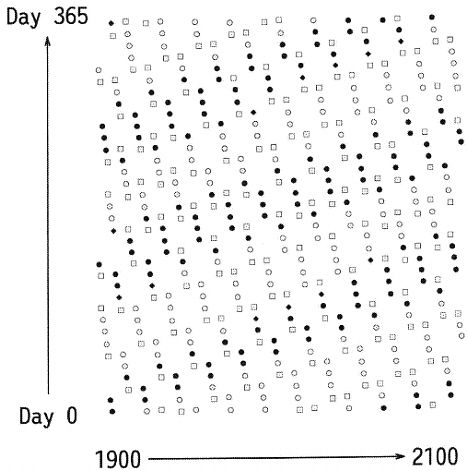
FIGURE 3–1. The pattern of solar eclipses between 1901 and 2100 is shown here. Diligent eclipse record keeping might have allowed an ancient society to predict future events, although this is more straightforward for lunar eclipses, as in Figure 3–2. (Solid circles represent total eclipses, open circles annular eclipses, and black diamonds hybrid events—part annular/part total. Partial eclipses are shown as open squares.)
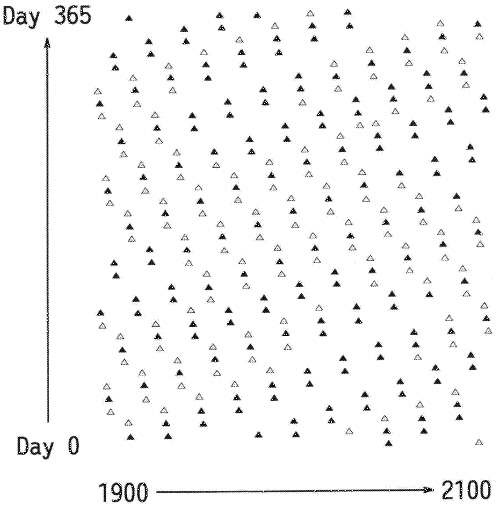
FIGURE 3–2. The pattern of lunar eclipses between 1901 and 2100 plotted in a similar way to Figure 3–1. These data are based upon our modern knowledge of the lunar orbit. However, in principle something like 60 percent of all the lunar eclipses over an extended period might be charted by some ancient civilization simply from diligent sky-watching, assuming that cloud cover sufficient to blanket the Moon for some hours did not occur throughout the kingdom. (Solid triangles represent total eclipses; open triangles are partial events.)
Patterns clearly can be seen in those plots. As described above, eclipse records are like tapestries woven in time:
Had I the heavens’ embroidered cloths,
Enwrought with golden and silver light,
The blue and the dim and the dark cloths
Of night and light and the half-light…
William Butler Yeats, He Wishes for the Cloths of Heaven
THE LENGTH OF THE YEAR
To make some statement of when an eclipse is anticipated, a framework is needed to which to fit the event of interest. That is, a calendar is required. To us, that seems an obvious concept, but only because we are habituated to a certain dating convention and think little about how it governs our lives. When the ancients studied eclipses this was not the case. There was no universal calendar, and even within a well-governed state such as the Roman Republic the calendar used was by no means regular. That is why Julius Caesar added 80 days to 46 B.C., to bring January 1, 45 B.C. near the time he thought it should be according to the seasons.
The situation was similar elsewhere. Although King Ptolemy III of Egypt had decreed in 238 B.C. that a quadrennial cycle of leap years should be used, to reflect the real duration of a year, his dictate was not put into common use. Different nations used calendars that drifted against the seasons, such drift either being allowed to continue, as with the earlier Egyptian Sothic cycle, or being abruptly corrected from time to time, as with the Roman calendar before Julius Caesar rectified matters.
The design of any perennial calendar obviously would require a detailed knowledge of the year length far beyond the flowers and floods mentioned earlier. The tapestry laid down by the eclipse records made this possible. Imagine that one vertical thread in our wall-hung tapestry represents a year and that you have somehow managed to get the year length correct. Time starts at far left and proceeds to the right until the present, which is where the tapestry turns a convex corner and is not yet visible to us.
Under this circumstance of one thread per year we can begin to pick up some features of the pattern that must result. The 19-year Metonic cycle produces numerous sets of four or five dots arranged horizontally. Each individual dot will be a component part of one of the sequences of 70 or 80 dots produced by the saronic cycle, these being slanted from bottom left towards upper right because their time spacing is 18.03 years. The origins of various other components of the tapestry pattern are detailed in the Appendix. For example, there will be sharply downwards-sloping lines produced by eclipses coming 10.88 days earlier from year to year, because 12 lunar months are that amount short of a full solar year.
It is not necessary to continue with more features of the pattern, such as the 3.8-year gaps (a subdivider of the 19-year Metonic cycle). You can refer to Figures 3–1 and 3–2 to see what I mean. The thing to recognize here is that if an incorrect length for the year were employed, then the complex pattern of the tapestry would be skewed. Getting the tapestry straight and agreeable provides in effect a precise evaluation of the length of the year. This measure is far more accurate than floods or flowers, cuckoo calls or salmon spawning, sunrises at solstices or equinoxes, or waiting
for Sirius to emerge again from the glare of the Sun, as we shall see below.
THE ECLIPSE GRID
Records of eclipses provided a “grid” against which the lengths of the celestial cycles could be reckoned, because eclipses repeat on a variety of distinct cycles defined by the lengths of month and year. You may be familiar with simple regularly spaced grids, like graph paper divided into big squares one inch on a side, and smaller squares each one-tenth that. The eclipse grid is different. The great thing about eclipses is that the subdivisions are not so simple, and that allows greater precision.
Similarly in many trades like engineering some device such as a vernier caliper is used. A vernier has sliding scales on which divisions are marked unequally on the two sides: on one side a centimeter may be split into ten separate millimeter marks, whereas on the sliding part which faces it the centimeter is divided into just nine equal units (each of 1.11111…millimeters). By noting where two notches align, it is possible to measure lengths accurate to one-hundredth of a centimeter, a tenth of the smallest division.
The eclipse grid provides not just one set of overlapping measuring sticks, like a vernier, but many. Because of that it can be used to deduce not only the duration of the year, but also the lengths of the various types of month, even without having artificial clocks available. The ancient Babylonians, Greeks, and Chinese, remember, did not have the advantage of mechanical timepieces, only water clocks and sundials.
Put yourself in their place. Imagine that you note a partial solar eclipse beginning about six hours after midday, a time that is
determined simply by measuring the angle of the Sun from the noon meridian. Looking back through the records you find that a similar event occurred 18 years and 10 days before, at about two hours before noon. There have been 223 synodic months in between, and you can determine the relative time of day accurate to about half an hour. This enables you to stipulate the mean length of a synodic month to better than a minute. This is much, much better than one could achieve simply by trying to judge when the Moon is fullest, especially as no clock is available. The other types of lunar month, discussed in the Appendix, may similarly be calculated.
That is how the month duration could be reckoned using eclipses. Now what about the year? The precession of the equinoxes was discovered by Hipparchus, a Greek astronomer who lived between about 190 and 125 B.C. The task Hipparchus began with was a determination of the lengths of the year and the months.
Others had come before him. In 432 B.C. Meton had proposed his 19-year cycle containing 6,940 days, producing an average year length of 365.2632 days. About a century later his countryman Callippus advocated an alternative cycle four times as long. His cycle of 76 years he thought should contain 27,759 days.That is one less than four Metonic cycles (27,760 days) and is a better approximation to the real year length: 27,759 divided by 76 equals 365.25. It is not perfect, though. When Hipparchus made his determination of the year another two centuries later, he arrived at a value one three-hundredth of a day less. Noting that four Callippic cycles last for 304 years, Hipparchus proposed a cycle of that duration with one day subtracted to compensate for the year really being slightly shorter than 365.25 days.
Actually, the year length derived by Hipparchus was still slightly wrong. (One part in 300 of a day below 365.25 results in 365.2467 days, whereas the mean tropical year—the average year length used by astronomers, as discussed in the Appendix—of 365.2422 days is about one part in 128 below.) Nevertheless his was a remarkable achievement because he was able to show that the seasonal cycle was not the same as the time between the stars returning to the same places in the sky, called the sidereal year. That is, Hipparchus recognized the movement of the Earth’s spin axis known as the precession of the equinoxes. In view of that his name is revered in the history of astronomy.
From our present perspective we should ask how he did this. The answer to that is simple: through eclipse tables. Hipparchus made his own eclipse observations between 146 and 135 B.C., and compared these with earlier Babylonian records. That is how he was able to determine the years and the months so accurately, feeding into the knowledge base that eventually brought about our calendrical systems.
Hipparchus lived well before the invention of the mechanical (let alone electronic or atomic) clock, the telescope, or finely divided measuring scales, pocket calculators, and computers. He was working two millennia before the necessary physical theories were developed allowing the motion of the Moon across the sky to be programmed and thus calculated ahead of time with utmost precision. It may well be that unknown Babylonian astronomers had beaten Hipparchus to it, using the same techniques, but that does not diminish the stature of his work. In ancient times, then, various individuals of genius, living in societies possessing careful records of past celestial events, were able to interpret those records and deduce the lengths of the years and the months to a matter of
minutes and seconds. That was a considerable achievement, made possible only by the regularity of the eclipse grid.
BY THE RIVERS OF BABYLON
Much of the eclipse and calendar knowledge spreading from the Middle East to Greece and Rome and thence the rest of Europe stemmed from understandings developed in Mesopotamia between 3000 and 500 B.C.
Mesopotamia is strictly the region between the Tigris and Euphrates rivers. In ancient times it was a bountiful shallow valley, the home of several distinct civilizations over the last three millennia B.C. Babylon itself was on the Euphrates, about 60 miles south of modern-day Baghdad. The establishment of the city predates 3000 B.C., and by 2500 B.C. the entire region was united under Babylonian rule.
The early peoples of that region are generally termed the Babylonians, but one should be aware that there were racial and cultural differences as power changed hands from one era to the next. Much of the learning of the melded culture that arose came from the Chaldeans, who originated on the western side of the Euphrates. Near where that river formerly emptied into the Persian Gulf was the city of Ur, the capital of the Sumerians, who lived along the northern fringe of that sea. From east of the Tigris came the Elamites, and from the north of Babylon arose the Akkadians. All these may be subsumed into the overall Babylonian Empire, the heights of which were reached between 2800 and 1700 B.C.
In the following thousand years their power ebbed, while the bellicose Assyrians from farther north became the dominant cul-
ture, conquering Babylonia in 689 B.C. and destroying much of the city. Thankfully the Assyrians did not obliterate the long-standing astronomical culture of Babylonia. They soon adopted various superstitious practices based upon the belief that celestial phenomena were harbingers of approaching events on Earth. The major developments that led to horoscopic astrology occurred in this era. Comets and vivid shooting stars were interpreted variously as being auspicious or dangerous omens, while eclipses were regarded as being highly significant. An example is the following prophecy from a court astrologer: “On the 14th an eclipse will take place; it is evil for Elam and Amurru, lucky for the king, my lord; let the king, my lord, rest happy. It will be seen without Venus. To the king, my lord, I say: there will be an eclipse. From Irasshi-ilu, the king’s servant.” Obviously the ruler could be put in a good temper by having an eclipse interpreted in advance as being beneficial (but heaven help the astrologer should, say, the king’s favorite horse or dog fall sick that day). Such predictions could be made with an incomplete understanding of eclipse cycles. The astrologers might notice sequences of several lunar eclipses recorded six full moons apart, and once the first in a new series was seen the subsequent events might be calculated. This is a much simpler knowledge than that of the saronic and longer-term cycles. The problem for the astrologers was that they could not anticipate the first eclipse in a series, and that might incur regal displeasure.
Assyrian rule was only temporary. Weakened by various incursions around its periphery, the over-stretched Assyrian Empire succumbed by 606 B.C. to attacks from the resurgent Babylonians and the Medes (the kingdom of Media was to the northeast, towards the Caspian Sea, the northwestern part of modern Iran).
Under the famous king Nebuchadnezzar, who ruled from 604
until 561 B.C., the Babylonian Empire expanded. They rampaged to the west and destroyed the great Temple of Solomon in Jerusalem, leading to the Exile (the captivity of the Jews in Babylonia, 597–538 B.C.). In this climate of astrological belief the Babylonian priesthood who read the signs of the sky became rich and powerful, the regents and generals making decisions based on advice interpreted from celestial phenomena, both of the past and anticipated in the future.
The Babylonian regime was overthrown for the last time, by the Persians, early in the fourth century B.C. When the Jews eventually returned to Judea, they took with them the astronomical knowledge on which the Hebrew calendar is based, with its strict rules for phasing various religious feasts against the Sun and the Moon. They had no time for the astrological deities of the Babylonians, but they did want to know about how the planets moved in the sky. In those days the term planets encompassed all regular moving objects: the Sun and the Moon, as well as Mercury, Venus, Mars, Jupiter, and Saturn. That makes seven. Our seven-day week derives from the astrological planetary week of the era reinforced by the Jewish Sabbath cycle of seven days.
With their new Persian masters the astrological priesthood in Babylon needed to adapt to preserve their privileged place in society, and to do that they needed to develop a better understanding of how the celestial objects moved. Studies of past eclipse records intensified, and it seems likely that about this time the saros was discovered.
There is direct evidence of this discovery. A fragment of an eclipse list between 373 and 277 B.C. has survived, and it is split into columns covering 223 synodic months; this is the number in a saros. A saros, remember, contains 19 eclipse years, each contain-
ing two eclipse seasons, making 38 in all. Each of the columns mentioned consists of 38 horizontal lines. It seems that the Babylonian astronomers knew about the saros at least by the third century B.C., and so were able to predict eclipses into the distant future rather than merely short-term runs.
By then the Persian Empire had been overwhelmed by Alexander the Great, and from about 331 B.C. Babylonia was incorporated into the vast empire that had been conjoined through his conquering forays west through Egypt, and then east all the way to India.
Alexander was from Macedonia, the northern part of what we now call Greece, as opposed to Athens and the southern states. His dynasty ruled much of the eastern Mediterranean for some centuries, for example as the Ptolemies in Egypt. The last of them was Cleopatra. After Alexander’s death—in Babylon in 323 B.C., at age 33—the lands he had conquered were consolidated into what became known as the Seleucid Empire.
Under Greek hegemony Babylonian astronomy continued to thrive, and the results of observations were relayed back to Greece, to men such as Hipparchus. It was the Babylonian records of eclipses, coupled with his own observations, that enabled Hipparchus to take such major steps forward in determining the cycles of the heavens.
PROJECTING THE PATTERN FORWARDS
How far back do the eclipse records of Babylon go? Solar eclipse notations that may be unambiguously interpreted and dated start from 700 B.C., but most postdate 350 B.C. On that basis, assuming that at least a century of records would be needed to decipher
the saros, it would seem unlikely that eclipse prediction based on those records would have been possible much before 250 B.C.
Who, then, was first to predict a total solar eclipse correctly? This is a question over which historians of astronomy have argued a great deal, because there is an apparent prediction from much earlier than that.
Herodotus (484–425 B.C.) was a Greek historian who wrote most of the surviving accounts of his era and earlier. He claimed that Thales of Miletus (see Figure 3–3) predicted the solar eclipse in 585 B.C. that occurred during a battle between the Medes and the Lydians. (Lydia was the western end of Asia Minor, where the city of Miletus was located.)
Thales does seem to have understood the rudiments of solar eclipses, recognizing that they are due to the Moon passing in front of the Sun, although in his day the nature of orbits was unsuspected. Thales thought of the Earth as a flat disk floating on a great sea, the Sun and Moon being other disks moving above it, and sometimes they happened to align. The suggestion of the Earth circuiting the Sun remained some time off. Aristarchus of Samos proposed the concept in the third century B.C., but it was not until after the Copernican revolution in the sixteenth century that the idea gained wider acceptance, in the face of ecclesiastical opposition.
The 585 B.C. eclipse certainly seems to have caused the Medes and the Lydians to reconsider their hostile intent and agree to a peace treaty after five years of war, each seeing it as an omen; however, it is not clear that Thales predicted its date and circumstances. We are able to back-calculate to show that the path of totality on the afternoon of May 28 swept along the Mediterranean and fairly centrally from west to east across Asia Minor, where
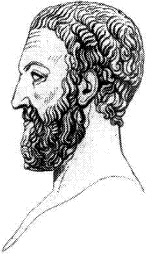
FIGURE 3–3. The pioneering Greek mathematician Thales is often credited with making the first prediction of a total solar eclipse, although historians of science now doubt whether he did more than suggest that such an eclipse would occur in a certain year. Thales was from Miletus, a town on the western coast of what is now Turkey. The eclipse track passed across that area in 585 B.C., bringing to an end a long-standing war between rival peoples.
the armed dispute was taking place and the Sun was blanked out for over six minutes.
It was a very unusual event, but Herodotus wrote only that Thales gave the year, so one might wonder whether it was a true prediction or just a lucky guess. Predicting that a partial solar eclipse will occur is fine, but getting a total solar eclipse right is another thing entirely. On balance it seems that Thales and his contemporaries did not know how to foresee eclipses by any means other than the short-term relations like the ten-day shifts from one year to the next. Hipparchus used eclipse data, and the saronic cycle, to ascertain accurate values for the year and the lunar months, but did not make forward eclipse predictions.
The eclipse knowledge gathered by the Babylonians lay dormant for many centuries. Hipparchus and others knew that the year was not exactly 365.25 days long, and yet the Julian calendar leap-year cycle based upon that length persisted until the sixteenth
century. In the same way, the detailed cycles making eclipse prediction possible were not to be used for a long time.
EDMOND HALLEY AND ECLIPSES
The first real predictor of eclipses will come as a bit of a surprise. Edmond Halley (1656–1742) knew that the comet bearing his name would come back in 1758, long after his death, and said he hoped that when it did appear it would be recalled that it was an Englishman who had foreseen its return. But Halley has another claim to fame with respect to predictions: in the modern era it was he who recognized how to use the saros to pre-calculate eclipses. In fact, his contemporaries considered that he had discovered that cycle, not realizing that the Babylonians and Greeks had known of it so long before, the understanding having been lost. It was Halley who gave the saros its name.
From the late seventeenth century Halley was one of the lions of the Royal Society of London (see Figure 3–4). His scientific interests were many and various. In 1693 alone Halley read papers at meetings of the Society covering such disparate subjects as:
-
How to determine the positions of the tropics
-
The pressure within a diving bell
-
How the length of the shortest day varies with latitude
-
How deformed fingers are inherited within some families
-
Mortality rates and annuities
-
How crabs and lobsters regrow amputated claws
-
A hydrographic survey of the coast of Sussex, in the south of England
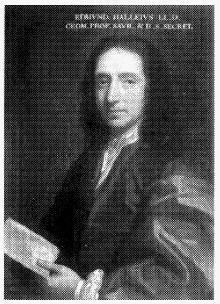
FIGURE 3–4. Edmond Halley pictured in his younger days, shortly after he discovered the saros. The inscription shows that, apart from being a doctor of laws, Halley was also Savillian Professor of Geometry at Oxford University and Secretary of the Royal Society of London. Later he took up the appointment of Astronomer Royal.
Obviously he was a very busy man.
Halley’s investigations of eclipses was a recurring theme, and the previous November he is recorded to have given “…an account of the Eclipses of the Sun and Moon to bee computed by an easy calculus, from the Consideration of the Period of 223 Months, shewing how to aequate between the extreams of the excess of the odd hours above even days, which is always between 6.20 and 8.50. He produced a Table ready calculated for this purpose, and shewed the use thereof. Which he promised to exemplify against the next Meeting.” That, in effect, is the announcement of the discovery of the saros, Halley having recognized even the limits to the odd hours and minutes above any particular 18-year plus 10- or 11-day period. The following week “Halley shewed a Paper wherein he had computed the Eclipses of the Moon in severall Series, and said, that he found, that he could very
well represent them all; much nearer than they were observed by the severall observers.” How could one predict something more accurately than it could be observed? The answer is that Halley had found that lunar eclipses predicted using the saros provided a more precise timepiece than the mechanical clocks used by the observers, and for matters of navigation that was potentially a most valuable discovery.
THE NAVIGATIONAL UTILITY OF LUNAR ECLIPSES
Britain’s rule of the waves from Halley’s time onwards came about not only from its strong navy, but also through its scientists providing accurate navigational charts and methods for determining position at sea.
This did not happen overnight. The measurement of one’s geographical longitude was a long-term problem. Deduction of the latitude was relatively easy, from the minimum angle achieved each day between the Sun and the overhead point (called the zenith). This minimum occurs at noon. At night, various stars can be used. Tables of Sun and stars were available allowing a ship’s latitude to be ascertained in that way, but longitude is a different story.
As you sail east or west the time according to the position of the Sun alters. If you had an accurate clock that maintained the time at some reference point, say back in London, then by comparing the clock time with the time according to the Sun in the sky, the longitude might be determined. Unfortunately the pendulum clocks used in churches and observatories would not work on a tossing and rolling ship at sea.
In 1714 the British government offered a very large prize—
£20,000, worth about $3 million today—to anyone who could solve this general problem and enable ships to be navigated more safely. Prospective solutions fell into two camps. One approach involved constructing mechanical clocks that would function accurately on board ship, and this led to many advances in timekeeping. (The identity of the word for a time period spent maintaining a lookout, and a small timepiece that will fit in a pocket or strap to your wrist, did not come about by accident. I refer, of course, to a watch.) The problem was eventually solved this way by a skilled artisan, John Harrison, although there was much wrangling over the award of the prize (he never received the cash and credit which was his due) continuing for several decades.
Harrison was an outsider to the scientific establishment, which favored a different method: using astronomical objects as natural clocks. In principle, for instance, the positions of the four giant moons of Jupiter might be read as the hands on a clock, showing the same time whether viewed from anchor in the Thames estuary or from Port Royal in Jamaica.
Jupiter, though, could not be seen for much of the year when lost in the solar glare and was also difficult to observe telescopically from a ship in the mid-Atlantic. The Moon provided a better target. It could be seen at some stage during the day for all except about 72 hours straddling conjunction each month, and in principle its position could be used to give the time.
The problem was that the location of the Moon in the sky, from a theoretical basis, was not known with sufficient precision. The best available set of positions for the Moon computed in advance was derived from the lunar theory published by Sir Isaac Newton in 1702, but observations showed these to be inaccurate. Halley examined this question and, realizing that the eclipse grid
allowed a major refinement, he suggested a solution that effectively used the saros.
Some decades before, John Flamsteed (1646–1719) had been Astronomer Royal and had made measurements of the lunar positions, these showing varying discrepancies from the positions according to Newton’s theory. Between 1722 and 1740 (a complete saros) Halley, by then Astronomer Royal himself, made 2,200 observations of the same parameter, and discovered that the discrepancies charted against the theoretical positions simply repeated those displayed by Flamsteed’s measurements from 18 and 36 years earlier. This indicated that Newton’s theory could be numerically corrected using the saros in quite a simple way.
In the middle of his observations, in 1731, Halley recognized the potential of this method to provide a solution to the navigation problem, but failed to publish the results during his lifetime. By the time Halley’s analysis appeared in 1749, better lunar theories had been developed. Unbiased observers also had realized by then the accurate and practical use of Harrison’s clocks. This did not, though, stop the establishment astronomers from fighting a continuing rearguard action.
Edmond Halley’s lunar observations were never used in the practical matter of navigation, but his earlier investigations did lead to the rediscovery and naming of the saros. Halley recognized not only that eclipses repeat on that cycle, but also that the eclipse characteristics recur. To that extent he is the true father of eclipse prediction as we have received it.
EARLIER USAGE OF SHORT ECLIPSE SEQUENCES
Although the saros had been forgotten between the era of the Babylonians and Greeks and Halley’s time, the fact that short-term
sequences of eclipses occur had not. Perhaps it might be more correct to say that each age rediscovered such coincidences, just as generations of schoolchildren look at their atlases, note that South America could be shifted eastwards and twisted to fit rather nicely into the concavity of Africa, and thus reinvent the concept of “continental drift.” Regular sky watchers would soon realize that eclipses tend to repeat in series moving progressively earlier by ten or so days in the year, such that the next event might be predicted. Similarly the Metonic cycle was well known, providing a 19-year pattern, plus the 3.8-year subdivider.
Some forward-prediction of eclipses over decades was feasible in medieval times, then, although it awaited Edmond Halley to tease out the secrets of the saros, employing the gravitational theory of Newton plus other achievements of the burgeoning pursuit of natural science. Three centuries before Halley and Newton, an astronomer might gather eclipse records from manuscripts kept in monasteries and identify patterns, but the wide dissemination of eclipse predictions could not occur until the introduction of printing.
Johannes Gutenberg (1400–1468) is normally credited with the invention of the printing press. It was another Johannes, also a German, who in 1472 became the first person to print an astronomical almanac. This was Johannes Müller, better known as Regiomontanus, the latinized name of the city of Königsberg where he was born. Regiomontanus produced printed predictions of when eclipses were due, and these tables plus later works of a similar nature would prove to be important for navigational purposes. Consider an example.
In the 1580s the British wanted to found a new colony in North America, that colony eventually becoming Virginia, named
for Queen Elizabeth I who sanctioned Sir Walter Raleigh’s tentative exploration of the region. The first thing they needed to do was to determine the geographical coordinates of the area, so that later ships would be able to find their way. Basically, Raleigh and his colleagues needed to know the width of the Atlantic Ocean.
It was known from the tables that a total lunar eclipse was due at about midnight (London time) on November 17–18, 1584. And so a pair of astronomers and their assistants landed on Roanoke Island, just off the main coast (where they might be protected to some extent from hostile natives), some months ahead of time. The eclipse would be visible both from England and the west of the Atlantic.
By setting up a pendulum clock and synchronizing it with the local time according to the Sun, the astronomers were able to say when the eclipse started as they saw it. At precisely the same instant astronomers in England would note the onset of the eclipse according to their own clocks. The difference in the times reflects the difference in longitudes, and thus the coordinates of the island were calculated once the data were brought back to England. Knowing that one location, it was then simple to determine other points in the new colony, in the same way as we might refer directions to some local landmark (like “five blocks west of Grand Central Station”).
An important factor to note is that only lunar eclipses were of utility in this regard. A lunar eclipse could be seen from the entire night-side hemisphere, the instants at which the various contact points are observed being independent of the viewer’s location. This is not the case for solar eclipses: the contact times in that case depend critically upon your location, the Moon’s shadow taking some hours to sweep across the globe.
The obvious usefulness of lunar eclipses for ascertaining the longitudes of transoceanic reference points meant that most voyagers carried predictive tables of such events. A prime example is Christopher Columbus, who possessed a copy of the Calendarium published by Regiomontanus in 1474. Most people know that Columbus landed in the New World in 1492, but few realize that he made several subsequent transatlantic trips. An eclipse saved him and his men on the fourth of his westerly ventures.
CHRISTOPHER COLUMBUS AND THE LUNAR ECLIPSE OF 1504
Columbus struck trouble in the Caribbean in 1503 when, having already needed to abandon two ships, his last pair of caravels also became riddled with marine worms. He was forced to lie up on the northern shore of Jamaica, at a small cove named Santa Gloria (now Saint Ann’s Bay).
The Jamaican indigenes were friendly when Columbus arrived, but their hospitality had begun to wane after six months of the prolonged Spanish stay, the stranded party repeatedly needing to request food and water in return for such trinkets as they could offer, things like beads, nails, and mirrors. Both the novelty and the supply had run out by the end of the year.
The admiral had sent a party of men east in small boats to the Spanish-occupied island of Hispaniola (now Haiti and the Dominican Republic) to seek help, but did not hear back. In January 1504 half of the remaining crew mutinied and departed for Hispaniola, attempting to make the hundred-mile passage in canoes hewn from local timber.
This left Columbus with 50-odd men on board two worm-
permeated vessels. He could not abandon the ships because of the many valuable items on board, not the least being the survey maps he had drawn up in exploring the coasts of Honduras, Costa Rica, Panama and Nicaragua as he searched unsuccessfully for a passage west to the Pacific and Asia. By February the Indian caciques (leaders or chieftains) saw the Spaniards were at their mercy and refused to provide any more provisions.
Columbus was desperate. Referring to his Calendarium he found that a total lunar eclipse was due on the evening of February 29 (soon after midnight on March 1 as seen from Europe). He invited the caciques on board his flagship, the Capitana, providing them with some entertainment but with serious undertones. Columbus explained that he and his men were Christians who worshipped a powerful god, superior to the deities of the Jamaicans, and that He had been angered by their refusal to succor the Spaniards in their time of need. As a result it was the intention of God to punish them with famine and disease, but He would give the caciques one last chance, by providing a sign from Heaven of His displeasure, darkening the full moon soon after it rose in the east. As an additional clear indication of divine wrath, the Moon would be reddened. If they paid heed and changed their ways they might be saved from pestilence and starvation. With this Columbus sent them on their way.
Many of the chiefs mocked Columbus for his suggestion, but others were less confident. As the Moon climbed above the horizon it was seen to be somewhat dimmed, the partial eclipse having already begun. All were convinced as the shadow of the Earth enveloped the orb rising in the east, reaching totality an hour after moonrise. Pandemonium ruled, and the caciques dropped to their
knees, begging Columbus to intercede on their behalf and save them, as depicted (rather imaginatively) in Figure 3–5.
Columbus was too smart to agree immediately. For added effect he retired to his cabin, knowing that the total phase would last for about one and three-quarter hours. Having timed his withdrawal with a sandglass, Columbus reemerged at the appropriate time. He told the Jamaicans that he had consulted God and persuaded Him to cease the shielding of the Moon, so long as they promised to behave themselves and supply the Spanish for so long as they needed to stay. The caciques hastily agreed, and with a wave of his arm Columbus gave the sign that the Moon should be unveiled, which of course was promptly enacted in the sky as the shadow slowly receded.
The Spaniards still needed to wait until June before a rescue ship appeared, but they did not lack food or water during the interim. For Columbus the eclipse had another implication, because it made it possible to calculate his longitude.
FOOLING THE NATIVES?
This tale of Columbus’s deceptive use of an eclipse to fool a less scientific people has been echoed in various works of fiction. Quite likely the episode provided a direct inspiration for such writers; for example, Washington Irving recounted Columbus’s subterfuge in a best-selling book, making the story well-known.
In 1889 Mark Twain published A Connecticut Yankee in King Arthur’s Court, a novel that envisions life in sixth-century England. The author has Hank Morgan, the Yankee in the title (and Bing Crosby in one movie version), hoodwinking the ignorant folk of that era by invoking prior knowledge of a solar eclipse due on
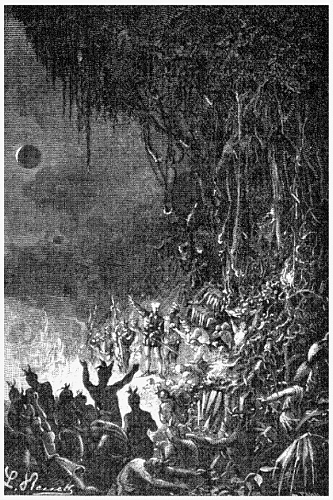
June 21, 528, even stating the precise time of totality (three minutes past noon). Twain has Morgan, who is jailed awaiting execution, threaten King Arthur with a blanking out of the Sun:
Go back and tell the king that at that hour I will smother the whole world in the dead blackness of midnight; I will blot out the Sun, and he shall never shine again; the fruits of the Earth shall rot for lack of light and warmth, and the peoples of the Earth shall famish and die, to the last man!
Morgan, though, is not believed, and he is tied to a stake to be burnt, Merlin wanting to light the flames himself. As in any thriller, rescue comes in the nick of time:
I said to myself that my eclipse would be sure to save me, and make me the greatest man in the kingdom besides…
I waited two or three moments: then looked up; he was standing there petrified. With a common impulse the multitude rose slowly up and stared into the sky I followed their eyes; as sure as guns, there was my eclipse beginning! The life went boiling through my veins; I was a new man! The rim of black spread slowly into the Sun’s disk, my heart beat higher and higher, and still the assemblage and the priest stared into the sky, motionless. I knew that this gaze would be turned upon me, next. When it was, I was ready. I was in one of the most grand attitudes I ever struck, with my arm stretched up pointing to the Sun. It was a noble effect…
“Name any terms, reverend sir, even to the halving of my kingdom; but banish this calamity, spare the Sun!”
My fortune was made. I would have taken him up in a minute, but I couldn’t stop an eclipse; the thing was out of the question. So I asked time to consider. The king said:
“How long—ah, how long, good sir? Be merciful; look, it groweth darker, moment by moment. Prithee how long?”
“Not long. Half an hour—maybe an hour.”
There were a thousand pathetic protests, but I couldn’t shorten up any, for I couldn’t remember how long a total eclipse lasts.
It grew darker and darker and blacker and blacker…. It got to be pitch dark, at last, and the multitude groaned with horror to feel the cold uncanny night breezes fan through the place and see the stars come out and twinkle in the sky. At last the eclipse was total, and I was very glad of it, but everybody else was in misery; which was quite natural…. Then I lifted up my hands—stood just so a moment—then I said, with the most awful solemnity:
“Let the enchantment dissolve and pass harmless away!”
There was no response, for a moment, in that deep darkness and that graveyard hush. But when the silver rim of the sun pushed itself out a moment or two later, the assemblage broke loose with a vast shout and came pouring down like a deluge to smother me with blessings and gratitude.
Twain’s description of the eclipse seems accurate in every way, except one. There was no solar eclipse visible in England in A.D. 528. That was an invention.
One must never let the facts get in the way of a good story. In his first novel, King Solomon’s Mines (1886), H.Rider Haggard has his heroes escape the clutches of a despotic African king by using a predicted eclipse in a similar way. Mind you, Haggard could not make up his mind whether it was a solar or a lunar eclipse, changing from one to another between editions: “Yet I tell you that tomorrow night, about two hours before midnight, we will cause the Moon to be eaten up for a space of an hour and half an hour. Yes, deep darkness shall cover the Earth, and it shall be for a sign.” The lunar eclipse duly occurred, and while the natives are in terror of their lives (Figure 3–6) Allan Quatermain and his colleagues make a getaway. In the previous edition it was a solar eclipse just after midday. Perhaps someone had told Haggard that his science was wrong; he has Quatermain describing their flight in this way:
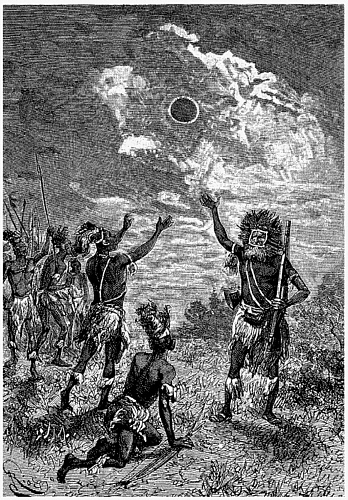
For an hour or more we journeyed on, till at length the eclipse began to pass, and that edge of the Sun which had disappeared the first became again visible. In another five minutes there was sufficient light to see our whereabouts…
Many eclipse enthusiasts would love to suffer the slings and arrows of hour-long totality, but the laws of physics forbid it. A handful of minutes is all you can get.
This basic idea of using an eclipse to escape hostile but ignorant natives was copied by the Belgian writer Hergé (Georges Rémi) in his Adventures of Tintin. In one episode Tintin and his eccentric colleagues are to be burnt at the stake by the Emperor of the Incas, having tried to make off with their pockets full of diamonds, just as in King Solomon’s Mines. Although his friends think that Tintin is babbling nonsense, in fact he is giving praise to the Sun as an eclipse approaches, bringing about their salvation.
MODERN TIMES
It is clear that eclipses have had an importance in the development of human society far beyond people simply wondering at their origin. Eclipses provided the measuring stick with which the year was determined, resulting in accurate calendars. From time to time they startled the ancients, perhaps precipitating pivotal moments in history, as the darkening of Sun or Moon was seized upon as a
propitious omen by some wily commander or feared by a superstitious enemy. The ability to foresee when eclipses would be witnessed allowed more scientific cultures to impose their will upon others, as in the case of the subterfuge conducted by Christopher Columbus.
Seeing the curved profile of the Earth cast onto the Moon, the ancient Greeks reasoned that the planet is spherical, and this was backed up by other simple observations like the finite curved horizon espied from the top of a mountain. The eventual acceptance of that notion, and the Earth’s movement about the Sun in common with the other planets and celestial wanderers like comets, led at last to an understanding of the lunar motion. From that comes our ability to predict eclipses independent of any past record: I can run a computer program using the lunar and solar orbits, printing out when the bodies align with utmost precision, without direct reference to any past eclipse.
Such a computer program may be complicated, but basically it uses the simple gravitational theory of Isaac Newton. We have studied the eclipses of the past, through to Newton’s time, but now we might like to come a little more up to date. That involves an interstitial step, though, in which eclipse observations were employed to show that although Newton’s theory is a good approximation, it is not a one hundred percent accurate description of the universe.
About the time Charlie Chaplin was making his earliest movies, eventually culminating in Modern Times, eclipse observations were likewise starting to enter their own modern times and being used to verify Albert Einstein’s Theory of Relativity. That is the subject to which we now turn.