Eclipse: The Celestial Phenomenon That Changed the Course of History (2001)
Chapter: 14. Stepping Beyond the Solar System
14
Stepping Beyond the Solar System
The astronomers said: “Give us matter, and a little motion, and we will construct the universe.”
Ralph Waldo Emerson
We have been straying towards the fringes of the Solar System, and now we have just about reached the edge. From 1979 until 1999 Pluto was not the outermost planet, its eccentric orbit making Neptune the furthest from the Sun. In February 1999, Pluto again attained its status of the most distant.
That would only be a factual statement if there were no other major body yet awaiting discovery out beyond Pluto’s orbit. Since 1992 astronomers have spotted some hundreds of minor planets in the region between about 30 and 60 astronomical units from the Sun, members of what is called the Edgeworth-Kuiper belt, recognizing the scientists who suggested their existence more than four decades before the first of them was discovered. Another collective name for them is the trans-Neptunian objects (TNOs). Pluto is about 1,410 miles in diameter, and is generally classed as being a major planet, the ninth in the Solar System. These
numerous TNOs are mostly between 200 and 300 miles in size. In the year 2000 a new TNO was found that may be as much as 600 miles across, perhaps even larger than Ceres, the biggest minor planet (or asteroid—the terms have the same meaning) in the main belt. The nature of the TNOs seems to be quite different from the asteroids in the inner Solar System, however. Those appear to be rocky and metallic in composition, whereas TNOs are largely icy, like Pluto itself. In many ways it might be better to think of TNOs as being giant comets, thankfully keeping their distance from us, rather than classing them as minor planets.
Clyde Tombaugh discovered Pluto in 1930. For some years he had been diligently scouring photographs of the deep sky, at the Lowell Observatory in Arizona, before he eventually found a tell-tale moving point of light. At first Pluto was thought to be much larger than is actually the case, with a mass perhaps six times that of the Earth. Over the seven decades since our estimates of its dimensions have systematically downgraded it, and only recently have its mass and diameter been determined properly from eclipse observations. We start this chapter by considering Pluto’s eclipses, and then see how the basic techniques employed can be extended beyond the Solar System.
THE DISCOVERY OF PLUTO
Although the perseverance with which Tombaugh searched the sky and eventually turned up Pluto is laudable, the discovery was really a fluke.
A century ago Percival Lowell and others were convinced there must be another large planet awaiting discovery, because the observed paths of Uranus and Neptune were discrepant, their
positions wandering slightly away from calculations based upon the orbits and masses of the other known planets. We have seen that in the 1840s Le Verrier and Adams had successfully predicted the existence of Neptune from such meanderings of Uranus. What Lowell did was to extend this thought process, imagining evidence for some undiscovered planet.
Lowell was prone to be over-enthusiastic in his astronomical interests. In the late nineteenth century the popular idea of life on Mars was triggered to a large extent when he argued that markings on the surface of that planet were evidence of a civilization thriving there. In part his imagined “Martians” stemmed from a misinterpretation of the writings of Giovanni Schiaparelli, the Italian word for “channels” being taken by Lowell to mean “canals.” River channels, of course, are natural hydrological features, whereas canals are artificial. Lowell was soon drawing Mars crisscrossed with a vast canal system. These perceived straight lines—which do not actually exist—suggested to Lowell and his followers that intelligent life existed on the red planet. They were wrong. This was a case of mass delusion.
Turning his enthusiasm to the possibility of an unknown planet beyond Neptune, the search Lowell sponsored did not bear fruit until well after his death in 1916. Even then his interpretation of the observed phenomena proved incorrect. In the decades after its discovery, astronomers realized that Pluto could not be responsible for the perceived wobbles in the orbits of Uranus and Neptune, and a resolution of that quandary did not come until the early 1990s. We will describe that solution at length, but first we must discuss how Pluto’s mass was determined.
PLUTO’S MOON AND MASS
When Pluto was spotted, after such a long quest, it hit the headlines worldwide. From its apparent brightness (or perhaps we should say its “faintness”) it was obvious Pluto must be small, and some of the euphoria abated. From time to time astronomers would again turn their telescopes towards Pluto, but it was hardly in the news again until 1978 when it was found to have a moon of its own. That moon was given the name Charon (see Figure 14–1). It is about 730 miles in diameter, around half the size of Pluto itself.
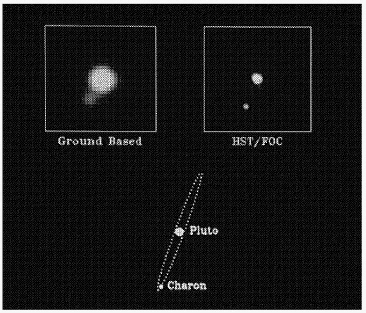
FIGURE 14–1. Images of Pluto and its moon, Charon. Ground-based observations demonstrated the latter’s existence (top left), but they are only well separated by the Hubble Space Telescope (top right). Between 1985 and 1990 our edge-on alignment to their mutual orbital plane (bottom) led to repeated eclipses, allowing the sizes and combined mass of the two to be evaluated.
The finding of Charon was nice in itself, but also quite a handy thing because it allowed astronomers to determine Pluto’s mass properly. Until then all that could be done was the definition of limits on its bulk from various perspectives. Taking characteristic values for the average albedo (the fraction of sunlight reflected), size limits could be calculated. Then, assuming Pluto to be made of rock, or of ice, or of a mixture, possible values for its mass could be calculated. Similarly a maximum value for its mass could be ascribed through the lack of major perturbations of the paths of the outer planets.
To get a better evaluation a probe is needed. That probe might be natural, or artificial. Take the case of Jupiter. The time that the four Galilean satellites take to circuit that planet can be measured, and also the sizes of their orbits. Those two pieces of information—orbit size, orbital period—make it possible to derive the mass of Jupiter, using Kepler’s laws of orbital motion. Even if only one such moon existed, the Jovian mass could still be found. Having those four bright satellites makes it a cinch, because you can compare the values obtained using each of them and look for consistency in the result.
Saturn was studied in the same way, especially through its large moon Titan. When the tiny Martian moons Phobos and Deimos were identified in the late nineteenth century it became feasible to reckon the mass of the red planet.
Unfortunately, Venus and Mercury presented long-standing problems because neither has a natural satellite. Using the magnitudes of their mutual orbital perturbations, limits had been placed on their masses, in line with those expected given densities characteristic for rocky bodies with iron cores. Better evaluations awaited visits by space probe to those planets. The mass of Venus
was determined in the 1960s through radio tracking of various spacecraft. Mercury had to wait until the mid-1970s, when NASA’s Mariner 10 satellite flew past it three times.
When Charon was discovered it was at last possible to have a stab at Pluto’s mass, but the situation was complicated. Firstly, the two objects are close to each other, and far from the Earth. Measuring their separation was therefore extremely difficult, especially through the blurring effect of our atmosphere, although the Hubble Space Telescope improved matters (compare the two upper images in Figure 14–1). Secondly, with a mass ratio of about eight to one, the Pluto-Charon system represents a binary planet (as discussed in the Appendix). Because of these factors, interpreting the orbits to get the mass of Pluto presents difficulties.
The situation was saved by the study of their mutual eclipses. Pluto and Charon rotate every six days about their barycenter with a separation of around 12,200 miles, like a cosmic dumbbell. The scale involved is shown by the lower image in Figure 14–1. The orientation of their axis of rotation is preserved, analogous to a gigantic gyroscope, meaning that at certain times we look edge-on along the plane of their mutual orbit. This means that eclipses will occur, Charon first skimming in front of Pluto, a little over three days later passing behind it. Given the sizes of the objects, one can calculate that such sequences of eclipses will last for about five years, but in episodes separated by 124 years (half the time it takes the Pluto-Charon pair to orbit the Sun).
By a great stroke of fortune, Charon’s discovery came with perfect timing, just as a five-year eclipse sequence was about to commence. This ran from 1985 to 1990, allowing astronomers to observe these events and determine a great deal about the double planet. The total intensity of light received by our telescopes was
found to drop off by about 20 percent when an eclipse occurred, Charon either dipping behind Pluto or covering part of its disk. The accurate timing of the way in which the brightness varied made it possible to calculate their mutual orbits, and so their combined mass. (Note that I wrote combined mass there, because even these observations have ambiguities, and do not render the individual masses with precision. Charon’s bulk seems to lie somewhere between 8 and 16 percent that of Pluto, but we cannot be sure.)
A better idea of the pair’s characteristics is unlikely to be obtained until the first spacecraft arrives there. A probe called Pluto Express is on the drawing board. It would certainly need to be an express, using a gravity assist from Jupiter to speed it on its way, because a slow trajectory to distant Pluto would mean that the scientists involved in its planning would have retired before their progeny arrives at its destination. At the time of writing it seems unlikely that we will deliver any space probe to Pluto before 2016.
AN OCCULTATION BY PLUTO
The atmosphere of Pluto might also be detected using eclipses: eclipses of the third kind, starlight being used to probe its properties. If this little body has any atmosphere, then one would expect it to be most abundant when near perihelion, because the increased solar heating may cause any volatile ices to sublimate. Pluto’s composition seems to comprise about 70 percent rock and 30 percent ices. The latter would be mostly water ice, but also other highly volatile solid materials like carbon monoxide, nitrogen and methane, which could form a temporary atmosphere whenever Pluto makes its nearest approach to the Sun, albeit at a distance of over 29 astronomical units.
Pluto was near perihelion in the late 1980s, and again fortune blessed astronomers interested in this little planet. In June 1988 it passed over a relatively bright star, making occultation observations feasible. The gradual dimming of the starlight before and after total obscuration allowed Pluto’s tenuous atmosphere to be fathomed. There is another reason for any space mission to Pluto to be an express: as it recedes from the Sun, that atmosphere will freeze once more, leaving the planet naked for the next two centuries.
NO PLANET X
Knowing that the mass of the Pluto-Charon double planet is small—only one part in 400 of the terrestrial mass—it was clear that the apparent wanderings of Uranus and Neptune required an alternative explanation. Many have seized upon the notion that indeed the discovery of Pluto was by chance, even if part of a deliberate search, and there must be another massive body out there, a Planet X.
This idea is too simple, though. The situation here is similar to when Le Verrier tried to explain the motion of Mercury using hypothetical bodies near the Sun. No single unknown object could explain how Mercury moved and, while popular imagination focussed upon a planet Vulcan, Le Verrier himself knew that several intramercurial bodies would be necessary. Turning to the cases of Uranus and Neptune, again no single unobserved body could explain the apparent anomalies. There would need to be not only a Planet X, but also a Planet XI, XII, XIII, XIV, XV, and so on.
Are these indeed the minor planets now being spotted regularly out beyond Neptune? The answer is no—for several reasons.
One is that they are simply not big enough, being smaller even than Pluto. Another, paradoxically, is that there are too many of them. When there are many objects, all separately producing gravitational tugs—and we think that there are some millions of minor planets in that belt concentrated between 30 and 60 astronomical units—their effect is smeared out, and no distinct wobbles to the motions of the outer planets would be produced.
This was all a bit of a tease to astronomers, the solution eventually being reached only in the early 1990s. When Voyager 2 flew by Uranus in 1986 and Neptune in 1989, radio tracking of the bending of its trajectory by the gravitational attractions of those bodies allowed researchers to determine the planetary masses with unprecedented precision. And they showed the previous values to be wrong.
When the measurement of the masses of planets using observations of natural satellites was discussed above, I did not mention Uranus and Neptune. The masses of those planets had indeed been evaluated in that way, each of them possessing a flotilla of moons, but remember that they are a long way from us. One could time the orbits quite accurately, by observing eclipses perhaps, but measurements of the sizes of their circumplanetary loops must be inherently inaccurate from this distance. However, not only did Voyager 2 pass close by those planets, but also the radio tracking could be carried out with great precision.
When the spacecraft data were analyzed, it was realized that the previous masses for Uranus and Neptune were each slightly wrong, by a fraction of 1 percent, one too high and one too low. The improved evaluations for the masses were plugged into the numerical models for the whole Solar System, and when that was done there no disagreement remained between the observed plan-
etary positions and the theoretical positions from the computed ephemeris. The earlier theoretical positions were wrong simply because they were based on slightly incorrect planetary masses.
By 1992 the last nail was hammered into the coffin of Planet X. The observed motions of the outer planets are consistent with there being no other planet comparable in size to the Earth anywhere within 100 astronomical units. This just shows again that the discovery of Pluto was a fluke, resulting from inaccurate data. No one was to blame for this; one must remember that there is never absolute certainty in science, only limits of confidence that depend on the accuracy of the information in hand at any time. Lowell and his colleagues started looking for Pluto due to wishful thinking, rather than a sober analysis of the situation, and so it was actually a happy chance that the planet was found. If Tombaugh had not spotted it in 1930, someone else would have done so before too many years were out.
ECLIPSES ELSEWHERE
It will be more than a century until we have another opportunity to witness Pluto-Charon eclipses. That pair comprises a binary planet with a mass ratio of about 8:1. Looking among the major planets, the next highest primary-to-secondary ratio is represented by the Earth and the Moon, weighing in at 81:1, so we may be justified in thinking of the Earth-Moon system as another binary planet.
Other binaries are known in the Solar System. Most asteroids are very irregular in shape (recall Figure 12–1). If they spin fast enough, asteroids may separate into component blocks that would then loop around each other, in a temporary gravitational
embrace. (“Temporary” has an astronomical meaning here: it might be a million years before some close passage by a planet causes a separated asteroid to lose its grip on the fragments.) In 1993 the Galileo spacecraft, while on its voyage to Jupiter, visited the large asteroid Ida. It was a surprise to many that Ida was found to have a small moonlet, which has been named Dactyl. The large mass ratio, however, means that we cannot really claim Ida and Dactyl to represent a binary asteroid.
From various lines of evidence there has long been a suspicion that there are binaries among the asteroids that cross the Earth’s orbit. For instance, several of the impact craters on our planet seem to be arranged in pairs formed at the same juncture. Direct evidence for such a binary object came in 1997, when observers following the brightness variation of the asteroid named Dionysus detected dips in its intensity curve characteristic of repeated mutual eclipses and occultations. Dionysus is a binary, with one lump larger than the other, and eclipses tell us so.
The astronomical context in which the term “binary” appears most often is far beyond the Solar System, in the description of binary stars. Such pairs are a well-known phenomenon. A large fraction of the apparent pinpoints of light one can see in the sky using only the naked eye actually display a dual nature if they are viewed instead through a telescope with sufficient resolution. For instance, the national flags of Australia and New Zealand both show the stars of the constellation known as the Southern Cross (or Crux), but the depictions are inaccurate on two counts. First, the colors are radically wrong. More important here, the binary properties are not shown on the flags. The brightest star in the Southern Cross is a multi-colored triplet, and the next brightest is
a doublet. Similarly Sirius, the most luminous star in all the heavens, actually has a faint companion.
It was not until the early nineteenth century that the binary nature of many stars was widely accepted, despite earlier evidence for their existence. The largest available telescope at the time was that of William Herschel, which he said could not separate stars into discrete components. Observers reporting that some bright stars had luminous companions tended to be ridiculed. It was not until 1802 that Herschel agreed that binaries existed and could be distinguished telescopically. His son John spent much of the period between 1820 and 1840 drawing up catalogues of binary stars, initially with James South in London and Paris (recall our discussion of South in Chapter 12). John Herschel later took his family with him to Cape Town in South Africa, from where he scanned the southern sky for binary stars for four years.
These were visual binaries—stars that could be resolved by eye using a good instrument. Nowadays astronomers study more distant binary systems, too far to be separated directly, by analyzing their composite spectra. The spectrum emitted by each of the two stars, often of quite disparate types, will display varying red- and blue-shifts as first one star and then the other approaches and recedes from us in their locked orbits about the mutual center of gravity. (The speed-dependent shift in the spectrum of an object, due to the Doppler effect in light, was discussed in Chapter 12.) Such stars are called spectroscopic binaries. As with Pluto and Charon, those orbits allow the stars’ masses to be investigated.
The first binary star to have its physical properties probed through such orbital data was not a spectroscopic binary, though. The star in question displayed not spectral changes, but rhythmic variations in its intensity.
THE ECLIPSES OF ALGOL
If you overshoot the mark when looking up the word “algol” in a dictionary, you may be surprised. Algology is the study of algae. Algolagnia is a psychiatric term covering sadism and masochism. ALGOL is an acronym recognized by the computer-literate, standing for ALGOrithmic Language, one of the earliest programming codes. It is Algol, a capitalized proper name, which is the subject of our present inquiry. This is otherwise known as Beta Persei, the second-brightest star in the constellation Perseus. (“Algol” is an old Arabic word, apparently meaning “demon,” so perhaps the ancients recognized its peculiar behavior long before tardy Western science did so.)
This star’s significance stems from being the first to be identified as an eclipsing binary, although its true nature was not widely comprehended until two centuries after 1667, when its radically-varying brightness first had been noted in the post-Renaissance era. In that year Geminiano Montanari, who was examining the sky from Bologna in Italy, recorded that at times it appeared much fainter than normal. No telescope is required to see this, just good visual acuity and patience.
After that no further notice was paid to Algol until 1782 when John Goodricke systematically followed its brightness over an extended period. Goodricke was an English astronomy enthusiast, a deaf-mute and just 18 years old at that stage. He found that the star’s apparent brightness decreased over several hours and then enhanced again, this trend being repeated every 69 hours, as regularly as clockwork. Goodricke communicated his discovery to the Royal Society of London and hazarded the guess that the variability might be due to some unseen pale object orbiting the star—a
planet perhaps—or possibly spots like those on the Sun, quickly moving across its surface. The notion of binary stars was yet unsuspected.
A few years later a Swiss mathematician, Daniel Huber, used Goodricke’s observations to show that “star spots” could not be responsible. He suggested instead that Algol had a darker companion star and, from an analysis of the way in which the brightness varied in time, was able to derive both feasible sizes for the pair and their separation from each other. This was pioneering work in what later became a standard field of astronomy.
Others were also of the opinion that Algol must be a binary star system producing regular eclipses but, strangely, even after the existence of visual binaries was accepted in the early nineteenth century, still the case of Algol lay dormant. Variable stars were seen, but not with the same form of brightness fluctuations as Algol. In science it is frequently the case that discrepant observations are ignored, because they do not fit in with mainstream thought at the time, and may lay ignored for years, or even decades. This was certainly the case with Algol. It was not until much later, when several similar cases were recognized, that the concept of eclipsing binaries gained a foothold, a hundred years after Goodricke and Huber got an inkling of the explanation. For them the trail did not go further, and it was long after their deaths that other astronomers realized they had been correct.
Eclipses by the Algol binary system are interesting because they differ in a fundamental way from all the types of eclipse previously mentioned. Algol comprises two large stars, one about three times the solar diameter, the other four times. They produce eclipses, as shown in Figure 14–2, which superficially might be considered similar to those of Pluto and Charon, but actually they
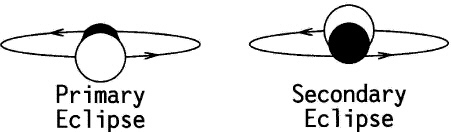
FIGURE 14–2. The eclipses of the Algol binary star system. Because the smaller star is much brighter than the larger, the primary eclipses cause the overall intensity to dip by a factor of three, while the secondary eclipses result in dimming by only about 10 percent.
are very different. Planets and their moons cannot produce light. All that Pluto and Charon (and all the other objects in the Solar System) do is reflect the light of the Sun back from their surfaces. During a Pluto-Charon eclipse the drop in the total intensity we receive is only 20 percent, depending solely on their comparative areas and albedos. In contrast, in a binary star system both components emit their own light, making possible much larger amplitudes in the variation of the total light received in our telescopes.
In most binary stars, the members are of differing types, and the intensities of the light each emits depend on the complexities of stellar evolution and their internal workings. It does not follow, therefore, that the larger of two stars must be the brightest, or even have the greater mass. If anything, the converse tends to be the case. A more massive star will have greater self-gravity which condenses it. This makes it hotter and denser in its interior, promoting nuclear fusion (the energy generation within stars through fusion reactions was discussed in Chapter 5). As a result, its energy generation rate would be elevated. Smaller stars tend to be hot and
thus white in color, larger ones cooler and redder. The amount of emitted light rises as the fourth power of the surface temperature, overpowering the influence of the greater surface area of big stars. It is like comparing a red-hot poker pulled from a fire with the filament in an electric light bulb: there is no doubt concerning which is the brighter. The tiny filament emits more light because it is much, much hotter.
In the case of Algol, then, the smaller member is hotter and brighter than its relatively dim companion. In the secondary eclipses (see Figure 14–2), at the phase when about half of the larger member is covered by the more brilliant, the total brightness of the system falls by only about 10 percent. In contrast, in the primary eclipses the dim star obscures more than half of its brighter companion, and the total intensity plummets by a factor of three. Separated by 69 hours, such eclipses last for 10 hours from start to end, the faintest part persisting for only an hour or so. During a long winter night Goodricke or others might have witnessed a complete eclipse in the Algol system and easily charted its relative magnitudes by comparison with other stars. Three nights later they could have seen the same thing, although gradually the eclipses would have fallen back until they occurred in daytime, because the cycle is not a multiple of 24 hours. Timing of the eclipses over a month or so, when visible, would have allowed the astronomers to determine the consistent 69-hour period governing the eclipses.
The fact that Algol’s errant behavior is so obvious, and yet was ignored by the astronomical establishment for many decades, is a prime example of scientific conservatism. Scientists are some of the most conventional of creatures, the majority being totally unwilling to stick their necks out. Thinking back to the lead-up to the outermost planet’s discovery, one might poke fun at Percival
Lowell and his beliefs about life on Mars, and the basis of the search that fortuitously turned up Pluto. Then again, I reckon that he derived more enjoyment from his astronomy than those who criticized him, before his death and after. “It takes all sorts to make the world turn,” goes the old aphorism, and the thought may be extended to the entire universe, and our study of it. Without the radicals who will not listen to “conventional wisdom,” scientific progress would be even slower than it is now.