Eclipse: The Celestial Phenomenon That Changed the Course of History (2001)
Chapter: 15. An Eclipse Chaser's Guide
15
An Eclipse Chaser’s Guide
High on her speculative tower
Stood science waiting for the hour
When Sol was destined to endure
That darkening of his radiant face
Which Superstition chose to chase,
Erstwhile, with rites impure.
William Wordsworth, The Eclipse of the Sun
Having reached this point in the book, it almost seems superfluous to mention what happens during a total solar eclipse. Indeed this was not intended as an eclipse watcher’s handbook, but rather an extended account of just why eclipses have been important in the development of human civilization. Nevertheless we should mention some of the phenomena: for completeness and interest. We must start with the safety aspects.
SAFE SOLAR ECLIPSE VIEWING
Typically the first contact, when the Moon begins cutting a notch from the solar disk, occurs about 75 minutes before totality, giving you an extended period during which the movement of the Moon across the face of the Sun may be monitored. How can you view
this? Not with the naked eye, and certainly not through any optical device like binoculars or a telescope. At the time of the eclipse in August 1999 over England and much of Europe, the newspapers were full of warnings, telling people of the danger posed to their eyesight. This led one letter writer to the London Times to suggest that “In view of the many warnings regarding adequate safety measures when viewing the eclipse, should we not be sensible and listen to it on the radio?” The following malapropism is especially delightful in that it appeared in the Lady, a hugely staid and straitlaced British magazine: “But few seem to realize that looking at an eclipse with the naked is dangerous…” The danger attached to eclipse watching though is a serious matter.
Almost a millennium ago, Al-Biruni, a multitalented Islamic scholar from the lands south of the Aral Sea, warned: “The faculty of sight cannot resist it [looking at the Sun directly], which can inflict a painful injury. If one continues to look at it, one’s sight becomes dazzled and dimmed, so it is preferable to look at its image in water and avoid a direct look at it, because the intensity of its rays is thereby reduced. Indeed such observations of solar eclipses in my youth have weakened my eyesight.” In the eleventh century Al-Biruni did not have the advantage of either a telescope to project an image safely onto a screen or optical filters. His suggestion was to view the Sun reflected from the surface of water in a bowl, which (depending upon the angles involved) can result in a few percent or less of the sunlight reaching the eye. This was a trick employed far back in antiquity by the Babylonians, Egyptians, Romans, and Greeks alike, the smarter ones using oil or pitch because their high viscosity makes for less rippling. There is no need to resort to such outmoded techniques nowadays; simply use a filter.
What sort of filter is needed? One simple filter is a piece of
grossly overexposed black-and-white film that has been fully processed. This leaves it largely opaque and if you peer through this then perhaps just one part in 10,000 of the sunlight makes it to your eye. Note that only certain types of black-and-white film will do: it is the silver granules that block most of the sunlight and the dyes used in color film are not adequate. There are also potential drawbacks with this method, such as the possibility of scratches through the emulsion allowing too much light to strike your eye. Similarly, smoked glass is inadequate and dangerous.
These, then, are cheap but unsatisfactory solutions. Bear in mind the various aphorisms along the lines of “don’t spoil the broth for want of a pinch of salt,” as this is a case where economy may lead not only to the broth missing its salt, but being poisoned with arsenic to boot. Don’t take silly risks for the want of a proper filter. There are many available commercially at little cost, often in the form of goggles with paper frames and flat “lenses.” These seem totally black until you look through them at a very bright source, and find that just a tiny fraction of the light penetrates the filter: just enough to enable you to monitor the progress of an eclipse safely.
Amateur astronomers usually have large filters to fix over the openings of their telescopes, allowing direct viewing, but unless you know precisely what you are doing, never put your eye near the ocular of any instrument directed towards the Sun. A projected image may be obtained using a small telescope (as in Figure 1–13), or a pair of binoculars clamped in a stand and with one lens covered, just in case. Often the image is so bright on its screen that it is necessary to stop down the aperture, by covering the top end of the telescope with a card penetrated by a suitably small hole, allowing only a fraction of the impinging sunlight to enter the instrument.
The partial phase of the eclipse can be followed using some sort of pinhole camera, such as a shoebox with one end cut out and a partially translucent paper screen taped in its place and a small hole punched in the opposite end. It would be even simpler to use a small mirror as follows: cut a hole about a quarter-inch across in a sheet of card, fix that over the mirror’s surface, and reflect the sunlight coming through the peephole back onto a shadowed wall. This will form an image of the solar disk, the lunar notch enlarging and creeping across it. Breaking a mirror is considered unlucky by the superstitious, but deliberately smashing one may be a good idea for an eclipse because each fragment may be used to reflect the sunlight and produce an image of the partial phase.
Actually, no equipment at all is needed to observe the partial eclipse. I often tell people to think of the surefire cure for seasickness, and also to look at the ground, not the sky. What is the cure for seasickness? Sit under a tree—it always works. If you are positioned under a suitable tree, with dense foliage, and look at the ground, you will see that the tiny gaps between the leaves act as natural pinhole cameras, casting myriad crescent images all around you. An example is shown in Figure 15–1.
To look directly at the Sun during the partial eclipse, on go your eclipse-viewing filters. The only time it is safe to view the Sun without such equipment is during totality, when your goggles or whatever equipment you have been using should be removed, else you will miss seeing the best bits. Apart from the short phase of totality—that precious couple of minutes—you must always have an appropriate filter to protect your eyes, if you want to gaze directly at the Sun.
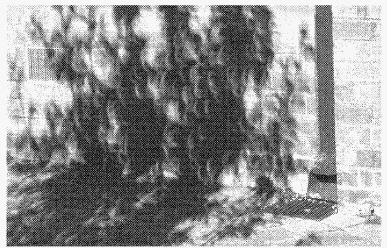
FIGURE 15–1. The foliage of a tree provides a set of natural pinhole cameras, producing crescent images during the partial phase of a solar eclipse.
THE ECLIPSE PROGRESSES
As the partial phase progresses, you are moving deeper and deeper into the Moon’s penumbra, as sketched in Figure 2–3. In Figure 2–4 we saw the lunar shadow cast on a largely cloud-covered globe in August 1999, as photographed from a low orbit above the atmosphere. Better images, of the annular eclipse in February 1999, are shown in Figures 15–2 and 15–3. These show the shadow over Western Australia, the coastline of that country plus parts of Southeast Asia being obvious.
In the last 10 to 20 minutes prior to totality the ambient light diminishes considerably. Not only its intensity alters, but also its tone, obtaining an eerie quality and a grayish hue, almost metallic in guise. As Percy Bysshe Shelley wrote:
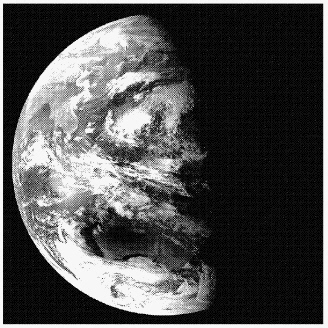
FIGURE 15–2. An annular eclipse swept across Australia on February 16, 1999. This image, obtained by the Japanese high-orbitingGMS-5satellite, shows the globe soon after the shadow entered Western Australia, leaving that area much darker than the similarly cloud-free regions of Southeast Asia visible further to the north.
With hue like that which some great painter dips
His pencil in the gloom of earthquake and eclipse.
Some people report that a green coloration appears, but that is generally because they have looked too closely at the Sun itself (recall the quote from Shakespeare’s Taming of the Shrew in Chapter 12). Way back in 1185 an eclipse viewed in Russia produced this report: “On the first day of the month of May, during the ringing of the bells for the evening service, there was a sign in the Sun. It became very dark for an hour or longer and the stars were visible

FIGURE 15–3. This image obtained with theNOAA-14meteorological satellite shows the lunar shadow over Western Australia in more detail. Although there were banks of cloud to the far north and south, the many observers concentrated just below the town of Geraldton, where the eclipse path met the coast, had clear skies. This picture was obtained a few minutes later, when the whole shadow was over land.
and to men everything seemed as if it were green. The Sun became like a crescent of the new moon and from its horns a glow like a roasting fire was coming forth.” One must avoid affecting one’s eyes in this way because it takes some minutes for them to recover and by then the totality will be over. Appropriate goggles will do the trick.
It is at this stage of gathering darkness that animals (and some humans) start to get confused. Birds land in the trees and go quiet, their anxiety being palpable. Conversely insects start to scrape and sing, as they do at dusk. Bats and nocturnal moths take to the wing, while butterflies settle and flowers begin to close their petals. Dogs may start to howl. Bees can get especially confused because they navigate by the polarization of the sky, and that depends on the angle of the Sun. Similarly, people may be psychologically affected in various ways, few being left unmoved by the experience of totality. That is very much an individual thing.
TOTALITY APPROACHES
As the obscuration of the Sun increases the sky darkens, although it never gets as black as dead of night. That would be too humdrum. The sky qualities during an eclipse are much more intriguing and unusual than this.
First we should think about what can be seen because the sky is dark. Many people seem to believe that no stars exist during the day, but they are there, simply drowned by the bright blue sky. If you don’t believe me, arrange to use a telescope one clear day and be sure to avoid pointing it at the Sun. The stars are there and of course with the naked eye the Moon is also often visible. Similarly, if you know where to look then Venus can be viewed unaided during daytime, although because of its orbit it’s always quite near the Sun, which is why one sees it best either soon after sunset or just before sunrise.
Similarly Mercury always stays close to the Sun, and many people only consciously spot that planet during an eclipse. I write “consciously” because it is often seen and yet not recognized by
the viewers. Many have sat and watched the Sun go down in the west over a placid ocean, and then wondered about a bright, slightly reddish “star” just above the horizon. If you’ve done that, chances are you’ve seen Mercury. My favorite memory of the type is having sat in a Jacuzzi at a splendid house on Malibu Beach with a movie producer friend, and after the sky had darkened still more we could see Comet Hale-Bopp blazing across the firmament.
The other planets though also move across the sky on paths close to the ecliptic. Depending upon the particular eclipse, it’s likely that you’ll have Mars, Jupiter, or Saturn providing a celestial jewel or two to glitter and attract your attention. The bright stars will also be out to dazzle you as the sky darkens, the specific array depending upon the season. Maybe it will be Castor and Pollux, the Gemini twins, accompanied by such stellar beasts as Sirius, Procyon, and Capella. But all of these are available at some time of the year during clear nights. If you’re blessed with cloud-free skies for an eclipse, it is the special phenomena that should occupy your attention.
Let us imagine that totality is now imminent, a few minutes to go. The temperature is dropping perceptibly, and many watchers start to shiver (so take a sweater). An effect often glimpsed just fleetingly is the shadow-band phenomenon. Turbulence in the Earth’s atmosphere causes differential refractive effects (bending of the paths taken by light), which is why the stars twinkle, as discussed in Chapter 12. The planets, however, look bigger because they are much closer to us and so do not twinkle. This is an easy way to differentiate Mars or Saturn from the stars at night. The Sun is normally much too large to twinkle, but as totality approaches only a slender crescent of the solar disk is left, making the equivalent of twinkling possible, except that here we have a very bright
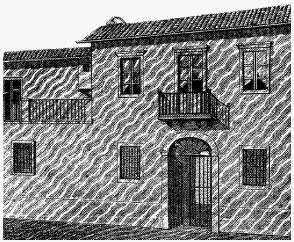
FIGURE 15–4. The shadow band phenomenon sketched, with some imagination, after an eclipse in Spain about a century ago.
source. If the conditions are right then you may see wavy bands of light flickering quickly over the terrain; their viewing is easier if you have something like a large white sheet spread over the ground. These shadow bands are similar to the patterns seen on the bottom of a swimming pool, except with much less contrast (they vary in intensity by a few percent at most). Photographs of these bands have proven elusive, with few clear examples. A sketch, drawn with very considerable artistic license, is shown in Figure 15–4.
The Moon’s shadow traverses the Earth at about 1,600 miles an hour. During the partial stage the increasing penumbral penetration is not noticeable on a minute-to-minute basis, but as the umbra approaches things start to happen fast. The complete lunar shadow can be seen zooming towards you from the west like a vast storm bearing down at supersonic speed. An elevated viewing location with a clear horizon to the west has much to recommend it, such that the rapidly encroaching shadow may be seen in these last 10 to 20 seconds before totality.
There are other aspects of the shadow to note. Totality only
takes place within the narrow band that you have sought out, and a few tens of miles to the north or the south there is incomplete blanking of the Sun. You can see the sky that far away—looking beyond the edge of the shadow—and it will appear the same orange as twilight, eventually all around the horizon.
Now to the Sun and Moon themselves. In the last quarter-minute Baily’s beads appear around the lunar limb, the final few specks of light passing between the mountains of the Moon, these seeming to shift around the periphery of the disk until only one is left: the diamond ring effect. A few more seconds and it is gone. That’s second contact. Totality is with you.
THE PHASE OF TOTALITY
As totality begins, the first thing to note is the chromosphere, as discussed in Chapter 5. The chromosphere is seen as a pinkish region (hence its name) along the limb near where the diamond ring just blinked out. It comprises a layer about 2,500 miles thick above the photosphere, but so much less intense that it cannot be seen except during an eclipse.
The corona, a pearly white crown extending several solar diameters above the surface, may have been apparent in the minute before second contact. Typically the corona is a million times fainter than the solar surface, which is why it cannot be seen except when the photosphere is mostly extinguished. The form of the corona varies with the solar cycle, which had a peak in 2000/2001. When the Sun is very active, a complete white aureole may occur, rather than the patchy corona with significant concentrations—the plumes and streamers—seen during periods of lower activity (as was portrayed in Figure 1–3).
Prominences may or may not be present. Figure 1–5 shows rather vividly that such structures are transient, often lasting only hours or days. Like the weather on any date, they cannot be predicted until, at best, the day before an eclipse. If there are any present, then the nineteenth-century term for these loops and arcs—the red flames—provides a pretty good summary of their appearance. Prominences may snake above the surface by a third or more of the solar radius.
Some solar eclipses produce totality for as much as seven minutes (such as those indicated in Figure 2–2), but typically the period is between two and three minutes. Some people experience that as lasting an age; for others it is come and gone in no time at all. Charles Lambert, a member of the French eclipse expedition to Sudan in 1860, had this to say: “But at the moment of totality, all became silent and dumb. Neither a cry nor a rustling, nor even a whisper was heard, but everywhere there was anxiety and consternation. To everyone the two minutes of the eclipse were like two hours.” On the other hand British astronomer Edward Dunkin, who went to northern Scandinavia to observe an eclipse in 1851, was frustrated by the brevity of totality. “So absorbed was I during this short interval that when the limb of the Sun reappeared I could scarcely realize the fact that two and a half minutes had elapsed since the commencement of totality. These were truly exciting moments, and although I had hastily witnessed most of the phenomena, I felt somewhat disappointed that more had not been accomplished. Few can imagine how much I longed for another minute, for what I had witnessed seemed very much like a dream.” Things are hectic during the hundred seconds or so of total eclipse with which one may be blessed. Keen amateur as-
tronomers tend to record dictation tapes ahead of time, with countdowns for what they need to do to get all their planned photographs. Activity is frenetic and it’s easy to get caught up with just staring, missing some of the things one might like to note while there is the fleeting opportunity.
Totality ends with third contact, when the diamond ring appears again. For the few minutes of totality, the eclipse should be viewed without filtration, but those goggles need to be on again for when the solar surface flashes back into view. Apart from perhaps damaging your eyes, the unattenuated brightness striking your retina will limit your ability to see Baily’s beads clearly. You might also miss the subsequent phenomena, such as the lunar shadow rushing eastwards as the Moon withdraws from the Sun. Then there is another hour or so of partial eclipse until fourth contact, when the Moon ceases all overlap with the solar disk, but that of course is all rather anticlimactic.
FROM TIMES PAST TO TIMES FUTURE
We have described above what can be seen during a total solar eclipse and various past eclipses were mentioned in passing. With luck, this will have whetted your appetite and you’ll be hungry to experience one yourself. So let us see what the future has in store for us.
Ancient sky watchers were able to predict the future—to some extent—using the tapestry of eclipses described in Chapter 3. There we presented two sketches covering all eclipses between 1900 and 2100: solar events in Figure 3–1, and lunar in Figure 3–2. Both types follow the same basic rules and so produce similar patterns. The short-term sequences of solar eclipses have greater
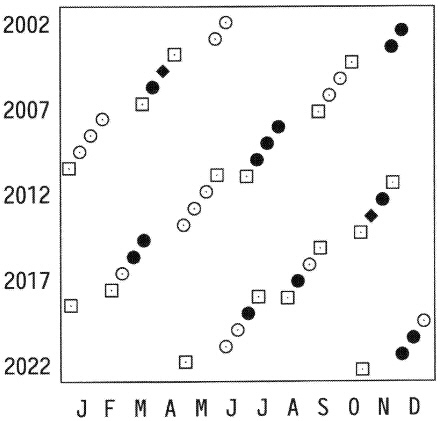
FIGURE 15–5. Plotted here are the dates for all solar eclipses due between 2002 and 2022. Solid circles represent total eclipses, open circles annular eclipses, and black diamonds hybrid events (part annular/part total). Partial eclipses are shown as squares.
numbers of members than the lunar because the ecliptic limits (see the Appendix) are more stringent for the latter.
Now we require a more detailed view, to show the eclipses due over the next two decades. By extracting the pertinent data and plotting them again, in a slightly different way, Figures 15–5 and 15–6 result. Those plots in hand, let us see what the heavens have in store for the eclipse watcher.
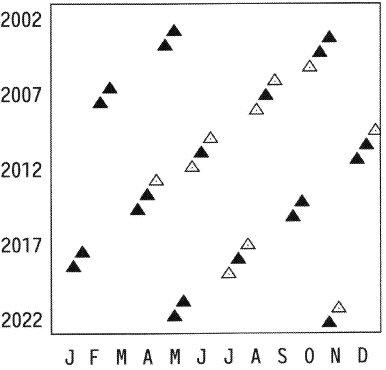
FIGURE 15–6. Lunar eclipses due between 2002 and 2022. Solid triangles represent total eclipses, open symbols are partial events. Only umbral eclipses are charted; over this period 19 penumbral eclipses will occur, but they are of little interest.
SOLAR ECLIPSES 2002–2022
From 2002 to 2022, 46 solar eclipses will occur: 13 total, 15 annular, 2 hybrid (changing between annular and total along the track), and 16 partial. The total eclipses are the gems, and the major quest of enthusiasts, and so we concentrate upon the 15 events producing at least some period of totality.
The years 2002 and 2003 each will have one total and one annular eclipse, before 2004 has partial eclipses only. This basic
form happens to continue through these decades: a run of two or three years each containing one total eclipse and most often an annular one, too, and then a year containing only partial events. There are 15 upcoming opportunities to see a total eclipse, and below we summarize when and where you should place yourself in order to experience the stunning phenomena firsthand. The map in Figure 15–7, showing the ground tracks for all such eclipses between 1996 and 2020, will help.
December 4, 2002:
In June of 2001 a total eclipse visited Angola and again in December 2002 that nation is crossed, the track continuing on a more southerly route along the Botswana-Zimbabwe border. Most of
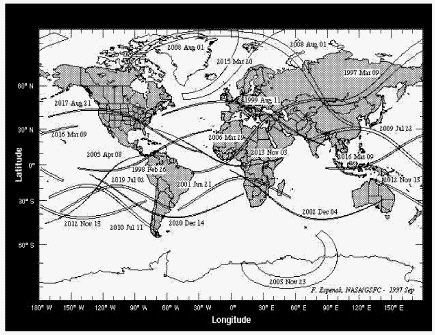
FIGURE 15–7. This world map shows the ground tracks for all total solar eclipses between 1996 and 2020.
the path is over the deep southern reaches of the Indian Ocean, but it enters land again near Ceduna in South Australia before frittering out in the northeast of that state. The maximum duration of totality is a few seconds over two minutes.
November 23, 2003:
Abandon all hope ye who enter here: the path of totality cuts only across a portion of Antarctica. Although this is near the start of the austral summer, so early in the season the sea-ice has yet to disperse sufficiently to make feasible a visit by a cruise ship to the great southern continent itself. If you can get there, totality will last for a few seconds less than two minutes.
April 8, 2005:
This is one of the hybrid annular/total eclipses, made possible by the finite size of the Earth: to begin with it is annular because the locations crossed are further from the Moon than those close to the sub-solar/lunar point near the middle of the track length. Unfortunately the portion giving totality is in the Pacific, just south of the equator, making a seaborne expedition necessary. The track there is only 15 miles wide and totality will last but 42 seconds.
March 29, 2006:
The track touches down in northeastern Brazil, crosses the equatorial Atlantic, and then enters Africa over Ghana and Togo. Continuing northeastwards it transits the Sahara before leaving the continent at the junction between Libya and Egypt. Sweeping over Turkey it traverses the north of the Caspian Sea and central Asia before terminating in Siberia just north of Mongolia. This is a
fairly long eclipse, with a maximum duration of more than four minutes.
August 1, 2008:
Starting in the far north of Canada, the track of totality crosses Greenland before descending over a Russian island called Novaja Zemla and then southeast through central Siberia. The west of Mongolia is touched before the track enters China where it terminates just before sunset. A view from the Great Wall would be splendid. The duration is almost two and a half minutes.
July 22, 2009:
This eclipse is significant as the next in the saronic sequence of long eclipses shown in Figure 2.2. The last one, in 1991, crossed Hawaii and then passed down through Central America, eventually petering out in Brazil. In 2009, the duration will be as much as 6 minutes and 38 seconds. The track begins off the western coast of India, cutting across that country before traversing the eastern Himalayas and then China again. At Shanghai it leaves land, moving out over the Pacific.
July 11, 2010:
Apart from Easter Island—another splendid place from which to witness an eclipse—this is another inhospitable event, reaching the south of Chile and Argentina close to sunset in the depth of the austral winter.
November 13, 2012:
The four-minute totality begins near Darwin in Australia s Northern Territory, then crosses the north of Queensland and the Great
Barrier Reef before heading out over the Pacific. There seems little doubt about the best place for viewing, hopefully before the rainy season starts in tropical Australia.
November 3, 2013:
The track of this hybrid annular/total eclipse begins in the Atlantic somewhat east of Florida and travels southeast, then across central Africa. There is a better opportunity to witness totality than in the case of the 2005 hybrid in that the track is wider (almost 40 miles) and totality longer (100 seconds), but again that portion occurs over water in the equatorial Atlantic.
March 20, 2015:
The track runs northeast between Scotland and Iceland, making the Faeroe Islands the only accessible land at this time of year, unless one wants to winter over in Norway’s far-north Svalbard archipelago. The eclipse actually ends with sunset at the North Pole, on the first day of sunlight after the six-month winter darkness. The maximum duration is 2 minutes and 46 seconds. Its saros pair in Figure 15–7 is the eclipse of March 9, 1997.
March 9, 2016:
Sumatra and southern Borneo are the larger landmasses under the track of this four-minute eclipse, which is mostly over water. Referring to Figure 15–7 one sees how this eclipse echoes that of February 26, 1998, which was a saros earlier.
August 21, 2017:
By the time this 70-mile wide track arrives, the United States will have been waiting 38 years for a total eclipse. It hits land at Salem,
Oregon, during the morning of Monday August 21 and eventually departs into the Atlantic in the early afternoon at Charleston, South Carolina. There are many other cities along the way. The maximum duration of 2 minutes and 40 seconds will be achieved in western Kentucky. This eclipse will also be notable because the bright star Regulus will be only one degree from the eclipsed Sun, so that it will peer through the periphery of the solar corona. Mars and Mercury will also be nearby. As mentioned earlier in the book, this eclipse is the one that follows in the same saronic cycle as that of August 11, 1999, and so their tracks echo each other in Figure 15–7.
July 2, 2019:
Mostly over the southeastern Pacific, the track crosses Chile and Argentina. Except for the skiing, the high Andes is not a place to be in July, and so the coast of Chile or the pampas provide the best bets. The maximum eclipse of four and a half minutes occurs out over the ocean. Compare its track to that of June 21, 2001, in Figure 15–7 (another saros pair).
December 14, 2020:
Chile and Argentina get another chance, this time at a more clement time of year, with an eclipse lasting a little over two minutes. Again the linkage between this eclipse and its predecessor in a saronic cycle, the event of December 4, 2002, is clear in Figure 15–7.
December 4, 2021:
Applying what we know about geographical shifts after one saros and the several examples mentioned above, it is obvious that this
eclipse, linked to that on November 23, 2003, must also be over the Antarctic and so is not an attractive proposition.
So you want to see a total solar eclipse. Where should you go? Given an unlimited budget, you have a choice of locations in southern Africa or Australia late in 2002. Turkey is likely the best bet in 2006. The Great Wall of China in 2008 is a must-do, and you could go back to the coast of that country, or India, in 2009. Easter Island with its monolithic carved heads gazing perennially at the rising Sun is the only place to be for the 2010 eclipse; similarly Australia s Great Barrier Reef in 2012. For a radical climate change head for the Faeroe Islands near the spring equinox in 2015, and then don your tropical vestments again for Indonesia in 2016. After that it’s Chile or Argentina in both 2019 and 2020.
An unlimited travel budget would not only be nice, but virtually a necessity if you wanted to complete that itinerary. American readers, however, have a stay-at-home opportunity in 2017, and doubtless many aficionados will have their own favored spots in mind already. My pick of a place from which to view it would the Grand Tetons. A map showing the path of that eclipse (and all other total solar eclipses crossing North America until 2050) is shown in Figure 15–8, for your own long-term planning.
The good news for the United States is that after the 38-year hiatus since 1979, when only parts of Oregon, Washington, Idaho, Montana, and North Dakota were crossed, there will only be another 7 years to wait until the next one. On April 8, 2024 there will be another total solar eclipse and it is a long one. With a 120-mile-wide track this four-minute event will pass centrally over Mexico, then Texas (including Dallas) and a chunk of the Midwest before reaching Cleveland, and then Buffalo and Montreal.
There is another peculiarity one might note about the April 2024 eclipse. Back in Chapter 11 we discussed how certain locations get more than their fair share of eclipses, focusing on Nantucket Island. We saw above that the maximum duration of the August 2017 eclipse will occur over Kentucky. Now refer to our North American eclipse map, Figure 15–8. It happens that the track for the 2024 eclipse crosses that for 2017 just to the west of there, mostly over southern Illinois, around the confluence of the Ohio and the Mississippi Rivers. This means that the good people of Carbondale will be so fortunate as to get not only the near-
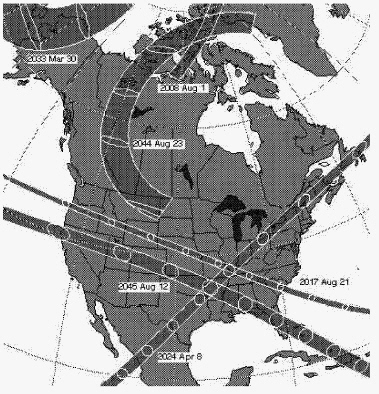
FIGURE 15–8. The ground tracks for all total solar eclipses crossing North America through to 2050.
longest eclipse totality in 2017, but also another event less than seven years later. Perhaps this is more than fair recompense for having the name of their state spelled incorrectly in Figure 10–1.
After April 2024, Alaska is the place to head in 2033 if you can stand the weather at the end of March. In August 2044 Montana and North Dakota are again lucky, although further north into Canada one will have a better view, lasting just over two minutes; this time it will be the mosquitoes rather than the snow you would need to battle. Just 354 days later, on August 12, 2045, the United States will be treated to a real humdinger of an eclipse, the track arriving over northern California and then following a track parallel to that of 2017 before it blankets most of Florida on departure. This one will be a beauty, with a track up to 160 miles wide and duration just over six minutes.
WHAT IF IT RAINS?
What if, despite your best efforts to pick the best location from which to observe an eclipse, it rains? Well, look on the bright side. A gentle sprinkle of rain will not stop all the sunlight getting to you. The clouds will just impede your direct view and the light of corona, chromosphere, and prominences may trickle through.
But what sort of light is that? Well, it’s pink. That is, if the pluvial conditions are such that a rainbow is produced, then that rainbow will look very different from the norm. A red arc will dominate that rainbow, with little intensity in the other parts of the spectrum. Such a thing has been seen in recent decades, during an eclipse in Colombia. If all else fails one could console one-self with the knowledge that few people have ever witnessed a pink rainbow. Make sure you get a photograph.
FORTHCOMING ANNULAR ECLIPSES
Although they are by no means as striking as total eclipses, annular eclipses can afford a semblance of the experience. On June 20, 2002, the narrow path of a short-lived annular eclipse will snake its way across the northern Pacific. A better opportunity presents itself in the following year, on May 31, 2003, when Iceland, Greenland, or the Highlands of Scotland should be your destination.
On that date a most peculiar annular eclipse will occur, making it interesting in its own right. Solar eclipses can only be seen during the daytime, of course, but this one involves the Sun effectively peeking over the top of the planet. The date is just three weeks before the summer solstice, so the Northern Hemisphere is tilted almost as far toward the Sun as it goes, with the result that the Land of the Midnight Sun is indeed getting 24 hours of sunlight. Any solar eclipse will be visible at that time of year if you are far enough north.
In this case a partial eclipse occurs over a vast area covering Alaska, all the Arctic, Europe, Egypt, Saudi Arabia, Russia, central Asia, and Siberia, but the annular eclipse is detectable only from a restricted D-shaped region centered near Iceland. This covers some of Greenland to the northwest and to the southeast the Faeroes, Shetlands, and parts of northern Scotland.
Undoubtedly many enthusiasts will be heading for the north Atlantic region to see this event, but if you go be sure to take your alarm clock. The eclipse happens at around four in the morning, with the Sun barely above the horizon.
An even better opportunity occurs on October 3, 2005. The track then will sweep over the Iberian Peninsula and then diagonally down through Africa.
Readers in the United States who are eagerly anticipating the total solar eclipse in August 2017 might care to note that they will have a chance to practice, using an annular eclipse, in 2012. On May 20 the event will begin over southern China and then arc up over Japan and the northern Pacific Ocean before meeting the coast of North America over northern California and the south-western tip of Oregon. The path of the annular eclipse will then paint a stripe through central Nevada and other western states before petering out in northwestern Texas. The choice place from which to watch? I’d go for the Four Corners region, where Utah, Arizona, New Mexico, and Colorado meet.
Although there are more annular than total eclipses scheduled soon, it happens that overall the total eclipses are better positioned for viewing: by chance most of the annular eclipses due over the next decade are mainly over the oceans. Give thanks for small mercies.
LUNAR ECLIPSES 2002–2022
Lunar eclipses are an entirely different prospect: a good fraction can be seen without leaving home sweet home. Maps like that in Figure 2–5 are readily available, indicating that well over half of the globe gets to see at least part of each lunar eclipse. In the case of that specific eclipse—the one due on May 16, 2003—the global map shows that it can be viewed from the east coast of North America in its entirety, with locations further west than Chicago and Dallas seeing the Moon in eclipse as it rises.
In fact, reckoning whether you will be able to see a lunar eclipse is quite straightforward so long as you know when it will take place, in Universal Time (the correct term for what is often
called Greenwich Mean Time or GMT). The sums are not difficult. Take the example of the above eclipse. Greatest eclipse is at 03:40 UT, which tells you the central longitude of the area on the Earth from which it may be seen: 3 hours and 40 minutes, which is equivalent to 55 degrees, to the west of the Greenwich meridian. This longitude passes down through Newfoundland and then through the western Atlantic, eventually meeting the land again at the northern coast of South America and then proceeding south through the middle of Brazil. Anywhere within about 90 degrees of longitude of that meridian will be able to see the complete eclipse.
There is also a latitude effect, however, due to the tilt of our spin axis. This eclipse will take place five weeks before the summer solstice, when the Northern Hemisphere is tipped towards the Sun during the day, which means that it is tipped away from the Moon in opposition at night. Thus more southern latitudes are favored (as is clear from Figure 2–5), the converse being true for an eclipse during the winter. Simply put, you are more likely to see a lunar eclipse during a long winter night than a short summer night. There’s not much more to it.
Unlike totality in a solar eclipse, which is brief and striking, a total lunar eclipse is more protracted, typically lasting from 60 to 80 minutes. Such eclipses are certainly dramatic in their own way, but they have neither the rarity value, nor the effects on animals and humans alike, that distinguish solar eclipses. Nevertheless they are well worth watching, when the chance arises, so let us summarize the circumstances for the first seven total lunar eclipses in Figure 15–6, through to the year 2010. All times given are in Universal Time. In the United States one needs to knock five hours
off for Eastern Standard Time, and so on through to eight hours for Pacific Standard Time.
May 16, 2003:
This is the eclipse in Figure 2–5, about which much has been said already. The map gives locations from where it can be seen: greatest eclipse at 03:40 points to the western Atlantic. It is visible throughout the Americas and in part from Africa and Europe. Totality lasts for 53 minutes. (Note also that there is a transit of Mercury nine days earlier, on May 7. This may also be seen from the eastern parts of North America, although Europe and Asia are better located because the transit straddles 08:00 UT.)
November 9, 2003:
Time 01:20 puts it over the eastern Atlantic, but totality is relatively brief (only 23 minutes). The eclipse is visible from Europe, Africa, western parts of Asia, and throughout the Americas as the Moon rises in the evening.
May 4, 2004:
This event is centered on 20:30, and so over the Middle East. It may be seen at least in part from Europe and most of Asia, plus all of Africa. It is not visible in any phase from North America.
October 28, 2004:
Another western Atlantic meridian, at just after 03:00, points to the Americas plus most of Europe and Africa having a view. Only the states on the West Coast of the United States miss any of the eclipse, the penumbral phase being in process as the Moon rises.
2005 and 2006:
As shown in Figure 15–6, there are no total lunar eclipses in either of these years, just a single partial eclipse in each.
March 3, 2007:
Occurrence at 23:20, and so ideally located for European viewers. Because this is near the equinox, the Earth’s tilt has little effect, and so all locations within about 90 degrees of longitude will get a view. Only the eastern coast of North America will see the eclipse totality, as the Moon rises.
August 28, 2007:
Greatest eclipse is at about 10:40 and therefore visible across the Pacific region, from the Americas across to China. Throughout North America totality may be seen, although the Moon will set before that phase is completed for viewers on the East Coast.
February 21, 2008:
This event is centered on 03:25, making it yet another western Atlantic eclipse. All longitudes from the Middle East to the Pacific Ocean side of North America provide viewing locations for the entire eclipse.
After the above, there are no more total lunar eclipses until December 21, 2010. Although that one is visible in its entirety from throughout North America, you would need to go elsewhere to see the two in 2011. Following that there are no opportunities until 2014.
Obviously total lunar eclipses make themselves available more
often than their solar equivalents, but they are not so frequent that there is a huge number occurring within your lifetime. If you live in North America, you have two opportunities in 2003, and then another later in 2004. After that there’s a wait until 2007. Take the chance while you can. In their own way, lunar eclipses are fascinating.