Eclipse: The Celestial Phenomenon That Changed the Course of History (2001)
Chapter: 10. The Great New York City Winter Eclipse
10
The Great New York City Winter Eclipse
There is no natural phenomenon that grips the imagination and stirs the soul of mankind as does a total eclipse. We ought not look at it with the eye of a dog and bark because we do not understand it. Nor ought we to look at it with the eye of a hen and tuck our heads under our wings and go to sleep because we are not interested. We must look at it with the eye of the mind.
From a pamphlet written for watchers of the 1925 eclipse
After the Rocky Mountain eclipse of 1878, viewers in the western states did not have long to wait until their next opportunities. In January of 1880 a narrow track entered California just to the south of Monterey Bay, and then passed over Nevada and northern Utah before expiring in the southwestern corner of Wyoming. On the first day of 1889 a broader track again arrived over California, this time to the north of San Francisco, then crossed northern Nevada, southern Idaho, and the northwest of Wyoming before passing over parts of Montana and North Dakota, just reaching beyond Lake Winnipeg at sunset.
Although that was it for the west for another few decades, the Deep South of the United States got an eclipse in 1900. On May
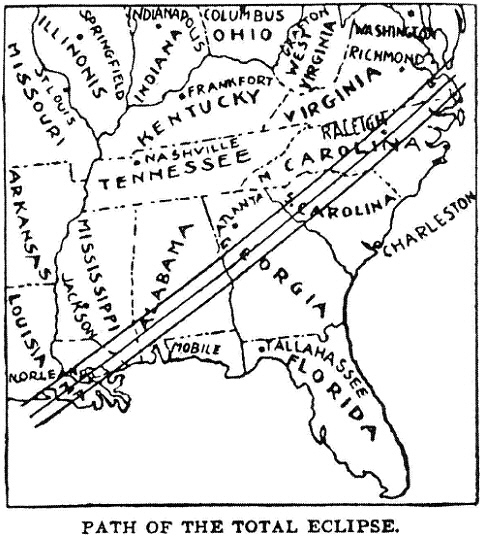
28 a total eclipse path started in the Pacific Ocean not so far off the Mexican coast, passing over that nation before clipping Brownsville, Texas, as it moved out into the Gulf. It hit land again in Louisiana, crossed southern parts of Mississippi and Alabama, and then swept fairly centrally over Georgia, and South and then North Carolina. It then departed into the Atlantic Ocean from the southeastern tip of Virginia near the town of Eclipse, which lies just across the James River and Hampton Roads from Newport News. That aptly named town gets another mention, and another eclipse, in the next chapter.
This eclipse breezed by New Orleans and many population centers along its path, and so it stirred great public interest. Many newspapers published maps showing the track of the eclipse, one of these being shown in Figure 10–1. The map is interesting for its several quirks. One is the liberty that was taken by the cartographer with various state boundaries: look at the Florida panhandle, for example. Another is the insult to the people of Illinois through the way in which their state’s name is spelled. The choice of towns to mark does not seem to be consistent (between state capitals and largest cities), although I am sure that the residents of Grafton, West Virginia, were pleased to be highlighted.
INTO THE TWENTIETH CENTURY
In 1905 and 1914 there were eclipses that could be viewed from parts of Canada, but no totality in the United States. In 1918, though, there was an eclipse that swept over a dozen states in all, starting at the southern coastline of Washington and ending as it left Florida. This was on June 8. Locations further west were favored for astronomical observations, because by the time it reached
the Atlantic it was near sunset, fizzling out just east of the Bahamas. On the other hand, the chance of rain is higher on the west of the Cascade Range, and so sites in eastern Oregon and Idaho were picked as being the most likely to have clear skies. In Figure 4–5 we saw the temporary observatory constructed at Baker, Oregon, specifically for this event.
On September 23, 1923, an eclipse track skimmed down the coast of southern California. Santa Barbara, Los Angeles, and San Diego were just on its edge. The obvious place to be was the Channel Islands, if you lived near L.A. and had a yacht. The track then bisected Mexico before passing into the Caribbean over the Yucatan Peninsula.
The famous New York City winter eclipse was just 16 months later. The great eclipse of January 24, 1925 began at sunrise to the west of Lake Superior. Cutting a swathe over frigid Wisconsin, Michigan, and western Ontario, it crossed the Niagara Falls and Buffalo as it entered New York. Shaving northern Pennsylvania it next darkened Connecticut and southern Massachusetts, including Nantucket Island, as discussed extensively in the next chapter. Our interest here concentrates on New York City though. As you can imagine, it caused some panic among the superstitious. But before considering what happened in the Big Apple, let us discuss some background astronomy.
PRECISE ECLIPSE TRACK CALCULATIONS
Modern science and computers have allowed the calculation of precise times and paths for eclipses, and so we know exactly when and where one should travel to experience totality. We might take
pause to consider just how accurately we need to know the eclipse time so as to be best positioned.
The Moon’s shadow sweeps across the Earth at between one-third and one-half of a mile per second (1,200 to 1,800 mph). That’s the speed along the ground track, typically 60 to 100 miles wide. Taking into account the track orientation, an error of a single second in reckoning the instant of the eclipse could shift it east-west by a quarter-mile, or one part in a few hundred of its width. That’s a rough estimate, but it’s in the correct ballpark.
Looking back at the timings of eclipses 70 or 80 years ago, pre-eclipse predictions were often found to be out by maybe a dozen seconds, translating into a few miles as the shift in the path of totality. Analyses of historical eclipses like that of 1715, and much earlier, have been possible only since we developed the capacity to compute them with a precision rather better than a mile. Recall that Edmond Halley’s predictions for 1715 were out by just 3 miles for the northern edge, but by 20 miles for the southern. Another example is the 1878 eclipse in the western parts of North America. The astronomical almanacs prepared independently in those days by astronomers at the U.S. Naval Observatory in Washington, D.C., and the Royal Greenwich Observatory in London, had maps of the track that differed by 4 miles at its borders.
Because of this timing problem it was not at all certain where the edge of the eclipse track in January 1925 would pass. One way to improve knowledge of such things was by obtaining accurate measures of when totality reached different points along the path. To this end Bell Laboratories set up a telegraphic ring of stations within the track, recording signals from them on a common chart so as to ensure uniformity. That chart is shown in Figure 10–2.
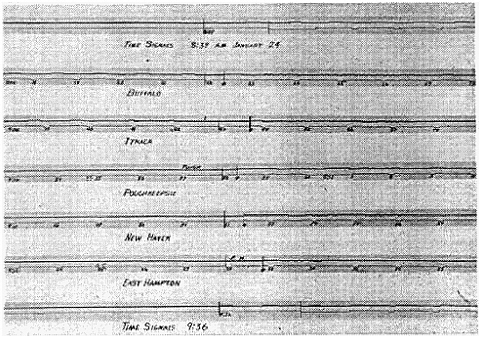
FIGURE 10–2. A chart of the time signals marking the beginning and end of totality as transmitted by telegraph, for Buffalo, Ithaca, and Poughkeepsie in New York and New Haven and East Hampton in Connecticut.
The other way of determining the edge of the track is obvious: have people spread out across the possible limits as estimated beforehand, and this is something to which we will come shortly. For the present, though, let us stick with eclipse timings. One matter that springs to mind would be the effect of the introduction of leap seconds, the need for which we discussed in Chapter 6.
Consider, for example, the next eclipse to cross the continental United States in August 2017. The track of that eclipse has been
calculated already, and it is shown in Figures 15–7 and 15–8. In the decade and a half between now and then it would be anticipated that about ten leap seconds might be inserted, shifting our clocks. But will they shift the eclipse path?
The answer, of course, is no. Leap seconds are inserted only for human convenience, and eclipse phenomena are computed using astronomers’ dynamical or ephemeris time systems. The leap seconds alter the time at which the eclipse will occur as displayed on a clock, but not the absolute time or the path followed.
You may think, then, that my question was misleading, but there is an important point that follows from this thought process. Although leap seconds themselves do not affect eclipse tracks, the phenomenon that makes leap seconds necessary does cause shifts in such tracks. Think back to Figure 6–2: the slowing of our planet’s rotation rate moves eclipse paths from those that would occur if the Earth spun at a constant rate. It doesn’t, because tidal drag slows it down, and leap seconds represent our solution to the problem, given the desire to keep the second a constant interval of time for various technological reasons. However, it is not possible to know ahead of time precisely how much the Earth’s spin will slow before 2017.
It follows that the prediction of eclipse paths cannot be an exact science. In writing computer programs to delineate the track for some eclipse, an assumption must be made that the terrestrial rotation rate will continue to behave as it has done in recent times (and it has not decelerated uniformly over the past several millennia: we know that from eclipse records).We can monitor the spin of the planet on a day-to-day basis, and know it to be erratic, but the deviations from the overall trend are not huge. The derived peripheries of the eclipse track predicted a year or so ahead of
time will not be off by more than a handful of yards. In consequence the argument might be considered moot because most observers will anyway be aiming to position themselves as close as possible to the central line. Recall, though, what was written in Chapter 8 concerning the desirability of being located nearer its edge.
Over extended periods the errors in the predictions enlarge. Until the time gets close, we cannot know the spin phase of the Earth at any specified juncture in the future. One may compute eclipse tracks for a century hence, but these are predicated upon an assumption that the day will continue to lengthen at the present rate, and it is virtually certain that this will not be the case. The fact of the eclipse is known, because the relevant orbits are determined with the necessary precision, but precise tracks of totality cannot be stipulated more than a century or so into the future.
The situation is analogous to flying a paper airplane. Especially given some experience one can predict with some confidence the path it will take in the inch, the foot, and maybe even the yard after it departs your fingertips. After that, who knows? Similarly there is a limit to the forward planning of eclipses, but on the scale of a human lifetime they can be predicted well enough for you to know precisely where you should be to see totality in 2045, say.
NEW YORK CITY, 1925
Let us step back now to the New York City eclipse. This was not the only major event in U.S. history to occur on January 24, 1925. In Chicago, apparently oblivious to the celestial spectacle occurring above their heads, gangsters were involved in an ongoing
fight over control of gambling, illegal distilleries, and brothels. As he left his apartment block that day, the boss of the leading gang, Little Johnny “The Brain” Torrio, was ambushed by his rivals. Hit by four bullets and several shotgun blasts, he was wounded in the chest, stomach, and arm. Torrio spent ten days in the hospital fighting for his life, guarded by 30 of his mobsters. Although he recovered, Torrio decided that the millions already stashed away were sufficient for a comfortable early retirement, and he returned to Brooklyn, where his parents had brought him from Italy at the age of two. Back in Chicago, leadership of his gang was taken over by his second in command, the notorious Al Capone.
Far away in Los Angeles the first simplified traffic code in the United States was introduced. As any visitor to that city knows, a car is a virtual necessity. As the 1920s progressed, an automobile changed from being a rich man’s luxury to a common means of transport for the less wealthy. As a result the rules governing the use of the road—both by drivers and by pedestrians—had steadily grown until they covered a bewildering 134 pages of turgid text, and so hardly anyone bothered to read them. On January 24, 1925, all this changed. A greatly simplified and shortened code was brought in, crammed into just four pages. This introduced, for example, the “right turn on a red light” law and also the concept of jaywalking. The public was forced to pay attention as every radio station was instructed to read the same description of the rules at eight o’clock every evening for the first week after it came into force. The ordinance was an immediate success: pedestrian deaths fell from 73 in the year preceding its introduction to 46 in the following year.
In New York, of course, cars ground to a halt as the sky darkened and the total eclipse neared. It was shortly after nine in the
morning. The temperature hovered around zero Fahrenheit (minus 18 Celsius). Others would later recount just how cold they felt. Barbara Rider was one of them. In 1991 she recalled this dramatic moment in her early life six and a half decades before, when she was just eight years old: “A total eclipse took place right above Van Cortlandt Park in New York City. We got up at four o’clock in the morning to take the subway ride to this huge park in the Bronx in order to view this heavenly phenomenon. It was a marvelous display of an orderly universe and a never-to-be forgotten experience of eerie beauty and magnificence. Also, it was bitterly cold, and my feet were almost rooted to the ground, immobile and without sensation until I tried to move. Hot chocolate in a nearby restaurant started the blood moving once more.” Barbara was fortunate in that she had been taken well into the eclipse track, a good way north of Yankee Stadium. Further south, not everyone on Manhattan Island necessarily fared so well.
THE TRACK EDGE OVER MANHATTAN
In the year leading up to the 1925 eclipse astronomers knew that the border of the track would slice through New York City, but they were not sure precisely where. Looking just at Manhattan, it was clear that the track limit would pass near Central Park, but as to whether the absolute edge would be to the north or the south of it was another question.
First, let us think about the orientation of the track. It approached the city in a broad arc from the extreme west of New York state, and so it was angling down from somewhat to the north of due west. It happens that the crosstown streets in Manhattan have a similar orientation, tilted by about 30 degrees away
from a precise west to east line. This meant that the track path and the cross streets were close to parallel. That was a fortuitous thing, because the street number where any observer may have been stood would on its own give a good indicator of the track limit.
Back in Chapter 3 we met Ernest Brown, an astronomer at Yale. Like most such professionals he planned to observe the eclipse from near the central line, and of course New Haven, Connecticut, was well positioned for that (see Figure 10–3). Brown, though, very much wanted to know where the edge of the track lay because this would assist him in his research on the theory of the lunar motion. Therefore he appealed to all New York residents to note where they were—on the roof of their apartment building, for example, or at a particular road intersection—and report whether they saw a total eclipse or not. In addition, observers
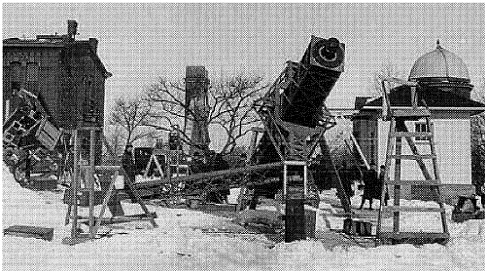
FIGURE 10–3. Snow surrounds the instruments set up on the Yale University campus to observe the January 1925 eclipse.
were stationed at every other intersection along Riverside Drive between 72nd and 135th Streets.
One might imagine this was unfair in that Brown was in effect asking people not to go into the zone where totality was assured: north to Yonkers or White Plains. The fact is that many of them in any case could not afford the time off work that would entail, or the traveling expense. Certainly it is true that many people south of 80th Street were disappointed not to witness totality. To the contrary, however, those very near the periphery of the track—even those slightly beyond it—actually saw a far more startling set of phenomena than those close to the center line, some tens of miles north.
Elsewhere we have described the diamond ring effect and how you are more likely to see this spectacle for a prolonged period if you happen to be located near the track edge. That is precisely what occurred in 1925. In fact the term “diamond ring” used to describe this appearance was coined by New Yorkers, when journalists asked them to describe what they had seen in their own words. It has since passed into the general vocabulary of eclipse watchers.
The result of the eyewitness accounts did enable Brown to work out precisely where the track boundary lay. It was between 95th and 97th Streets. Although it might seem that the volunteer observers had sacrificed themselves for Brown’s experiment, in fact they got a far better experience than he did, even if his period of totality lasted longer.
There was great excitement, then, that Saturday night after the eclipse had passed by. Nowhere was this more so than in Chinatown. The eclipse that morning was when the Moon was at conjunction. Thirty-three hours later, as the Moon set in the west,
it would be visible as a slender crescent. That meant that January 24 had been predetermined as the last day of the Chinese year, the Year of the Rat, heralding celebrations for the New Year beginning the next day.
AIRBORNE OBSERVATIONS
Quite apart from tying down the southern extent of the eclipse track by making use of the grid pattern of Manhattan and the thousands of people who reported what they saw, other important scientific results were derived from the eclipse through the cooperation of the public. A couple of years previously the American Astronomical Society had convened a “Subcommittee on Measurements and Public Cooperation of the 1925 Eclipse,” suggesting a variety of ways in which the average person could contribute useful information. This resulted in the eclipse becoming a scientific experiment with perhaps the largest mass participation ever known.
The astronomers themselves were also hard at work. Many eclipse expeditions to remote locations in preceding decades had their plans upset and their hopes dashed by cloudy, rainy weather, and the prognosis for clear skies over the eclipse track were not good in 1925, given that it was the middle of the winter. As it happened, the sky was clear in New York and most other spots, which is why it was so cold. Rather than take a chance, though, arrangements had been made for instruments to be flown far above any clouds.
In all 25 aircraft carried scientists aloft, plus other interested observers who could afford the trip. The Navy airship USS Los Angeles flew at an altitude of 4,500 feet over Block Island, off the
coast of Rhode Island and Connecticut, carrying a party of 19 astronomers plus crew. These were perilous trips. Later in the same year a similar dirigible, the Shenandoah, was torn apart by a storm in Ohio, resulting in the deaths of 14 passengers. The utility of airplanes was proven, however, and ten days later President Calvin Coolidge signed the act that authorized the transport of mail by air. This was in effect the first step in the process that resulted in the great airline industry of the United States.
ECLIPSES AND THEIR EFFECT ON PEOPLE
Wall Street, down near the southern tip of Manhattan, was not within the band of totality in 1925, and yet it may well have been affected. Analysts who study trends in stock market prices have suggested from time to time that surges and falls in share prices may be linked with eclipses. Apparently there is often a crash in prices within a few days of a lunar eclipse and within six weeks of a solar eclipse. It would be difficult to imagine any causal connection that could produce such a relationship and because there are several eclipses every year such coincidences may be simply a matter of chance.
Despite this there is a link with Wall Street, in one way or another. Philip L.Carret was a legendary investor and the founder of one of the first mutual funds. He watched the 1925 eclipse from Westerly in Rhode Island, from where he would also have been able to see the Navy dirigible buzzing around Block Island. Henceforth he became an eclipse fanatic, traveling around the world to see 20 total solar eclipses in all. Carret watched his final one in Barbados just a few months before his death in 1998 at the age of 101.
Not everyone is so keen. William Lyon Phelps, a professor of English at Yale from 1896 to 1933, was an astronomy enthusiast. In 1925 he was severely ill and so unable to witness the eclipse, to his perennial regret. (He made up for it by traveling to Canada to catch the eclipse on the last day of August 1932.) Phelps was staggered by the apathy he found in many others, writing as follows in his autobiography. “There are educated people who care nothing for eclipses. Some otherwise intelligent friends of mine left New York the day before that eclipse, when they could easily have waited. And another friend told me that as he and his brother (a Harvard graduate) were in exactly the right position to see it, his brother, one minute before the eclipse, said, ‘Well, this is my regular time for going to the bathroom,’ and went indoors. Hundreds of busy men travel six thousand miles on the mere chance of seeing what this university graduate thought quite unimportant.”
Philip Carret would not have missed a chance like that. In 1979 he had an opportunity to see another total solar eclipse in the United States, this one linked to the one with which he started his odyssey in 1925. We noted in Figure 2–2 how the saros cycle pushes eclipses progressively towards the west and alters their latitudes a little. If you count three saros periods each of 18 years and 11 days after January 24, 1925, you derive a date of February 26, 1979, and the expectation of an echo of the New York City winter eclipse displaced right across the United States. And that’s just what happened. On that date the track met the coast straddling the junction of Washington and Oregon, then passed over Idaho, most of Montana, and a corner of North Dakota before sweeping over the center of Canada, Hudson’s Bay, Baffin Island, and Greenland.
There were a few other eclipses in North America during the
twentieth century, but not many. In February 1943 one ended at sunset in Alaska. Another in July 1945 began at sunrise in Idaho, then crossed Montana and Canada, a similar path to that in 1979 mentioned above. In June 1954 another began at sunrise in Nebraska, zipping over Minnesota, Wisconsin, and Lake Superior, and then into Canada again. We will meet a few others of interest in the next chapter.