Eclipse: The Celestial Phenomenon That Changed the Course of History (2001)
Chapter: Appendix: Calculating Eclipses
Appendix: Calculating Eclipses
We have seen in the main text how various forms of eclipse result from cosmic alignments and found evidence of the regularities in their occurrences. There are, though, many details that we glossed over, postponing their discussion to this Appendix. This was for two main reasons: one is that too much mathematical discussion tends to interrupt the now of narrative, and the other is that many readers will feel uncomfortable with such analysis anyway.
In fact the calculations involved in eclipse prediction can be understood quite simply, once one has learned a little about how celestial objects move in their orbits. No higher math is needed than straightforward arithmetic, as you will see if you follow the arguments through as they are laid out below. In doing so you will gain a greater appreciation not only of eclipses, but also of our calendar, of how the movements of the Moon and Sun affect our climate here on the Earth, and various other matters. You will also catch a glimpse of how various ancient civilizations discovered the ways the eclipse cycles work, despite the fact that it would yet be many centuries before the nature of planetary orbits around the Sun was comprehended, in renaissance Europe. It is worth the little effort.
THE EARTH-MOON BINARY PLANET
Simple accounts of the Solar System often start by saying that the Earth orbits the Sun, and as it does so the Moon revolves around the Earth. While this is a reasonable first step, it is not quite true. Many stars are said to be binary: pairs of stellar bodies locked together in mutual gravitational embrace, each orbiting the center of mass of the duo. Similarly the Earth—Moon system can be thought of as being a binary planet.
The mass of the Moon is about one part in 81 that of the Earth. There are larger natural satellites elsewhere in the Solar System, such as Jupiter’s Ganymede and Callisto, Saturn’s Titan, and Neptune’s Triton, but they are smaller in proportion to the mass of the associated planet. The only exception is Pluto and its moon Charon, discovered in 1978; Charon is about one-eighth the mass of Pluto, so that system certainly comprises a binary planet, although they are both tiny.
In the case of the Earth-Moon system, one should really say that the pair orbits their combined center of mass, which is termed the barycenter. In turn the barycenter orbits the Sun. The barycenter is on the line joining the middles of Earth and Moon, and the relevant calculation places it about 2,900 miles from the core of our planet. Because the terrestrial radius is about 3,964 miles, the barycenter is within the Earth, as shown in Figure A-1. As the Moon orbits, the Earth also swivels around this point, as indicated in the diagram.
Generally we are not aware of any wobble in our movement, but by the same token we tend not to notice that we are speeding along on our path around the Sun at near 18.5 miles per second (almost 67,000 mph). This velocity varies between about 18.2 miles per second in early July and 18.8 in January. Similarly, on
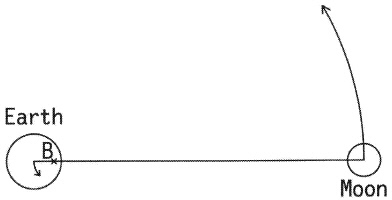
FIGURE A-1. The Earth and the Moon orbit their mutual center of mass, which is termed the barycenter (B). The barycenter happens to be within the Earth because our planet is so much bigger than the Moon. The two bodies are not here shown to scale compared with their separation.
the equator you are whizzing along at more than a thousand miles an hour, as you spin around the Earth’s center. In our everyday frames of reference we are unaware of such movements. Wobble and change speed we certainly do, as we revolve around the Sun.
The Earth and the Moon rotate about the barycenter quite independently of the fact that they both spin on their central axes—the Earth once a day and the Moon, it happens, exactly once a month. The Moon therefore keeps basically the same face towards us at all times. We say that it is “tidally locked.” Over the eons the lunar spin rate has been damped by Earth’s gravity, because the Moon’s mass distribution is not uniform. There is a greater density beneath the lunar nearside, displacing its center of mass away from its axis of symmetry, and the pull of the Earth keeps that greater mass directed towards us.
Finally, I wrote above that the barycenter is about 2,900 miles from the Earth’s center, but actually its position varies. This is
because the separation of the Earth and Moon changes, the lunar orbit being noncircular. We will learn more about this below.
THE ECCENTRICITY OF THE ORBITS OF EARTH AND MOON
The terrestrial orbit about the Sun is not a circle, its deviation from such a shape being defined by a quantity that astronomers call the eccentricity. The symbol used for this is e. A circle is defined as having e=0.0 precisely, whereas the Earth has e=0.0167 in the present epoch. Over many millennia this value changes and reaches a maximum value of almost 0.06 at times. This affects the climate because the influx of solar energy to our planet would then vary between perihelion and aphelion by a larger proportion than at present. The noncircularity of the orbit also causes the speed variation mentioned above. The effect is like a child on a playground swing, the highest velocity being achieved as the swing moves through the lowest point in the oscillation.
Currently we pass perihelion in early January and aphelion in early July (often on July 4, in fact). In consequence the Earth is moving slowest in July, during the warmest season in the Northern Hemisphere, soon after the summer solstice, and as a result summers in the north tend to be longer but cooler (the Sun being more distant) than those in the Southern Hemisphere. Similarly the winters in the north are shorter and milder than they would be otherwise. This will not persist forever because the dates of perihelion and aphelion advance by about one day every sixty years in the calendar we use. (That calendar was designed with a leap year scheme aimed at keeping the spring equinox on about the same date for ecclesiastical purposes, in particular the calcula-
tion of the date of Easter. If we wanted to keep perihelion and aphelion on the same dates instead then we would need to revise the calendar, and insert some extra leap years, rather than losing some as we do at present, as in 1800, 1900, 2100, 2200, and so on. Further matters concerning the calendar are discussed below.)
Now let’s consider the Moon. The shape of the lunar orbit about the barycenter is likewise noncircular, having an eccentricity e=0.0549. With an average separation of 238,850 miles, the lunar distance varies between about 225,740 miles at perigee and 251,970 miles at apogee, so long as that eccentricity is maintained. In fact, it is not. While the Moon is in a secure orbit (that is, it is gravitationally bound to the Earth), the attraction of the Sun perturbs its path in a cyclic fashion, and the lunar eccentricity varies fairly rapidly between 0.044 and 0.067.
This means that the barycenter moves rather erratically back and forth within the Earth, but let us lay that aside for simplicity, and in the following discussions and illustrations just imagine the Moon to orbit the center of the Earth. Keep in mind, though, the fact that effects like the motion of the barycenter are significant if one wants to compute accurate eclipse paths.
Figure A-2 shows the shape of the lunar orbit, compared to a circle. The Earth-Moon distance only changes by a small amount, but that is very significant with respect to the nature of eclipses. When the Earth is at its mean distance from the Sun, the solar orb has an apparent angular diameter of 0.533 degrees. That is the size of the light source that the Moon must entirely obscure to produce a total solar eclipse. Using the perigee distance of 225,740 miles mentioned above, with a diameter of 2,160 miles, the Moon subtends an angle of 0.548 degrees, and so is able to cover the Sun completely: a total eclipse. At apogee the lunar angular diameter is
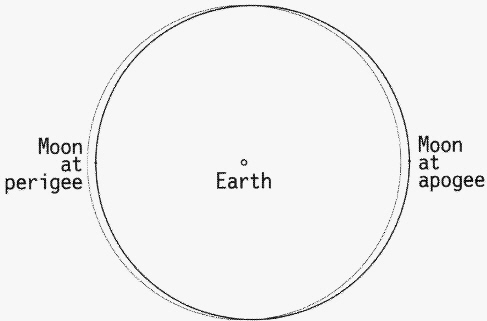
FIGURE A-2. The orbit of the Moon about the Earth (more strictly, about the barycenter) is not circular. Here the lighter curve is a circle centered on the Earth, while the heavier line is the elliptical lunar orbit. The Earth is shown to scale; the size of the Moon is equivalent only to about the width of the line depicting its path.
only 0.491 degrees, and so this time when the centers of Sun and Moon line up the latter cannot completely obscure the former, and so there must be a bright ring around its circumference: an annular eclipse. (The effect of the varying lunar distance was shown schematically in Figure 2.1.) Note that these angular sizes were calculated using the average eccentricity of the lunar orbit. The figures will change slightly as the eccentricity varies. For simplicity, in further discussions of the lunar orbit we will depict that orbit as circular, but remember that it is actually an ellipse.
Apart from the above we must also take into account the
noncircularity of the Earth’s heliocentric orbit. This results in the apparent size of the Sun oscillating during the year, altering the target the Moon must obscure. The small eccentricity of the terrestrial orbit results in our separation diminishing to near 91.4 million miles at perihelion before growing to 94.5 million miles at aphelion, the apparent diameter of the Sun therefore changing between 0.542 and 0.524 degrees. Obviously this will also affect whether a solar eclipse is total or annular, if the Moon happens to be at a distance giving it an apparent size near those solar limits.
There are other complications. It was effectively assumed above that the potential observer is at the barycenter, which is not realistic of course, since it is deep underground! The size of the Earth is a significant fraction of the Earth-Moon separation, and so the angular size of the Moon someone will see depends to some extent upon his or her location on the surface of the planet. Imagine, for instance, that you are gazing at a full moon that has just risen above the eastern horizon at sunset. Six hours later, at midnight, you will be several thousand miles closer to it, and by sunrise you will have receded from the Moon again, all because of the Earth’s rotation. This movement alters the angular dimension of the Moon by about a hundredth of a degree, and this may be critical when considering whether an eclipse seen from a certain location will be total or annular.
THE ORBIT OF THE EARTH AND THE CALENDAR
How long is a month? Even laying aside calendar months, with their variety of lengths (30 or 31 days, 28 for February but 29 in a leap year), the question is not a trivial one to answer. We start with a related question: how long is a year?
Before one can answer this, one must ask a simple but deceptive question. What is the crux of the matter at hand? In the case of the Gregorian reform—the alteration of the calendar by the Roman Catholic Church in 1582—the essential consideration was trying to maintain the date of the spring equinox. The “year” required for that aim is the time between such equinoxes, and that is not the same as the time taken to complete one orbit. In fact, due to several vagaries the notion of a period “to complete one orbit” has little meaning in itself. One must be very definite about the phenomenon of interest that is employed to define the start and end of the orbit, because different start and end points lead to different values for the year length.
Prior to the Gregorian reform, and after Julius Caesar introduced his eponymous calendar, a leap year had been employed every fourth year, producing an average year length of 365.2500 days. The Gregorian calendar reform amended the leap year rule such that the years A.D. divisible by 100 but not by 400 are common years (that is, not leap years), with no February 29. The result is that 97 leap year days are added to four centuries, and so the average year length is equal to 365.2425 days. (That comes from the fact that 97 divided by 400 equals 0.2425.) This “year”—the mean Gregorian year—is an artificial length of time, invented by humankind. One next needs to ask how long the natural or astronomical year might be, and compare the two.
The terrestrial orbit is shown schematically in Figure A-3. The large arrows indicate the spin axis of the Earth, which for the time being is assumed not to alter in orientation. Winter solstice occurs when that arrow is pointed as far as possible from the Sun, and at that time the Sun reaches its most southerly rising point during the year, on about December 22. In essence this is the
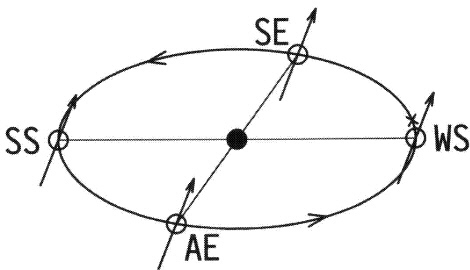
FIGURE A-3. The orbit of the Earth about the Sun (solid circle at center), in a slant angle view; in reality the terrestrial orbit is fairly close to circular. The positions of our planet at spring equinox (SE), summer solstice (SS), autumnal equinox (AE), and winter solstice (WS) are shown, the long arrows indicating the direction of our spin axis. The small cross indicates the position of the Earth when at perihelion (closest approach to the Sun) in early January.
shortest day (assuming you are in the Northern Hemisphere). The summer solstice around June 22 is when the Sun rises at its most northerly point, and the daytime hours are longest.
In between are the two equinoxes. Despite popular belief, it is not quite true that at the equinoxes the number of daylight hours equals that of nighttime hours, as the word “equinox” would suggest, because there is sunlight available for some time before sunrise and after sunset, plus other complicating factors. The equinoxes are defined astronomically, as follows. If one extrapolates the equator of the Earth out into the sky, the celestial equator is delineated as a circle cutting the celestial sphere into two. From
spring (or vernal) equinox to autumnal (or fall) equinox the Sun is north of the celestial equator, and south thereafter. The equinoxes are the instants at which the Sun appears to cross the equator, on about March 20 and September 22 (the dates vary slightly with the leap-year cycle). In March it is heading northwards, in September it is heading southwards.
It happens that a year counted from one spring equinox to the next averages to about 365.2424 days, and that is distinct from the time between summer solstices, which is 365.2416 days. The times between winter solstices, or between autumnal equinoxes, also give different values for the astronomical “year.” The reason for these values being different is that the speed of the Earth changes during its orbit. The average of the four is 365.2422 days, which is termed the mean tropical year.
It is a mistake, often made, to compare the mean duration of the year in the Gregorian calendar with the tropical year; the difference between them, about 0.0003 days, suggests that a single day correction might be required every three or four millennia. Actually the mean Gregorian year should be compared with the spring equinox year, the difference between these being but 0.0001 days, three times less. This might suggest that a correction of one day every ten millennia might be needed. However, the latter would again be based on a false premise: because the perihelion point of the Earth is moving, the lengths of all these “years” are changing from one century to the next. Another matter to consider is the fact that the Earth’s spin rate is slowing, making the days longer, and so reducing the number of “days” in a year. It happens that, in the present epoch and continuing for a couple of thousand years, the Gregorian leap year rule actually provides for a better approximation to the necessary year length than most people
imagine. Indeed many prominent astronomers have been led astray by misunderstanding what is going on.
The above should not be construed as a statement in praise of the Gregorian rule for leap years as used in the Western calendar. The system of dropping three leap-year days in four centuries results in the spring equinox shifting over a total span of 53 hours, between March 19 and March 21. In computing the date for Easter, the Church actually stipulates March 21 always to be the equinox, disregarding the phenomenon as defined astronomically. If in 1582 the Roman Catholic Church had really wanted to keep the equinox within a 24-hour period it could have done so by employing a 33-year cycle containing 8 leap years. This is because 8 divided by 33 equals 0.242424…(these two digits recurring). The average year length in such a scheme would be a little over 365.2424 days, closer to the desired spring equinox year than the Gregorian rule. More important, from an ecclesiastical standpoint, the briefer cycle time of 33 years would result in the equinox wandering by less than 24 hours.
In fact the Persian or Iranian calendar, which tries to regularize the date of the equinox for other cultural purposes, uses this 33-year leap cycle and so performs better than the Gregorian scheme in terms of astronomical accuracy. From the perspective of the Western calendar, which is used as the standard for commerce and communications throughout the developed world, because this is a secular calendar the wandering equinox, resulting from copying the Gregorian leap year cycle, is not of practical or symbolic importance. It is interesting to muse, however, on how our dating scheme might have been different.
There is, of course, an implication for eclipse cycle interpretation. We saw in Chapter 2 that the saros, the great cycle of eclipse
repetition, leads to gaps of 18 years plus 10 or 11 days between eclipses of a similar nature. Whether that extra number of days is 10 or 11 depends upon the phasing against the leap-year cycle. To some extent that jitter would be ironed out if a 33-year calendar were used, as does Iran.
The saros is discussed in much greater detail below, but first we must consider other aspects of the apparent movements of the Sun and the Moon.
THE PRECESSION OF PERIHELION
Refer back now to Figure A-3. This diagram is a slanted view to allow the orientation of the Earth’s spin axis to be clear, but even if it were drawn looking straight down from above the very low eccentricity would make the orbit’s deviation from a circle difficult to identify. Note that a small cross is drawn on the terrestrial orbit. This cross indicates the position of the Earth at perihelion, equivalent to a date around January 4 in the current epoch, soon after the winter solstice on December 22. The perihelion point is slowly moving, however, owing to tugs imposed by the other planets, and this motion is called precession of perihelion.
The date of perihelion moves later by about one day every 60 years, so that 4,500 years into the future it will align with the spring equinox. About 750 years ago, perihelion and the winter solstice coincided. A full rotation of the perihelion point around the orbit takes about 21,000 years. These gradual alterations in relative alignment affect our climate, and are thought to be one of the causes of the Ice Ages. To demonstrate clearly what is meant by precession of perihelion, Figure A-4 depicts an imaginary precessing orbit with a large eccentricity. In the four-and-a-half orbits

FIGURE A-4. Under the influence of various gravitational perturbations successive orbits precess (swivel around in their orientation) compared to the fixed stars. For clarity a highly eccentric (meaning noncircular) orbit is shown here. Both the perihelion point q and the aphelion point Q move counterclockwise from one orbit to the next in this diagram. Similarly both the terrestrial orbit about the Sun and the Moon’s orbit about the Earth undergo precession in the counterclockwise direction.
displayed the perihelion point (labeled q) has turned through about 45 degrees, this movement being more obvious in the case of the aphelion point (Q).
The time taken for the Earth to return to perihelion, termed the anomalistic year, is 365.2596 days, almost one-hundredth of a day longer than 365 and a quarter. This might be considered the period to complete an orbit, but there are problems. If that year
were used to design a calendar, then because it is longer than 365.25 days one would need not only a quadrennial leap year, but also an additional day every century, maybe a super-leap year with 367 days. If such a calendar were employed, predicated upon keeping the date of perihelion constant, then the dates of the equinoxes and the solstices would progressively move earlier in the year, and that would not do.
A better definition of the time taken to complete an orbit might be how long it takes the Earth to execute a 360-degree arc around the Sun. Because perihelion is moving counterclockwise, the Earth must traverse a little more than 360 degrees to reach it again. If one instead asked that the stars return to their previous positions in the sky, then the planet will have circuited through precisely 360 degrees, occupying a length of time called the sidereal year, which lasts for 365.2564 days. Again this is not really the sort of year wanted for setting up a calendar because the stars do not affect such things as our climate and seasons. The fundamental reference points we use are the equinoxes and solstices, but again those are not stationary, as we will see below.
THE PRECESSION OF THE EQUINOXES
The cyclic period of 21,000 years given in the previous section results from two quite different effects. One is the precession of perihelion as described: the gradual swiveling of the Earth’s egg-shaped orbit. That length of time results from comparing the perihelion position with those of the equinoxes and solstices, but the latter positions are themselves moving, compared to a fixed reference frame based on the distant stars.
Imagine you are suspended in space far above the Solar Sys-
tem, looking down from the north. From this perspective you would see the perihelion point moving counterclockwise as in Figure A-4, the same direction as the orbits of the planets, and taking 110,000 years to complete a circuit. The equinoxes and solstices, on the other hand, would be seen to be moving in the opposite direction (clockwise) and taking about 25,800 years to turn. This gradual movement is called the precession of the equinoxes, and it has been a recognized phenomenon for more than two millennia, at least since the Greek astronomer Hipparchus described it in the second century B.C.; some historians claim that the Babylonians independently discovered the phenomenon centuries earlier.
The period of 21,000 years mentioned earlier results from these combined precessional effects, which are proceeding in opposite directions. You can check this with your calculator. Take the reciprocals of 25,800 and 110,000 (that is, 1/25,800 and 1/110,000), add them together, and take the reciprocal of the result. You will get 21,000 as the final answer. (The values are all approximate.)
If this is too complicated to visualize, the precession of the equinoxes may be better understood from Figure A-5. The long arrow represents the Earth’s spin axis, pointing to the pole, P. The points marked A, B, C, and D are arrayed around the equator. When direction CD is aligned with the Sun it is the time of an equinox, and when AB is in the same plane as the direction of the Sun it is the time of a solstice. Although the spin axis remains in much the same orientation during one orbit, as depicted in Figure A-3, over millennia it gradually swivels, describing the clockwise circle shown at the top in Figure A-5. The movement is similar to the precession displayed by a toy gyroscope.
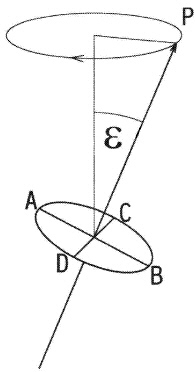
FIGURE A-5. The orientation of the terrestrial spin axis swivels around to complete a loop over a period of 25,800 years, measured against the distant stars. This is shown as the circle at the top of this diagram, P being the direction of the North Pole while A, B, C, and D are points on the equator. This motion is called the precession of the equi noxes. The angle denoted e is called the obliquity of the ecliptic; in simple terms, it is the tilt of the Earth’s spin axis.
The angle labeled 8 is technically termed the obliquity of the ecliptic. It is simpler to think of it as being the tilt of the terrestrial spin axis, the angle of about 23.4 degrees between the line passing vertically through the plane of the terrestrial orbit (the ecliptic) and the line pointing towards the pole. The obliquity is therefore equal to the latitude of each of the tropics, because the lines mark-
ing the tropics are the extreme locations where the Sun passes overhead at the solstices. Various perturbations cause this angle to change slightly over millennia, but we will not worry about that here. I will merely note for interest that the slow, tiny decrease in the obliquity is of importance in astronomical interpretations of the first developments at Stonehenge, five millennia ago. At that time the obliquity was slightly bigger, and as a consequence the Sun rose on midsummer’s day just a little further north than it does now. In testing such megalithic alignments one needs to take into account the value of the obliquity in the era in question.
THE CYCLES OF THE MOON
Imagine looking down upon the Moon’s orbit (as in Figure A-2) from the depths of space, out among the stars. As with the sidereal year, one can define a sidereal month as the time the Moon takes to return to the same position relative to the stars; that is, to complete a 360-degree circuit around the Earth. This sidereal month lasts 27.32166 days, taking a long-term average value to smooth out short-term erratic variations.
The sidereal month is significant in that it is also the time the Moon takes to spin on its axis, so that it perennially points the same face towards us. Nevertheless we were able to map more than half of the lunar surface before satellites were launched to return images of the far side, because we can peek just beyond the eastern and western limbs of the Moon at different times, the lunar orbit not being circular. We can also see over the poles slightly, and overall 59 percent of the Moon can be mapped from Earth. Figure 1–2 shows these effects in action.
Is the sidereal month the one we need for eclipse computations? Well, not really. The reason is demonstrated in Figure A-6. It is the synodic month that is relevant for eclipses, as discussed in Chapter 2. This type of month describes the lunar brightness cycle, the length of time from one full moon to the next. Any particular synodic month may last for between 29.2 and 29.8 days, but the average taken over many years is 29.53059 days. That is a very significant figure in eclipse calculations.
OTHER TYPES OF MONTH
Just as the “year” comes in different flavors depending upon which precise phenomenon is of interest, there are other types of “month” beyond the two mentioned above. First we look at how the lunar orbit precesses.
The perturbations causing the precession of perihelion of the Earth’s orbit are due to the other planets. Because these are mostly at great distances and all have much smaller masses than that of the Sun, the rate of precession is very slow: 110,000 years to complete a full turn. The Moon in its geocentric orbit is subject to much larger perturbations, because it is now the massive Sun that is mainly responsible for tweaking the lunar path. This results in its perigee precessing quite quickly, making a complete revolution in 8.85 years.
In consequence an alternative type of month can be defined, the anomalistic month, the time from one perigee to the next. This takes 27.55455 days on average, five and a half hours longer than a sidereal month. In Figure A-2 perigee was shown at far left; on the next orbit it would have moved counterclockwise by an angle of about three degrees.
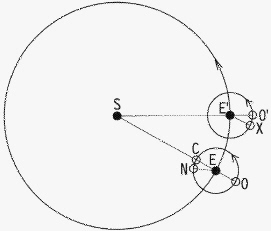
FIGURE A-6. The Earth (labeled E) orbits the Sun (S) while the Moon executes its own orbit about our planet. In the lower position, when the Moon is aligned with the Sun it is in conjunction (C), whereas when it is opposite (that is, 180 degrees from) that point it is at opposition (O). The Moon is said to be in syzygy when it is at either of these points. Eclipses can occur only at syzygy: a solar eclipse at conjunction, a lunar eclipse at opposition.
Although opposition is the time of full moon, conjunction is not the time of new moon. For the new moon to be seen it needs to have moved along its orbit to be sufficiently separated from the Sun in the sky such that it can be spotted near the western horizon just after sunset, and N is a typical new moon position. Conjunction may be thought of as being dark of Moon: our companion cannot be seen at all in the solar glare.
Now consider the second position of the Earth (labeled E’). When the Moon had turned 360 degrees about the Earth starting from O it reached position X, and the time taken to reach that point is a side real month (a month measured against the stars). To reach opposition again at point O’ and produce the next full moon requires a little longer, a length of time called the synodic month (a month measured against the Sun). It is the synodic month of about 29.53 days over which the complete cycle of lunar phases is run, from dark of Moon at conjunction, to new moon an evening or two later, to first quarter, then full moon, then last quarter, and back again to conjunction. (Note that this diagram is not drawn to scale.)
There is yet another form of month we need to consider. The Moon’s orbit does not remain in the same plane as that which the Earth occupies (the ecliptic plane), a matter of vast importance with regard to eclipses. This is illustrated in Figure A-7. The lunar orbit is tilted by a little over five degrees to the ecliptic, an angle called the inclination.
For an eclipse to occur requires a quite stringent alignment: the Moon needs to cross the ecliptic when very close to either conjunction or opposition. A few numbers might serve to show how improbable this is. With an inclination of 5.15 degrees and a geocentric separation of 238,850 miles, the Moon’s distance above and below the ecliptic would oscillate between extremes of 21,440 miles, more than five times the terrestrial radius. In fact the Moon can deviate even more than this from the ecliptic because at apogee the geocentric distance is greater, and also its inclination varies between 4.96 and 5.32 degrees. Most of the time the Moon comes to syzygy (see Figure A-6) far above or below the ecliptic, and no eclipse occurs.

FIGURE A-7. The Moon has an orbit that is tilted slightly against the plane, called the ecliptic, in which the Earth circuits the Sun. In this diagram (not drawn to scale) we look sideways along the ecliptic, and note that the lunar orbit makes an angle of about five degrees to it, with an orientation that swivels around making alignments of all three bodies possible. An eclipse can only occur if the Moon happens to be crossing the ecliptic when at conjunction (producing a solar eclipse) or opposition (producing a lunar eclipse).
During each circuit of the Earth, the Moon crosses the ecliptic once travelling upwards, and once travelling downwards. These crossings are called the nodes of the orbit, the ascending and descending nodes respectively. Another way to define a month is using the interval between the Moon’s nodal passages. This is usually called the nodical month, but another name often applied is the draconic month. The reason for the latter is that an eclipse can only occur when the Moon is passing a node, and ancient superstition said that a dragon then swallowed up the Sun (as in the story of Hsi and Ho related in Chapter 1), resulting in its obscuration; hence the term draconic. The nodical month has a mean duration of 27.21222 days. Unlike the anomalistic month, the nodical month is shorter than the sidereal month, and this requires an explanation.
Under various perturbational forces the nodes of all the objects in the Solar System are precessing. This is also true for the Moon. The Sun is causing the lunar perigee to shift, and similarly it is mainly responsible for the lunar nodes precessing. Actually, the nodes regress in that they move backwards (clockwise) around the orbit, in the same sense as the precession of the equinoxes, and this is why the nodical month is so short. This is illustrated in Figure A-8, both the precession of perigee and the regression of the nodes being represented, arrows indicating the sense in which they shift.
The above behavior of the Moon is of fundamental importance in the mechanism of eclipses. It is critical to follow what is going on. Figure A-9 shows the traverses of the Moon through three successive ascending nodes. Each time the Moon passes through that node the celestial longitude has been reduced by 1.44 degrees from the previous value (the origin of this step size is
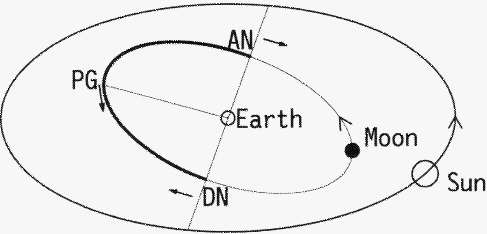
FIGURE A-8. How the lunar orbit precesses. To an observer on the Earth the Sun appears to orbit us, although the reality is that we are orbiting it. This produces the outermost path, which is close to being circular and restricted to the ecliptic. The lunar orbit is inclined to the ecliptic plane by just over five degrees, and so repeatedly crosses that plane at its ascending node (AN) and half a nodical month later at the descending node (DN). Half this time the Moon is above the ecliptic (heavy line) and half below (light line). The straight line connecting the nodes, passing through the Earth, swivels around in the clockwise direction as viewed from the north, as indicated by the arrows. This is called regression. A complete turn of the nodal line takes 18.61 years.
The perigee point (PG) precesses in the opposite direction, counterclockwise and in the plane of the lunar orbit. It takes only 8.85 years to complete a full turn.
In this diagram the Moon is shown near conjunction, but a solar eclipse could not occur because it is well below the ecliptic. For an eclipse to take place one of the two lunar nodes must be in the proximity of an imaginary line connecting Earth and Sun. Total solar eclipses occur when perigee is also near the node in question.
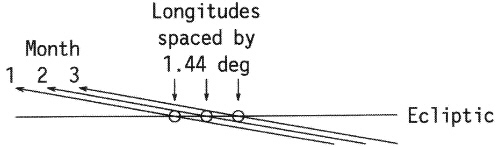
FIGURE A-9. The Moon ascends through its node (where its orbit crosses the ecliptic) once every nodical month, such a month having an average duration of 27.21222 days. Because this is less than the time it takes the Moon to complete a revolution about the Earth, the node moves clockwise along the ecliptic (from left to right in this view), successive values of the nodal longitude dropping by 1.44 degrees. The size of the Moon is shown to scale.
given below). As can be seen in Figure A-9, the shallow angle at which the Moon climbs up through the ecliptic results in some overlap with the path it took the previous month.
This implies that the Moon scans all of the sky along the ecliptic. Sooner or later the Moon at one of its nodes is certain to traverse the same longitude as the Sun, the latter being confined to the ecliptic. That’s when a solar eclipse can occur: when a node occurs at conjunction. On the other hand, if the Moon reaches its node near a longitude 180 degrees from the Sun—at opposition, that is—a lunar eclipse will occur.
The lunar perigee precesses such that it takes about 8.85 years to progress around a full rotation. Similarly the lunar nodes perform a loop about the Earth, although in this case in the opposite (clockwise) direction, taking 6,798.3 days to do so. This regression period, about 18.61 years, is a fundamental cycle time that
enters into eclipse calculations. For example, the step of 1.44 degrees given above stems from that period: if it takes 18.61 years to perform a complete 360 degree rotation, then 1.44 degrees is the distance the node shifts in one nodical month of 27.21222 days.
THE METONIC CYCLE
We have met with a variety of year and month lengths. From the perspective of calendar definition, we saw that the month of interest is the synodic month, the cycle time for the brightness phases of the Moon, currently lasting for an average of 29.53059 days (it is necessary to quote that to at least seven figures). Those readers with pocket calculators on hand may multiply that number by 235, for reasons that will soon be apparent, deriving a total of 6,939.69 days after rounding-off.
One could now argue about the proper length to use for a year, but the mean tropical year of 365.2422 days will do for these sums. If you multiply by 19 you get 6,939.60 days, rounded off. (In reality any particular set of 19 calendar years will contain either 6,939 or 6,940 days, depending upon whether five or only four leap years are counted among them.) It is immediately obvious that 235 synodic months last for almost exactly 19 years, the difference amounting to only 125 minutes. This 19-year period is called the Metonic cycle; we mentioned it earlier, in the Preface and in Chapter 2. There is more to be said about it, however.
The actual years we count in the Gregorian/Western calendar average to 365.2425 days, so that 19 of those will average to 6,939.6075 days. People often claim that the Gregorian calendar reform was necessary simply because the mean year in the Julian
system (365.2500 days) was too long, and over the 16 centuries from Julius Caesar through to Pope Gregory XIII this resulted in the equinox arriving about 12 days too early. But that is only half the story.
From A.D. 532 the Metonic cycle had been employed in calculating the dates of Easter. For the cycle to be precise the average year length would need to be 365.2468 days (that is, 6,939.69 days divided by 19). Under the Julian calendar the average year lasted about 0.0032 days longer than this, and between 532 and 1582 these little differences had accumulated to exceed 3 days. In consequence the Moon in the sky was nowhere near the ecclesiastical moon followed by the Church tables for Easter, making Easter deviate substantially from full moon.
The Gregorian reform was therefore necessary to correct not only the Sun, but also the Moon, in terms of how closely the imaginary bodies encoded in the tables used to calculate Easter followed the movements of the real astronomical objects. The correction was designed to set those orbs right according to their parameters in A.D. 325, the time of the Council of Nicaea, when the fundamental tenets of the Christian faith were laid down.
Since 1582 the Catholic Church (joined later by many other Christian Churches) has continued to follow the Metonic cycle, but with two types of correction having been made. One is well known: the leap day corrections with three out of four century years being omitted and counted as common years instead, thus allowing the solar motion to be followed more accurately. But there is also a lunar correction, unrecognized by most people. This involves eight steps each of one day spread over 2,500 years. Using the figures cited above this correction appears to be near-
perfect: 2,500 divided by 8 gives an average of once every 312.5 years, which is the same as the reciprocal of 0.0032 days (although more decimal places are really required in the calculations to be precise). Nevertheless it is a pretty good approximation to the real behavior of the Moon. (Note that many of the Eastern Orthodox Churches continue to follow the Julian calendar, so that their Easter is often on a different date.)
THE COINCIDENCES BETWEEN THE MONTHS
The Metonic cycle represents a coincidence between the synodic month and the solar year. There are three other definitions of the month we have met (the sidereal, anomalistic, and nodical months), each of them lasting for 27 days plus some fraction. In discussing eclipses we are not much worried about the stars, and so the side-real month can be laid aside. But consider the mean lengths of the other three types of month:
|
Synodic month: (full moon to full moon) |
S=29.53059 days |
|
Anomalistic month: (perigee to perigee) |
A=27.55455 days |
|
Nodical month: (node to node) |
N=27.21222 days |
Using those figures we can explore various matters of interest. For example, during a single lunation it is brightest at full moon, but not all full moons are equally bright: if opposition occurs near apogee then the full moon will be dimmer than during an opposi-
tion near perigee, because that orb is farther from us. We could ask then: How long is the period between those ultra-bright full moons near perigee? The answer is given by multiplying the synodic month by the anomalistic month and dividing by their difference [(S×A)/(S-A)], the result being about 412 days. That value is 13.94 times S: 13 complete synodic months plus about 94 percent of such a month, or 0.06 months (actually 1.64 days) short of the next full moon. Thus starting with a full moon at perigee, the fourteenth full moon will occur about a day and a half after perigee, and there will be a long-term cycle in full moon brightness.
One could take the broad question further. The brightness of full moon will depend upon how far above or below the ecliptic the Moon happens to be at opposition. One might imagine that brighter full moons occur when the Moon is at a node at opposition. In fact that would be the dimmest possible full moon, because that is when a lunar eclipse takes place. (Nevertheless, the brightest the Moon ever gets to be occurs just before a lunar eclipse, because then it is the nearest it ever comes to being precisely opposite the Sun in the sky, and that favors back-scattering of sunlight, plus the bonus of being closest if at perigee.)
Eclipses are what we are interested in here, and in this respect the month lengths we have labeled S, A, and N above have some remarkable relationships. We shall now examine just what sorts of cycles exist by doing a little numerical manipulation.
Full moon occurs near perigee about every 412 days, but over longer intervals there are cycles that are much more precise. Try doing the following sums on your calculator (the justification for them will soon become apparent):
223×S=6,585.32 days
242×N=6,585.36 days
This means that after 223 synodic months the Moon has returned to close to the same node as at the start of that sequence. The difference amounts to merely 51 minutes.
We are also interested in when perigee occurs, so consider the anomalistic month:
239×A=6,585.54 days
That is only about five hours longer than the canonical 223 synodic months above.
Shortly we will see the interval of 6,585.32 days to be extremely significant, but first we must learn about yet another type of year: the eclipse year.
THE ECLIPSE YEAR
In Chapter 2 we met a length of time termed the eclipse year. It was noted to last for about 346 days. Now we will see how it comes about.
A few pages back we saw that the time required for the lunar nodes to revolve once is 18.61 years. If the lunar orbit were stationary, in that the nodes were fixed, then the Sun would pass through those nodes once per solar year and we would get eclipses only on certain calendar dates. This is not the case, though. Because the nodes are regressing the Sun gets to them earlier, producing a type of year that is somewhat shorter than the solar or calendar year. Just how short may be calculated as follows.
Adding unity onto 18.61 to account for that revolution of the nodes, one derives a period equal to 18.61/19.61 times the solar year of 365.24 days (not worrying too much about the last decimal places), or 346.6 days, and this is the eclipse year. Pairs of solar eclipses are easily identified in tables, separated by about half an eclipse year, such as June 10 and December 4, 2002.
THE SAROS
The cycle of 6,585.32 days or 18.03 solar years is the saros, which we initially discussed in Chapter 2 without detailing its origin. This is the period over which conjunctions and oppositions repeat, making an eclipse possible.
Although the contrasting astronomical year lengths all involve fractions, each discrete calendar year must contain a whole number of days. Consider the saros counted off against our calendar. If there are 4 leap years within it, that cycle represents 18 years and 11 days, but just 10 days if by chance there are 5 leap years.
The saros contains close to, but not precisely, 19 eclipse years. Nineteen of those years persist for 6,585.78 days, which is 0.46 days longer than the saros. This means that when the syzygy passages repeat after 6,585.32 days, the lunar node is not quite in the same place as it was one saros earlier, because there is still 0.46 of a day to go. We can work out how much that equates to in terms of celestial longitude by expressing it as a fraction of the eclipse year and multiplying by 360 degrees; the answer is about 0.48 degrees, which is just less than the angular diameter of the Moon.
The situation can be visualized more easily by reference to Figure A-10. In Figure A-9 we were looking at successive nodal transits, producing a longitude jump of 1.44 degrees. Now we are
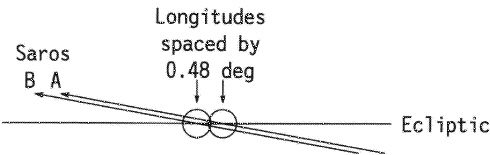
FIGURE A-10. After a complete saros the Moon comes back to a node just 0.48 degrees away from where it was 18.03 years before. Unlike in Figure A-9, the second saros (labeled B) starts with the longitude being enhanced (the node has moved counterclockwise, towards the left).
considering the situation after a whole saros. During that time the node has circuited the Earth 19 times, but returns to a position just 0.48 degrees from where it began the saros; the longitude is actually enhanced rather than reduced by that amount. As Figure A-10 shows, because the Moon is of slightly larger angular extent than this longitude jump, the lunar disks just overlap in terms of their positions from one saros to the next.
We know that the Sun is of virtually the same angular size as the Moon. Does this bare overlap mean that an eclipse occurring at the start of one saros will result in a miss at the start of the next?
REPEATING ECLIPSES
Regarding Figure A-10, one can see that although the lunar disk has shifted by 0.48 degrees in longitude, practically a whole diameter, because the Moon is crossing the ecliptic at such an oblique
angle it will progressively cover most of the other disk before receding. Let us consider this in more detail.
Figure A-11 shows the trajectory that would give a grazing eclipse: the limb of the Moon just touches against the apparent edge of the Sun in the sky. Using quite simple geometry it is possible to calculate the value of the ecliptic limit, the longitude difference between the node and the Sun at which such a grazing eclipse would occur.
Actually there are distinct values for the ecliptic limit depending upon the specific conditions, because several varying parameters affect the calculations: the apparent sizes of both Sun and Moon depend upon our distances from those orbs, and also the inclination of the lunar orbit oscillates. Call the ecliptic limit L for shorthand purposes. Taking the most unfavorable values for the
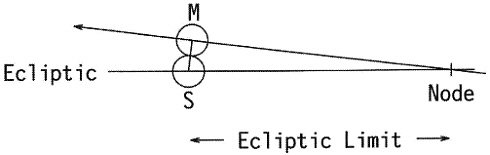
FIGURE A-11. A grazing eclipse of the Sun (S) would result in the situation depicted here. We know the angle at which the Moon (M) crosses the ecliptic at its node; this is the inclination, about 5.15 degrees. Then it is a simple geometrical matter to calculate the ecliptic limit, the maximum separation in longitude between the Sun and the node that will result in an eclipse of some stipulated type.
above parameters, if L is below 15.35 degrees then at least a partial solar eclipse is certain; if L is less than 9.92 degrees then a total or annular solar eclipse is certain. If L were below respective limits of 18.52 and 11.83 degrees, then such eclipses are possible but not certain.
The precise limits are not important. The significant factor to note is that they are all much greater than the step of 0.48 degrees that occurs from one saros to the next. This means that once the Moon gets into an orientation such that it passes a node within the ecliptic limits, for many following saronic cycles it will continue to produce eclipses.
Consider first the most stringent limit above, the range of 9.92 degrees certain to produce a total or annular eclipse. This is a permissible range for each side of the Sun, so that the total range in nodal longitude is almost 20 degrees. It will take 41 or 42 steps of 0.48 degrees to cross that distance, meaning that there will be a sequence of at least 40 total solar eclipses, each spaced by 18.03 years, the sequence lasting for perhaps 750 years.
This is the minimum sequence duration. For total eclipses the greater limit of 11.83 degrees might apply, producing a sequence persisting for maybe 900 years. If one allowed any solar eclipse to count, including the partial obscurations, then a sequence may continue for over 1,400 years and contain in excess of 80 events. Certainly saros (meaning “repetition,” remember) is an apt name!
THE ECLIPSE SEASONS
The above does not mean that there are only 70 or 80 solar eclipses spread over 13 or 14 centuries, with gaps of almost two decades between them. Eclipses are much more common than that. Dur-
ing an eclipse year the Sun passes through the positions of both lunar nodes, and although the Moon may not be at its node, the ecliptic limits calculated above make it possible for solar eclipses to occur during the eclipse seasons that last while the Sun is traversing those limits.
The lengths of such seasons depend upon the eclipse type in question. Consider the widest, the ecliptic limit of 18.52 degrees making partial eclipses possible. The full longitude range is a little more than 37 degrees. Because the Sun moves through slightly less than a degree of longitude per day, the eclipse seasons are over 37 days long, but they slide through our calendar year, there being two such seasons (one for the ascending and one for the descending node) in each eclipse year.
Multiple eclipses can occur within an eclipse season: because a synodic month lasts less than an eclipse season, it is feasible that there will be two solar eclipses close together. In the year 2000 there were partial eclipses on July 1 and 31; these will repeat one saros later on July 13 and August 11, 2018, and again on July 23 and August 21, 2036. Such pairings of partial eclipses are possible because of the wide ecliptic limits; the narrower limits for total eclipses are not so generous.
THE ROLE OF THE METONIC CYCLE IN ECLIPSES
Eclipses recur in sequences separated by one saros, which lasts for 18.03 solar years (very close to 19 eclipse years). At any time there are many interleaved saronic cycles in action: 39 at present. Astronomers label these cycles with numbers. For example, the total solar eclipse of August 11, 1999 is part of saros 145, a sequence that began with an eclipse on January 4, 1639, and will end with the
77th on April 17, 3009. The next in this sequence is that cutting across the United States on August 21, 2017: book your viewing location now. Similarly the total solar eclipse of June 21, 2001 is part of saros 127, which consists of 82 eclipses between the years 991 and 2452.
(It may be noted that for the sake of clarity I have been a little lax in my usage of the term “saros.” Correctly the word applies to the period of about 18.03 years after which eclipses repeat, whereas a phrase like “saros 145” refers to a whole sequence of eclipses spaced by such gaps. The intended meaning in each case should be clear enough.)
The saros is not the only cycle important in eclipse prediction. Earlier we met the Metonic cycle of 19 solar years and saw that it is of fundamental significance in calendar matters. After 19 years, 235 synodic months have elapsed, bringing the conjunctions and oppositions back to the same phase, to within a few hours. The Metonic cycle lasts for 6,939.6 days.
Break out the pocket calculator again. Multiplying the eclipse year (346.62 days to five figures) by 20 you will derive 6,932.4 days, which is just 7.2 days short of the Metonic cycle.
The implication of this is that after 19 years the Moon comes back to be not much more than seven degrees from its node, and another 19 years later it returns to a position again advanced by seven degrees. The maximal eclipse season we described above lasts while the Sun moves through 37 degrees, and the Moon’s position may skip through that taking steps separated by seven degrees but 19 years apart. That is, there may be a short sequence of four or five (and just possibly six) eclipses separated by 19-year gaps, occurring at the same time of year.
The ecliptic limit chosen there is the largest possible, which is appropriate for partial eclipses. Regarding total and annular eclipses, three or four will occur in these brief sequences related to the Metonic cycle. For example, consider the total solar eclipse due on December 4, 2002. This will be followed by another such event on the same date in 2021. Looking back in time, there was an annular eclipse in 1983, and a partial eclipse in 1964, all on December 4. After 2021 the lunar node slips out the ecliptic limit, but re-enters on the other side a month earlier in the calendar with a partial solar eclipse on November 4, 2040, followed by three annular eclipses on similar dates in 2059, 2078, and 2097. These are all instances of the 19-year Metonic cycle gap, then.
THE MINUS 10 OR 11 DAY JUMP
The effect of the saros is that eclipses repeat on intervals of 18 years plus 10 or 11 days. But if you look at a tabulation of past eclipses you will find that there are sequences with interstitial periods of a year minus 10 or 11 days, with three or four eclipses in a row. For example:
February 15, 1961; February 5, 1962; January 25, 1963; January 14, 1964 (total, total, annular, partial eclipses of the Sun);
July 17, 1981; July 6, 1982; June 25, 1983 (partial, total, partial eclipses of the Moon);
September 2, 1997; August 22, 1998; August 11, 1999; July 31, 2000 (partial, annular, total, partial eclipses of the Sun).
The reason for this is easy to see. Solar eclipses occur at conjunction, and conjunctions are spaced by synodic months; similarly for lunar eclipses at opposition. Twelve synodic months last for 354.37 days on average, which is 10.88 days short of a solar year.
On that basis one might expect eclipses to recur spaced by 354/355 days, but for how long could the sequence continue? The answer is given again by the lengths of the eclipse seasons, and the spacing between them. The longest eclipse season lasts for just over 37 days. The spacing of the eclipse season centers is equal to the eclipse year, 346.62 days, which is 18.62 days short of a solar year of close to 365.24 days. Therefore the eclipse seasons step backwards through the solar year in jumps of 18.62 days. At the same time the twelfth conjunction is stepping back by 10.88 days every year, producing a relative change of 18.62-10.88=7.74 days. Within a 37-day partial eclipse season one might get a sequence of a maximum of five solar eclipses in consecutive years (i.e., four steps of 7.74 days, equal to just below 31 days), usually less. Using the more stringent limits for total eclipses, a lower number of events appear in such a chain. These chains of eclipses just arrive consecutively 10 or 11 days earlier on the calendar (equivalent to 355/354 days later).
Turning to lunar eclipses, the ecliptic limits are more restricted, and as a result only pairs or trios with this spacing are identified. This is the reason for the patterns seen in Figures 15–5 and 15–6.
THE 3.8-YEAR GAP
The saros is a wonderful cycle: not only do eclipses recur with 18.03-year spacings, because 223S is very close to 242N, but their character also repeats owing to the fact that 239A is also near to the
magic number of days, 6,585 and a bit. Just what I mean by their character we will discuss later, but if we relax that added constraint, and look only for repeating occurrences of any sort, then we need to find only an agreement between S (the synodic month) and N (the nodical month).
Again a few strokes on the pocket calculator should satisfy you that
47×S=1,387.94 days
51×N=1,387.82 days
The difference amounts to about three hours.
This implies that an eclipse will likely take place 47 synodic months after a previous event. In terms of solar years that is a 3.8-year gap, almost exactly (I could have written 3.80005). Rather than convert the decimal to months and days it’s easier just to count off the 1,388 days making up 3.8 years.
Again one can pore over tables of eclipses and check whether this is the case. I will not bore you with a whole string of examples, but take just one. Adding 3.8 years onto the July 6, 1982, total lunar eclipse invoked above, one expects a following eclipse about a week before the end of April in 1986. Sure enough, there was one on April 24.
There is an obvious relationship with the Metonic cycle here. Five multiplied by 3.8 equals 19 solar years, and 5 times 47 makes 235 synodic months. The 3.8-year cycle is a submultiple of the Metonic cycle. Not only do short sequences of eclipses occur with regular intervals of 19 years, but also that period is split up into five interleaving but distinct eclipse series.
The 3.8-year gap provides yet another regularity, then, which
would allow investigators of eclipse records to make prognoses about future events once the pattern was recognized.
GEOGRAPHICAL SHIFTS IN ECLIPSE PATHS
So far we have concentrated on the spacing in time of eclipses. Next we consider some other characteristics. Flick back to Figure A-10. Imagine that saros A produced a total solar eclipse, so that the right-hand of the pair of disks may be thought of as equally well representing the Sun. Now think of the position of the Moon as it passed that position in saros B; that is, you slide it back down its inclined path until the two are aligned north-south, putting them at the same celestial longitude. In that position the center of the Moon is a little below that of the Sun, and so a total solar eclipse may still be witnessed in saros B, but its track on the Earth’s surface will be displaced south from that which occurred 18.03 years earlier in saros A.
That is one distinct trend in eclipse occurrence representing a latitudinal shift. There will also tend to be an associated small shift in geographical longitude of the eclipse track because the terrestrial spin axis is tilted. However, there is another, larger, longitudinal shift, with a different origin. This was previously mentioned in Chapter 2.
The saros lasts for 6,585.32 days, indicating an excess of just less than one-third of a day over a round number of days. That represents almost a third of a rotation of the planet, the equivalent to 7 hours and 41 minutes. This means that the eclipse track is shifted by about 115 degrees to the west from one saros to the next.
These shifts—both north-south and east-west—were illus-
trated in Figure 2–2. Although the longitude movement is always from east to west, the latitudinal motion may be either from north to south or vice versa. In Figure 2–2, which is for total solar eclipses in saros sequence 136 during the twentieth century, the movement was from south to north because that sequence pertains to the descending node of the Moon’s orbit. Other saronic sequences, associated with the ascending node (as in Figure A-10), demonstrate similar four-degree jumps, but from north to south.
A REPEAT ON REPEATING ECLIPSES
Referring again to Figure 2–2, the eclipses depicted all occurred around the middle of the year—shifting with forward steps of 10 or 11 days from May 18, 1901 to July 11, 1991, in accord with the saros—but are otherwise noteworthy because of the duration of totality. Most total solar eclipses last for only two or three minutes; the six eclipses shown each had totality lasting for about seven minutes. No natural solar eclipse will present such an opportunity again until the year 2150. One can increase the duration of totality by artificial means, by flying along the eclipse path as fast as you can in a supersonic aircraft, although even that cannot keep pace with the eclipse for much more than ten minutes.
When we first met the saros we merely noted that there was another near-coincidence with its length—that is, 239 anomalistic months last for 6,585.54 days, just 0.22 days longer than the saros—but we did not take that observation further at that stage.
The anomalistic month is the cycle time of the angular diameter of the Moon, altering between 0.548 degrees (at perigee) and 0.491 degrees (at apogee). At the end of a saros the Moon still has 0.22 days to go before it returns to the geocentric distance at
which it began. If it started the saros precisely at perigee then at the end it has another 5 hours and 17 minutes to go before next passing through perigee. That is only one part in 125 of an orbit, the result being that the angular size of the Moon changes by very little, if measurements at start and completion of a saros are compared.
Now what about the apparent size of the Sun? That also affects whether or not an eclipse is going to total. The apparent solar diameter varies with the heliocentric distance of the Earth, and we saw earlier that it oscillates between 0.542 and 0.524 degrees during a complete orbit, or a full year. But we are not concerned with a full year. The saros lasts for 18.03 years implying that, compared with its beginning, at the end of a saros the Earth has traveled just 3 percent more than 18 complete orbits. Therefore the angular size of the Sun will not be much different from what it was at the start.
There is another remarkable coincidence, then. The apparent sizes of both Sun and Moon are close to being duplicated from one saros to the next. The eclipses in Figure 2–2 are a good example. Equally well the eclipses coupled with that of August 11, 1999, in saros 145 (those of July 31, 1981, and August 21, 2017, plus several others before and after) are also total eclipses, just shifted in steps west by 115 degrees and south by about 4 degrees. In the case of the 2017 eclipse this places the route beautifully across breadth of the contiguous United States, given that the 1999 event tracked over Europe and the Middle East.
Let us summarize what we have learned above. The saros enables us to predict repeating eclipses every 18.03 years, due to the fact that 223 synodic months happen to last for close to 242 nodical months. It also happens that 239 anomalistic months have
essentially the same total duration, making the apparent size of the Moon not alter much after a saros, and the saros being not greatly different from 18 whole years results in the Sun also being near its original apparent diameter. These facts result not only in eclipses repeating, but also they repeat in basic character, a fact that was foreshadowed in Chapter 2 but not completely explained there.
HOW LONG IS THE PERIOD OF TOTALITY?
All the total eclipses in Figure 2–2 lasted for about seven minutes. What factors control that time span? The duration of totality depends upon the relative angular sizes of Sun and Moon. The greatest interval of obscuration is when a solar eclipse occurs (1) when the Moon is at perigee, so that the lunar diameter is maximized; and (2) when the Earth is at aphelion, so that the solar diameter is minimized (this is why those long eclipses straddled July, aphelion occurring early in that month).
The changing speeds of these bodies also affect the duration of totality: the apparent angular speed of the Sun is lowest when we are at aphelion, as above, and this enhances the duration of totality. On the other hand, when the Moon is at perigee its angular speed is the maximum it ever attains, and that has a contrary effect. Basically, seven-minute-plus eclipses result from the greatest feasible difference in lunar versus solar apparent diameter, about one-fortieth of a degree: Moon 0.548 degrees, Sun 0.524 degrees. The converse can also be true, the Moon appearing smaller than the Sun, making the duration of totality zero; that is, an annular eclipse occurs.
Apart from the stage of totality, we saw in Chapter 2 that there is an extended period—some hours—of partial eclipse that
precedes and follows the main event. This is the time it takes for the Moon gradually to cover the Sun, and then to uncover it again later. More often, there is no totality (or even an annular eclipse) because the Moon does not pass centrally across the solar disk, and so only a partial eclipse takes place. Lunar eclipses may similarly be subdivided, and we should consider the different circumstances that can occur for those.
LUNAR ECLIPSE PHENOMENA
What basic phenomena occur during a lunar eclipse? A longitudinal section through the shadow cast by the Earth is shown in Figure A-12. If the Sun were a point object then the planet would produce only a complete shadow (termed the umbra), but the Sun is actually over half a degree wide. This makes the shadow fuzzy around the edges, producing a region called the penumbra.
This effect is easy to demonstrate in your back garden on any sunny day. Hold a sheet of paper up close to a shadow, such as that cast by the leaves of a tree. Near the leaves their shadows appear to have sharp, well-defined edges, but as you pull the paper back further they become less and less distinct. This is due to the finite size of the Sun.
Now consider the Earth in space rather than a leaf in your garden. The distance that the shadow is projected is immense. Figure A-12 is drawn in a much-compacted form: the angles between the straight lines are actually very small (about 0.533 degrees, that being the Sun’s average angular diameter). This produces a conical shadow zone with the apex at point A, a distance 850,000 miles from the Earth.
If the Moon has a node close to opposition it will pass through

FIGURE A-12. The Earth casts a conical shadow that is about 850,000 miles long, to its apex labeled A here. When the Moon passes somewhere through the shadow a lunar eclipse occurs (not to scale).
that shadow, and an eclipse will occur. The mean geocentric distance of the Moon (238,850 miles) is about 28 percent of the distance to the apex of the shadow. As a result the umbra is 72 percent the diameter of the Earth at the position of the Moon, or about 5,700 miles across. Recall that the Moon is 2,160 miles in diameter, and so the umbra can easily envelop it. That is, a total lunar eclipse is easily achieved, and will last for some time as the Moon slowly moves through the umbra. On the other hand the penumbra is about 128 percent the planet’s width at the lunar position, a diameter of close to 10,150 miles, and so almost five times the extent of the Moon. The sizes of the umbra and penumbra are portrayed to scale in Figure A-13 as slices through the terrestrial shadow, to show how total, partial, and penumbral lunar eclipses may occur.
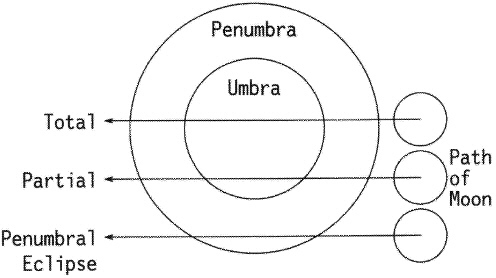
FIGURE A-13. A section through the terrestrial shadow shown in Figure A-12. The diameters of the Moon, umbra, and penumbra are shown to scale here. If the Moon completely enters the umbra, a total lunar eclipse occurs. A partial lunar eclipse is when only part of the lunar disk is enveloped in the umbra in any phase of the episode. The Moon passing wholly or in part through merely the penumbra is called a penumbral eclipse.
THE DURATIONS OF LUNAR ECLIPSES
How long do lunar eclipses last? How long does the Moon take to cross the umbra and the penumbra along paths like those shown in Figure A-13? The sums are quite easy to do once one knows the speed of the Moon in its orbit. (One might imagine that it is more complicated because the Earth’s conical shadow is not staying still, moving along as the planet orbits the Sun, but remember that the Moon is moving with us.) A few taps on the pocket calculator show that the Moon’s speed in its geocentric orbit is around 2,300 miles per hour, although variable between perigee
and apogee. The diameter of the umbra is about 5,700 miles, so the Moon takes close to two and a half hours to traverse a central line through that shadow.
At least, that is what you get if you are considering just the center of the lunar disk. In reality, that is not what one observes. The Moon is large, and observers note when the edges of its apparent disk touch the extremes of the umbra and penumbra. As shown in Figure 2.5 it is conventional to define several distinct contact points. The first is P1, when the leading edge of the lunar limb touches the periphery of the penumbra. U1 is similarly defined for the initiation of entry to the umbra, and U2 is when the Moon is completely immersed therein. Exit from the umbra is U3, and then U4 is when the trailing part of the Moon escapes the umbra, the final exit from the penumbra being P4. (One could similarly define junctures P2 and P3 but they are of limited utility.)
The phase of totality for a lunar eclipse is between U2 and U3. This may last for an hour and a half, but it can be much less if the Moon crosses the umbra far off-center. Under such circumstances certainly most of the Moon is within the umbra for about an hour, but true totality is only briefly achieved. Unlike with total solar eclipses, the distinction is not important. The entire eclipse may be considered to last throughout the interval, with some part of the Moon within the penumbra, meaning from P1 to P4. This lasts for up to five and a half hours.
SOLAR ECLIPSE CONTACTS
Similar definitions to the above are used for defining the contact points during a solar eclipse, although the repeat usage of some of
the alphanumeric terms can cause some confusion. P1 is when the partial solar eclipse begins, the lunar limb first appearing to touch the disk of the Sun, and similarly P2 is when the Moon wholly departs. For a total eclipse, U1 is defined as the instant at which totality begins, and U2 when it ends, the two being separated by merely a few minutes. For an annular eclipse, U1 is when the Moon is first completely enveloped within the solar disk, U2 when it touches the opposite solar limb.
THE ECLIPTIC LIMITS FOR LUNAR ECLIPSES
The fact that lunar eclipses are intrinsically less frequent than solar eclipses is reflected by the fact that the ecliptic limits are more stringent for the former. A total solar eclipse is certain if the Moon passes a node having a longitude within about 10 degrees of the Sun and possible if the separation is below about 12 degrees. For lunar eclipses one must compare the Moon’s nodal longitude instead with the opposition point, 180 degrees away from the sunward direction. If the relevant gap is below 3.75 degrees then a total lunar eclipse is certain, and similarly possible beneath about 6 degrees. For partial lunar eclipses the corresponding ecliptic limits are 9.5 and 12.25 degrees.
The total lunar eclipse depicted in Figure 2–5 provides a good example. The Moon happens not to pass its node (that is, cross the ecliptic) until all phases of the eclipse are complete, that node being about 4 degrees from the opposition point (which is the middle of the umbra). That separation could have been considerably larger still, but again a total lunar eclipse would occur.
All the lunar ecliptic limits are substantially lower than the solar values, and that is why solar eclipses outnumber lunar eclipses
by about three to two. Purely penumbral eclipses are more numerous, but often involve little more than a slight darkening of the full moon, and so we neglect them herein.
THE FREQUENCIES OF ECLIPSES
What is the maximum and minimum numbers of eclipses that can occur in any one calendar year? The matter of the minimum number is the easiest to address. The ecliptic limit pertaining to certainty of at least a partial solar eclipse is 15.35 degrees, producing a range in longitude of 30.7 degrees. The Sun appears to move along the ecliptic at just less than 1 degree per day (360 degrees to move and almost 365.26 days in a sidereal year). Therefore it takes just over 31 days to traverse the zone in which eclipses can occur, the seasons that recur twice per eclipse year when the lunar nodes are close to the solar direction. Because 31 days is longer than the nodical month, there must be at least one solar eclipse of some description in each eclipse season, making two each year. The eclipse year of 346.6 days most often is phased such that there are only two eclipse seasons in a calendar year, so that every calendar year must contain a minimum of two solar eclipses.
In contrast, partial lunar eclipses are certain only within ecliptic limits of 9.5 degrees, a range of 19 degrees in all, which the Sun takes just over 19 days to traverse, considerably less than a nodical month. Therefore it is possible for the Moon to avoid being eclipsed, in fact to avoid such ignominy in both eclipse seasons within a certain calendar year.
In consequence the minimum number of eclipses in any calendar year is two: both solar. Next we turn to the maximum.
The ecliptic limit rendering the possibility of partial solar
eclipses is 18.5 degrees, making for a range of 37 degrees, which the Sun takes 37.5 days to traverse. One could get a solar eclipse at one conjunction, and then another at the following conjunction about 29.5 days later, both within that one eclipse season. Not only that, but a lunar eclipse between times is also feasible.
One can imagine, then, getting one lunar and two solar eclipses in an eclipse season, and in the next such season half an eclipse year later the same thing occurs, making six.
Is that the maximum? No, it’s not quite. If the first eclipse season were centered on about January 15, the initial trio of eclipses would be in January with the lunar eclipse on that date and the initial solar eclipse on the first or second day of the month. The next set of three would be centered on July 8. Such a phasing allows for a third eclipse season partially lying within the calendar year, starting on December 12. A solar eclipse might occur soon thereafter, making seven in all within the calendar year, five solar and two lunar. In this scenario there cannot be a third lunar eclipse within the year, because twelve synodic months last for 354 days, and that period counted after January 15 puts any possible lunar eclipse twelve full moons later, on about January 4 of the following year.
A similar wrangling with dates allows one to ascertain that it is feasible to get four solar and three lunar eclipses in a year, again a total of seven. For this to occur one needs a lunar eclipse early in January followed by a solar eclipse at the next conjunction, then a solar/lunar/solar trio straddling the middle of the year, and finally in December a solar eclipse and paired lunar eclipse at the following opposition.
The bottom line is that in any calendar year there are at least two eclipses, both solar, but there may be up to a total of seven,
split either 5:2 or 4:3 as solar: lunar. Nowadays that’s of interest on a trivial level only, though, because such eclipses may be a mixture of partial, annular, and total, and for scientific purposes (and indeed public enthusiasm) it is really only the total eclipses that inspire. On the other hand, the mere keeping of records of when eclipses of any variety occurred would have allowed ancient civilizations to unravel the secrets of the cycles of the Moon. Our discussion of those cycles will have given you some inkling of how that could have been achieved.
THE DISTRIBUTION OF ECLIPSES
The average numbers of eclipses per century were mentioned in Chapter 2. The figures used were based on a monumental work by the nineteenth-century Viennese astronomer Theodor von Oppolzer, published posthumously in 1887. Using detailed theories for the orbits of the Sun and Moon, Oppolzer calculated by hand the circumstances for all eclipses between 1208 B.C. and A.D. 2161, a total of 3,368 years providing in all 8,000 solar and 5,200 lunar eclipses. From this compendium are derived the averages of 238 solar and 154 lunar eclipses per century.
These may further be subdivided into partial and total events, and so on. Easiest to analyze are the lunar eclipses: over a hundred years about 71 total and 83 partial lunar eclipses may be expected.
Turning to solar eclipses, the 238 per century break down as 84 partial, 66 total, 77 annular, and 11 partly annular and partly total.
How could a particular eclipse event be both? Consider Figure 2–1 again. The nearest part of the Earth’s surface to the Moon, around the noon meridian, may be only just close enough to be
within the umbra (the conical lunar shadow), so that observers there experience a very brief total eclipse. Further to the east and the west the observers are a few thousand miles more distant, putting them beyond the vertex of the umbral cone, so that they witness only an annular eclipse. The track of the eclipse drawn across the globe would start in the west as an annular phenomenon, become total as the point of greatest eclipse is approached, and then become annular again as the track proceeds east. This may be termed a hybrid eclipse.
If there are 66 total eclipses per century, then such an opportunity presents itself somewhere around the world once every 18 months on average. If you were clever enough to take advantage of one of the 11 hybrid eclipses by placing yourself within the portion of the ground track achieving totality, then with an unlimited travel budget you might manage one total eclipse every 15 or 16 months, on average. They are not smoothly distributed in time, though.
Unfortunately many total solar eclipses have paths unfavorable for potential viewers, and a track traversing an accessible location with a good chance of clear weather occurs only about once every three years. Nevertheless, many is the keen eclipse watcher who has spent an enormous amount of time and money getting to a well-considered prime spot, only to be stymied by an unseasonably cloudy day.
These numbers of eclipses per century are all averages, such as would result if they happened randomly in time. But we know that is not reality. They repeat on regular cycles. Total solar eclipse tracks perform consistent geographical steps within a saros, as in Figure 2.2, and there are systematic trends in other eclipse sequences.
There is another geographical effect that we have yet to mention, although it was alluded to at the start of this book. Taking into account the summed area of a track of totality across the surface of the Earth, and the average occurrence rate, for any random point on the planet a total solar eclipse might be expected about once per 410 years. But just as they are not randomly distributed in time, so they do not occur randomly in terms of geography.
A total solar eclipse is more likely to happen while the Earth is near aphelion than when near perihelion, because while we are further from the Sun its apparent diameter is minimized, presenting less of a target area for the Moon to obscure. This means that more total solar eclipses occur between May and August (straddling aphelion in early July) than between November and February (bracketing perihelion in early January), at least in the present epoch. Over the next six or seven millennia the date of perihelion will move much later in the year, eventually reversing this trend.
This implies that more total eclipses occur during the Northern Hemisphere summer than its winter. Summer is the time when the Northern Hemisphere is tipped over towards the Sun (that’s why it is summer), as in Figure A-3, presenting a larger sunward area than the Southern Hemisphere. Overall the effect is that the north gets more total solar eclipses. Averaged over the globe the rate is about one per 410 years for a random location, but a random location chosen in the Northern Hemisphere gets one total eclipse every 330 years or so, whereas in the Southern Hemisphere it is less frequent, once per 540 years.
As the bulk of the population lives in the Northern Hemisphere, a person picked at random from the whole of humankind has an enhanced probability of experiencing a total solar eclipse
without needing to chase after one. Lifetimes average to about 80 years in the developed world, such as in North America, Europe, or Japan. A randomly chosen person from such a country therefore has about a one-in-four chance of happening to be crossed by a total solar eclipse track during his or her lifetime.
That probability can be turned into a certainty by going in chase of such an event. I hope this book will have persuaded you that this is an attractive idea.