Eclipse: The Celestial Phenomenon That Changed the Course of History (2001)
Chapter: 6. Ancient Eclipses and the Length of the Day
6
Ancient Eclipses and the Length of the Day
…time that takes survey of all the world…
William Shakespeare, Henry IV Part I
It may seem surprising, in the Space Age with cosmic phenomena being studied using hugely sophisticated instrumentation, that relatively crude ancient eclipse records are invaluable, even irreplaceable, to modern science.
Let me give an example of the value of such eclipse records. Imagine you suspect the day is getting longer, because the rate of spin of the Earth is very gradually slowing. You can measure that spin rate directly in the short term using a host of high technology equipment: vast arrays of radio telescopes following the motion of extra-galactic objects across the sky, laser beams reflected from orbiting satellites, phenomenally precise clocks employing beams of cesium atoms or hydrogen masers. Data collected using such techniques indicate that the duration of a day in 2001 was about 0.17 milliseconds longer than it was back in 1991. It’s a small change, but a decade is only a short interval, historically speaking.
Alternatively, one can investigate how the day length has changed not just over the past decade, but also over 200 or 300
decades. How is this possible? In the first millennium B.C. the Egyptians, Babylonians, and Chinese did not have atomic clocks. In fact they had no artificial clocks at all, apart from simple devices measuring water flow, which were hardly very precise. But they did have natural clocks provided by the Sun and the Moon in the sky.
Suppose that a total solar eclipse was observed and recorded from Athens in 500 B.C., on the local calendar scheme in use in that era. Such eclipses are so infrequent that we can identify the event using our knowledge of the apparent orbits of Sun and Moon about the Earth. The bare observation of the total eclipse tells you that on that date the Sun, Moon, and Athens were aligned (to within a tolerance equal to the width of the eclipse track, which is equivalent to a few minutes of time). This then tells you the local solar time for Athens in that era: that is, when the Sun rose, when it crossed the meridian, when it set.
Since 500 B.C. the day has continually been getting longer. Over a single century the day increases by about 1.7 milliseconds (although there are reasons to believe that this deceleration is variable). This tiny amount summed over 2,500 years gives a total shift amounting to about four hours, equivalent to one-sixth of a rotation of the planet. So, if the day length had stayed the same, the eclipse track would have been out over the Atlantic and would have escaped detection by the Greeks.
The mere recording of an eclipse from Athens so long ago would provide rather accurate information about how our rotation rate has slowed, without the Greeks having made any sophisticated scientific measurements. Actually, no such eclipse occurred at that place and time (I made it up as a thought experiment). However, there are records of a similar nature written down by
disparate civilizations over the last three millennia. Despite the fact that the ancients had no lasers, artificial satellites, radio telescopes, or cesium clocks, their accounts of eclipses have made it possible to build up a consistent picture of how the length of the day has changed.
Not only is the day getting longer (making necessary the insertion of leap seconds), but so, too, is the month, because the Moon is slowly receding from the Earth. In this chapter we consider the implications of these trends.
THE INCREASING DISTANCE TO THE MOON
When, back in Chapter 2, we looked at the fundamental processes by which eclipses eventuate, we noted that the angular diameter of the Moon as seen from the Earth is almost precisely the same as that of the Sun. This is a quite remarkable coincidence. There are small cyclic variations in those apparent sizes because the Earth-Moon distance changes as the latter moves between perigee and apogee, and the Earth-Sun separation alters as the former moves between perihelion and aphelion. Nevertheless it seems a staggering coincidence that the angular diameters of the Sun and the Moon are so similar.
If the dimensions of either Moon or Sun were a little bit different, then the stringent eclipse conditions would collapse. If the Moon were slightly further away then no total solar eclipse could ever occur. Conversely, if it were slightly closer then eclipses would occur more frequently, and we would have added opportunities to wonder at them.
In fact the Moon was closer to us in the past. And if you happen to read these words precisely one year after I typed them,
then, the Moon will have receded from the Earth by about an inch and a half.
The value I have just given for the increasing separation is derived directly from lunar laser ranging experiments. Between 1969 and 1972 the Apollo astronauts left several retro-reflectors on the lunar surface, these acting similarly to the glass “cat’s eyes” inserted along the central line of a road, reflecting back the light from an advancing car’s headlamps. The retro-reflectors installed on the lunar surface are similar devices, although rather more sophisticated, shaped like the corner of a cubic prism (see Figure 6–1).
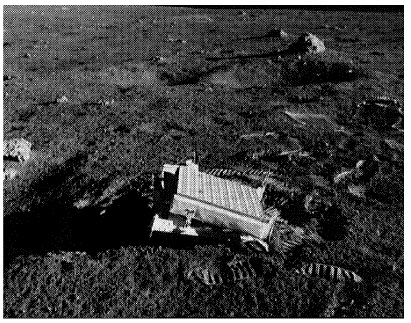
FIGURE 6–1. The laser retro-reflector array left on the surface of the Moon in the Apollo 14 mission in 1971. A hundred separate corner-cube prisms are used in this device. Over the past 30 years it has been used to reflect laser pulses back to observatories on Earth, making it possible to monitor the slow drift of the Moon away from our planet.
By firing short laser pulses towards these through a large telescope and measuring the time it takes for a few of the transmitted photons to be reflected back to the Earth, physicists can measure the round-trip time: slightly over two and a half seconds. Knowing the speed of light, the experimenters can determine rather accurately the current distance to the Moon. Over three decades of such trials they have shown that the recessional speed of the Moon is about an inch and a half per year.
THE NEED FOR LEAP SECONDS
The above conclusion was not unexpected. We already knew the Moon to be drifting away from us very slowly. The Moon raises tides in the oceans, and these create a drag force that is incessantly dropping the terrestrial rotation rate. Although the effect is small, it is both calculable and observable, for example through radio astronomical observations of distant quasars (these are so far away that they provide unmoving references against which the terrestrial spin may be gauged). On top of this persistent slowdown trend, the rotation rate of the planet is also found to undergo seasonal variations, as the atmosphere swells under summer heating and then shrinks in the winter.
It is because of this general slowing down of the Earth that leap seconds need to be inserted into some years. In the past, time was defined astronomically, from observations of when the Sun and the stars crossed the noon meridian. However, during the twentieth century methods of time determination that were of ever increasing accuracy were developed, eventually resulting in time according to the heavens being abandoned in favor of time according to atomic clocks. The atomic second is the standard we
use now, and that is defined according to the length of the day as it was in 1900. Over the century that has elapsed since then, the days have become about 1.7 milliseconds longer. Such differences accumulate to give a discrepancy of one second over 19 or 20 months, making a leap second necessary to keep the time shown by atomic clocks in accord with the spin of the planet. Leap seconds are inserted on an as-needed basis, by international agreement, at the end of either December 31 or June 30.
As the years pass the day is getting longer and longer, and leap seconds will eventually be required more often. If the present rules are maintained then within a few centuries we may need a leap second at the end of every month. One way to avoid this would be to redefine the atomic second in terms of the day length in A.D. 2000 rather than 1900, and then no leap seconds would be needed for some decades, but there are problems with such a solution. For example the fundamental unit of length used in all science and technology, the meter, is now stipulated in terms of how far light travels in a second, and so amending the second would alter the definition of the meter. Also, radio frequencies are given in units of Hertz, or cycles per second, so that changing the second would affect those too.
WHY THE MOON IS RECEDING
As the Earth’s speed of rotation diminishes owing to tidal friction, its angular momentum falls. The angular momentum of a body is a measure of its disinclination to stop rotating (or indeed to speed up), whether that rotation is in the form of spinning on its axis, or revolving around another body. An example of the latter is any planet orbiting the Sun, or the Moon orbiting the Earth. A body’s
angular momentum depends upon its total mass, the distribution of that mass, and its rotation rate. The total angular momentum of any system is a quantity that is absolutely conserved (remains the same). An example is a pirouetting ice-skater. With arms out-stretched her spin rate may be slow, but as she draws her arms down to her sides, the rate of spin increases. Because the mass distribution has been changed, the spin rate alters to compensate and thus keep the angular momentum constant.
In the case of the Earth there is braking due to tidal drag, because the continents prohibit the free movement of the tidal swell right around the globe, and in consequence the planet’s spin angular momentum reduces. We have just seen, though, that the angular momentum must remain the same. Evidently, something else has to be happening here if the laws of physics are to be obeyed.
How is this achieved? I noted above that it is the total angular momentum of the system that is conserved. Here we are considering the Earth-Moon system as a whole. As the spin angular momentum of the former drops, the angular momentum associated with the orbit of the latter must increase. To make this happen, the Moon recedes from our planet, very slowly. And that is why the lunar laser ranging experiments indicate that our natural satellite is receding from us at about an inch and a half every year.
THE EFFECT UPON ECLIPSE TIMES
As it moves further away from us, the Moon takes longer to complete an orbit. Looking backwards in time, perhaps to 500 B.C., it was closer to us and so its orbital period was less. If the recession rate given above, an inch and a half per year, has continued
throughout the intervening 2,500 years, this would imply that back then the Moon was about one-sixth of a mile closer, and the synodic month lasted for almost two seconds less than it does now.
Without accurate clocks in ancient times, how could we check the correctness of these calculations, which are based upon backward extrapolations of modern ultra precise measurements? The answer comes from eclipses. The milliseconds-per-day slowing of the terrestrial rate of rotation and the seconds-per-month discrepancies produced by the receding Moon, add together and result in severe displacements of the ground tracks of solar eclipse totality.
All those seconds accumulate to produce an eclipse time four hours earlier in 500 B.C., as foreshadowed above. This displaces the track of totality about 60 degrees east in longitude. For example, an eclipse that would otherwise have been expected to have had a track crossing the Italian peninsula 2,500 years ago might actually have been seen in Pakistan and western India, making a search through Roman republican accounts from that era futile. The problem can be attacked in the opposite way, however. With some ancient record of an observed total eclipse, knowing where it was observed, and approximately when, it is possible to back compute the circumstances of all feasible eclipses and identify the one responsible. Because the tracks of totality are so narrow, knowing a blacked out Sun was observed in Athens, Babylon, or Beijing on a certain date enables us to determine the spin phase of the Earth in that epoch.
There is a problem, though. If the rate of deceleration of the Earth’s rotation were uniform, then the corrections needed would be straightforward. But this is not the case. Since the last Ice Age terminated about 10,000 years ago many continental regions (such as the northern parts of Europe, Asia, and North America), which
were overlain for eons by thick ice layers, have been rebounding gradually. That is, their ice burden compressed them, but now they are expanding again. Like the skater raising her arms, this causes the spin rate to fall. One does not expect the deceleration in the Earth’s rotation rate to be constant over millennial time scales, then. The eclipse records found on Babylonian clay tablets and in medieval chronicles are allowing investigators to track these changes in our planet’s dynamical behavior rather precisely.
Having mentioned Beijing (formerly Peking) above, let us look at a specific record from ancient China. A couple of millennia back the imperial capital was Chang’an (known as Xi’an or Sian nowadays). A chronicle for 181 B.C. records that a total solar eclipse was witnessed there, and we can identify its circumstances through back-computations of the relevant orbits in all respects except one: the spin phase of the Earth. If one assumes that the planet rotated at its present rate throughout the years since 181 B.C. then the ground track of the eclipse would have missed Chang’an by about 50 degrees of longitude (equivalent to 3 hours and 20 minutes of spin), as shown in Figure 6–2. But the eclipse track did intersect Chang’an, indicating how much the Earth’s rotation has slowed over all those centuries.
Many of the Babylonian clay tablets containing records of ancient eclipses are now archived at the British Museum, in London. It is not a coincidence that much of the leading work on ancient eclipse interpretation has been by British astronomers. In particular Richard Stephenson of the University of Durham, aided by Leslie Morrison of the Royal Greenwich Observatory and others, has found vital evidence for how the Earth’s spin rate has varied since about 700 B.C. Mesopotamian tablets and Chinese records, plus various Arab chronicles and European annals, have all
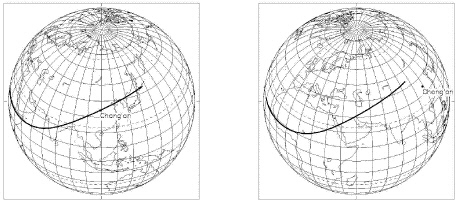
FIGURE 6–2. A total solar eclipse was observed from the ancient Chinese capital of Chang’an in 181 B.C. The eclipse ground track can be computed and plotted onto the globe such that it passes through Chang’an, as on the left, indicating the spin phase of the Earth in that era. If our planet had continued to rotate at the same rate as at present over all the intervening years, then the track would have missed Chang’an by 50 degrees of longitude (equivalent to 3 hours and 20 minutes of time), as on the right. Such eclipse records allow us to understand how the Earth’s spin rate has slowed under tidal friction in recent millennia.
been trawled for their useful eclipse data. The results have applications in a number of areas of science other than just astronomy, for instance in developing our understanding of the long-term climatic vagaries of the Earth.
THE DISCREPANCY BETWEEN EARTH AND MOON MEASURES
We have seen above that tidal friction is causing the spin rate of the Earth to fall, and to compensate for that the Moon is receding from us. Direct measurements are made of two quite different
things: the rotation rate of the planet (using historical eclipses for the long-term changes, and ultra precise radio astronomical techniques and so on for the short-term changes), and the distance of the Moon (through laser ranging). You might expect the results obtained from these distinct measurements to be in agreement, but that is not the case: there is a marked discrepancy between them. Why is this?
Let us go back to thinking in terms of the length-of-day (LoD) because it is the easiest parameter to understand. We have said that the LoD is increasing by around 1.7 milliseconds per century. So, as I write in the year 2001 the LoD is 1.7 milliseconds longer than it was in 1901, and in the year 2101 it will be (we anticipate) close to 3.4 milliseconds longer than it was back in 1901. The LoD is a quantity we can measure directly.
The rate at which the Moon is receding is also measured directly (from the retro-reflectors left on the lunar surface; see Figure 6–1), and that inch-and-a-half per year can be converted into the equivalent increase in the LoD that would result over a century. But when we do this, the answer is 2.3 milliseconds, and not the 1.7 milliseconds we might have expected. How does the discrepancy of 0.6 milliseconds arise? Some other process must be counteracting a part of the slowdown due to the tidal drag imposed by the Moon.
The answer to this puzzle seems to be related to the Ice Age cycle. At first sight it might appear that, as sketched earlier, the melting of the vast ice packs at latitudes beyond 40 degrees (which occurred around 10 millennia ago) would lead to a simple expansion of the rock and soil that had been compressed beneath them. Such an expansion would increase the average distance of these landmasses from the spin axis of the Earth, and so the spin rate
would fall just as when the ice-skater spreads her arms. But it is not quite that straightforward.
It seems that since the ice burden melted (one can hardly call it polar ice because it covered about a quarter of the globe) the shape of the Earth as a whole has been changing due to the migration of the liquid water so released. Rotating objects are not spherical, but oblate; that is, they are flattened slightly, the distance pole to pole through the middle being less than that measured crosswise in the equatorial plane. Since the termination of the last glacial period it appears that the Earth has become a little less flattened (that is, it has become closer to spherical), with oceanic water moving away from the tropics and towards the poles. This means that the water involved is nearer to our spin axis, and so possesses less angular momentum. Overall, this boosts the planet’s spin rate very slightly. The enhancement caused by shape change is equivalent to 0.6 milliseconds (per day per century). Subtracting that from the tidal drag imposed by the Moon and Sun, the value of 2.3 milliseconds, the overall change measured directly is 1.7 milliseconds.
I have just slipped something else in there. I mentioned the Sun imposing a tidal drag, as it surely does. Although the Moon is the major cause of the tides as such, it is the solar influence that produces the difference between the heights of spring and neap tides. Because of the Sun’s effect, the angular momentum of the Earth-Moon system is not conserved precisely: the system is not completely isolated. This, though, is a minor complication. In fact, you can probably imagine what is happening here. The tidal friction due to the Sun produces a change that must be taken up by the orbital angular momentum of the Earth, and in consequence the mean Earth-Sun separation increases a little. But the change
involved is minute, compared to what is happening in the Earth-Moon system.
THE PHYSICAL SIZE OF THE MOON
In all of our discussions of eclipses so far we have tacitly assumed that the intrinsic physical sizes of the Sun and the Moon are not changing appreciably.
The Moon is a rocky body. When it was young and hot it was slightly larger because by heating things you generally make them expand. That is why a glass jar may crack if you pour in a boiling liquid: the rapidly heating interior tries to expand against the cool exterior, breaking it asunder. Imagine you are making jam and have gotten to the point where you pour the steaming liquor of fruit, sugar, and pectin into the jars. You should be sure that you immerse those jars first in boiling water not only to sterilize but also to heat them, thus avoiding breakage due to temperature differentials.
Although the Moon may have been a little larger when young, it has long since completed its cooling and reached its equilibrium dimensions. (The puckering of its surface during this cooling and contracting from an initially molten state is thought to explain some of its peculiar surface features like cracks and rills—similar to the wrinkling of a prune as it dries out.) From the perspective of eclipse calculations, the physical size of the Moon may be taken to be unchanging. Over the time scale of human history, even the gradual increase in its mean distance from the Earth is not a significant effect compared to the monthly in-and-out movement varying its angular size.
THE PHYSICAL SIZE OF THE SUN
Turning our attention to the Sun, this is a gaseous body so we may expect it to expand and contract. For example, changes in the rate of energy generation (through nuclear fusion in its core) will cause its diameter to vary. The Sun is almost 5 billion years old, and over that time span we know that its energy output has not been constant. After the next 5 billion years, when the hydrogen fuel within it starts to be exhausted, astrophysicists expect the Sun to expand to become a red giant star, with a radius perhaps as large as the orbit of Jupiter, more than a thousand times its present size. After that, with little internal energy production to support it, the Sun will shrink again and attain a dimension rather less than at present, becoming a white dwarf.
Astronomers see these processes occurring in other stars and witness outbursts and oscillations in stellar sizes on all sorts of time scales. Some alter quickly, within days or weeks, but most stars have shown no significant alteration over the decades in which measurements of their brightness have been possible. Although the solar output is reasonably constant in the short-term (which is just as well, otherwise we might get fried), we should be prepared at least to entertain the notion that over centuries or millennia the Sun might grow or shrink. Such variations would of course affect the occurrences of eclipses, and their characteristics. In Chapter 7 we turn our attention to this matter.