Eclipse: The Celestial Phenomenon That Changed the Course of History (2001)
Chapter: 9. The Rocky Mountain Eclipse of 1878
9
The Rocky Mountain Eclipse of 1878
The mapping of the dark shadow, with its limitations of one hundred and sixteen miles, lay across the country from Montana, through Colorado, northern and eastern Texas, and entered the Gulf of Mexico between Galveston and New Orleans. This was the region of total eclipse. Looking along this dark strip on the map, each astronomer selected his bit of darkness on which to locate the light of science.
Maria Mitchell, professor of astronomy at Vassar College, describing the eclipse of 1878
Several total eclipses crossed North America during the nineteenth century, and each has an interesting story to be told about it, although no other had the same order of significance as that of 1806. The authorities would not let themselves be caught out again in the same way as with the Shawnee Prophet. In this chapter we will concentrate upon the eclipse of July 29, 1878.
Eclipses had entered a period of heightened scientific study. As I wrote in Chapter 5, the heyday of eclipse watching was between the 1840s and the 1930s. Having realized that the corona was some form of extensive solar atmosphere, astronomers
mounted expeditions to find out what they could during the precious few minutes of totality. Elsewhere we have learned about the discovery of helium in 1868, and other secrets of the Sun that were uncovered in following eclipses.
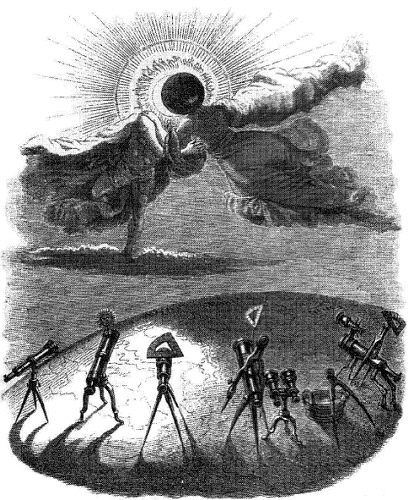
That is not to say that eclipses were regarded solely through the cold visage of science. As people abandoned their old irrational beliefs, there was more romance attached to eclipses. Yes, they were regarded as being perfectly understandable natural phenomena, but also wonderful things to behold for their sheer beauty. An example of this new attitude is shown in Figure 9–1. The Sun is depicted as a male deity, being embraced by the female moon goddess during an eclipse. All this is watched by an array of anthropomorphized optical instruments on the Earth below.
The total eclipse in 1878 was big news, exciting the general public throughout the land. Although it was far to the east of totality, in St. Louis the local people were thrilled by the partial obscuration they saw, and they thronged around Washington University where telescopes were trained on the Sun. Immediately after the termination of the event the St. Louis Evening Post put out a second edition, recounting such information as had been gathered already by telegraph from the observing parties in Wyoming and Colorado. The headlines, reading as follows, used the same symbolism as that in Figure 9–1:
THE ECLIPSE.
Old Sol Obscured by the Lunar Sphere.
The Sun God Embraces the Queen of Night.
All About the Astronomical Event of the Year.
Although eclipses had firmly entered the sphere of science, rather than superstition, it does not follow that they were viewed
from an atheistic standpoint. Indeed many then, as now, regarded the splendor of the skies as being manifestations of their religious beliefs. As one writer put it: “Science and general education have banished all the dread these events inspired. Announced with exhaustive accuracy before their coming, fear has given way to admiration at the fixed laws, the order, the harmony of God’s workings, where once ignorance anticipated accident, the coming of disasters, and tokens of the anger and wrath of the Creator.”
THE SAROS AND THE NINETEENTH-CENTURY U.S. ECLIPSES
Only Washington and Canada were visited by the eclipse of July 1860, and so comparatively few people watched it. In August 1869, though, a broad eclipse track swooped down over Alaska and the western parts of Canada. Crossing the border into the United States at Montana, the eclipse path covered many of the states in the Midwest before fizzling out in the Atlantic soon after straddling North and South Carolina. Although this was relatively close to the major population centers and universities on the East Coast, astronomers tended to head further west to observe it from Iowa and Illinois, because from there the Sun was higher in the sky.
This, then, stirred up more interest for the great Rocky Mountain eclipse of 1878. But before we move on to that event, let us consider the way it is linked with those in 1806 and 1860. The saros period is 18 years plus 10 or 11 days. Triple that, and add the result onto June 16, 1806. You will get the date of July 18, 1860, when the eclipse began at sunrise in the Pacific Ocean just off the coast of Washington. Add on another single saronic period, and you get July 29, 1878, the date of the eclipse that is the main
subject of this chapter. Thus these three eclipses crossing the United States were all part of the same saros cycle, a sequence that began in 1535 and will continue until the 75th eclipse in the year 2888.
ECLIPSE PREPARATIONS IN THE WEST
Expeditions were sent to the west in July 1878 from many of the established universities. From institutions in New York, Rochester, Philadelphia, and Chicago a stream of astronomers issued forth, heading for the mountains to set up their instruments (see Figure 9–2). Princeton University sent a team that was reputed to be the best equipped, with the latest telescopes and spectroscopes needed for the job. The U.S. Naval Observatory in Washington, D.C., dispatched five separate groups of observers to well separated points so as to be sure that they would not all be clouded out. As it happened, Monday July 29 dawned clear, after 12 days of unsettled weather. Very few observers had their plans disrupted in any way by clouds.
The choice of location was dictated to a large extent by the paths taken by the different railroad companies. The Union Pacific line from Chicago to San Francisco running through southern Wyoming afforded one possibility. Along that stretch of the railroad, near Rawlins, there were four separate eclipse parties, sampling alternative points across the track of totality.
Another route was further south. By taking the Santa Fe railroad from Kansas City to Pueblo, Colorado, eclipse parties could get to the edge of the plains in front of the Rockies. They could then decide how far north they wanted to go, on the Rio Grande railroad passing up through Denver to Cheyenne. Most did go to
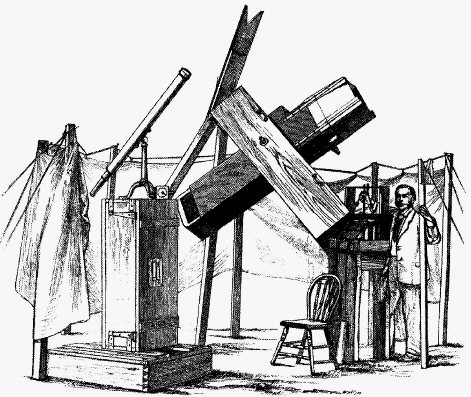
FIGURE 9–2. A temporary observatory set up in Colorado for the 1878 eclipse.
Denver or thereabouts, the eclipse providing the greatest single influx of people ever seen by that city since its foundation. Others had determined that Colorado Springs was far enough. Samuel Pierpont Langley of the Allegheny Observatory, near Pittsburgh, was later to become an aeronautical pioneer: the NASA-Langley Research Center in Virginia is named for him. Back in 1878 he was reaching for the sky in a different way. Accompanied by several other astronomers he established a temporary observatory on Pikes Peak, the summit of which is over 14,000 feet above sea
level. In the event their observations went well, but only after some consternation in the days beforehand, because several members of the party had to be taken off the mountain when they started suffering from altitude sickness.
As regards the general public, there was some argument in the preceding weeks with regard to whether businesses and factories should close up, in order to allow workers a chance to view the eclipse. An announcement was made in Denver the day before that all banks would close early, at 1:30 in the afternoon, 45 minutes prior to the first contact. Essentially all shops were closed by two o’clock, and the only thing one could easily buy was a piece of smoked glass for eclipse watching, boys walking the streets hawking such aids to anyone who had not had the foresight to prepare their own. As the Rocky Mountain News said, “The show was on the grandest of grand scales, free to all, without money and without price”—except perhaps in lost wages.
Several overseas visitors came to Colorado for the eclipse, in particular a group of half a dozen British astronomers, who were accompanied by Asaph Hall from the U.S. Naval Observatory.They positioned themselves at Fort Lyon, on the plains out to the east of Pueblo, where the Santa Fe Trail snaked down from Kit Carson. Hall had recently become internationally famous through his discovery, just the year before, of the two small moons of Mars we call Phobos and Deimos. In this party was Norman Lockyer, whom we met in Chapter 5. An avid eclipse chaser, Lockyer was the founder and first editor of Nature, a magazine that continues as the world’s premier scientific journal. He was hugely impressed by the enthusiasm for the eclipse shown by the local people, sending home to London the following report: “As significant of the keen interest taken in the eclipse by all classes here, I may mention that
on the Sunday before the event prayers for fine weather were offered in all the churches of Denver.” Even more, Lockyer was delighted by the encouragement given to science by the U.S. government, contrasting it against the attitude he experienced back in Britain: “Strange as it may seem, this is the expressed feeling of all the authorities here, from the Chief of the State downwards. In interviews with which I have been honored, the President of the United States himself, the Secretary for War, General Sherman, and other members of the Cabinet have one and all insisted upon the importance of securing records of all possible natural phenomena, and expressed their gratification that such records have been secured in the present instance by Government aid.”
SCIENTIFIC INVESTIGATIONS
For the professional astronomers, the main subject of inquiry was the solar corona. The nature of that structure, seen only during an eclipse, was as yet unclear. What is it made of? Does it contain yet more unknown chemical elements, like helium? These are the sorts of questions we addressed in Chapter 5. Back in 1878, scientists had real quandaries with understanding the corona. These are nicely encapsulated by the following passage that appeared in the Boston Globe: “The corona is not a solar atmosphere in the sense in which the word is usually understood, since the great comet of 1843 passed through 300,000 miles of it at the enormous velocity of 350 miles per second without suffering visible damage, or being in the least retarded; yet shooting stars passing through the upper portions of the Earth’s atmosphere are completely vaporized, although their speed never exceeds fifty miles per second. What then is the corona?”
The problem with the corona was based upon its dimensions. Although its measured size alters from eclipse to eclipse due to variations in solar activity, typically it stretches up above the photosphere by a distance of the same order as the radius of the Sun. That means it is huge. The atmospheres of the Earth and Mars were known to be of very limited extent, only tiny fractions of the radius of either planet, and so astronomers were at a loss to explain the vast corona they saw. Even given that they knew that the solar photosphere was very hot, many thousands of degrees, still they could not explain the corona’s extent. The calculations indicated that if it were as hot as the glowing solar surface, then the corona might extend out into space for a few hundred miles—but not half a million miles.
It was known that the corona must be very tenuous, else it would be apparent at other times than during eclipses. Limits on its thickness, in terms of the amount of light it absorbs, were set in 1878 when an observing team from Chicago noted that they could see one of the stars in the constellation Cancer right through the corona. Thus although it appears bright during an eclipse, the corona must contain very little matter, else it would have absorbed the star’s light.
The eventual solution came when it was realized that the temperature of the corona is measured not in thousands of degrees, but in millions. In 1878 this was entirely unsuspected.Various specific experiments were planned to probe its nature during the eclipse. By using spectroscopes it was hoped to identify new constituents. Using polarimeters, which enable the polarization of the light received to be determined, astronomers hoped to be able to identify whether there was dust within the corona. Nowadays it is known that there is an enhancement in the density of interplanetary dust near the Sun which may be investigated by using the
sunlight it scatters, and this is termed the F-corona, but a century and more ago there was scarce knowledge of such things.
Regarding the temperature of the corona, an attempt was made to measure its heat directly. These were still early days in infrared astronomy and very little was understood. But the right man to have on that task was Thomas Alva Edison, the great inventor.
EDISON’S OBSERVATIONS IN WYOMING
In 1878, Edison was 31 years old.The year before he had invented the phonograph, which is widely regarded as the second best of his ideas, behind the incandescent electric light bulb. And there is evidence that the development of the light bulb was connected with the eclipse.
Edison had been working hard on a gadget known as a tasimeter to use during the eclipse. The basic concept of this device involves a small solid block having light shone on it from a certain source in the sky, selected by using a telescope with a screen or slit arranged such that only light from that source reaches the block. Any slight temperature change produced by the incoming radiation will cause the block to expand or contract, and the stress induced is a sensitive measure of the temperature variation. That stress or pressure can be measured electrically. It was reckoned that Edison’s tasimeter could show a change of just one part in 50,000 of a degree Fahrenheit, and maybe even ten times better using an improved galvanometer. The idea was to try to measure the infrared radiation emitted by the corona, and so deduce its temperature.
Edison decided to combine his expedition to the eclipse with
a month-long vacation in the western states. Leaving New York on July 13, he reached Laramie a week later and stopped to buy some hunting and fishing equipment. His spot for observing the eclipse was a hundred miles west, in Rawlins, Wyoming, along with various other parties who had used the Union Pacific railroad.
Unfortunately Edison made the mistake of setting up his equipment in a chicken coop. As the obscuration of the Sun progressed the chickens decided it was time to return to their boxes, getting under his feet at the critical stage, limiting the observations. He certainly got a reading, but did not have time to do much else. Edison should have read the Chinese annals of the thirteenth century: “The Sun was eclipsed; it was total…The chickens and ducks all returned to roost. In the following year the Sung dynasty was extinguished.”
At the start of August Edison headed onwards to San Francisco, also visiting Yosemite and various mines in the region to look into their ventilation and lighting requirements. He returned to Rawlins two weeks later to do some fishing, before heading on to Chicago and St. Louis. There he presented a paper on the tasimeter to the American Association for the Advancement of Science. On August 26 he returned to his laboratory in New Jersey, and the following day began his experiments on his electric light bulb. What is the connection with the eclipse?
In all Edison and his team of researchers tested something like six thousand different materials as possible filaments for the light bulb. (It was Edison who coined the term “filament” during these experiments.) Although they had many early successes, still the filament lifetimes were limited. It was not until 1897 that they settled on cotton thread that had been carbonized as the best they
could do. In 1910 Edison’s rival William Coolidge realized that a microscopically thin tungsten wire was much better, and that is basically what is still used in light bulbs today. In any case Edison’s technique was limited by his insistence on using direct current, rather than the standard alternating current that soon took its place when the advantages were recognized.
Stepping back in time, Edison broke a bamboo fishing rod while angling near Rawlins and that night he threw it on the campfire. As he watched it burn he noticed how individual strands of the wood glowed white as they burned fiercely, and that convinced him that bamboo might be the best material to use for his light bulb filaments. His final solution, carbonized thread, is not much different.
LOOKING FOR VULCAN
In Chapter 13 we will be examining another type of eclipse, a phenomenon known as a transit. This is when a planet or some other small body crosses our line of sight to a larger celestial object. Examples are transits of Mercury and Venus across the face of the Sun (Figure 13–1), or by the Galilean moons of Jupiter across the disk of that planet (Figure 13–5).
As will be described in more detail in that section, there was a problem in the nineteenth century with astronomers’ observations of Mercury. The motion of that planet appeared to be discrepant, and a suggestion for the origin of this anomaly was that there was a small, unsighted, interior planet tugging Mercury along. That hypothetical intra-mercurial planet was labeled Vulcan, even though it had yet to be found. There had been reports that it had
been seen as a dark spot cutting across the face of the Sun—in transit that is—but these claims were inconsistent and ambiguous. Many people confidently expected that it would be spotted during this eclipse. When the Moon hid the bright solar disk it might be possible to see this faint body, orbiting close to the Sun. At least that was the idea. The Boston Globe began a report that morning by stating: “This is the day when the inhabitants of a goodly portion of the American Continent are to be favored with the rare pleasure of an unobstructed view of Vulcan.” Several of the astronomers who trekked to Colorado and Wyoming did so specifically with a search for Vulcan in mind. Just think of the fame that would be attached to the discoverer of a new planet. Wishful thinking led to a couple of claimed sightings, but in the end it all came to naught. The reason why will be discovered in Chapter 13.
THE POPULAR VIEW
Dozens of astronomers came to see the eclipse, but there were thousands and thousands of people outside to watch it. In Denver the tops of all the taller buildings were festooned with ladies and gentlemen fighting for what they imagined to be the best spots, although the middle of a road or field would have done just as well.
This is what the Rocky Mountain News had to say the next day: “While the professionals, with their sails trimmed, calmly awaited Luna’s approach, the average citizen was frantically engaged in hunting pieces of broken glass in the back-yard and burning it and their fingers over a dubious light on the kitchen table. The stock of street vendors of the dusky article was soon exhausted, and the demand continued up to the first moment of the contact.” In this
regard, some people had a little luck. The year before a phenomenal hailstorm in Iowa had smashed over a thousand greenhouse windowpanes, much to the owners’ distress. Now that broken glass was proving to be a saleable item, conveniently chopped into the appropriate size for smoking and eclipse viewing.
As the partial phase progressed, the temperature began to drop. Although the day was clear, it was hot and humid. Just before first contact the temperature displayed by a thermometer left in direct sunlight was 114 degrees Fahrenheit. As the eclipse reached totality that had fallen to just 83 degrees.
In Denver totality began a few seconds after 3:29, and lasted for 2 minutes and 40 seconds. Even if your watch was not quite correct, it was easy to see when the eclipse would arrive. The track brought the shadow over Longs Peak, towering above the horizon to the northwest at a distance of about 60 miles. The edge of that shadow was moving at around 32 miles per minute, and so it took just about 2 minutes to sweep down from the heights of the Rockies and reach Capitol Hill in Denver, where thousands were massed to see it.
As the Sun went dark the corona became visible to all, although not much of a chromospheric display was seen, with only one notable prominence, perhaps two close by each other. There were stars to be seen, however, which is a staggering thing to an inexperienced observer. Regulus and Procyon, along with the Gemini twins Castor and Pollux, were obvious. Even brighter was Venus, and Mercury was seen, too.
Not everyone was so pleased with the eclipse. It was reported that the workers in the Chinese laundries went outside and “beat their gongs all through the totality.” Even less happy was one lad whose sad story was told by the Rocky Mountain News: “The young man whose customary siesta yesterday extended beyond the pe-
riod of totality, his landlady forgetting to awaken him, was around looking for a cactus to sit down on last night.”
THE ZULU WAR ECLIPSE
After the great Rocky Mountain eclipse of July 1878, the next one was annular, visible as such on a line passing over Africa on January 22, 1879. It is only the partial eclipse as seen from the southeastern segment of the continent that is of interest to us here.
This was the time of the Zulu Wars, when the British were trying to wrest from the native peoples the region of South Africa now known as KwaZulu Natal. One particular battle in those wars, occurring at Rorke’s Drift, is well known to many because it was the subject of the 1960s movie Zulu (starring Michael Caine and Stanley Baker). At Rorke’s Drift, a Swedish mission station far from civilization, 100 British soldiers held off an attack by 4,000 Zulu warriors. The highest-ranking medal awarded for bravery in the British armed forces is called the Victoria Cross: at Rorke’s Drift more of these were won than in any other battle in history. Seventeen of the defenders died; countless attackers also perished.
The Zulus who attacked Rorke’s Drift, beginning at about three o’clock in the afternoon of that January 22, had sped there from another battle just completed nearby at a rocky pinnacle called Isandlwana. The outcome was not so favorable for the British; in fact it is often cited as being the greatest disaster in British military history. Only a few escaped unhurt from a contingent that had been surrounded by over 20,000 Zulu fighters. Of the 1,700 men on the British side, 1,329 were killed. That said, the number of Africans who died under the rain of bullets was estimated to be about 3,000.
The progress of that ferocious battle was affected by the eclipse, leading to it being remembered as the Day of the Dead Moon. In fact, because of the Zulu superstition about the state of the Moon, they had not intended to fight on that day. When the Moon disappears near conjunction they believed there were evil spirits in the air, and so they were waiting for the new moon to appear the following day. When a detachment of British troops blundered into the Zulu army, hidden from view in the undulating terrain, a spontaneous attack began, with their opponents being forced back towards the stony outcrop that is Isandlwana.
The Zulu commanders had gathered together a massive army, the warriors being deployed into a formation known as the “Buffalo Head.” That is, there was a main central contingent of men, but with two horns to the sides. In this case the distance between the tips of the horns was huge, about five miles. The tactic then was to advance on the enemy, and let the horns wrap around each side, meeting at the rear to cut off any retreat by their opponents. This formation, on its grand scale, is what the British saw from Isandlwana, advancing over the horizon towards them shortly before noon.
Unlike the British, with their heavy clothes, guns, ammunition, and other equipment, the Zulu soldiers were able to move quickly on foot. Very rapidly most of the British troops who had any chance of escape dashed from them. And then, soon after one o’clock, the eclipse began, as if it were a divine sign to the Zulu that they should massacre the foreigners. At the location of the battlefield, the eclipse reached a maximum at half past two, with two-thirds of the Sun being covered.
The significance of the eclipse here is not that it hid part of the Sun, but that it made visible, as a silhouette, part of the Moon.
The Zulu initially did not want to fight because of the bad portent represented by the Moon not being seen at that time in the month. The solar eclipse, paradoxically, made the Moon obvious in the sky, giving great heart to the Africans. The eclipse was still in progress as they stormed down towards the Buffalo River to begin the assault on Rorke’s Drift.
Did the Zulu know in advance about the impending eclipse? Unlike the case of the Shawnee Prophet and the eclipse of 1806, there is no evidence of any prior knowledge on the part of the Africans. The British officers, however, could and should have known about it. If they had studied military history, they would have known that it is often a good thing to avoid an engagement during or soon after an eclipse, of any variety. They might even have used it to their advantage. But that’s not what happened. The Battle of Isandlwana remains one of the worst reverses the British ever suffered, although the role played by the eclipse is often neglected.