Eclipse: The Celestial Phenomenon That Changed the Course of History (2001)
Chapter: 2. The Heavenly Cycles
2
The Heavenly Cycles
And the Moon in haste eclipsed her
And the Sun in anger swore
He would curl his wick within him
And give light to you no more.
Aristophanes, The Chorus of Clouds
Our life rhythms are controlled by the heavenly cycles: the daily rising and setting of the Sun, the monthly variation in the brightness of the Moon, and the seasonal north-south displacement of the Sun affecting the influx of solar power and thus the climate.
It does not necessarily follow that all plants and animals have identical tempos. For any cyclic phenomenon, scientists may speak of both its frequency (the number of times it occurs within a given time, or equivalently its period, the duration of the cycle), and also its phase. Football games, for example, are played once a week (the frequency), making the period seven days, but there are different phases depending upon the level involved: high schools tend to play on Friday evenings, college matches are on Saturday afternoons, and professional games on Sundays.
In the natural world most organisms follow a basic daily cycle,
although their phases may differ. The majority of animals go about their business during daylight hours, but there are many specialized nocturnal beasts, too. (To go back to our football metaphor, there are also a few games on Monday or Thursday nights.) In addition, not all animals follow 24-hour cycles, as we will see.
Turning to the yearly cycle, the changing levels of daylight and temperature influence us all, and more so at extreme latitudes rather than the tropical zones where intra-annual variations are minimized. Who can claim that they are not affected in any way by the seasons, if only through oscillations in the price of fresh foods? Other animals suffer more radical alterations in food availability during the year, which exert greater control over their lives. In consequence many species hibernate during the winter, emerging only when the signs of spring promise plenty of food, telling them it is time to eat and breed again.
THE CALENDRICAL INFLUENCE OF THE MOON
The Moon also affects us in sundry ways. Much has been made by numerous authors of the apparent fact that the human female menstrual cycle has an average duration of about 29.5 days, which is indistinguishable from the cycle of lunar phases. One might consider this to be a coincidence. On the other hand it might be evidence of a causal relationship, perhaps amenable to scientific analysis; for example it may be that repeated high fertility near new moon, when it is dark and dangerous to roam at night, favored reproductive success in early humans.
Quite apart from this physiological cycle, it is indisputable that our natural satellite exerts control over our affairs. First, we should look at the calendar (or perhaps I should write calendars,
because different nations and religions use calendars other than the familiar calendar to which we in the Western world are habituated) . In the Western calendar the months, despite the etymology of that word, are no longer linked to the lunar phases, which is why I differentiate between lunar and calendar months. That divorce between the calendar month and the Moon, in the evolutionary history of the Western calendar, occurred before 400 B.C., in the Roman republican era before Julius and Augustus Caesar instigated Imperial Rome. The influence of learned Egyptians upon Julius Caesar ensured that his reformed calendar post-46 B.C. was an exclusively solar calendar.
Other calendars retain the influence of the Moon. While the civil Western calendar is solar, the ecclesiastical calendar endorsed by Pope Gregory XIII in A.D. 1582 (called the Gregorian calendar) is luni-solar. That is, the Moon defines the dates of all moveable feasts in the liturgical year, reckoned from Easter, which is based on the full moon after the spring, or vernal, equinox. (Beware, though, that the days of the full moon and the equinox used to derive the date of Easter Sunday are founded upon ecclesiastical rules, rather than the real Moon and Sun in the sky.) The Hebrew calendar is also luni-solar, with the Moon affecting the dates on the Western calendar for Passover, Rosh Hashanah, and Hanukkah. Similarly Chinese New Year is often celebrated at the second full moon after the winter solstice, although again the precise rules are complicated. In such calendars the Sun still defines the average (mean) length of the year, because the holidays are simply phased according to the lunar cycle following some solar-defined juncture (one of the equinoxes or solstices).
The Islamic calendar contrasts with this, the year being defined exclusively by the Moon, the annual round containing 12
lunar cycles. Because each month starts with an observed new moon, and there is only one chance a day to witness this (after sundown), the months and the years must contain a discrete number of days. On average, the Islamic year lasts for 354.37 days, but particular years generally contain either 354 or 355 days, and more extreme lengths are possible because of vagaries in spotting the new moon owing to atmospheric conditions. The Islamic lunar year is thus 10 or 11 days short of a solar year, and the calendar slips through the seasons on a cycle of almost 34 years.
More information about the astronomical bases of different calendars is given in the Appendix.
THE TIDAL INFLUENCE OF THE MOON
The Moon also influences us through the tides, which are raised by the attraction of the lunar gravity on our oceans. While the Sun also plays a role, resulting in the contrasting heights attained by spring and neap tides, the major cause is the lunar attraction. At the side of the Earth nearest the Moon the oceans bulge upwards due to its pull. On the far side of our planet the seas also bulge outwards away from the Moon’s direction (in simple terms this is because that part of the globe is furthest from the Moon, its gravitational pull minimized there).
The tides do not follow a 24-hour cycle. This is because, during the time the Earth takes to spin on its axis, the Moon has moved some distance along its orbit around us. The latter body does not return to the same place in the sky until 24 hours and 50 minutes later; this is a whole day plus one part in 29.5 (the number of days the Moon takes to orbit the Earth). The effect is that
the times of high tides shift progressively later by almost an hour each day.
To someone in the developed world interested in boating or fishing this may merely prove a nuisance, but to maritime societies such as in Greenland, or the Melanesian and Polynesian islands in the Pacific, the tide timetable is fundamental to their livelihood. Thus their “day” would not be based on the movement of the Sun, a 24-hour cycle, but rather a lunar day, lasting 24 hours and 50 minutes.
In the natural world many animals living in mangrove swamps and intertidal mudflats are similarly affected by the Moon. Their daily routine follows not the cycle of sunlight, but rather the rhythm of the tides, which is controlled by the spin of the Earth and the orbit of the Moon.
Clearly the Moon affects both the human and the natural world in diverse ways. It is not just some lifeless lump of rock forever circuiting our planetary home as a mere curiosity. We have good cause to want to understand its cycles, which are both complex and remarkable. The length of the year we use in religious calendars and so forth may be directly affected by the presence of the Moon. Long-term changes in the dates of the solstices and equinoxes are caused mainly by tugs imposed on the orientation of the Earth’s spin axis by the Moon. The Moon’s various cycles are considered next in further detail, along with their effect on the pattern of eclipses.
THE CYCLES OF THE MOON
As we have already seen, our Western calendar months are divorced from the Moon. Let us leave them aside. There are several
astronomical definitions for the month, each taking some specific phenomenon as its basis. These are each of vital significance in determining eclipse cycles, and they are all defined and discussed in the Appendix. Immediately, however, it is the brightness cycle of the Moon that we want to know about, and so the length of the month appropriate is that from one full moon to the next. That is called the synodic month, or sometimes a lunation, or simply lunar month (the latter terms perhaps being somewhat ambiguous). It lasts for about 29.5 days, as we mentioned previously. Any particular synodic month may range in duration by six or seven hours from the mean (between about 29.2 and 29.8 days), the average over several years being 29.53059 days.
When the Moon is aligned with the Sun we say it is at conjunction, whereas when it is 180 degrees from that point it is at opposition. (Although opposition is the time of full moon, strictly speaking conjunction is not the time of new moon. This is because for the new moon to be visible near the western horizon just after sunset, it needs to have moved along its orbit so it is sufficiently separated from the Sun. Conjunction may be thought of as being “dark of moon,” when it cannot be seen at all in the solar glare.) The Moon may be said to be in syzygy when it is at either of these points. Eclipses can occur only near syzygy.
Until now we have been effectively assuming that the Earth, Sun, and Moon all inhabit the same plane. If this were the case then the Moon would cross the face of the Sun, producing an eclipse, every time it passed conjunction. The lunar orbit does not remain in the same plane as that which the Earth occupies, a matter of great importance with regard to eclipses. If we consider the Sun and the Earth’s orbit around it to be in the plane of the paper
in this book, then the Moon’s orbit is, in reality, tilted by about five degrees to that plane; this angle is called the inclination.
The Sun has a diameter about 109 times that of the Earth, while the Moon is not much more than a quarter the size of our planet. This means that to get an eclipse requires a quite stringent alignment. An eclipse occurs only if the Moon crosses the ecliptic when very close to either conjunction or opposition, respectively producing solar and lunar eclipses. During each circuit of the Earth, the Moon crosses the ecliptic once traveling upwards, and once traveling downwards. These are called the nodes of the orbit, the ascending and descending nodes respectively. An eclipse can occur only at a node.
An angle measured counter-clockwise around the ecliptic from the location of the spring equinox is called a celestial longitude, a similar parameter to the geographical longitudes we use to produce a grid on the Earth’s surface, the Greenwich meridian being the fundamental reference. Astronomers likewise use celestial latitudes for the angle north or south of the ecliptic plane.
THE METONIC CYCLE
You may recall that, at the beginning of the book, we mentioned the period of 235 synodic months, which lasts for almost exactly 19 years. The difference between these is just 125 minutes. Astronomers call this 19-year period the Metonic cycle, after the mathematician Meton who lived in Athens in the fifth century B.C., although there is evidence that the Babylonians knew of the synchrony earlier.
Meton invented a calendar cycle containing 6,940 days, but the Greeks never adopted it for widespread use. The 19-year cycle
is employed, though, in various other calendrical spheres. Many past and present calendar schemes using leap months rather than the familiar leap days have seven extra lunar-based months spread over 19 years. Thus a dozen of the years each contain 12 months, while seven of them have 13, making 235 in all.
A form of the Metonic cycle is used today in the Hebrew calendar, and many other luni-solar calendars. It is also employed in the calculation of Easter. Its inaccuracy—that discrepancy of 125 minutes—has affected history in various ways, most especially in the evolution of ecclesiastical calendars. Again the intricate details are discussed in the Appendix.
The discovery of the Metonic cycle by the ancients would have been possible simply by watching for a repeated full or new moon at the same time of year. The fact that there are almost exactly 235 lunations in 19 years is a phenomenon that could have been identified by quite early societies, such as those who were building megalithic monuments in Britain and elsewhere in Western Europe from at least the middle of the fourth millennium B.C. This simple coincidence between the lunar and solar cycles would have been fairly impressive, and most important would have allowed the subsequent prophecy of various celestial events. Starting from that basis further coincidences would soon be unveiled. Such considerations may underlie the gradual evolution of impressive sites such as Stonehenge.
THE ECLIPSE YEAR
If the lunar orbit were fixed in space, such that the nodes occurred always in the same locations, then the Sun would pass through those nodes once per solar year. This is not the case, though; in
fact the nodes are moving backwards around the lunar orbit, a motion that is termed precession. (This is similar to the way in which a toy gyroscope twists around.) In consequence the Sun gets to the nodes (where eclipses may occur) progressively earlier, producing a type of year that is somewhat shorter. This is called an eclipse year, lasting about 346.6 days, and it is a crucial cycle of time because it will affect the frequencies and characteristics of eclipses. In any calendar year one will usually find pairs of solar eclipses separated in time by close to half an eclipse year (173 days). An example is June 10 and December 4, 2002, a separation of 176 days.
Why is this slightly more than half an eclipse year? There are two contributing factors. First, the Sun does not move across the sky at a constant rate throughout the year, because our orbit is not precisely circular. The Sun’s apparent speed is slowest around June/July, when it is furthest from Earth (astronomers call this aphelion), and quickest around December/January when we are closest to that orb (perihelion). Second, and more significant, eclipses do not necessarily occur precisely on the node, but rather there is a range of possible positions called the ecliptic limits. These limits are defined in the Appendix.
During each eclipse year, eclipses can take place only while the Sun and Moon are within the ecliptic limits, defining periods known as the eclipse seasons. The lengths of such seasons depend upon the eclipse type in question: Solar or lunar? Are they partial or total? We will discuss this matter shortly and show how the eclipse seasons come about in the Appendix.
THE SAROS
There is also a long-term cycle over which conjunctions and oppositions repeat, making eclipses possible. This period is known as the saros, a Greek word meaning “repetition” that is itself derived from the Babylonian sharu. In eclipse calculations the saros is of huge importance.
On our calendar we will see eclipses repeating with gaps of 18 years plus 10 or 11 days (a length of time very close to 19 eclipse years, or 18.03 solar years). Take, for example, the eclipse of August 11, 1999. It was preceded by a similar event on July 31, 1981, and will be followed by another on August 21, 2017. The first saros gap had four leap years (1984, 1988, 1992, 1996) so each date within the year was 11 days earlier, while the second saros gap contains five leap years (2000, 2004, 2008, 2012, 2016) leading to the next date being but 10 days later. Knowledge of this cycle (the saronic cycle) therefore allows a sky watcher or astronomer to make long-term eclipse predictions.
At any time there are several distinct saronic cycles in action, interwoven but distinguishable. By now you will have got the picture that due to a host of coincidences of celestial mechanics, there are various underlying cycles that make eclipses repeat in a rather predictable way.
TYPES OF ECLIPSE
A scientific understanding of any phenomenon starts by sorting the available observations into appropriate groupings based upon some fundamental characteristic. We sort small six-legged beasts
into the category “insects,” while eight-legged ones are called “arachnids” (spiders, scorpions, mites, ticks, etc.). Naturally other considerations also apply: an octopus is not an arachnid.
Similarly the basic eclipse phenomenon is subdivided into different types. The first distinction, as we have already seen in Chapter 1, is between lunar and solar eclipses. Up to this juncture we have been concerned mainly with solar eclipses, produced by the Moon passing between us and the Sun. Similarly, the Earth may circulate between the Sun and the Moon, putting the latter into its shadow. This is a lunar eclipse.
A second distinction is between total and partial eclipses. In a partial eclipse the alignment of Earth, Moon, and Sun is not exact, so only part of the disk of the Sun (in a solar eclipse) or Moon (in a lunar eclipse) is obscured.
Considering now only solar events, one can get a perfect alignment, but nevertheless not a total eclipse. This is due to the mutual separations of the three bodies varying. As the Moon intercedes between the Earth and the Sun, it may or may not be large enough to block out the whole of the solar disk. This is because its orbit is not circular, so it is sometimes closer to the Earth (at perigee) and sometimes further away (at apogee). When near perigee its disk appears comparatively large (refer to Figure 1–2) and so can cover the Sun completely—a total eclipse. When it is at apogee, its disk appears smaller and so it is unable to obscure the Sun completely. A bright “annulus” then appears around the circumference of the Moon, and so this is called an annular eclipse. These three situations are depicted in Figure 2–1.
There is a fourth type known as a grazing eclipse. It occurs when the limb of the Moon just touches the apparent edge of the Sun in the sky, but does not overlap it. Solar eclipses may also be of
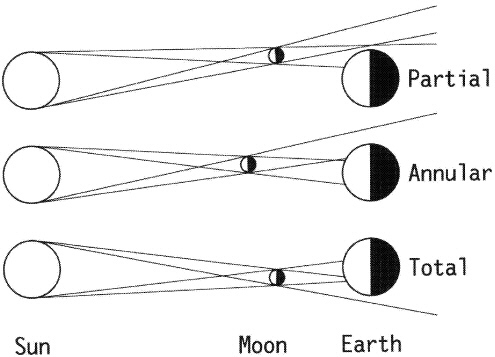
FIGURE 2–1. Three basic forms of solar eclipse can occur. If the Moon does not pass centrally over the solar disk, then the eclipse is only partial. If the passage is close to central, then the eclipse may be either total or annular, depending on the distance from us of the Moon and, to a lesser extent, the Sun. A total eclipse occurs if the rays from top and bottom of the Sun touching top and bottom of the Moon do not cross before reaching the Earth. If those rays do cross above the Earth’s surface, then the eclipse will be annular, with a ring of the solar surface being visible around the Moon’s periphery. In this diagram the sizes of the three bodies are highly exaggerated.
hybrid nature, total in some locations and annular in others. All these situations are explained in more detail in the Appendix, including the additional influence of the Earth-Sun distance varying during the year.
GEOGRAPHICAL SHIFTS IN ECLIPSE PATHS
Apart from regularly repeating in time according to the saros, another effect associated with that 18.03-year cycle in eclipses is a consistent shift in the geographical location of the track of totality. There is both a small step in latitude (the north-south direction) and a larger shift in geographical longitude (the east-west direction). Let us examine the origin of these shifts.
The saros actually lasts for 6,585.32 days. Knocking off the integer number of days, there is an excess of just less than one-third of a day, representing almost one-third of a rotation of the planet. In terms of time, it is equivalent to 7 hours and 41 minutes; in terms of geographical longitude, it means that the eclipse track is shifted by about 115 degrees to the west from one saros to the next.
The latitudinal offset occurs because after one saros has elapsed the Moon takes a slightly different path across the face of the Sun. This is explained in more detail in the Appendix. From one eclipse to the next in any saronic cycle, the step in latitude is about four degrees. This may either be northwards, or southwards, depending on whether the Moon is at its descending or ascending node (passing through the ecliptic moving either south or north). These two effects (north-south and east-west shifts of eclipse tracks) are illustrated in Figure 2–2, with six twentieth-century total solar eclipses in a sequence known as saros 136 delineated. After each 18.03-year gap there is a consistent offset in the path of totality: westwards by 115 degrees, northwards by 4 degrees.
Although the tracks move from east to west from one saronic cycle to the next, the actual path followed by the lunar shadow traces across the Earth from west to east, because the Moon is
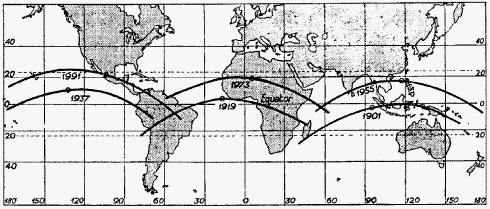
FIGURE 2–2. The six long-duration eclipses of the twentieth century were all members of the same saronic cycle. After each gap of 18.03 years, another seven-minute eclipse occurred, displaced westwards by 115 degrees and northwards by 4 degrees. From the onset of each of these tracks to its end took about five hours; that is, totality occurred at quite different times in separated locations.
overtaking the Sun in the sky. For example, the eclipse of 1991 shown in Figure 2–2 started to the southwest of Hawaii, crossed the eastern Pacific, passed over Mexico and other parts of Central America, and finished over Brazil.
I have just mentioned that these were all total eclipses, which might seem unexpected: would not a mix of total, annular, and partial eclipses be anticipated? The answer is NO. The reasons for this are explored in the Appendix, but the pertinent point here is that the basic characteristics of the six eclipses in Figure 2–2 repeated; they did not comprise a random hotchpotch of partial, annular, and total eclipses. Indeed this is a particularly prominent sequence as they had the longest periods of totality (six or seven minutes) of any solar eclipses in recent centuries. Obviously something systematic happened, and this is another fundamental
quality of any saros sequence. Again, we delve into this in the Appendix.
A final note on the sequence shown in Figure 2–2: it is not finished yet, with the next members being due on July 22, 2009 and August 2, 2027, each lasting for about six and a half minutes (the lengths are decreasing from a peak in 1955). It should be easy enough to extrapolate from that diagram and work out the eclipse tracks in those years, in case you want to make travel plans: the 2009 path will cross eastern Asia, while in 2027 northern Africa will be the place to be.
THE SHAPES OF THE ORBS
So far it has been assumed that the Earth, Moon, and Sun are spherical. In reality, because of their rotational properties they are each slightly flattened into shapes known as “oblate spheroids.” The Earth is actually somewhat pear-shaped, the northern hemisphere a little thinner than the south, and both our planet and the Moon are also a little rough around the edges (both possess mountains and so on). At least their shapes are constant in the short term, whereas the Sun is forever throwing out material in coronal loops and prominences.
For simplicity, however, we assume spherical profiles in the following text, and thus circular disks and shadows. We turn next to the characters of these shadows.
THE UMBRA AND PENUMBRA
The shadow cast by the Moon onto the terrestrial surface has a form as sketched in Figure 2–3. The dark central spot is the region

FIGURE 2–3. The umbra (complete shadow) of the Moon on the Earth is a solitary black spot in the middle of the pattern shown here. It is quite small, typically only 60 miles across, whereas the partial shadow or penumbra is over 4,000 miles in diameter, covering a large fraction of the dayside during an eclipse.
of totality: the Moon as seen from anywhere within that small region completely covers the solar disk, and this totally shadowed spot is called the umbra. Typically the umbra, or the path of totality, is 60–100 miles wide, although it can have effectively zero width (as in the case of a transition between a total and an annular eclipse), or be intrinsically a little wider in the longer eclipses. There is also a geographical effect: the lunar shadow may be cast
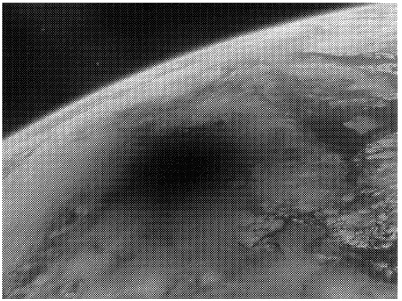
FIGURE 2–4. During the total solar eclipse of August 11, 1999, the crew of the Russian space station Mir photographed the Moon’s shadow moving across the Earth’s surface.
obliquely onto the Earth’s surface, and so the width of the ground track tends to be wider for eclipses in the Arctic or Antarctic.
All around the region of totality the Moon only partially obscures the Sun, and this partial shadow is termed the penumbra. The penumbra is much wider than the umbra. While the umbral spot may have a radius of only tens of miles, the penumbral radius is 2,000–2,200 miles. A partial eclipse will be detectable anywhere within that large area, a grazing touch between lunar and solar disks occurring at its very edge.
Figure 2–4 is a photograph of the Earth obtained looking down from orbit during an eclipse, showing the lunar shadow very clearly. It is the people under this dark central spot who experience totality.
If you were living in Babylon a few thousand years ago, only a tiny fraction of all total solar eclipse paths would cross that city. The penumbra for a total eclipse seen elsewhere would cross Babylon in about a quarter of all cases, because the penumbral circle in Figure 2–3 scans about half of the dayside face of the globe (and half the time you would be on the night side). Mostly the city would lie towards the periphery of that shadow and the Moon would only cover perhaps 10 or 20 percent of the Sun, so that the eclipse might well be missed without foreknowledge. For a society constrained to Mesopotamia and environs, only a small fraction of all solar eclipses would appear in the records, making the discovery of the complex cycles described earlier a near-impossibility.
How, then, were the eclipse cycles unveiled?
LUNAR ECLIPSES
That question may be answered by considering lunar eclipses. First, note that the frequency of lunar eclipses is not the same as the frequency of solar eclipses. Although the Earth is bigger than the Moon, so that it casts a larger shadow, the Moon is a smaller target for that shadow to hit and so, overall, lunar eclipses are not so numerous. There are on average 238 solar eclipses per century, but only 154 lunar eclipses.
Despite their comparative infrequency, for an observer restricted to one position on the terrestrial surface (say, an ancient Babylonian astronomer), lunar eclipses are witnessed more often than solar. This is because the full moon may be seen from anywhere on the night side of the planet. That implies that half of humanity might see the Moon being eclipsed, but in addition
such eclipses last several hours, and the globe spins to allow observers elsewhere a chance to note the eclipse, even if all the phenomena may not be seen from the extreme locations.
An example of a lunar eclipse, that of May 16, 2003, is shown in Figure 2–5. Throughout South and Central America, and the Atlantic, the entire eclipse may be witnessed. The start of the eclipse, and all of the total phase, can be seen throughout the contiguous United States and most of Canada. The same is true for Europe and Africa. In the western parts of North America the Moon will be in eclipse as it rises. Europe will miss the final stages of the eclipse because the Moon sets during the process.
THE SELENELION OR HORIZONTAL LUNAR ECLIPSE
If you are interested in experiencing something that very few other eclipse watchers have seen, this event in 2003 may provide you with an opportunity. If you were in one of those zones where the eclipse is in progress at moonrise or moonset you have the peculiar chance to be able to see both the Sun and the eclipsed Moon in the sky at the same time, with a quick twist of the head. An eclipse occurs when the two celestial orbs are 180 degrees apart, with the Earth in between. The refraction (or bending) of light beams in the Earth’s atmosphere, however, makes it possible to see both at once. Geometrically they may both be below the horizon, but the refraction by about half a degree makes this double appearance possible. In order to witness this you need to go to as high an altitude as possible and have a clear distant horizon to both the east and west. You have only a fleeting chance lasting a few minutes.
In general this is possible only with the partially eclipsed
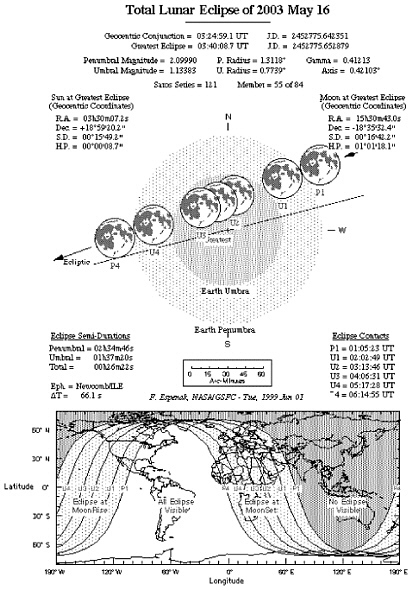
FIGURE 2–5. Details of the total lunar eclipse that will occur on May 16, 2003. Various types of pertinent data are shown, such as the timings for different contact points and the locations from where the eclipse may be viewed. Note the angle between the path of the Moon and the ecliptic: the eclipse occurs near the descending node. Also note that the nodal passage occurs well after the eclipse has finished, an example of the idea of the ecliptic limits.
Moon, because when the eclipse is total the Moon is simply too dark to see when it is also right on the horizon. At that time you are looking through such a thickness of atmosphere that the weak light from the totally eclipsed orb is attenuated to leave almost nothing. The best chance is when there is still a thin crescent of the lunar disk illuminated by the Sun, meaning between contact points U1 and U2, or between U3 and U4 in Figure 2–5 indicates that the Hawaiian Islands are a candidate location, although many parts of the western United States will also provide an opportunity.
This phenomenon is called a “horizontal eclipse” or, from a French term, a “selenelion.” There is evidence that the Babylonians noted an occurrence of this peculiarity in 1713 B.C. In modern times the first record seems to date from 1590, when the great astronomer Tycho Brahe saw a selenelion from his observatory on the island of Ven that lies in the strait between Sweden and Denmark. Five more such events were recorded from Europe over the next century (see Figure 2–6 for an example from 1666), but none in the 1700s and only one during the 1800s. The next record was not until 1975, when Allan Fries noted a selenelion from an island in the sound off Everett, Washington. The first photograph of a selenelion was not obtained until July 16, 1981, when professional
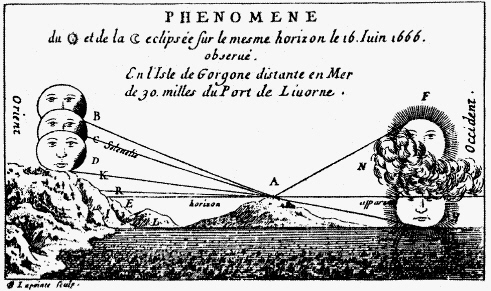
FIGURE 2–6. A sketch of the circumstances of the lunar eclipse observed on June 16, 1666. Prince Leopold of Florence instructed his astronomers to go to the island of Gorgona, 30 miles off the Italian coast near Livorno, in order to record what was seen. The flat Mediterranean Sea provided their horizon to the west where the Sun was setting. By gaining some altitude the distant Appenines were visible low in the east where the Moon was rising, and they were able to witness both the Sun and the eclipsed Moon in the sky at the same time. Such an observation is known as a “selenelion.”
astronomer William Sinton permanently recorded one from the Mauna Kea Observatory in Hawaii.
That brings us to the present. A few days before the lunar eclipse on January 9, 2001, I realized that a selenelion might be seen from Adelaide in South Australia, where I had lived for some years. So I alerted friends in the local astronomical society, suggesting that they might try to catch a glimpse from Mount Lofty, the tallest hill on the eastern fringe of the city. I knew that to the
west they would look out over the sea, while to the east their view would be over the extensive plains through which the River Murray flows. And in January, at the start of the southern summer, the sky was almost certain to be clear. A small group rose early and climbed not only that hill, but also the fire-spotting tower at the summit, from where they were afforded an excellent view. The result is shown in Figure 2–7.
THE DURATIONS OF ECLIPSES
Total solar eclipses are brief. Although a small fraction last for as long as seven minutes, most present a period of totality lasting only two or three minutes. The partial phase of such an eclipse lasts for much longer, some hours.
Refer back to Figure 2–3, and imagine that you are waiting somewhere on the track that the spot of totality will eventually cross, blanking out the Sun for a couple of minutes. The radius of the footprint delineating the penumbra is about 2,000 miles, and it sweeps across the globe at around 1,600 miles per hour. This means that the partial phase starts about 75 minutes before totality is achieved and continues thereafter for a similar interval. People located well north or south of the track will see only a partial eclipse, but it may last for a couple of hours.
The specifics may be rather different for particular solar eclipses, especially for observers situated close to the edges of the planet in this view, but the broad picture is correct: totality lasts for a couple of minutes, partiality for over an hour before and after.
How long do lunar eclipses last? Since the Moon is large, it is conventional to define several distinct contact points or times, as shown in Figure 2–5. The Moon is within the penumbra between
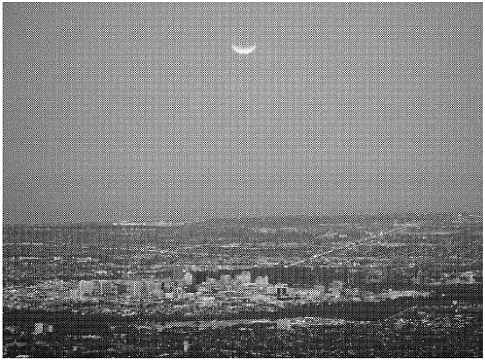
FIGURE 2–7. A selenelion photographed over the city of Adelaide, South Australia, in January 2001. The Sun has just risen in the east, behind the photographer, and its feeble light is starting to illuminate the city, although street lamps can still be seen. The western horizon, out over the sea, can hardly be distinguished in the gloom. Less than a degree above the horizon is the Moon, in partial eclipse, meaning that both the Sun and the eclipsed Moon may be seen at the same time. This is only the twelfth time in history that such an occurrence has been recorded.
P1 and P4, which lasts for up to five-and-a-half hours, during which time the Earth has executed almost a quarter of a revolution. In principle this would allow 70 percent of the planet’s inhabitants a chance to see that a lunar eclipse is underway. The umbral stage is much more noticeable. The phase of totality, be-
tween U2 and U3, may last for 80 to 90 minutes, but can be much less if the Moon is slightly further north or south compared to the terrestrial shadow. These contact points for lunar eclipses, and the equivalents for solar eclipses, are discussed in more detail in the Appendix.
THE BRIGHTNESS AND COLOR OF THE MOON IN TOTAL ECLIPSE
During a total solar eclipse the Sun’s disk gets very dark indeed—you can’t see it—but the same is not true of a total lunar eclipse. While it is entirely within the umbra the lunar disk brightness drops to about one part in 5,000 that of the near-full moon, and so it can still be seen. One needs no sophisticated equipment to recognize that the normal bluish-white Moon appears a reddish-brown during the eclipse, and many describe the Moon as taking the color of blood. How does any sunlight at all get to the Moon to provide it with some dim yet red illumination?
The answer lies with the atmosphere. Our planet possesses a considerable atmosphere, and that makes its edge somewhat fuzzy. On the other hand, the Moon has no atmosphere of which to speak, and so it casts a shadow whose sharpness is limited only by the Sun’s finite size: when a solar eclipse reaches totality it is sudden and abrupt.
Why does red light preferentially get to the Moon during a total lunar eclipse? This occurs because of inequalities in the atmospheric transmission of different wavelengths of light. This effect actually occurs all the time and is obvious once one thinks about it. At sunset the image you see of our star as it sinks below the western horizon is much redder than at midday because the
air molecules between your eyes and the Sun scatter light at the blue end of the spectrum more than at the red end, allowing more of the red light to reach the planet’s surface directly, but by the same token making the sky look blue.
The images of the Sun and Moon at rising and setting are also distorted somewhat, producing oval rather than circular profiles. This is due to refraction (that is, bending of light) in the atmosphere; it is similar to the way in which your arm seems to develop a sharp kink when thrust through the surface of a swimming pool. The amount of refraction produced in the atmosphere again depends upon the wavelength of the light in question, just as white light passing through a prism is split into the constituent colors of the rainbow. (It is a fallacy that the Sun and Moon are actually larger in size at rising or setting. This is an illusion produced by having reference objects visible along the horizon, as compared with none when the orbs are overhead.)
The atmosphere can thus produce coloration through two means. One is the fact that the blue end of the spectrum is more efficiently scattered by individual air molecules. The second is that the amount of refraction similarly varies across the spectrum.
At sunset the Sun looks red, but think of the light passing ten miles above your head, skimming through the atmosphere. The blue light is largely being scattered, making the sky blue, and also being refracted to such an extent that it is directed more towards the ground, pushing it deeper into the atmosphere and therefore suffering even more scattering. The red light is more likely to escape scattering and may be refracted by just enough to direct it towards the Moon. What is happening is shown schematically in Figure 2–8.
All around the globe the atmosphere is acting to transmit a
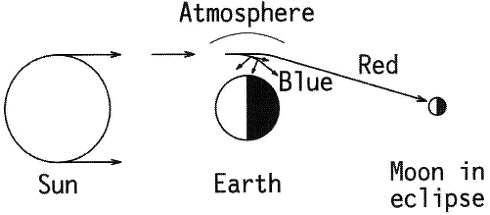
FIGURE 2–8. Why does the Moon turn the color of blood during a total lunar eclipse? Sunlight enters the atmosphere (the thickness of which is shown greatly exaggerated here) and the blue end of the spectrum is preferentially scattered, making the sky blue. This means that more of the red light makes it through on a route to the Moon. In addition, blue light is refracted more (has its course bent) by the air and fails to make it along the necessary direction (not to scale).
little sunlight to the Moon, and that small fraction that makes it through is predominantly at the red end of the spectrum. That is why in a total lunar eclipse the Moon appears a dark reddish-brown. Any dust suspended in the air will add to these effects.
As the curved shadow of the Earth creeps across the Moon, its boundary is blurred, producing a graded fringe rather than a sharp edge. This is because of both the finite solar diameter and the terrestrial atmosphere, but the presence of a substantial atmospheric loading of dust will cause the normal shadow profile to be altered. After major volcanic eruptions, such as those at Mount St. Helens in Washington and Mount Pinatubo in the Philippines, the dust left lofted in the atmosphere may be immense and take
months to years to settle out. It tends to drift around in the upper air, but within a restricted latitude range, resulting in a distinct blob of darkness on the Moon’s face during an eclipse. It is as though the Sun is acting as the lamp in a slide projector and the Moon as the screen, throwing an image of the Earth’s outline onto the latter. Similar effects were also observed after the Gulf War, when oil-well fires produced vast, dense smoke plumes.
Other features may also be investigated by dint of a lunar eclipse. The Earth’s atmosphere is not perfectly spherical, and its profile can be monitored by timing when the eclipse shadow gets to various marker points on the lunar surface, such as well-known craters.
It is only during a lunar eclipse that the influence of our atmosphere in these regards is obvious. Lunar eclipses are quite unlike solar eclipses, then.
THE DISTRIBUTION OF ECLIPSES
There are about 66 total solar eclipses per century, but many have ground tracks unfavorable for potential viewers. These may be located either at very high latitudes (over the Arctic or Antarctic), or over regions in which the weather is likely to be poor, such as the tropics during the monsoon, or completely over the ocean. In practice, a total solar eclipse track traversing accessible places with a good chance of clear weather occurs about once every three years. Nevertheless there is many a keen eclipse watcher who has spent an enormous amount of time and money getting to a well-considered prime spot, only to be stymied by an unseasonably cloudy day.
The number of eclipses per century given above is an average,
which would result if they occurred randomly in time. The reality, though, as we have seen, is eclipses are not random at all; they repeat on regular cycles. The tracks of total solar eclipses within specific saros sequences advance consistently by steps across the Earth, as in Figure 2–2, and there are other systematic trends.
Eclipses do not occur randomly in terms of geography either. If they happened entirely by chance then any particular location would get a total solar eclipse about once every 410 years. In fact more of these events occur during the summer than the winter in the Northern Hemisphere, because the Earth passes aphelion in July, when the Sun has its smallest apparent size. This makes it more likely that the Moon will be large enough to cover it completely. The Northern Hemisphere is tilted towards the Sun in the summer, meaning that there is a greater probability that it will get an eclipse, and so places north of the equator are visited about once per 330 years. Being the summer there’s also a greater chance of clear skies. In contrast Southern Hemisphere locations receive total solar eclipses about once per 540 years. As the bulk of the population lives in the north, this quirk of nature increases the likelihood that a person picked at random from the whole of humankind will experience a total solar eclipse without needing to chase after one.
EXTRAPOLATING ECLIPSES FORWARD
Stepping back some millennia, any civilization in the temperate and tropical zones of the Northern Hemisphere would have been able to register up to 70 percent of all lunar eclipses. Apart from those a lesser number of solar eclipses would have been seen, and the oft-repeated relationships between them noted, such as a solar
eclipse often being preceded or succeeded by a lunar eclipse with a time gap of 14 or 15 days. Eclipses would help them to determine the length of the solar year and develop calendars based upon it.
Through assiduous record keeping passed from one generation to the next, after a few saronic cycles the patterns would be noticed by skilled astronomer-mathematicians. Even the fact that about one-third of all lunar eclipses are missed because the Moon was not visible at the appropriate time would become obvious.
It would thereafter become apparent that both lunar and solar eclipses occur only in allowed periods lasting for several weeks, and spaced by about 173 days (half an eclipse year). Poring over eclipse records, fastidiously maintained for generations by their predecessors, the ancient scholars would notice that eclipses of the same basic characteristics seemed to recur with gaps of 18 solar years plus 10 or 11 days (close to 19 eclipse years). Such sequences might last for a millennium or more. If instead 19 solar years were taken as the yardstick, short sequences of eclipses of varying types would be identified as occurring on or about the same dates within the calendar.
The recognition of these patterns of eclipses in the archives then would have allowed them to reverse the arrow of time, and project the cycles into the future. Eclipses could be predicted with utmost precision, without the need for an understanding of celestial mechanics and the use of elaborate calculations on an electronic computer. A few sums scratched on a papyrus scroll would do the trick. And a very useful trick it was, too.
Knowledge of the characteristics of the eclipse cycles enabled ancient astronomers to predict repeat performances without understanding even that the Earth circles the Sun and the Moon
orbits the Earth. (In just the same way one can predict when song-birds will trill again in some Appalachian forest after a winter migration to Mexico, even though their route and homing instinct is not known. Similarly we know when salmon will return to spawn in the rivers where they hatched in the Pacific Northwest, although we do not understand how they find their way from the deep oceans where they live the majority if their lives.) Such knowledge of eclipses was power, for the magi who understood the cycles, and for the kings and emperors who employed them. We will explore this power of prediction in the next chapter.