Eclipse: The Celestial Phenomenon That Changed the Course of History (2001)
Chapter: 4. A Warp in Space
4
A Warp in Space
By means of prolonged processes of mathematics, entirely separate from the senses, astronomers are able to calculate when an eclipse will occur. They predict by pure reason that a black spot will pass across the Sun on a certain day. You go and look, and your sense of sight immediately tells you that their calculations are vindicated. So here you have the evidence of the senses reinforced by the entirely separate evidence of a vast independent process of mathematical reasoning.
Sir Winston Churchill
The Sun shines—but how? A hundred years ago this deceptively trivial question was causing great consternation not only to astronomers, but also to other scientists.
During the previous centuries, Western scientists discovered new phenomena that raised previously unsuspected quandaries. For example, before we realized that biological evolution occurs, producing new species from old, the avenue by which genetic change takes place was not a problem for consideration. Today, five or six generations after Charles Darwin, the mechanisms and processes of natural selection remain hotly debated within the academic community.
The question of how the Sun shines—that is, the source of its energy—did not become a matter of concern among scientists until the concept of geological deep time was established. Many will have heard of Archbishop James Ussher and his seemingly absurd statement that the world began in 4004 B.C. Those who mock Ussher do so from their own ignorance. One should not judge him by the standards of modern-day scientific knowledge, but rather from the perspective of the accepted wisdom in his own time, the mid-seventeenth century. In those days the age of the Earth was thought to number only a handful of millennia, and Ussher’s conclusion was a respectable effort in the context of the scholarship of his era.
The realization that our planet is not just millions, but actually billions of years old was a long time coming. Edmond Halley enters our story again at this juncture: he suggested that the age of the Earth might be estimated by comparing the salinity of rivers with the salt content of the oceans, reasoning that the saltiness had built up over the eons. There are various shortfalls with this concept, but later experimenters did derive ages of many millions of years based on such measurements.
Another method was founded upon the observation that far below ground, deep down mine shafts, the rock is hotter than at the surface. Volcanoes provide unmistakable evidence that deeper yet it is hotter still. Eighteenth-century scientists reasoned that the elevated temperature below ground represents a gradual cooling of the planet since its formation, the heat still flowing upwards. They experimented with various-sized spheres of warmed rock and metal, and noted how long it took these to cool, scaling their results up to derive ages for the planet that were much longer than hitherto suspected.
Actually that basic technique is flawed, because it is tacitly assumed that the Earth has no internal heat generation, the temperature differential representing a fossil remnant from the planet’s formation as a molten sphere. In fact energy is liberated deep within our globe through radioactive decay; but stepping back a century or two the phenomenon of radioactivity was yet unsuspected. This relates to the problem of the Sun’s energy: it was assumed in that era that the Sun was glowing hot because, as a much larger body, it had cooled less than the Earth from its primordial state. The notion of nuclear reactions powering the Sun was unknown until early in the twentieth century.
The whole question was brought to a head when Darwin and his colleagues, studying geological strata such as limestone, showed that sedimentary rock sequences must be hundreds of millions of years old if laid down at a similar rate to those in production today. Up to that point the physicists, on the one side, who were measuring cooling rates and so on, had been able to reconcile their values with the age of the Earth according to geologists, biologists, and the like. However, such a vast planetary and solar age could not be accommodated by the physical theory of the time.
So physicists looked to other possible energy sources for the Sun. If the Sun were gradually shrinking, energy could be produced and the Sun heated. The process may be thought similar to a tennis ball warming as it is compressed whenever struck by a player. During a championship tennis match the balls heat up and this alters their bounce characteristics; cool ones are retrieved from the refrigerator every so often. The familiar phrase “New balls, please” is uttered by the umpire every seven games at Wimbledon. In the case of the Sun or some similar large object, as it contracts there is a decrease in its gravitational energy because the compos-
ite matter is moving closer to the middle, and that energy has to go somewhere. Half of it is converted into heat, which is then lost by radiation.
This shrinkage producing heating and hence radiation is a process that is known to occur in the Solar System. Although such a source is insufficient to explain the observed solar power output, we recognize that Jupiter is still settling after its formation so long ago. In consequence it emits two and a half times more energy than it receives from the Sun. Jupiter is not hot enough to emit visible light (we see it only by reflected sunlight), but it does radiate a huge flux of microwaves, making it quite bright to a radio telescope. Saturn and Neptune do likewise, although to lesser extents, whereas the data with respect to Uranus are ambiguous. For the Sun, there is no ambiguity: no such settling could explain the enormous radiated flux of light.
A suggested alternative solar energy source was that meteoroids and other debris continually cascade down upon the Sun; although the individual particles could not be seen burning up, their combined contributions might power the solar furnace. Again, however, the sums would not add up, and the feasible age for the Sun calculated that way was much less than the geologists insisted upon.
A major confrontation over this matter therefore ensued late in the nineteenth century, the physicists seeing a relatively youthful Sun and Earth, the geologists requiring hundreds of millions of years of elapsed time to explain their data. In this argument some physicists acted rather arrogantly, with disregard for what they saw as “softer” scientific disciplines, and yet it was physics itself that threw up the solution and proved these earlier physicists wrong.
MASS-ENERGY EQUIVALENCE
All readers will have heard of Albert Einstein and his Theory of Relativity, but few recognize that there are two rather distinct divisions to it. The so-called “Special” Theory of Relativity is special in that it is limited in scope, whereas the “General” Theory of Relativity is much wider ranging. The latter is often referred to as “GTR” for short, and in essence it may be thought of as being a more sophisticated gravitational theory than that of Newton.
But we must begin with the Special Theory. In 1905 Einstein published four papers on different topics, one of which presented the famous equation showing the equivalence of mass and energy (E=mc2). Here E represents the energy (in Joules), m the mass (in kilograms), and c the speed of light (300 million meters per second). (Einstein actually got his Nobel Prize for one of the other papers, which explained the “photoelectric effect”; his analysis showed that light is split into discrete packets, or photons.) Using that equation, and knowing the flux of solar energy at the Earth and our distance from the Sun, it is trivial to show that our local star is losing mass by conversion to energy at an astounding rate, about four million tons per second. Over millions and billions of years it is obvious that the total mass lost must have been enormous, but in terms of the entire bulk of the Sun it is a minor fraction.
The problem of the solar power source was solved, and astronomers at last knew how the Sun and stars shine. From various lines of investigation, especially radioactive dating of terrestrial rocks and meteorites, we now have good reasons to believe that the whole Solar System formed together about 4.5 billion years ago.
The above account glossed over the fact that merely knowing about mass-energy equivalence does not provide an understanding of the complexities of nuclear reactions. Developing such an understanding was the work of many scientists over the subsequent decades. One man in particular, British astrophysicist Arthur Stanley Eddington, was largely responsible for elucidating the physical behavior of stellar interiors in the 1920s.
THE GENERAL THEORY OF RELATIVITY
Eddington had started his astronomical research some years before, in the climate of excitement surrounding Einstein’s GTR, which was issued in dribs and drabs before being finalized in 1916. One story often retold is that at a scientific meeting someone mentioned to him that he must be one of only three people who understood relativity, this resulting in Eddington looking puzzled. When chided not to be so modest, his reply was “On the contrary, I am trying to think who the third person might be.”
The GTR was viewed as being hugely complicated and disbelieved by many. It presented an entirely new concept of the universe, in which space-time is warped by the presence of matter. This notion always gives trouble to people because they think that their everyday experiences of the physical world can be translated into a comprehension of how the whole universe behaves. This is simply wrong. Einstein’s theory was revolutionary in that it said that the shape of space itself is changed by the distribution of matter. This has various concomitant effects, such as clocks going slower (time itself being slowed down) if they are in the proximity of a large mass, or if they are moving through space at a high speed.
If Einstein’s theory was to be accepted, it had to demonstrate that it could predict or explain some observed phenomenon when the Newtonian theory could not. It was quickly realized that a previously known anomaly in the orbital motion of Mercury was explicable with the relativistic theory. (This had been a long-standing puzzle, as we will see in Chapter 13.) Einstein’s opponents argued that this was a convoluted matter that might be resolved in some other way without recourse to relativity theory. A simpler demonstration of the truth of relativity was required, and Eddington recognized that a total solar eclipse provided a possibility.
THE GREAT ECLIPSE OF 1919
Eddington knew a few things about eclipses (he had gone eclipse chasing to Brazil in 1912 as a member of a large British party which had been clouded out), and he saw how a total solar eclipse could provide a unique opportunity to provide verification for Einstein’s theory. The reason for this is illustrated in Figure 4–1.
Consider the light from some distant star passing by the Sun. The path of the light is bent by the Sun’s gravity (the rule you may have been taught at school that light travels in straight lines is only a first-order approximation). According to Einstein’s theory the bending of the path of the light beam is twice that which Newton’s theory of gravity would suggest.
In principle this provides a test, but when one does the sums it turns out that the angles are extremely small. Even for light passing just above the Sun’s surface, for which the bending is greatest, the direction change is less than two seconds of arc. How much is that? A degree may be split into 60 minutes of arc, each of
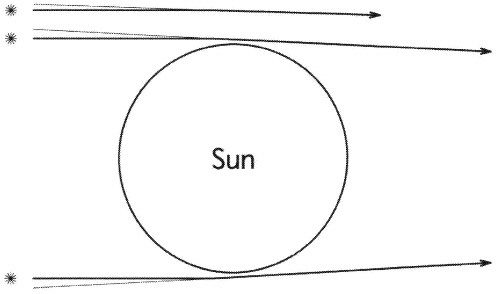
FIGURE 4–1. The deviation of starlight produced by the mass of the Sun, detectable during a total solar eclipse. The paths the light takes from the distant stars at left follow the heavy lines, but from Earth the arrival directions extrapolated backwards appear further from the Sun, as shown by the faint lines. The deflection angles are shown greatly exaggerated. Einstein’s relativity theory said that the deflection would be twice that based on Newtonian gravitational theory, and this was verified using the great eclipse of 1919.
which comprises 60 seconds of arc (using the addendum “of arc” to show that we are referring to angles here, not units of time). To put that into some context, two seconds of arc is the apparent width of a matchstick viewed from 220 yards, almost twice the length of a football field. The test would involve being able to differentiate between a single matchstick width, and merely half that as the Newtonian theory would have it.
The problem is that starlight passing so close by the Sun is
drowned in the solar glare at all times except during a total eclipse, and so Eddington proposed making observations during such an event. Just any eclipse would not do though. Not only did Eddington need totality, he also needed stars, because the project would not work unless there were several bright stars close to the limb of the Sun during the eclipse. Looking up the eclipse predictions, Eddington saw that one of those represented in Figure 2–2, occurring on May 29, 1919, allowed a unique opportunity. Not only was the totality long, at 6 minutes and 51 seconds, but it was also in late May when the Sun is passing through the constellation Taurus, and crossing a rich cluster of bright stars known as the Hyades.
His mentor, the Astronomer Royal Sir Frank Dyson, was so enthused about the concept that he lobbied the government to avoid having the youthful Eddington drafted to fight in the First World War. Instead Eddington was allowed to prepare for the great eclipse expedition of 1919. The British foray was in several parts, with Eddington leading one group to Principe (a tiny island owned by Portugal, just north of the equator and 150 miles from the African coast), while another headed for the opposite side of the Atlantic, setting up their equipment at Sobral in northeastern Brazil. A contemporary map of the eclipse track, indicating when the footprint reached different locations, is shown in Figure 4–2.
EQUIPMENT CONSIDERATIONS AND PREPARATIONS
If tracks of totality were so considerate as to pass across wellestablished observatories, then astronomers’ lives would be simpler. However, the tracks dictate where one must go to obtain the desired data, which means setting up one-off observatories. The
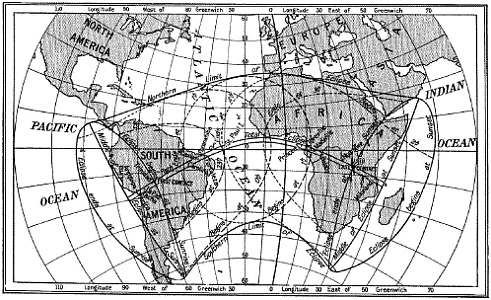
FIGURE 4–2. The track followed by the great eclipse of 1919. The British expeditions were sent to the northeast of Brazil and the island of Principe (labeled here as Princes I).
1919 and other eclipses had to be observed using equipment that perforce was portable, sturdy enough to resist transport to distant spots of high humidity and temperature, and yet easy enough to erect on temporary mounts and then dismantle after use.
In a permanent observatory it is essential that vibrations of the telescope be limited, so that long exposures on faint celestial objects are possible. A telescope is normally bolted to a vast concrete plinth around which the observatory dome can rotate without touching it, and the instrument isolated from tremors. Solar eclipses, though, are relatively brief affairs and so such stability is not as great a problem, making wooden frames like that shown in Figure 4–3 a desirable and practical solution.
A simple mirror to track the Sun, coupled with a long focal
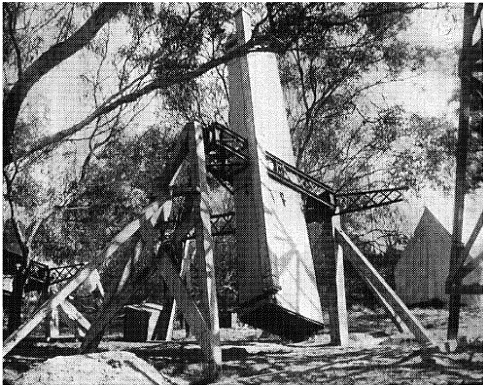
FIGURE 4–3. The wooden mount for a large camera used in photographing the 1922 eclipse from Australia.
length to produce an image as in Figure 4–4, provides an excellent means to photograph an eclipse. Another point to note is that the frame is an open lattice, with only the box around the focus (the actual camera) baffled; if the whole length was enclosed then the Sun’s rays would heat it, causing turbulence of the air within and distorting the image.
Although a horizontal arrangement has many advantages, there is a problem with stray light entering the camera. If an eclipse is due on your own doorstep, as was the case in 1918 when
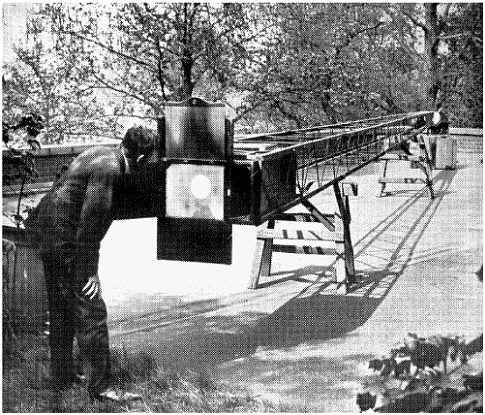
FIGURE 4–4. A heliostat (a rotating mirror used to track the Sun) may be used to reflect an image horizontally into a camera. This is an easier solution than having a long camera tube directed skywards (see Figure 4–5).
a track of totality crossed the United States, one can be a little more extravagant with the preparations. Figure 4–5 shows the scene near the town of Baker, in eastern Oregon, chosen as the best location for observations. The 40-foot-long camera tube was directed towards the precalculated position of the Sun during the eclipse. No matter where the eclipse, clearly setting up the necessary equipment would have posed a major task. Figure 4–6 is a

FIGURE 4–5. The 40-foot camera used to photograph the American eclipse of June 8, 1918.
photograph of a proud array of sailors from the U.S. Navy, plus other helpers, and of course the astronomers, after they had set up the cameras to photograph an eclipse in Spain in the early 1900s.
THE 1919 ECLIPSE RESULTS
In 1919 the British observations did not go smoothly either in Brazil or on Principe, but the altered positions of the target stars were still measurable on the photographic plates exposed.
The astronomers did not immediately break camp and head back to England to announce their results. First they had to wait
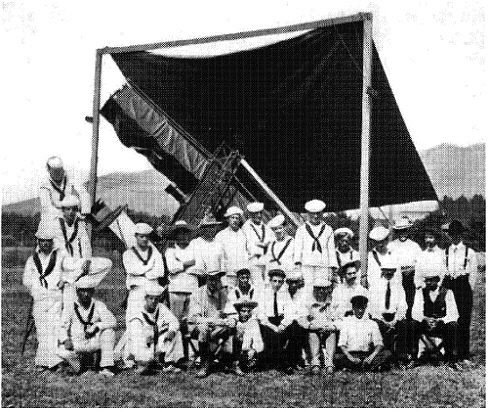
FIGURE 4–6. Sailors of the U.S. Navy, having labored to erect the instruments to view a total solar eclipse, pose with astronomers in Spain early in the 1900s.
some months before again photographing the star fields at night, when the Sun was far away, so that the space through which the starlight traveled was not warped by the solar gravity. It was only by directly comparing the two sets of plates that the subtle shifts in the stellar positions would be discernable. They were looking for a differential shift of less than one second of arc; even on a perfectly still night, the amount of scintillation or blurring shown by stars
due to atmospheric turbulence is of this order. (Recall the nursery rhyme: “Twinkle, twinkle, little star, how I wonder what you are.”)
It was November of 1919 before the outcome of the eclipse analysis was made public, with great fanfare in London. Einstein was right, Dyson and Eddington said, and it was front-page news around the globe.
In subsequent years data collected at other eclipses has clearly confirmed that the deviation of starlight is just as Einstein anticipated. For instance, photographs taken from Mauritania during the great eclipse of 1973 (as plotted in Figure 2–2) again demonstrated that the stellar displacements are larger than Newtonian physics would allow. Measurements using large arrays of radio telescopes have shown that the gravitational deflection of starlight is within one percent of Einstein’s value. These and other experiments have shown that Einstein’s GTR gives a better representation of the universe than Newton’s theory of gravity. Nevertheless, it is possible that there are refinements yet to be discovered.
GRAVITATIONAL LENSES
At the close of the previous chapter I mentioned Charlie Chaplin and his magnum opus Modern Times, a movie first shown in 1936. In the same year Albert Einstein published a short note in the journal Science concerning how starlight might be focused by gravitational fields. The gist of his paper was as follows.
Consider again Figure 4–1 and imagine the light beams being extended to the right until they meet. Then you could think of the Sun as having acted as a lens: a gravitational lens. Light passing the Sun at top and bottom is brought to a common focus, well off the page compared to the scale of that diagram.
Astronomers like to use big telescopes for two distinct reasons. One is that a larger mirror or lens collects more light, making fainter objects detectable. The other is that better resolution or acuity is, in principle, possible when a large aperture is employed. In reality, however, the turbulence of the terrestrial atmosphere limits the resolution achievable with ground-based telescopes; this movement causes the scintillation (the technical term for twinkling) of stars. This is one of the reasons for putting devices like the Hubble Space Telescope into orbit, above the blurring effect of the atmosphere.
Suppose we positioned a satellite at the focus of the solar gravitational lens, the extended Figure 4–1. With an occulting disk obscuring the Sun, an artificial eclipse would be produced. In a ring around the edge of the disk, the light coming from some hugely distant star or planet would be focused by the solar gravity. The width of the aperture produced by this “solar gravitational lens” would be phenomenal, the Sun being about 865,000 miles in diameter. This would give a resolution—a measure of the smallest detail possible—totally outstripping anything we can achieve either from Earth or using satellites like Hubble.
This solar lens concept all sounds very nice, but is it practical? Actually, when one puts the relevant figures into the equations one calculates a focal length for the solar gravitational lens (the distance to where the lines extrapolated to the right in Figure 4–1 meet each other) of about 500 times the Sun-Earth distance (the astronomical unit or AU). This would mean that your imaginary satellite would need to be located out beyond all the planets, a dozen times as far away as Pluto. So it doesn’t appear to be a feasible proposition, at least within the next several decades.
Might we, though, see the gravitational lens effect produced
by some other star? The nearest stars are about 260,000 AU away (this is equivalent to about 4.2 light-years). Other stars have different masses and sizes from the Sun, and so produce all sorts of focal lengths. It could happen that the Solar System is close to the focus produced by some relatively nearby star (nearby on the cosmic scale that is).
This is what Einstein discussed in his 1936 paper: the possibility of other stars producing gravitational lenses. It is a nice idea, but for us to see anything in this way some object of interest must lie very close to the extrapolated line from the Earth to the star acting as a lens, and then beyond, and the probability of such a coincidence occurring is miniscule. For that reason Einstein considered his note only of theoretical interest; “Of course, there is no hope of observing this phenomenon directly,” he wrote.
Here, though, the great man’s imagination had failed him. He was thinking only of the chance of individual stars within our own galaxy, the Milky Way, acting this way. Single stars are of comparatively small mass, cosmically speaking, and so produce little deflection of light beams. Whole galaxies, made up of hundreds of billions of stars, can produce greater effects though. In the 1930s the cosmic distance scale and the characteristics of galaxies were only just beginning to be comprehended, so Einstein can hardly be blamed for his comment. But it was wrong.
A year later another astronomer suggested that galaxies might produce such a lensing effect, but it was four more decades before the first example was uncovered. Several more examples followed, and in the 1990s the search for gravitational lenses became a major pursuit of astronomers, with detection becoming commonplace. The basic idea is shown in Figure 4–7, with interstitial masses such as the spiral galaxy sketched there producing distorted images of
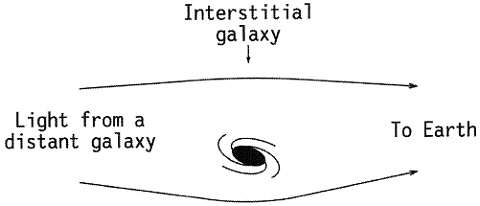
FIGURE 4–7. How an intervening galaxy may cause gravitational lensing of some distant object, producing multiple images that may be amplified in brightness. The deflection angles shown here are greatly exaggerated.
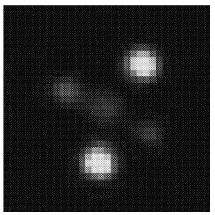
FIGURE 4–8. This image shows the effect of a gravitational lens. The bright smudge in the center is a massive galaxy, but arrayed about it are four other spots, those at the top and bottom being especially bright. These are separate images of some more distant quasar, focused by the lens action of the intervening object. In essence the galaxy is eclipsing the quasar, but paradoxically its gravitational lens effect brightens the light received from the latter. These quadruple images form what is known as an Einstein Cross. It is also possible for other slight misalignments to produce bright images that are double, triple, arcuate, or other distorted forms. In the case of a precise alignment, a circular image, called an Einstein Ring, is formed.

FIGURE 4–9. This Hubble Space Telescope image shows the gravitational focusing effect of a huge cluster of galaxies known as Abell 2218. The many arcs spread across the photograph are distorted images of other galaxies and quasars five to ten times as far away from us as the cluster causing the lensing.
more-distant light sources. An example is shown in Figure 4–8, a focusing galaxy producing four images of a distant quasar (that is, a quasi-stellar object; the true nature of such sources is still unknown, but they seem to be very distant but extremely luminous objects). The effect is similar to that obtained by looking through the bottom of a wineglass, where a variety of distorted images form as you move your eye around. This is more obvious in Figure 4–9, a photograph of a cluster of galaxies whose combined gravity leads to many arcuate images of more distant galaxies and quasars that cannot otherwise be seen.
Is the phenomenon seen in Figure 4–8 an eclipse? Yes, because the focussing galaxy is blocking our direct view of what is behind it. Paradoxically the eclipse is amplifying the brightness of the quasar, in the same way a magnifying glass enhances the intensity
of sunlight such that a piece of paper may be ignited. Without that amplification the quasar might well have been too faint to detect, so that, rather than simply hiding it, the galactic eclipse has made possible the detection of this light source at the periphery of the universe.
It happens that Einstein was also wrong in the context of observing gravitational lenses within the Milky Way. The gravitational lens formed by a single star is extremely narrow, and so even with about 400 billion stars in our galaxy he reasoned that the chance of getting two stars aligned with the Earth at the focal position must be exceedingly small. That is based on the assumption of a static situation though. In fact, all the stars are moving, in orbit around the galactic center and also shifting relative to each other with their own peculiar velocity components. Every so often two will align with the Earth, and major astronomical research projects now automatically monitor thousands of stars each night. As an alignment occurs, the focussing through the transient “lens” produces an increase in intensity (like the magnifying glass again), and this brightening may persist for days or months. The computers scanning the images are programmed to draw attention to such intensity enhancements. Using the results, astronomers are also searching for the so-called “missing mass” that seems to hold our universe together.