Eclipse: The Celestial Phenomenon That Changed the Course of History (2001)
Chapter: 8. The American Eclipses of 1780 and 1806
8
The American Eclipses of 1780 and 1806
June 16, 1806: Pleasant morning—total Eclipse of the Sun & the stars twinkled at noonday. Wonderful are the changes of nature but more astonishing the wonders of redeeming love.
Entry in the diary of Mary Avery White (Boylston, Massachusetts)
Elsewhere in this book we have seen that superstitious beliefs concerning eclipses have enabled certain nations or armies to gain an advantage over their opponents. Let me add another two examples to the litany.
Ever since Byzantium had been adopted early in the fourth century by Constantine the Great as the capital of the Eastern Roman Empire, that city (renamed Constantinople) had been in Christian hands, despite internecine squabbling. The residents largely believed, however, in an ancient prophecy that said the city was safe from its enemies during the waxing phase of the Moon. In May 1453, while defending their walls against the marauding Ottomans, the Byzantines were horrified to see that the rising moon was in eclipse. Their morale was broken and a week later the city fell into the hands of the Turks, who have held it ever since. It was the capital of the Ottoman Empire, and then Turkey,
until 1923 (when the capital was shifted eastward to Ankara), and then renamed again in 1930 as Istanbul.
That was an instance of an eclipse aiding the Ottomans. During the First World War, a counterexample occurred. On July 6, 1917, Lawrence of Arabia and his Bedouin troops overran the ancient city of Aqaba, located at the northern tip of the Red Sea. One of their advantages was that, having crossed the Sinai by camel, they attacked from the inland side, whereas the Turkish armaments were pointed out to sea to repel a maritime assault. Their other advantage came from the fact that as they approached from the north, on the evening of July 4 there had been a total lunar eclipse. This preoccupied the defenders with banging together pots and pans and otherwise making loud noises in order to scare off the shadow that was darkening the Moon.
Those were both lunar eclipses. In this chapter we will be considering the significance of solar eclipses in the early history of the United States. In Chapter 1 we learned that the ancient Chinese would shoot arrows into the air in order to scare away the dragon they imagined to be devouring the Sun during an eclipse. Similarly, the Native Americans of the Chippewa/Ojibwa tribes thought that the Sun’s flames were being extinguished, and so during an eclipse they would launch skywards burning arrows in order to replenish it. We will see below that the total solar eclipse of 1806 was one of the pivotal junctures in the Indian wars provoked by the spread of the white man westwards through Ohio and Indiana.
THE ADVENT OF ECLIPSE TRACK PREDICTION
Edmond Halley was the first person able to predict with reasonable accuracy the tracks of total solar eclipses, such as those cross-
ing the British Isles in 1715 and 1724. This was an important development, not just for science. It meant that, in principle, it was feasible for cultures with modern scientific attainments (and thus the ability to read an astronomical almanac) to scare the wits out of less-learned peoples.
The reality is that this ability was only really employed by the authors of novels, such as H.Rider Haggard, Mark Twain, and Hergé, whose invention of solar eclipses at critical points in their stories were considered earlier. For potential conquerors or colonists the problem, as such, was that total solar eclipses are so infrequent that it is most unlikely that a track will pass through any region of interest where they are trying to unseat the natives. Lunar eclipses—like that advantageously interpreted by Christopher Columbus in 1504 (see Figure 8–1)—may more easily be used because they can be seen over a much wider area.
Given these facts, it seems ironic that the two total solar eclipses to cross the fledgling United States in the decades following independence—in 1780 and in 1806—each had results that are the converse of what one might have expected. Their stories contradict the impression that the superior science delivered by Halley and his successors must surely have lead to advantages for the purveyors of precise astronomical knowledge. The first eclipse led to a major embarrassment for the new American astronomy. And it was the indigents, rather than the incomers, who exploited the second eclipse to gain the upper hand in a festering dispute.
THE ECLIPSE OF 1780
Soon after its foundation in the seventeenth century, Harvard University instigated the study of physics. In 1726 a benefaction from
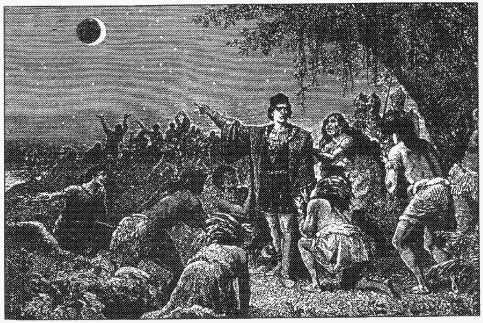
FIGURE 8–1. This drawing of Christopher Columbus using the lunar eclipse of February 29, 1504, which appeared in Washington Irving’s Life and Voyages of Christopher Columbus in 1892, gives a rather different impression to that shown in Figure 3–5, which is from a few decades earlier. This depiction shows Columbus in a more benevolent light, garbed in fine clothes and with the Jamaicans at his feet, whereas the other picture has him armed with a sword and closely accompanied by armed guards.
an Englishman, Thomas Hollis, led to the endowment of a professorial chair of “Mathematicks and Experimental Philosophy.” It continues to this day.
The second occupant of that chair was John Winthrop, who was appointed in 1738 at the age of 24 and held the position until his death at 65. Winthrop is often regarded as the first true “American astronomer,” and he made observations of many celestial phenomena. In particular he was involved with timing the transits of Venus, a subject we discuss in Chapter 13. It seems though that
Winthrop’s attainments in physics were not so wonderful, and it is not clear from the notes he left that he even understood Newton’s laws of motion, one of the most rudimentary facets of the science. Winthrop’s demise led to the appointment of Samuel Williams, just in time to start planning for the solar eclipse anticipated for October 27, 1780. The track of totality was expected to pass over much of Maine and parts of maritime Canada.
There was an obvious problem. This was the time of the Revolutionary War, and the track lay within enemy (i.e., British) territory. Undeterred, Williams made his calculations, studied his maps, and chose the western part of Penobscot Bay in Maine as a suitable observation point. This choice was based largely on the need to bring in a large sailing ship carrying the heavy equipment required for the eclipse observations: the telescopes, clocks, and so on. This decided, Williams prevailed upon John Hancock, the first signatory to the Declaration of Independence and in 1780 the Speaker of the Continental Congress, to write to the commander of the British forces. “Though we are political enemies, yet with regard to Science it is presumable we shall not dissent from the practice of all civilized people in promoting it,” wrote Hancock. After such sweet-talking, safe passage was granted to the party.
On October 9 a group of four faculty members and six students set off up the coast in a boat supplied by the Commonwealth of Massachusetts. On arrival in Penobscot Bay they set up their equipment, calibrated their clocks with other astronomical observations, and confidently awaited the eclipse. This duly arrived, starting in the middle of the morning and reaching a peak shortly before noon. There was just one problem: They did not witness totality. The visible fraction of the solar disk shrank to a sliver, but it did not disappear. Williams’s calculation of the eclipse
track was wrong. It turned out that they should have been positioned at least 30 miles further north.
The embarrassment over the failure of this official expedition was made even more acute by the fact that on the British side Dr. John Clarke, a Harvard graduate, had successfully witnessed the eclipse from Prince Edward Island. Accompanied by Thomas Wright, the local surveyor general, Clarke used a small telescope to make observations, and then sent the results to the American Academy of Arts and Sciences.
What went wrong with the expedition led by Williams has long been a mystery. In an attempt to throw light on the matter, on the bicentenary of the eclipse in 1980, a new expedition of Harvard staff and students returned to Penobscot Bay, taking with them maps and instruments identical to those used by Williams and his group. All worked precisely as they should, although there have been questions raised as to whether the times of the eclipse contacts reported by Williams, and the extent of the arc of the Sun seen as remaining uncovered, were consistent with the stipulated observatory site.
Explanations for the blunder fall into three categories. The first is that Williams simply made a numerical error in his sums. The second is that the map used was inaccurate, showing the wrong latitude for the bay. The third category is connected with errors in the astronomical tables from Europe used by Williams. Although there seems to be inadequate documentary material left in order to know whose fault this farce was, it has been usual to lay the blame at the door of Samuel Williams. Both during this first American eclipse expedition, and in later life, he did a number of things that might be regarded as imprudent. But there is not the evidence necessary to be sure of his guilt here.
There is someone else who was greatly unhappy at turns of events on October 27, 1780, in this case for an entirely different reason than the failed eclipse expedition. This story involves another of the signers of the Declaration of Independence, Francis Hopkinson. Despite a widespread belief that Betsy Ross designed the Stars and Stripes, in fact it was Hopkinson who was responsible some years earlier. He invented not only the basic design for the flag of the United States, but also various other insignia and seals. With some justification he felt it was his due that this should be recognized and some nominal amount paid to him. On the same date as the eclipse the Treasury Board presented its report to Congress and recommended that because Hopkinson was already in the government’s employ he should receive no further payment. In consequence he resigned in disgust. After all, he had only asked for a “quarter cask of the public wine” as a token of gratitude.
BAILY’S BEADS SEEN IN 1780
One may or may not consider another outcome of the eclipse expedition to Maine in 1780 to be an embarrassment. In the opening chapter we met Francis Baily, the British astronomer who in 1836 gave a description of the luminous phenomenon seen just as totality begins and ends, universally known as “Baily s beads.” It so happened that Samuel Williams noticed these beads of light during the 1780 eclipse. If his account had been better known, then people would nowadays talk about spotting “Williams’s beads,” and he would not have been relegated to the fringes of science history. Those few tens of miles made all the difference.
In fact there is more to it than that. Paradoxically, the mis-
taken location of the Harvard expedition made it more likely that they would witness the beads than if they had been right in the middle of the eclipse track. Ever since Halley made eclipse track prediction possible, astronomers have glibly assumed that the best place to be is right on the central line, but in recent years it has slowly dawned on eclipse watchers that this is not the case at all.
Imagine that a particular eclipse track is precisely 100 miles wide, and the maximum eclipse duration is to be 3 minutes. There is 50 miles from the center to the edge and beyond that edge there will be no totality. If you are positioned 10 miles from the central line, the duration of totality falls by only a few percent, and so there is no need to worry about one’s precise position. If, though, you are located 47 or 48 miles from the central line (2 or 3 miles from the edge) then totality will last for only one minute, rather than three.
That’s an assessment of the quantity of totality; a quite different thing is the quality. It happens that total solar eclipses are rather more spectacular if they are viewed from near the periphery of the path. Because they depend upon the light just reaching your eyes around the crinkly edge of the Moon, both the diamond ring effect and Baily’s beads may last for about ten times longer if you are near the fringe of the track. Indeed, the beads often seem to run quickly around one edge of the Moon in that position. The elusive shadow bands discussed in Chapter 15 may last for up to five times longer and be easier to see. But more important still is your chance to see the chromosphere, the most colorful feature of an eclipse.
For decades astronomers labored to get good photographs of the chromosphere, and in particular its spectrum. Close to the central line, the opportunity to obtain such observations lasts for
only a few seconds and because of that it is often termed the “flash spectrum” (see Figure 5–7). If only they had positioned themselves well away from the central line, the astronomers involved would have stood a far better chance. The reason is this: If you are located near the very edge of the eclipse track the apparent disks of the Sun and the Moon glide along the same tangential line. In consequence the bright red chromosphere may be visible for up to a minute and a half, allowing ample time for its spectrum to be captured. Similarly, giant prominences can be seen for longer, jutting up above the solar surface.
Although they experienced no actual totality, Samuel Williams’s party was close enough to the edge of the track that only a very thin layer of the Sun was visible. This was slender enough that it appeared to become broken up into separate patches by the mountainous limb of the Moon, and so they gave an account of the phenomenon that later became known as Baily’s beads. They were aided by the fact that they were viewing by telescope: it is easier (but dangerous, unless you know precisely what you are doing) to see the beads with a telescope, rather than the naked eye.
It is worth noting in passing that Francis Baily could perhaps have been aware of the discussion of the eclipse by Williams. In 1796 a youthful Baily spent some time in America, traveling west from the east coast and then down the Mississippi by boat to New Orleans. From there he walked much of the two thousand miles back to New York. His published account of that trip is a classic of the era. In those days, however, his knowledge of astronomy was still modest. It was only after his return to England, and his amassing of a small fortune in business, that he was able to devote his time to the study of celestial phenomena and assist in the founding of the Royal Astronomical Society.
THE GREAT DARK DAY OF 1780
Every year there are several eclipses and 1780 was no exception. Indeed a partial lunar eclipse could be seen from New England, early in the morning on May 18, although only at moonset. The following day was most peculiar, though. It has gone down in history as the Great Dark Day. No one really knows what caused the darkness experienced then, throughout the states in the northeast.
The basic information is clear enough. At about 10 in the morning on May 19 the sky started to dim and by 11 there was darkness all around. It seems that the whole of New England was affected, an area “at least 650 miles in extent” according to contemporary reports. The Sun was blanked to such an extent that it was impossible to read a newspaper. In the context of this book, it is worthwhile to note that the responses of plants and animals were the same as during a solar eclipse. Cows ambled back to their sheds, fowl went to their roosts, bees returned to their hives, other insects went quiet, and flowers closed their petals.
It was not only the Sun that was affected. As there had been a lunar eclipse the day before, obviously the Moon was just past being full. When it rose on the evening of May 19, it was dimmed too. This gloomy state of affairs continued until two o’clock on the morning of May 20, and by four all had returned to normal, except that people were mightily upset. This is what the Boston Independent Chronicle related: “During the whole time a sickly, melancholy gloom overcast the face of Nature. Nor was the darkness of the night less uncommon and terrifying than that of the day; notwithstanding there was almost a full moon, no object was discernible…. This unusual phenomenon excited the fears and apprehensions of many people. Some considered it as a portentous
omen of the wrath of Heaven in vengeance denounced against the land, others as the immediate harbinger of the last day, when ‘the sun shall be darkened, and the moon shall not give her light’.” The closing quote there, from the Bible, shows the way many people regarded the dark day in 1780. Indeed the event is still cited by some with strong religious beliefs as having been a sign of the Second Coming.
Five months later the sky went dark again around noontime in New England, but the reason for that is well understood. The eclipse on October 27 was seen by many. For a few, though—the party of ten from Harvard camped in Penobscot Bay and surrounded by an opposing army—the sky did not get as dark as they had hoped or earnestly expected.
INSPIRED BY ECLIPSES
One of the great figures of American science in the early nineteenth century was Nathaniel Bowditch. Born in Salem, Massachusetts, in 1773, this self-educated mathematician and astronomer made many seminal contributions to the physical sciences, but he is best remembered for his book entitled The New American Practical Navigator. This volume has gone through more than 60 editions, updated long after his death in 1838 so as to include developments such as the use of radio and electronics, but it is still commonly known by the simple sobriquet “Bowditch.” At the age of seven Bowditch may well have witnessed a partial eclipse from his home when totality swept its path a little to the north in 1780. In 1806, though, he certainly observed a total eclipse from his garden in Salem.
A youngster who did see the eclipse in 1806 wrote about it
six decades later, in the Boston Globe, with a familiar recounting of the effect of the eclipse upon animals: “Then a boy of five and a half years old, [I recall] seeing the eclipse through a piece of smoked glass, as I was held up in my father’s arms in the yard of our home on Washington Street, Boston. Our hens made for the barn, and the doves flew to their cote; the cows, then by custom pastured on Boston Common, sought the Park Street outlet, supposing milking time to be at hand, but the returning light disabused them of their error, and they again took to grass.”
In this later age the date June 16 has attained a specific meaning for many people. It is often termed “Bloomsday” because that was the date in the year 1904 on which all the action in James Joyce’s novel Ulysses takes place, following the life of the central character, Leopold Bloom of Dublin. Go to an Irish gathering anywhere in the world on that date and you will find public readings from Ulysses underway.
Another budding writer gained some inspiration from the eclipse of June 16, 1806, James Fenimore Cooper. The town of Cooperstown, which houses the Baseball Hall of Fame, gets its name from Cooper’s family. Located on the shore of Lake Otsego in upstate New York, Cooper was there, about two hundred miles west of Bowditch in Salem, when the eclipse passed by. At the age of 16 young James could and should have been away at college, but Yale had expelled him for fighting, and he had been packed off home with his tail between his legs. The eclipse certainly taught him something. Later he would write: “Never have I beheld any spectacle which…so forcibly taught the lesson of humility to man as a total eclipse of the sun.” Cooper’s experience was heightened by a melancholy circumstance. A local schoolteacher had been convicted of murdering one of his pupils, and after a year of
confinement in a windowless cell awaiting his fate, the prisoner was allowed out to see the eclipse. Cooper was taken to see this unfortunate man, who was weighed down with chains and looking haggard and pale. The combined experience was almost more than Cooper could bear, and eclipse allusions appear in several of his later novels.
THE CORONA UNDERSTOOD
The quotation from Edmond Halley that began Chapter 5 indicates that, in his day, the corona seen during an eclipse was assumed to be a lunar—rather than a solar—phenomenon. The early modern astronomers Clavius and Kepler thought that the corona was simply the back-illuminated atmosphere of the Moon, although one could raise any number of objections to that interpretation.
The fact that the corona is actually the extended but tenuous atmosphere of the Sun became clear from observations made of the eclipse of June 16, 1806. The Spanish astronomer José Joaquin de Ferrer traveled to Kinderhook, just south of Albany, New York, to observe. You may have noticed that “corona” appears to be a Spanish word, and this is why: it was Ferrer who coined the term to describe the crown he saw circling the Sun during totality that day. The pivotal scientific contribution he made stemmed from his measurement of the extent of the corona. Ferrer showed that if it were a lunar atmosphere then it must be 50 times larger than that of the Earth, a notion that made no sense. In consequence he opined that the corona was attached to the Sun. The final proof of this did not come until much later, when the first eclipse photographs were obtained in the 1840s and 1850s, but it was Ferrer who first recognized the origin of the corona.
That is not to say that Ferrer neglected the Moon. Especially in view of our discussion about Baily s beads, it is worth mentioning that the Spaniard also noticed that the irregularities of the lunar surface could plainly be discerned around its periphery. Those, of course, are the cause of the beads of light often seen as totality begins and ends.
The eclipse track proceeded eastwards, then, from Cooperstown to Kinderhook to Salem, plus all places in between. It is sometimes misstated that this was the last total solar eclipse visible from New York City prior to that in 1925, which we will discuss in Chapter 10. However, that is incorrect. Although the eclipse was total in a band stretching across upstate New York, the people in the city never saw less than one-sixtieth of the solar disk exposed, and you have to go several centuries further back—to before the foundation of the city—to find the preceding event.
But what of the track of the eclipse of 1806 further west, in the region of the Great Lakes?
THE ECLIPSE ON THE WESTERN FRONTIER
Nathaniel Bowditch wrote his book about navigation largely as a result of finding over 8,000 errors in an earlier manual, written by an Englishman, John Moore; hence the inclusion of the word “American” in the title of his book. Volumes such as that by Moore were in wide circulation, in order to enable explorers to find their way in uncharted territory, as well as for sailors to navigate at sea (so long as the mistakes did not lead them astray). All sorts of astronomical phenomena would be listed: things like the times and circumstances of eclipses, and occultations by the Moon of bright stars. These would be invaluable to the hardy souls
pushing west over the Appalachians and beyond in the quest for new lands to settle.
Those lands were occupied, of course. American Indians had lived on the Great Plains for millennia before the white men arrived. Friction and strife were inevitable. This is not the place to detail the history of the wars and battles that occurred as the settlers usurped the ancient territories of the indigenes. We are interested here simply in the eclipse of 1806, and how it enters into that greater story.
Prior to it reaching New England as described above, having passed over much of upstate New York and the northern half of Pennsylvania, the eclipse track had enveloped the whole of Lake Erie. Using the states as later delineated, the north of Ohio was crossed, and before that the south of Michigan, and half of Indiana. The angled path of the track put the northernmost fringe near the present city of Gary, the southern near St. Louis, with Fort Wayne fairly close to the middle.
The people in these regions should not have been entirely ignorant of the forthcoming eclipse. As foreshadowed above, many settlers and explorers would buy an annual almanac, containing notes of what was to be expected in the forthcoming year. Although it is usually remembered for its humorous aphorisms, a half-century earlier Benjamin Franklin’s Poor Richard’s Almanac had been one of the biggest-selling books in the American colonies, and others had followed in its stead.
Perhaps as one went further west, the frontiersmen had other things to think about. But the eclipse in 1806—which might have been used as a tool to quell the natives as Columbus had done in Jamaica three centuries before—was actually used by the Indian people to provoke an uprising against the insurgent whites.
THE SHAWNEE PROPHET
Although they had earlier fought against the British and the French, after the Declaration of Independence in 1776 the Indian nations in the Old Northwest (the area to the east of the Mississippi and north of the Ohio River) tended to side with the British against the newly defined Americans. Perhaps the greatest native leader to have arisen since Europeans first arrived in North America was Tecumseh of the Shawnee. Born near Springfield, Ohio, in 1768, Tecumseh eventually died in 1813 at Battle of the Thames, near Detroit, fighting alongside the British with his Indian warriors.
Tecumseh was one of eight children. One of his brothers, ten years younger than he, was named Lauliwasikau, which meant “Loud Mouth.” Apparently he was a noisy baby, and one of triplets at that. Unlike Tecumseh who was a renowned warrior and thinker—he read the Bible and also books on world history—Lauliwasikau was a dissolute character. As a child he had been blinded in one eye in a hunting accident, and he fell steadily into alcohol over-consumption as he grew older. In 1805 he drank himself into such a stupor that his family thought he was dead and began preparing a funeral pyre. To considerable surprise Lauliwasikau suddenly awoke, saying that the Great Spirit had shown him wonderful visions. He then foreswore liquor and all other appurtenances of the white man and declared that he was an instrument for the Indian people to lead their way forward. Tecumseh had long realized that for the American Indians to survive against the encroachment of the whites from the east it would be necessary for all the tribes to band together in a common purpose. His efforts in this regard had been stymied by inter-tribe
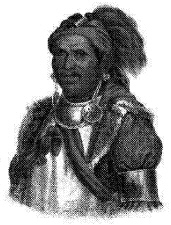
FIGURE 8–2. Tenskwatawa, the Shawnee Prophet, used foreknowledge of the eclipse of 1806 to stir up unrest among the American Indians of Ohio and Indiana.
rivalry. Now, though, Tecumseh saw in his brother the instrument to unite the Indians to resist the otherwise inevitable, gradual seizure of their lands.
Lauliwasikau’s name was changed to become Tenskwatawa, meaning “He Who Opens the Door.” He is more often recalled, though, as The Shawnee Prophet (Figure 8–2). He was a shaman, a charismatic religious leader whose influence quickly spread through Ohio and Indiana. He claimed he could cure all types of disease and provide divine protection in battle for his adherents, a popular notion that the people were ready to believe.
Tenskwatawa himself was influenced by the Millennial Church, which had originated in eighteenth-century England, but owing to persecution had migrated across the Atlantic in 1774 to seek a more tolerant horizon. The members are usually known as the Shakers, due to a ritual dance they perform involving a shaking motion of the body. Thus the Prophet was directly affected by an English connection, and he sought to build up anti-American feelings to the benefit of the morale of his own people. He was very clear in differentiating between the different peoples of Eu-
ropean origin. In 1807 he said: “I am the Father of the English, of the French, of the Spaniards and of the Indians…. But the Americans I did not make. They are not my children but the children of the Evil Spirit…. They are very numerous but I hate them. They are unjust—they have taken away your lands which were not made for them.”
THE ECLIPSE PREDICTED
The Prophet first came to the attention of the United States administration when he was involved in the burning of some proclaimed witches. The Delaware Indians, originally from the region now known as New Jersey and the state bearing their name, had become refugees through the grabbing of their lands. In consequence they had been driven westwards, into Ohio. They were not happy. Hearing about how the Prophet had condemned both the Americans and also other religious leaders, they invited him to come and help them purify themselves. Sure enough the Prophet identified several of their number as witches responsible for the ills that had befallen them and ordered their torture. One unfortunate woman was roasted for four days over a slow fire. The Indians accused of witchcraft tended to have one thing in common: they had taken up with at least some of the ways of the whites (for example wearing hats or drinking liquor). Christian converts among the tribes were a particular target. Tenskwatawa was weeding out those who would oppose his brother’s campaign for a return of the Indians to their olden ways. He moved on to other villages, and other tribes, stirring up revolt as he did so.
This unrest in the Midwest was viewed askance from Washington. Thomas Jefferson opined that the Prophet was “more rogue
than fool, if to be a rogue is not the greatest of all follies.” Although Tenskwatawa was trying to persuade or force his fellow Indians to give up the ways of the white man, Jefferson did not view him as being a major threat: “I thought there was little danger of his making many proselytes from the habits and comfort they had learned from the whites, to the hardships and privations of savagism, and no great harm if he did. We let him go on, therefore, unmolested.”
The governor of the Indiana Territory was William Henry Harrison, who in 1841 became the ninth President of the United States. He had a high opinion of Tecumseh, once writing to the Secretary of War that the Indian leader was a “bold, active, sensible man, daring in the extreme and capable of any undertaking.” Now, though, Harrison was faced with Indian roguery that was reaching a fever pitch, under the guise of divine influence. It became obvious that something would need to be done.
Early in 1806 Harrison wrote an explicit, challenging letter to the Delawares, inviting that they demand the Prophet prove his exalted status. Using phrases from the Bible, Harrison suggested to them that they should “ask of him to cause the Sun to stand still, the Moon to alter its course, the rivers to cease to flow or the dead to rise from their graves. If he does these things, you may then believe he was sent from God.” This turned out to be a most unfortunate challenge, from Harrison’s perspective. News of it soon spread. When a copy reached Tecumseh and Tenskwatawa, they retired to a tent to consider their response. Emerging shortly thereafter, the Prophet proudly stated that he was pleased to cause the Sun to stand still, and he would do so 50 days hence: on June 16, 1806. Further, he said that the Sun would be darkened in a cloudless sky, and the stars would come out in daytime. So dark
would it be that the birds would return to their nests, while nocturnal animals would emerge from their lairs.
It seems obvious what had happened. Perhaps Tecumseh had seen one of the almanacs of the Shakers. Maybe a British agent, eager to take any chance to provoke foment and disrupt the progress of the fledgling United States, had armed the Indian leader with this piece of astronomical intelligence. Another possibility is that a party of astronomers, looking for a prime place from which to observe the eclipse, had informed Tecumseh what was to happen. The previous year, on June 26, a partial eclipse had been visible from North America, with half of the Sun being covered; maybe Tecumseh had noticed that and realized the possibilities. Whatever the background involved, to the average Indian a darkening of the Sun was to occur at the behest of the Prophet, who would thus be proven to be the agent of the Great Spirit.
At the time of this prognostication, Tecumseh and Tenskwatawa appear to have been in the region of the Sandusky River, close to the southern bank of Lake Erie. That is significant, as we will see, because by June 16 they had moved south again, to the village the Shawnee had established on the site of the defunct Fort Greenville.
THE ECLIPSE OBSERVED
At Greenville, thousands of Indians from many tribes gathered, having heard of the prophecy. Accounts handed down to us have the Prophet pointing his finger toward the Sun at just the correct time, and as all cowered in fear he appealed to the Great Spirit to remove the obstruction and let the beneficial orb again shine down upon the land. This, of course, is said to have happened precisely as he ordered it.
But there is a puzzle here. The accounts talk of this eclipse occurring when the Sun was highest in the sky, close to midday, but in Greenville the middle of the eclipse was at about 9:45 in the morning, local time. It did occur rather closer to noon for a viewer in Boston, like Bowditch, suggesting that out on the East Coast, from where the history has propagated, there may have been some later embellishment of the story after the fact.
But that is a triviality compared with what was actually seen from Greenville. The story tells of the Sun being completely blanked out and stars being seen. We can calculate the track of totality, however, and it did not pass over Greenville at all. The southern limit of the track passed some tens of miles north of the Shawnee village. If Tenskwatawa had remained where he was, close to Lake Erie, then the eclipse would have caused just the effects he had pronounced. But at Greenville the eclipse was only partial. Admittedly only about one part in 500 of the solar disk was left uncovered, and that obscuration would have been impressive in itself, but that is not a total eclipse.
The conclusion is that the stories of the Prophet astonishing his people by causing the Sun to be blotted out cannot be entirely true. The descriptions of seeing Venus, Mars, and various stars in a black sky during the eclipse must have been transplanted from the awed accounts given by viewers who were further north at the time.
Nevertheless the eclipse did provide a mighty impetus to Tecumseh in his efforts to provoke a great rising of the Indians. In 1808 the brothers moved west into Indiana, establishing a larger settlement variously called Tippecanoe or Prophetstown. There, members of many different tribes gathered to plot the eventual overthrow of the Americans and the formation of a single Indian
nation. To that end, Tecumseh spent much of his time traveling widely to garner support. One day in 1811, while Tecumseh was away, Harrison approached Tippecanoe with a thousand troops. Tenskwatawa had been warned by his brother to avoid any fighting while he was absent, but the Prophet perhaps believed too much in his own propaganda and launched an attack. The Indians were routed and Harrison burnt their village to the ground.
Having had it demonstrated to them rather painfully that the Prophet, despite his claims, could offer them no protection against the Americans’ bullets, the Indians lost faith in their leadership and dispersed. The long-term effects of the Battle of Tippecanoe were therefore far more significant than might be imagined from the relatively small number of Indians killed. Tecumseh was forced to throw in his lot with the British, resulting in his death in battle two years later. Tenskwatawa was obliged to move to Canada, where he stayed for more than a decade before returning to Ohio and then Missouri when all Shawnee were ordered to move west of the Mississippi. He finally died in Kansas in 1837.
One final thing worth mentioning: Tecumseh s name means “shooting star.” Apparently a very bright meteor was seen at the time he was born, and so he was perhaps destined from the start to be linked with astronomical phenomena.