Eclipse: The Celestial Phenomenon That Changed the Course of History (2001)
Chapter: 13. ...and a Fourth
13
…and a Fourth
The planets show again and again all the phenomena which God desired to be seen from the Earth.
Georg Joachim Rheticus (1514–1576)
Because Mercury and Venus are sunward of the Earth they, like the Moon during a solar eclipse, may pass across the face of the Sun. Such events do not occur frequently. Eclipses of the third kind are called occultations; the present subject, eclipses of the fourth kind, are termed transits.
Earlier we noted that, if the Moon orbited us in the same plane as the Earth itself orbits the Sun (the ecliptic), it would be inevitable that eclipses (both solar and lunar) would happen every month. Because the lunar orbit is tilted at five degrees to this plane, however, they occur with a lesser frequency.
The same reasoning applies to Mercury and Venus: likewise they do not orbit in the same plane as the Earth. Mercury’s orbit is tilted by just over 7 degrees, and that of Venus by 3.4 degrees. Using those angles one can go through the same rigmarole as for the Moon, to derive ecliptic limits on the nodal longitudes producing a transit. We won’t trouble to step through those calculations though. Let’s simply note that, due to regularities in their orbital motion, transits of both Mercury and Venus occur in
distinct cycles. Those cycles will be discussed later. Historically, the transits of Venus comprise the most significant and rare phenomenon, and so we will first discuss those, and then look at Mercury.
THE TRANSITS OF VENUS
Looking up “Venus” in a gazetteer of world place names, one would find there are towns with that name in Florida, Pennsylvania, and Texas, a Venus Bay near Melbourne in Australia, and a Point Venus (actually Pointe Vénus in the local French) in Tahiti. It was from there that James Cook and his companions observed the transit of Venus in 1769. Why they traveled so far and at such expense to witness this celestial event is a matter of some significance. As we will see, Cook’s expedition had enormous ramifications for the European settlement of the Pacific.
As it passes across the face of the Sun, Venus appears about one-sixtieth of a degree wide, equivalent to one part in 30 of the solar diameter. This means that it could be observed with the naked eye using a suitable filter, but it is better and safer to use a telescope projecting an image onto a screen. Venus then would look like a circular sunspot taking typically six hours to cross the face of the Sun, depending on which path across the disk (which chord) it follows. No living person has seen such a thing, because none has occurred since 1882.
In principle Venus could have been seen in transit before the invention of the telescope early in the seventeenth century, but no such observation prior to 1600 has been identified. This is hardly surprising since a transit is such an infrequent event. At about the same time as the first telescopes were being turned to the skies by Galileo and his followers, Kepler was evincing the laws of plan-
etary motion. These laws enabled him, in 1629, to predict that transits of both Mercury and Venus would occur in 1631. It happened that he died in 1630. Even if he had lived, Kepler knew he would not see the Venusian transit, as it was only visible from much further west than Europe, from the Americas and the Pacific. But his prophecy of its occurrence was in itself a triumph. Most European astronomers had no doubt that Kepler was correct about that, despite the lack of visual confirmation, because the predicted transit of Mercury was seen, from Paris in particular, in November 1631.
Kepler did get something wrong though. He thought there would be no more Venusian transits until 1761, whereas in England Jeremiah Horrocks realized that Kepler was mistaken, just in time for the 1639 transit. In principle this event was visible over a wide area, but Horrocks only managed to alert one other observer to his calculations. Between clouds and between church services—it was a Sunday and he was the curate at a small village just north of Liverpool—by projecting an image onto a screen using a small telescope Horrocks glimpsed Venus creeping over the face of the Sun.
O most gratifying spectacle! The object of so many earnest wishes, I perceived a new spot of unusual magnitude, and of a perfectly round form, that had just wholly entered upon the left limb of the Sun, so that the margin of the Sun and spot coincided with each other, forming the angle of contact.
Horrocks was able to monitor the transit for only half an hour before sunset, but his observation of the planet starkly and sedately moving over the disk of the Sun was confirmed by his friend William Crabtree, who lived about 30 miles away, near Manchester.
We saw earlier that total solar eclipse tracks crossed Britain in 1715 and 1724, followed by a hiatus of two centuries. This was just due to chance, in essence. Were the two transits of Venus in 1631 and 1639, followed by a gap of over a century, similar chance occurrences?
The answer is no. Transits of Venus occur as regular as clockwork, following a simple cycle. The transits always occur in pairs separated by 8 years. The Venusian orbit lasts for 8 parts in 13 of a year, an example of a resonance (the technical term is a “commensurability”) in the Solar System. This means that after eight of our orbits Venus has circuited the Sun 13 times, and returns to more or less the same position relative to us. Due to the precessional movements of both planets the alignment does not repeat precisely. If in one nodal passage Venus happens to be near conjunction, resulting in a transit, eight years later it has shifted such that its apparent path has moved, but it is still within the ecliptic limit and a transit recurs, following a different chord across the Sun. Another eight years later the node has moved beyond the ecliptic limit, and no transit can take place. There is then another century or so of nodal movement before an alignment can occur again.
The clockwork of the heavens is such that transits of Venus occur with separations of 8.0, 121.5, 8.0, and then 105.5 years. Two transits occur spaced by 8 years; then there is a 121.5-year gap before there is another pair at a time of year 6 months away from the first pair; then another 105.5-year gap producing a pair again in the original month. This is because the nodes of the orbit of Venus pass across the Sun in early June at the descending node, and early December at the ascending node. (Note that taking 105.5 away from 121.5 you get 16, which is twice 8, showing the clockwork in action again.)
Including 1639, only five transits of Venus have ever been observed, in December of that year by Horrocks and Crabtree, in June of 1761 and 1769, and in December of 1874 and 1882. None occurred during the twentieth century. Without too much mental exhaustion you should be able to see that we are due to be treated to a repeat performance soon: the first transit of Venus for more than 120 years is scheduled for June 8, 2004.
This forthcoming transit is centered on about 08:20, Universal Time (UT: the standard time for the prime meridian passing through the Greenwich Observatory in London, England). If you plan to be in London on that day, the time on your watch would be an hour later, because Britain will be using summer time (clocks moved forward an hour) in June. To save confusion I will use UT for all times here.
The transit begins when Venus first appears to make contact with the solar disk at 05:15, about an hour after sunrise in Britain, and continues until 11:28, so that the event lasts for more than six hours in all. In Continental Europe, and further to the east, the Sun will have risen earlier and consequently be higher in the sky. One could argue that the optimum location from which to view the transit would be where the Sun is close to overhead at mid-transit, and that would indicate somewhere in the Middle East, such as Saudi Arabia. There is also a higher chance of the sky being clear there than in London. Much further east, such as in Japan, only the onset will be visible, the Sun setting before the transit ends.
For American viewers, the advice must be to head east. If you are enthusiastic (and wealthy) enough, head for Europe or beyond. If you stay in North America, you need to be close to the Atlantic seaboard. For example, Venus will be near mid-transit when the
Sun rises as seen from Boston. As far west as the Mississippi the end of the show will be visible, as the planet slips off the Sun’s face soon after it rises over the eastern horizon.
But what if it’s cloudy? At least there is not another century to wait. On June 6, 2012 another transit of Venus will occur. This time you would need to travel to eastern Asia or Australia to get the best view. After that, Venus does not align again with the Sun until December 11, 2117 and December 8, 2125.
THE TRANSITS OF MERCURY
Given that Mercury is smaller than Venus, more distant from us, and also inclined at a greater angle to the ecliptic plane, you might guess that transits of Mercury occur less frequently even than the rare Venusian transits. But you would be wrong. Mercury crosses the face of the Sun 13 times a century on average.
This does not imply, though, that Mercurial transits are spaced by even gaps of 7.7 years. Like Venus, Mercury follows a cycle with steps of certain length, quantized as multiples of an Earth year, but those steps are uneven. For Venus the steps are a regular sequence of 8, 121.5, 8, 105.5 years, but for Mercury there are interleaved cycles of 7, 13, and 33 years.The outcome is that Mercury’s transits may be separated by only 3 years, but there may be up to a 13-year gap.
As for Venus, the dates of Mercurial transits are spaced by six months: they all fall within a few days of May 8 and November 10. Those dates define a position of the Earth in its orbit, and if on either date Mercury happens to be near its appropriate node (descending in May, ascending in November) then a transit will occur.
Another regularity is also produced. In a November transit, Mercury is near its perihelion, making it more distant from Earth, and so its disk appears small: only about one part in 190 of the solar diameter. Conversely, a May transit happens while Mercury is near aphelion, making it appear larger, about one part in 160 of the solar disk. (Recall that Venus appears to be about one part in 30 the solar diameter when in transit, so that Mercury always represents a rather smaller spot passing over the Sun.) This behavior makes May transits slightly easier to follow, but they occur only about half as often as November transits. This is because at aphelion the planet is moving slowest, and consequently it is less likely to pass across the Sun during the critical window. November transits independently follow a cycle with 7-, 13-, and 33-year intervals, while May transits are governed only by 13- and 33-year gaps.
Recent and upcoming transits of Mercury are as follows.
1970: May 9
1973: November 10
1986: November 13
1993: November 6
1999: November 15
2003: May 7
2006: November 8
2016: May 9
2019: November 11
There is then a 13-year wait until 2032 for the next opportunity.
Transits of Mercury typically last several hours, the longest in recent times being the 7 hour 47 minute behemoth of 1878. That
which occurred in November 1999 was much briefer, lasting for but 50 minutes. This was barely a transit at all because, depending upon the viewing latitude, Mercury only just managed to break onto the Sun. This is called a graze, a rather rare event. Observers far enough north saw Mercury enter the face of the Sun in its entirety, but not venture far from the edge before terminating its fleeting visit (see Figure 13–1), whereas those further south saw the planet simply skim along the solar limb.
A transit is something well worth seeing at least once in your life, and there is a better window of opportunity in May 2003, when all longitudes from Europe east across Asia to Japan are favored as Mercury traverses the face of the Sun in a much deeper fashion.
A small telescope projecting an image onto a screen is what is needed, or a proper filter fitted to a telescope allowing direct view-
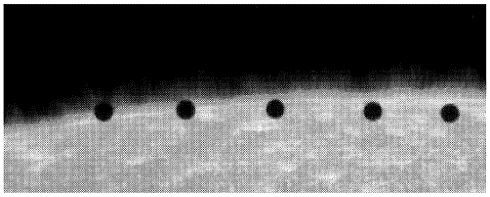
FIGURE 13–1. The transit of Mercury over the edge of the Sun on November 15, 1999, as recorded with an ultraviolet telescope on board a satellite called TRACE (Transition Region And Coronal Explorer). The five dark spots show the movement of Mercury over a time-span of almost 30 minutes.
ing. Mention was made much earlier of the ubiquitous Ha filter used in solar observing. Such a filter is especially useful in this case because it dims the brightness of the solar disk while making the chromosphere and corona visible, because it permits the transmission of only a single red light wavelength emitted by hydrogen. As a result Mercury (or Venus, if you watch in 2004 and 2012) may be seen silhouetted against the chromosphere before and after it meets the solar limb, whereas a simple gray (neutral-density) filter leaves the chromosphere virtually invisible.
Let us leave Mercury with a historical note. The first recorded transit was seen from Paris in November 1631. Pierre Gassendi was able to watch Mercury cross the Sun’s face after receiving Kepler’s prediction, confirming that the calculations were correct. A few other European astronomers who had heard of Kepler’s work did likewise. The transit of Venus in the following month was unseen due to geographical considerations: there was not the time for observers to travel to the Pacific Ocean from where it could have been seen. We described above how Horrocks watched the Venusian transit in 1639, based upon his own calculations and ignoring the slip made by Kepler. For some reason the transit of Mercury in November 1644 passed unnoticed.
Another Englishman, Jeremiah Shakerley later computed that a transit of Mercury would occur in 1651, but found it would be night in Britain when it occurred. Accordingly he traveled all the way to Surat in India to observe it. Solar eclipse chasing became a major pursuit in the Victorian era, but perhaps we should accord Shakerley some recognition as the first individual to make an intercontinental voyage in the quest for a glimpse of an eclipse of the fourth kind.
INGRESS AND EGRESS
Ingress and egress are the terms usually employed for the phases when Mercury or Venus are entering and leaving, respectively, the solar disk. Such terminology may also be used for eclipses and occultations, along with their synonyms immersion (or entrance) and emersion (or emergence).
The different contact points for a transit are shown in Figure 13–2. Ingress lasts from when the planet meets the solar limb (contact I) until the instant at which the planetary disk is totally encompassed (contact II), and similarly for contacts III and IV at egress. These junctures are analogous to the contacts occurring in an annular solar eclipse, except that now the dark object is much smaller than the Moon. Without a suitable filter one cannot properly observe contacts I and IV, making accurate timings difficult, and astronomers try to time instead contacts II and III, but fixing those instants is not easy either.
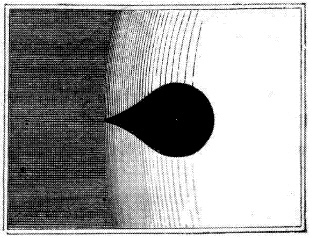
This difficulty is caused by a phenomenon called the black-drop effect. As the planet is completing its ingress, instead of a simple dark disk its image seems to be distorted into the form of a rain-drop, as if a thread or ligament of material has attached it to the solar limb, pulling it out of shape. The appearance of Venus in 1769 is sketched in Figure 13–3. Contact II is strictly when that thread seems to break, with a circular silhouette being formed, completely surrounded by the Sun. Similarly at egress, for contact III, the time in question is just before the thread appears.
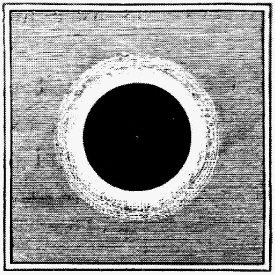
In visual observations the eye is often deceived. Apart from the black-drop effect, observers of the transits of Venus have reported the planet to appear surrounded by a luminous patch or aureole (Figure 13–4), sometimes with a bright spot on the dark
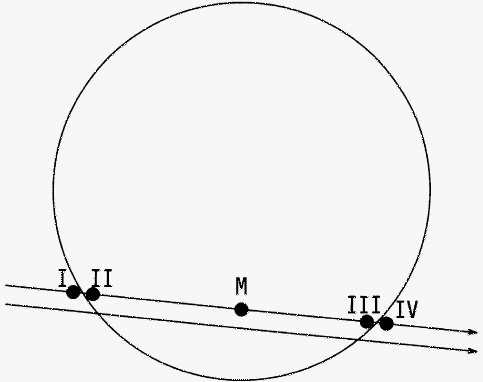
FIGURE 13–2. The contact points in a transit are labeled with Roman numerals from I to IV. Here M is the mid-point. The chords followed by Venus in transit across the face of the Sun during a transit depend especially upon the latitude of the observer. By measuring the times of ingress and egress accurately, the precise chord taken can be determined, and with two timings/two chords (as depicted here) from observers at known locations, it is feasible to calculate the distance to the Sun with some accuracy.
disk. These optical effects, due to scattering by the atmosphere of Venus, were unsuspected until transits were first watched. They limit the accuracy with which the phenomena may be timed, and that has important scientific and practical repercussions, as we will now see.
THE SCIENTIFIC USE OF TRANSITS
Leaving aside the transits of Mercury in 1661, 1664, and 1674, the next important occurrence in this field of endeavor was in November 1677 when another was observed by Edmond Halley who at the time was on the island of St Helena, engaged in a survey of the South Atlantic.
This episode is significant because Halley later expounded a technique for using complete transit timings to determine the distance between the Earth and the Sun (that is, the astronomical unit or AU), a measurement that was sorely wanted. It was contemporary ignorance of the scale of the Solar System that led to the inaccuracy of Halley’s computed track for the 1715 eclipse (see Chapter 7). An even more important consideration was that navigational accuracy at sea required precise knowledge of the future positions of the Sun, Moon, and planets.
Many authors credit Halley with inventing the transit technique. Actually it had been a Scottish mathematician, James Gregory, who first propounded the idea, in 1663, but it was Halley’s later description of the concept that led to attempts to put it into action. He read a paper on this topic to the Royal Society in 1691, but did not publish his analysis until 1716. Halley realized that only transits of Venus, not Mercury, would afford a feasible avenue for determining a better value for the mean Earth—Sun distance. Knowing that those transits would not occur until 1761 and 1769, Halley recognized he would not live to put the technique to the test (he died in 1742). Nevertheless, he was happy to leave his reputation to posterity, just as he knew that he would not be around to see the return of the comet that bears his name, in 1758.
The significance of these transits we should put in the context
of the era. The quest for a practical method for determining the longitude of a ship at sea was an overbearing desideratum at the time, as we discussed in Chapter 3. Astronomers were engaged in a race to develop some accurate method that would allow the position of a vessel far from the sight of land to be easily and accurately measured. Reckoning the distance to the Sun was not some abstract piece of scientific curiosity: it bore the promise of more accurate celestial tables and thus improved navigation. In consequence the British (and other) governments were strongly interested in having the transits utilized by their astronomers to ascertain that quantity, from which the distances and motions of the Moon and planets could be computed using Kepler’s Laws. This explains the expense and effort put into this endeavor, as exemplified by the voyage of Lieutenant James Cook detailed in the next section.
THE FIRST VOYAGE OF LIEUTENANT JAMES COOK
The explorations of James Cook in the Pacific are well known, but the primary purpose of his first voyage, from 1768 to 1771, is not so extensively recognized. That purpose was to observe the anticipated transit of Venus on June 3, 1769, from Tahiti. In fact there had been a transit in 1761, as noted earlier, and the peculiar tale of that event will be told a little later in the book. For the time being, we pick up the story with Cook having been dispatched to the South Seas on board a small ship named the Endeavour, loaded with men and supplies, but most especially carrying various telescopes, a pendulum clock, English astronomer Charles Green, and Swedish naturalist Dr. Daniel Solander. Also on board was Sir Joseph Banks, who left a long-term mark on British science, serv-
ing as President of the Royal Society for several decades after his return.
Overcoming mishaps along the way, Cook and his party arrived at Tahiti a couple of months before the transit was due. They needed plenty of time to set up their temporary observatory. Nowadays the location may be denoted Pointe Venus on a map, one of the few non-Polynesian names thereabouts, but Cook called it Fort Venus, as he had to guard his establishment to stop the indigents from stealing the equipment and supplies. Similarly the island appears in the records of the expedition not as Tahiti, but as King George’s Island, for the sovereign. A British party had charted it only a year or so before, just in time for planning Cook’s expedition, a good base in the largely unexplored South Pacific being required for the transit timings.
The astronomical observations of the party went well, although with some drawbacks, the significance of which we will come to later. To quote from Cook’s personal journal: “Saturday 3rd June. This day prov’d as favourable to our purpose as we could wish, not a Clowd was to be seen the whole day and the Air was perfectly clear, so that we had every advantage we could desire in Observing the whole of the passage of the Planet Venus over the Suns disk: we very distinctly saw an Atmosphere or dusky shade round the body of the Planet which very much disturbed the times of the Contacts particularly the two internal ones.” This brings us to the secondary aim of the voyage. Cook took with him a sealed envelope, containing his instructions for the rest of his mission. Although the gist of it seems to have been common knowledge in England, the contingent on board the Endeavour could not have known for sure what those orders were until after the transit. By that time they were already nine months into a voyage that was to last for almost three years.
The secondary task is now well known: explore the southern oceans to search for the hypothesized great southern continent, Terra Australis Incognita, and claim it for the British crown. There is no great landmass in the far southern Pacific, so they sailed that ocean in vain. However, Cook charted and claimed New Zealand and the east coast of Australia, even though the French and especially the Dutch had been there before, with the result that those became British colonies. French Polynesia, from where the transit was observed, is obviously a different story.
Earlier I challenged you to look up “Venus” in a gazetteer, identifying Pointe Vénus in that way. If you do the same thing for “Mercury,” you will find a small town in Nevada, 60 miles northwest of LasVegas—perhaps because a thermometer’s mercury soars in the desert—and also a settlement known as Mercury Bay in New Zealand. This is on the Coromandel Peninsula, east of Auckland, and to the northeast in the Pacific is Great Mercury Island. How did these names come about?
It happens that, like 1631, 1769 was a double transit year. After the one by Venus in June, Cook knew that Mercury would also pass over the face of the Sun in November. This event he planned to put to a different purpose. Concurrent lunar eclipse observations from separate locations allow their difference in longitude to be derived, by comparing the eclipse timings to the local solar time. This method had been used, for example, to determine the distance west from London to the Caribbean and the Americas, certain eclipses being visible both from there and back in Europe. Cook, however, was right around the other side of the planet, meaning that he could not watch an eclipse at the same instant as astronomers viewed it from England.
The instant of the transit of Mercury had been precalculated
with some precision. It provided a natural clock in the sky. By comparing the time at which it was observed with the local time according to the Sun, Cook could determine the longitude of New Zealand. For this reason he scouted the North Island, eventually choosing the place now called Mercury Bay because the Maoris there seemed less hostile than elsewhere.
The rival method to astronomical observations for determining longitude at sea was John Harrison’s chronometer, which eventually triumphed. On this first voyage Cook had no marine clock, so he needed to rely on astronomy for determining time and longitude. The transit of Mercury in late 1769 provided a particular opportunity. At other places he used both the lunar distance technique, and the eclipses of the four Galilean moons of Jupiter, methods mentioned in Chapter 3. On his subsequent voyages of discovery Cook had an excellent chronometer on board, but still made astronomical observations to verify that clock’s accuracy.
Cook eventually arrived back in England in 1771, after many tribulations, with his much-awaited transit timings. The astronomer Green did not make it, having died on ship. Our next port of call is the usage that was made of the transit observations, but to understand that we must step back to 1761.
PARALLAX AND DISTANCE OF THE SUN
After Halley’s death, others took up the cudgels in persuading the British government that the 1761 and 1769 transits of Venus represented an opportunity that should be seized, confident that the problems of maritime navigation would be solved once the distance to the Sun was known with sufficient accuracy.
This distance was largely a matter of conjecture. Halley him-
self had decreased his estimate for the astronomical unit by a factor of four, but even his final value was about 30 percent too high. On the Continent, astronomers had tried using observations of Mars to measure this parameter, but their results did not agree.
The basis of the method used was parallax. This is easy to demonstrate. Hold your arm out straight, with one finger pointing upwards and some far-flung background beyond it. Repetitively looking at the background with one eye shut and then the other, your finger seems to jump left and right. If you measure the distance it appears to move, and also the separation of your eyes, then you could determine the length between your head and your finger. A tape measure may be a simpler way, but one cannot stretch a tape measure to Mars. In the astronomical context Mars is equivalent to the finger, and the far panoply of stars is the unmoving background. So what is the analogue of the separation between your eyes, providing the parallax effect? In 1751 French astronomers observed the apparent position of Mars against the stars both from Paris and the Cape of Good Hope (South Africa), providing a baseline of over six thousand miles. From their derived distance to Mars they calculated the astronomical unit, but their value was too high.
Remember these were the days before photography. Unlike in Eddington’s 1919 eclipse expedition, it was not possible to photograph Mars surrounded by a star field at a particular time, bringing the plates home for close comparison. A more accurate visual method was needed, and a transit of Venus afforded just that. The basis of the technique was as follows.
Just as your finger moves as you blink eyes, if observers are well separated they will see Venus take different paths or chords
across the Sun during a transit. That’s parallax, and the idea in this context is represented in Figure 13–2. If the distance between those chords is determined, then it is feasible to compute the distance to Venus, and to the Sun. The trick is in measuring the locations of the chords with sufficient precision. This could not be done directly because of the uncertainty of the azimuthal positions on the Sun’s face of the contact points, the finite size of the disk of Venus, and so on. But there was a refinement, as follows, making the path determination possible.
The rate at which Venus appears to move across the sky during a transit may be calculated quite accurately on a theoretical basis. If the transit is timed, then the angle Venus moved through during that time interval may be calculated, and from that the chord taken across the solar disk determined with some precision. It was anticipated that, if the contact junctures were timed to within a few seconds, then with a transit lasting for five or six hours the chord would be extremely well defined. With two observers separated by some known distance (that is, if their latitudes and longitudes were known), it would be feasible to arrive at the solar distance with an accuracy far superior to all previous measures.
The simple idea that Cook and his party were sent to Tahiti to measure the distance to the Sun is a little misleading, however. From the above description, it is clear that two observation points are required, separated by as far as possible. Cook’s expedition provided just one of them, so it is incorrect to think that the Tahiti measures could be used on a stand-alone basis. We will come back to this later.
THE TRANSIT OF 1761
Going back a little before Cook’s voyage in the late 1760s, let us consider what happened with the earlier transit, that in 1761. As this was approaching, astronomers were not inactive. It was known that the event would be visible in its entirety in a band stretching from northern Europe across the landmass to the southeastern parts of Asia. To each side of that band either only ingress or only egress could be observed, but that did not preclude useful timings being obtained: an ingress observed at one point could, at least in principle, be combined with an egress timing elsewhere, so long as their geographical coordinates were well determined.
In London the Royal Society organized several expeditions. The fifth Astronomer Royal, Nevil Maskelyne, set sail for St. Helena. From there and at the Cape of Good Hope the egress would be visible. Far better were locations from which both ingress and egress could be seen. The French, British, and several other nations set up a number of temporary observatories in suitable places. The shortest transit time was observed from Tobolsk, 300 miles east of the Ural Mountains in western Siberia. In India the duration was three minutes longer. It follows that, although the transit lasted for many hours, to differentiate between the chords required timings good to a matter of seconds.
There is another, related, consideration. To get the best parallax, the widest possible latitudinal separation is needed. In the event the furthest northern point at which the entire transit was timed was Torniö (on the current border between Sweden and Finland), at a latitude near 66 degrees; the furthest south was Calcutta, at 22.5 degrees north. The separation of these is not much more than 40 degrees. Other sites (such as South Africa) were much further
south, but only the egress was observable from there. On the other hand, the longitude coverage was excellent, from Jesuits in Beijing to astronomers sent to Newfoundland, 120 observers in all, but with the restricted latitude range covered, they were all watching similar paths across the Sun.
This meant that the data collection was far from optimal, and it was realized that the much hoped-for improvement in astronomical and navigational knowledge would not result, at least immediately. The transit could have been observed from start to finish on the equator in Indonesia, and even further south (the Dutch had already literally run their ships into New Holland, now called Australia). Why wasn’t it?
DIXIELAND BLUES
All will be familiar with the southern parts of the United States—the old Confederacy—being termed Dixieland or simply Dixie. There are several theories concerning the origin of this moniker. A leading idea is that it derives from the name of an English astronomer, Jeremiah Dixon.With his compatriot, Charles Mason, Dixon surveyed the border between Maryland and Pennsylvania from 1763 to 1767, defining the famous Mason-Dixon line. Until the Civil War in the 1860s this was considered to be the demarcation between the free states and the areas of black slavery below.
In 1760, however, the pair was looking at heading east towards Asia rather than west towards the Americas. The British wanted to send a transit observing team to Bengkulu in Sumatra, four degrees south of the equator. In those days nearby Jakarta was named Batavia, the capital of the Dutch East Indies. Mason and Dixon were engaged for the task, and in March 1760 they set sail
from Portsmouth on a Royal Navy ship. Before slipping out of the Channel, their vessel was attacked by a French frigate. Eleven sailors were killed, and 37 wounded, the British limping back into Plymouth.
Not surprisingly Mason and Dixon had lost much of their enthusiasm for the adventure, and despite the navy offering to provide a mighty escort out of the Channel after their vessel was repaired, they wrote to the Royal Society petitioning for their destination to be switched to the Black Sea. One might suggest that this would involve an even more dangerous voyage through the Mediterranean, but it seems that it was not only the French guns that worried Mason and Dixon. On their abbreviated venture the landlubbers had been stricken with seasickness, and they felt they could not stomach a voyage down through the Atlantic and across the Indian Ocean. This they were charged to do, though, in a forceful rejoinder from London. Nevertheless, a postscript to their instructions allowed them some discretion, and in the event they decided to halt at the Cape, from where they observed the egress. This was just as well: in the interim the French had seized Bengkulu, so that Mason and Dixon would hardly have been afforded a welcome there.
The timings our heroes made at the Cape were useful in the analysis of the transit carried out by mathematician James Short back in London, but there was a problem. A French expedition had gone to Rodrigues, a little island just east of Mauritius, where astronomer Alexandre Pingré watched the egress. Jacques Cassini, Director of the Paris Observatory like his father, grandfather, and great-grandfather before him, supplied that egress timing to Short. (Just because their countries are perpetually at war does not mean that scientists will not collaborate.)
Unfortunately the value obtained from the Rodrigues recording was discrepant when compared to the relatively nearby Cape, and Short thought that Mason and Dixon, who were already subject to some opprobrium, had mistimed the event by precisely one minute. By making this “correction” Short derived a distance to the Sun that was more than 10 percent lower than the real length. In fact the error was due to the longitude quoted for Rodrigues being out by a quarter of a degree. In the late nineteenth century the American astronomer Simon Newcomb, with the advantage of valid geographical coordinates for the observation sites, reanalyzed all the 1761 transit timings and showed that they were consistent with the true solar distance, which by then had been determined by other means.
Back in the 1760s this was not known. It seemed that the transit of Venus in 1761 had passed by without the necessary timings having been made with a sufficiently wide geographical spread. There was a determination that the opportunity in 1769 would not be similarly wasted.
PREPARATIONS FOR THE 1769 TRANSIT
Both the British and the French redoubled their efforts in the quest to obtain the desired benefit from the 1769 transit. The middle of the event was at about 22:20 UT (i.e., London time), so it was clear that stations in the Pacific were required if the entire six-hour transit was to be followed.
Simplistically, one could imagine that locations further east (for instance in the Caribbean) might be able to see the ingress, those further west (in India) the egress, and only at longitudes for which local midday is near 22:20 UT would the complete transit
be observable. From that perspective Tahiti was an excellent prospect. Hawaii, which Cook was to map on a later voyage and name the Sandwich Islands, meeting his death there in 1779, would have been at a good longitude, although a more southern latitude was desired.
But that discussion is too simple. The transit was on June 3, only 19 days before the summer solstice, and so the Northern Hemisphere was tilted toward the Sun. In consequence the event might be seen throughout the Arctic, almost independent of longitude. Lapland is often called the Land of the Midnight Sun for a good reason, and it was realized that the transit could be observed from, say, the Russian town of Murmansk, and right across northern Siberia to the Pacific and thence Canada. At that time of the year the Sun is above the horizon for most of the day at such latitudes.
This meant the observational baseline could be stretched far to the north, and an international effort was organized, the British taking responsibility for extrapolating that baseline as far south as possible. Apart from Murmansk, and Hudson’s Bay, ingress-toegress timings were made in Norway. In fact it was our old friend Jeremiah Dixon who went to Norway, this time unaccompanied by Charles Mason. The idea that Cook was sent to Tahiti because the transit could not be observed from anywhere near the longitude of Britain is therefore incorrect: paradoxically, he sailed to Cape Horn and then westwards for reasons of latitude. That is, Cook’s party went to the Pacific in order to observe the transit from as far south as possible.
One other important location from which the transit in 1769 was observed deserves special mention, a French expedition. It was the Abbé Jean Chappe d’Autoroche who had watched the
1761 transit from Tobolsk, in Siberia, an observation mentioned earlier. This time he wanted to sail to the Solomon Islands. These islands lie in the western Pacific, northeast of Australia, and were the site of ferocious fighting during the Second World War. Back in the eighteenth century the Solomons were under Spanish control, but despite intending to take two Spanish naval officers along the court of Spain refused him leave, suspecting him of wanting to spy out the territory on behalf of France. Thus Chappe sailed across the Atlantic, through the Caribbean, and landed in Mexico at Veracruz. From there his party traveled overland through Mexico City at great personal danger from banditos, the local Viceroy then providing them with an escort of soldiers as they pushed on to the Pacific coast through Guadalajara. From San Blas they sailed, with some difficulty, northwest towards Cape San Lucas, the tip of Baja California, and observed the transit from San José del Cabo. This has been the source of much confusion, “San José, California” being a totally different place, deep in Silicon Valley.
Chappe got to this lesser-known San José a fortnight before the transit and fixed its latitude by observing the culmination of stars, its longitude using the moons of Jupiter, and then the transit. A complete success, except that a contagious disease—a strain of typhoid it seems—was already sweeping San José when his party arrived. Ignoring the danger, Chappe insisted on remaining not only for the transit, but also thereafter for a lunar eclipse on June 18. Timing of that eclipse was required to secure the site’s longitude, an essential parameter if the transit project was to succeed. By then Chappe had himself succumbed to the illness. He died six weeks later, as did one of the Spanish officers, but the remnants of the party ensured that the invaluable timings were returned to Europe.
ANALYZING THE 1769 RESULTS
Back in England, the task of analyzing the available timings fell to Thomas Hornsby, the Savilian Professor of Astronomy at Oxford. His selection from the data available from Tahiti was peculiar, however. The observations from Cook himself, Green and Solander, all with their own telescopes, showed a scatter often seconds or more in some of the contact timings, as foreshadowed by the quote from Cook’s journal given earlier. Hornsby seems to have selected the values from Tahiti that fitted in best with what he expected, based upon the calculations he had already completed using information over the shorter baselines. That is, because Cook did not arrive back until 1771, Hornsby had already made calculations using combinations of readings from Wardhus in Norway, Murmansk in Russia, and Hudson’s Bay in Canada. Later came the timings from the French at San José del Cabo in Baja California, and finally the data from Cook’s party in Tahiti. It seems that by the time that he received the final set of timings, Hornsby had already made up his mind what the answer should be.
This selection of data is dubious in itself, but also there were other observations available, which Hornsby ignored. One wonders how his report would be treated if subject to the rigorous perusal typical for modern-day scientific papers. Perhaps not by chance, Hornsby’s final value for the Earth—Sun distance was much the same as that he had derived using the 1761 transit.
The matter did not sit there, though. The timings from Rodrigues in 1761 were misleading because the longitude of that island was imprecisely known. Cook and colleagues in Tahiti in 1769 determined the longitude of Fort Venus in two ways: from the eclipses of the satellites of Jupiter, and lunar observations. Both
results differed from the true longitude, measured later when marine chronometers were carried to Tahiti, by tens of seconds. Even if the observations of Cook, Green, and Solander had agreed with each other, still there was another inherent source of error making the final result for the Earth-Sun distance incorrect: the site coordinates were wrong.
To that extent, one has to say that the expeditions mounted to observe the transit of Venus in 1769 overall were a failure; a failure that cost many lives. Of course there were many spin-offs, such as those accruing from Cook’s sealed-envelope orders (I am a citizen of Australia, and previously lived in New Zealand for some years), but basically the science did not work.
The transit observations from 1761 and 1769, so eagerly recommended by Halley and others, did not lead to improvements in navigational capabilities, but within a handful of years that motive anyway had been surpassed by other developments. As aforementioned, on his second and third voyages James Cook carried accurate marine chronometers modeled on Harrison’s clocks and fixed his longitude using those.
MEASURING THE ASTRONOMICAL UNIT
The fundamental aim of the transit expeditions was to enable the astronomical unit—the AU, the Earth-Sun distance—to be determined. It would be remiss if I did not complete that part of the story.
It already has been mentioned how Simon Newcomb, in 1891, reexamined the 1761 transit data and, using the correct geographical coordinates for the observation sites, showed that the timings were consistent with the actual solar distance. In fact he
did this likewise with the 1769 data, handling well over a hundred timings, some of which he had to reject as clearly erroneous.
Newcomb was not the first to attempt this reanalysis. Astronomers did not simply wait for the 1874 and 1882 transits to arrive. In the first half of the nineteenth century various attempts were made to exploit the 1761 and 1769 data. The German astronomer Johann Encke did this, but ended up with an answer making the solar distance somewhat larger than indicated by other techniques; the result was that the transit observations were distrusted until Newcomb demonstrated their veracity.
In both 1874 and 1882 renewed efforts were made to determine the AU through Venusian transits. In the former year the United States alone sent three expeditions to Siberia, Japan, and China to achieve northern sightings, and five groups to New Zealand, Australia, and Kerguelen Island in the Southern Hemisphere, the advent of photography allowing a permanent record of the phenomena to be made. The weather stymied much of the photography, and comparatively little success was met by the Americans or the numerous British, French, and Russian groups, and others. The Germans did better, obtaining clear weather at all six of the sites they had chosen. In 1882 a similar array of astronomers observed the path taken by Venus across the Sun, although American astronomers did not need to venture too far: the whole transit was visible from the eastern two-thirds of North America and all of South America.
Science moves on, though. In 1898 the large Earth-approaching asteroid 433 Eros was discovered. Within a couple of years, astronomers were using parallax observations of Eros in the same way as Mars had been employed earlier. Eros comes much closer to us than Mars, leading to a more accurate evaluation of the AU.
The invention of radar led to the ultimate determination of the AU. Again,Venus has been involved, although in a quite different way. By bouncing radio pulses off that planet and timing the echoes’ return, the solar distance now has been measured with a precision unimaginable to Halley, Cook, and all others involved when transits of Venus were considered by many to be the only viable avenue to improved navigation.
PLANET-PLANET ECLIPSES
For the sake of completeness, there are a couple of other phenomena we might tidy up in our survey of peculiar types of eclipse. The first is trivial. In the Space Age a host of artificial satellites has joined our natural satellite, the Moon, in orbit about the Earth. These are eclipsed frequently. The time to watch for satellites is soon before dawn or just after dusk (because during the deep night, satellites in low orbits are within the terrestrial shadow, in eclipse). Far enough up that the Sun is still catching them, satellites in low orbits such as the space shuttle, the space station, or the Hubble Space Telescope typically take 90 minutes to circuit the planet. Those are only a few hundred miles up, higher paths taking longer to complete an orbit. The time to move from horizon to horizon typically is only a few minutes, but often one will see a satellite abruptly disappear, as it enters the shadow zone.
Devotees of satellite spotting also enjoy solar eclipses. In that situation the name of the game is predicting when a particular satellite visible in daytime (usually with binoculars) is going to pass into the shadow of the Moon—and then watch it actually happen. Catching artificial satellites being eclipsed, though, is a specialized modern-day sport. Let us return to natural events.
We have considered the Moon and planets crossing the Sun or the stars, Jupiter eclipsing the Galilean satellites, and measuring the sizes of asteroids and comets. Is it possible, though, that one planet could eclipse another? Venus, say, could cross the face of Jupiter, and because the former appears smaller than the latter this could be classed as a transit. Such an event might be seen around dawn or dusk if it happened that Venus were near maximum elongation (the greatest angular distance it achieves from the Sun) and Jupiter, on the opposite side of the Sun to the Earth, happened to line up. Alternatively Mercury might pass behind Venus and be occulted. Such things must happen—but not very often.
There is a thin line of differentiation between an occultation and a transit. One might say that a Galilean satellite is occulted when it passes behind Jupiter, but is in transit when it moves across the Jovian disk as seen from the Earth, the somewhat different direction to the Sun causing its shadow to be located elsewhere on that disk (see Figure 13–5). Both events might be thought of as forms of eclipse, which is why they merit mention.
The planets all orbit the Sun in the same direction, with orbital planes inclined slightly to the ecliptic. This prohibits planet-planet eclipses from occurring every year, but makes their occurrence more frequent than if they sped around the Sun with random orientations. Just how often do such events occur? As a long-term average, there are 7 or 8 years between solar transits of Mercury, and solar transits of Venus occur once every 60 years. The Sun covers a much larger target area than any of the planets, so one might anticipate that transits of one planet across the face of another would be rare birds indeed. This is indeed the case.
In 1591, while still a student at Tübingen in Germany, Johann Kepler ventured out into a cold January night with his teacher to
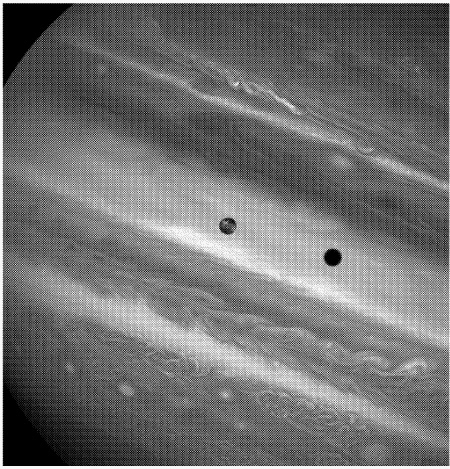
FIGURE 13–5. A transit of lo, one of the four Galilean moons of Jupiter, across the face of the planet results also in a form of eclipse, with its shadow being cast on the cloud tops below.
observe a predicted close conjunction between Mars and Jupiter. To their astonishment only one reddish spot could be seen in the sky, and they surmised that the two had aligned with each other. This would be the first planet-planet eclipse observed, except that precise backward computations show that Kepler’s senses must have deceived him. What actually occurred is called an appulse,
Mars and Jupiter passing very close to each other, like a grazing occultation. Without a telescope, two decades before Galileo opened the heavens to closer inspection, the human eye was inadequate to differentiate the adjacent pair of tiny planetary disks.
In all recorded history there is only one definite observation of a planet-planet eclipse, and that was watched by but one man, from the Royal Greenwich Observatory in 1737. John Bevis was a physician from a country area a hundred miles west of London, who had done well for himself in the city, giving him the time and money to pursue his amateur scientific interests, including astronomy. Although not on the staff, he often observed the heavens from the great observatory, his expertise with the telescopes being well recognized.
One evening he was observing with a rather crude refractor (a lens telescope), with a focal length of 24 feet. In those days such simple telescopes tended to produce poor images with colored fringes around celestial objects. Through the long tube of this ungainly instrument Bevis saw a gibbous Mercury and narrow crescent Venus near each other in the sky, and rapidly closing. (Both planets display phases like the Moon; “gibbous” is the phase between when a half and a full disk is illuminated.) Clouds intervened, and it was eight minutes before Bevis could again espy the brilliant but slender Venus. The dimmer Mercury he no longer could detect. He surmised that Venus had eclipsed Mercury, but he was prohibited from seeing the smaller body emerge from behind the larger by yet more clouds, which blanketed the sky until the planets set in the west.
We met Urbain Le Verrier in the previous chapter, as one of the predictors of the existence of Neptune. Having been appointed Director of the Paris Observatory, in the mid-1800s he had drawn
up tables of planetary positions and wanted to test their accuracy. Le Verrier seized upon Bevis’s report from more than a century before as a stringent test. Sure enough he found the alignment would have occurred as described, with the slight refinement that Mercury was not completely covered by Venus. That part of Mercury protruding, though, was the dark part shadowed from the Sun, so Bevis could not have seen it in the glare of Venus. Bevis’s northerly location was also critical; if he had been on the equator, the two planets would have swept past each other in an appulse.
A handful of other opportunities to witness planet-planet eclipses have been missed by astronomers over the past five centuries. In 1570 and 1818 Venus skimmed over Jupiter, but neither event seems to have been noticed. In 1705 an observer in Japan could have witnesssed Mercury practically touch Jupiter, as seen in the night sky, but it seems that none did.
Looking into the future, in 2037 Mercury will pass very close by Saturn, but not quite transit its disk or rings. If you choose your location carefully (go north, young men and women), you may see Mercury blotting out Neptune in 2067, but you’ll need a decent telescope. After that, there is a transit of Venus over Jupiter in 2123, and in 2223 Mars will do likewise. Planet-planet eclipses, then, do not occur often.
LE VERRIER’S PLANETS
Having reintroduced Urbain Le Verrier above, we will now describe how he enters into transit observations.
As was mentioned earlier, after its discovery by William Herschel in 1781 the British wanted to name Uranus for King George III. Almost in retaliation, when Neptune was found in
1846 utilizing a Frenchman’s predictions, his countrymen wanted to call it “Le Verrier” (I will leave it to the reader to consider why they did not instead try to honor their own royalty). The mythological name Neptune eventually prevailed.
The predictions of Le Verrier and Adams (see Chapter 12) were based upon the slight deviations between the theoretical and observed positions of Uranus. Some unknown body seemed to be tugging the planet along, and that was Neptune. A decade or so later Le Verrier had turned his attention to Mercury. The innermost planet also had an orbit that could not be explained using Newtonian gravitational theory coupled with the positions and masses of the known planets. It seemed that Mercury’s perihelion point was precessing faster than expected (see the Appendix for an explanation of what is meant by “precession”).
What Le Verrier suggested in 1859 was that several previously unsuspected small planets existed, orbiting closer to the Sun than Mercury. He reasoned that there must be several of these, rendering a total mass about one-tenth that of the Earth, and they had hitherto escaped detection because they were small and dim, compared to the bright solar glare. Le Verrier suggested that these unseen bodies were tugging Mercury along a little, explaining its slightly anomalous motion. So, how could they be discovered? The answer is simply to look at the Sun. Every so often one should appear in transit, taking minutes or hours to cross, not the 10 or 12 days of a sunspot.
This concept was greeted with enthusiasm and, sure enough, announcements of small dark spots transiting the Sun soon flooded in. The first to claim to have seen one was another Frenchman, Edmond Modeste Lescarbault. He was a country physician keen on astronomy, and he spent his leisure hours in a quest for these
hypothetical tiny planets. Le Verrier was quickly acclaimed as the predictor of not only the outermost planet, but the innermost too. It was even given a name: Vulcan (aficionados of Star Trek take note).
The problem was that none of the putative observations could be verified, and the reports were inconsistent. In the heydays of visual astronomy, many claimed discoveries were figments of the fond imaginations of the observers involved. What was required was an opportunity for many observers to peruse a target at the same time. A total solar eclipse affords just such an opportunity: if Le Verrier was correct and there were one or more intramercurial planets, then they should be detectable during an eclipse, when the bright sunlight is largely blocked out.
The search for Vulcan and its putative companions became one of the major aims of the eclipse expeditions to the western United States in 1878 (as previously mentioned in Chapter 9). Observers in Colorado and Wyoming announced they had found not just one planet, but two, close to the Sun. But there were discrepancies in what was reported, and a major public argument ensued. The claimed discoveries were to the southwest of the Sun, whereas any body causing the charted perturbations of Mercury would need to have been to the east. The measurements from the two sites were inconsistent with each other, making some think that four new planets had been found. In the end it was realized that two rather faint stars in Cancer were all that had been detected, and so there were red faces all round.
Over the following years more rigorous scouring of the space around the Sun was conducted, when total solar eclipses allowed. These efforts did not go totally without reward: during the 1882 eclipse over Egypt, a comet was found that had previously defied
discovery. A similar discovery, of a different comet, had been made way back in A.D. 418; and in 1948 observers in Kenya also found a comet in the eclipse-darkened sky. But no small planets within the orbit of Mercury, such as the Vulcan envisioned by Le Verrier, have ever made their existence known.
This is not surprising, because Le Verrier’s analysis was based on a false premise, that the Newtonian gravitational theory is an adequate description of the laws of physics. When you are as close to the Sun as Mercury, it happens that Newton’s theory breaks down. The explanation of Mercury’s anomalous precession awaited Einstein’s relativity theory, as was mentioned in Chapter 4. Along with the gravitational deviation of starlight, the explication of Mercury’s orbital motion is one of the great demonstrations of the veracity of Einstein’s theory.
There are, however, known asteroids that pass closer to the Sun than the Earth, making transits feasible. Since the first was found in 1932, several hundred Earth-crossing asteroids have been catalogued. Imagine that one was passing relatively close by our planet. If it happened to align with the direction of the Sun, we would see it transit the solar disk, taking between a few seconds and a minute to cross. (It would need to be close—within, say, a million miles of us—because all these asteroids are smaller than five miles in size, making them imperceptible against the solar disk if further away.) Very small dark spots quickly crossing the Sun have been reported many times, often by reputable and experienced observers, but the frequency of such events seems much higher than may be explained by the suspected flux of asteroids, leaving it all a bit of a mystery. As of yet no wholly intramercurial object has been found (nor indeed any intravenusian asteroid), but that does not mean that they do not exist. For example, the first
asteroid always closer to the Sun than is the Earth was spotted only in 1998, and those still closer to the Sun would be even more difficult to find. We do know that all such bodies that may exist must be small, too small to cause any significant gravitational perturbations of the planets.
This is not the end of the story. After Neptune had been discovered and tracked for some decades, all the computations indicated that neither its path nor that of Uranus could be accommodated by the mutual gravitation of the known masses in the Solar System. This led Percival Lowell and others to think that there was another large planet still to be found. Lowell, who was introduced in Chapter 12, was a Bostonian who had made a fortune out of textiles, and so had money to spend on his favored hobby: astronomy. In Flagstaff, Arizona, he founded the great observatory that still bears his name. Apart from looking for evidence of life on Mars, the major task of the fledgling Lowell Observatory was a search for a further outer planet, and that project led to the discovery of Pluto in 1930. But the history is not quite as simple as that, as we’ll see in the next chapter.