Eclipse: The Celestial Phenomenon That Changed the Course of History (2001)
Chapter: 12. Eclipses of the Third Kind
12
Eclipses of the Third Kind
Damn the Solar System. Bad light; planets too distant; pestered with comets; feeble contrivance; could make a better myself.
Lord Francis Jeffrey (1773–1850)
So far we’ve looked at two basic types of eclipse: solar and lunar. Our Sun is not the only star whose face the Moon can pass across though. Every month the Moon, in its passage around the Earth, blocks out the light from some millions of stars in the Milky Way, and many extragalactic objects, too, each reappearing about an hour later behind the trailing limb of the Moon.
Most of these remote light sources are extremely faint, but every so often the Moon will obscure some particularly bright star, and numerous amateur astronomers will be keen to witness the event. The target might be Regulus, the bright white star in the constellation Leo, or Aldebaran, the vivid red object in Taurus, or some other familiar heavenly jewel. Nor do the planets escape alignment with the Moon: because they occupy a restricted band about the ecliptic, they, too, are frequently blotted out for a brief time.
One may think of these as “eclipses of the third kind,” but there is a specific astronomical term attached to them: occultations.
This is an area of astronomy in which amateurs are able to make vital contributions to our knowledge base.
LUNAR OCCULTATIONS
Imagine that the Moon is due to cross a particular well-known star. What useful information can be obtained about our natural satellite?
First, because we can measure and catalog the coordinates of the stars with great precision, by timing the instant at which the star disappears behind the Moon one may determine the lunar position at that instant with similar accuracy. It is relatively easy to ascertain the locations of objects that effectively stand still, like the stars. Because they are moving in concert around the sky, a telescope can continuously track them if it is rotated at just the right rate to compensate for the turn of the Earth. Yet this is not so with the Moon or other members of the Solar System, which are in constant but variable motion relative to the static background of stars. Timing an occultation to a fraction of a second allows the observed location to be referenced against the predicted position from the computed ephemeris, perhaps leading to an update.
Nineteenth-century astronomers argued over what they saw through their telescopes when the Moon occulted a star. To many observers it seemed that the image of the star was projected onto the dark lunar disk, seeming to remain visible even after it was obvious that the star must be hidden. Some claimed that this image seemed to be colored even though the star may have been white.
Debates over this phenomenon raged for years, various hypotheses being advanced for its origin. In those days the nature of
light was still a mystery. Some argued that the Moon was partially translucent, acting like a cloud whose periphery lets some light through (the “every cloud has a silver lining” effect).
Eventually it was realized that the apparition is simply an artifact of the human eye. It is similar to staring at a light globe for a few seconds, and then looking towards a dark background, resulting in a residual colored image: your retina takes a short while to recover from the bright light it had been sensing. Shakespeare knew all about this, having Katherina in The Taming of the Shrew say this:
Pardon, old father, my mistaking eyes,
That have been so bedazzled with the Sun
That everything I look on seemeth green…
Precisely the same thing happens if you follow a star with a telescope as it slips behind the Moon: paradoxically the stellar image seems to creep over the lunar landscape for a second or two, even though the source has already disappeared from view.
The second sort of quantitative information about the Moon that may be obtained from modern-day occultation observations pertains to its surface contours. Suppose that a particular occultation was timed by a string of observers spread over some hundreds of miles. If the Moon were exactly spherical, then there would be a simple arithmetical relationship between the times they recorded. But we know that the Moon is not spherical: rather, it is mountainous in some regions, deep canyons and rills permeating the surface elsewhere, and it is pockmarked with craters, too. Imaginary straight lines from the star to each of the observers, just touching the lunar limb, will variously strike crater rim, mountaintop, or
slip through a deep valley. Because of this, some watchers will record the occultation as occurring a split second early, others a similar time late, compared to a perfectly even curve.
With a concerted effort, and accurate knowledge of the observers’ positions and timings, a contour of the lunar limb may be drawn up. In addition, because the Moon vacillates slightly, not presenting a completely constant face to us, each occultation presents the opportunity to study a different arc drawn across the Moon’s surface. An especially valuable opportunity occurs when a star passes virtually parallel to the lunar limb—a grazing occultation—because then observers at critical locations on the Earth see it being successively hidden and then briefly revealed as it skims along the serrated edge of the Moon. Observers separated by just a mile will see different aspects of the Moon’s crinkled fringe.
STARS, GALAXIES, AND QUASARS
The above studies help us to understand the Moon itself. In the same way as solar eclipses allow the Sun’s corona to be studied, so lunar occultations enable astronomers to investigate the distant light sources being occulted. That is, we can discover things about the stars and galaxies involved from the way in which the Moon cuts off their light. To understand what is going on, we must first discuss some background information about the behavior of light.
The wave nature of electromagnetic radiation (which includes visible light and radio waves) imposes a fundamental limit on the resolution or detail achievable with a specific optical system, even if that system is perfect (here perfect means that it is precisely aligned with aberration-free components, an unachievable idealistic limit). This means that there is no point in using an eyepiece on
a telescope with ever-increasing magnification, even if you are in orbit on the Space Shuttle, because the resolution any telescope can deliver is limited by the laws of physics. The relevant law in this case governs the diffraction of light as it passes the edges of an opening such as a telescope aperture. (As light passes through an aperture some part of it is deviated in its path, and this is called “diffraction.”)
For any optical system a measure of the best-possible resolution or resolving power (R) is simply the ratio of the wavelength (the Greek letter λ, is normally used) to the diameter of the aperture (D). A factor of 70 converts the result into degrees so long as both λ, and D are expressed in the same units—usually meters—so that the resolution may be expressed as R=70 λ/D.
An example will assist here. Consider an optical telescope with an aperture of 5 meters, such as the 200-inch reflector at Palomar Mountain in California. Observing at a wavelength of 500 nanometers (that is blue-green light) the limiting resolution, at least in theory, is about seven millionths of a degree. Imagine that the great telescope is directed horizontally at two bright, shiny pins stuck in a pincushion ten miles away. If they are separated by more than two millimeters (one-twelfth of an inch) then the telescope can resolve them as being separate, at least in principle. If they are closer than that limit, then they appear as a single object: the telescope is not capable of splitting them, even under the ideal limits cited above.
In reality any optical system is not perfect, and most importantly ground-based telescopes are used to watch astronomical objects through the atmosphere, which is turbulent and so blurs the images formed. This image degradation is what astronomers call the seeing; it is what causes stars to twinkle. The very best
observatory sites may have seeing as good as one part in 10,000 of a degree, but that is about ten times worse than the theoretical resolution of a perfect large telescope. This problem with the atmosphere is one of the main reasons for putting systems like the Hubble Space Telescope into orbit far above us.
Now consider the implications of the finite resolving power of telescopes for our observations of even the closest stars. If these were about the same physical size as the Sun, then their disks would only appear a few millionths of a degree across because of their huge distances. Even a perfect five-meter telescope in orbit above the atmosphere, escaping its detrimental effects, would not be capable of resolving the nearest stars. For this reason the Sun is the only star for which we have direct pictures of its shape and features (although there are complicated techniques that allow profiles of nearby stars to be mapped).
One might ask then how we could measure the sizes of the stars. One answer lies with occultations. If the light from the star is fed into a detector that gives a readout of the intensity as it changes every microsecond then, as the lunar limb quickly slices across the stellar disk, the way in which the starlight diminishes will allow a deduction of the star’s size. The disappearance would take about a hundredth of a second from first contact until the star is completely obscured, so that if the instrument’s time resolution is good enough then one can obtain a measure of the light profile across the stellar disk. In this respect the Moon acts like a knife-edge sweeping across the sky at known speed.
Now, instead of a star being the target of interest, consider a galaxy. That galaxy might be a major fraction of a degree wide, although most are more distant and have apparent sizes only around one-hundredth of a degree. That, though, is much larger
than the apparent size of an individual star. In consequence, during an occultation the total light flux collected from a galaxy drops off over many seconds of time. This means that the light signal observed during any occultation enables astronomers to differentiate between objects that are essentially points or at most very small disks, like stars, and sources that are extended, like galaxies. On the other hand a binary star (a pair of stars orbiting around each other) would produce two distinct downward slopes in received brightness: first one would be hidden by the Moon, and the other a brief instant later. The relative timing of the two decreases in the light signal would render a measure of the separation of the two stars.
In the early 1960s a new class of celestial objects called quasars was identified. (We will come to the origin of that word shortly.) These were unusual in that they looked small and bright, like stars in our galaxy, and yet they had huge redshifts, indicating distances from us of billions of light-years, putting them at the periphery of the universe. The redshift of a cosmological object is the displacement of its spectral lines owing to the Doppler effect. A familiar analog for sound rather than light is how the pitch of an ambulance or police car siren alters as it whizzes past you. There is a change from a deviation towards a higher frequency to one at a lower frequency. Celestial objects receding from us at an appreciable fraction of the speed of light have the wavelengths of their emitted light effectively increased towards the red end of the spectrum, leading to the term redshift. It is believed that their speeds relate to their distance, a large redshift implying a vast separation from us. It is by using this assumed distance-speed relationship that astrophysicists are mapping the universe in three dimensions.
When quasars were first recognized the initial question was
whether they are peculiar stars and nearby, or peculiar galaxies and distant. Although telescopes could not resolve their forms, occultation observations indicated that they were small but extremely powerful emitters of light, hence the name quasar: it is short for quasi-stellar object. Their true nature is still a mystery, in that they seem to emit far more energy from a restricted volume than is easily explicable using our present knowledge of physical processes.
RADIO OCCULTATIONS
The Moon has also been utilized by radio astronomers to investigate the angular sizes of celestial objects. We saw above that a large optical telescope has a resolving power, in principle, approaching one part in 100,000 of a degree. Radio telescopes have much bigger apertures, and there are several with diameters over 100 meters. Let us use that in our equation R=70 λ/D. One might imagine that this would render an improved resolution, but the radio wavelengths employed are much longer than those of visible light, typically λ=1 centimeter. Putting those two figures into the equation renders a resolving power R=0.007 degrees, a thousand times less than that of the optical telescope. That is, the detail that might be mapped with even a large radio telescope dish is quite limited.
To overcome this handicap, in the early days of radio astronomy, when little was comprehended about the radio universe, lunar occultations were regularly employed to delineate the dimensions of newly found radio sources. The way in which the received radio signal varied in time could indicate whether emission was occurring from throughout a galaxy that the Moon hap-
pened to scan over, or only from a discrete source at the galactic center, for example.
In recent decades astronomers have used more sophisticated techniques to counterbalance the physical limitation of the resolving power achievable by single radio dishes. By linking together many small radio telescopes it is possible to obtain resolution equivalent to a single much larger dish, because the value of D to be used in the equation is given by the separation of the smaller dishes. That baseline length may be some miles, as in the case of the Very Large Array near Socorro, New Mexico. In fact, by linking together radio telescopes spaced across the whole globe, baselines of thousands of miles are feasible. The next step is to have radio telescopes in orbit, making even longer baselines and so radio maps of distant galaxies with unprecedented detail. The first step in this progression, though, was taken when lunar occultations were employed to set limits on the sizes of cosmic radio sources.
MEASURING ASTEROIDS
Although cartoonists often depict asteroids as being spherical, in fact they are mostly of irregular shape, so it is incorrect to think of them having a “radius.” The major planets are spherical because of their huge masses: energetically a sphere is the form that any large body would assume, if self-gravity were the only significant factor. Without the Earth’s geologically active interior, producing continental drift and volcanoes, the Earth would have no mountains and would be a solid sphere covered by continuous ocean.
For a large object to obtain a basically spherical form, the tensile strength of its component material must be overcome.
Therefore the shape attained depends on the comparative values of that strength—the ability to withstand distortion—and the gravitational force trying to pull it into a sphere. A fluid has essentially zero strength, so it attains a spherical form no matter what the size. For a solid body it is different.
In the case of an arbitrary asteroid (“minor planet” is an equivalent term), the rocks and metals of which it is composed would be strong enough to maintain an irregular shape, unless it were more than a hundred miles or so in size. There are only a few dozen asteroids of such dimensions. There are also about a million closer to one mile in size, most of them in the main belt between Mars and Jupiter. The total mass of all the asteroids in the main belt is less than that of the Moon.
The largest asteroid is called 1 Ceres, and it was the first discovered minor planet (which is why it has that preceding number one in the master list), on the opening day of the nineteenth century; it has a diameter of 580 miles. Along with a handful of other minor planets, Ceres is large enough to be resolved to some extent using the Hubble Space Telescope. These really large rocks are found to be spherical, due to their self-gravity, whereas the more-numerous smaller asteroids have all sorts of convoluted shapes (see Figure 12–1).
Small asteroids are not spherical, then, and one would like to measure both their shapes and sizes. Given that most asteroids appear merely as pinpricks of light in our telescopes, how can we fathom their dimensions? It happens that occultations enable astronomers to obtain such measurements.
If an asteroid were to pass across the face of the Sun, then we might see it in transit (as is discussed at the end of Chapter 13) but it would be so tiny that all that could be seen would be a little dark
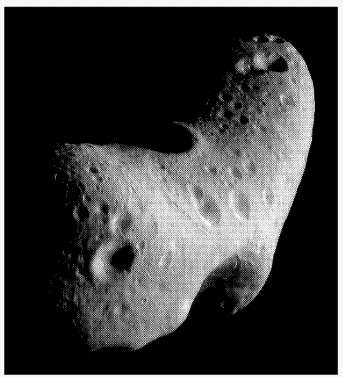
FIGURE 12–1. Minor planet 433 Eros photographed by NASA’s NEAR- Shoemaker satellite during 2000. Eros is about 20 miles long, but less than ten miles wide: it is obviously irregular in shape and has been struck by many smaller objects.
spot. No shadow would be cast on the Earth’s surface because the Sun appears much larger than the asteroid. No measurement of the asteroid size would be possible unless it were very close to us. It happens that Mars has two moons, named Phobos and Deimos, which are captured asteroids orbiting very close to that planet. As a result they do cast distinct shadows on the Martian surface (see Figure 12–2). For an asteroid observed from the surface of the Earth, to get an effective “shadow” whose size might be measured we would need a smaller light source than the Sun, such as a star
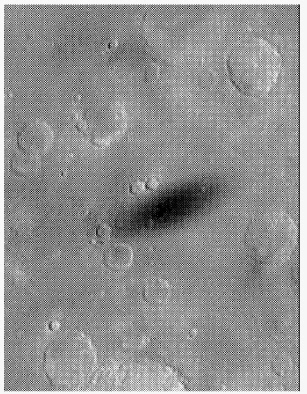
FIGURE 12–2. Phobos, one of the two moons of Mars, is only about eight miles across but it is still big enough to cast a shadow on the surface of the planet below, as in this image obtained with the Mars Global Surveyor satellite.
far away within our galaxy. This could produce an occultation, if the alignment were right.
Imagine that a 100-mile wide asteroid cuts across our line of sight to some distant star. We will probably not have its trajectory determined with enough precision to be sure where its shadow will pass, and as of yet we do not know its size or shape. If the movement of the shadow is west-east one might organize a team of a dozen or so observers stretched along a line north-south for
300 or 400 miles, to be sure of intercepting that shadow. Each astronomer would be armed with a small telescope and stopwatch, plus some absolute time reference such as a GPS receiver or their wristwatch accurately calibrated against standard time, and they would watch as the asteroid closed in on the star. Some would see the star blink off for a short while, as the asteroid eclipses or occults it, whereas those at the northern and southern extremes of the line would not see the star disappear at all, but just slip close past the asteroid. (Such an event is termed an appulse.)
The limits along the line of humans from where the star was occulted will render the asteroid dimension along that axis, perpendicular to its apparent motion. But its size in the other direction (that is, along the shadow path) and even shape may also be deduced from the observations. The duration of the occultation timed by each observer indicates the length of the star’s path behind the asteroid as seen from the particular viewing location. The idea is sketched in Figure 12–3.
Because it is difficult to predict the eclipse path for an asteroid far ahead of time, due to uncertainty in its orbit, occultation chasing may be a haphazard and frantic affair. One afternoon in October 1981, while I was a graduate student at the University of Colorado, with a colleague I got a call from astronomers at the Lowell Observatory in Flagstaff, Arizona. They said that an asteroid occultation had just been predicted for that evening and we asked if we could please observe it from the on-campus observatory. This we did without any great trouble and sent off our timings. (That colleague, by the way, was Chris McKay, now one of America’s most prominent planetary scientists; he works at NASA-Ames Research Center in California.) The Lowell observers had some problems though. They had found that the track was going
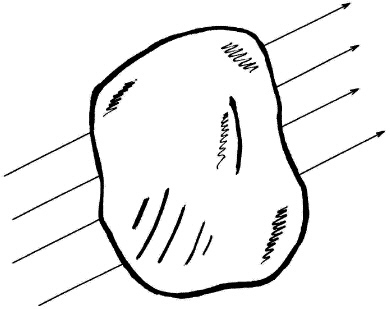
FIGURE 12–3. How the size of an asteroid can be determined from occultation data. Observers spread out over the shadow ground track and measure how long the starlight blinks off, each viewing a different path for the star behind the asteroid as shown here by the arrows. Knowing the speed of the asteroid, its dimensions along the direction of motion may then be ascertained. Any astronomer in the team who was located too far north or south would not see any occultation, and so the size of the asteroid crosswise can also be determined in this way.
to pass north of them, over Utah, and so they scrambled in their cars carrying two portable telescopes. Ideally one would organize for the observation points to be well separated so as to give the best distribution of chords across the asteroid. On campus in Boulder, Colorado, our telescope was fixed; but the mobile teams could in principle drive to locations giving an equable spacing over the occultation track. In the rush the teams lost contact with each
other, and by chance the two sets of mobile observers managed to choose sites giving precisely the same chord. With the whole of the Utah wilderness to choose from, they had picked separated but equivalent points. As the final publication reported, “As a result, they were deployed in accordance with Murphy’s Law.”
The specific minor planet observed in that case was 88 Thisbe. The result of the analysis was that it measures about 144 miles across, around 10 percent more than the value estimated from earlier data (it is possible to estimate asteroid sizes by seeing how bright they are, and couple that with a guess at the fraction of sunlight they reflect). Ten percent in size means 20 percent in area, or 30 percent in volume and density. It was also obvious from the results that Thisbe is not precisely spherical. Clearly occultation measurements are scientifically useful.
THE MASSES OF COMETS
Asteroids are mere lumps of rock and metal, scattering tiny fractions of the sunlight impinging upon them. This, coupled with their great distances from the Earth, make them difficult to spot unless you know just where to look, using a substantial telescope. The largest, Ceres, was found only two centuries ago, even though it is almost 600 miles across. On the other hand, from the images returned by the spacecraft that were launched to greet it in 1986 we know that Halley’s Comet has a solid nucleus only five to ten miles in size. It is irregular in profile, shaped somewhat like a potato. That nucleus reflects merely 3 or 4 percent of the incident sunlight. Nevertheless, for over two millennia our various civilizations have been recording the returns of Comet Halley. How could this be?
The fundamental difference between comets and asteroids, regarding their appearance in a telescope, is that comets are largely composed of ice and other volatile material that starts to sublimate as the Sun is approached. At 3 AU from the Sun, midway between Mars and Jupiter, the cometary surface heats sufficiently for water to start to vaporize, forming a tenuous cloud around the nucleus. Such a cloud—called the coma—may be over a hundred thousand miles across, bigger even than Jupiter, the king of the planets. Some of the gaseous products may be dissociated and ionized by the solar ultraviolet flux (water may split into hydrogen and oxygen ions, for example), and then swept outwards by the solar wind, giving comets their characteristic ion tails that seem to glow bluish. Ejected dust and meteoroids trail the cometary orbit, producing a secondary tail, usually pinkish in color. These tails may be tens of millions of miles long.
These huge expanses of fine material scatter a great deal of sunlight, which makes comets easy to see compared to dark asteroids. But how did astronomers first discover the true size of cometary nuclei, given that the only comet we have seen up close—the only one for which resolved images of the nucleus are available—is that bearing the name of Edmond Halley?
In Halley’s day comets were believed to be much more massive than they really are. We now know that a cometary coma is a very tenuous gaseous shroud surrounding a tiny solid lump, keeping it from view, but in the eighteenth-century comets were thought to be huge, bulky affairs. One early hypothesis for how the planets were formed was that a gigantic comet had collided with the Sun, causing material to be ejected like the rebounding drop of liquid when a sugar cube is plopped into a cup of coffee. Individual drops were imagined to have coalesced into the sepa-
rate planets. There are various problems associated with the physics involved in that idea, but in any case we now know that comets are much smaller. When they do hit the Sun, they are simply swallowed up (see Figure 5–2).
The way in which astronomers developed this understanding was through studies of occultations. Although a cometary coma looks bright, that cloud is really very thin indeed, with a density lower even than the filigree mist hugging the landscape on a warm summer’s morning. Because of its vast dimensions the coma scatters much sunlight, but still it does not absorb much of the starlight coming from behind. Similarly, in thick fog your car headlights may only allow you to peer only 10 yards ahead, the water droplets reflecting so much light back into your eyes that you can see little else, but another car’s headlamps can be perceived over a hundred yards away, permeating the gloom. In the same way, astronomers could probe the contents of a comet’s coma by following the light of a star passing behind it. They were surprised to find that the starlight was almost always uninterrupted, penetrating the gas cloud with very little diminution. The deduction was clear: the observed parts of comets are mostly gas, originating from a tiny solid mass at the center. Comets are easily seen once the ice starts to sublimate and form that misty cloud, but when far from the Sun a comet has no coma and the bare nucleus is difficult to detect.
From more recent radar and other observations, most cometary cores are estimated to be only a mile or so in dimension. However, this smallness of cometary nuclei was first recognized from occultation investigations that, as described above, showed no occultation at all. Stars shine unabated through the tenuous but extensive comae, missing the solid nuclei.
A FUZZY OCCULTATION BY MARS
William Herschel was mentioned earlier; he was the GermanBritish astronomer who discovered Uranus in 1781. His sister Caroline found many comets using her brother’s telescopes, both from the city of Bath, where they had been living, and also from Slough, where they later moved. (Slough is near where London’s main airport, Heathrow, was much later built.) The Herschel family had moved closer to the capital under the patronage of King George III. Nowadays the idea that major astronomical discoveries might be made from your rooftop or backyard in such locations seems bizarre, observatories being built on mountaintops in remote locations far from city lights, but two hundred years ago the skies were still relatively clear. The smoke of the Industrial Revolution was yet to have a crippling effect on sky translucency, and electrification causing light pollution (one of the main banes of modern-day astronomy) was an unimagined development.
If you ever visit London for the shopping, after the famous Oxford Street one of the best-known areas is Kensington High Street. Shoppers bustling along there might be surprised to learn that one of the world’s largest telescopes was once situated nearby. Looking up a street directory, one may find Observatory Gardens (a road, despite the name), a few hundred yards off High Street. On that site, since built over, Sir James South established an observatory that stood for 40 years until his death in 1867. The blue plaque marking the spot is incorrect in stating that South s dome housed the largest telescope in the world. Actually it was the biggest refractor (lens telescope); Sir William Herschel, who had died in 1822, had previously constructed larger reflecting telescopes (using curved mirrors) out at Slough. South s telescope had a lens
just below 12 inches in diameter. It is still in use today, at the Dunsink Observatory just outside of Dublin.
Although he has since been mostly forgotten, South was a very prominent astronomer in his day. He was one of the founders of the Astronomical Society of London in 1820 and, as the sitting President, pivotal in securing its royal patronage through contacts assembled by having the gentry come to Kensington to view comets and nebulae through his several telescopes. Thus the Charter of the Royal Astronomical Society, granted in 1831, begins with South’s name. On the other hand the first Fellow of the Royal Astronomical Society could be claimed to be Charles Babbage, whom we met earlier, because he was listed first amongst the founders, due to his alphabetical advantage, being followed by Francis Baily (of Baily’s beads fame).
In those days the scientific circle was limited. John Herschel, the son of William, often observed the heavens with South, and they jointly drew up catalogues of binary stars. The advent of electrification was mentioned above; this was in part due to the pioneering investigations of Michael Faraday, who frequented South’s private observatory, as did Isambard Kingdom Brunel, the great engineer of the early Victorian age. Babbage was also a good friend, and it was ill-feeling fostered by a court case over the mounting of South’s large telescope (which he claimed to be inadequate), that led to the opposing party recommending that the government cease all funding of Babbage’s computing machines. Babbage made the political mistake of appearing as a witness on South’s side in a trial that divided the scientific establishment. South was a fiery controversialist, never far from an argument with someone, and Babbage had a similarly bellicose temperament.
With his great telescope South made comparatively few
useful observations, forever complaining that its pivot wobbled, blurring the objects he wished to monitor. In 1830, though, he did make a revolutionary discovery. While watching the planet Mars moving through the constellation Leo, he saw it pass in front of a bright star.
For all his faults and intellectual limitations, South was an experienced visual observer, and he recognized that this Martian occultation was not like the numerous lunar occultations he had seen previously. Instead of suddenly blinking off (perhaps with the “projected image” effect mentioned earlier: South was one of those who had noticed this visual phenomenon and debated its origin), as Mars crept up on the star he noticed that the starlight reaching his eye slowly wavered and attenuated.
How could this be? South made the correct deduction: Mars has a substantial atmosphere. Rather than the knife-edge provided by an airless body like the Moon, Mars has a fuzzy border. This produces effects like those we depicted in Figure 2–8, when we were considering how the Moon still receives sunlight, mostly from the red end of the spectrum, during a total lunar eclipse. When watching Mars as it cut across the star in question, South saw that the starlight was gradually absorbed by the ever-thickening layer of Martian atmosphere needing to be negotiated for the light to reach his eye, glued to the ocular of his precious instrument.
Using the primitive equipment of the era, little was yet known about Mars. It presents merely a ruddy disk through a telescope, with a hint of pale colorless patches at top and bottom, the polar ice caps. The imagined canals of American millionaire Percival Lowell were still many decades in the future, along with ideas of Martians and H.G.Wells’s War of the Worlds. From his private obser-
vatory near the heart of London, largely surrounded in those days by green fields, James South discovered that Mars has an atmosphere via his acute observations of that planet eclipsing a star. That’s something to remember next time your underground train rumbles through Kensington and Notting Hill Gate, not half a mile from South’s old observatory.
THE RINGS OF URANUS
When William Herschel spotted Uranus he thought it was a comet, and its true nature was not recognized for some time. When later observations indicated it to follow a near-circular orbit, not an elongated ellipse like the path of a comet, and the disk visible through suitable telescopes looked like those of Jupiter and Saturn, not the nebulous, variable form of a comet, the scientific world was astounded. No new planet had ever been identified, the naked eye planets out to Saturn having been known since time immemorial. Apart from the visits of sporadic comets, it had been assumed that the Solar System as known was complete.
To the greater glory of Britain, its astronomers tried to name the new planet the Georgium Sidus—George’s Star—in honor of the king. (Note though that the king, like Herschel, was German in origin: the House of Hanover ruled Britain until the death of Queen Victoria in 1901, she having been prohibited from becoming the monarch of the province of Hanover by virtue of her sex.) In France and elsewhere astronomers would have none of this, and the title Uranus was eventually accepted internationally. The attempted foisting of the name George upon the planet led to regal approval for Herschel, however, and he became Royal Astronomer (not Astronomer Royal: there was already one of those),
with a liberal monetary allowance. Astronomers know that it is not only stars that glisten.
In subsequent years numerous studies of Uranus were conducted, for example leading to the discovery of its several large satellites. It also became apparent that it orbits the Sun with its rotation axis tipped right over, leading to each pole having 42 years of summer followed by 42 years of winter.
Because Uranus never comes closer than about 1,700 million miles from the Earth it is difficult to investigate the planet in detail. Our best data come from the flyby of the planet made by NASA’s Voyager 2 probe in 1986. Just a handful of years before that, an occultation experiment led to a discovery that allowed the planning of some important data collection with Voyager 2.
Back in 1830, James South used his eye at the telescope to see Mars gradually extinguish the light from the star in Leo that he was watching. Nowadays we can conduct much more sophisticated experiments, using electronic light detectors. For example, not only will the brightness of a star be attenuated by the atmosphere of a planet, but also its position will shift due to refraction (or bending) of light in that atmosphere. This is why it takes so long for the Sun to set: refraction in the terrestrial atmosphere shifts the apparent position of the Sun as it approaches the horizon by fully half a degree. Observations of such effects in other planets’ atmospheres during occultations allow astronomers to probe the density and profile of those atmospheres with a resolution many times better than otherwise feasible.
The problem is that Uranus has such a small disk that it rarely crosses stars sufficiently bright for useful data collection. Even when such an event occurs the planetary shadow is unlikely to pass over a major observatory, in the same way as a total solar
eclipse is not often seen from, say, the many observatories in California, Arizona, or Hawaii. In 1977 a good occultation by Uranus was due, but to observe it a chase along the shadow path was necessary. Actually NASA maintains aircraft for high-altitude astronomical observations, and one was used to collect data in this case, the intention being to improve our understanding of the atmosphere of Uranus before Voyager 2 got there.
But the observers got a surprise. Having switched on their equipment and acquired the star well before the occultation was due, they found that the light signal dipped not just once but several times while the star was still well separated from the planet. In itself one might explain away this as being due to some instrumental glitch, or extreme altitude wisps of terrestrial cloud, but after the planetary occultation had concluded continued data collection provided another set of dips in the signal. These were of the same form as the first set and symmetric about Uranus itself.
The explanation for these observations was clear: Uranus possesses a set of rings that had not previously been suspected. When Voyager 2 reached Uranus it was instructed to look for the rings in close-up, with a successful outcome. The Hubble Space Telescope has since been used to get pictures of those rings, such as in Figure 12–4.
…AND THOSE OF NEPTUNE
Similar occultation observations involving Neptune were made during the 1980s. These also provided a hint that the planet has rings, but with a difference.
In the decades after Uranus was spotted, astronomers followed its progress in order to chart its orbit. Because that planet takes 84
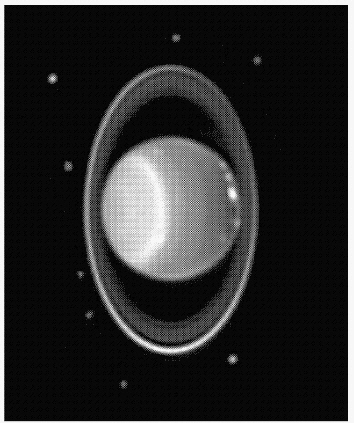
FIGURE 12–4. The rings of Uranus photographed using the Hubble Space Telescope in 1998. The rings were discovered through occultation observations 20 years before. This is the true orientation, because the spin axis of this planet is tipped over, and the rings orbit above the equator. Several of the Uranian moons can be seen, along with bright areas on the cloud-canopied planet itself.
years to circuit the Sun, less than three Uranus years have yet to elapse since it was discovered (and it is sobering to note that Pluto has not completed even one-third of an orbit since it was found in 1930). Astronomers quickly realized that there was a problem with Uranus, because it didn’t seem to behave as calculated, wavering
from the path expected if only the Sun and the known planets affected its motion. By the 1840s it was obvious that something was wrong, and two astronomers—Urbain Le Verrier in Paris, France, and John Couch Adams in Cambridge, England—independently predicted the mass and position of another planet beyond Uranus. The idea was that the gravitational tugs of this yet-unseen planet would explain the anomalous orbit of Uranus. While British astronomers dithered, Johann Galle and Heinrich d’Arrest, using the Frenchman’s predicted positions for the new planet, spotted Neptune from Berlin in September 1846.
This provoked uproar in Britain, as claims were made for parity between Adams and Le Verrier in terms of credit for the prediction. The brunt of the responsibility for letting the discovery slip away needed to be borne by the professionals at the Royal Greenwich Observatory and within the universities, particularly at Cambridge. If amateurs with good equipment, such as James South in Kensington, had been privy to Adams’s prediction then perhaps British honor might have been saved and Neptune discovered from within its shores.
Stung by all this, various amateur astronomers leapt into action. One of them was William Lassell, who had an excellent private observatory situated near Liverpool, later removing to the clearer climes of Malta. Like William Herschel before him, Lassell was skilled at constructing large reflecting telescopes, and with his champion he quickly discovered Triton, the massive moon of Neptune. But Lassell went further. Before long he was claiming that a ring like that of Saturn accompanied this new planet. That ring seems to have been either a figment of Lassell’s imagination or a spurious image produced by his homemade instrument. Eventually rings around Neptune were discovered, but only a couple of
decades ago, and they are much too tenuous to bear any relation to Lassell’s claim.
Again these rings were identified through the tracking of occultations. Astronomers in the 1980s witnessed dips in their traces of stellar intensity before and after the star passed behind the planet itself, as with Uranus, but in this case the dips were not symmetric about Neptune. A strong decrease on one side was not repeated on the other, and when a pair of dips did occur they were not equally distant from the planet. This left a bit of a quandary for the astronomers: had they identified Neptunian rings or not?
By this time a dark, thin ring about Jupiter had been spotted using the Voyager spacecraft, leaving Neptune the odd man out of the gas giants if it lacked a ring system. Thus the betting was on rings being confirmed when Voyager 2 at last reached Neptune in 1989. Sure enough, those rings were found in accord with the occultation data, and the reason for the ambiguity became obvious: rather than having complete circular rings, the dust orbiting Neptune seems to be concentrated in short arcs, as in Figure 12–5. The occultation observers by chance had intersected some arcs, but not others, producing their puzzling results.
PROBING SATURN’S RINGS
Even in the case of Saturn, whose rings were discovered by Galileo in the early seventeenth century (he described them as horns or handles jutting out from the planetary disk), occultations can still tell us much about the structure of the debris circuiting that planet. The timing of the roller-coaster ride followed by the intensity of light from a carousing star allows far better resolution than we can obtain from direct images of the rings. The photographs of Saturn

FIGURE 12–5. The ring arcs of Neptune as imaged by Voyager 2 in 1989. Neptune itself is at lower right, somewhat overexposed with the image contrast stretched to make the rings visible.
from the Voyager spacecraft encounters are wonderful, but our detailed knowledge of the ring structure derives from artificial occultation data obtained by recording the intensity blips of stars whose light was intercepted as the spacecraft swept by the rings. Because of the data collected in that way we know that, rather than being broad, flat, featureless bands, the rings of Saturn actually contain many thousands of individual strands, their dynamical behavior affected by the gravitational tugs of its several dozen moons.
OCCULTATION OMNIBUS
An eclipse of the third kind—an occultation—occurs when a Solar System body traverses our line of sight to some distant cosmic light source. Studies of occultations allow both the nature of the light source (single star, double or binary star, galaxy, quasar) and that of the occulting object (lunar limb, asteroid size and shape, comet, planetary atmosphere, planetary ring) to be investigated.
One can think of a form of eclipse of yet another class, though. What about when three Solar System objects line up? The three involved in solar and lunar eclipses are the Earth, Moon, and Sun, but other combinations are possible. For example, both Venus and Mercury have smaller orbits than that of our planetary domicile. Do they ever cross the face of the Sun?