Critical Issues in Transportation for 2024 and Beyond (2024)
Chapter: Increasing Road Safety
without additional changes in transportation demand. Decreasing VMT by fossil-fuel vehicles and encouraging modal shifts will also be necessary. As temperatures and sea levels rise and extreme weather events become more common, transportation infrastructure and operations will need to become far more resilient. These goals are achievable if society can agree to make the sustained effort necessary to support their pursuit. R&D addressing the complexities and tradeoffs of achieving these decarbonization goals for transportation can help society identify and make the most cost-effective choices.
 Societal Goals
Increasing Road Safety
Transportation—moving through space, often at high speeds—involves risk. Motor vehicle travel has become safer in terms of risk exposure (millions of VMT) over the last several decades, even though the number of motor vehicle–related fatalities has exceeded 30,000 every year since the end of World War II (see Figure 10).51 In addition to the pain and suffering of victims and their families, crash deaths and injuries cost more than $340 billion annually to society and families from the associated medical care, lost time, insurance, legal proceedings, and other factors.52 After reaching almost 55,000 deaths in 1972, fatalities oscillated from year to year in a downward trend as the fatality rate declined. However, total fatalities began increasing in 2015. Although fatalities had generally increased in ensuing years, deaths increased sharply again during the COVID-19 years of 2020 and 2021 when fatalities increased despite reduced exposure to risk from declining VMT.
The risk of death across the transportation system has been generally declining, but stark differences exist between passenger modes: “Over the last 10 years, the light-duty vehicle passenger death rate per 100,000,000 passenger miles was over 20 times higher than for buses, 17 times higher than for passenger trains, and 595 times higher than for scheduled airlines.”53 Given these large differences in risk, and that fact that the vast majority of passenger travel in the United States is by personal vehicle, roughly 95 percent of deaths within the U.S. transportation system occur on roads and highways.
Even so, travel on roads in the United States has become significantly safer over the last century (see Figure 10). Many improvements in vehicle and road design and traffic laws, as well as social adaptation, appear to have contributed to this downward trend. For example, airbags and federal motor vehicle occupant protection standards have greatly reduced injuries and fatalities.54 Other advancements in crash avoidance technologies, such as front and rear automatic braking and automatic braking with pedestrian detection have proven to be roughly 30 to 50 percent effective in avoiding front and rear crashes.55,56
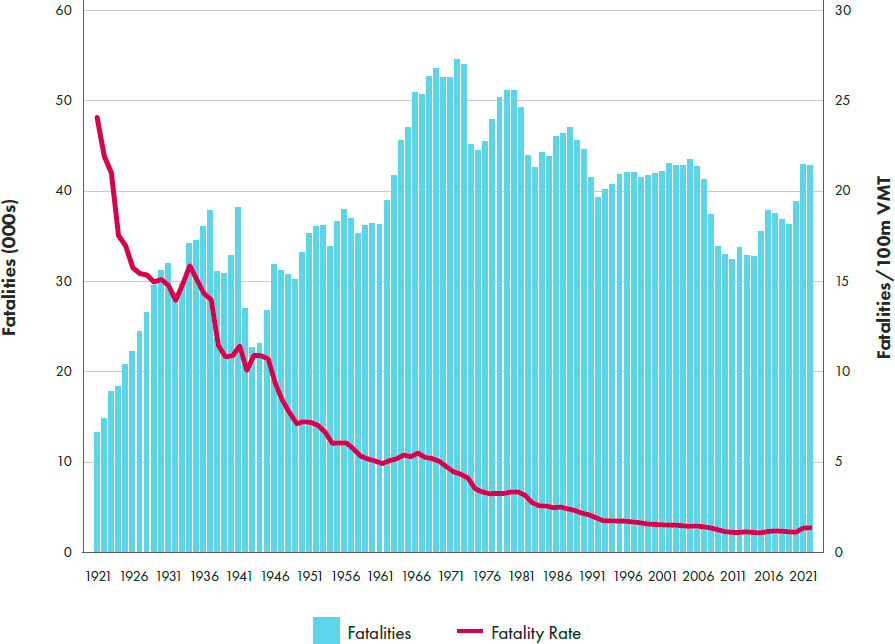
SOURCE: U.S. Department of Transportation, National Highway Traffic Safety Administration. 2023. https://cdan.dot.gov/tsftables/Fatalities%20and%20Fatality%20Rates.pdf.
As much as the risk of automotive travel has been reduced over time, many people still die each year. In 2021 and 2022, almost 43,000 people were killed in traffic crashes, about 10,000 more than in 2011.57,58 Traffic death rates are also substantially higher for American Indian/Alaska Native and Black individuals than for White individuals.59,60 The increase in traffic fatalities in 2020 and 2021, especially in the early months of 2020 when travel declined abruptly as the COVID-19 pandemic began, is not fully understood. Indirect evidence points to people driving at faster speeds, reduced use of safety belts, and increased drug and alcohol impairment.61 The COVID-19 pandemic’s broader effects on mental health and social norms are also not fully understood. Society and individuals have been deeply affected by the COVID-19 pandemic, and further research may help explain how and why.

SOURCES: U.S. Department of Transportation, National Highway Traffic Safety Administration. For Traffic Safety Facts, Annual Tables, see https://crashstats.nhtsa.dot.gov/#!/DocumentTypeList/12 and for 2021 special publications for Pedestrians and Cyclists, see https://crashstats.nhtsa.dot.gov/Api/Public/ViewPublication/813458 and https://crashstats.nhtsa.dot.gov/Api/Public/ViewPublication/813484.
Pedestrian and bicyclist fatalities and fatality rates have also increased sharply; fatalities reached 8,300, roughly 3,300 more in 2021 than in 2010 (see sources cited in Figure 11). Design guidance is being developed to address the safety challenges of accommodating growing demand for active travel and the increasing forms of micromobility operating at different speeds.62 Separated lanes are widely advocated to reduce crash risk, but even users of separated lanes are exposed to motor vehicles at intersections, where most crashes occur. The design challenges are compounded in busy corridors with limited capacity for expansion.
The U.S. motor vehicle fatality rate has leveled out at a higher point than in peer countries, as 17 other industrialized Western-style nations have lower fatality rates—some more than 40 percent lower than that of the United States.63 Canada and Australia, which also have large land masses and high dependency on automobiles, have motor vehicle fatality rates that are more than 30 percent lower than in the United States. Possible reasons for
the exceptionally high U.S. fatality rate include lack of political consensus to implement proven safety strategies, less stringent traffic safety laws, higher speed limits, weaker enforcement of traffic laws, and the ever-increasing popularity of SUVs and pickup trucks.64,65,66,67 The ongoing shift to SUVs and pickup trucks enhances safety for occupants of those vehicles, but their increased weight, higher bumpers, and flat fronts impose greater risk on occupants of smaller vehicles, pedestrians, and cyclists in the event of a crash.68,69 Europe and Australia conduct pedestrian safety tests as part of vehicular standards, but the United States does not.70,71
At some point in the future, autonomous vehicles may improve safety.72 In the nearer term, the filtering of available crash avoidance technologies through the vehicle fleet may reduce the U.S. fatality rate. These technologies may also help reduce the rising number of fatalities among non-occupants. However, whether the crash avoidance features of new vehicles will offset their increasing weight, size, and designs that pose higher risks to occupants of smaller vehicles, pedestrians, and bicyclists remains to be seen and cause for ongoing monitoring and analysis. Also of concern are whether driver reliance on commercially available partial automation will reduce engagement and increase distraction73 and whether the increased weight of EVs (due to heavy batteries) will increase risks to occupants of smaller vehicles, pedestrians, and cyclists.
The thousands of avoidable deaths every year due to excess speed, drug and alcohol impairment, lack of safety belt use, and distraction74 are well known but persistent problems that can be addressed through policy. Approaches such as Vision Zero,75 Safe System Design,76 and Complete Streets,77 which specifically address pedestrian and cyclist safety, deserve further examination and the development of data-driven standards, guidance, and applications. Further analysis of effective safety countermeasures applied in safer nations can inform policy choices in the United States. A deeper understanding of the causes of disproportionate traffic deaths among Native American/Alaska Native and Black individuals noted above is also needed, as this knowledge could lead to effective countermeasures.
Understanding the reasons behind the post-2010 roadway fatality rate plateau is urgent, as deaths and injuries will continue to rise if the rate stays flat as travel increases. Crash avoidance technologies and automation hold considerable promise to improve safety but will require ongoing R&D, innovation, monitoring, and analysis to inform policy and regulation. Increasing broader public support for implementing proven and effective countermeasures to reduce crashes and injuries is also an urgent priority.


