Integrating Crisis Management and Business Continuity at Airports: A Practical Guide (2024)
Chapter: 1 A New Role for Continuity

CHAPTER 1
A New Role for Continuity
Guide’s Purpose
In January 2020, ACRP commissioned the publication of this guide because it is becoming critical to plan for the rapid resumption of normal operations and business alongside the response to any crisis that an airport may face. The effects of disruptions on airport operations potentially can be felt throughout the aviation community for an extended period and impact the cities and communities that airports serve, ranging from loss of life and facilities to delays and lost revenue (Exhibit 1).
Short-term crises that are measured in minutes and hours may not warrant continuity efforts during the crisis response, especially when the performance gap may only result in negligible losses. When a crisis lasts for days, months, or years, a waiting period before ensuring continuity of business and critical operations can jeopardize an airport’s survival or its ability to meet strategic goals. These losses have never been so visible as during the COVID-19 pandemic, when passenger traffic plummeted practically overnight under strict travel restrictions.
As the pandemic spread across the world in 2020, traveler throughput decreased by up to 95 percent from the year prior, leaving airports in a scramble to adapt their operations and accommodate safe travel (Figure 3).
From severe weather and pandemics to technology outages and broken water pipes, these events will continue to negatively impact the full scope of activities on an airport’s campus if the airport is not prepared. With the right steps, airports can manage the resulting consequences and transform their challenges into catalysts for improvement.
Background
The ACRP Project 10-28 research team wrote this guide to help airports evolve and adapt their day-to-day operations based on changing access to the facilities, personnel, and resources relied upon to perform essential functions and services. Each chapter provides historically effective examples and strategies that have been tested in airports of various sizes.
The research phase focused on understanding the status of operational and business continuity at airports, identifying best practices that are currently being used, and uncovering challenges and lessons learned related to continuity. The research phase was conducted in two stages: a literature review and a case study analysis.
- The literature review captured the current state of operational and business continuity at airports during the COVID-19 pandemic. A wealth of literature exists in the aviation industry relating to frameworks for continuity programs. Groundbreaking research like that conducted in ACRP Report 93: Operational and Business Continuity Planning for Prolonged Airport Disruptions

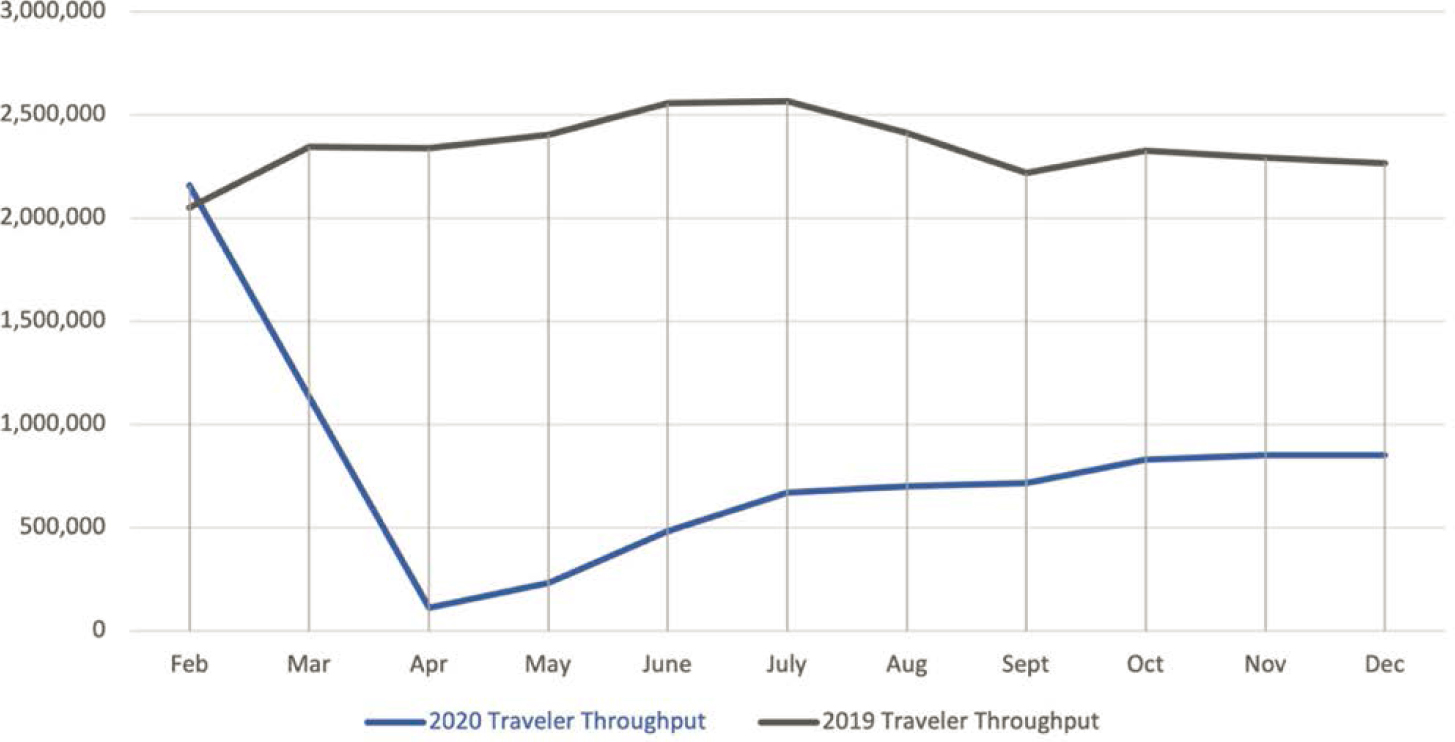
Figure 3. Average passenger throughput at TSA checkpoints.
- (Corzine 2013) meant that ACRP Project 10-28 was able to build on an existing awareness of continuity in the aviation industry.
- The research team conducted a series of case study interviews to discuss and consider how airports tackle the complex issues that emerge when responding to real-world disruptions and incidents. In total, 10 case studies were completed; the research team interviewed staff at nine airports and used pre-existing information to draft a case study for London Gatwick Airport. The case studies were compiled to capture the themes and findings uncovered by engaging experts from large, medium, and small airports about their experiences implementing and integrating crisis management and continuity programs.
After the research team completed its research phase and developed the guide, the effort pivoted to testing and validating strategies in the guide to address airports’ real-world needs. The pilot program focused on validating guide concepts with its intended users: airports. The research team tailored its training plan to four pilot airports to meet their individual needs.
Defining Terms
The following terms will be used throughout the guide. Because of different uses in industry publications and conversations, each definition will be the standard used throughout this guide.
Crisis Management and Continuity
The distinction between continuity and crisis management and their relationship to different phases of a response effort needs to be addressed to support integration.
Crisis Management
Crisis management is used to identify activities that can directly address and end the response to an incident, emergency, or disaster. This is the airport’s response to incidents to save lives and eliminate life-threatening conditions.
The term crisis will be used more generally to capture the full range of potential emergencies or disasters that an airport might experience. However, the context of an emergency versus a disaster may differ based on whether the incident exceeds an airport’s ability to respond to the situation.
Emergencies
Emergencies characterize serious, unexpected, and often dangerous situations that require immediate action and that are within the realm of the airport’s response capability. Emergencies could include cyber events, severe weather, roadway disruptions, and power outages.
Disasters
Disasters characterize a devastating event or a natural catastrophe that exceeds the airport’s reasonable ability to respond. Aircraft mass casualty accidents would be included here.
Continuity
Continuity identifies activities that allow the airport community to adapt its operations to meet the demands of a disruption that has prevented the airport from performing all normal activities. The term continuity addresses elements often discussed as business continuity management, business continuity planning (BCP), and continuity of operations (COOP).
The primary concern for continuity is how operations can either be restored following or protected from the impacts of a crisis event. Through this process, continuity becomes an essential element of the response because it is focused on the restoration of essential functions and services in response to an interruption.
COOP and Business Continuity
In addition to how it is placed in a response, an airport’s understanding of continuity can benefit from more straightforward definitions of how it is planned for and implemented. The terms “business continuity planning” and “continuity of operations planning” are often used interchangeably within airports to describe continuity programs. The difference between these terms may appear to be semantics; however, the perspective of any individual airport will directly impact its ability to integrate a “continuity capability” into its crisis management framework.
COOP Planning
COOP planning is frequently used to describe the efforts of public sector and government entities to maintain operations for the good of the community. Continuity Guidance Circular [Federal Emergency Management Agency (FEMA) 2018a] defines COOP as a process to “ensure an individual organization can continue to perform its essential functions, provide essential services, and deliver core capabilities during a disruption to normal operations.”
Business Continuity Planning
BCP is frequently applied in a private-sector context and is more often used by professionals in the aviation industry than “continuity” or “continuity of operations planning.” ACRP Report 93: Operational and Business Continuity Planning for Prolonged Airport Disruptions (Corzine 2013) defines BCP as “the process of developing a roadmap for continuing operations under adverse conditions and during disruptions caused by all types of incidents, emergencies, and crises.” BCP is often used to plan for and ensure the continued financial viability of the disrupted business.
This guide aims to build the bridge between different types of stakeholder and operations in the public and private sectors in the aviation industry. The term “continuity” is used to describe the overarching function of COOP and BCP, unless a more specific term is required. Continuity is
defined as the ability to restore and continue performing critical functions during a disruption to normal operations, regardless of whether the goal is to deliver critical services to the community or ensure the survivability of an airport system.
Phases of Continuity Activation
Continuity activation occurs in four phases (FEMA 2018a). Understanding the activities that take place during each phase can help practitioners understand the larger continuity process as well as the sequence of events involved in developing, maintaining, and implementing continuity capabilities.
The phases of continuity sort continuity activities into a cycle (Figure 4). The value of the continuity cycle is to understand the process as a whole and how activities in one phase may support or lead to the next phase. That said, there are no formal boundaries for each phase, and practitioners should not get preoccupied with defining which phase they are in.
Preparedness
In the Preparedness phase, the airport develops and reviews continuity planning materials, tests them with exercises, acquires the resources necessary to ensure continuity, and trains staff

to improve readiness. This phase aims to create processes familiar to personnel and easily implemented and scaled during a disruptive incident or event.
Activation
The Activation phase takes place following an anticipated or actual disruption of the airport’s ability to carry out its essential functions. During this phase, continuity policies and plans are activated with the goal of organizing key staff members to address the disruption and adapt their operations.
Continuity and Restoration
During the Continuity Activities and Restoration phase, the airport continues to perform its essential functions and restores its essential functions with the support of continuity resources and identifies a path to the resumption of normal operations in preparation for the next phase, Reconstitution.
Reconstitution
In the Reconstitution phase, the airport returns to normal operations or establishes “new normal” operations. In this phase, the airport may conduct after-action reporting to document lessons learned and areas of improvement. Following Reconstitution, the airport returns to the Preparedness phase, where it remains until the next disruption.
Essential Functions
Essential functions are the heartbeat of a continuity capability because they inform the target objectives regarding what the airport needs to restore during and after a disruption. There are two layers to the identification of essential functions across the airport ecosystem: an airport and its stakeholders must define its primary essential functions; and subsequently, those can inform identification of essential functions.
Primary Essential Functions
Primary essential functions are the organization’s priorities for what must be continued or resumed when disruptions to normal operations occur. Primary essential functions reflect the objectives and guidance from an airport’s leaders to the teams, departments, divisions, and stakeholders responsible for performing the work about what activities should be considered essential and, by definition, nonessential.
Essential Functions
Essential functions are the critical activities performed by the airport that must be sustained despite any disruption to normal operations to ensure the continued performance of the airport’s primary essential functions. Identifying essential functions is a fundamental step in developing a continuity capability as it allows an airport to focus on high-priority activities and reallocate staff, resources, and facilities from lower priority activities.
Additional detail on how to identify essential functions is provided in Chapter 3 Integrated Continuity Planning, including examples of essential functions from pilot program airports.
Disruptions
The guide describes how airports can integrate continuity into crisis management planning by preparing for the disruptions to normal operations that may take place when crises occur.
Disruptions impact normal operations and prevent an airport from performing all functions at the normal levels of staff and resources, thereby forcing the prioritization of activities. Disruption
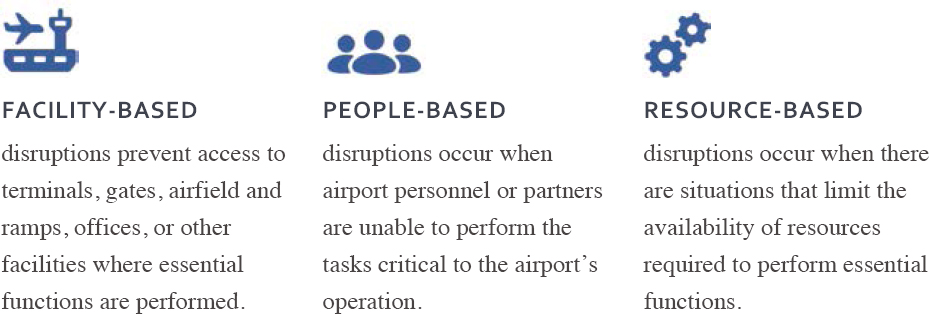
encompasses the impacts caused by crises that put lives at risk or potentially non-life-threatening and inconvenient situations like broken water pipes. Disruptions to airport operations—regardless of their cause—can be categorized by their impacts to facilities, people, and resources (Figure 5).
Trends in the Aviation Industry
A research team of experts in the aviation and emergency preparedness industries wrote and reviewed this guide to help airports evolve and adapt their day-to-day operations despite varying degrees of access to the facilities, personnel, and resources relied upon to perform essential functions and services. Each chapter provides historically effective examples of continuity and outlines strategies that have been tested in airports of multiple sizes. These examples were collected through a pilot program that implemented the guide’s methodology in four airports of different sizes.
The guide’s research approach was supplemented further through case studies providing an in-depth and multi-faceted look at the complex issues that airports face when responding to real-world disruptions and incidents. The findings from the case studies and the pilot programs are captured in “snapshots” located throughout the guide to provide real-world examples of how to implement different concepts across the four elements of a practical program.
How to Use This Guide
This guide is intended for use by the full scope of stakeholders in an airport ecosystem seeking guidelines for leveraging continuity strategies during response operations (Table 1). The framework presented here, particularly as it relates to staff training, targets end users who have a leading role in airport operations, such as executive directors, chief operating officers, and public safety. However, there are no limits to the application of the critical thinking skills defined in this guide as they relate to planning, stakeholder engagement, resource management, and training approaches.
Every airport will take the pathway to its continuity program differently. Size, resource availability, the strength of the current continuity and crisis management programs, personalities and leadership focus, personnel structure, and many other factors will contribute to how an airport can implement an integrated program. Taking these different factors into account, the guide is structured to provide regular markers that identify the importance and flexibility for each step and tool to create an effective and integrated continuity program.
The rest of this guide will provide the concepts, tools, and resources developed to help airports prepare for anticipated and unforeseen crises that threaten to disrupt their operations. Whether reading it from cover to cover or selecting the sections that may best serve your needs, every element in this guide will reinforce the importance of creating effective leaders and building an environment where they can help the airport adapt to new and unexpected challenges.
Table 1. How to navigate this guide.
| Chapter | What You Will Find |
|---|---|
| Chapter 1: A New Role for Continuity |
|
| Chapter 2: Opportunity for Integration |
|
| Chapter 3: Integrated Continuity Planning |
|
| Chapter 4: Engaging People and Stakeholders |
|
| Chapter 5: Managing Resources |
|
| Chapter 6: Training and Exercises |
|
| Chapter 7: The Way Forward |
|
| Appendix A: Business Continuity Primer |
|
| Appendix B: Primary Essential Function Guide |
|
| Appendix C: Continuity Planning Worksheet |
|
| Appendix D: Line of Succession Worksheet |
|
| Appendix E: Stakeholder Matrix |
|
| Appendix F: Mapping Stakeholder Networks |
|
| Appendix G: Baseline Assessment |
|
| Appendix H: Equity Assessment |
|
| Appendix I: Training Plan |
|


