Integrating Crisis Management and Business Continuity at Airports: A Practical Guide (2024)
Chapter: 4 Engaging People and Stakeholders

CHAPTER 4
Engaging People and Stakeholders
The people and stakeholders’ element for developing capabilities focuses on coordinating the internal and external stakeholders to support a continuity capability. This chapter will identify the stakeholders that play a role in continuity and how they can help establish a shared vision for the airport (Exhibit 4).
Strategies for improving the coordination with people and stakeholders include:
- Identifying and understanding the stakeholders who need to be engaged.
- Creating a crisis management organizational chart for the integrated program.
- Preparing materials to be used quickly during a crisis.
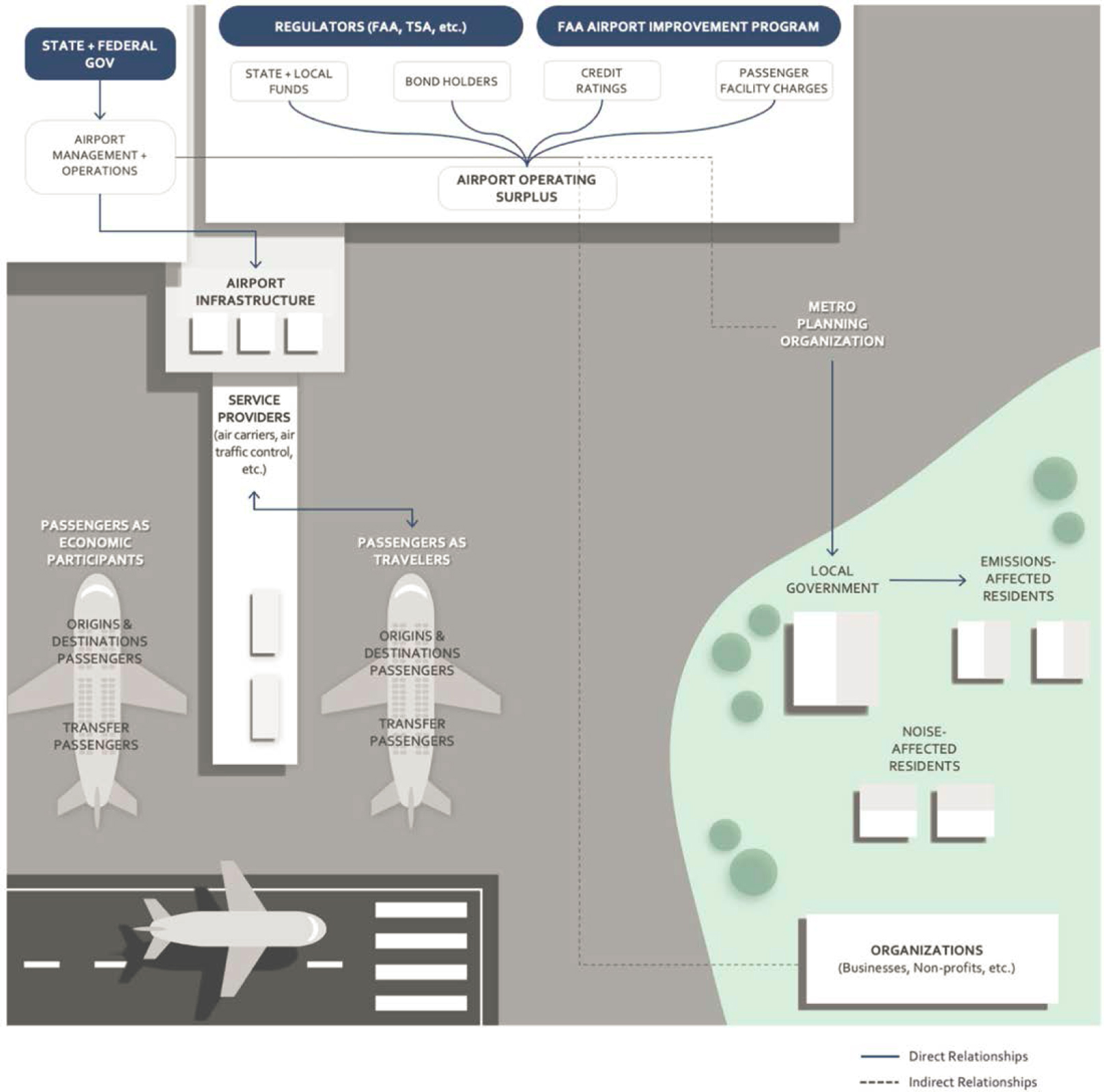
An airport’s success is anchored by the full network of people and stakeholders that make up the airport campus (Figure 14). Proactive and established relationships across this airport ecosystem provide an important resource during a crisis, especially as impacts cascade across the airport and its partners.
Mapping the Airport Ecosystem
There is an expansive group of stakeholders who impact and are impacted by disruptions at airports. Often resembling small cities more than stand-alone businesses, airports must manage the numerous interdependencies across stakeholders during crises and disruptions to their operations. Because the airport operates as an ecosystem—the success of one will impact the success of others.
To prepare themselves for crises, airports first need to understand their ecosystem, the key stakeholders, and whom to engage when disruptions occur. This can be an extensive list, and it often needs to be—airports have many partners—however, this list can be subdivided so that airports can engage their stakeholders strategically.
How do we develop a new operating model that accounts for our role as a steward of an operational ecosystem? If the ecosystem breaks down due to any one component, the travelers consider the airport responsible, whether that is fair or not.
Airport representative, Minneapolis, St. Paul International Airport’s Regional Network
Airport stakeholder networks can typically be captured in four categories:
- Internal airport operations;
- Service providers and business partners;
- Local community; and
- Regional and national regulatory bodies.
The stakeholders that might be included in each of these categories are listed in Table 4.
Table 4. Common airport stakeholder groups.
| Airport Operations | Partners & Providers | Local Community | Regulatory Bodies |
|---|---|---|---|
| Airport operator | Airlines | City/county government | FAA |
| Air traffic control | Concessionaires | State government | Transportation Security Administration |
| Facilities personnel | FBOs and fuel providers | First responders (mutual aid) | Customs and Border Patrol |
| Ground handlers | Other service providers | Community members and mutual aid providers | DOT |
With stakeholders identified, an airport can begin to think about how to subdivide different stakeholder groups into committees and communication channels. For example, while an airport might have 60 airline partners, those partners might be subdivided into regional, national, and international carriers, as well as subdivided into passenger and cargo carriers. Each of those subdivisions can select a representative that can advocate for their group’s interests. These groups are often developed to meet the needs of normal airport operations and, by considering who is a part of each group, the needs of each group, and how each group can be reached, airports can quickly engage the right stakeholders during crises.
Pilot Program Takeaway: Integrating a Communications Network
Crisis communication in the airport ecosystem is inherently complex. One of the biggest challenges that one airport’s stakeholders identified is maintaining oversight over the airport’s public relations outputs, outcomes, and impacts. As one leader shared, “Communicating is very challenging because we have to figure out how big to go. It’s about internally getting the information to find the right methods to push information out. . . . We make judgment calls on when and how to communicate based on the type of event and its impacts.” Across all pilot airports, leaders further highlighted the importance of extending communications beyond airport management to include vendors, airlines, and other airport stakeholders. As part of training, airports can focus on scenarios where communication is integral to protecting the airport’s ecosystem. This practice can further expand the circle of communication to include different types of partners who may not be included in the standard network of communications and engagement. As this type of coordination is established, it may involve contracts that include clear expectations surrounding elements of continuity planning.
Creating a map of stakeholders can help airports visualize stakeholder interdependencies, identify which should be contacted when a disruption occurs, and more strategically manage stakeholder relationships. Visualizing airport interdependencies can help airports identify the processes underlying essential functions, which can lend further insight into their criticality. More importantly, the interdependent nature of airport stakeholder relationships can pose a challenge to developing continuity capabilities to be implemented during a crisis. Each stakeholder may have their own essential functions, meaning if anyone is disrupted, it impacts the airport as a whole. Stakeholders also will likely be dealing with the consequences of an event and may not have the staffing resources available to support continuity operations, so while mapping interdependencies, it is important to identify those vulnerabilities.
Airports often sit at the center of a community ecosystem that includes external counterparts (e.g., FAA, regulators), as well as community partners (e.g., local government, residents). Understanding this ecosystem is important to be able to prepare for potential cascading impacts from and to the airport (Figure 15).
The goal of stakeholder mapping is to make communication more effective and comprehensive, not to inundate the airport’s incident command team with stakeholder communications. Not every stakeholder will need to be included in all communications from the airport, especially during a crisis. Even for those stakeholders that do need to be engaged, representatives
for subdivided stakeholder groups can become liaisons that support communications to the broader group (e.g., cargo carrier representative communicates messages to all cargo carriers). The mapping process should focus on understanding what each stakeholder needs to know, how frequently they need to know it, and what channels can fit those needs. This process can be facilitated through Appendix F: Mapping Stakeholder Networks.
Pilot Program Takeaway: Relationships Expedite Recovery
A pilot airport referenced building relationships with internal and external partners as a key factor for minimizing incident impacts and increasing the speed of recovery. Fundamental to business continuity is the ability to mobilize the necessary resources and the ability of people to leverage a variety of resources. This airport’s stakeholders make it an active priority to maintain contact with mutual aid partners on a weekly basis to continue fostering relationships.
Snapshot: Los Angeles International Airport (LAX)
Challenge
LAX stakeholders aspire to achieve a more integrated interoperable communication capability to better serve the complex operating environment of large-hub, international airports. Increasing information sharing and intelligence leads to more effective decision-making to support rapid COOP. One of the biggest challenges is maintaining a situation picture during emergencies between the airport and its federal, city, and nongovernmental organization (NGO) partners that operate on their own individual communication systems.
We make judgement calls on when and how to communicate based on the type of event and its impacts.
Solution
Establish a single communications platform for two-way real-time information sharing that can be easily accessed by the airport, first responders, air carriers, and their service providers from their computers and mobile devices.
Building the Line of Succession
The line of succession characterizes the process for identifying individuals able to fill a role if the individual in that role is no longer able to perform their responsibilities. Line of succession planning anchors on the ability of a team to identify team members capable of filling different positions. This may be done horizontally (e.g., one manager takes on two sets of roles for their counterpart) or vertically (e.g., a higher-level manager assumes a role, or a lower-level designee assumes higher responsibility).
The line of succession is critical to a team’s preparedness because it positions staff for full adaptation based on the staffing environment that may result from a disaster. For example, a lead designee may be the primary on an activity; however, if that person is somehow prevented from returning to the airport campus or is requested to fill another role, someone needs to be prepared to fill their shoes.
Pilot Program Takeaway: Establish Primary and Secondary Leads
At least one of the pilot program airports had defined primary and secondary leads clearly designated to complete critical response and continuity roles. After having defined those individuals, personnel were trained on their roles and cultivated an in-depth understanding of how to execute their responsibilities. A secondary support designee does not always need to occur at a lower level based on the defined hierarchy. For example, it is often more prudent to assign the role to a more senior person with the experience and authority to complete the function.
The process to fill the line of succession is defined under Appendix D: Line of Succession Worksheet. Using this worksheet, airports can review the specific responsibilities assumed by individual personnel, so if that person is incapacitated, there is a clear set of responsibilities that must be completed in their stead. It is recommended that this worksheet be filled out for high-level and mid-level managers, again accounting for the likelihood that, as individuals fill in the line of succession, they will need backfills for their typical responsibilities.
Finally, the line of succession provides an important tool for airports to identify who may need to undertake cross-training. While shadowing is generally a best practice in the airport environment, it is especially important for the secondary and tertiary designees of a role, so that they can see the responsibilities of a position through the eyes of its primary designee.
The Argument for Integration: Sustainable Staffing
Many airports have existing plans to support unique staffing needs during or following a disruptive event. However, many airports also have stories of staff working two, three, or more days in a row to support the operational needs of the airport during a crisis. Airports striving for resiliency should aim for sustainable staffing practices; in other words, they need to understand the patterns of staffing needs over the course of an incident or event to support the execution of essential functions, while avoiding staff burnout and extreme fatigue.
Throughout a disruptive event or emergency, demands for staff support for the execution of essential functions may fluctuate. . . . Over time, airports can learn the pattern of human resource needs and, eventually, apply this knowledge to future events to determine the appropriate number of staff needed to support essential functions without extreme overwork. This may, of course, be impossible for small airports with limited or reduced human resources; however, understanding the ebb and flow of staffing demands during an incident or event is also important information for setting expectations for supporting personnel.
Thinking ahead and preparing for anticipated staffing needs is helpful for the health and productivity of airport personnel and is an important continuity tool. If airport personnel are stretched thin and are operating beyond capacity for an extended period, they may not be able to respond to concurrent disruptions if and when they occur.
The prolonged nature of the COVID-19 pandemic was a poignant example of this phenomenon. Many airports were forced to lay off and furlough personnel due to the pandemic, straining the remaining personnel when another incident occurred (e.g., the extreme weather in the southern United States in February 2021).
By establishing staffing patterns that allow for continued execution of essential functions over a sustained period, airports can better prepare themselves to respond to prolonged, concurrent, or rapidly changing events.
Organizing the Response
The organizational structure an airport uses during a crisis or disruptive event will influence many aspects of its response, including communications, decision-making, and coordination. By implementing a response structure that is like normal operations, airports will also make the most of the existing interconnected systems and departments. Instead of creating new processes or avenues of communication within a new response structure or one that is used only during emergencies or disruptive events, airport personnel can leverage and adapt existing systems that they know and can use effectively.
Pilot Program Takeaway: Assessing Local Government Capabilities
Some pilot airports have a direct relationship with their local government entity (e.g., city, county). For one of these airports, the campus relies on municipal and county government agencies for fire, rescue, and emergency services. This was identified as a potential limitation for two reasons. First, the scenario-based exercise during the pilot program made clear that the geographical boundaries of the airport—and specifically the limited access by one highway—could hinder the movement of people and resources due to limited access to road networks into neighboring cities. The implication of this limitation is that surge support can take several minutes to arrive at the airport during a crisis, creating a point of vulnerability for the airport. Second, while the county could provide surge support, the airport’s stakeholders recognized that the county could not afford to send all engines and ambulances to the airport without comprising local needs. The airport’s awareness and assessment of these limitations—and their subsequent contingencies—was a central feature of its continuity planning outcomes.
Because FAA Regulation Part 139 recommends airports to conduct National Incident Management System (NIMS) and Incident Command System (ICS) training, many airports already use the ICS response framework during incident response (FAA 2013). At the community level, utilizing an ICS structure gives airports and local response partners, such as emergency responders, a shared understanding and terminology about the roles and responsibilities of individuals and groups responding to an incident. At the organizational level, the ICS structure provides clear guidance on the flow of information, resources, and decisions during incident response (FEMA 2017). NIMS principles are widely applicable and provide effective management tools. For particularly complex incidents, cross jurisdictions, or those involving multiple departments or agencies,
the use of Unified Command enables multiple entities to work together to manage an incident (FEMA 2017). Administrators across agencies, departments, and stakeholder groups can work together in Multiagency Coordination Groups to provide policy guidance and support decision-making among senior leadership and incident managers (FEMA 2017). NIMS principles like these apply to the airport environment and can support airports’ ability to navigate complex communications, stakeholders, and coordination networks during the response to an incident.
While there is no single “right” response structure, thoughtful selection and implementation of an organizational response structure can help airports be prepared to react quickly and efficiently for a variety of circumstances, from significant crises to small-scale events that have disrupted normal operations. The benefit of developing an adapted organizational response structure to integrate continuity and crisis management is that they:
- Formalize interdependencies and airport-specific functions related to crisis management and business continuity;
- Demonstrate that collaboration between continuity and crisis management practitioners is possible in a single organizational structure; and
- Allow airports to continue to benefit from the effective management tools integral to ICS, including the use of Unified Command and Multiagency Coordination Groups.
Pilot Program Takeaway: Amplifying the Communications Team
The communications team in one pilot airport participated in the continuity planning sessions and said that their role is to ensure that customers and other key stakeholders understand how the airport is responding to any incident and what they can expect next. For example, when the airport community experienced two airplane runway incidents—the first involving a cargo airplane that went off the runway, and the second involving a passenger carrier—the communications team played a critical role in acting as the bridge to communicate to employees, vendors, and customers when disruptions occurred, the airport’s response, and what to expect. Communications naturally sits at the heart of the people and stakeholder’s element. It is a function that serves a critical role in continuity operations and is best incorporated into planning efforts so that information is clearly communicated to all stakeholders throughout response and recovery.
Leadership at Every Level
The airport’s need for leadership to push the continuity capability forward is not limited to its executives or even its continuity champions. Especially during large-scale disasters, airports need to have leaders at every level ready to identify choke points and challenges to the performance of essential functions and who are empowered to solve the problems the airport is facing. Finance, facilities, and operations have unique essential functions and a defined stake in getting them back up and running. To be successful, those departments need leaders who can keep response activities in line with the airport’s mission and priorities.
Multilevel leadership requires planning, training, and evaluation strategies that are not limited to one department or set of individuals. Airports can initiate opportunities for personnel at all levels so that teams know their piece of the continuity puzzle. Departments and grassroots-level leaders also can be encouraged to take ownership of their essential functions. This reduces the
stress level on emergency and risk management personnel and simultaneously grows buy-in from across the airport to the continuity capability.
Continuity can further become the thread connecting leaders across different departments to the airport’s objectives. This can be achieved by making continuity a regular part of how each person and critical node in airport operations thinks about their role day-to-day. Even if a crisis is not taking place, leaders from every level and corner of the airport can share the common vision of innovating and adapting when they are called to do so.
Pilot Program Takeaway: Establishing a Common Goal
Many of the pilot program airports’ stakeholders take a customer-centered approach to crisis management and business continuity, which focuses their team dynamic on a common goal. Customers were a central part of multiple pilot airport’s business continuity strategies, which in turn informed which essential functions were prioritized. For example, during an incident, an airport’s priority was restoring functions that impact the customer safety and overall experience. An overarching vision and mission or guiding principles can assist airport decision-makers and incident leaders with identifying incident objectives. These guiding principles and values can support a shared vision and understanding of what needs to be prioritized during a crisis, because it builds a clear picture regarding the logic behind essential functions.
Continuity Requires Champions
No matter how well the airport coordinates its stakeholders and groups, there will be barriers and obstacles to developing an airport’s integrated continuity capability. When airports face these challenges, their success in overcoming them will depend on the presence of a continuity champion who is able to recognize the issues and influence the group to identify the solutions necessary to move past them.
Continuity champions are the individuals who break down the barriers so that the continuity capability can take root in the culture across the airport’s ecosystem. They are dedicated to continuity as a priority and likely have continuity as a defined aspect of their job title. When the airport needs to rally its stakeholders around a common vision for continuity, a continuity champion is the problem-solver and advocate who can bring the network together.
Qualities of a Champion
- Leads from where they are, whether it be in a department or the executive leadership team.
- Engages airport stakeholders effectively, both internally and externally.
- Communicates clearly and can clarify key concepts and vision statements across the airport.
- Persuasively advocates for ideas to grow buy-in.
Because continuity plans reflect the ways an airport will adapt its operations to meet the demands of a disruption, the chief operating officer (COO) or senior leaders in the operations team are often logical positions to sponsor or champion the continuity program. In an ideal scenario, the COO will support the Emergency or Risk Manager who will develop the capability, serve as an adviser throughout a crisis or disruption, and manage the coordinated response across the organization to ensure a rapid resumption of essential functions. However an airport designs this structure, the role of the continuity champion should be well defined. They can take on key initiatives, including:
- Educating stakeholders to inspire buy-in to the continuity capability;
- Allocating resources to support continuity-related tasks; and
- Developing and maintaining planning efforts.
The importance of a continuity champion cannot be overstated. They are a defining characteristic of every successful continuity program identified by the research team. If an airport wants a continuity capability, it needs to identify its champions.
Creating Your Surge Force
Oftentimes, a major emergency or disaster may reduce the need for functions that are not deemed essential while simultaneously increasing the number of people required to restore essential functions in another part of the airport. The reduced staffing needs for some functions may therefore be able to translate into surge capacity for functions that need additional support to restore the airport’s essential functions.
Additionally, it is equally important to educate the managers of essential functions about leading a workforce that is operating outside of their typical duties. In a role that may more closely resemble leading volunteers than the management of employees, managers need to be prepared to effectively integrate employees facing a great deal of uncertainty about the incident, experiencing confusion over their role, or questioning their ability to succeed. Employees may also be personally impacted by the crisis that caused the disruption and could be balancing personal needs alongside their professional obligations.
This is important to keep in mind when emergency management personnel risk becoming completely overwhelmed with the volume of tasks and needs during a disaster—there are often personnel who lack a defined role during crises who may be able and available to support. The more quickly that personnel can be identified, re-assigned, onboarded, and integrated into the performance of essential functions, the faster the airport will be able to restore functions and return to normal operations.
The Opportunity for Integration
When a disruptive event or emergency occurs, airports and their partners work together to put passengers first, in terms of life safety and, when possible, comfort and convenience. While this concept is not new to airports, they may consider reviewing their public messaging and notification plans to ensure passengers and other public stakeholders are provided with timely, accurate information. Providing as much notice as possible is not only good business practice but incorporates continuity into communications by enabling customers to self-redirect when the
airport is experiencing a crisis. By sharing news of a flood in a terminal and information about where passengers are being redirected, for example, airports can reduce the burden on airport staff to support traffic flow.
Another way to build continuity into existing communications activities is utilizing the identified stakeholder information on the continuity planning worksheet (see Appendix C: Continuity Planning Worksheet) to notify all impacted stakeholders of a real or potential disruption. Implementing this practice in a timely manner can help stakeholders who will experience the downstream impacts of a disruption prepare accordingly. Notifying fuel providers of a prolonged outage in a terminal, for example, enables them to prepare to deliver fuel for generators and prevent a secondary outage.
Ultimately, passengers and other airport customers expect the airport to carry out essential functions without interruptions. While customers may permit some leeway in extreme circumstances, they expect that airports will be able to continue to provide critical services even when a disruptive event takes place. Building continuity into communications practices can help airports set, meet, and exceed customer expectations.
Chapter Takeaways
By identifying stakeholders who may be impacted by a change in airport operations and understanding each group’s specific information needs, airports are able to develop organizational structures and communication plans that meet customers and partners where they are. Throughout this chapter, the idea of preparing and developing staff from across the airport to support customers, restore operations, and return to a state of normalcy is fundamental to maintaining continuity. This type of cross-training is most successful when it is implemented at all levels of the organization to prepare for disruptions to an airport’s personnel.


