Integrating Crisis Management and Business Continuity at Airports: A Practical Guide (2024)
Chapter: 2 Opportunity for Integration

CHAPTER 2
Opportunity for Integration
With an understanding of the value of creating a continuity program that can be integrated into crisis response, how can airports go about doing it? This chapter describes how continuity can fit into existing crisis management structures and functions (Exhibit 2).
- Describe why integrating crisis management and continuity is strategic for airports;
- Introduce how airports can integrate continuity into existing crisis management functions; and
- Share practical, intuitive strategies for making continuity a shared responsibility among airport personnel.
This chapter shows how and why continuity capabilities should be incorporated into crisis management activities.
Opportunity for Integration
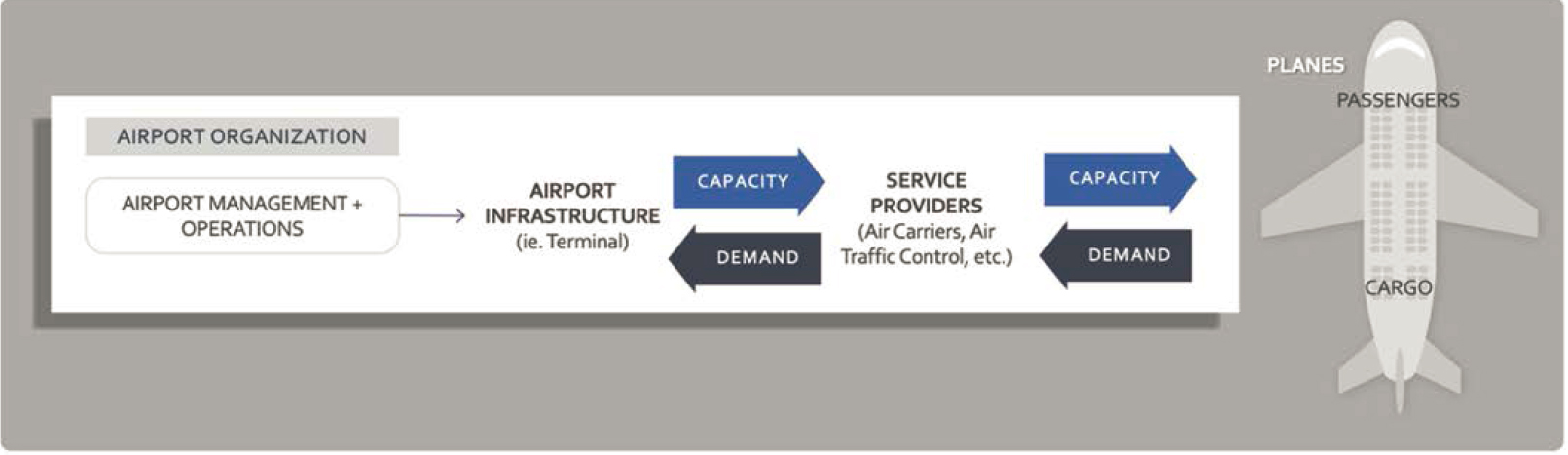
Disruptive events can result in choke points throughout the airport. Choke points can take place airside (where planes are moving to and from the runway), at the terminal, or in the landside infrastructure (where the airport is moving passengers, baggage, and cargo between the airport’s facilities). Impacts on one side affect the other, and vice versa, creating a constant need for airports to balance priorities and choke points.
Airports are constantly managing a delicate balance between airside, terminal, and landside operations as they ebb and flow with capacity and demand based on each other’s activities (Figure 6). An imbalance in this dynamic can result in significant cascading impacts within an airport and to its partners. Continuity requires consideration of how to maintain this balance effectively during a disruption.
For example, if an airport focuses entirely on keeping the airside open and moving efficiently without accounting for the overall capacity of its terminal and landside operations, the terminal may become completely overwhelmed with passengers, baggage, and cargo. If efficient movement landside is the only focus and airplanes are not appropriately managed airside, airports can find themselves stacked with planes on the airfield for hours at a time. As airport managers know, a disruption at the airport can turn this already tenuous balance into chaos. Incorporating continuity practices into crisis management activities can help airports achieve those aims.
Moving Toward a Proactive Response
Traditional crisis management approaches focus on immediate needs to stabilize the incident or event and prioritize life safety issues. A key indicator of successful integration of continuity

capabilities into crisis management is planning beyond immediate needs during a disruptive event. There is a desire among airports for an operational strategy that extends beyond the current operational period. Accomplishing this task requires building the longer time horizon concepts of operational and business continuity into the crisis management processes that are immediately activated during a disruptive event.
Building continuity into crisis management activities could, for example, include establishing a role within the airport’s response structure that monitors short-term and long-term needs or incorporating questions into crisis management tools to prompt conversation about what the airport will face two to five days down the line. Doing so can help airport emergency managers move away from constantly “putting out fires” during and after a disruptive event and toward a thoughtfully managed, proactive response.
At an operational level, making continuity a part of crisis management helps soften a disruption’s impact on the airport’s operations, personnel, and finances. By implementing continuity practices, airports can think proactively about the sustained and future response needs—not just the demands of the day (or hour) at hand. In many cases, airports that integrate continuity into crisis management can start planning for a return to normal while a disruptive event is still taking place rather than waiting until the crisis is over. Finally, being known as an airport that can withstand extreme circumstances and continue to provide essential functions and services to customers is an invaluable competitive edge.
Defining and Understanding the Challenge
When a crisis occurs, an airport’s ability to maintain the safe and efficient movement of passengers and goods by air can be compromised. Critical to an airport’s ability to effectively manage any crisis is the total scale of the impact caused to its facilities, personnel, and resources, as well as the duration of that impact. Airport response systems are structured with airside, terminal, and landside personnel positioned to identify choke points that make operations challenging and pursue contingencies so that operations are not significantly inhibited. However, the longer and more significant the disruption, the more an airport may face a situation from which it becomes difficult to recover.
Through the research process that supported the development of this guide, several recurring themes and trends were found that shape how airports view the challenge of preparing for disruptive events and maintaining the balance between the inbound and outbound flows of planes, passengers, baggage, and cargo.
 Issue: Building Your Way Out Might Not Be an Option
When considering the types of disruptions and protective measures an airport should take to minimize the impacts of extended disruptions, the research team found that many airports attempted to “build their way out” of the risk. Often, this involved making investments in capital improvement projects to address the specific systems or infrastructure that previously caused the disruptions to operation with the implied goal of “not letting that happen again.”
While investments into redundant systems can help contribute to the continued performance of essential functions during disruptions, they do not provide the catch-all solution for mitigating risks. Even if that incident is prevented from happening again, airports can expect to contend with unforeseen crises that can cripple their operations. When capital improvement projects require a level of investment that detracts from other critical preparedness needs, that may be an unsustainable approach.
Issue: Continuity Is Not Recovery
Many airports treat their continuity plans as a recovery function instead of as a response priority. For these airports, continuity is something to be considered once the crisis has already been addressed. Delaying continuity creates a gap in their ability to respond to disruptions holistically, and opportunities to restore critical operations can be ignored or missed. As a result, airports lose the chance to minimize impacts on their operations.
This is not to say that airports are unaware of, or lack, continuity programs; resources like ACRP Report 93 have helped many airports develop a plan that accounts for continuity needs. However, when the report was published in 2013, it was generally recognized that, despite some adoption of business continuity programs, the airport industry lacked widespread implementation of continuity. It was neither a priority nor a common practice in airports, therefore the report mainly provided the framework for creating a continuity plan. Today, there is an understanding of the need for a strong continuity program.
There is no lack of understanding about the factors that can be used to develop comprehensive and expansive continuity plans. During the research for this guide, many aviation professionals described well-made planning binders, some entirely focused on compliance rather than functionality in the face of new and unexpected crises. These airports might have been better served through a more tactical and focused approach to their continuity programs, the utilization of quick-reference tools, and supplemented by ongoing socialization of the airport’s continuity concepts.
Issue: Incident-Specific Plans Leave Airports Unprepared for the Unexpected
Many organizations prepare for incidents by first identifying prospective threats and hazards (the natural, human-made, or technological events that put lives at risk) and then developing a response plan that addresses the anticipated impacts. However, few organizations have sufficient resources to meaningfully develop, maintain, and regularly update a robust response and recovery plan for the major prospective hazards that may befall them—and even if they had infinite resources, no airport could genuinely prepare for every hazard. No two incidents or two responses are identical and basing planning assumptions on past events can overemphasize preparedness efforts for a specific set of circumstances that may never happen again. An airport ecosystem can better prepare by understanding that while hazard-specific response is imminent, adequate continuity planning can help manage the consequences of an incident.
Focusing on an incident-specific approach to preparedness has shortfalls that impact an airport’s ability to meaningfully prepare for the unexpected.
Issue: Not Being Able to Sustain the Response
For airports that see crisis management or continuity falling to a smaller subset of personnel, any crisis response can cause the airport to enter survival mode. Often, these cases trigger an “all-hands-on-deck” response until the disruption has been fully addressed and services have been restored. While that is good enough for some disruptions an airport may face, the shortfall of this approach is that it has left airports with minimal available capacity of personnel and resources to sustain the response effort for long-duration crises or address issues beyond the immediate crisis response.
As highlighted by the COVID-19 pandemic, sustaining that effort indefinitely can push an organization to its breaking point, eroding its resilience to the other crises that may occur. While an all-hands-on-deck approach may be necessary, a continuity plan can help better define roles, tasks, and duration in hopes of avoiding the breaking point. It is critical to step outside the box and take risks to evolve planning efforts. A balanced approach allows airports to be prepared and responsible but quick to action and ready to react.
Breaking Down Essential Elements to a Practical Program
While airports may have different starting lines for launching or growing their capabilities and different needs, this guide was written to assess programs based on four common essential elements: plans; people and stakeholders; resources; and training and exercises (see Table 2). An airport needs all of them to be successful.
Building an Actionable Capability
Continuity issues have limited an airport’s ability to turn plans into a real capability that is available when crises occur. As airports manage the seemingly constant flow of crises and emergencies that disrupt the balance between airside, terminal, and landside operations, the need for a holistic strategy to manage risk that leverages all available solutions is paramount. As a result, the next step for continuity in aviation is turning continuity planning into something actionable when airports face crises.
Continuity: The ability to restore and continue performing critical functions during a disruption to normal operations.
Understand Continuity and Make it a Priority
The key to integrating continuity and crisis management at airports is understanding continuity itself. Continuity is the good business practice of ensuring an organization’s essential functions can continue to be performed under any circumstances (FEMA 2018a). Developing continuity capabilities helps airports and their stakeholders adapt to new circumstances and makes them better positioned to continue performing essential functions before, during, and after a disruptive event.
Table 2. Breaking down essential elements to a practical program.
| Element 1: Plans |
Actionable tools that can be used during a crisis that reflect the organization’s approach to responding to crises and allow for the restoration of essential functions.
Do the plans for responding to crises and ensuring continuity of essential functions provide a clear scope and method for guiding and organizing the response efforts? Are the plans actionable and support the implementation of the predetermined reactions to disruptive events? |
| Element 2: People and Stakeholders |
Engagement with all the people, groups, and airport organizations (governmental and nongovernmental) responsible for addressing the crisis or disruption.
Is it clear who is responsible for developing and implementing the plans and how personnel ensuring continuity are incorporated within the crisis response structure? Are there systems in place to support communication with stakeholders? Plans should be inclusive and reviewed by the stakeholders that will be impacted by these plans. |
| Element 3: Resources |
Resources that are necessary to implement the plan, restore essential services, and ensure the continued safety of all persons in the airport.
Does the airport have the resources required to implement the plans, and ensure the continued performance of essential services as well as the safety of all personnel in the airport? |
| Element 4: Training and Exercises |
Assessment of the airport community’s ability to carry out its continuity capability, including implementing the plan and mobilizing the people and resources necessary to save lives.
Are personnel trained and educated to think creatively and adapt to unanticipated situations? Does the airport regularly exercise continuity alongside its crisis management capability and make the plans and processes natural to the people who implement them? |
Continuity planning ensures that an organization has actionable, well-understood continuity policies and processes that help it continue to perform essential functions across a variety of disruptive circumstances.
Continuity capabilities are the tested practices, plans, people, resources, and strategies that support the continuation of airport operations whether the interruption to normal operations was pre-planned or occurred without any warning.
Disruptions to airport operations can result from several events, including severe weather, power outages, supply chain interruptions, or human-made incidents and can originate within or outside of the airport. Preparing for these disruptions involves developing a continuity program that provides guidance at every stage of an incident.
Beyond simply being prepared for disruptions, continuity planning supports airports’ ability to adapt and respond to the unexpected. By establishing robust continuity capabilities, airports will be better able to achieve the following goals:
- Ensure the performance of essential functions so that airports can continue to operate;
- Improve communications and information sharing (internal and external) during crises;
- Reduce the impact of disruptions (consequences) on airport operations, personnel, facilities, and equipment; and
- Identify a path toward the timely resumption of normal (or new normal) operations.
Continuity is an important part of preparedness planning that supports an organization’s ability to be adaptable in an irregular operations environment (i.e., one where operational circumstance differs from the norm). Clear priorities are the building blocks to well-coordinated airport operations before, during, and after a crisis or a disruptive event. Priorities let personnel know what needs to happen, and they inform the vision for making the necessary investments to accomplish the airport’s goals.
Continuity needs to be a priority during the response to a crisis if an airport is going to be able to minimize the impact of a disruption to its operations. Decisions are held constantly during a crisis, and, if continuity is not a factor contributing to those decisions, an airport will not meet its operational and restoration goals. Prioritizing continuity does not displace the importance of life safety operations; it ensures that business needs are being addressed concurrently.
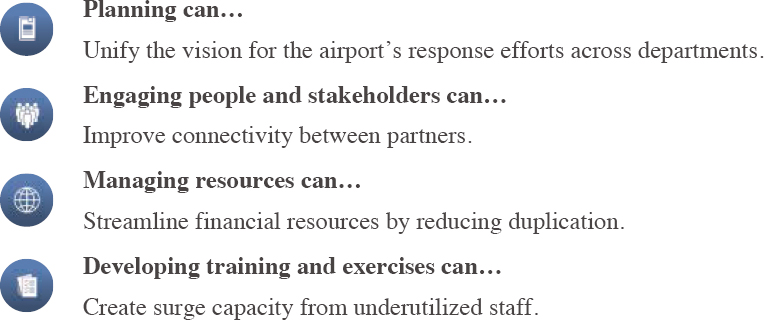
Executive buy-in is critical to making continuity a priority. While a grassroots approach may generate interest, it is unlikely to fully prepare the airport for anticipated and unforeseen events that threaten operations needed to move planes, passengers, baggage, and cargo around the world. Designating an executive sponsor for continuity can provide leadership, resources, and connections that can build the capability quickly, sustainably, and in a way that meets the airport’s resilience and financial objectives (see Figure 7). As continuity is recognized as an important part of how disruptions are addressed, it does not have to carry a high price tag. Rather, integrating continuity with crisis management can provide many benefits.
Focusing on Disruptions
Many incidents have common impacts. For example, a power outage may be caused by severe weather, a fire, or an intentional attack. By preparing for the consequences of incidents and events rather than the event itself, airports can build capabilities that work when faced with an unexpected threat. Rather than relying on prescripted plans for specific types of incidents when a disaster or emergency occurs, airports should apply a response framework that focuses on the disruption caused by any kind of incident. Doing so enables airports to be adaptable in their response; they can shift away from reacting to immediate needs and focus on near-term and prolonged response and restoration needs.
Facility-Based Disruptions
Facility-based disruptions prevent airport personnel, customers, or business partners (i.e., airlines, concessionaires) from accessing terminals, gates, offices, or other facilities where critical business functions are performed. These disruptions may occur when:
- An asset/facility (runway) is physically damaged;
- An asset/facility is inaccessible due to road closures or other hindrances; or
- A facility is in an area that has been evacuated.
Disruptions to facilities may not always result from an emergency or disaster, as they also may occur from regular day-to-day events such as flooded bathrooms, planned construction, debris on runways or taxiways, etc. These disruptions force the airport to adapt to continue providing essential functions and services from another location (physical or virtual) until the primary facility—be it a runway, taxiway, ramp, terminal, or air traffic control tower—is restored and able to support the demand of airport operations.
People-Based Disruptions
People-based disruptions occur when airport personnel or business partners cannot perform the tasks critical to the airport’s operation (e.g., lack of training or equipment) or during times when staffing levels are insufficient. People-based disruptions often occur in circumstances that result in an imbalance of supply and demand for personnel, such as the following.
- There is a reduction in available qualified personnel (e.g., boarding bridge operation) to perform essential functions. This incidence occurs when the demand on airport operations during crisis operations is like that of day-to-day needs, but the number of airport personnel available is reduced (e.g., multiple airport personnel are unable to work because their homes and vehicles were damaged during a natural disaster or off due to illness).
- There is an increase in need. This occurs when the availability of airport personnel is the same for day-to-day operations, but demand on airport operations or personnel needed to perform essential functions has increased as a result of the crisis and now exceeds the output capabilities of current staff (e.g., the airport is experiencing increased activity during a regional evacuation). This disruption can occur for multiple reasons that result in an insufficient number of airport personnel available.
When responding to people-based disruptions, airports must focus on accounting for available personnel and reassigning people from nonessential operations to essential tasks (i.e., performing or supporting essential functions). Response to this disruption may take the form of extending shifts to meet staffing needs with fewer people or having a plan for surge staffing.
Resource-Based Disruptions
Disruptions to resources occur in situations that limit the availability of the resources required for an airport to perform essential functions. Airports rely on access to utilities (e.g., power, water, sewage), access to the telecommunications or information technology platforms required for the airport’s communication and operation, and a supply chain able to deliver the right materials at the right time and to the right place. Additionally, some resources provided by external partners, such as fuel and deicing fluid, are fundamental to the performance of essential functions. Interruptions to any of these components prevent airports from carrying out their critical operations. These disruptions may occur if:
- An incident or event damages the airport’s (or the surrounding community’s) critical infrastructure or forces an interruption in passenger/cargo service;
- A cyberattack takes the airport’s and airline’s technological platform(s) offline;
- An incident or event impacts the availability of the airport owner or operator’s working capital and liquid assets; or
- Any type of disruption impacts the ability of an airport partner or vendor to provide a resource on which the airport depends, such as airline platforms; equipment failures; lack of generators, snowplows.
Building Airport Continuity Capabilities
Shifting the planning approach to focus on building the capabilities to respond to disaster impacts, regardless of the hazard or threat, will enable airports to align their preparedness efforts
and improve their overall resilience. The process of developing plans is a learning opportunity in and of itself. As organizations go through the process of investigating threats and considering how to respond to them, they learn about their vulnerabilities, capabilities, and gaps and may change their plans over time.
Additionally, by shifting focus away from specific events, this planning approach will naturally meet the needs of an individual airport and accounts for the unique culture, mission, vision, and priorities pursued by an organization’s leadership. By considering the impacts that may result from a disruptive event, airports can carry out impact-based planning in conjunction with hazard-specific planning, enabling them to be prepared and adaptable in a diverse set of crises and events.
Paired with robust continuity capabilities, airports can be more prepared for various disruptive circumstances by utilizing a planning approach that emphasizes preparing for the impacts of incidents and events. By using a planning approach that aims to mitigate these disruptions rather than respond to specific incidents themselves, airports will be better prepared for a wide range of circumstances, including natural, human-made, and technological hazards as well as planned events. Airports also will have a more sustainable planning process, leading to fewer but higher quality plans and tools.
Acting Quickly Can Get the Airport Back to “Normal”
Continuity can have its most significant impact during the initial response, when non-emergency staff can be assigned to critical functions to address customer and business needs while emergency responders and operations staff are simultaneously addressing the needs of the crisis. If an airport grows its continuity capability and can restore essential functions quickly, reallocate personnel effectively, and reduce the impact of the disruption at the earliest possible moment, it may mitigate the consequences of the crisis (see Figure 8).
When disruptions take place, airports may experience a loss in business output. In Figure 8, the black line reflects the normal business output, and the curves reflect the varying scale of impact on those operations based on the airport’s continuity capability.
The impact from a disruption is evaluated length and severity. The longer that the disruption lasts, the more severe the impacts. If the continuity capability is in place and essential functions can be restored more quickly, the airport will shorten the length of disruptions and overall severity.
Integrating continuity into a crisis response requires that airports can first restore critical functions to establish the “floor” for the incident with the worst-case scenario for the disruption to airport operations, and then be ready and able to return to a level of normalcy. Normal operations may
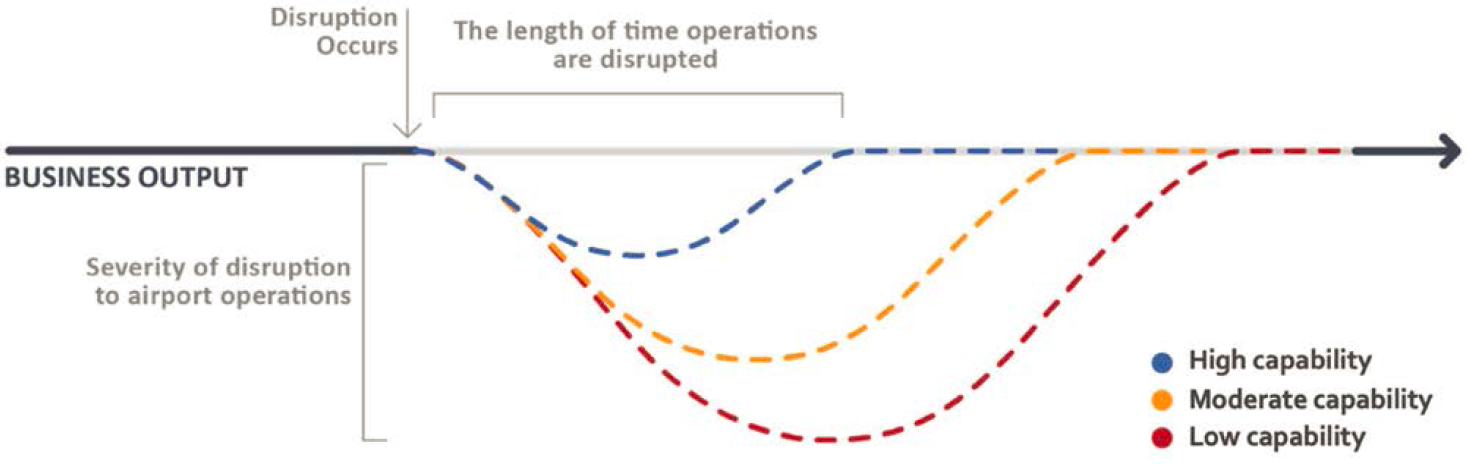
reflect the “norm” that existed before the disruption occurred, a “temporary normal” that accounts for ongoing response activities taking place, or a “new normal” that includes the enduring changes to an organization’s operations. The earlier an airport can address the disruption impacting their operations, the sooner it can focus on positioning themselves for a “new normal.”
Chapter Takeaways
In this chapter, some of the common obstacles to building effective continuity capabilities were addressed. In the past, airports have misplaced their energy into investing in redundant issues and incident-specific planning. This has led to unsustainable response efforts and confusion between continuity and recovery. Continuity ensures that the airport ecosystem’s essential functions can be performed under nearly all circumstances. It prioritizes reducing the impact of disruptions and identifies a path forward to fully resuming normal operations.


