Integrating Crisis Management and Business Continuity at Airports: A Practical Guide (2024)
Chapter: 3 Integrated Continuity Planning

CHAPTER 3
Integrated Continuity Planning
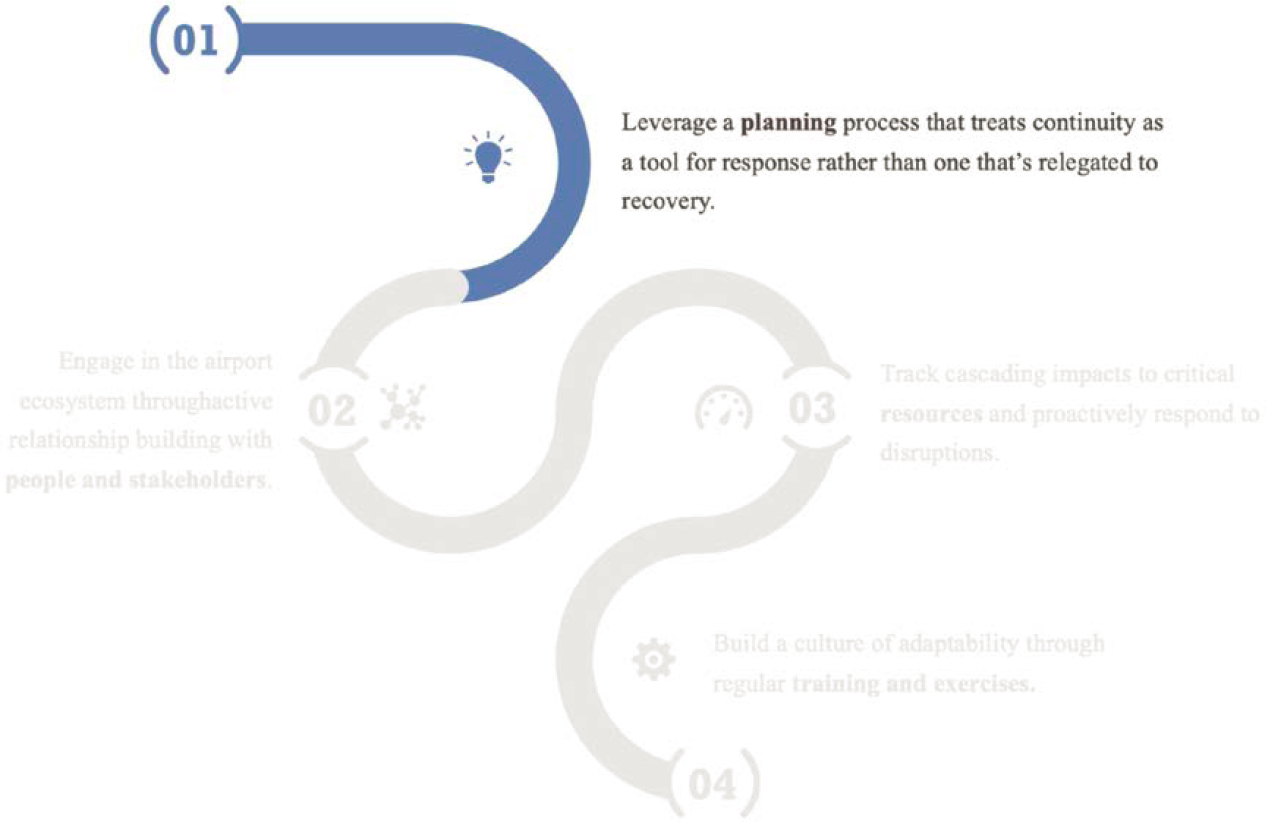
This chapter will focus on leveraging a collaborative planning approach so that the team emerges from the process understanding the plan without needing to use it. It will describe the steps to creating a built-in and accessible plan that can be used during a crisis based on a common vision across staff for continuing the airport’s mission, even during a disruption (Exhibit 3).
Plans include strategies to facilitate this kind of planning anchor on:
- Identifying the essential functions needed to ensure the airport can accomplish its mission and purpose; and
- Creating actionable tools and resources that support steps to be taken during a crisis.
Plans provide a helpful resource to building a continuity capability; but perhaps more important is the planning process, which provides a critical opportunity for information sharing and building the critical thinking skills that will serve the airport, not only after, but during a crisis (Figure 9).
Coordinating the planning efforts of continuity and crisis management personnel increases the efficiency of the planning process and reduces redundant work, conserving resources for the airport. Aligning planning for both efforts also will reduce conflicts in objectives or execution during and after a disruptive event, helping streamline the airport’s response, recovery, and return to normal.
Step-by-Step: Building an Integrated Continuity Plan
The planning process articulated here focuses on providing staff with the basic knowledge about the essential functions in the airport ecosystem and the resources available to restore those essential functions. It builds from a common vision for the airport’s mission to establish essential functions and identify the capabilities needed to support them. The continuity plan envisioned by this guide does not seek to provide a comprehensive reference or resource; however, this planning process can serve its own benefits and may be aided by resources such as ACRP Report 93.
Pilot Program Takeaway: The Plan Is Not the Goal
A pilot airport explicitly called out its need: not a plan, but effective team-building skills. This was echoed across all other pilot airports, with the common sentiment that plans are not the priority when building a continuity capability. Rather, success was defined by this airport as the internal knowledge and skills across the team to delegate tasks and problem-solve when faced by a disruption. This underscored the importance of planning the line of succession.
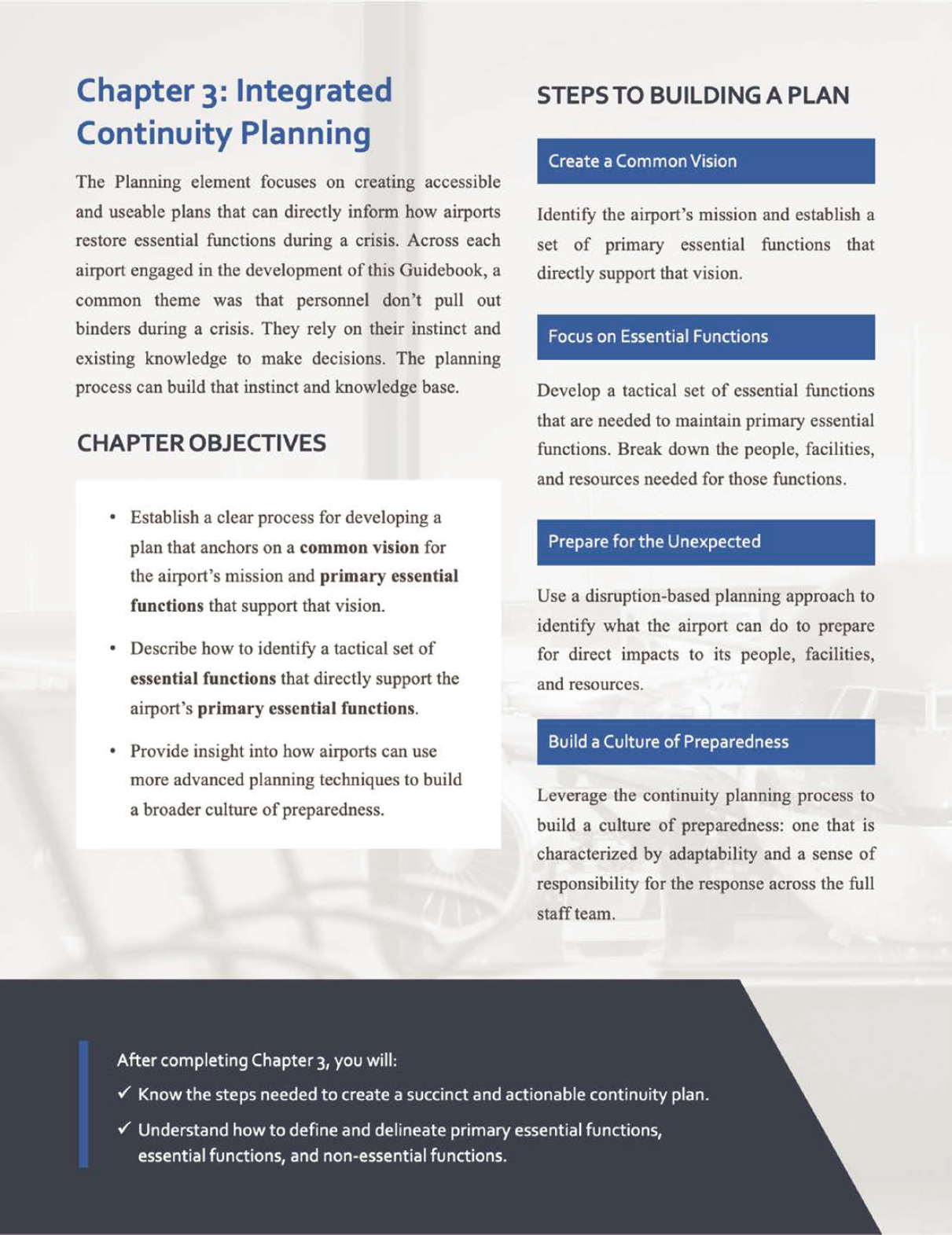
Through the process of defining essential functions and delineating contingency planning based on the three different types of disruptions—to people, facilities, and resources—the airport is building a structure that can be used to adapt to any kind of crisis, particularly the unexpected ones. When a plan is implemented, staff should immediately understand which essential functions need to be restored and what needs to be done to support that restoration.
From the planning perspective, airports should use their knowledge of agreed-upon priorities to create redundancies in the systems and equipment critical to essential functions, implement hazard mitigation measures, and conduct training and exercises to educate airport personnel. This step is an important opportunity to decide how constrained resources will be allocated before an incident occurs—a consideration that will be important to small airports and those with limited resources.
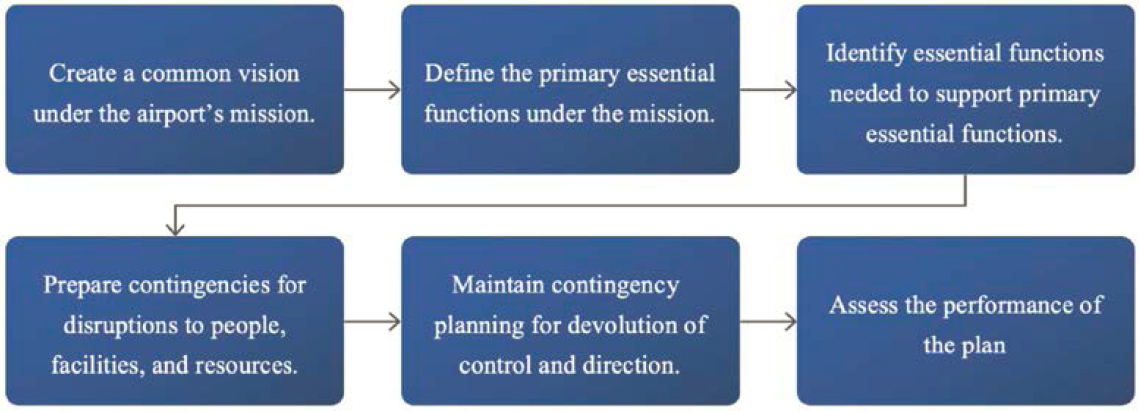
The process for building a continuity plan anchors on a shared vision for the airport’s mission and strategic objectives and then builds from that vision to identify primary essential functions and, subsequently, essential functions. This process then informs proactive analysis to preempt disruptions to people, facilities, and resources (Figure 10).
No matter what stage of the planning process an airport is in, the plan itself is an opportunity to engage and educate staff. It is a chance to talk about why the plan is being written and the priority it is supporting. It creates space for staff to talk about what does or does not happen during a crisis and consider what will or will not work. By taking full advantage of these opportunities for discussion, airports expand the reach of their efforts beyond the planning element and into people, stakeholders, development, and evaluation.
Qualities of an Integrated Continuity Plan
- Includes plan activation and notification procedures.
- Lists restoration and recovery priorities based on identified airport essential functions.
- Lists actions needed to promptly restore essential functions and continue their operations.
- Outlines the airport’s response structure and individual roles and responsibilities, including orders of succession.
- Includes a description of how the plan will be tested and maintained, including a training and exercise schedule.
Planning the Essential Elements of a Practical Program
The planning process can leverage the four essential elements of a practical program to shape the different pipelines of research, process mapping, and stakeholder engagement that occurs during a planning project. By leveraging the four essential elements, an airport can build actionable checklists that support continuity operations; proactive relationships with people and stakeholders; resource management planning that preempts potential single points of failure; and training and exercise programs that support continuous education programming.
Planning the Element: Actionable Plans
The planning process prescribed in this guide emphasizes the use of simple, straightforward resources, tools, and checklists that clearly articulate how an airport:
- Reviews its current capabilities (see Appendix G: Baseline Assessment and Appendix H: Equity Assessment);
- Defines its mission and subsequent primary essential functions (see Appendix B: Primary Essential Function Guide);
- Identifies its essential functions (see Appendix C: Continuity Planning Worksheet);
- Plans for potential impacts to essential functions based on disruptions to people, facilities, and resources; and
- Develops contingencies and checklists to restore essential functions.
Pilot Program Takeaway: Use Checklists
Airport leadership at one pilot airport heavily emphasized the increased use of checklists in continuity planning. The airport’s stakeholders focused on using
checklists to identify and prioritize essential functions that need to be recovered and restored. Checklists can help maintain consistency and reduce the likelihood of overlooking important steps in a crisis response.
Planning the Element: People and Stakeholders
The planning process for engaging people and stakeholders can support airports at different stages of relationship development within their broader network of stakeholders. Initial stages of the planning process might focus on:
- Mapping the stakeholder network (see Appendix F: Mapping Stakeholder Networks); and
- Categorizing those stakeholders (see Appendix E: Stakeholder Matrix).
Over time, further engagement strategies may leverage this information to focus on establishing mutual aid partnerships, pre-disaster planning processes, and other lines of communication so that engagement strategies are set far ahead of any major disaster. The full scope of these activities is described in Chapter 4: Engaging People and Stakeholders.
Planning the Element: Resources
The planning process for managing resources primarily focuses on conducting an audit process so that the airport clearly understands which resources (including people, facilities, and tangible assets) it needs to sustain operations, as well as what might cause a single point of failure. Airports conducting this process may:
- Assess essential functions based on the assets needed to support their implementation;
- Identify which resources, if compromised, constitute a single point of failure;
- Expand the scope of the review process to consider how resources may impact one another if a disruption cascades upstream and downstream within the airport ecosystem;
- Conduct procurement contingency planning to prevent the single point of failure; and
- Develop tracking systems (e.g., dashboards) to efficiently monitor and track those impacts.
The full scope of these activities is described in Chapter 5: Managing Resources.
Planning the Element: Training and Exercises
An airport’s planning for its training and exercise program can be most effective by designating regular (e.g., daily, weekly) opportunities to reinforce cross-training and adaptability in airport operations. The conceptual overview of this process is provided in Chapter 6: Training and Exercises. Airports are recommended to follow the full training plan provided in Appendix I: Training Plan, which includes the following steps (as implemented and refined under the pilot program):
- Engage executives to establish buy-in;
- Educate the team on the utility of essential functions to determine how they prioritize activities during a crisis;
- Establish and socialize the lines of succession to improve cross-training;
- Break down disruptions into the three main categories (facilities, people, and resources) to inspire adaptive thinking, regardless of the incident;
- Map out the airport’s single points of failure;
- Use scenario-based discussions to forecast impacts across the airport; and
- Conduct regular tabletop exercises to further reinforce the ideas and critical thinking developed through the planning process.
Challenge
While stakeholders at Louisville Muhammad Ali International Airport (SDF) recognized the value of plans, plans alone are not enough for successful continuity. For SDF stakeholders, the success of plans depends on the knowledge and skills of the people implementing them. SDF’s prioritization of people underscores people as critical airport assets because of their ability to draw on and apply experiential knowledge and skills.
If you treat normal operations like they are normal, you’re not preparing for a crisis.
Solution
Airports should focus on strengthening delegation and problem-solving skills among personnel. When done effectively, delegation and problem-solving can be particularly impactful to line of succession planning because it requires aligning roles and responsibilities with a person’s area(s) of expertise.
Creating a Common Vision
A clear and easy-to-understand vision is critical when airports are preparing their continuity or crisis management plans to respond to disruptive events. Because pursuing continuity objectives simultaneously to crisis management objectives during a disruption may be different from what some stakeholders have experienced throughout their careers, it is important that the need for the integration and the vision for how integration will occur be explained at the beginning of the plan and reiterated throughout the planning process.
The vision for integrated planning processes and documents sets the tone for the need to immediately restore essential functions internally at the airport and communicates to the broader community that the airport is working to contribute to the mutual benefit of all stakeholders.
Pilot Program Takeaway: Engage Stakeholders in Planning
A pilot airport noted that their business continuity plan was not in use by stakeholders across the airport’s ecosystem. The draft plan was used in a limited capacity due to its length. To improve the usability of a business continuity plan, the planning process should position any operational manager or partner to feel empowered to implement a plan, rather than overwhelmed by the amount of content it provides. This can be reinforced by simplifying plan content and by operationalizing the plan’s steps in day-to-day discussions and operations.
An important piece of keeping a continuity program practical is ensuring the airport’s mission and its primary essential functions are at the center of its program. Airports can facilitate this process using the resource provided in Appendix B: Primary Essential Function Guide. This appendix takes planners through a process of defining priorities by asking:
- What is the core mission of the airport?
- What are the airport’s goals as a business, an organization, and a center of transportation?
- What are the primary services the airport offers?
- Who are the airport’s primary stakeholders?
These questions set the pillars for the airport’s broader mission. Subsequently, personnel have the foundational information needed to ask:
- What airport objectives directly support the services and aims outlined above?
- What operations directly support the airport’s mission and objectives?
- What functions, if interrupted, would prevent the airport from accomplishing its mission?
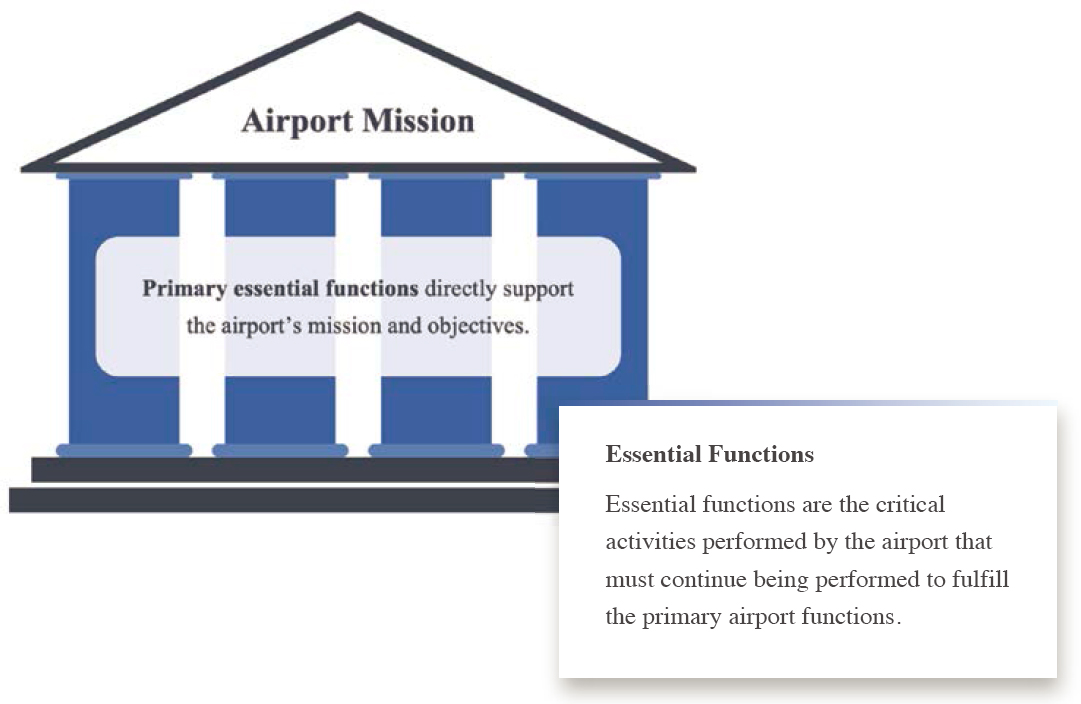
By asking these questions, the airport is able to use its primary essential functions to inform the identification of its essential functions. An airport’s primary essential functions must support and be subordinate to its primary goal as well as the values and principles that it carries with it. As airports identify those cross-cutting values that feed into their primary goal—for example, regulatory compliance and exceptional customer service—essential functions should be vessels for implementing those values. Regardless of what the airport determines its mission to be, it should serve as a guidepost that helps orient the airport’s continuity and crisis management efforts in a consistent direction.
Primary essential functions are the organization’s priorities for what must be continued or resumed when disruptions to normal operations occur (Figure 11). Primary essential functions reflect the intent and guidance from an organization’s leaders to the teams, departments, and divisions responsible for performing the work about what activities should be considered essential and, by definition, nonessential.
Focusing on Essential Functions
Essential functions support the airport’s vital services to accomplish the organization’s mission, maintain the health and life safety of those within and around the airport, ensure the airport meets regulatory requirements, and account for the organizational values that must endure throughout a disruption or crisis. By understanding its essential functions, the airport always knows what needs to get back online first when a disruption occurs.
The process to identify and understand essential functions can be facilitated at the department level by taking the following steps:
- List all airport functions assigned to the department.
- Re-order the functions, activities, and services for the airport’s department into three categories of prioritization: essential, important, and noncritical.
- For each essential function or service, identify the staff positions required to lead and perform the function, the primary and alternate locations where the function can be performed, and the resources necessary to perform the function.
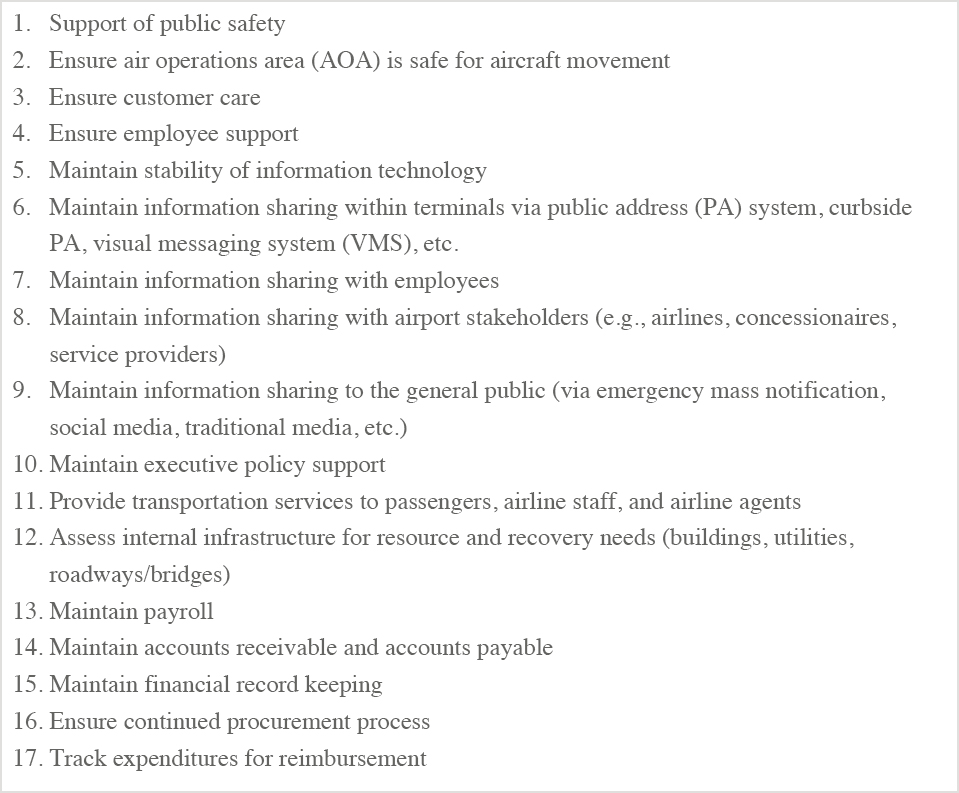
The following examples provide different frameworks for capturing this information, including via a general process flow (see Figure 12, based on a continuity plan provided by a pilot airport); based on the alignment with the movement of planes, passengers, baggage, and cargo (see Table 3); and based on a more general list developed by airport stakeholders (see Figure 13).
The guide provides Appendix C: Continuity Planning Worksheet to facilitate these steps, allowing departments to focus on the information necessary to restore service, identify the stakeholders impacted by disruptions to their essential functions, and anticipate the types of events that may cause the disruption. Departments can walk their staff through this tool in a continuity planning meeting to openly discuss considerations relating to their specific function.
Categorizing many functions or positions as “essential” will make it difficult for the airport to dedicate sufficient resources and personnel to restoring or maintaining those functions during and after a disruptive event. On the other hand, if all essential functions that allow an airport to continue operating are not identified, those functions may not be performed during or after an incident or may require hasty decisions to reallocate personnel and resources to support unaccounted for essential functions.
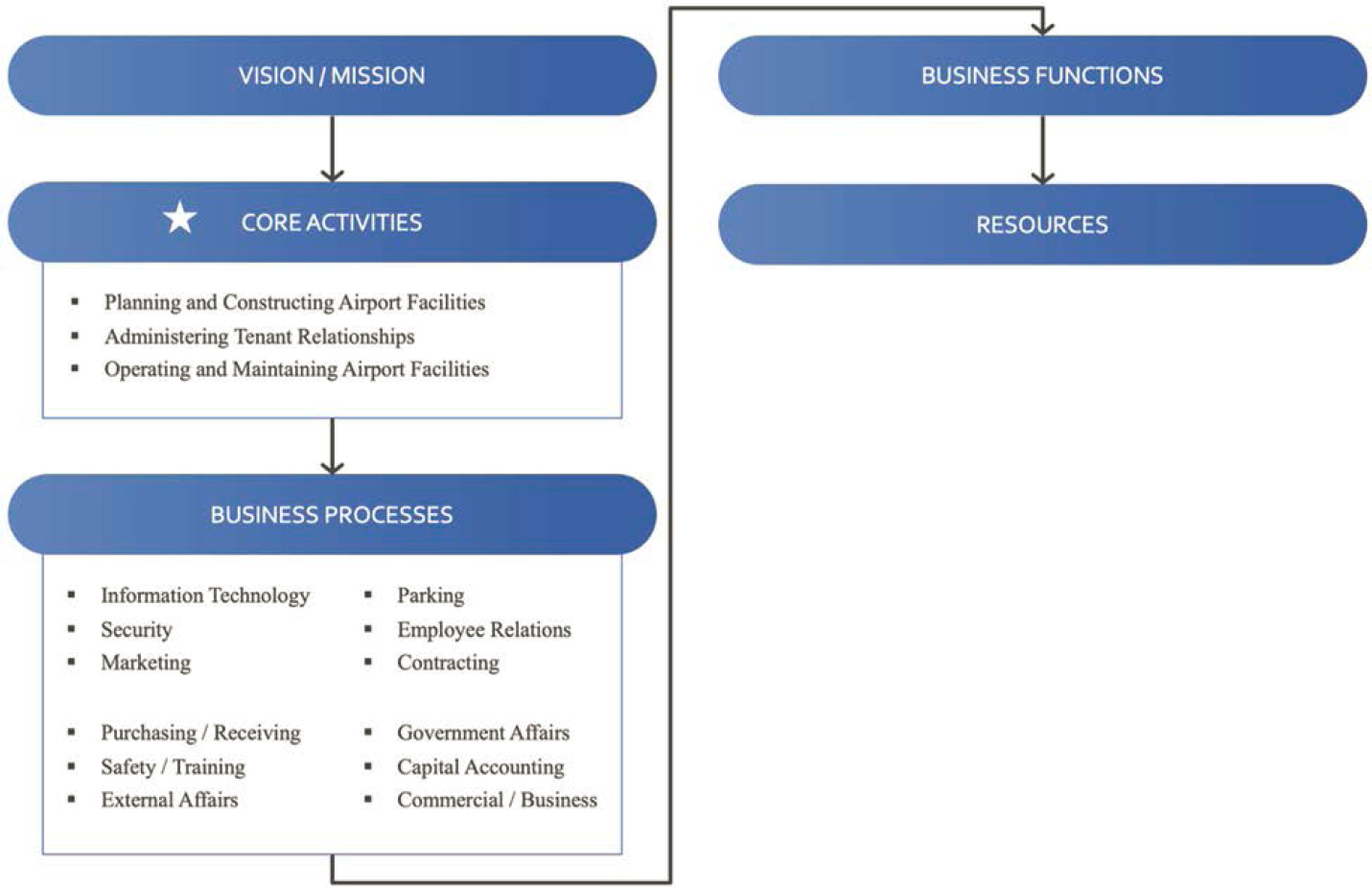
Table 3. Essential functions example #2: aligned by type of movement.
| Airfield/Airlines | Passenger | Baggage | Cargo |
|---|---|---|---|
| Runway capacity | Reservation and ticketing | Conveyance systems | Cargo ramp access |
| Access to runways, taxiways, and terminal ramp | Screening | TSA inline screening | Runway capacity |
| Airspace capacity | Parking | Baggage claim system | Access to runways, taxiways, and terminal ramp |
| Airfield lighting and signs | Roadway access | Tagging system | Facility roadway access |
| ILS systems | Mass transit and shuttle operations | Airport/airline network | Facility utilities (lighting, electrical, HVAC, water, gas, compressed air, etc.) |
| Fuel system | Internet access | Internet access | Fuel system |
Pilot Program Takeaway: Prepare for Different Time Horizons
A pilot program airport approached continuity planning by identifying, evaluating, and communicating the factors that could influence the forecasting of capabilities across people, facilities, and resources. Specifically, the airport focused on understanding and communicating the estimated lengths of time it may take to stabilize, restore, and reconstitute operations based on different scenarios. The airport’s small team size relied on this approach so that there were clear time horizons for engaging different resources strategically.
The depth of the exploration of essential functions may vary based on airport size. However, all airports can identify essential functions and the purpose of each function. Airports with more time or resources can utilize tools like a business impact analysis (BIA) to map out each essential function’s underlying processes and resources. A BIA can help the airport understand its vulnerabilities and the risks it faces in performing essential functions (FEMA 2019). The information gained from a BIA will serve as a basis for the airport’s efforts to address organizational vulnerabilities and mitigate risk.
In addition to identifying and addressing vulnerabilities, the BIA process can be a valuable way to map out the partners and personnel who may be affected by not carrying out essential functions. This understanding is critical to keeping continuity practical and informing crisis and event planning.
Planning for Action
Plans are made for action. If an airport has an exceptionally thorough and well-developed plan that is unable to be implemented during a crisis, the planning process has failed to prepare a plan that contributes to an actual capability. While undesirable, this is common. The research team observed in its case study research that many airports’ continuity plans often went unused and did not align with the steps that personnel took during a crisis. In these cases, the planning process had lost sight of its purpose.
Snapshot: Louisville Muhammad Ali International Airport (SDF) Plans
The purpose of the planning process is to inform how the airport will act when disruptions occur. Plans can be structured to highlight actionable information and steps used during a crisis to restore essential functions. Planners can look to the criteria for success, defined in the following as standards to pursue throughout the planning process.
The Plan Should Be Accessible
- Will staff know where the plans are located?
- Are the planning documents easy to read?
The Plan Should Include Actionable Tools
- Are there checklists available to support staff who are implementing key steps?
- Are there job aids for personnel providing surge support for essential functions?
- Is it easy for the team to visualize their process flow during a continuity activation?
The Plan Is Scalable and Flexible
- Can the processes for ensuring continuity be tailored to different types of incidents?
- Are staff able to think creatively and adapt based on how the situation evolves?
The Opportunity for Integration: Establishing Integrated Response Objectives
Most airports outline response and recovery objectives or strategic goals in planning documents like the Airport Emergency Plan (International Civil Aviation Organization 2015). Objectives of response operations traditionally focused on the short-term goals to ensure people safety and stabilize the incident, which, while reasonable may not account for the specific needs associated with restoring essential functions.
In practice, integrating objectives in real-time during a response may mean establishing targeted dates and times to:
- Tighten the perimeter around a crime scene to enable key entrance points to reopen so that the passengers can move into and out of the airport.
- Focus facility safety inspections on critical occasions to allow for the movement of passengers to or within a terminal even if this approach increases the total time needed to complete all assessments.
- Restore power to key locations in an airport to allow for the performance of essential functions even if other sections of the airport must then remain without power.
Aligning the objectives of crisis management and continuity efforts enhances coordination of efforts, allows an airport to address an infinite holistically, and helps prevent conflicting goals during response operations.
Chapter Takeaways
This chapter focuses on gaining the knowledge of the steps needed to create an actionable continuity plan. One of the biggest takeaways is that the plan is not the goal: returning to normal operations after using the plan is. The biggest steps are creating a common vision within the airport’s mission, defining and delineating between primary essential functions and essential functions, and preparing contingencies for disruptions and maintenance. Heavy focus should go to the four elements: actionable plans, people and stakeholders, resources, and training and exercises.


