Integrating Crisis Management and Business Continuity at Airports: A Practical Guide (2024)
Chapter: 5 Managing Resources

CHAPTER 5
Managing Resources
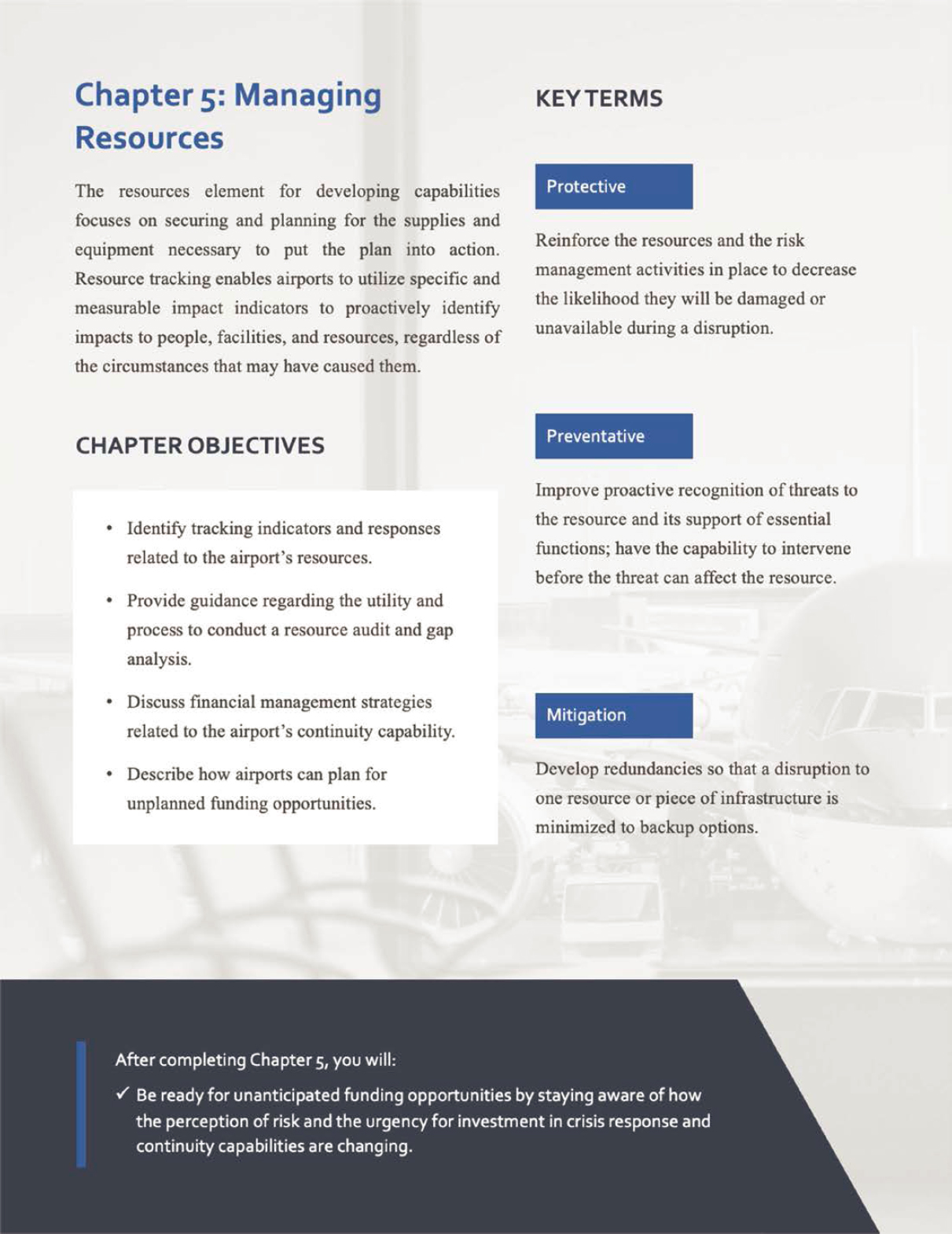
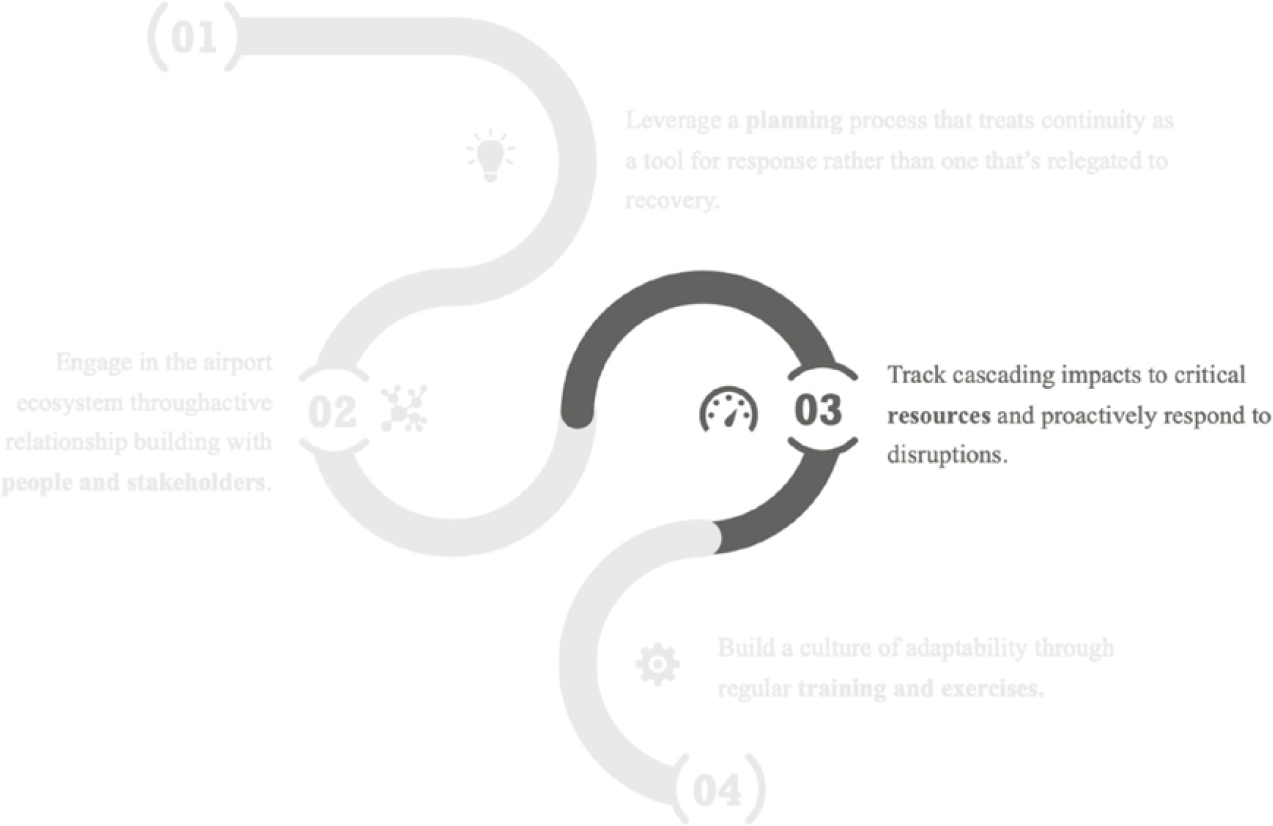
The resources element for developing capabilities focuses on securing and planning for the supplies and equipment necessary to put the plan into action. This chapter provides a roadmap about how airports can plan their resource readiness ahead of disruptions (Exhibit 5). Strategies for improving the resource element to capabilities include:
- Tracking indicators and responses related to the airport’s resources.
- Conducting a resource audit and gap analysis.
- Addressing risks to critical resources and single points of failure.
- Incorporating financial considerations to sustain the airport’s key sources of revenue.
- Preparing for unplanned funding opportunities to advance airport programs.
An airport’s resources most tangibly include its physical assets; however, this term can also be used to encompass the broader set of people and facilities that support operations. Tracking and moving around these resources is the core of how an airport restores its essential functions (Figure 16).
Indicators, Capabilities, and Responses
The term “resources” characterizes tangible items and systems (e.g., internet) used to support airport operations. For the purposes of this section, the tangible aspect of resource tracking is a helpful starting point for conceptualizing the airport’s broader approach to tracking key indicators associated with three types of disruptions to people, facilities, and resources. Resource tracking enables airports to utilize specific and measurable impact indicators to proactively identify potential and active impacts to people, facilities, and resources, regardless of the circumstances that may have caused them. Indicators related to impacts from disruptions are summarized in Table 5.
These indicators can inform the airport’s identification of watchpoints and action points. Watch points are threshold indicators that prompt regular monitoring and discussion to prepare for a response. For example, an outbreak of a disease with the potential to expand into a broader risk to public health might be leveraged as a watchpoint to support regular monitoring before that risk results in an impact on the airport. Tracking inclement weather and airline operations locally and nationally to prepare for diversions and IRregular OPerationS (IROPS) is an example of such watchpoints.
Action points are threshold indicators that immediately trigger tangible action to begin the response, either because the airport has experienced a tangible impact, as demonstrated by the impact indicators, or because the impact is imminent without an immediate response. For example, if the disease (from the earlier example) resulted in one known case within the airport’s region, that might trigger an action point.
In the same way an airport’s indicators can track the trajectory of a disruption and its impacts to the airport, similar indicators can be used to track those capabilities that can support and inform the airport’s response to the disruption (Table 6).
At the nexus of the airport’s impact and capabilities indicators, the airport can leverage data and information tracking to determine how available capabilities and resources can be reallocated to supplement losses or increased demand resulting from the impacts. The sum of this information tracking directly feeds into the airport’s analysis and tracking of its essential functions; after all, the ability to deliver essential functions is a product of the airport’s access to available resources.
Table 5. Impact indicators.
| Type of Disruption | Impact Indicators |
|---|---|
| Facilities |
|
| People |
|
| Resources |
|
Table 6. Capability indicators.
| Type of Disruption | Capability Indicators |
|---|---|
| Facilities |
|
| People |
|
| Resources/Assets |
|
Preparing for Cascading Impacts
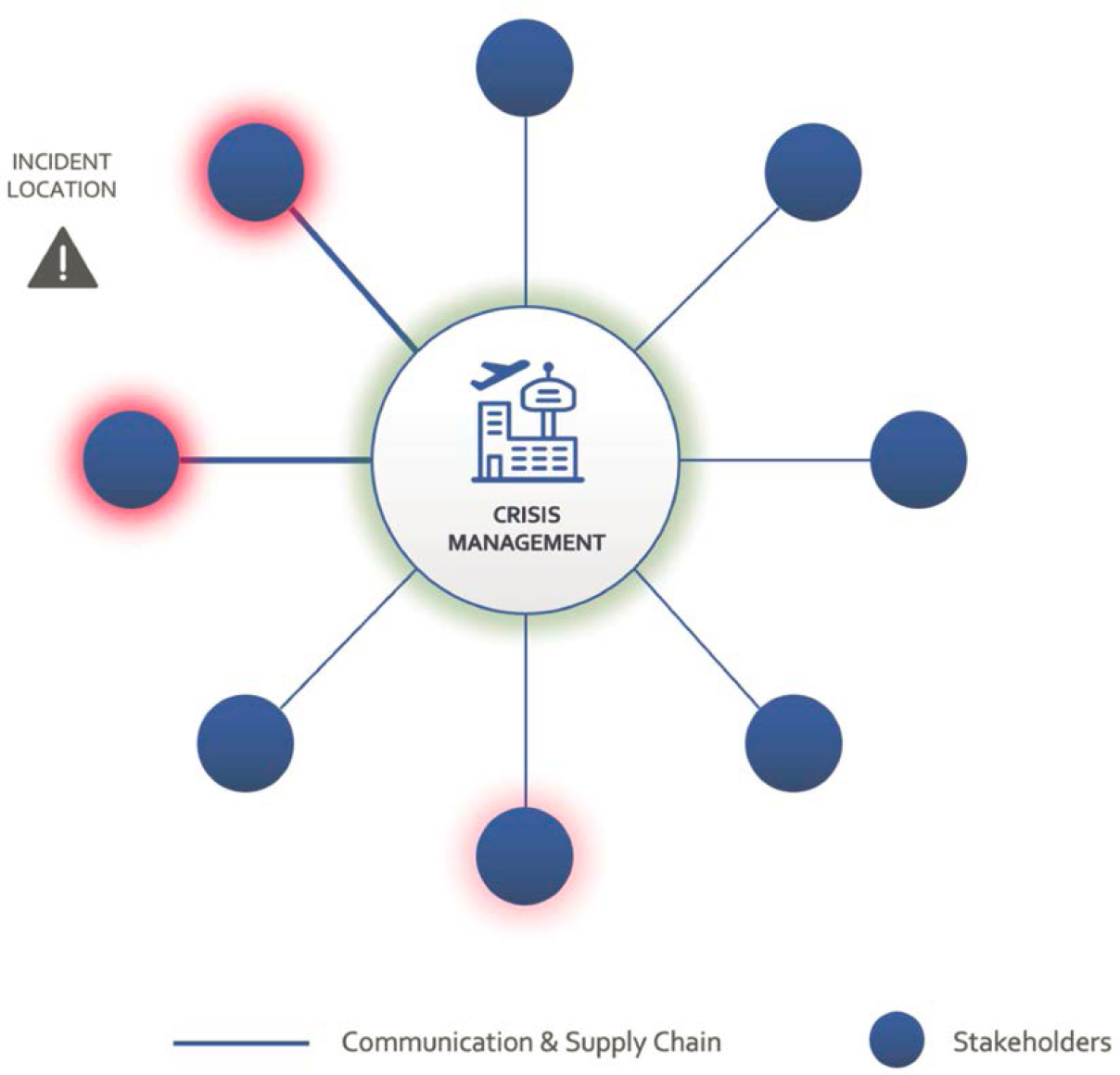
Once the airport has a clear sense of its partners, there’s an opportunity to consider and prepare for the cascading impacts that may prolong a disruption. Cascading impacts are impacts experienced by a partner or counterpart in the ecosystem that have the potential to spread to the airport and, by extension, its other partners. For example, if the airport has a cargo carrier that experiences disruptions in the supply chain, those impacts may cascade to impeding or slowing down cargo carriers. That change can then impact the air traffic control at the airport, which can impact other flights.
An airport’s internal continuity and crisis management approach can operate without error and still fall subject to cascading impacts. For example, many airports have interdependencies with other airports; if one airport is impacted, its traffic may be diverted to another.
Airports sit at the center of a range of partners and can be one of the first organizations to struggle as cascading impacts echo throughout a community or national ecosystem. As visualized in Figure 17, an incident at a partner airport or organization can ripple across the airport and then affect its partners.
A holistic continuity approach relies on the ability of the airport to track the upstream and downstream impacts that take place across the airport ecosystem. This can include tracking the supply chain, maintaining regular communication with key partners, and identifying types of activities that are subject to cascading impacts (e.g., sources of revenue, use of facilities).
Conducting a Resource Audit and Gap Analysis
Airports require resources to perform their essential functions; without them, even the most well-prepared personnel cannot restore the airport’s operations. Many airports are proficient at preparing for disruptions to critical resources, including creating redundancies (e.g., backup file storage) or minimizing reliance on external providers (e.g., building a power generator).
The worksheet included in Appendix C: Continuity Planning Worksheet can support airports with identifying resources necessary for each of the essential functions. An airport can use these findings to consolidate a list of all the supplies, equipment, technology platforms, and infrastructure required to maintain airport operations, which can then inform continuity plans and restoration priorities for the airport.
Once consolidated, the list of resources required for essential function performance can be expanded to include an assessment of the resources available in the department responsible for performing the function as well as the resources available across all departments in the airport. Understanding where departments can turn when disruptions to resources occur can allow for rapid restoration of that essential function by reallocating existing resources from noncritical tasks that can reduce the impacts of the disruption.
The Argument for Integration: Best Practices in Resource Management
What resources does the airport need to accomplish its objectives? Airports aiming to build continuity into their resource management practices following a disruptive event may consider:
Planning Immediately for Normal Operations
While most personnel will naturally be focused on restoring or replacing the disrupted resource, those who are not actively working to do so should begin preparing for the restoration of the resource and its return to normal function. This practice will minimize any transition period between irregular and normal operations and speed up the airport’s return to normal function.
Communicating Trade-Offs for Replaced or Temporary Resources
If a resource is disrupted and a substitute is being considered, it is important that any trade-offs and limitations are communicated to those ultimately using
the resource. If unreliable cellular towers necessitate the use of radios over a prolonged period, for example, airport personnel must understand the timeline, limitations, and function of the use of radios in support of airport operations. While the substitute (in this case, the radios) may not exactly replace the resource (uninterrupted cellular coverage), the goal is to reduce demand on the primary resource so it can be allocated where it is most needed.
Knowing the difference between the supplies that an airport has on-hand and what will be needed to perform a function can support procurement decisions made at the beginning of a response to crises to secure the resources and ensure uninterrupted service. An example can be seen in the months before the first COVID-19 cases were confirmed in the United States in 2020. For some organizations, the advance warning provided about the risk of the virus allowed for an assessment to be made about personal protective equipment (PPE) needs and allowed for the purchase of large quantities of the items before the surge in global demand made it hard to purchase protective masks, gloves, cleaning supplies, and other items used to prevent the spread of COVID-19.
Addressing Single Points of Failure and Securing Critical Resources
Upon completing the resource assessment and knowing where alternative sources for critical resources are located, it is likely that some equipment, technology platforms, supplies, or infrastructure are going to stand out on the list as single points of failure because there is not a backup option available. Recognizing which essential resources are single points of failure can allow airport leadership to begin a deliberate analysis of the risks of that resource being disrupted during a crisis and the length of time it would take for a disruption to that resource to affect airport operations.
The loss of power alone is not a crisis. It becomes a crisis when essential functions are disrupted for a long period of time, preventing the airport from meeting its mission.
Pilot Program Takeaway: The Parking Example
When discussing its analysis of total revenue, one pilot airport highlighted the broader customer experience at the airport, including parking. Parking provides a helpful example, both of how revenue plays a role in the overall analysis of the airport’s revenue (and subsequently, essential functions), as well as its representation of how revenue plays into continuity decision-making. Parking is one of the airport’s most valuable assets and is typically compromised during a power outage, as pay stations are inoperable. Its role in total revenue lends itself to pay stations being prioritized during the airport’s restoration of essential functions; however, revenue does not come before safety. As one leader shared, “Revenue does impact decisions later on but not immediately.”
Snapshot: Cincinnati/Northern Kentucky International Airport (CVG) Interdependencies
Challenge
For CVG stakeholders, a crisis is the sum of its parts. One participant gave the example of a power outage caused by a storm. Years ago, CVG experienced a power outage that shut down the airport’s conveyor belt and baggage system. CVG was able to use a generator for 36–48 hours, but had to find fuel suppliers to get the fuel necessary to keep the generator running.
Solution
Knowledge of infrastructure interdependencies can help stakeholders prioritize essential functions during incident scenarios. Familiarity with infrastructure interdependencies equips stakeholders with the necessary knowledge to pinpoint sources of disruption and minimize cascading impacts.
Snapshot: Louisville Muhammad Ali International Airport (SDF) Maintenance
Challenge
SDF stakeholders recognized that timely, routine maintenance of facilities and equipment decreases downtime and the number of large-scale repairs, especially during an incident.
Fix things when they are not broken.
Solution
SDF stakeholders identified the upkeep of facilities and equipment as economically beneficial for airports as it reduces the likelihood of disruptions to essential functions (e.g., baggage handling), which can impact business continuity. Regular maintenance of facilities and equipment can also improve the overall performance and safety of airports.
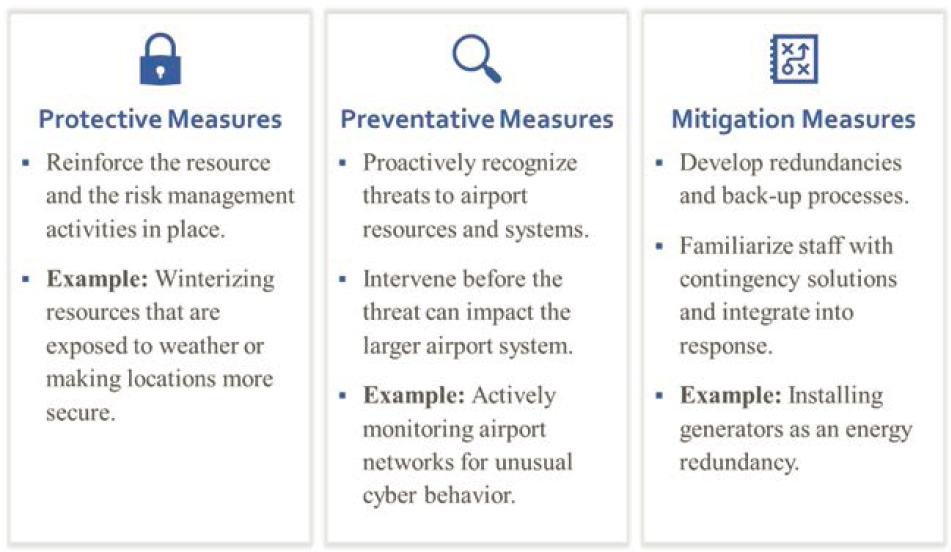
If the vulnerability of a resource results in a decision to take proactive action, risk analysis can set the path forward. Action to address these vulnerabilities can take three forms: protective measures, preventive measures, and mitigation measures (Figure 18).
Adapting and Planning for New Technology
Effective resource management, especially as it applies to technology, is an enabling capability for airports. Systems continue to move online, which can be a benefit as much as it is a risk, as demonstrated by the industry’s shift into a remote working environment during the COVID-19 pandemic. Whether or not software and IT are protected through robust security systems and multiple redundancies is a defining factor of an airport’s vulnerability to ransomware and other cyberattacks. When airports are unable to protect data and software, any other COOP is crippled until systems are back online.
Research during the investigative phase of this guide also found that some simple solutions, such as cleaning up file tracking online and using a single system for recordkeeping, are also making life easier in cyberspace. While every element in this path to a practical program overlaps with the others, resource management and cybersecurity are especially cross-cutting. Their success will amplify the success of other elements, yet they depend on the application of the other elements in their own implementation. To this point, airports should plan for cyber threats, organize online files and systems, and cultivate leaders who understand how to adapt those systems, especially if they are online.
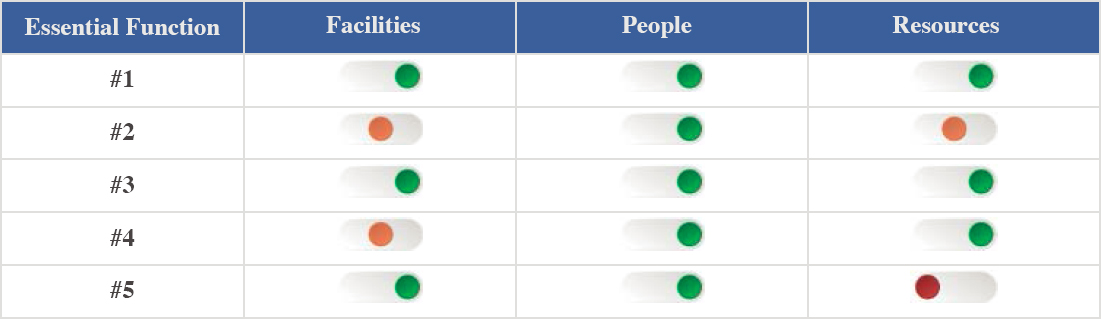
A digital dashboard of the airport’s essential functions like that in Figure 19, which uses a traffic light rating system (red, yellow, green), can serve as a central hub for airport stakeholders to see what essential functions—as well as the resources supporting them—are at risk or directly impacted by a disruptive event.
A technological tool like the dashboard enables airports to quickly share information about the status of essential functions across the airport environment and increases the situational awareness of the airport (Figure 19). The status of the essential functions, according to the digital dashboard, should guide the airport’s objective during and after a disruptive event.
Primary objectives will be addressing essential functions “in the red,” secondary objectives will be addressing nonessential functions that are “yellow,” and tertiary objectives will be getting all essential functions to “green.” Airports can create their own definitions for the levels of the stoplight system, incorporating key performance indicators to measure the accomplishment of objectives and restoration needs.
Sustaining the Airport’s Financial Health
At the heart of the airport’s operability is its financial management approach. During a crisis, airports will be clear that the top priority is supporting life safety and response activities. The bottom line falls second to enabling that response. It is worth reiterating a central tenet to this
guide’s continuity approach: first responders can and should be focused on response, not the finances. However, when a concurrent continuity event occurs, revenue considerations can reenter the picture.
As an airport redelegates staff and resources to support its continuity operations, finances provide a helpful roadmap for informing both the functions that may be prioritized, as well as the timeframe for defining key tracking mechanisms and associated responses that can make sure the airport has what it needs to keep operating, especially during an extended disruption. When preplanning for disruptions to airport operations, considerations about the financial requirements for the rents and leases of its facilities, concessions, cargo and sorting rents and leases, fuel flowage, advertising, and any other revenue-generating functions can inform an airport’s restoration goals.
These calculations may vary based on the time of year that an impact occurs (e.g., it will look different during Thanksgiving compared to mid-February). They will also evolve based on the scale and duration of the disruption. As an interruption extends beyond a short-term timeframe to a longer-term one (i.e., from hours/days to weeks/months), this financial analysis can inform other actions as well, including hiring freezes, pausing capital improvement, enabling early retirement, and adjusting supplies purchases.
Being Prepared for Unplanned Funding Opportunities
When the risk to an airport is perceived to be low, securing the funding necessary for proactive development of a continuity capability can be challenging. During a period of normal operations, redundancies that can ensure the continued performance of essential functions during a disruption may be seen as having a smaller impact on an organization’s performance, especially when compared to investment in new programs that may appear to offer greater opportunities. Funding for emergency preparedness and crisis readiness is often tied to the perception of risk that an airport is exposed to, and, during an extended period of uninterrupted operations or only responding to minor emergencies, the value of investing in continuity capabilities may not be shared across an airport’s stakeholder group. Still, airport continuity champions can ready themselves for when a change in that perception occurs.
Shifts in perceived risk often occur for people during crises. When the consequences and impacts of an incident change from the abstract understanding that was in place before a crisis, to a clear understanding of the tangible impacts on operations, financial stability, or an organization’s ability to survive the event, an opportunity is created to influence the investment decisions being made at an airport.
Continuity champions can be ready for unanticipated funding opportunities by staying aware of how the perception of risk and the urgency for investment in crisis response and continuity capabilities are changing, especially during the following times:
- Immediately before an incident that has allowed for advance warning;
- During a crisis when the impacts on operations are being felt; and
- In the immediate aftermath of a crisis when people are inclined to make decisions to ensure “that never happens again.”
Effective resource management, especially as it applies to technology, is an enabling capability for airports. Whether or not software and IT are protected through robust security systems and multiple redundancies is a defining factor of an airport’s vulnerability to ransomware and other cyberattacks. When airports are unable to protect data and software, COOP can be crippled until systems are back online.
Chapter Takeaways
Throughout this chapter the importance of identifying and tracking indicators to proactively identify impacts has been highlighted. After identifying these indicators, a resource audit and gap analysis can help single out the points of potential failure and provide better planning opportunities. Finances cannot be ignored during these stages, and a sustainable approach must be taken to prioritize the financial health of the airport. Some of this can be leveraged when perceived risk to the airport ecosystem is considered to be high and buy-in is easier to garner.


