A Science Strategy for the Human Exploration of Mars (2026)
Chapter: 6 Synopsis
6
Synopsis
A Science Strategy for the Human Exploration of Mars outlines a comprehensive framework for the first three human-scale missions to the martian surface, focusing on the highest priority research objectives to guide the initial three human landings, identified as campaigns, on the red planet. This report
- Aligns science objectives with broader community priorities, identifies crucial samples and measurements, defines and ranks campaigns to address key goals, and examines how crew size and surface stay duration influence these priorities.
- Details essential measurements to be conducted prior to landing, during surface operations, or on the return journey, with a focus on what science needs to be performed rather than how it would be implemented.
- Suggests representative equipment and techniques for each campaign, while emphasizing that these are candidate concepts and not prescribed solutions.
- Establishes landing site criteria for each campaign, without recommending specific sites.
- Analyzes areas of overlap with NASA’s current Moon to Mars approach and highlights where gaps remain.
This report reaffirms the foundational role of science in shaping the future of human Mars exploration. The committee created a combined, prioritized list of 11 science objectives across the themes of
- Life: Past and Present;
- Life: Habitability;
- Climate: Weather, Processes, and History;
- Human Experience and Habitation; and
- Enabling Future Missions.
Table 2-1 presents the 11 prioritized science objectives:
- Determine if, in the exploration zone, evidence can be found for any of the following: habitability, indigenous extant or extinct life, and/or indigenous prebiotic chemistry.
- Characterize past and present water and CO2 cycles and reservoirs within the exploration zone to understand their evolution.
- Characterize and map the geologic record and potential niche habitats within the exploration zone to reveal Mars’s evolution and to provide geologic context to other investigations, including the study of bolide impacts, volcanic and intrusive igneous activity, the sedimentary record, landforms, and volatiles, including liquids and ices.
- Determine the longitudinal impact of the integrated martian environment on crew physiological, cognitive, and emotional health, including team dynamics, and confirm effectiveness of countermeasures.
- Determine what controls the onset and evolution of major dust storms, which dominate present-day atmospheric variability.
- Characterize the martian environment for in situ resource utilization (ISRU) and determine the applications associated with the ISRU processing, ultimately for the full range of materials supporting permanent habitation but with an early focus on water and propellants.
- Determine whether the integrated martian environment affects reproduction or the functional genome across multiple generations in at least one model plant species and one model animal species.
- Determine throughout the mission whether or not microbial population dynamics and species distribution in biological systems and habitable volumes are stable and are not detrimental to astronaut health and performance.
- Characterize the effects of martian dust on human physiology and hardware lifetime.
- Determine the longitudinal impact of the integrated martian environment on plant and animal physiology and development across multiple generations where possible as part of an integrated ecosystem of plants, microbes, and animals.
- Characterize the primary and secondary radiation at key locations in the crew habitat and astrobiological sampling sites to contextualize sample collection and improve models of future mission risk.
The steering committee identified five cross-cutting or extradisciplinary topics, which were incorporated into this report, namely, radiation effects on humans and on martian materials, ISRU available on Mars, human–agent teaming, the social science and humanity of space exploration, and dust on Mars.
The report highlights that advancing Mars science objectives necessitates a functional and capability-driven approach. Key enabling capabilities identified include advanced robotics and autonomy for remote operations (Figure 6-1), robust in situ analytical platforms, deep drilling systems for subsurface access, sample collection and return infrastructure, high-resolution surface and subsurface imaging, and comprehensive habitation and life-support systems for the martian environment. These elements are crucial for empowering human explorers to achieve the prioritized scientific objectives for Mars exploration.
Recognizing the evolving nature of mission planning, architectures need to remain adaptable to scientific discoveries, technological progress, and operational experience, particularly lessons learned from lunar missions under the Moon to Mars (M2M) framework. Four illustrative campaigns are presented, offering flexible pathways that will evolve over time while remaining firmly rooted in the overarching scientific objectives. The four campaigns of three missions each are described in priority order as follows:
- Mars Science Across an Expanded Exploration Zone (30-sol mission, cargo mission, 300-sol mission) focused on achieving all science objectives via a single landing site and exploration zone.
- Synergy of Mars Science Measurements (30-sol mission, cargo mission, 300-sol mission) focused on optimizing scientific results from the suite of most crucial measurements across all science objectives.
- Seeking Life Beneath the Martian Icy Crust (30-sol mission, cargo mission, 300-sol mission) focused on prioritizing the search for extant (currently surviving) life.
- Investigating Mars at Three Sites (three 30-sol missions at different locations) focused on exploring the heterogeneity of Mars.
Common to all four of the campaigns is the set of biological and physical sciences and human factors research objectives that can be conducted anywhere on Mars and are included in all campaigns to the greatest extent possible. Primary and secondary science objectives are identified by each of the four campaigns.
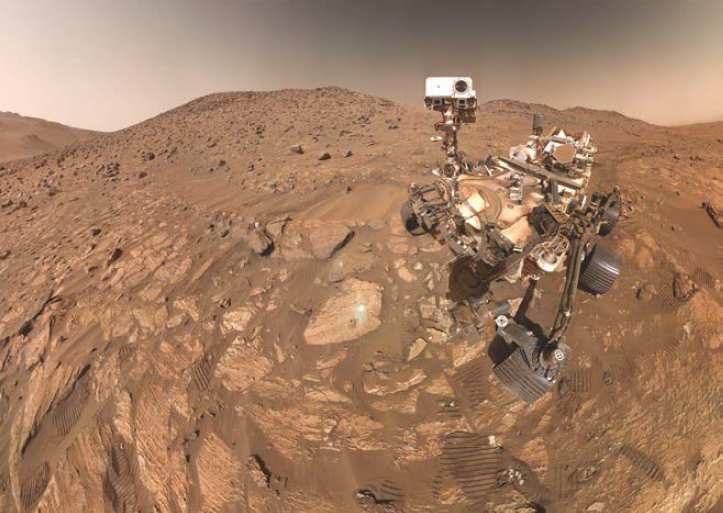
SOURCE: NASA/JPL-Caltech/MSSS, https://science.nasa.gov/resource/perseverances-selfie-with-cheyava-falls.
Four key recommendations are provided, namely, planetary protection (Section 2.3.4), a Mars surface laboratory (Section 2.3.5), sample return (Section 2.3.6), and human–agent teaming (Section 2.2.6).
Recommendation: Human missions to Mars should be designed to meet scientific and exploration objectives. Many of these objectives are limited by current planetary protection guidelines, notably the search for extinct and extant life with human explorers. NASA should continue to collaborate on the evolution of planetary protection guidelines, with the goal of enabling human explorers to perform research in regions that could possibly support, or even harbor, life.
Recommendation: NASA should include as part of its crewed surface infrastructure a Mars surface laboratory consisting of a variety of geologic, astrobiologic, and biomolecular analytical tools and analysis capabilities.
Recommendation: Samples from every human mission to Mars should be returned to Earth. NASA should engage the science community to determine the number, type, mass, and environmental conditioning required for samples before the first human missions commence. Sample return guided by human interpretation of in situ measurements should be a priority for all human missions.
Recommendation: NASA should initiate a recurring Mars Human–Agent Teaming Summit that captures emerging trends in the field. The goal of this summit should be to maximize the amount of time on Mars available for astronauts to perform scientific research, and to maximize the quality of that science. In planning these summits, NASA should cover, at a minimum, the following topics:
- Updating detailed task analyses necessary to complete science objectives on Mars;
- Identification of tasks best suited to human and automated agents;
- Updates on the development of reliable, trusted, and environmentally robust artificial intelligence, including machine learning capabilities, as components of human–agent teams on Mars;
- Communication between human and artificial agents; and
- Decision making.
The report positions Mars exploration as the natural progression from decades of robotic Mars missions and human spaceflight experience, building on continuous human presence in low Earth orbit over four decades and the ongoing scientific discoveries from Mars rovers such as Curiosity and Perseverance.
The report assumes successful resolution of current technical challenges, including entry/descent/landing systems, long-duration life support, propellant production, and crew health maintenance. Rather than prescribing specific technologies or landing sites, the report focuses on defining what science should be accomplished, leaving how to implement these goals to future mission architects. This approach provides flexibility while ensuring that the most scientifically valuable research drives mission planning decisions.
The first human Mars landing is characterized as potentially rivaling the Apollo Moon landing in historical significance, representing “humanity’s next great exploration” and inspiring future generations while advancing our understanding of life in the universe.
The importance of sustaining momentum via precursor missions, Earth-based analog research, orbital platforms, lunar missions, and crossdisciplinary collaboration will ensure that each step toward Mars exploration is informed, strategic, and rooted in the overarching goal of expanding human understanding of Mars, the solar system, and life itself.


